Hierarchical assembly in action: a galaxy tail from a disrupting group in the Virgo cluster outskirts
Pith reviewed 2026-06-28 14:01 UTC · model grok-4.3
The pith
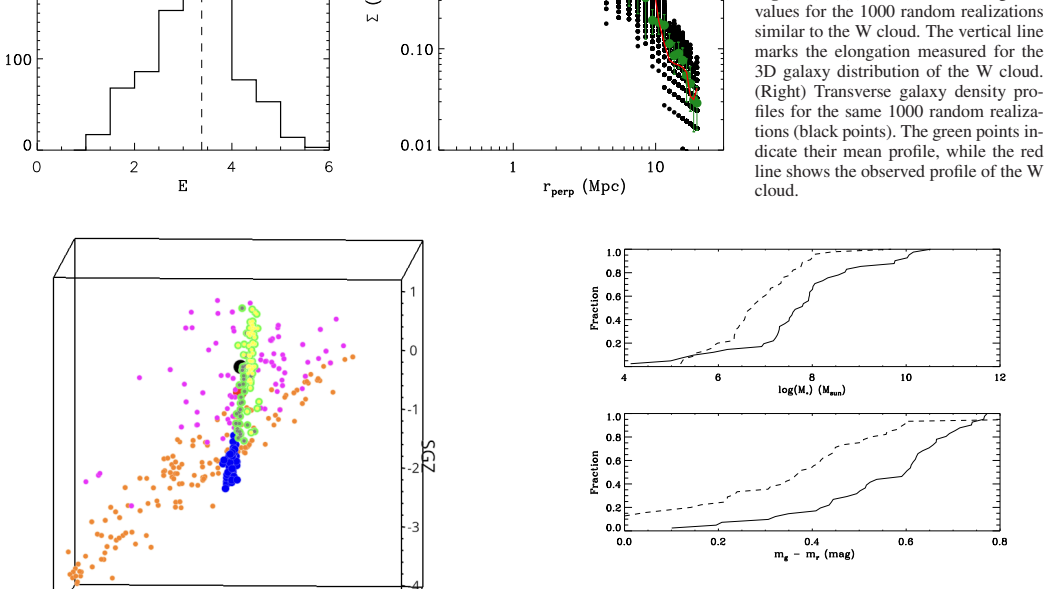
The W cloud is a compact galaxy group disrupting into the Virgo cluster, trailed by a coherent tail of infalling dwarf galaxies.
A machine-rendered reading of the paper's core claim, the machinery that carries it, and where it could break.
Core claim
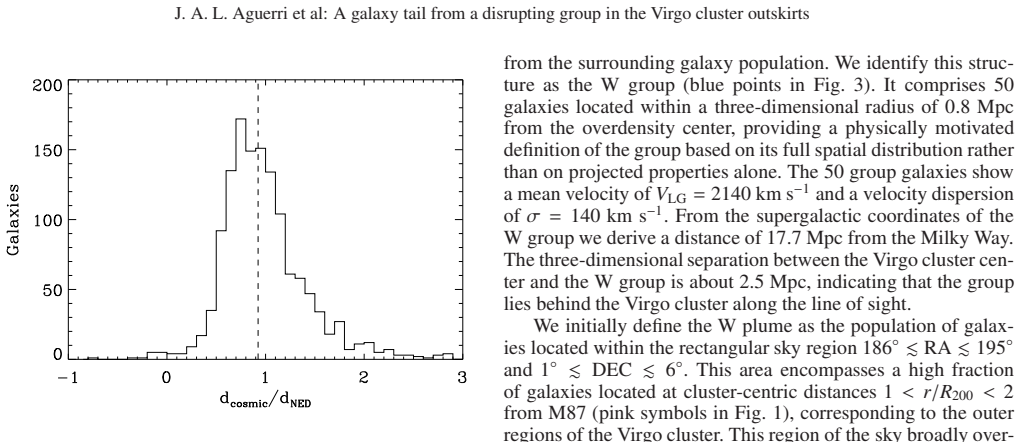
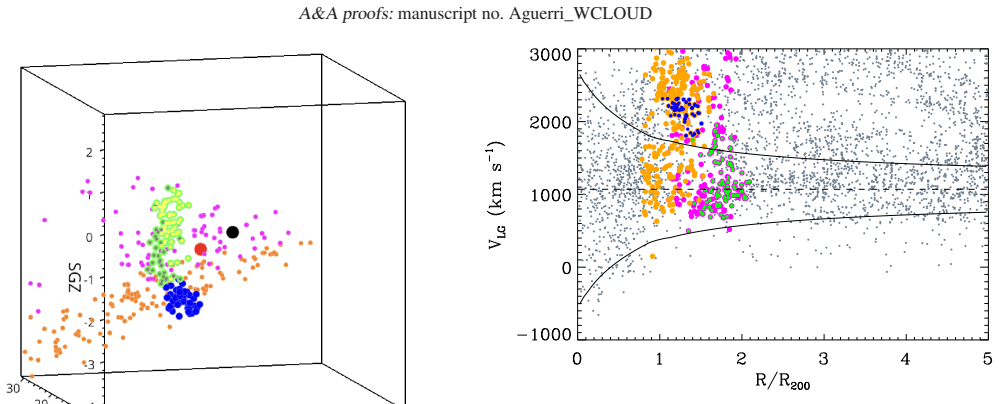
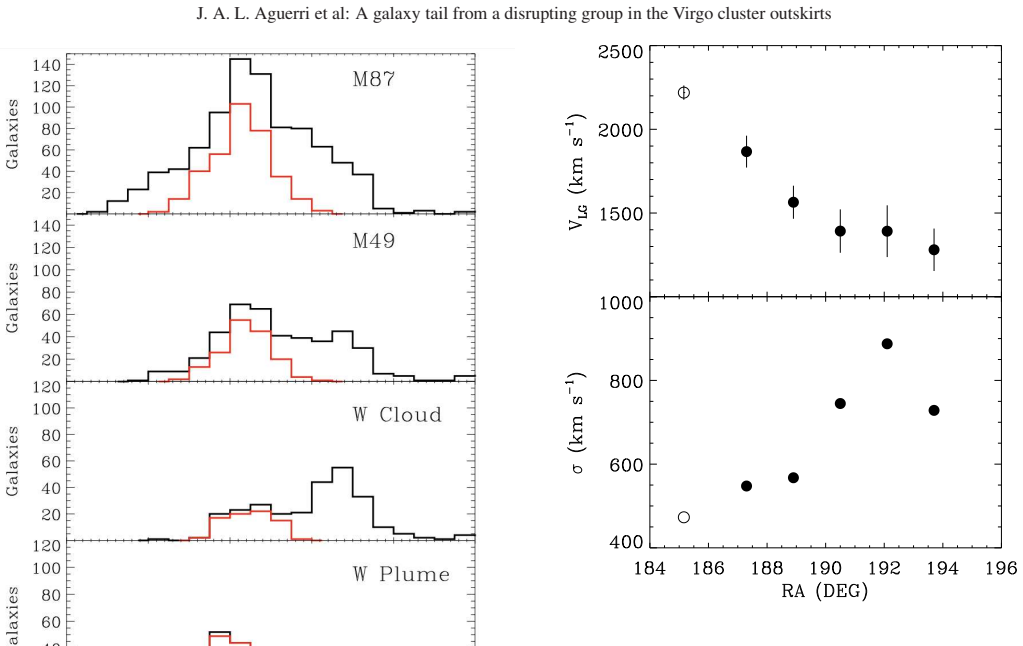
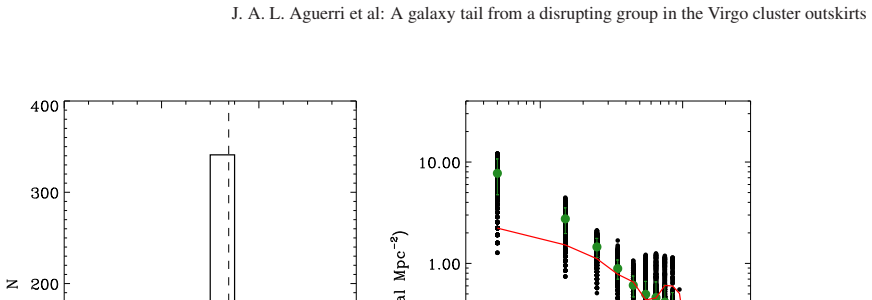
We show that the W cloud is not a large-scale filament seen in projection, but is instead dominated by a compact galaxy group (the W group) currently interacting with Virgo. We also identify a previously unknown, dynamically coherent tail of galaxies (the W tail) connecting the W group to the cluster. The tail exhibits a continuous sequence in velocity, velocity dispersion, and three-dimensional distance. Its low-velocity component is already gravitationally bound to Virgo, whereas higher-velocity galaxies remain associated with the W group and are still infalling. The W tail forms a planar structure aligned with the orbital geometry of the W group, strongly supporting a tidal origin. The st
What carries the argument
The W tail, identified by its continuous sequence in velocity, velocity dispersion, and three-dimensional distance, plus planar alignment with the W group's orbit.
If this is right
- Low-density groups can deliver largely unprocessed dwarf galaxies into clusters.
- The W group--W tail system illustrates ongoing group--cluster interaction during cluster assembly.
- Provides observational constraints on the buildup of dwarf galaxy populations in clusters.
- Higher-velocity galaxies in the tail are still infalling while lower ones are bound.
Where Pith is reading between the lines
- Similar tails might be identifiable around other clusters if high-quality kinematic data is available.
- The dominance of blue cloud dwarfs suggests that environmental quenching happens after accretion rather than before.
- This example could be used to calibrate simulations of group infall and tidal stripping.
Load-bearing premise
That the observed continuous sequence in velocity, velocity dispersion, and three-dimensional distance together with planar alignment means the galaxies form a single tidal structure from the W group instead of unrelated objects aligned by chance.
What would settle it
Spectroscopic measurements showing that galaxies along the proposed tail have velocities or distances that do not form a continuous sequence with the W group would disprove the tidal connection.
Figures

read the original abstract
Group environments are thought to play a key role in shaping galaxy evolution prior to cluster accretion. However, direct observational evidence linking group--cluster interactions to the transformation of low-mass galaxies remains scarce. We reexamine the nature and origin of the W cloud, located in the southern outskirts of the Virgo cluster, to better understand the dynamical processes driving group accretion and galaxy transformation during cluster assembly. Using the spatial distribution, kinematics, and stellar population properties of galaxies in the W cloud and its surroundings, we characterize the three-dimensional structure and dynamical state of the system. We show that the W cloud is not a large-scale filament seen in projection, but is instead dominated by a compact galaxy group (the W group) currently interacting with Virgo. We also identify a previously unknown, dynamically coherent tail of galaxies (the W tail) connecting the W group to the cluster. The tail exhibits a continuous sequence in velocity, velocity dispersion, and three-dimensional distance. Its low-velocity component is already gravitationally bound to Virgo, whereas higher-velocity galaxies remain associated with the W group and are still infalling. The W tail forms a planar structure aligned with the orbital geometry of the W group, strongly supporting a tidal origin. The stellar masses and colours of its members indicate that the stripped population is dominated by low-mass, star-forming dwarf galaxies that remain in the blue cloud. The W group--W tail system provides a well-resolved example of an ongoing group--cluster interaction, illustrating how low-density groups can deliver largely unprocessed dwarf galaxies into clusters. This system provides important observational constraints on the hierarchical assembly of galaxy clusters and the buildup of their dwarf galaxy populations.
Editorial analysis
A structured set of objections, weighed in public.
Referee Report
Summary. The paper reexamines the W cloud in the southern outskirts of the Virgo cluster using spatial distributions, kinematics, and stellar population properties of galaxies. It argues that the W cloud is not a projected filament but a compact galaxy group (the W group) interacting with Virgo, and identifies a previously unknown dynamically coherent 'W tail' of galaxies linking the group to the cluster. This tail shows a continuous sequence in velocity, velocity dispersion, and three-dimensional distance, with planar alignment indicating a tidal origin; its members are predominantly low-mass, star-forming dwarf galaxies still in the blue cloud, providing an example of group accretion delivering unprocessed dwarfs into the cluster.
Significance. If the central interpretation is robust, the result supplies a rare, spatially resolved observational case of ongoing hierarchical group-cluster assembly. It directly links group infall to the delivery of low-mass dwarfs and constrains the timing of environmental transformation, complementing simulations of cluster buildup. The multi-probe approach (kinematics plus stellar populations) is a strength, though the absence of a quantitative null test limits the strength of the tidal-tail claim.
major comments (2)
- [Abstract and results describing the W tail] The claim that the W tail constitutes a single tidal structure (rather than projection or chance alignment) rests on the reported continuous sequence in velocity, velocity dispersion, and 3D distance together with planar alignment. No quantitative test against a null hypothesis (e.g., randomized velocities or positions preserving the overall distribution) is described, leaving the mapping from observed coherence to a common dynamical origin as an assumption rather than a demonstrated result. This is load-bearing for the tidal-origin and group-accretion conclusions.
- [Methods / data analysis sections] Sample selection criteria, velocity and distance error bars, the precise method used to compute three-dimensional distances, and explicit exclusion rules for non-members are not detailed. These omissions directly affect assessment of whether the reported continuous sequences are robust or sensitive to choices in membership definition.
minor comments (1)
- Notation for velocity dispersion and 3D distance should be defined explicitly on first use to aid readability.
Simulated Author's Rebuttal
We thank the referee for their thoughtful review and positive assessment of the paper's significance. We address each major comment below and will revise the manuscript to improve clarity and strengthen the presentation of the W tail results.
read point-by-point responses
-
Referee: [Abstract and results describing the W tail] The claim that the W tail constitutes a single tidal structure (rather than projection or chance alignment) rests on the reported continuous sequence in velocity, velocity dispersion, and 3D distance together with planar alignment. No quantitative test against a null hypothesis (e.g., randomized velocities or positions preserving the overall distribution) is described, leaving the mapping from observed coherence to a common dynamical origin as an assumption rather than a demonstrated result. This is load-bearing for the tidal-origin and group-accretion conclusions.
Authors: We agree that a quantitative null test would strengthen the dynamical coherence argument. In the revised manuscript we will add a Monte Carlo analysis that randomizes galaxy velocities (while preserving the observed spatial distribution and overall velocity range) to assess the statistical significance of the reported continuous sequences in velocity, dispersion, and 3D distance. This addition will make the mapping from observed coherence to a common origin explicit rather than implicit. revision: yes
-
Referee: [Methods / data analysis sections] Sample selection criteria, velocity and distance error bars, the precise method used to compute three-dimensional distances, and explicit exclusion rules for non-members are not detailed. These omissions directly affect assessment of whether the reported continuous sequences are robust or sensitive to choices in membership definition.
Authors: We acknowledge that these methodological details are insufficiently described. The revised version will expand the data analysis section to include: (i) explicit sample selection criteria (position, velocity, and photometric cuts), (ii) tabulated velocity and distance uncertainties with sources, (iii) the exact procedure for computing three-dimensional distances (combining projected positions with line-of-sight velocities under the adopted geometry), and (iv) the membership exclusion rules with any applied velocity or distance thresholds. These additions will allow readers to evaluate the sensitivity of the reported sequences to membership choices. revision: yes
Circularity Check
No circularity: purely observational interpretation of galaxy kinematics and positions
full rationale
The paper's central claims rest on direct interpretation of observed galaxy positions, velocities, velocity dispersions, 3D distances, colors, and stellar masses in the Virgo outskirts. No equations, fitted parameters, or model predictions are presented that reduce to inputs by construction. No self-citations are invoked as load-bearing uniqueness theorems or ansatzes. The continuous sequence in velocity-distance is reported as an observed pattern used to infer a tidal tail; this is an interpretive step but does not constitute circularity under the defined criteria, as it does not involve renaming a fit as a prediction or smuggling assumptions via prior self-work. The analysis is self-contained against external benchmarks (catalog data) and receives the default non-circularity outcome.
Axiom & Free-Parameter Ledger
axioms (1)
- domain assumption Velocity serves as a reliable proxy for line-of-sight distance when determining three-dimensional structure and binding status in the cluster environment.
Reference graph
Works this paper leans on
-
[1]
doi:10.1093/mnras/278.3.697 , eprint =
, year =. doi:10.1093/mnras/278.3.697 , eprint =
- [2]
- [3]
-
[4]
arXiv , doi =:1106.3328 , keywords =
, year =. arXiv , doi =:1106.3328 , keywords =
-
[5]
doi:10.1086/157881 , keywords =
, year =. doi:10.1086/157881 , keywords =
-
[6]
doi:10.1086/160000 , keywords =
, year =. doi:10.1086/160000 , keywords =
-
[7]
doi:10.1086/165629 , keywords =
, year =. doi:10.1086/165629 , keywords =
- [8]
-
[9]
arXiv , doi =:1205.3163 , keywords =
, year =. arXiv , doi =:1205.3163 , keywords =
-
[10]
arXiv , doi =:1005.2413 , keywords =
, year =. arXiv , doi =:1005.2413 , keywords =
-
[11]
, year =. doi:10.1046/j.1365-8711.2003.06947.x , eprint =
-
[12]
arXiv , doi =:1403.0588 , keywords =
, year =. arXiv , doi =:1403.0588 , keywords =
-
[13]
arXiv , doi =:1506.03076 , keywords =
, year =. arXiv , doi =:1506.03076 , keywords =
-
[14]
arXiv , doi =:1511.02854 , keywords =
, year =. arXiv , doi =:1511.02854 , keywords =
-
[15]
doi:10.1086/114694 , keywords =
, year =. doi:10.1086/114694 , keywords =
-
[16]
, year =. doi:10.1038/nature03597 , eprint =
-
[17]
arXiv , doi =:0708.1945 , keywords =
, year =. arXiv , doi =:0708.1945 , keywords =
Pith/arXiv arXiv 1945
- [18]
-
[19]
doi:10.1086/191333 , keywords =
, year =. doi:10.1086/191333 , keywords =
- [20]
- [21]
-
[22]
arXiv , doi =:1002.2360 , keywords =
, year =. arXiv , doi =:1002.2360 , keywords =
-
[23]
doi:10.1088/1475-7516/2016/07/022 , eid =
Journal of Cosmology and Astro-Particle Physics , year =. doi:10.1088/1475-7516/2016/07/022 , eid =
-
[24]
, year =. doi:10.1111/j.1365-2966.2008.13221.x , keywords =
-
[25]
doi:10.3847/1538-4357/aa7b88 , eid =
, year =. doi:10.3847/1538-4357/aa7b88 , eid =
-
[26]
doi:10.1111/j.1745-3933.2010.00962.x , keywords =
, year =. doi:10.1111/j.1745-3933.2010.00962.x , keywords =
-
[27]
doi:10.1051/0004-6361/201629012 , eid =
, year =. doi:10.1051/0004-6361/201629012 , eid =
-
[28]
doi:10.1086/171695 , keywords =
, year =. doi:10.1086/171695 , keywords =
-
[29]
doi:10.1086/318665 , keywords =
, year =. doi:10.1086/318665 , keywords =
-
[30]
doi:10.1051/0004-6361:20041306 , keywords =
, year =. doi:10.1051/0004-6361:20041306 , keywords =
-
[31]
doi:10.1086/155369 , keywords =
, year =. doi:10.1086/155369 , keywords =
-
[32]
doi:10.1086/157753 , keywords =
, year =. doi:10.1086/157753 , keywords =
-
[33]
doi:10.1086/172531 , keywords =
, year =. doi:10.1086/172531 , keywords =
-
[34]
doi:10.1086/115070 , keywords =
, year =. doi:10.1086/115070 , keywords =
-
[35]
arXiv , doi =:astro-ph/9409006 , keywords =
, year =. arXiv , doi =:astro-ph/9409006 , keywords =
-
[36]
arXiv , doi =:astro-ph/0503089 , keywords =
, year =. arXiv , doi =:astro-ph/0503089 , keywords =
-
[37]
arXiv , doi =:astro-ph/0305237 , keywords =
, year =. arXiv , doi =:astro-ph/0305237 , keywords =
-
[38]
arXiv , doi =:1306.6935 , keywords =
, year =. arXiv , doi =:1306.6935 , keywords =
-
[39]
Reviews of Modern Physics , year =
-
[40]
arXiv , doi =:0903.2360 , keywords =
, year =. arXiv , doi =:0903.2360 , keywords =
-
[41]
arXiv , doi =:1101.2447 , keywords =
, year =. arXiv , doi =:1101.2447 , keywords =
-
[42]
arXiv , doi =:0804.4390 , keywords =
, year =. arXiv , doi =:0804.4390 , keywords =
-
[43]
doi:10.1093/mnras/stx457 , keywords =
, year =. doi:10.1093/mnras/stx457 , keywords =
-
[44]
doi:10.1051/0004-6361/201731711 , eid =
, year =. doi:10.1051/0004-6361/201731711 , eid =
-
[45]
arXiv , doi =:1403.0590 , keywords =
, year =. arXiv , doi =:1403.0590 , keywords =
-
[46]
arXiv , doi =:1110.0465 , keywords =
, year =. arXiv , doi =:1110.0465 , keywords =
-
[47]
arXiv , doi =:1809.01251 , keywords =
, year =. arXiv , doi =:1809.01251 , keywords =
-
[48]
doi:10.1051/0004-6361/201730785 , eid =
, year =. doi:10.1051/0004-6361/201730785 , eid =
-
[49]
ArXiv e-prints , year =
-
[50]
doi:10.1086/169091 , keywords =
, year =. doi:10.1086/169091 , keywords =
-
[51]
doi:10.1093/mnras/178.4.701 , keywords =
, year =. doi:10.1093/mnras/178.4.701 , keywords =
-
[52]
arXiv , doi =:1001.4533 , keywords =
, year =. arXiv , doi =:1001.4533 , keywords =
-
[53]
arXiv , doi =:1510.05659 , keywords =
, year =. arXiv , doi =:1510.05659 , keywords =
-
[54]
doi:10.1086/115487 , keywords =
, year =. doi:10.1086/115487 , keywords =
-
[55]
arXiv , doi =:1704.00731 , keywords =
, year =. arXiv , doi =:1704.00731 , keywords =
-
[56]
arXiv , doi =:1705.10808 , keywords =
, year =. arXiv , doi =:1705.10808 , keywords =
- [57]
-
[58]
arXiv , doi =:0707.2628 , keywords =
, year =. arXiv , doi =:0707.2628 , keywords =
-
[59]
arXiv , doi =:1211.1007 , keywords =
, year =. arXiv , doi =:1211.1007 , keywords =
-
[60]
arXiv , doi =:1503.06219 , keywords =
, year =. arXiv , doi =:1503.06219 , keywords =
-
[61]
doi:10.1086/324741 , keywords =
, year =. doi:10.1086/324741 , keywords =
-
[62]
arXiv , doi =:astro-ph/9710327 , keywords =
, year =. arXiv , doi =:astro-ph/9710327 , keywords =
-
[63]
arXiv , doi =:1603.09708 , keywords =
, year =. arXiv , doi =:1603.09708 , keywords =
-
[64]
arXiv , doi =:astro-ph/9809387 , keywords =
Publications of the Astronomical Society of the Pacific , year =. arXiv , doi =:astro-ph/9809387 , keywords =
-
[65]
arXiv , doi =:1203.0297 , keywords =
, year =. arXiv , doi =:1203.0297 , keywords =
- [66]
-
[67]
arXiv , eid =:1612.05560 , keywords =
arXiv e-prints , year =. arXiv , eid =:1612.05560 , keywords =
-
[68]
arXiv , doi =:1601.00329 , keywords =
, year =. arXiv , doi =:1601.00329 , keywords =
-
[69]
doi:10.1002/asna.200710817 , keywords =
Astronomische Nachrichten , year =. doi:10.1002/asna.200710817 , keywords =
-
[70]
The Pan-STARRS Data Processing System , journal =
-
[71]
arXiv , doi =:1708.07349 , keywords =
, year =. arXiv , doi =:1708.07349 , keywords =
-
[72]
arXiv , doi =:1412.2137 , keywords =
, year =. arXiv , doi =:1412.2137 , keywords =
-
[73]
arXiv , doi =:1901.00873 , keywords =
, year =. arXiv , doi =:1901.00873 , keywords =
Pith/arXiv arXiv 1901
-
[74]
arXiv , doi =:1712.06607 , keywords =
, year =. arXiv , doi =:1712.06607 , keywords =
-
[75]
arXiv , doi =:1103.4829 , keywords =
, year =. arXiv , doi =:1103.4829 , keywords =
-
[76]
arXiv , doi =:astro-ph/0603217 , keywords =
, year =. arXiv , doi =:astro-ph/0603217 , keywords =
-
[77]
arXiv , doi =:0807.1533 , keywords =
, year =. arXiv , doi =:0807.1533 , keywords =
-
[78]
arXiv , doi =:astro-ph/0402308 , keywords =
, year =. arXiv , doi =:astro-ph/0402308 , keywords =
-
[79]
arXiv , doi =:astro-ph/9408030 , keywords =
, year =. arXiv , doi =:astro-ph/9408030 , keywords =
-
[80]
arXiv , doi =:1301.1682 , keywords =
, year =. arXiv , doi =:1301.1682 , keywords =
discussion (0)
Sign in with ORCID, Apple, or X to comment. Anyone can read and Pith papers without signing in.