S3TS: Stochastic Scenario-Structured Tree Search for Advanced Planning Under Uncertainty
Pith reviewed 2026-06-28 14:54 UTC · model grok-4.3
The pith
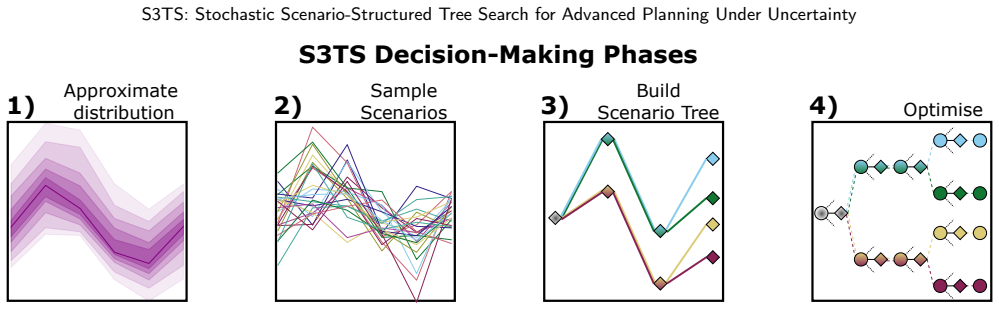
S3TS structures tree search around scenario trees to handle both uncertainty and non-linear models in planning.
A machine-rendered reading of the paper's core claim, the machinery that carries it, and where it could break.
Core claim
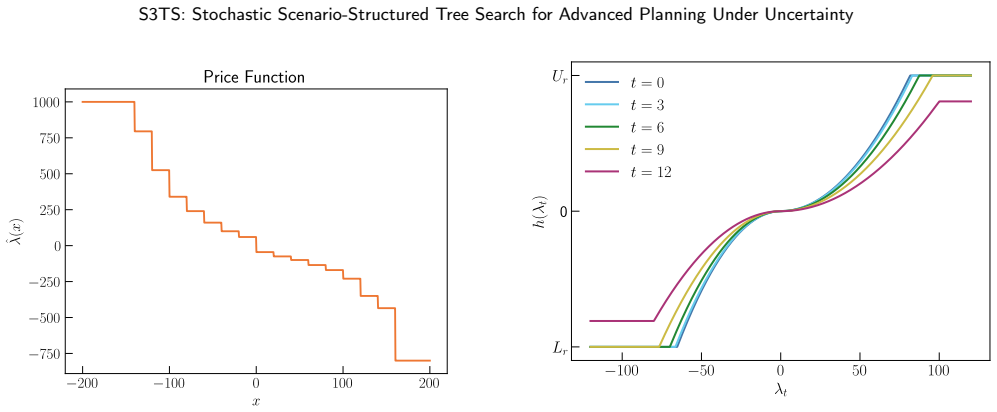
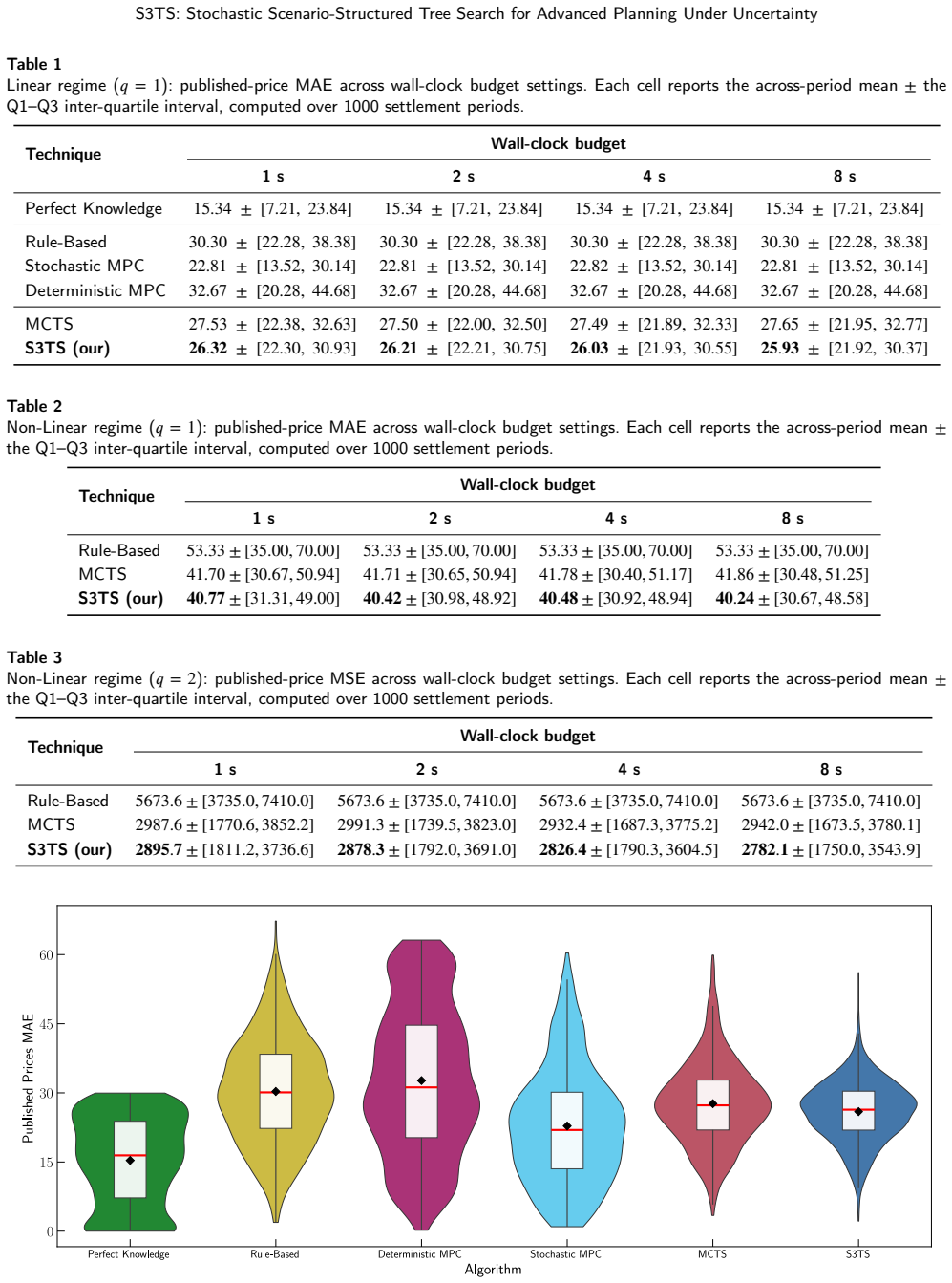
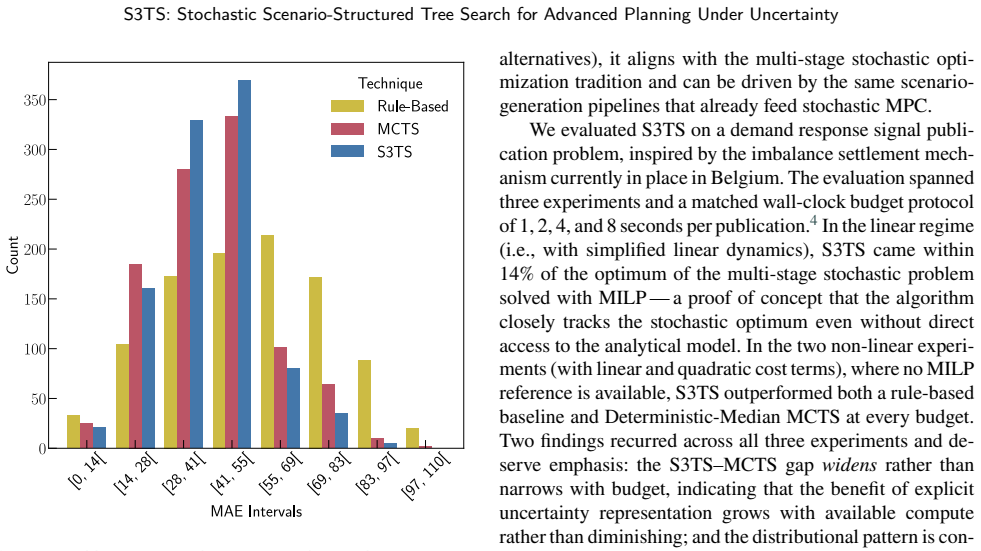
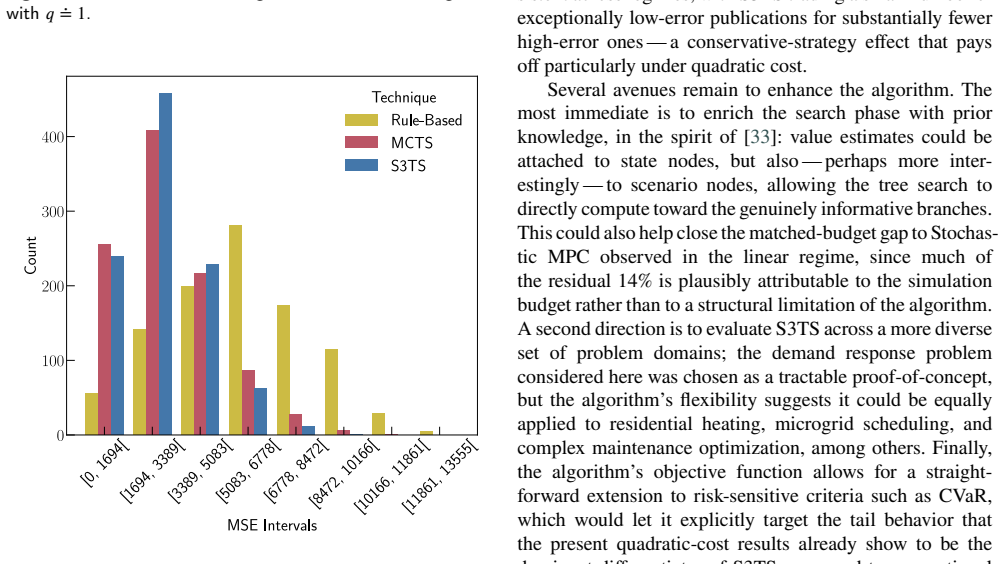
S3TS explicitly represents uncertainty through scenario trees while enabling the integration of advanced non-linear models. In linear analytically tractable settings it produces costs within 14 percent of the mathematically optimal solution conditioned on the scenario trees. In highly non-linear scenarios it achieves cost reductions of up to 51 percent relative to a myopic algorithm and 5.4 percent relative to deterministic MCTS on a simulated demand response signal publication problem.
What carries the argument
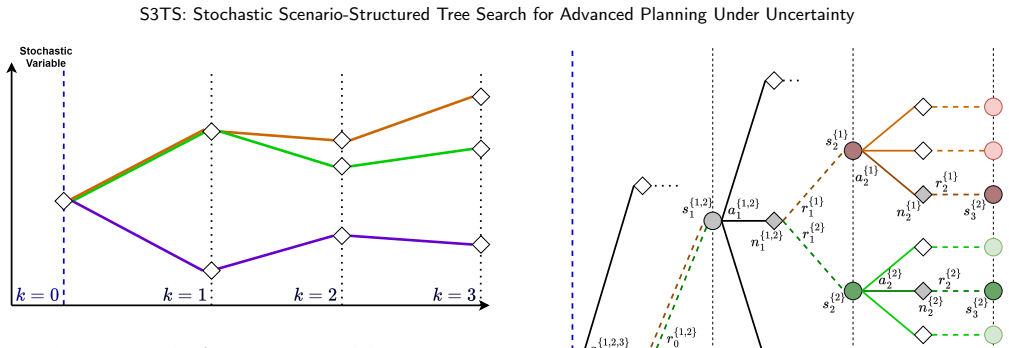
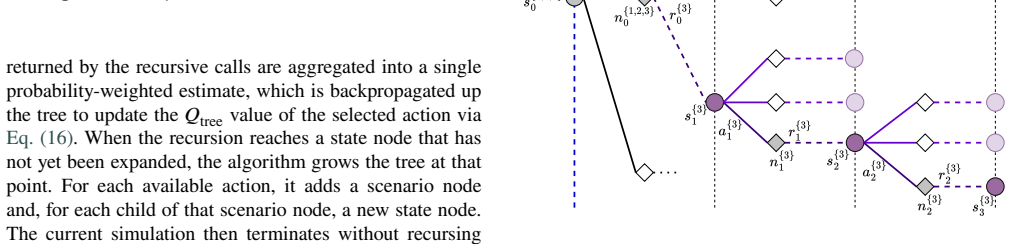
Stochastic Scenario-Structured Tree Search (S3TS) algorithm, which organizes the tree search around discrete scenarios to represent uncertainty and permits direct evaluation of non-linear models inside the search.
If this is right
- In linear analytically tractable settings S3TS reaches costs within 14 percent of the mathematically optimal solution given the scenario trees.
- In highly non-linear scenarios S3TS reduces costs by up to 51 percent compared with a myopic algorithm.
- In highly non-linear scenarios S3TS reduces costs by up to 5.4 percent compared with deterministic MCTS.
- The method supplies a single algorithmic framework that simultaneously addresses non-linearity and uncertainty, removing the need to choose between separate families of techniques.
Where Pith is reading between the lines
- The same scenario-structured search pattern could be applied to other sequential decision problems that combine non-linear dynamics with exogenous uncertainty, such as inventory control under demand volatility.
- Performance may improve if scenario generation itself is learned from data rather than fixed in advance, though the paper does not test this extension.
- Larger scenario trees would increase fidelity to the underlying stochastic process at the expense of higher computation per decision epoch.
Load-bearing premise
The simulated demand response signal publication problem and the scenario trees employed adequately represent the uncertainties and non-linearities of real energy planning without systematic bias.
What would settle it
Running S3TS on a non-linear instance whose true optimal cost (conditioned on the same scenario trees) is known by other means and checking whether the reported cost gap holds would directly test the performance claims.
Figures
read the original abstract
Effective scheduling in the energy sector is essential to ensure the reliable operation of electrical grids and their connected assets by, for instance, optimizing the dispatch of generation units and storage systems. An effective planning strategy must (a) accommodate advanced and potentially non-linear system models -- exploiting the increasing data availability of modern grids, and (b) explicitly handle uncertainties arising, for instance, from the integration of renewable energy sources. While existing approaches can address either non-linearity (e.g., Monte Carlo Tree Search) or uncertainty (e.g., stochastic mathematical optimization), there is a lack of planning techniques capable of addressing both challenges simultaneously. To bridge this gap, we propose a Stochastic Scenario-Structured Tree Search (S3TS) algorithm that explicitly represents uncertainty through scenario trees while enabling the integration of advanced non-linear models. We evaluate S3TS on a simulated demand response signal publication problem, largely mimicking the imbalance settlement mechanism in Belgium. The results demonstrate near-optimal performance in linear, analytically tractable settings, with costs within 14% of the mathematically optimal solution conditioned to the scenario trees. In highly non-linear scenarios, S3TS significantly outperforms baseline methods, achieving cost reductions of up to 51% and 5.4% compared to a myopic algorithm and deterministic MCTS, respectively.
Editorial analysis
A structured set of objections, weighed in public.
Referee Report
Summary. The paper proposes Stochastic Scenario-Structured Tree Search (S3TS), an algorithm that represents uncertainty explicitly via scenario trees while supporting integration of non-linear system models for planning. It evaluates the method on a simulated demand response signal publication problem that mimics the Belgian imbalance settlement mechanism, reporting costs within 14% of the tree-conditioned optimum in linear cases and cost reductions of up to 51% versus a myopic baseline and 5.4% versus deterministic MCTS in non-linear cases.
Significance. If the empirical claims hold under more detailed scrutiny, the work would offer a practical bridge between scenario-based stochastic optimization and non-linear tree search methods, with potential applicability to energy dispatch and storage problems that combine complex models with renewable-driven uncertainty. The explicit scenario-tree structure and reported near-optimality in the linear case are positive features, but the single simulated proxy and absence of sensitivity or statistical detail currently constrain the assessed significance.
major comments (3)
- [Abstract / evaluation] Abstract and evaluation section: performance metrics (within 14% of optimum; 51%/5.4% gains) are stated without any description of experimental setup, number of replications, statistical significance tests, or concrete implementation details for the myopic algorithm and deterministic MCTS baselines. Because these numbers are the primary evidence for the central bridging claim, the missing information is load-bearing.
- [Evaluation] Evaluation section: no sensitivity analysis or ablation is reported on scenario-tree parameters (branching factor, depth, or sampling procedure for tail events). The outperformance margins could therefore be sensitive to the particular tree construction chosen for the Belgian imbalance proxy, undermining the generality of the non-linear-case gains.
- [Evaluation] Evaluation section: the demand-response simulation is presented as a proxy for real-world energy planning, yet no discussion or diagnostic is given on whether the generated scenarios adequately capture renewable-driven uncertainty or introduce systematic bias relative to the true stochastic process.
minor comments (2)
- [Method] Notation for scenario-tree nodes and value functions should be introduced with a small diagram or explicit recursive definition to improve readability for readers unfamiliar with stochastic programming.
- [Abstract] The abstract states 'costs within 14% of the mathematically optimal solution conditioned to the scenario trees' without clarifying whether this optimum is obtained by an exact solver or by another approximation; a one-sentence clarification would help.
Simulated Author's Rebuttal
We appreciate the referee's constructive feedback on the evaluation aspects of our manuscript. We address each major comment below and will make revisions to improve the clarity and completeness of the reported results.
read point-by-point responses
-
Referee: [Abstract / evaluation] Abstract and evaluation section: performance metrics (within 14% of optimum; 51%/5.4% gains) are stated without any description of experimental setup, number of replications, statistical significance tests, or concrete implementation details for the myopic algorithm and deterministic MCTS baselines. Because these numbers are the primary evidence for the central bridging claim, the missing information is load-bearing.
Authors: We agree that additional details are needed to substantiate the performance claims. In the revised manuscript, we will expand the Evaluation section with a full description of the experimental setup, the number of replications, any statistical significance tests, and concrete implementation details for the myopic algorithm and deterministic MCTS baselines. We will also ensure the abstract refers readers to these details. revision: yes
-
Referee: [Evaluation] Evaluation section: no sensitivity analysis or ablation is reported on scenario-tree parameters (branching factor, depth, or sampling procedure for tail events). The outperformance margins could therefore be sensitive to the particular tree construction chosen for the Belgian imbalance proxy, undermining the generality of the non-linear-case gains.
Authors: We acknowledge the value of such analysis for demonstrating robustness. The revised manuscript will incorporate a sensitivity analysis and/or ablation study on scenario-tree parameters including branching factor, depth, and tail-event sampling to evaluate the stability of the reported gains. revision: yes
-
Referee: [Evaluation] Evaluation section: the demand-response simulation is presented as a proxy for real-world energy planning, yet no discussion or diagnostic is given on whether the generated scenarios adequately capture renewable-driven uncertainty or introduce systematic bias relative to the true stochastic process.
Authors: We will add a new subsection in the revised Evaluation section discussing the scenario generation procedure, its alignment with renewable-driven uncertainty in the Belgian imbalance mechanism, and any diagnostics or acknowledged limitations regarding potential systematic bias. revision: yes
Circularity Check
No significant circularity; derivation is self-contained via new algorithm and empirical evaluation.
full rationale
The paper introduces S3TS as a novel tree-search algorithm that combines scenario trees for uncertainty with non-linear models, then reports empirical performance on a simulated Belgian demand-response proxy. No step reduces a claimed result to a fitted parameter renamed as prediction, a self-citation chain, or a self-definitional equivalence; the central claims rest on explicit algorithmic construction and out-of-sample cost comparisons rather than tautological inputs. The evaluation metrics (costs within 14% of tree-conditioned optimum, gains vs. baselines) are externally falsifiable against the stated simulation and do not rely on prior author work as load-bearing uniqueness theorems.
Axiom & Free-Parameter Ledger
Reference graph
Works this paper leans on
-
[1]
Ten challenges for mathematical modeling of the green- energytransition
Anderson, E., Ferris, M., Philpott, A., Anitescu, M., Cramton, P., Geng, S., Green, R., Homem-de Mello, T., Huber, O., Leclère, V., et al., 2025. Ten challenges for mathematical modeling of the green- energytransition. CurrentSustainable/RenewableEnergyReports12, 1–13
2025
-
[2]
Antonoglou, I., Schrittwieser, J., Ozair, S., Hubert, T.K., Silver, D.,
-
[3]
Planning in stochastic environments with a learned model, in: International Conference on Learning Representations
-
[4]
Generation expansion planning by milp considering mid-term scheduling deci- sions
Bakirtzis,G.A.,Biskas,P.N.,Chatziathanasiou,V.,2012. Generation expansion planning by milp considering mid-term scheduling deci- sions. Electric Power Systems Research 86, 98–112
2012
-
[5]
The*-minimax search procedure for trees containing chance nodes
Ballard, B.W., 1983. The*-minimax search procedure for trees containing chance nodes. Artificial Intelligence 21, 327–350
1983
-
[6]
Introduction to stochastic program- ming
Birge, J.R., Louveaux, F., 1997. Introduction to stochastic program- ming. Springer
1997
-
[7]
Reinforce- ment learning and dynamic programming using function approxima- tors
Busoniu,L.,Babuska,R.,DeSchutter,B.,Ernst,D.,2017. Reinforce- ment learning and dynamic programming using function approxima- tors. CRC press
2017
-
[8]
Couëtoux,A.,Hoock,J.B.,Sokolovska,N.,Teytaud,O.,Bonnard,N.,
-
[9]
Continuousupperconfidencetrees,in:Internationalconference on learning and intelligent optimization, Springer. pp. 433–445
-
[10]
TariffsforMaintainingandRestor- ing the Residual Balance of Individual Access Responsibles (2024– 2027 Period)
EliaTransmissionBelgium,2024. TariffsforMaintainingandRestor- ing the Residual Balance of Individual Access Responsibles (2024– 2027 Period). Technical Report. Elia. URL:https://www.elia.be/-/ media/project/elia/elia-site/public-consultations/2024/20240606_ proposal-for-modification-of-the-tariff-for-maintaining-and-restoring-the-residual-balance/ 2024060...
2024
-
[11]
Scenario reduc- tion and scenario tree construction for power management problems, in: 2003 IEEE Bologna Power Tech Conference Proceedings,, IEEE
Growe-Kuska, N., Heitsch, H., Romisch, W., 2003. Scenario reduc- tion and scenario tree construction for power management problems, in: 2003 IEEE Bologna Power Tech Conference Proceedings,, IEEE. pp. 7–pp
2003
-
[12]
Gurobi Optimizer Reference Manual
Gurobi Optimization, LLC, 2024. Gurobi Optimizer Reference Manual. URL:https://www.gurobi.com
2024
-
[13]
Monte carlo tree search-based deep reinforcement learning for flexible operation & maintenance optimization of a nuclear power plant
Hao, Z., Di Maio, F., Zio, E., 2024. Monte carlo tree search-based deep reinforcement learning for flexible operation & maintenance optimization of a nuclear power plant. Journal of Safety and Sus- tainability 1, 4–13
2024
-
[14]
Repre- sentationofuncertaintyinmarketmodelsforoperationalplanningand forecasting in renewable power systems: a review
Haugen, M., Farahmand, H., Jaehnert, S., Fleten, S.E., 2023. Repre- sentationofuncertaintyinmarketmodelsforoperationalplanningand forecasting in renewable power systems: a review. Energy Systems , 1–36
2023
-
[15]
Efficient mpc-based energy management system for secure and cost-effective microgrid operations
He, H., Harlim, J., Huang, D., Li, Y., 2025. Efficient mpc-based energy management system for secure and cost-effective microgrid operations. arXiv preprint arXiv:2510.03241
-
[16]
Scenario reduction algorithms in stochastic programming
Heitsch, H., Römisch, W., 2003. Scenario reduction algorithms in stochastic programming. Computational optimization and applica- tions 24, 187–206
2003
-
[17]
Scenario tree modeling for mul- tistage stochastic programs
Heitsch, H., Römisch, W., 2009. Scenario tree modeling for mul- tistage stochastic programs. Mathematical Programming 118, 371– 406
2009
-
[18]
A sparse sampling algo- rithm for near-optimal planning in large markov decision processes
Kearns, M., Mansour, Y., Ng, A.Y., 2002. A sparse sampling algo- rithm for near-optimal planning in large markov decision processes. Machine learning 49, 193–208
2002
-
[19]
Intelligent consumer flexibility man- agement with neural network-based planning and control
Kiljander,J.,Sarala,R.,Rehu,J.,Pakkala,D.,Pääkkönen,P.,Takalo- Mattila, J., Känsälä, K., 2021. Intelligent consumer flexibility man- agement with neural network-based planning and control. IEEE Access 9, 40755–40767
2021
-
[20]
Banditbasedmonte-carloplanning, in:Europeanconferenceonmachinelearning,Springer.pp.282–293
Kocsis,L.,Szepesvári,C.,2006. Banditbasedmonte-carloplanning, in:Europeanconferenceonmachinelearning,Springer.pp.282–293
2006
-
[21]
Kotzur, L., Nolting, L., Hoffmann, M., Groß, T., Smolenko, A., Priesmann, J., Büsing, H., Beer, R., Kullmann, F., Singh, B., et al.,
-
[22]
Advances in Applied Energy 4, 100063
A modeler’s guide to handle complexity in energy systems optimization. Advances in Applied Energy 4, 100063
-
[23]
Multi-stage stochastic planning of regional integrated energy system based on scenario tree path optimization under long-term multiple uncertainties
Lei, Y., Wang, D., Jia, H., Li, J., Chen, J., Li, J., Yang, Z., 2021. Multi-stage stochastic planning of regional integrated energy system based on scenario tree path optimization under long-term multiple uncertainties. Applied Energy 300, 117224
2021
-
[24]
Leastsquaresquantizationinpcm
Lloyd,S.,1982. Leastsquaresquantizationinpcm. IEEEtransactions on information theory 28, 129–137
1982
-
[25]
Model predictive control-guided reinforcement learning for implicit balancing
Madahi, S.S.K., Bruninx, K., Claessens, B., Develder, C., 2025. Model predictive control-guided reinforcement learning for implicit balancing. arXiv preprint arXiv:2510.04868
-
[26]
Distributional reinforcementlearning-basedenergyarbitragestrategiesinimbalance settlement mechanism
Madahi, S.S.K., Claessens, B., Develder, C., 2024. Distributional reinforcementlearning-basedenergyarbitragestrategiesinimbalance settlement mechanism. Journal of Energy Storage 104, 114377
2024
-
[27]
Stochastic mpc for real-time market-based optimal power dispatch, in: 2011 50th IEEE conferenceondecisionandcontrolandEuropeancontrolconference, IEEE
Patrinos, P., Trimboli, S., Bemporad, A., 2011. Stochastic mpc for real-time market-based optimal power dispatch, in: 2011 50th IEEE conferenceondecisionandcontrolandEuropeancontrolconference, IEEE. pp. 7111–7116
2011
-
[28]
Demand response for residential building heating: Effective monte carlo tree search control based on physics-informed neural networks
Pavirani,F.,Gokhale,G.,Claessens,B.,Develder,C.,2024. Demand response for residential building heating: Effective monte carlo tree search control based on physics-informed neural networks. Energy and Buildings 311, 114161
2024
-
[29]
Predicting and publishing accurate imbalance prices using monte carlo tree search
Pavirani,F.,VanGompel,J.,Madahi,S.S.K.,Claessens,B.,Develder, C., 2025. Predicting and publishing accurate imbalance prices using monte carlo tree search. Applied Energy 392, 125944
2025
-
[30]
Pinson,P.,Madsen,H.,Nielsen,H.A.,Papaefthymiou,G.,Klöckl,B.,
-
[31]
WindEnergy:AnInternationalJournal forProgressandApplicationsinWindPowerConversionTechnology 12, 51–62
From probabilistic forecasts to statistical scenarios of short- termwindpowerproduction. WindEnergy:AnInternationalJournal forProgressandApplicationsinWindPowerConversionTechnology 12, 51–62
-
[32]
Power systems optimization under uncertainty: A review of methods and applications
Roald, L.A., Pozo, D., Papavasiliou, A., Molzahn, D.K., Kazempour, J., Conejo, A., 2023. Power systems optimization under uncertainty: A review of methods and applications. Electric Power Systems Research 214, 108725
2023
-
[33]
Schrittwieser, J., Antonoglou, I., Hubert, T., Simonyan, K., Sifre, L., Schmitt, S., Guez, A., Lockhart, E., Hassabis, D., Graepel, T., et al.,
-
[34]
Nature 588, 604–609
Masteringatari,go,chessandshogibyplanningwithalearned model. Nature 588, 604–609
-
[35]
Option value of electricity demand response
Sezgen, O., Goldman, C., Krishnarao, P., 2007. Option value of electricity demand response. Energy 32, 108–119
2007
-
[36]
Onlineschedulingofaresidentialmicrogrid via monte-carlo tree search and a learned model
Shuai,H.,He,H.,2020. Onlineschedulingofaresidentialmicrogrid via monte-carlo tree search and a learned model. IEEE Transactions on Smart Grid 12, 1073–1087
2020
-
[37]
Demand response performance and uncertainty: A systematic literature review
Silva, C., Faria, P., Vale, Z., Corchado, J., 2022. Demand response performance and uncertainty: A systematic literature review. Energy Strategy Reviews 41, 100857
2022
-
[38]
Mastering Chess and Shogi by Self-Play with a General Reinforcement Learning Algorithm
Silver,D.,Hubert,T.,Schrittwieser,J.,Antonoglou,I.,Lai,M.,Guez, A., Lanctot, M., Sifre, L., Kumaran, D., Graepel, T., et al., 2017. Mastering chess and shogi by self-play with a general reinforcement learning algorithm. arXiv preprint arXiv:1712.01815
work page internal anchor Pith review Pith/arXiv arXiv 2017
-
[39]
Monte-carlo planning in large pomdps
Silver, D., Veness, J., 2010. Monte-carlo planning in large pomdps. Advances in neural information processing systems 23
2010
-
[40]
Smets, R., Bruninx, K., Bottieau, J., Toubeau, J.F., Delarue, E.,
-
[41]
IEEE Transactions on Energy Markets, Policy and Regulation 1, 373–385
Strategic implicit balancing with energy storage systems via stochastic model predictive control. IEEE Transactions on Energy Markets, Policy and Regulation 1, 373–385
-
[42]
As- sessment of tso-dso coordination to enhance flexible grid operation
Zahraoui, Y., Pokhrel, B.R., Oleinikova, I., Gros, S.N., 2025. As- sessment of tso-dso coordination to enhance flexible grid operation. Current Sustainable/Renewable Energy Reports 12, 20. First Author et al.:Preprint submitted to ElsevierPage 16 of 16
2025
discussion (0)
Sign in with ORCID, Apple, or X to comment. Anyone can read and Pith papers without signing in.