Quantum optimal control of the Dicke manifold in dipolar Rydberg atom arrays
Pith reviewed 2026-06-28 14:04 UTC · model grok-4.3
The pith
Irrep distillation truncates the Hilbert space to linear scaling, enabling quantum optimal control of Dicke states in Rydberg arrays despite dipole-induced leakage.
A machine-rendered reading of the paper's core claim, the machinery that carries it, and where it could break.
Core claim
By distilling the relevant irreducible representations that couple the symmetric Dicke manifold to its dominant error spaces, the full many-body dynamics can be approximated in a truncated space whose dimension grows only linearly with N, allowing gradient-based optimal control to generate high-fidelity resourceful states in dipolar Rydberg arrays.
What carries the argument
irrep distillation (IRD), a truncation procedure that retains the symmetric subspace and the dominant leakage error-spaces it couples to, thereby reducing the effective Hilbert-space dimension to linear scaling with atom number.
If this is right
- Control pulses designed with IRD-GrAPE achieve the quantum speed limit for GHZ and Dicke state preparation under global or near-global driving.
- Fidelities measured on small arrays can be extrapolated to predict performance on larger arrays without full exponential simulation.
- The same truncation enables design of extremal quantum states that maximize certain collective observables.
- Leakage is suppressed without requiring individual site addressing for the target states.
Where Pith is reading between the lines
- The linear-scaling truncation could be combined with tensor-network methods to reach system sizes inaccessible to exact diagonalization.
- Similar distillation techniques might apply to other symmetry-protected subspaces in long-range interacting systems such as trapped ions or polar molecules.
- If the dominant leakage channels remain low-order for larger N, the method could support fault-tolerant preparation of symmetric states in near-term hardware.
Load-bearing premise
The truncated space of symmetric states plus leakage channels accurately reproduces the full dynamics for the array sizes of interest.
What would settle it
An exact simulation of pulse fidelity on an array size large enough that the full Hilbert space is still computable but beyond the sizes used for IRD calibration, compared directly against the IRD prediction.
Figures



read the original abstract
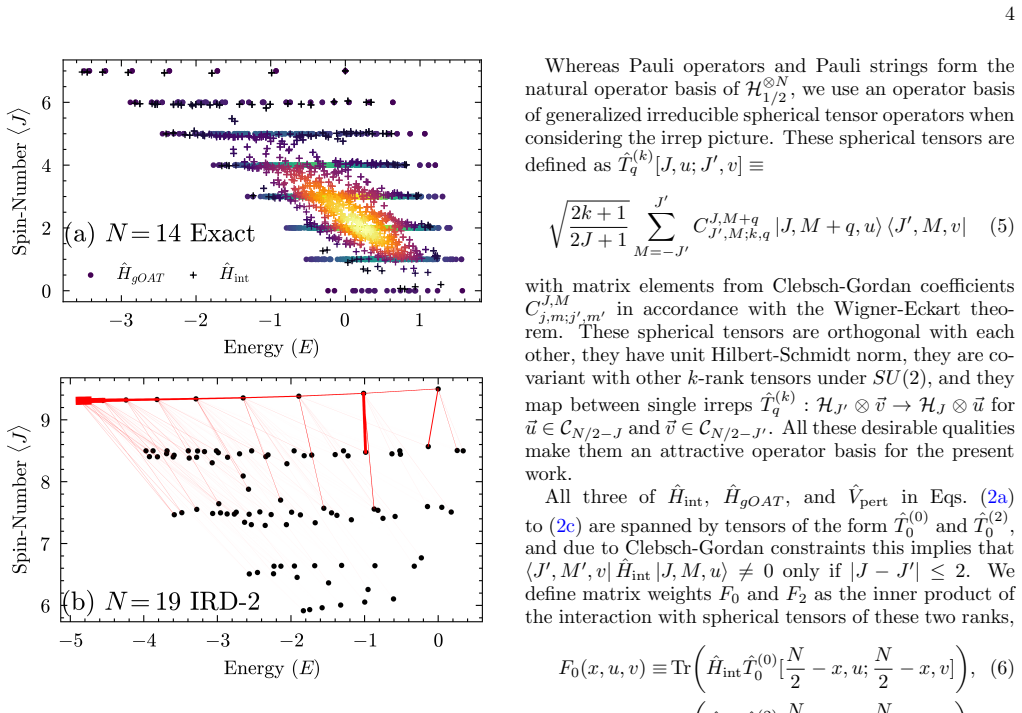
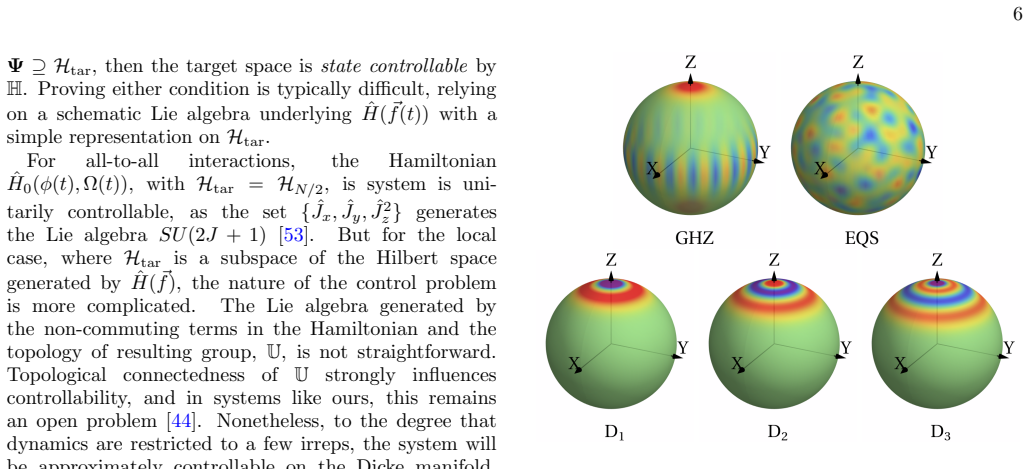
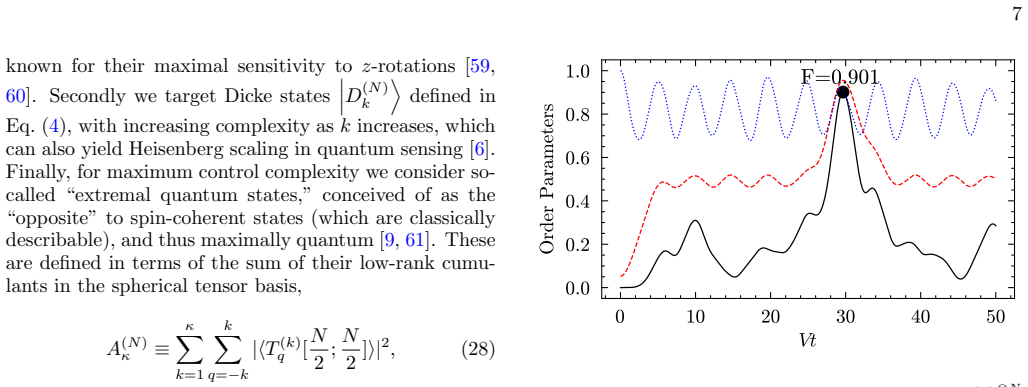
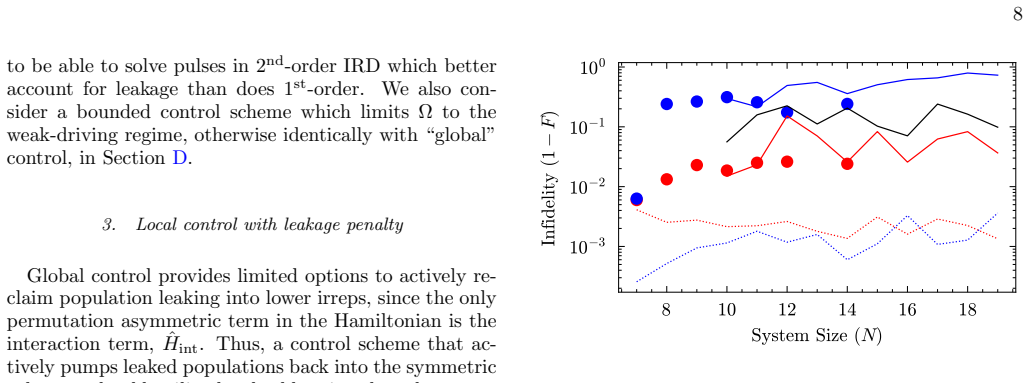
The ability to engineer and control quantum states of many-body systems is a central challenge in quantum information science. For a register of $N$ qubits, the full Hilbert space dimension grows exponentially as $2^N$, rendering generic state preparation and control infeasible without exploiting structure or symmetry. A particularly important and physically motivated restriction is to the fully symmetric subspace, spanned by the Dicke states, which are simultaneous eigenstates of collective spin $J=N/2$. Ensembles of Rydberg atoms interacting via electric dipoles in two-dimensional tweezer arrays form a promising platform for achieving such control. However, the finite range of dipole-dipole interactions poses a challenge to generating and controlling the Dicke manifold because the Hamiltonian incurs leakage from the computational subspace. To counteract this leakage, we perform quantum optimal control algorithms on a truncated Hilbert space according to our newly developed method of ``irrep distillation'' (IRD), which captures the process by which the symmetric subspace couples to leakage error-spaces, using only linear-scaling Hilbert dimension. We implement gradient ascent pulse engineering (GrAPE) on control schemes with little or no local addressing, to generate resourceful states like Greenberger-Horne-Zeilinger, Dicke, and extremal quantum states. We benchmark each scheme of IRD-GrAPE for its quantum speed limit (QSL), as well as exactly testing pulse fidelities on small system sizes and predicting fidelities using higher-order IRD on larger systems.
Editorial analysis
A structured set of objections, weighed in public.
Referee Report
Summary. The manuscript introduces the irrep distillation (IRD) method to truncate the full Hilbert space of dipolar Rydberg atom arrays to the symmetric Dicke subspace plus selected leakage error-spaces, achieving linear scaling in system size N. It applies gradient ascent pulse engineering (GrAPE) with minimal local addressing to prepare GHZ, Dicke, and extremal states, benchmarks the quantum speed limit (QSL) for each scheme, validates pulse fidelities exactly on small systems, and uses higher-order IRD to predict fidelities on larger arrays.
Significance. If the IRD truncation accurately reproduces the full dynamics and leakage processes, the approach would enable scalable optimal control of symmetric many-body states on Rydberg platforms, directly addressing the exponential Hilbert-space barrier while exploiting the physical structure of dipole-dipole interactions.
major comments (2)
- [Abstract] Abstract: the central claim that IRD yields a linearly scaling effective space whose dynamics match the full dipolar Hamiltonian is stated without any derivation, explicit selection rule for leakage irreps, or numerical benchmark; this is load-bearing for all subsequent fidelity and QSL results.
- [Abstract] Abstract: the assertion that higher-order IRD enables fidelity predictions on larger systems rests on the unverified assumption that the truncation error remains controlled; no error bound, convergence test, or comparison to exact dynamics for intermediate sizes is supplied.
minor comments (1)
- [Abstract] The abstract does not define the precise form of the dipolar Hamiltonian or the control fields used in GrAPE.
Simulated Author's Rebuttal
We thank the referee for their careful reading of the manuscript. Below we respond point-by-point to the two major comments, both of which concern the abstract. We provide references to the relevant sections where the requested derivations, rules, benchmarks, and error controls appear, and we agree to revise the abstract for greater self-containment.
read point-by-point responses
-
Referee: [Abstract] Abstract: the central claim that IRD yields a linearly scaling effective space whose dynamics match the full dipolar Hamiltonian is stated without any derivation, explicit selection rule for leakage irreps, or numerical benchmark; this is load-bearing for all subsequent fidelity and QSL results.
Authors: The derivation of the IRD truncation, the explicit selection rules for leakage irreps (based on dipole-dipole commutation with collective spin operators), and the proof of linear scaling are given in Sec. II, Eqs. (3)–(7). Direct numerical benchmarks comparing IRD-truncated dynamics to the full Hilbert space for N ≤ 6 appear in Fig. 2 and the surrounding text. We will revise the abstract to include a concise reference to Sec. II and the benchmarks so that the central claim is supported within the abstract itself. revision: yes
-
Referee: [Abstract] Abstract: the assertion that higher-order IRD enables fidelity predictions on larger systems rests on the unverified assumption that the truncation error remains controlled; no error bound, convergence test, or comparison to exact dynamics for intermediate sizes is supplied.
Authors: Convergence tests, comparisons to exact dynamics for intermediate sizes (N = 4–8), and explicit error bounds for the higher-order IRD expansion are supplied in Sec. IV, Appendix C, and the Supplementary Material. We will revise the abstract to note that truncation error is controlled, as verified by these tests and bounds. revision: yes
Circularity Check
No significant circularity identified
full rationale
The paper develops a new truncation method (IRD) for the symmetric subspace plus selected leakage irreps, applies GrAPE optimization within that space, and benchmarks exact fidelities on small N while extrapolating via higher-order IRD. No equation or step is shown to reduce by construction to a fitted parameter or prior self-citation; the truncation is defined independently and validated against full dynamics on accessible system sizes. The derivation chain remains self-contained against external benchmarks.
Axiom & Free-Parameter Ledger
Reference graph
Works this paper leans on
-
[1]
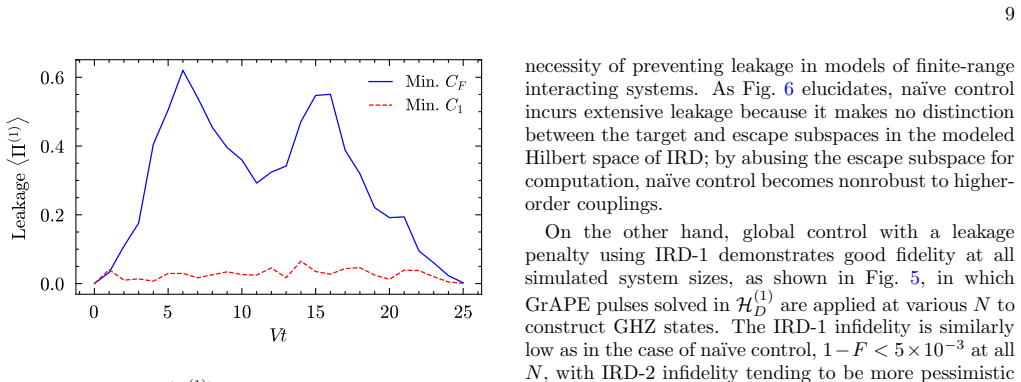
Collective control without leakage penalty The simplest control strategy uses the infidelity,C F = 1−F, as the cost-function. While this is well suited to problems where the Hilbert space is closed under control operators, in our problem this strategy is “na¨ ıve” because we perform control on a truncated Hilbert space. First- order irrep distillation,H (...
-
[2]
Like na¨ ıve control above, we consider a “global” control with collective Rabi rotations, generated by Ω(t) ˆJϕ(t)
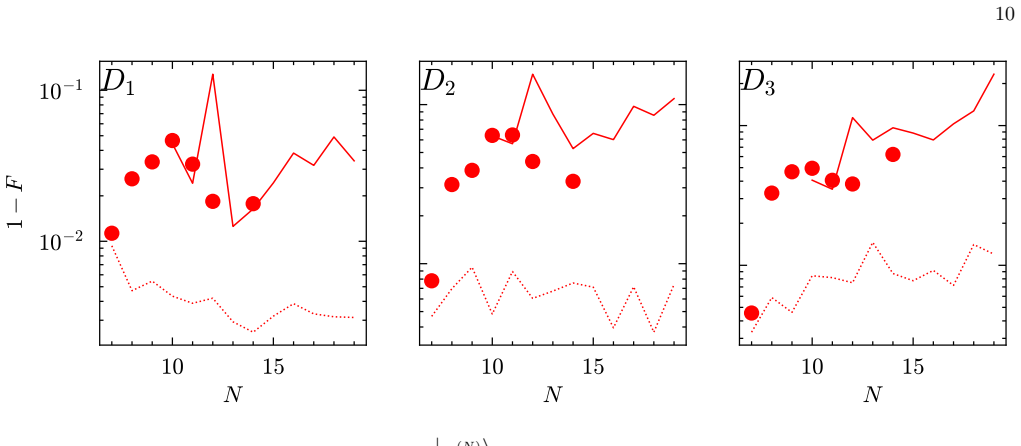
Collective control with leakage penalty To ensure simulated pulses also perform well when the truncated Hilbert space is restored to full dimensional- ity – that is, in the exact dynamics – we must build into the cost function a preference against populating es- cape subspaces. Like na¨ ıve control above, we consider a “global” control with collective Rab...
-
[3]
na¨ ıve control
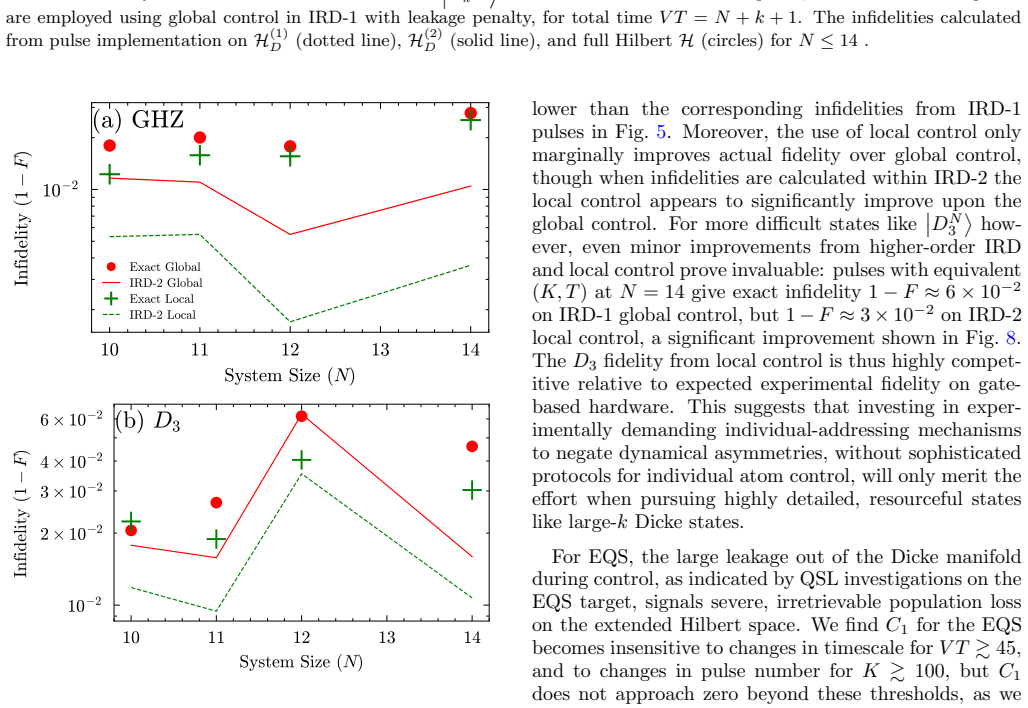
Local control with leakage penalty Global control provides limited options to actively re- claim population leaking into lower irreps, since the only permutation asymmetric term in the Hamiltonian is the interaction term, ˆHint. Thus, a control scheme that ac- tively pumps leaked populations back into the symmetric subspace should utilize local addressing...
-
[4]
Pannier-G¨ unther, A
I. Pannier-G¨ unther, A. K. Forbes, P. M. Poggi, and I. H. Deutsch, Long-range interacting many-body systems in the irrep basis, Phys. Rev. Res.7, 043056 (2025)
2025
-
[5]
R. H. Dicke, Coherence in spontaneous radiation pro- cesses, Phys. Rev.93, 99 (1954)
1954
-
[6]
P. Kirton, M. M. Roses, J. Keeling, and E. G. Dalla Torre, Introduction to the dicke model: From equilibrium to nonequilibrium, and vice versa (adv. quantum technol. 1-2/2019), Ad- vanced Quantum Technologies2, 1970013 (2019), https://advanced.onlinelibrary.wiley.com/doi/pdf/10.1002/qute.201970013
-
[7]
A. Sinatra, Spin-squeezed states for metrol- ogy, Applied Physics Letters120, 120501 (2022), https://pubs.aip.org/aip/apl/article- pdf/doi/10.1063/5.0084096/20034807/120501 1 - 5.0084096.pdf
-
[8]
Pezz` e, A
L. Pezz` e, A. Smerzi, M. K. Oberthaler, R. Schmied, and P. Treutlein, Quantum metrology with nonclassical states of atomic ensembles, Rev. Mod. Phys.90, 035005 (2018)
2018
-
[9]
Z. H. Saleem, M. Perlin, A. Shaji, and S. K. Gray, Achiev- ing the heisenberg limit with dicke states in noisy quan- tum metrology, Phys. Rev. A109, 052615 (2024)
2024
-
[10]
Zhang and L
Z. Zhang and L. M. Duan, Quantum metrology with dicke squeezed states, New Journal of Physics16, 103037 (2014)
2014
-
[11]
A. Z. Goldberg and D. F. V. James, Quantum-limited eu- ler angle measurements using anticoherent states, Phys. Rev. A98, 032113 (2018)
2018
-
[12]
A. Z. Goldberg, A. B. Klimov, M. Grassl, G. Leuchs, and L. L. S´ anchez-Soto, Extremal quantum states, AVS Quantum Science2, 044701 (2020), https://pubs.aip.org/avs/aqs/article- pdf/doi/10.1116/5.0025819/19738929/044701 1 on- line.pdf
-
[13]
Martin, S
J. Martin, S. Weigert, and O. Giraud, Optimal Detec- tion of Rotations about Unknown Axes by Coherent and Anticoherent States, Quantum4, 285 (2020)
2020
-
[14]
Z Goldberg, A
A. Z Goldberg, A. B Klimov, G. Leuchs, and L. L S´ anchez-Soto, Rotation sensing at the ultimate limit, Journal of Physics: Photonics3, 022008 (2021)
2021
-
[15]
Marconi, G
C. Marconi, G. M¨ uller-Rigat, J. Romero-Pallej` a, J. Tura, and A. Sanpera, Symmetric quantum states: a review of recent progress, Reports on Progress in Physics89, 024001 (2026)
2026
-
[16]
Y. Wang, Z. Hu, B. C. Sanders, and S. Kais, Qudits and high-dimensional quantum computing, Frontiers in PhysicsV olume 8 - 2020, 10.3389/fphy.2020.589504 (2020)
-
[17]
Z. Wang, R. W. Parker, E. Champion, and M. S. Blok, High-EJ /EC transmon qudits with up to 12 levels, Phys. Rev. Appl.23, 034046 (2025)
2025
-
[18]
C. W. Bauer, Z. Davoudi, A. B. Balantekin, T. Bhat- tacharya, M. Carena, W. A. de Jong, P. Draper, A. El-Khadra, N. Gemelke, M. Hanada, D. Kharzeev, H. Lamm, Y.-Y. Li, J. Liu, M. Lukin, Y. Meurice, C. Monroe, B. Nachman, G. Pagano, J. Preskill, E. Ri- naldi, A. Roggero, D. I. Santiago, M. J. Savage, I. Sid- diqi, G. Siopsis, D. Van Zanten, N. Wiebe, Y. Ya...
2023
-
[19]
C. W. Bauer, Z. Davoudi, N. Klco, and M. J. Savage, Quantum simulation of fundamental particles and forces, Nature Reviews Physics5, 420 (2023)
2023
-
[20]
Blatt and C
R. Blatt and C. F. Roos, Quantum simulations with trapped ions, Nature Physics8, 277 (2012)
2012
-
[21]
M. Meth, J. Zhang, J. F. Haase, C. Edmunds, L. Postler, A. J. Jena, A. Steiner, L. Dellantonio, R. Blatt, P. Zoller, et al., Simulating two-dimensional lattice gauge theories on a qudit quantum computer, Nature Physics21, 570 (2025)
2025
-
[22]
Esposito, F
C. Esposito, F. Di Colandrea, F. Hoch, G. Carvacho, F. Cardano, N. Spagnolo, L. Marrucci, and F. Sciarrino, Generation of high-dimensional qudit quantum states via two-dimensional quantum walks, Phys. Rev. Res.5, 043025 (2023)
2023
-
[23]
H. Yu, S. Sciara, M. Chemnitz, N. Montaut, B. Crockett, B. Fischer, R. Helsten, B. Wetzel, T. A. Goebel, R. G. Kr¨ amer,et al., Quantum key distribution implemented with d-level time-bin entangled photons, Nature Commu- nications16, 171 (2025)
2025
-
[24]
D. J. Spencer, A. Tanggara, T. Haug, D. Khu, and K. Bharti, Qudit low-density parity-check codes, Quan- tum10, 2023 (2026). 15
2023
-
[25]
Tavis and F
M. Tavis and F. W. Cummings, Exact solution for ann- molecule—radiation-field hamiltonian, Phys. Rev.170, 379 (1968)
1968
-
[26]
Brion, K
E. Brion, K. Mølmer, and M. Saffman, Quantum com- puting with collective ensembles of multilevel systems, Phys. Rev. Lett.99, 260501 (2007)
2007
-
[27]
Labuhn, D
H. Labuhn, D. Barredo, S. Ravets, S. De L´ es´ eleuc, T. Macr` ı, T. Lahaye, and A. Browaeys, Tunable two- dimensional arrays of single rydberg atoms for realizing quantum ising models, Nature534, 667 (2016)
2016
-
[28]
Zeiher, J.-y
J. Zeiher, J.-y. Choi, A. Rubio-Abadal, T. Pohl, R. van Bijnen, I. Bloch, and C. Gross, Coherent many-body spin dynamics in a long-range interacting ising chain, Phys. Rev. X7, 041063 (2017)
2017
-
[29]
Hollerith, K
S. Hollerith, K. Srakaew, D. Wei, A. Rubio-Abadal, D. Adler, P. Weckesser, A. Kruckenhauser, V. Walther, R. van Bijnen, J. Rui, C. Gross, I. Bloch, and J. Zeiher, Realizing distance-selective interactions in a rydberg- dressed atom array, Phys. Rev. Lett.128, 113602 (2022)
2022
-
[30]
B. Yan, S. A. Moses, B. Gadway, J. P. Covey, K. R. Hazzard, A. M. Rey, D. S. Jin, and J. Ye, Observation of dipolar spin-exchange interactions with lattice-confined polar molecules, Nature501, 521 (2013)
2013
-
[31]
Entanglement and spin-squeezing without infinite-range interactions
M. Foss-Feig, Z.-X. Gong, A. V. Gorshkov, and C. W. Clark, Entanglement and spin-squeezing without infinite- range interactions, arXiv preprint arXiv:1612.07805 (2016)
work page internal anchor Pith review Pith/arXiv arXiv 2016
-
[32]
Lerose, T
A. Lerose, T. Parolini, R. Fazio, D. A. Abanin, and S. Pappalardi, Theory of robust quantum many-body scars in long-range interacting systems, Phys. Rev. X15, 011020 (2025)
2025
-
[33]
Comparin, F
T. Comparin, F. Mezzacapo, and T. Roscilde, Ro- bust spin squeezing from the tower of states ofU(1)- symmetric spin hamiltonians, Physical Review A105, 022625 (2022)
2022
-
[34]
M. A. Perlin, C. Qu, and A. M. Rey, Spin squeezing with short-range spin-exchange interactions, Physical Review Letters125, 223401 (2020)
2020
-
[35]
J. T. Young, S. R. Muleady, M. A. Perlin, A. M. Kauf- man, and A. M. Rey, Enhancing spin squeezing us- ing soft-core interactions, Physical Review Research5, L012033 (2023)
2023
-
[36]
Block, B
M. Block, B. Ye, B. Roberts, G.-W. Chern, W. Wu, Z. Wang, L. Pollet, E. J. Davis, B. I. Halperin, and N. Y. Yao, Scalable spin squeezing from finite-temperature easy-plane magnetism, Nature Physics20, 1575 (2024)
2024
-
[37]
Roscilde, F
T. Roscilde, F. Caleca, A. Angelone, and F. Mezzacapo, Scalable spin squeezing from critical slowing down in short-range interacting systems, Physical Review Letters 133, 210401 (2024)
2024
-
[38]
Bornet, G
G. Bornet, G. Emperauger, C. Chen, B. Ye, M. Block, M. Bintz, J. A. Boyd, D. Barredo, T. Comparin, F. Mez- zacapo,et al., Scalable spin squeezing in a dipolar ryd- berg atom array, Nature621, 728 (2023)
2023
-
[39]
Lerose and S
A. Lerose and S. Pappalardi, Origin of the slow growth of entanglement entropy in long-range interacting spin systems, Phys. Rev. Res.2, 012041 (2020)
2020
-
[40]
Defenu, A
N. Defenu, A. Lerose, and S. Pappalardi, Out-of- equilibrium dynamics of quantum many-body systems with long-range interactions, Physics Reports1074, 1 (2024), out-of-equilibrium dynamics of quantum many- body systems with long-range interactions
2024
-
[41]
Mori, Prethermalization in the transverse-field ising chain with long-range interactions, Journal of Physics A: Mathematical and Theoretical52, 054001 (2019)
T. Mori, Prethermalization in the transverse-field ising chain with long-range interactions, Journal of Physics A: Mathematical and Theoretical52, 054001 (2019)
2019
-
[42]
Z. Zeng, G. Giudici, A. Senoo, A. Baumg¨ artner, A. M. Kaufman, and H. Pichler, Adiabatic echo protocols for robust quantum many-body state preparation, Phys. Rev. Lett.136, 120404 (2026)
2026
-
[43]
Ansel, E
Q. Ansel, E. Dionis, F. Arrouas, B. Peaudecerf, S. Gu´ erin, D. Gu´ ery-Odelin, and D. Sugny, Introduction to theoretical and experimental aspects of quantum op- timal control, Journal of Physics B: Atomic, Molecular and Optical Physics57, 133001 (2024)
2024
-
[44]
C. W. Duncan, P. M. Poggi, M. Bukov, N. T. Zinner, and S. Campbell, Taming quantum systems: a tutorial for us- ing shortcuts-to-adiabaticity, quantum optimal control, and reinforcement learning, PRX Quantum6, 040201 (2025)
2025
-
[45]
E. S. Carrera, H. Erbin, and G. Misguich, Preparing spin- squeezed states in rydberg atom arrays via quantum op- timal control, Phys. Rev. A112, 052615 (2025)
2025
- [46]
-
[47]
E. S. Carrera and G. Misguich, Random-state genera- tion and preparation complexity in rydberg atom arrays (2026), arXiv:2604.18457 [quant-ph]
work page internal anchor Pith review Pith/arXiv arXiv 2026
-
[48]
A. Muratori, V. M. Stojanovic, E. Cuestas, T. Calarco, and F. Motzoi,w- and dicke-state engineering using op- timal global control in nearest-neighbor coupled ring- shaped qubit arrays (2025), arXiv:2512.19545 [quant-ph]
-
[49]
Roscilde, T
T. Roscilde, T. Comparin, and F. Mezzacapo, Rotor/spin-wave theory for quantum spin models with u(1) symmetry, Phys. Rev. B108, 155130 (2023)
2023
-
[50]
Khaneja, T
N. Khaneja, T. Reiss, C. Kehlet, T. Schulte-Herbr¨ uggen, and S. J. Glaser, Optimal control of coupled spin dy- namics: design of nmr pulse sequences by gradient as- cent algorithms, Journal of magnetic resonance172, 296 (2005)
2005
-
[51]
Motzoi, J
F. Motzoi, J. M. Gambetta, S. T. Merkel, and F. K. Wil- helm, Optimal control methods for rapidly time-varying hamiltonians, Physical Review A—Atomic, Molecular, and Optical Physics84, 022307 (2011)
2011
-
[52]
M. A. Perlin, C. Qu, and A. M. Rey, Spin squeezing with short-range spin-exchange interactions, Phys. Rev. Lett. 125, 223401 (2020)
2020
-
[53]
Kuriyattil, P
S. Kuriyattil, P. M. Poggi, J. D. Pritchard, J. Kombe, and A. J. Daley, Entangled states from sparsely coupled spins for metrology with neutral atoms, Phys. Rev. Lett. 134, 240801 (2025)
2025
-
[54]
Kitagawa and M
M. Kitagawa and M. Ueda, Squeezed spin states, Physical Review A47, 5138 (1993)
1993
-
[55]
Omanakuttan, A
S. Omanakuttan, A. Mitra, M. J. Martin, and I. H. Deutsch, Quantum optimal control of ten-level nuclear spin qudits in 87Sr, Phys. Rev. A104, L060401 (2021)
2021
-
[56]
Chaudhury, S
S. Chaudhury, S. Merkel, T. Herr, A. Silberfarb, I. H. Deutsch, and P. S. Jessen, Quantum control of the hy- perfine spin of a cs atom ensemble, Phys. Rev. Lett.99, 163002 (2007)
2007
-
[57]
Tindall, M
J. Tindall, M. Fishman, E. M. Stoudenmire, and D. Sels, Efficient tensor network simulation of ibm’s eagle kicked ising experiment, PRX Quantum5, 010308 (2024)
2024
-
[58]
Dynamics of disordered quantum systems with two- and three-dimensional tensor networks
J. Tindall, A. Mello, M. Fishman, M. Stoudenmire, and D. Sels, Dynamics of disordered quantum systems with two- and three-dimensional tensor networks (2025), arXiv:2503.05693 [quant-ph]. 16
work page internal anchor Pith review Pith/arXiv arXiv 2025
-
[59]
S. Midha, G. M. Sommers, J. Tindall, and D. A. Abanin, Belief propagation and tensor network expansions for many-body quantum systems: Rigorous results and fun- damental limits (2026), arXiv:2604.03228 [quant-ph]
work page internal anchor Pith review Pith/arXiv arXiv 2026
-
[60]
R¨ uckriegel, A
A. R¨ uckriegel, A. Kreisel, and P. Kopietz, Time- dependent spin-wave theory, Phys. Rev. B85, 054422 (2012)
2012
-
[61]
Wiedmann and D
M. Wiedmann and D. Burgarth, Quantum speed limits from symmetries in quantum control, Journal of Physics A: Mathematical and Theoretical59, 065301 (2026)
2026
-
[62]
D. Leibfried, M. D. Barrett, T. Schaetz, J. Britton, J. Chiaverini, W. M. Itano, J. D. Jost, C. Langer, and D. J. Wineland, Toward heisenberg-limited spectroscopy with multipar- ticle entangled states, Science304, 1476 (2004), https://www.science.org/doi/pdf/10.1126/science.1097576
-
[63]
J. J. . Bollinger, W. M. Itano, D. J. Wineland, and D. J. Heinzen, Optimal frequency measurements with maxi- mally correlated states, Phys. Rev. A54, R4649 (1996)
1996
-
[64]
Bj¨ ork, A
G. Bj¨ ork, A. B. Klimov, P. de la Hoz, M. Grassl, G. Leuchs, and L. L. S´ anchez-Soto, Extremal quantum states and their majorana constellations, Phys. Rev. A 92, 031801 (2015)
2015
-
[65]
Martin, Library of spin anticoherent states: John mar- tin (2024)
J. Martin, Library of spin anticoherent states: John mar- tin (2024)
2024
-
[66]
S. J. Evered, D. Bluvstein, M. Kalinowski, S. Ebadi, T. Manovitz, H. Zhou, S. H. Li, A. A. Geim, T. T. Wang, N. Maskara, H. Levine, G. Semeghini, M. Greiner, V. Vuleti´ c, and M. D. Lukin, High-fidelity parallel entan- gling gates on a neutral-atom quantum computer, Nature 622, 268 (2023)
2023
-
[67]
R. B.-S. Tsai, X. Sun, A. L. Shaw, R. Finkelstein, and M. Endres, Benchmarking and fidelity response theory of high-fidelity rydberg entangling gates, PRX Quantum6, 010331 (2025)
2025
-
[68]
Bartschi and S
A. Bartschi and S. Eidenbenz, Short-depth circuits for dicke state preparation, in2022 IEEE International Con- ference on Quantum Computing and Engineering (QCE) (IEEE, 2022) p. 87–96
2022
-
[69]
J. Yu, S. R. Muleady, Y.-X. Wang, N. Schine, A. V. Gor- shkov, and A. M. Childs, Efficient preparation of dicke states, Phys. Rev. Lett.136, 030601 (2026)
2026
-
[70]
Denis, C
J. Denis, C. Read, and J. Martin, Coherent generation and protection of anticoherent spin states, SciPost Phys. Core9, 001 (2026)
2026
- [71]
- [72]
-
[73]
ˇSibali´ c, J
N. ˇSibali´ c, J. Pritchard, C. Adams, and K. Weatherill, Arc: An open-source library for calculating properties of alkali rydberg atoms, Computer Physics Communica- tions220, 319 (2017)
2017
-
[74]
Machnes, E
S. Machnes, E. Ass´ emat, D. Tannor, and F. K. Wilhelm, Tunable, flexible, and efficient optimization of control pulses for practical qubits, Phys. Rev. Lett.120, 150401 (2018). 101 102 103 System Size (N) 100 Laplacian Gap (∆) Triangular Dipole-Dipole Graph FIG. 13. Laplacian gap ∆ for the triangular lattice, dipole- dipole interaction graphV ij, as a fu...
2018
-
[75]
Lerose, J
A. Lerose, J. Marino, A. Gambassi, and A. Silva, Prether- mal quantum many-body kapitza phases of periodically driven spin systems, Phys. Rev. B100, 104306 (2019)
2019
-
[76]
M. H. Mu˜ noz Arias, I. H. Deutsch, and P. M. Poggi, Phase-space geometry and optimal state preparation in quantum metrology with collective spins, PRX Quantum 4, 020314 (2023). Appendix A: Laplacian Gap Decay The Laplacian matrix describes the connectedness of the interaction graph, Λij = ¯Viδij −V ij,(A1) ¯Vi = X j Vij,(A2) and is positive semidefinite:...
2023
discussion (0)
Sign in with ORCID, Apple, or X to comment. Anyone can read and Pith papers without signing in.