γ-CounterBoost: Optimizing response time tails using job type information only
Pith reviewed 2026-06-28 11:28 UTC · model grok-4.3
The pith
The γ-CounterBoost policy minimizes the tail of the response time distribution among Contextual CounterBoost policies using only job type counts.
A machine-rendered reading of the paper's core claim, the machinery that carries it, and where it could break.
Core claim
The γ-CounterBoost policy minimizes the tail in an even broader class of scheduling policies called Contextual CounterBoost policies. The policy is defined for the partial information setting with d job types and does not use arrival times, relying solely on job type counts.
What carries the argument
The γ-CounterBoost policy, a scheduling rule that uses boosted counters based on job types to decide which job to serve next without reference to arrival times.
Load-bearing premise
The queue has light-tailed service times and the scheduler is limited to policies that use only job type counts without arrival times.
What would settle it
Run simulations of an M/G/1 queue with exponential or other light-tailed service distributions and multiple job types, then check if γ-CounterBoost yields a smaller tail probability than alternative Contextual CounterBoost policies for large response time thresholds.
Figures

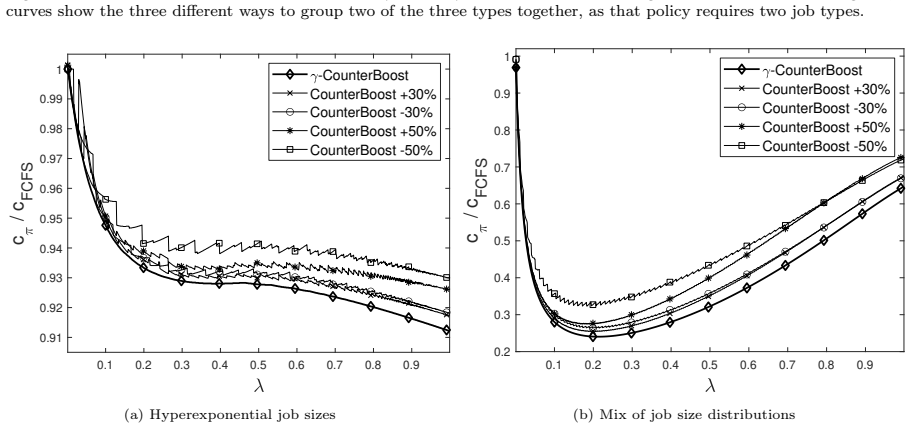

read the original abstract
In a recent paper the $\gamma$-Boost scheduling policy was shown to minimize the tail of the response time distribution in a light-tailed M/G/1-queue. This policy schedules jobs using a boosted arrival time, defined as the arrival time of a job minus its boost, where the boost of a job depends on its exact job size. The $\gamma$-Boost policy can also be used when only partial job size information is available, such as the type of an incoming job. In such case the boost $b_i$ of a job depends solely on its type $i$ and $\gamma$-Boost was shown to optimize the tail among all boost policies, where a boost policy is fully determined by the $b_i$ values. In the partial information setting $\gamma$-Boost relies on two types of information: job types and arrival times. This paper focuses on the problem of minimizing the tail in a light-tailed M/G/1-queue in the partial job size information setting when the scheduler only makes use of the job types and {\it does not exploit arrival times}. Prior work showed that in case of $2$ job types the so-called Nudge-$M$ policy minimizes the tail in a large class of scheduling policies. In this paper we introduce the $\gamma$-CounterBoost policy in the partial information setting with $d \geq 2$ job types and prove that it minimizes the tail in an even broader class of scheduling policies called Contextual CounterBoost policies. The $\gamma$-CounterBoost policy reduces to the Nudge-$M$ policy in case of $d=2$ job types.
Editorial analysis
A structured set of objections, weighed in public.
Referee Report
Summary. The paper introduces the γ-CounterBoost policy for a light-tailed M/G/1 queue in the partial-information setting (d ≥ 2 job types known, arrival times unused). It proves that γ-CounterBoost minimizes response-time tail asymptotics inside the explicitly defined class of Contextual CounterBoost policies and shows that the policy coincides exactly with the known Nudge-M policy when d = 2.
Significance. If the proof is correct, the result supplies a clean generalization of the d = 2 Nudge-M optimality result to an arbitrary number of types while remaining inside a well-delimited policy class that never uses arrival epochs. The reduction to Nudge-M supplies an immediate consistency check. The work therefore strengthens the theoretical toolkit for tail-optimal scheduling under type-only information.
minor comments (3)
- §2 (model section): the precise definition of the Contextual CounterBoost class should be stated as a numbered definition rather than inline prose so that the optimality statement can cite it directly.
- The proof sketch in §4 relies on an inductive argument over the number of types; a short appendix containing the base case (d = 2) written out in full would make the induction step easier to follow.
- Notation: the symbol γ is overloaded between the boost parameter and the policy name; a brief clarifying sentence at first use would remove ambiguity.
Simulated Author's Rebuttal
We thank the referee for the positive summary, the recognition of the generalization from the d=2 Nudge-M result, and the recommendation of minor revision. No specific major comments appear in the report.
Circularity Check
No significant circularity; mathematical proof within explicitly defined policy class
full rationale
The paper's central result is a proof that γ-CounterBoost minimizes response-time tail asymptotics inside the explicitly delimited class of Contextual CounterBoost policies (which use only job-type counts). The class is defined independently of the policy being proved optimal, the reduction to the known Nudge-M policy for d=2 is presented as a consistency check rather than a derivation step, and no parameters are fitted to data then relabeled as predictions. Prior citations supply context but are not load-bearing for the new proof. The derivation chain is therefore self-contained and non-circular.
Axiom & Free-Parameter Ledger
Reference graph
Works this paper leans on
-
[1]
J. C. Gittins, K. D. Glazebrook, and R. R. Weber,Multi-Armed Bandit Allocation Indices, 2nd ed. Chichester, UK: John Wiley & Sons, 2011. [Online]. Available: https://onlinelibrary.wiley.com/doi/ book/10.1002/9780470980033
-
[2]
On the Gittins index in the M/G/1 queue,
S. Aalto, U. Ayesta, and R. Righter, “On the Gittins index in the M/G/1 queue,”Queueing Systems, vol. 63, no. 1–4, pp. 437–458, 2009. [Online]. Available: https://doi.org/10.1007/s11134-009-9141-x
-
[3]
The Gittins policy in the M/G/1 queue,
Z. Scully and M. Harchol-Balter, “The Gittins policy in the M/G/1 queue,” inProceedings of the 19th International Symposium on Modeling and Optimization in Mobile, Ad hoc, and Wireless Networks (WiOpt). IEEE, 2021. [Online]. Available: https://doi.org/10.23919/WiOpt52881.2021.9586214
-
[4]
The impact of the service discipline on delay asymptotics,
S. Borst, O. Boxma, R. Núñez-Queija, and A. Zwart, “The impact of the service discipline on delay asymptotics,”Performance Evaluation, vol. 54, no. 2, pp. 175–206, 2003
2003
-
[5]
O. Boxma and B. Zwart, “Tails in scheduling,”SIGMETRICS Perform. Eval. Rev., vol. 34, no. 4, p. 13–20, mar 2007. [Online]. Available: https://doi.org/10.1145/1243401.1243406
-
[6]
Strongly tail-optimal scheduling in the light-tailed M/G/1,
G. Yu and Z. Scully, “Strongly tail-optimal scheduling in the light-tailed M/G/1,”SIGMETRICS Perform. Eval. Rev., vol. 52, no. 1, p. 5–6, Jun. 2024. [Online]. Available: https: //doi.org/10.1145/3673660.3655084
-
[7]
Exponential approximations for tail probabilities in queues, i: Waiting times
J. Abate, L. Choudhury, and W. Whitt, “Exponential approximations for tail probabilities in queues, i: Waiting times.”Operations Research, vol. 43, pp. 885–901, 1995
1995
-
[8]
Is tail-optimal scheduling possible?
A. Wierman and B. Zwart, “Is tail-optimal scheduling possible?”Operations Research, vol. 60, no. 5, pp. 1249–1257, 2012. [Online]. Available: http://www.jstor.org/stable/23323693
arXiv 2012
-
[9]
Nudge: Stochastically improving upon FCFS,
I. Grosof, K. Yang, Z. Scully, and M. Harchol-Balter, “Nudge: Stochastically improving upon FCFS,”Proc. ACM Meas. Anal. Comput. Syst., vol. 5, no. 2, jun 2021. [Online]. Available: https://doi.org/10.1145/3460088
-
[10]
On the stochastic and asymptotic improvement of first-come first-served and nudge scheduling,
B. Van Houdt, “On the stochastic and asymptotic improvement of first-come first-served and nudge scheduling,”Proc. ACM Meas. Anal. Comput. Syst., vol. 6, no. 3, pp. 1–22, dec 2022. [Online]. Available: https://doi.org/10.1145/3570610
-
[11]
Tail optimality and performance analysis of the Nudge- M scheduling algorithm,
N. Charlet and B. Van Houdt, “Tail optimality and performance analysis of the Nudge- M scheduling algorithm,”arXiv preprint arXiv:2403.06588, 2024. [Online]. Available: https: //arxiv.org/abs/2403.06588
Pith/arXiv arXiv 2024
-
[12]
Latouche and V
G. Latouche and V. Ramaswami,Introduction to Matrix Analytic Methods and stochastic modeling. Philadelphia: SIAM, 1999
1999
-
[13]
Harchol-Balter,Performance Modeling and Design of Computer Systems: Queueing Theory in Action
M. Harchol-Balter,Performance Modeling and Design of Computer Systems: Queueing Theory in Action. New York, NY, USA: Cambridge University Press, 2013. [Online]. Available: https://doi.org/10.1017/CBO9781139226424
-
[14]
J. F. C. Kingman, “On queues in heavy traffic,”Journal of the Royal Statistical Society. Series B (Methodological), vol. 24, no. 2, pp. 383–392, 1962. [Online]. Available: http: //www.jstor.org/stable/2984229 21
arXiv 1962
discussion (0)
Sign in with ORCID, Apple, or X to comment. Anyone can read and Pith papers without signing in.