Regression on Regression: Mapping Data-Driven Binary Black Hole Merger Rate Fits to Progenitor Histories
Pith reviewed 2026-06-28 13:05 UTC · model grok-4.3
The pith
The log-space slope of the progenitor formation rate for binary black holes is about 5.3 times steeper than the star formation rate between redshift 0.1 and 1.0.
A machine-rendered reading of the paper's core claim, the machinery that carries it, and where it could break.
Core claim
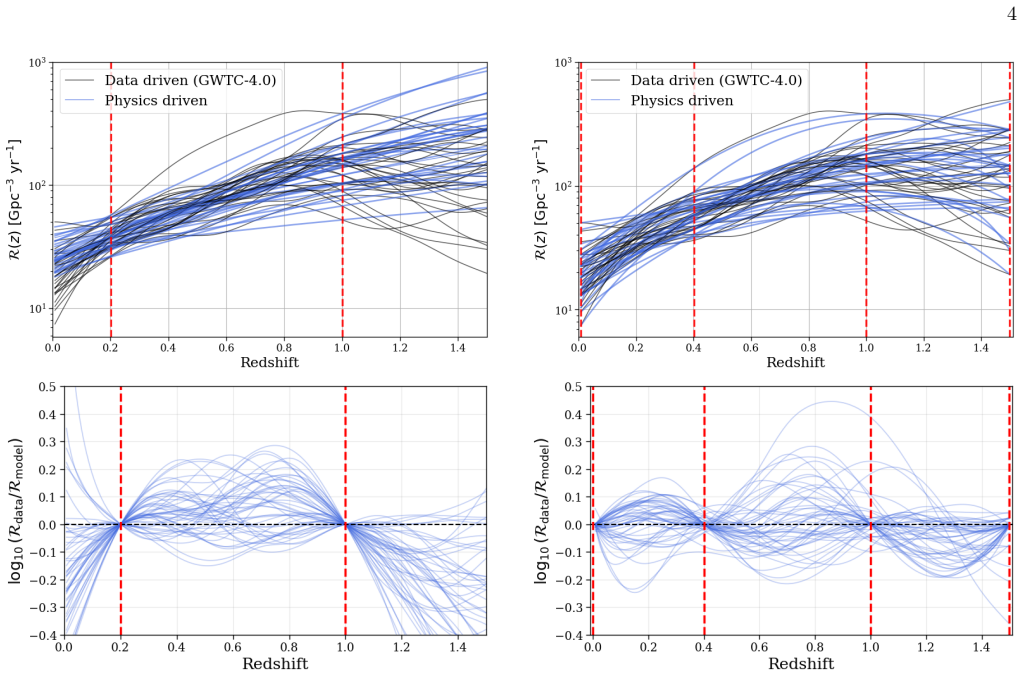
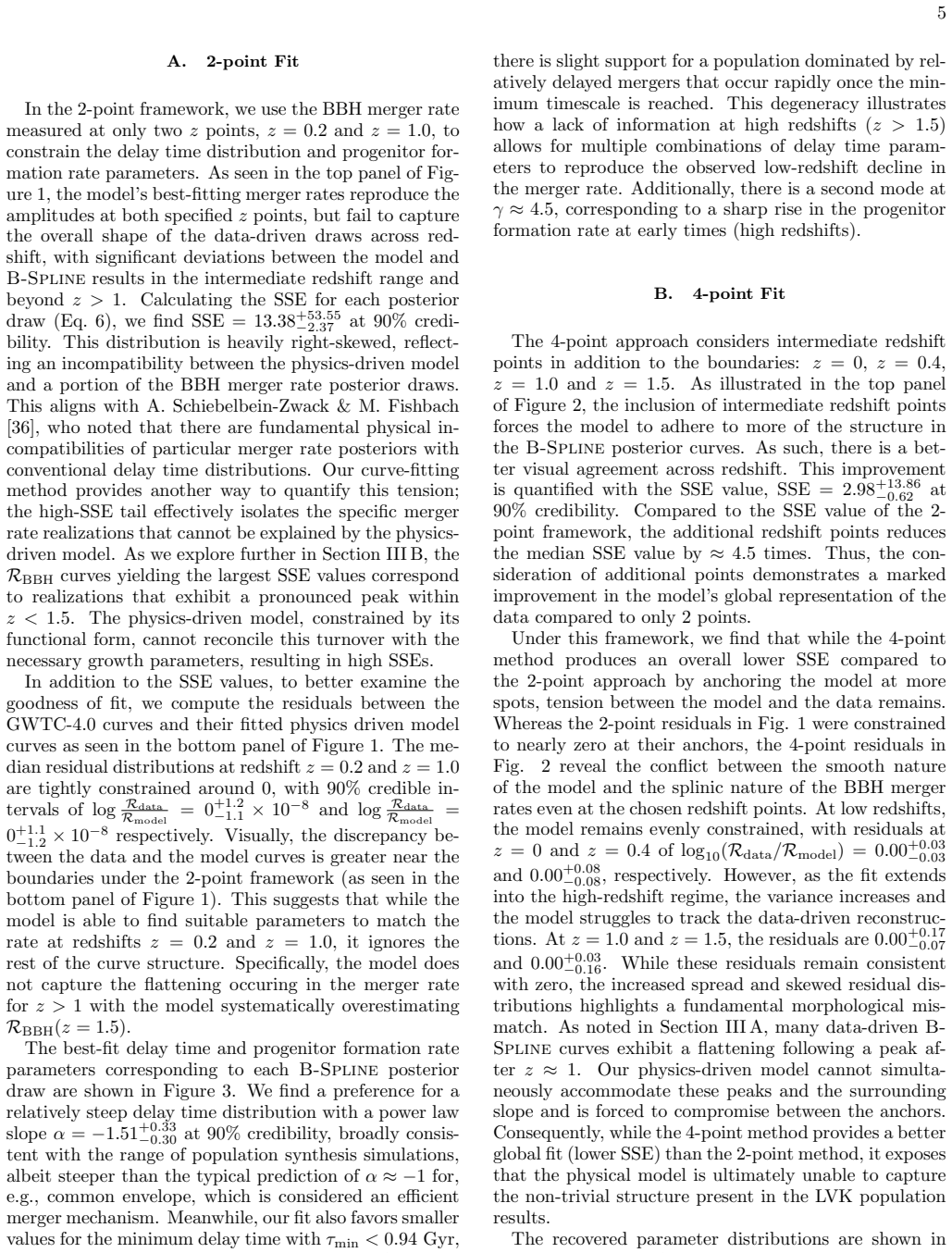
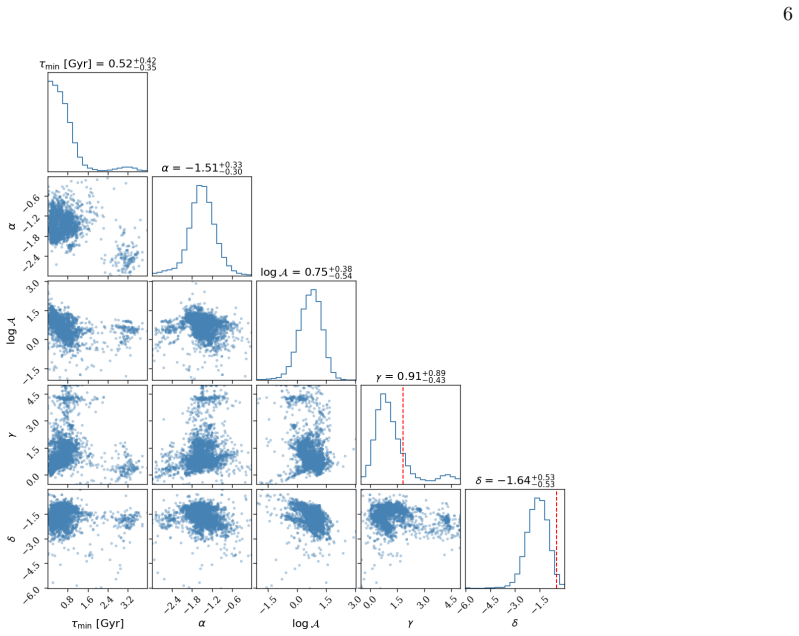
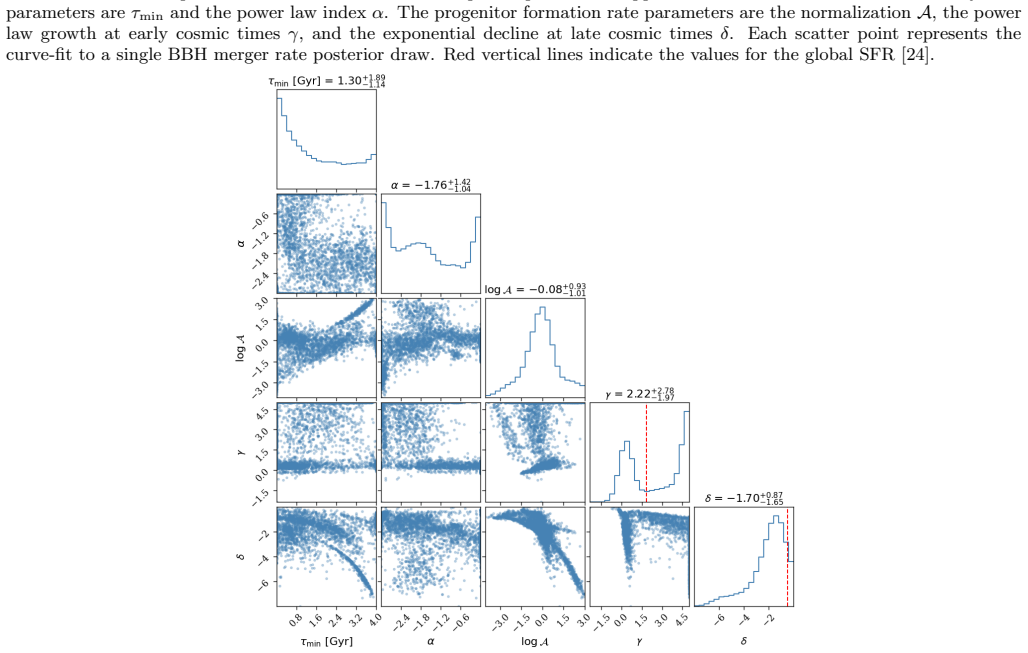
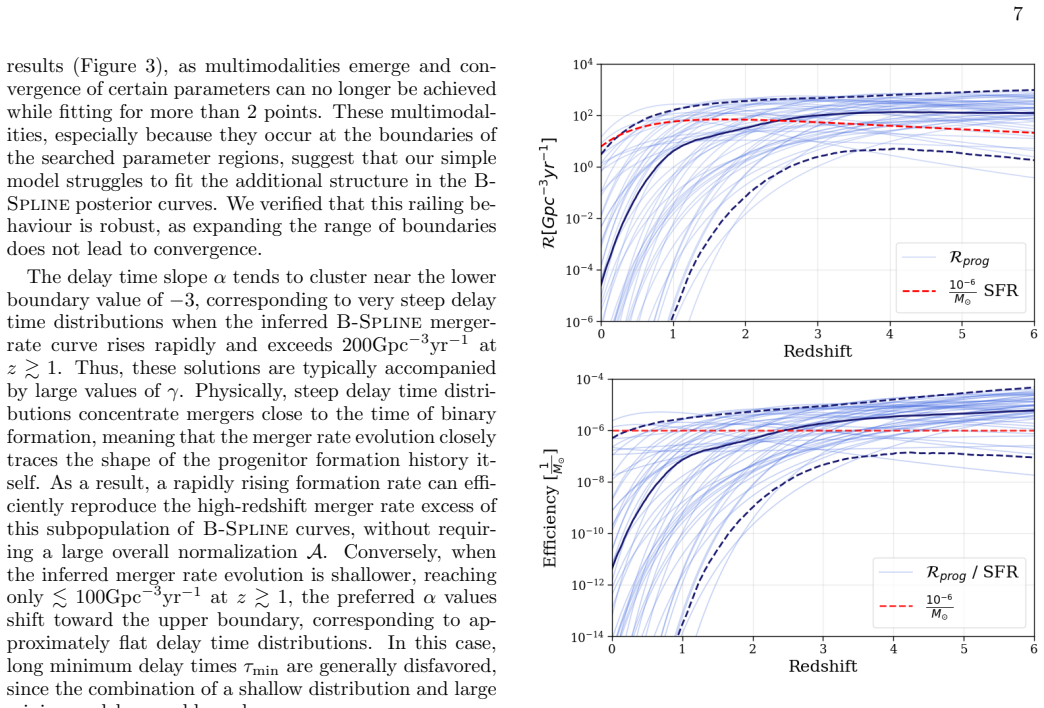
The paper maps the B-Spline merger-rate posteriors from GWTC-4 to a physical model consisting of a power-law delay-time distribution (minimum time τ_min and index α) and a three-parameter progenitor formation rate (normalization A, early growth γ, late decay δ). Fitting by minimizing sum-squared error at chosen redshift anchors shows that increasing the number of anchors from two to four reduces median SSE by a factor of approximately 4.5. The resulting progenitor rate has a log-space slope 5.3 times steeper than the star formation rate between z=0.1 and z=1.0, yet the model still fails to pass through all four anchors, exposing structural misspecification.
What carries the argument
The regression-on-regression framework that minimizes sum-squared residuals between a parameterized progenitor-plus-delay model and the B-Spline merger-rate curves at selected redshift anchors.
If this is right
- The progenitor formation rate evolves more steeply than the global star formation rate at low redshifts, favoring low-metallicity environments.
- A simple power-law delay time plus three-parameter progenitor model cannot reproduce the full shape of the B-Spline posteriors.
- Using four redshift anchors improves fit quality by a factor of 4.5 in sum-squared error relative to two anchors.
- The low-redshift shape of the progenitor rate remains robust even when high-redshift uncertainties are large.
Where Pith is reading between the lines
- The same mapping technique could be applied to other data-driven merger-rate models to test alternative physical assumptions without repeating full population inference.
- If the steeper low-redshift evolution persists in future catalogs, binary black hole formation must be more metallicity-sensitive than simple scalings with total star formation rate allow.
- Higher-redshift gravitational-wave measurements could distinguish whether the current model misspecification is an artifact of limited data or a genuine requirement for more complex progenitor histories.
Load-bearing premise
The chosen functional forms (power-law delay time and the three-parameter progenitor rate) are flexible enough to represent the true rates that produced the B-Spline posteriors.
What would settle it
Observing that the best-fit progenitor rate, when convolved with the delay-time distribution, produces merger rates whose point-by-point residuals to the B-Spline posterior exceed the reported posterior width at the anchor redshifts would falsify the extracted slope and model adequacy.
Figures
read the original abstract
The binary black hole (BBH) merger rate is governed by the progenitor formation rate and the distribution of delay-times between formation and merger, but these functions remain poorly constrained. We introduce a framework that maps the parameters of physics-driven models directly onto existing data-driven fits of the BBH merger rate. This ``regression on regression'' approach enables physical interpretation of flexible population models without the computational burden of reanalyzing the underlying gravitational-wave event data. Applying this method to the \textsc{B-Spline} merger-rate posteriors from the Fourth Gravitational-Wave Transient Catalog, we fit the minimum delay time ($\tau_{\text{min}}$), delay-time power-law index ($\alpha$), and progenitor formation parameters controlling the normalization ($\mathcal{A}$), early-time growth ($\gamma$), and late-time decay ($\delta$). Increasing the number of anchoring redshift points from two to four reduces the median sum-squared error (SSE) by a factor of $\approx 4.5$. However, residuals reveal that the physical model does not pass through all four anchors, exposing model misspecification and demonstrating a key strength of the framework: unlike standard inference methods, which preferentially weight compatible curves and mask underlying tensions, our approach exposes BBH posteriors irreconcilable with the model. Despite uncertainties at $z\gtrsim1$, the shape of the progenitor formation rate at low-$z$ is robust and evolves more steeply than the global star formation rate (SFR), supporting a preference for low metallicity environments. Specifically, the log-space slope of the progenitor rate is $\approx 5.3$ times steeper than the SFR between $z=0.1$ and $z=1.0$. Ultimately, a more complex phenomenological model is required to match the \textsc{B-Spline} merger rates.
Editorial analysis
A structured set of objections, weighed in public.
Referee Report
Summary. The paper introduces a 'regression on regression' framework to map the parameters of a 5-parameter physics-driven model (power-law delay-time distribution with τ_min and α, plus progenitor formation rate controlled by normalization A, early growth γ, and late decay δ) onto existing B-Spline posteriors for the BBH merger rate from GWTC-4. Fitting via anchoring points at selected redshifts shows that increasing anchors from 2 to 4 reduces median SSE by ~4.5 but leaves systematic residuals indicating model misspecification. The low-redshift (z=0.1 to 1.0) shape of the progenitor rate is reported as robust and ~5.3 times steeper in log-space than the SFR, implying a preference for low-metallicity environments, with the conclusion that more complex phenomenological models are required.
Significance. If the low-z robustness claim holds under the acknowledged misspecification, the work provides a computationally efficient way to extract physical parameters from flexible data-driven merger-rate fits and demonstrates a method that can expose tensions masked by standard inference. The explicit reporting of residuals and the call for more complex models are strengths, as is the focus on falsifiable mapping rather than full re-inference.
major comments (2)
- [Abstract] Abstract: The central quantitative claim that the log-space slope of the progenitor rate is ≈5.3 times steeper than the SFR between z=0.1 and z=1.0 is extracted from the best-fit γ and δ of the assumed functional form. However, the same abstract reports that even with four anchoring points the model leaves residuals and does not pass through all anchors, directly indicating that the parametric family is misspecified; this undermines that the reported factor reflects the underlying B-Spline posteriors rather than an artifact of the chosen form.
- [Model parameters and residuals paragraph] Model parameters and residuals paragraph: The robustness statement for the low-z shape does not include a quantitative test (e.g., variation of the extracted slope under alternate parametrizations of the progenitor rate or different choices of anchoring points beyond the reported 2-to-4 increase) that would show whether the 5.3 factor is stable when the functional family is altered, given the explicit misspecification flag.
minor comments (1)
- The description of how the regression is performed (choice of loss function, weighting of B-Spline posterior samples, and exact definition of anchoring points) could be expanded for reproducibility.
Simulated Author's Rebuttal
We thank the referee for their insightful comments on our manuscript. We address each major comment below and outline the revisions we will make to improve the clarity and robustness of our claims regarding the low-redshift progenitor formation rate.
read point-by-point responses
-
Referee: The central quantitative claim that the log-space slope of the progenitor rate is ≈5.3 times steeper than the SFR between z=0.1 and z=1.0 is extracted from the best-fit γ and δ of the assumed functional form. However, the same abstract reports that even with four anchoring points the model leaves residuals and does not pass through all anchors, directly indicating that the parametric family is misspecified; this undermines that the reported factor reflects the underlying B-Spline posteriors rather than an artifact of the chosen form.
Authors: We agree that the reported 5.3 factor is conditional on the assumed functional form of the progenitor rate, and the presence of residuals with four anchors indicates that this form is misspecified. The abstract already highlights this misspecification as a strength of the framework for exposing tensions. The low-z slope is determined by the parameters that best fit the anchoring points in that regime. To address the concern, we will revise the abstract to more explicitly state that the factor is derived from the parametric model fit and is subject to the acknowledged limitations of the model family. revision: yes
-
Referee: The robustness statement for the low-z shape does not include a quantitative test (e.g., variation of the extracted slope under alternate parametrizations of the progenitor rate or different choices of anchoring points beyond the reported 2-to-4 increase) that would show whether the 5.3 factor is stable when the functional family is altered, given the explicit misspecification flag.
Authors: The current manuscript demonstrates robustness through the consistency of low-z parameters when increasing from two to four anchors. However, we acknowledge that additional tests with alternate parametrizations would provide stronger evidence. We will add such quantitative tests in the revised version, including the variation of the extracted slope under different functional forms for the progenitor rate, to confirm the stability of the low-z behavior. revision: yes
Circularity Check
No circularity: regression of parametric model to independent external B-Spline posteriors
full rationale
The paper describes a deliberate regression framework that fits a 5-parameter physical model (power-law DTD with τ_min and α; progenitor rate with A, γ, δ) to the pre-existing B-Spline merger-rate posteriors from GWTC-4. The reported 5.3× slope factor is read off the best-fit parameters of this regression, not supplied as input. No self-citation chains, self-definitional equations, or fitted-input-called-prediction patterns appear. The text explicitly flags model misspecification via residuals, confirming the procedure is falsifiable against the external data rather than tautological. This is a standard mapping exercise whose central quantitative claim remains independent of its own outputs.
Axiom & Free-Parameter Ledger
free parameters (5)
- τ_min
- α
- A
- γ
- δ
axioms (2)
- domain assumption Delay-time distribution follows a power-law form with minimum τ_min and index α.
- domain assumption Progenitor formation rate follows a specific functional form controlled by normalization A, early growth γ, and late decay δ.
Reference graph
Works this paper leans on
-
[1]
In 3 their approach, a data-driven or phenomenological model is first fit to the gravitational wave data to estimate RBBH(z)
of fitting the delay time distribution and formation rate parameters by using previous fits to the BBH merger rate inferred at two redshift points,z= 0 andz= 1. In 3 their approach, a data-driven or phenomenological model is first fit to the gravitational wave data to estimate RBBH(z). Rather than using the posterior on the merger rate at all redshift poi...
-
[2]
This method was later applied to GWTC-3.0 by Refs
isolate the joint posterior onR BBH(z= 0) and RBBH(z= 1), and use this to derive an approximate like- lihood from which to sample the delay time distribution and formation rate parameters of interest. This method was later applied to GWTC-3.0 by Refs. [18, 35, 41, 45], albeit with varied details on the definition of the progen- itor formation rate. For ex...
2023
-
[3]
P., Abbott, R., Abbott, T
Abbott, B. P., Abbott, R., Abbott, T. D., et al. 2016, Observation of Gravitational Waves from a Binary Black Hole Merger, Phys. Rev. Lett., 116, 061102, doi:10. 1103/PhysRevLett.116.061102
2016
-
[4]
Acernese, F., Agathos, M., Agatsuma, K., et al. 2015, Advanced Virgo: a second-generation interferometric gravitational wave detector, Classical and Quantum Gravity, 32, 024001, doi:10.1088/0264-9381/32/2/ 024001
-
[5]
2021, PTEP, 2021, 05A101, doi: 10.1093/ptep/ptaa125
Akutsu, T., Ando, M., Arai, K., et al. 2021, Overview of KAGRA: Detector design and construction history, Progress of Theoretical and Experimental Physics, 2021, 05A101, doi:10.1093/ptep/ptaa125
-
[6]
Belczynski, K., Dominik, M., Bulik, T., et al. 2010, The Effect of Metallicity on the Detection Prospects for Grav- itational Waves, The Astrophysical Journal Letters, 715, L138, doi:10.1088/2041-8205/715/2/L138
-
[7]
Belczynski, K., Ryu, T., Perna, R., et al. 2017, On the likelihood of detecting gravitational waves from Popula- tion III compact object binaries, Mon. Not. R. Astron. Soc., 471, 4702, doi:10.1093/mnras/stx1759
-
[8]
Boesky, A., Broekgaarden, F. S., & Berger, E. 2024, The Binary Black Hole Merger Rate Deviates From the Cos- mic Star Formation Rate: A Tug of War Between Metal- licity and Delay Times, arXiv.http://arxiv.org/abs/ 2405.01623
arXiv 2024
-
[9]
S., Berger, E., Stevenson, S., et al
Broekgaarden, F. S., Berger, E., Stevenson, S., et al. 2022, Impact of massive binary star and cosmic evolution on gravitational wave observations - II. Double compact object rates and properties, Mon. Not. R. Astron. Soc., 516, 5737, doi:10.1093/mnras/stac1677
-
[10]
Callister, T. A., & Farr, W. M. 2024, Parameter-Free Tour of the Binary Black Hole Population, Physical Re- view X, 14, 021005, doi:10.1103/PhysRevX.14.021005
-
[11]
Chatterjee, C. 2026, Interpretable Analytic Formulae for GWTC-4 Binary Black Hole Population Properties via Symbolic Regression, arXiv e-prints, arXiv:2604.20941. https://arxiv.org/abs/2604.20941
Pith/arXiv arXiv 2026
-
[12]
Chru´ sli´ nska, M. 2022, Chemical evolution of the Universe and its consequences for gravitational-wave astrophysics, https://arxiv.org/abs/2206.10622
arXiv 2022
-
[13]
2020, The effect of the environment-dependent IMF on the formation and metallicities of stars over the cosmic history, Astronomy & Astrophysics, 636, A10, doi:10
Chru´ sli´ nska, M., Jeˇ r´ abkov´ a, T., Nelemans, G., & Yan, Z. 2020, The effect of the environment-dependent IMF on the formation and metallicities of stars over the cosmic history, Astronomy & Astrophysics, 636, A10, doi:10. 1051/0004-6361/202037688
2020
-
[14]
S., Collaboration, T
Collaboration, L. S., Collaboration, T. V., & Collabo- ration, T. K. 2025, GWTC-4.0: Population Properties of Merging Compact Binaries, Zenodo, doi:10.5281/ zenodo.16911563
2025
-
[15]
2012, DOU- BLE COMPACT OBJECTS
Dominik, M., Belczynski, K., Fryer, C., et al. 2012, DOU- BLE COMPACT OBJECTS. I. THE SIGNIFICANCE OF THE COMMON ENVELOPE ON MERGER RATES, The Astrophysical Journal, 759, 52, doi:10. 1088/0004-637X/759/1/52
2012
-
[16]
Edelman, B., Farr, B., & Doctor, Z. 2023, Cover Your Basis: Comprehensive Data-driven Characterization of the Binary Black Hole Population, Astrophys. J., 946, 16, doi:10.3847/1538-4357/acb5ed
-
[17]
M., Gerosa, D., Santini, A., et al
Fabbri, C. M., Gerosa, D., Santini, A., et al. 2025, Recon- structing parametric gravitational-wave population fits from nonparametric results without refitting the data, Phys. Rev. D, 111, 104053, doi:10.1103/PhysRevD.111. 104053
-
[18]
M., Edelman, B., Zevin, M., et al
Farah, A. M., Edelman, B., Zevin, M., et al. 2023, Things That Might Go Bump in the Night: Assessing Structure in the Binary Black Hole Mass Spectrum, Astrophys. J., 955, 107, doi:10.3847/1538-4357/aced02
-
[19]
2025, Probing cosmic chemical enrich- ment with next-generation gravitational-wave observato- ries, Classical and Quantum Gravity, 42, 055009, doi:10
Fishbach, M. 2025, Probing cosmic chemical enrich- ment with next-generation gravitational-wave observato- ries, Classical and Quantum Gravity, 42, 055009, doi:10. 1088/1361-6382/adaf70
2025
-
[20]
Fishbach, M., & Fragione, G. 2023, Globular cluster for- mation histories, masses, and radii inferred from grav- itational waves, Mon. Not. R. Astron. Soc., 522, 5546, doi:10.1093/mnras/stad1364
-
[21]
Fishbach, M., & Kalogera, V. 2021, The Time Delay Distribution and Formation Metallicity of LIGO-Virgo’s Binary Black Holes, The Astrophysical Journal Letters, 914, L30, doi:10.3847/2041-8213/ac05c4
-
[22]
Fishbach, M., & van Son, L. 2023, LIGO–Virgo–KAGRA’s Oldest Black Holes: Prob- ing Star Formation at Cosmic Noon With GWTC- 3, The Astrophysical Journal Letters, 957, L31, doi:10.3847/2041-8213/ad0560
-
[23]
Gallegos-Garcia, M., Berry, C. P. L., Marchant, P., & Kalogera, V. 2021, Binary Black Hole Formation with Detailed Modeling: Stable Mass Transfer Leads to Lower Merger Rates, The Astrophysical Journal, 922, 110, doi:10.3847/1538-4357/ac2610
-
[24]
Hurley, J. R., Tout, C. A., & Pols, O. R. 2002, Evo- lution of binary stars and the effect of tides on bi- nary populations, Mon. Not. R. Astron. Soc., 329, 897, doi:10.1046/j.1365-8711.2002.05038.x
-
[25]
Karathanasis, C., Mukherjee, S., & Mastrogiovanni, S. 2023, Binary black holes population and cosmology in new lights: signature of PISN mass and formation chan- nel in GWTC-3, Mon. Not. R. Astron. Soc., 523, 4539, doi:10.1093/mnras/stad1373
-
[26]
Katsianis, A., Yang, X., & Zheng, X. 2021, The Observed 10 Cosmic Star Formation Rate Density Has an Evolution that Resembles a Γ(a, bt) Distribution and Can Be De- scribed Successfully by Only Two Parameters, The As- trophysical Journal, 919, 88, doi:10.3847/1538-4357/ ac11f2
-
[27]
2000, Winds from Hot Stars, Annu
Kudritzki, R.-P., & Puls, J. 2000, Winds from Hot Stars, Annu. Rev. Astron. Astrophys., 38, 613, doi:10.1146/ annurev.astro.38.1.613
2000
-
[28]
Levina, S., Broekgaarden, F., van Son, L., et al. 2026, From cosmological simulations to binary black hole merg- ers: The impact of using analytical star formation history models on gravitational-wave source populations, arXiv e-prints, arXiv:2601.20202, doi:10.48550/arXiv.2601. 20202
-
[29]
LIGO Scientific Collaboration, Aasi, J., Abbott, B. P., et al. 2015, Advanced LIGO, Classical and Quantum Gravity, 32, 074001, doi:10.1088/0264-9381/32/7/ 074001
-
[30]
G., Abouelfettouh, I., et al
LIGO Scientific Collaboration, Virgo Collaboration and KAGRA Collaboration, Abac, A. G., Abouelfettouh, I., et al. 2025, GWTC-4.0: Population Properties of Merg- ing Compact Binaries,https://arxiv.org/abs/2508. 18083
2025
-
[31]
2022, Merging stellar-mass bi- nary black holes, Physics Reports, 955, 1–24, doi:10
Mandel, I., & Farmer, A. 2022, Merging stellar-mass bi- nary black holes, Physics Reports, 955, 1–24, doi:10. 1016/j.physrep.2022.01.003
2022
-
[32]
Mapelli, M. 2020, Binary black hole mergers: formation and populations, Frontiers in Astronomy and Space Sci- ences, 7, 38, doi:10.3389/fspas.2020.00038
-
[33]
Mapelli, M. 2021, Formation Channels of Single and Bi- nary Stellar-Mass Black Holes, in Handbook of Gravi- tational Wave Astronomy (Singapore: Springer), 1–65, doi:10.1007/978-981-15-4702-7_16-1
-
[34]
Panter, B., Jimenez, R., Heavens, A. F., & Charlot, S. 2008, The cosmic evolution of metallicity from the SDSS fossil record, Mon. Not. R. Astron. Soc., 391, 1117, doi:10.1111/j.1365-2966.2008.13981.x
-
[35]
Rinaldi, S., Toubiana, A., & Gair, J. R. 2025, Trust the process: mapping data-driven reconstructions to in- formed models using stochastic processes, J. Cosmology Astropart. Phys., 2025, 031, doi:10.1088/1475-7516/ 2025/12/031
-
[36]
L., Amaro-Seoane, P., Chatterjee, S., et al
Rodriguez, C. L., Amaro-Seoane, P., Chatterjee, S., et al. 2018, Post-Newtonian dynamics in dense star clusters: Formation, masses, and merger rates of highly-eccentric black hole binaries, Phys. Rev. D, 98, 123005, doi:10. 1103/PhysRevD.98.123005
2018
-
[37]
Schiebelbein-Zwack, A., & Fishbach, M. 2024, The Mass Density of Merging Binary Black Holes Over Cosmic Time,https://arxiv.org/abs/2403.17156
arXiv 2024
-
[38]
2026 in prep
Schiebelbein-Zwack, A., & Fishbach, M. 2026 in prep
2026
-
[39]
The LIGO Scientific Collaboration, the Virgo Collabo- ration, the KAGRA Collaboration, et al. 2025, GWTC- 4.0: Updating the Gravitational-Wave Transient Cata- log with Observations from the First Part of the Fourth LIGO-Virgo-KAGRA Observing Run, arXiv e-prints, arXiv:2508.18082, doi:10.48550/arXiv.2508.18082
work page internal anchor Pith review Pith/arXiv arXiv doi:10.48550/arxiv.2508.18082 2025
-
[40]
Turbang, K., Lalleman, M., Callister, T. A., & van Re- mortel, N. 2024, The Metallicity Dependence and Evolu- tionary Times of Merging Binary Black Holes: Combined Constraints from Individual Gravitational-wave Detec- tions and the Stochastic Background, Astrophys. J., 967, 142, doi:10.3847/1538-4357/ad3d5c
-
[41]
van Son, L. A. C., de Mink, S. E., Callister, T., et al. 2022, The Redshift Evolution of the Binary Black Hole Merger Rate: A Weighty Matter, The Astrophysical Journal, 931, 17, doi:10.3847/1538-4357/ac64a3
-
[42]
van Son, L. A. C., Roy, S. K., Mandel, I., et al. 2025, Not Just Winds: Why Models Find That Binary Black Hole Formation Is Metallicity-dependent, while Binary Neutron Star Formation Is Not, Astrophys. J., 979, 209, doi:10.3847/1538-4357/ada14a
-
[43]
Vijaykumar, A., Fishbach, M., Adhikari, S., & Holz, D. E. 2024, Inferring Host-galaxy Properties of LIGO- Virgo-KAGRA’s Black Holes, Astrophys. J., 972, 157, doi:10.3847/1538-4357/ad6140
-
[44]
Vink, J. S. 2008, Mass loss and the evolution of massive stars, New Astron. Rev., 52, 419, doi:10.1016/j.newar. 2008.06.008
-
[45]
Nature Methods, 17 (3), 261--272, doi:https://doi.org/10.1038/s41592-019-0686-2
Virtanen, P., Gommers, R., Oliphant, T. E., et al. 2020, SciPy 1.0: Fundamental Algorithms for Scien- tific Computing in Python, Nature Methods, 17, 261, doi:10.1038/s41592-019-0686-2
-
[46]
Wong, K., & Cranmer, M. 2022, Automated discovery of interpretable gravitational-wave population models, in Machine Learning for Astrophysics, 25, doi:10.48550/ arXiv.2207.12409
arXiv 2022
-
[47]
Y., & Fishbach, M
Wu, T. Y., & Fishbach, M. 2024, Are Long Gamma- Ray Bursts Progenitors to Merging Binary Black Holes? The Astrophysical Journal, 977, 239, doi:10.3847/ 1538-4357/ad98ed
2024
-
[48]
Ye, C. S., & Fishbach, M. 2024, The Redshift Evolu- tion of the Binary Black Hole Mass Distribution from Dense Star Clusters, The Astrophysical Journal, 967, 62, doi:10.3847/1538-4357/ad3ba8
discussion (0)
Sign in with ORCID, Apple, or X to comment. Anyone can read and Pith papers without signing in.