Towards Automated Discovery: A Review of Generative Models, Multimodal Learning and Closed-Loop Workflows in Inverse Materials Design
Pith reviewed 2026-06-28 13:29 UTC · model grok-4.3
The pith
Generative models learn chemical-structural priors from databases to enable controllable sampling of periodic crystal structures for inverse materials design.
A machine-rendered reading of the paper's core claim, the machinery that carries it, and where it could break.
Core claim
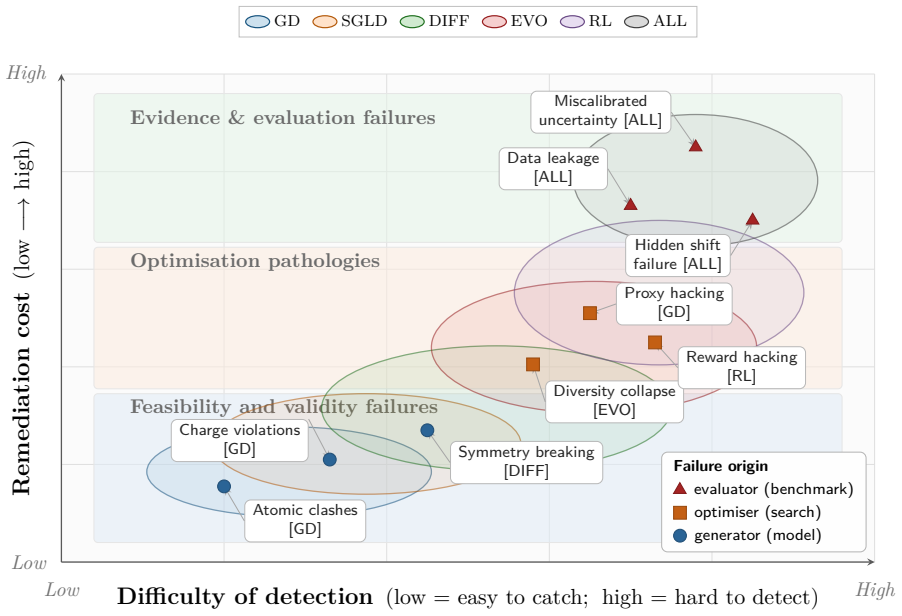
Modern generators learn chemical-structural priors from large databases to enable controllable sampling of periodic structures, with multimodal learning and closed-loop integration advancing inverse design while recurring failure modes include surrogate exploitation, diversity collapse, distribution shift, and the stability-synthesizability gap.
What carries the argument
Generative crystal structure models (variational autoencoders, normalizing flows, autoregressive formulations, diffusion models) that acquire priors from databases and enforce physical constraints via representation, objectives, guidance, and screening.
If this is right
- Controllable sampling of periodic structures follows from learning priors in the listed model classes.
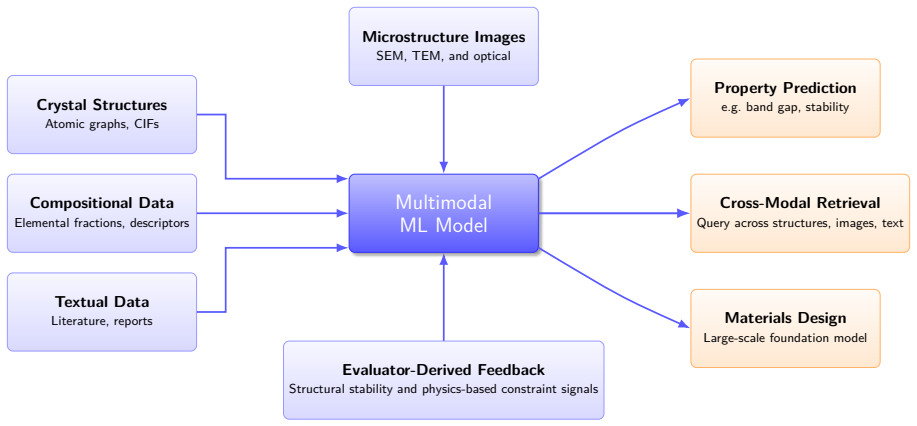
- Multimodal fusion of structures, thermodynamics, spectra, and text produces more transferable representations of chemical space.
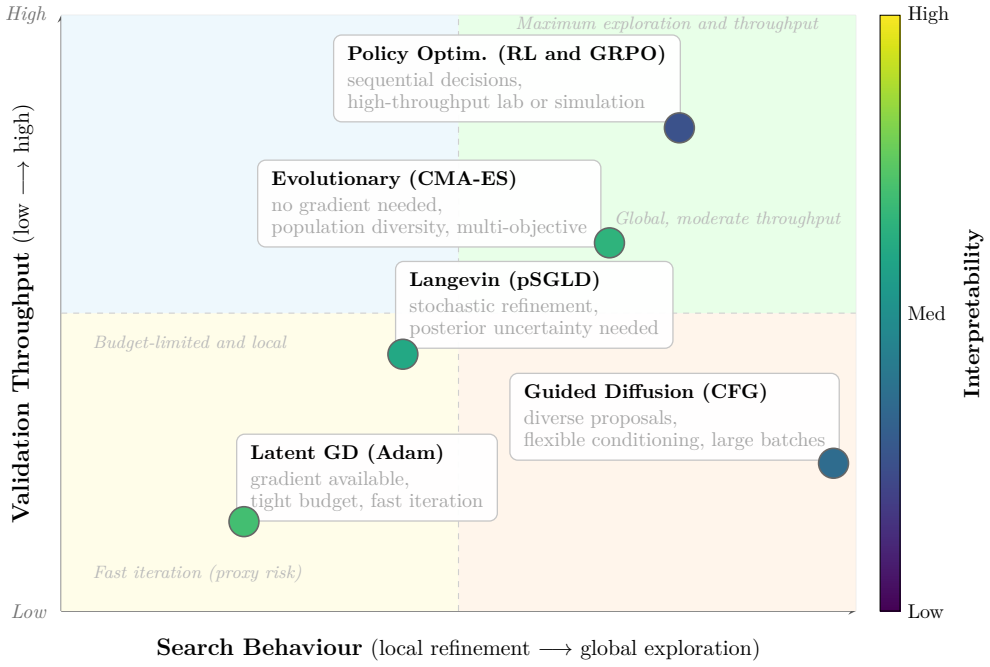
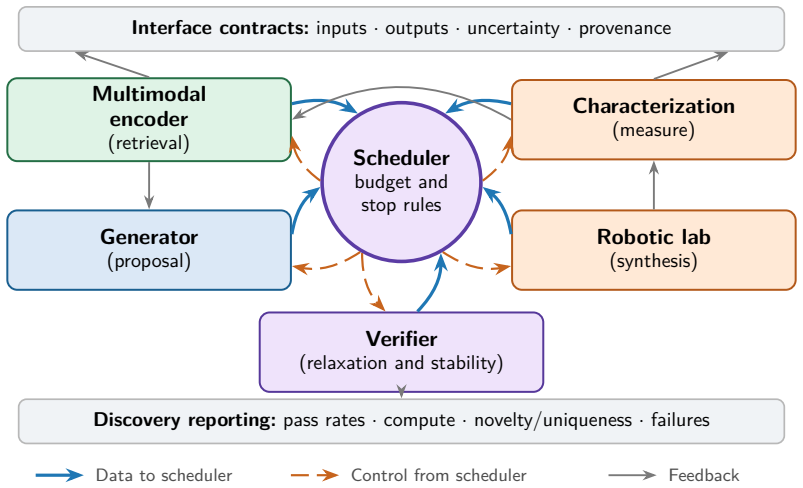
- Integration of conditional generation with latent optimization, Bayesian optimization, reinforcement learning, and active learning yields concrete inverse-design strategies.
- Staged reporting of validity, novelty, uniqueness, stability, and cost becomes the required standard for discovery-grade evaluation.
- Mitigation of surrogate exploitation, diversity collapse, distribution shift, and the stability-synthesizability gap is necessary for reliable automated discovery.
Where Pith is reading between the lines
- If the stability-synthesizability gap narrows through these workflows, experimental validation cycles could shorten substantially.
- Distribution shift between generated and real-world databases implies that models trained on current data may require periodic retraining on new experimental results.
- Closed-loop integration could extend naturally to processing parameters and device-level performance once multimodal representations include those modalities.
- The emphasis on post-generation relaxation and screening suggests that purely generative approaches may still need hybrid physics-based refinement steps.
Load-bearing premise
The surveyed literature and model classes comprehensively represent leading approaches and the identified failure modes apply broadly across the field.
What would settle it
A new generative model that produces high novelty, uniqueness, and stability scores on held-out databases without diversity collapse or surrogate exploitation would challenge the claim that these failure modes are recurring.
Figures

read the original abstract
Inverse materials design is shifting materials discovery from forward prediction to targeted proposal of candidates that satisfy objectives under physical constraints. Here, we review recent advances in generative crystal structure modeling, multimodal learning, and closed-loop design pipelines for crystalline solids. We survey how modern generators learn chemical-structural priors from large databases to enable controllable sampling of periodic structures, and compare leading model classes including variational autoencoders, normalizing flows, autoregressive formulations, and diffusion models. Particular attention is given to how feasibility constraints and physical priors are enforced across the workflow, through representation choices, training objectives, sampling-time guidance, and post-generation screening and relaxation. We also discuss how multimodal learning fuses diverse materials modalities, including crystal structures, thermodynamic, electronic information, microscopy, spectroscopy, processing context, and scientific text, to construct a more universal, transferable representation of chemical space. In addition, diverse inverse-design strategies are examined, particularly those that integrate conditional generation with latent optimization, Bayesian optimization, reinforcement learning, and active learning. Finally, we highlight recurring failure modes, such as surrogate exploitation, diversity collapse, distribution shift, and the stability-synthesizability gap, and outline discovery-grade evaluation practices based on staged reporting of validity, novelty, uniqueness, stability, and cost.
Editorial analysis
A structured set of objections, weighed in public.
Referee Report
Summary. The manuscript is a review surveying recent advances in generative models for crystal structures (VAEs, normalizing flows, autoregressive formulations, diffusion models), multimodal learning that fuses crystal structures with thermodynamic, electronic, microscopy, spectroscopy, processing, and text data, closed-loop inverse-design workflows integrating conditional generation with latent optimization, Bayesian optimization, reinforcement learning and active learning, enforcement of physical constraints via representations, objectives, guidance and post-processing, recurring failure modes including surrogate exploitation, diversity collapse, distribution shift and the stability-synthesizability gap, and staged evaluation practices based on validity, novelty, uniqueness, stability and cost.
Significance. If the coverage is representative, the review provides a timely synthesis of trends in automated inverse materials design, explicitly naming failure modes and evaluation criteria that can help standardize reporting and reduce common pitfalls in the field.
minor comments (1)
- The abstract lists model classes and failure modes but does not indicate the number of papers or time window surveyed; adding this in the introduction would help readers gauge scope.
Simulated Author's Rebuttal
We thank the referee for their positive summary of the manuscript, recognition of its timeliness, and recommendation to accept. We are pleased that the coverage of generative models, multimodal learning, closed-loop workflows, failure modes, and evaluation practices was viewed as representative and useful for standardizing reporting in the field.
Circularity Check
Review paper: no derivations or self-referential claims present
full rationale
This is a survey paper summarizing external literature on generative models, multimodal learning, and closed-loop workflows for inverse materials design. No equations, derivations, fitted parameters, predictions, or load-bearing self-citations are present that could reduce to the paper's own inputs. Central claims are descriptive summaries of trends from cited works, with no internal technical assertions that require validation against the paper itself. The weakest assumption (comprehensiveness of surveyed literature) is inherent to review format and does not constitute circularity. Score 0 is the appropriate finding for self-contained survey content.
Axiom & Free-Parameter Ledger
Reference graph
Works this paper leans on
-
[1]
Curtarolo, S. et al. The high-throughput highway to computational materials design. Nature Mate- rials 12, 191–201 (2013). doi:10.1038/nmat3568. https://doi.org/10.1038/nmat3568
-
[2]
Jain, A. et al. Commentary: The Materials Project: A materials genome approach to accelerating materials innovation. APL Materials 1, 011002 (2013). doi:10.1063/1.4812323. https://doi.org/ 10.1063/1.4812323
-
[3]
Ward, L. et al. Matminer: An open source toolkit for materials data mining. Computational Materials Science 152, 60–69 (2018). doi:10.1016/j.commatsci.2018.05.018. https://doi.org/10.1016/j.co mmatsci.2018.05.018
-
[4]
Choudhary, K. et al. The joint automated repository for various integrated simulations (JAR VIS) for data-driven materials design. npj Computational Materials 6, 173 (2020). doi:10.1038/s41524-020- 00440-1. https://doi.org/10.1038/s41524-020-00440-1
-
[5]
Kirklin, S. et al. The Open Quantum Materials Database (OQMD): assessing the accuracy of DFT for- mation energies. npj Computational Materials 1, 15010 (2015). doi:10.1038/npjcompumats.2015.10. https://doi.org/10.1038/npjcompumats.2015.10
-
[6]
Saal, J. E. et al. Materials design and discovery with high-throughput density functional theory: The Open Quantum Materials Database (OQMD). JOM 65, 1501–1509 (2013). doi:10.1007/s11837-013- 0755-4. https://doi.org/10.1007/s11837-013-0755-4
-
[7]
Ong, S. P. et al. Python Materials Genomics (pymatgen): A robust, open-source Python library for materials analysis. Computational Materials Science 68, 314–319 (2013). doi:10.1016/j.commatsci.2012.10.028. https://doi.org/10.1016/j.commatsci.2012.10.028
-
[8]
Lookman, T., Balachandran, P. V., Xue, D. and Yuan, R. Active learning in materials science with emphasis on adaptive sampling using uncertainties for targeted design. npj Computational Materials 5, 21 (2019). doi:10.1038/s41524-019-0153-8. https://doi.org/10.1038/s41524-019-0153-8
-
[9]
Shahriari, B., Swersky, K., Wang, Z., Adams, R. P. and de Freitas, N. Taking the human out of the loop: A review of Bayesian optimization. Proceedings of the IEEE 104, 148–175 (2016). doi:10.1109/JPROC.2015.2494218. https://doi.org/10.1109/JPROC.2015.2494218 31
-
[10]
Snoek, J., Larochelle, H. and Adams, R. P. Practical Bayesian optimization of machine learning algorithms. Advances in Neural Information Processing Systems 25 (2012). https://arxiv.org/ab s/1206.2944
Pith/arXiv arXiv 2012
-
[11]
Frazier, P. I. A tutorial on Bayesian optimization. arXiv (2018). arXiv:1807.02811. https://arxiv. org/abs/1807.02811
Pith/arXiv arXiv 2018
-
[12]
Active Learning Literature Survey
Settles, B. Active Learning Literature Survey. University of Wisconsin-Madison, Computer Sciences Technical Report 1648 (2009). https://minds.wisconsin.edu/handle/1793/60660
2009
-
[13]
Häse, F., Roch, L. M. and Aspuru-Guzik, A. Phoenics: A Bayesian optimizer for chemistry. ACS Central Science 4, 1134–1145 (2018). doi:10.1021/acscentsci.8b00307. https://doi.org/10.1021/ acscentsci.8b00307
-
[14]
Häse, F., Roch, L. M. and Aspuru-Guzik, A. Gryffin: An algorithm for Bayesian optimization of categorical variables informed by physical intuition with applications to chemistry. ACS Central Science 7, 1230–1237 (2021). doi:10.1021/acscentsci.0c01520. https://doi.org/10.1021/acscents ci.0c01520
-
[15]
Luo, X. et al. Deep learning generative model for crystal structure prediction. npj Computational Materials 10, 254 (2024). doi:10.1038/s41524-024-01443-y. https://doi.org/10.1038/s41524-024 -01443-y
-
[16]
Xie, T. et al. Crystal Diffusion Variational Autoencoder for periodic material generation. arXiv (2021). arXiv:2110.06197. https://arxiv.org/abs/2110.06197
arXiv 2021
-
[17]
Jiao, R. et al. Crystal Structure Prediction by Joint Equivariant Diffusion. arXiv (2023). arXiv:2309.04475. https://arxiv.org/abs/2309.04475
arXiv 2023
-
[18]
Zhao, Y. et al. Probabilistic constrained graph variational autoencoders for crystal generation. npj Computational Materials 9, 30 (2023). doi:10.1038/s41524-023-00987-9. https://doi.org/10.103 8/s41524-023-00987-9
-
[19]
Qiu, J. et al. VQCrystal: A vector-quantized diffusion framework for crystal generation. npj Com- putational Materials 11, 63 (2025). doi:10.1038/s41524-025-01613-6. https://doi.org/10.1038/s4 1524-025-01613-6
-
[20]
Zeni, C. et al. A generative model for inorganic materials design (MatterGen). Nature (2025). https://www.nature.com/articles/s41586-025-08628-5
2025
-
[21]
Luo, X. et al. CrystalFlow: a flow-based generative model for crystal structure prediction and mate- rials discovery. Nature Communications (2025). https://www.nature.com/articles/s41467-025 -64364-4
2025
-
[22]
Park, C. W. et al. Exploration of crystal chemical space using text-guided generative artificial intelli- gence. Nature Communications (2025). doi:10.1038/s41467-025-59636-y. https://www.nature.com /articles/s41467-025-59636-y
-
[23]
Ren, Z. et al. An invertible crystallographic representation for general inverse design of inorganic crystals with targeted properties. Matter 5, 314–335 (2022). doi:10.1016/j.matt.2021.11.032. https: //doi.org/10.1016/j.matt.2021.11.032
-
[24]
Ho, J., Jain, A. and Abbeel, P. Denoising diffusion probabilistic models. arXiv (2020). arXiv:2006.11239. https://arxiv.org/abs/2006.11239
Pith/arXiv arXiv 2020
-
[25]
Song, Y., Sohl-Dickstein, J., Kingma, D. P., Kumar, A., Ermon, S. and Poole, B. Score-based generative modeling through stochastic differential equations. arXiv (2020). arXiv:2011.13456. https://arxiv.org/abs/2011.13456
Pith/arXiv arXiv 2020
-
[26]
Wu, Y. et al. A versatile multimodal learning framework bridging multiscale knowledge for material design. npj Computational Materials (2025). doi:10.1038/s41524-025-01767-3. https://doi.org/10 .1038/s41524-025-01767-3
-
[27]
Moro, V. et al. Multimodal foundation models for material property prediction and discovery. Newton (2025). PII: S2950636025000088. https://www.sciencedirect.com/science/article/pii/S295 0636025000088 32
2025
-
[28]
Babu, A. et al. MEIDNet: Multimodal generative AI framework for inverse materials design. arXiv (2026). arXiv:2601.22009. doi:10.48550/arXiv.2601.22009. https://arxiv.org/abs/2601.22009
-
[29]
Kononova, O. et al. Text-mined dataset of inorganic materials synthesis recipes. Scientific Data 6, 203 (2019). doi:10.1038/s41597-019-0224-1. https://doi.org/10.1038/s41597-019-0224-1
-
[30]
Tshitoyan, V. et al. Unsupervised word embeddings capture latent knowledge from materials science literature. Nature 571, 95–98 (2019). doi:10.1038/s41586-019-1335-8. https://doi.org/10.1038/ s41586-019-1335-8
-
[31]
Olivetti, E. A. et al. Data-driven materials research enabled by natural language processing and information extraction. Applied Physics Reviews 7, 041317 (2020). doi:10.1063/5.0021106. https: //doi.org/10.1063/5.0021106
-
[32]
Venugopal, V. and Olivetti, E. A. MatKG: A knowledge graph for materials science. Scientific Data 11, 141 (2024). doi:10.1038/s41597-024-03039-z. https://doi.org/10.1038/s41597-024-03039-z
-
[34]
Burger, B. et al. A mobile robotic chemist. Nature 583, 237–241 (2020). doi:10.1038/s41586-020- 2442-2. https://doi.org/10.1038/s41586-020-2442-2
-
[35]
MacLeod, B. P. et al. Self-driving laboratory for accelerated discovery of thin-film materials. Science Advances 6, eaaz8867 (2020). doi:10.1126/sciadv.aaz8867. https://doi.org/10.1126/sciadv.aaz 8867
-
[36]
Flores-Leonar, M. M. et al. Materials acceleration platforms: On the way to autonomous experi- mentation. Nature Reviews Materials 5, 575–590 (2020). doi:10.1038/s41578-020-0226-2. https: //doi.org/10.1038/s41578-020-0226-2
-
[37]
De Breuck, W. et al. Generative AI for crystal structures: a review. npj Computational Materials (2025). doi:10.1038/s41524-025-01881-2. https://doi.org/10.1038/s41524-025-01881-2
-
[38]
Wagner, J. et al. Benchmarking machine learning in self-driving laboratories. Digital Discovery (2026). doi:10.1039/D5DD00337G. https://doi.org/10.1039/D5DD00337G
-
[39]
Dunn, A. et al. Benchmarking materials property prediction methods: the Matbench test set and Automatminer reference algorithm. npj Computational Materials 6, 138 (2020). doi:10.1038/s41524- 020-00406-3. https://doi.org/10.1038/s41524-020-00406-3
-
[40]
Kent, P. et al. Foundation models for materials discovery – current state and future directions. npj Computational Materials (2025). doi:10.1038/s41524-025-01538-0. https://www.nature.com/artic les/s41524-025-01538-0
-
[41]
Butler, K. T., Davies, D. W., Cartwright, H., Isayev, O. and Walsh, A. Machine learning for molecular and materials science. Nature 559, 547–555 (2018). doi:10.1038/s41586-018-0337-2. https://doi. org/10.1038/s41586-018-0337-2
-
[42]
Schmidt, J., Marques, M. R. G., Botti, S. and Marques, M. A. L. Recent advances and applica- tions of machine learning in solid-state materials science. npj Computational Materials 5, 83 (2019). doi:10.1038/s41524-019-0221-0. https://doi.org/10.1038/s41524-019-0221-0
-
[43]
Batra, R., Song, L. and Ramprasad, R. Emerging materials intelligence ecosystems propelled by machine learning. Nature Reviews Materials 6, 655–678 (2021). doi:10.1038/s41578-020-00255-y. https://doi.org/10.1038/s41578-020-00255-y
-
[44]
Chen, C. et al. Generative models for inverse design of inorganic solid materials. Journal of Materials Informatics (2021). https://www.oaepublish.com/articles/jmi.2021.07
2021
-
[45]
Jha, D. et al. ElemNet: Deep learning the chemistry of materials from only elemental composition. Scientific Reports 8, 17593 (2018). doi:10.1038/s41598-018-35934-y. https://doi.org/10.1038/s4 1598-018-35934-y
-
[46]
Fudge, B. et al. Design and implementation of self-driving laboratories. Digital Discovery (2024). https://doi.org/10.1039/D4DD00059E 33
-
[47]
Hysmith, H., Foadian, E., Padhy, S. P., Kalinin, S. V., Moore, R. G., Ovchinnikova, O. S. and Ahmadi, M. The future of self-driving laboratories: from human in the loop interactive AI to gamification. Digital Discovery (2024). doi:10.1039/D4DD00040D. https://doi.org/10.1039/D4DD00040D
-
[48]
Han, X.-Q. et al. InvDesFlow-AL: active learning-based workflow for inverse design of functional materials. npj Computational Materials (2025). doi:10.1038/s41524-025-01830-z. https://doi.org/ 10.1038/s41524-025-01830-z
-
[49]
Antunes, L. M. et al. CrystaLLM: data-efficient autoregressive generation of inorganic crystal structures. Nature Communications 15, 10570 (2024). doi:10.1038/s41467-024-54639-7. https: //www.nature.com/articles/s41467-024-54639-7
-
[50]
Chenebuah, C., Qi, Y. and Ghosh, P. Learning crystal morphology with graph autoencoders for inverse design. npj Computational Materials 10, 129 (2024). doi:10.1038/s41524-024-01381-9. https: //doi.org/10.1038/s41524-024-01381-9
-
[51]
Davies, D. W. et al. SMACT: Semiconducting materials by analogy and chemical theory. Journal of Open Source Software 4, 1361 (2019). doi:10.21105/joss.01361. https://doi.org/10.21105/joss. 01361
-
[52]
Wang, A. Y.-T. et al. Compositionally restricted attention-based network for materials property prediction. npj Computational Materials 7, 77 (2021). doi:10.1038/s41524-021-00545-1. https: //doi.org/10.1038/s41524-021-00545-1
-
[53]
Goodall, R. E. A. and Lee, A. A. Predicting materials properties without crystal structure: Deep representation learning from stoichiometry. npj Computational Materials 6, 148 (2020). doi:10.1038/s41524-020-00381-w. https://doi.org/10.1038/s41524-020-00381-w
-
[54]
Court, C. J. and Cole, J. M. 3-D inorganic crystal structure generation and property prediction via representation learning. J. Chem. Inf. Model. (2020). https://pubs.acs.org/doi/10.1021/acs.j cim.0c00048
-
[55]
Kim, B. et al. Generative adversarial network for crystal structure prediction. ACS Central Science (2020). https://pubs.acs.org/doi/10.1021/acscentsci.0c00426
-
[56]
Gao, Y. et al. ConditionCDV AE+: physically informed conditional crystal generation. Scientific Reports (2025). https://www.nature.com/articles/s41598-025-06432-9
2025
-
[57]
Karras, T., Aittala, M., Aila, T. and Laine, S. Elucidating the design space of diffusion-based gener- ative models. arXiv (2022). arXiv:2206.00364. https://arxiv.org/abs/2206.00364
Pith/arXiv arXiv 2022
-
[58]
Karpovich, C. et al. Deep reinforcement learning for inverse inorganic materials design. npj Compu- tational Materials (2024). doi:10.1038/s41524-024-01474-5. https://doi.org/10.1038/s41524-024 -01474-5
-
[59]
Isayev, O. et al. Universal fragment descriptors for predicting properties of inorganic crystals. Nature Communications 8, 15679 (2017). doi:10.1038/ncomms15679. https://doi.org/10.1038/ncomms 15679
-
[60]
Suzuki, H. et al. Bridging text and crystal structures: literature-driven contrastive learning for materials science. AI4Mat @ NeurIPS (2024). OpenReview: JPL2XhDqeM. https://openreview.n et/forum?id=JPL2XhDqeM
2024
-
[61]
Ozawa, N. et al. Graph-text contrastive learning of inorganic crystal structure toward a foundation model of inorganic materials. STAM Methods (2024). doi:10.1080/27660400.2024.2406219. https: //doi.org/10.1080/27660400.2024.2406219
-
[62]
Das, K. et al. CrysMMNet: Multimodal Representation for Crystal Property Prediction. Proceedings of Machine Learning Research (UAI) 216 (2023). https://proceedings.mlr.press/v216/das23 a.html
2023
-
[63]
Court, C. J., Jain, A. and Cole, J. M. Inverse Design of Materials That Exhibit the Magnetocaloric Effect by Text-Mining of the Scientific Literature and Generative Deep Learning. Chemistry of Materials 33, 7217–7230 (2021). doi:10.1021/acs.chemmater.1c01368. https://pubs.acs.org/doi /10.1021/acs.chemmater.1c01368 34
-
[64]
N., Duvenaud, D., Hernández -Lobato, J
Gómez-Bombarelli, R., Wei, J. N., Duvenaud, D., Hernández-Lobato, J. M., Sánchez-Lengeling, B., Sheberla, D., Aguilera-Iparraguirre, J., Hirzel, T. D., Adams, R. P. and Aspuru-Guzik, A. Automatic Chemical Design Using a Data-Driven Continuous Representation of Molecules. ACS Central Science 4(2), 268–276 (2018). doi:10.1021/acscentsci.7b00572. https://doi...
-
[65]
Xiao, H., Li, R., Shi, Q., Chen, Y., Zheng, L., Chen, F. and Xu, L. An invertible, invariant crystal representation for inverse design of solid-state materials using generative deep learning. Nature Com- munications 14, 7027 (2023). doi:10.1038/s41467-023-42870-7. https://doi.org/10.1038/s41467 -023-42870-7
-
[66]
The CMA Evolution Strategy: A Tutorial
Hansen, N. The CMA Evolution Strategy: A Tutorial. arXiv (2016). arXiv:1604.00772. https: //arxiv.org/abs/1604.00772
Pith/arXiv arXiv 2016
-
[67]
and Teh, Y
Welling, M. and Teh, Y. W. Bayesian Learning via Stochastic Gradient Langevin Dynamics. In Proceedings of the 28th International Conference on Machine Learning , 681–688 (2011). https: //icml.cc/2011/papers/398_icmlpaper.pdf
2011
-
[68]
and Carin, L
Li, C., Chen, C., Carlson, D. and Carin, L. Preconditioned Stochastic Gradient Langevin Dynamics for Deep Neural Networks. In Proceedings of the 30th AAAI Conference on Artificial Intelligence 30(1), 1788–1794 (2016). https://ojs.aaai.org/index.php/AAAI/article/view/10200
2016
-
[69]
Ho, J. and Salimans, T. Classifier-Free Diffusion Guidance. arXiv preprint arXiv:2207.12598 (2022). https://arxiv.org/abs/2207.12598
Pith/arXiv arXiv 2022
-
[70]
Schulman, J., Wolski, F., Dhariwal, P., Radford, A. and Klimov, O. Proximal Policy Optimization Algorithms. arXiv preprint arXiv:1707.06347 (2017). https://arxiv.org/abs/1707.06347
Pith/arXiv arXiv 2017
-
[71]
Banik, S., Dhabal, D., Chan, H., Manna, S., Cherukara, M., Molinero, V. and Sankaranarayanan, S. K. R. S. CATING: Crystal structure generation from composition using attention-based neural networks. npj Computational Materials 9, 117 (2023). doi:10.1038/s41524-023-01094-5. https: //doi.org/10.1038/s41524-023-01094-5
-
[72]
Kusne, A. G., Yu, H., Wu, C., Zhang, H., Hattrick-Simpers, J., DeCost, B., Sarker, S., Oses, C., Toher, C., Curtarolo, S., Davydov, A. V., Agarwal, R., Bendersky, L. A., Li, M., Mehta, A. and Takeuchi, I. On-the-fly closed-loop materials discovery via Bayesian active learning. Nature Communications 11, 5966 (2020). doi:10.1038/s41467-020-19597-w. https://...
-
[73]
Merchant, A., Batzner, S., Schoenholz, S. S., Aykol, M., Cheon, G. and Cubuk, E. D. Scaling deep learning for materials discovery. Nature 624, 80–85 (2023). doi:10.1038/s41586-023-06735-9. https: //doi.org/10.1038/s41586-023-06735-9
-
[74]
Volk, A. A. and Abolhasani, M. Autonomous flow chemistry platforms: benchmarking and assessment criteria. Nature Communications 15, 5433 (2024). doi:10.1038/s41467-024-49716-4. https://doi. org/10.1038/s41467-024-49716-4
-
[75]
Szymanski, N. J. et al. An autonomous laboratory for the accelerated synthesis of novel materials. Nature 624, 86–91 (2023). doi:10.1038/s41586-023-06734-w. https://doi.org/10.1038/s41586-0 23-06734-w
-
[76]
Rombach, R., Blattmann, A., Lorenz, D., Esser, P. and Ommer, B. High-resolution image synthesis with latent diffusion models. CVPR (2022). doi:10.1109/CVPR52688.2022.01042. https://doi.or g/10.1109/CVPR52688.2022.01042
-
[77]
Diwale, S. et al. Bayesian optimization for material discovery processes with noisy and unreliable measurements. Molecular Systems Design & Engineering (2022). https://doi.org/10.1039/D1ME 00154J
-
[78]
Tian, K. et al. Materials design with target-oriented Bayesian optimization (t-EGO). npj Computa- tional Materials (2025). doi:10.1038/s41524-025-01704-4. https://doi.org/10.1038/s41524-025 -01704-4
-
[79]
Chitturi, K. et al. Targeted materials discovery using Bayesian algorithm execution. npj Computa- tional Materials 10, 126 (2024). doi:10.1038/s41524-024-01326-2. https://doi.org/10.1038/s415 24-024-01326-2 35
-
[80]
Riebesell, J., Goodall, R. E. A., Benner, P., Chiang, Y., Deng, B., Ceder, G., Asta, M., Lee, A. A., Jain, A. and Persson, K. A. A framework to evaluate machine learning crystal stability predictions. Nature Machine Intelligence 7, 836–847 (2025). doi:10.1038/s42256-025-01055-3. https://doi.org/ 10.1038/s42256-025-01055-3
-
[81]
Skalse, J., Howe, N. H. R., Krasheninnikov, D. and Krueger, D. Defining and Characterizing Reward Gaming. Advances in Neural Information Processing Systems 35 (2022). https://arxiv.org/abs/ 2209.13085
arXiv 2022
discussion (0)
Sign in with ORCID, Apple, or X to comment. Anyone can read and Pith papers without signing in.