A Massive Hot-Jupiter Companion that Disfavors Giant Planet Formation Beyond the Water-Ice Line
Pith reviewed 2026-06-28 12:20 UTC · model grok-4.3
The pith
A brown-dwarf companion limits the KELT-20 hot Jupiter to formation inside the water-ice line.
A machine-rendered reading of the paper's core claim, the machinery that carries it, and where it could break.
Core claim
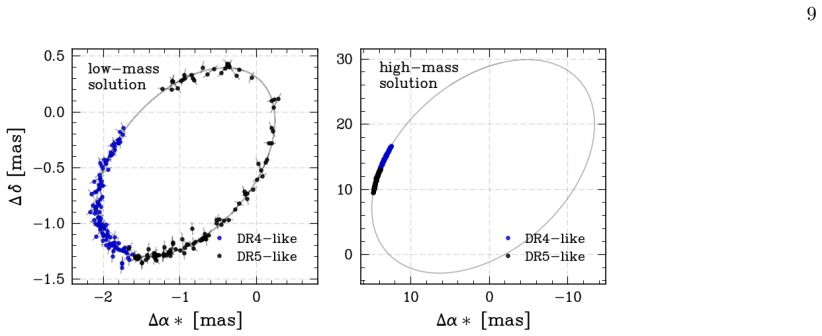
We report evidence for a brown-dwarf companion with mass 34 Jupiter masses whose pericenter distance of a few au would lead to orbit crossing or long-term instability for any planet formed at or beyond the water-ice line at 8-15 au. If the companion formed early and remained near its current orbit, the proto-hot Jupiter must have formed within 3.7 au to avoid orbit crossing and within 1.5 au to remain dynamically stable, disfavoring formation beyond the ice line.
What carries the argument
The brown-dwarf companion's pericenter distance, derived from joint astrometric and transit-timing analysis, which sets upper bounds on the hot Jupiter's formation semimajor axis.
If this is right
- The hot Jupiter formed inside roughly 3.7 au rather than at or beyond the ice line.
- Inward migration after formation is required to reach the observed close orbit.
- Long-term dynamical stability requires formation inside about 1.5 au under the stated assumptions.
- Giant-planet formation models that rely on core accretion beyond the ice line are disfavored for this system.
Where Pith is reading between the lines
- Similar brown-dwarf companions around other hot-Jupiter hosts could provide independent tests of in-situ versus migrated formation.
- If many such companions exist, the fraction of hot Jupiters that formed inside the ice line may be higher than current population synthesis models predict.
- Precise measurement of the companion's eccentricity and mutual inclination with the hot Jupiter would tighten the formation-distance limits.
Load-bearing premise
The brown-dwarf companion formed early and has remained near its current orbit over the system's lifetime.
What would settle it
Direct imaging or radial-velocity follow-up that shows the companion formed after the hot Jupiter or has migrated substantially inward since formation.
Figures

read the original abstract
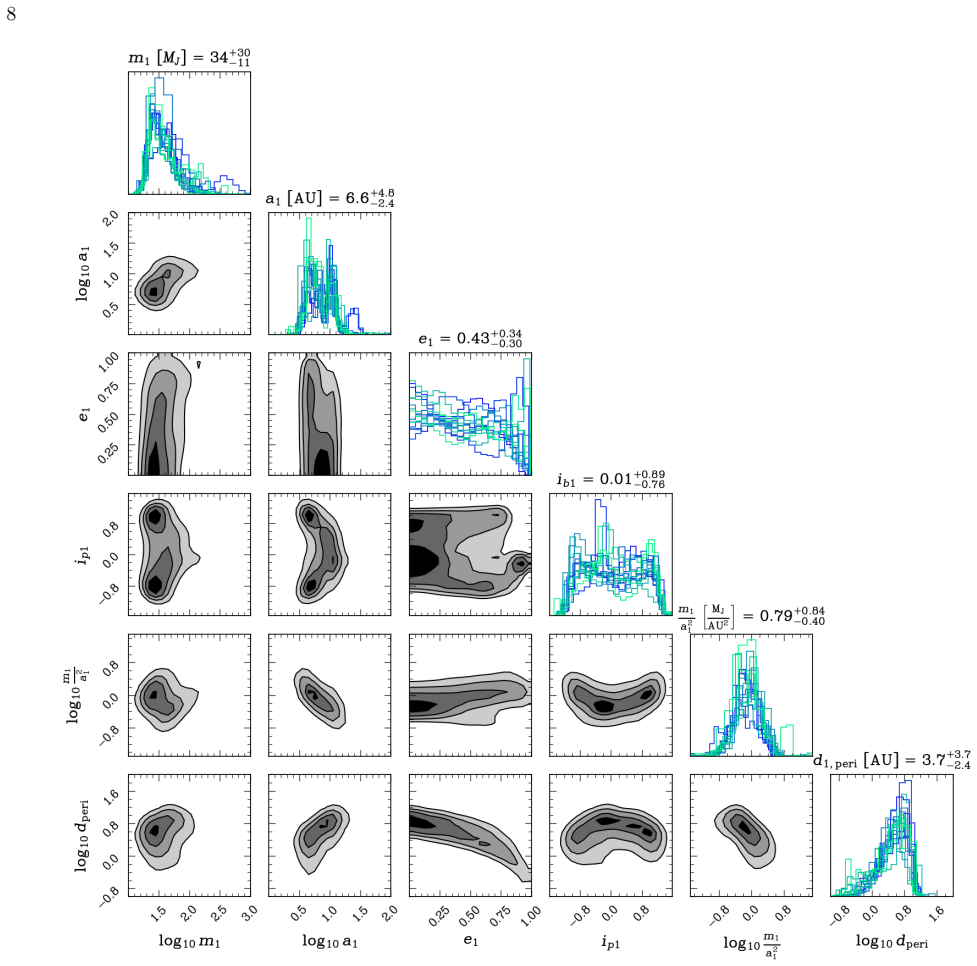
We report evidence for a brown-dwarf companion with mass $34^{+30}_{-11}~M_{\rm J}$ in the KELT-20 system, in which an ultra-hot Jupiter transits an A2-type star. The companion's properties are inferred from a joint analysis of astrometric accelerations and transit timing variations, and its present-day orbit imposes dynamical limits on where the hot Jupiter could have formed. Given the star's current luminosity, the water-ice line is expected at $\sim$8-15 au, but the companion's inferred pericenter distance of a few au would lead to orbit crossing or long-term instability for any planet formed at such distances. If the companion formed early and remained near its current orbit over the system's lifetime, the proto-hot Jupiter must have formed within $\sim$3.7 au to avoid orbit crossing, and within $\sim$1.5 au to remain dynamically stable over the system's lifetime. These results disfavor formation beyond the ice line and point instead to formation at smaller orbital distances followed by inward migration.
Editorial analysis
A structured set of objections, weighed in public.
Referee Report
Summary. The manuscript reports a joint astrometric-TTV detection of a brown-dwarf companion (mass 34^{+30}_{-11} M_J) to the KELT-20 ultra-hot Jupiter system. The companion's inferred pericenter (a few au) is used to place dynamical limits on the hot Jupiter's formation location: if the companion formed early and remained near its present orbit, the proto-hot Jupiter must have formed within ~3.7 au to avoid orbit crossing and within ~1.5 au for long-term stability, thereby disfavoring formation beyond the water-ice line at 8-15 au.
Significance. If the orbital-history assumption holds and the mass/pericenter constraints are robust, the result supplies a concrete dynamical argument against ice-line formation for at least one hot Jupiter, complementing migration and disk-chemistry studies. The joint astrometric-TTV method itself is a useful technical contribution for companion detection around bright stars.
major comments (2)
- [Abstract] Abstract and § (formation-limits paragraph): the central disfavoring claim is explicitly conditioned on the untested premise that the companion 'formed early and remained near its current orbit.' No stability maps, migration timescale calculations, or dynamical simulations are referenced to justify this over the alternative that the companion formed farther out and migrated inward after the hot Jupiter's formation epoch. Because the pericenter is only loosely constrained to 'a few au' and the ice line spans 8-15 au, relaxing this assumption removes the formation-radius limit; this is load-bearing for the title and abstract conclusion.
- [Abstract] Abstract: no error analysis, covariance information, or data tables are provided for the joint astrometric-TTV fit that yields the mass 34^{+30}_{-11} M_J and pericenter. The soundness assessment cannot be completed without these quantities and the associated model assumptions (e.g., whether the TTV signal is attributed solely to the companion or includes other effects).
minor comments (1)
- [Abstract] The ice-line location (8-15 au) is stated without reference to the specific stellar luminosity or disk model used; a brief citation or calculation would clarify the range.
Simulated Author's Rebuttal
We thank the referee for their constructive comments on our manuscript. We address each major comment below and outline planned revisions to improve clarity and completeness.
read point-by-point responses
-
Referee: [Abstract] Abstract and § (formation-limits paragraph): the central disfavoring claim is explicitly conditioned on the untested premise that the companion 'formed early and remained near its current orbit.' No stability maps, migration timescale calculations, or dynamical simulations are referenced to justify this over the alternative that the companion formed farther out and migrated inward after the hot Jupiter's formation epoch. Because the pericenter is only loosely constrained to 'a few au' and the ice line spans 8-15 au, relaxing this assumption removes the formation-radius limit; this is load-bearing for the title and abstract conclusion.
Authors: We agree that the formation-radius limits are conditional on the companion having formed early and remained near its present orbit, as the manuscript already states explicitly with the clause 'If the companion formed early and remained near its current orbit'. The paper does not include new stability maps or migration simulations because its focus is the observational detection and the direct dynamical implications of the measured pericenter; basic orbit-crossing and Hill-radius stability criteria suffice for the quoted limits. To address the concern that the assumption is load-bearing, we will revise the abstract to foreground the conditional phrasing and expand the formation-limits discussion with references to existing dynamical studies on companion migration and multi-body stability. We maintain that the result provides a useful constraint under this assumption but acknowledge that alternative orbital histories for the companion cannot be excluded by the current data. revision: partial
-
Referee: [Abstract] Abstract: no error analysis, covariance information, or data tables are provided for the joint astrometric-TTV fit that yields the mass 34^{+30}_{-11} M_J and pericenter. The soundness assessment cannot be completed without these quantities and the associated model assumptions (e.g., whether the TTV signal is attributed solely to the companion or includes other effects).
Authors: The joint astrometric-TTV fit details, including error analysis, covariance information, and model assumptions about the TTV signal origin, are described in the Methods section. To allow full soundness assessment from the abstract alone, we will add a supplementary table in the revised manuscript that summarizes the best-fit parameters, uncertainties, covariance matrix, and explicit model assumptions. revision: yes
Circularity Check
No circularity; limits derived from explicit dynamical assumption applied to observed pericenter
full rationale
The paper states its formation-radius limits (~3.7 au, ~1.5 au) as direct consequences of applying orbit-crossing and long-term stability criteria to the companion's inferred pericenter distance under the explicitly conditioned premise that the companion 'formed early and remained near its current orbit.' No equations, fitted parameters, or self-citations are invoked that reduce these limits to definitions or prior results by construction. The derivation chain is self-contained against the reported astrometric and TTV data plus standard dynamical criteria; the conditional nature of the conclusion is acknowledged rather than smuggled in.
Axiom & Free-Parameter Ledger
free parameters (1)
- companion mass =
34 M_J
axioms (1)
- domain assumption The brown-dwarf companion formed early and has remained near its present-day orbit throughout the system's lifetime.
Reference graph
Works this paper leans on
-
[1]
Armitage, P. J. 2010, Astrophysics of Planet Formation
2010
-
[2]
Armitage, P. J., & Bonnell, I. A. 2002, MNRAS, 330, L11, doi: 10.1046/j.1365-8711.2002.05213.x Astropy Collaboration, Price-Whelan, A. M., Lim, P. L., et al. 2022, ApJ, 935, 167, doi: 10.3847/1538-4357/ac7c74
-
[3]
2014, in Protostars and Planets VI, ed
Baruteau, C., Crida, A., Paardekooper, S.-J., et al. 2014, in Protostars and Planets VI, ed. H. Beuther, R. S. Klessen, C. P. Dullemond, & T. Henning, 667–689, doi: 10.2458/azu uapress 9780816531240-ch029
work page doi:10.2458/azu 2014
-
[4]
Batygin, K., Bodenheimer, P. H., & Laughlin, G. P. 2016, ApJ, 829, 114, doi: 10.3847/0004-637X/829/2/114 Beaug´ e, C., & Nesvorn´ y, D. 2012, ApJ, 751, 119, doi: 10.1088/0004-637X/751/2/119
-
[5]
Bodenheimer, P., Hubickyj, O., & Lissauer, J. J. 2000, Icarus, 143, 2, doi: https://doi.org/10.1006/icar.1999.6246
-
[6]
Boley, A. C., Granados Contreras, A. P., & Gladman, B. 2016, ApJL, 817, L17, doi: 10.3847/2041-8205/817/2/L17
-
[7]
Boss, A. P. 1997, Science, 276, 1836, doi: 10.1126/science.276.5320.1836
-
[8]
Brandt, T. D. 2021, The Astrophysical Journal Supplement Series, 254, 42, doi: 10.3847/1538-4365/abf93c
-
[9]
Casasayas-Barris, N., Pall´ e, E., Yan, F., et al. 2019, A&A, 628, A9, doi: 10.1051/0004-6361/201935623
-
[10]
2025, The Astronomical Journal, 170, 234, doi: 10.3847/1538-3881/adfbeb
Chachan, Y., Lothringer, J., Inglis, J., et al. 2025, The Astronomical Journal, 170, 234, doi: 10.3847/1538-3881/adfbeb
-
[11]
doi:10.1146/annurev-astro-081817-051853 , eprint =
Dawson, R. I., & Johnson, J. A. 2018, ARA&A, 56, 175, doi: 10.1146/annurev-astro-081817-051853
work page internal anchor Pith review doi:10.1146/annurev-astro-081817-051853 2018
-
[12]
Distler, A., Soares-Furtado, M., Mann, A. W., et al. 2026, AJ, 171, 248, doi: 10.3847/1538-3881/ae4c48
-
[13]
2007, The Astrophysical Journal, 669, 1298, doi: 10.1086/521702
Fabrycky, D., & Tremaine, S. 2007, The Astrophysical Journal, 669, 1298, doi: 10.1086/521702
-
[14]
Finnerty, L., Xin, Y., Xuan, J. W., et al. 2025, AJ, 169, 333, doi: 10.3847/1538-3881/adce02
-
[15]
Fu, G., Sing, D. K., Lothringer, J. D., et al. 2022, ApJL, 925, L3, doi: 10.3847/2041-8213/ac4968 Gaia Collaboration, Prusti, T., de Bruijne, J. H. J., et al. 2016, A&A, 595, A1, doi: 10.1051/0004-6361/201629272
-
[16]
Guerriero, F., Penoyre, Z., & Brown, A. G. A. 2026, MNRAS, 548, stag654, doi: 10.1093/mnras/stag654
-
[17]
Hattori, S., Garcia, L., Murray, C., et al. 2024, exoplanet-dev/jaxoplanet: Astronomical time series analysis with JAX, v0.0.2, Zenodo, doi: 10.5281/zenodo.10736936
-
[18]
2019, A&A, 628, A42, doi: 10.1051/0004-6361/201833486
Heller, R. 2019, A&A, 628, A42, doi: 10.1051/0004-6361/201833486
-
[19]
2019, Statistics and Computing, 29, 891, doi: 10.1007/s11222-018-9844-0
Higson, E., Handley, W., Hobson, M., & Lasenby, A. 2019, Statistics and Computing, 29, 891, doi: 10.1007/s11222-018-9844-0
-
[20]
Holman, M. J., & Wiegert, P. A. 1999, AJ, 117, 621, doi: 10.1086/300695
-
[21]
Ida, S., & Lin, D. N. C. 2004, ApJ, 616, 567, doi: 10.1086/424830 —. 2005, ApJ, 626, 1045, doi: 10.1086/429953 —. 2008, ApJ, 673, 487, doi: 10.1086/523754
-
[22]
Ivshina, E. S., & Winn, J. N. 2022, ApJS, 259, 62, doi: 10.3847/1538-4365/ac545b
-
[23]
Johnston, H. F., Pani´ c, O., & Liu, B. 2024, MNRAS, 527, 2303, doi: 10.1093/mnras/stad3254
-
[24]
Kennedy, G. M., & Kenyon, S. J. 2008, ApJ, 673, 502, doi: 10.1086/524130 10
-
[25]
2025, Journal of Korean Astronomical Society, 58, 243, doi: 10.5303/JKAS.2025.58.2.243
Kim, Y.-J., Lee, J.-E., Baek, G., & Lee, S. 2025, Journal of Korean Astronomical Society, 58, 243, doi: 10.5303/JKAS.2025.58.2.243
-
[26]
Lee, E. J., & Chiang, E. 2016, ApJ, 817, 90, doi: 10.3847/0004-637X/817/2/90
-
[27]
Lenhart, C., Johnson, M. C., Wang, J., et al. 2026, AJ, 171, 81, doi: 10.3847/1538-3881/ae2252
-
[28]
Li, J. 2023, AstroJacobLi/smplotlib: v0.0.9, v0.0.9, Zenodo, doi: 10.5281/zenodo.8126529 Lightkurve Collaboration, Cardoso, J. V. d. M., Hedges, C., et al. 2018, Lightkurve: Kepler and TESS time series analysis in Python, Astrophysics Source Code Library. http://ascl.net/1812.013
-
[29]
Lin, D. N. C., Bodenheimer, P., & Richardson, D. C. 1996, Nature, 380, 606, doi: 10.1038/380606a0
-
[30]
Liu, B., Mu˜ noz, D. J., & Lai, D. 2015, MNRAS, 447, 747, doi: 10.1093/mnras/stu2396
-
[31]
2025, The Astrophysical Journal, 979, 218, doi: 10.3847/1538-4357/ad9b79
Lu, T., An, Q., Li, G., et al. 2025, The Astrophysical Journal, 979, 218, doi: 10.3847/1538-4357/ad9b79
-
[32]
Lund, M. B., Rodriguez, J. E., Zhou, G., et al. 2017, AJ, 154, 194, doi: 10.3847/1538-3881/aa8f95
-
[33]
2002, The Astrophysical Journal, 580, L171, doi: 10.1086/345520
Mandel, K., & Agol, E. 2002, The Astrophysical Journal, 580, L171, doi: 10.1086/345520
-
[34]
2008, ApJ, 678, 498, doi: 10.1086/529369
Nagasawa, M., Ida, S., & Bessho, T. 2008, ApJ, 678, 498, doi: 10.1086/529369
-
[35]
Perri, F., & Cameron, A. G. W. 1974, Icarus, 22, 416, doi: 10.1016/0019-1035(74)90074-8
-
[36]
Perryman, M. A. C., Lindegren, L., Kovalevsky, J., et al. 1997, A&A, 323, L49
1997
-
[37]
2015, ApJ, 805, 75, doi: 10.1088/0004-637X/805/1/75
Petrovich, C. 2015, ApJ, 805, 75, doi: 10.1088/0004-637X/805/1/75
-
[38]
B., Hubickyj, O., Bodenheimer, P., et al
Pollack, J. B., Hubickyj, O., Bodenheimer, P., et al. 1996, Icarus, 124, 62, doi: 10.1006/icar.1996.0190
-
[39]
2020, The Astronomical Journal, 159, 80, doi: 10.3847/1538-3881/ab64fa
Quarles, B., Li, G., Kostov, V., & Haghighipour, N. 2020, The Astronomical Journal, 159, 80, doi: 10.3847/1538-3881/ab64fa
-
[40]
Rafikov, R. R. 2005, ApJL, 621, L69, doi: 10.1086/428899
-
[41]
Rice, W. K. M., Armitage, P. J., Bonnell, I. A., et al. 2003, MNRAS, 346, L36, doi: 10.1111/j.1365-2966.2003.07317.x
-
[42]
Ricker, G. R., Winn, J. N., Vanderspek, R., et al. 2015, Journal of Astronomical Telescopes, Instruments, and Systems, 1, 014003, doi: 10.1117/1.JATIS.1.1.014003
work page internal anchor Pith review doi:10.1117/1.jatis.1.1.014003 2015
-
[43]
Singh, V., Scandariato, G., Smith, A. M. S., et al. 2024, A&A, 683, A1, doi: 10.1051/0004-6361/202347533
-
[44]
Speagle, J. S. 2020, MNRAS, 493, 3132, doi: 10.1093/mnras/staa278
-
[45]
Stassun, K. G., Oelkers, R. J., Paegert, M., et al. 2019, AJ, 158, 138, doi: 10.3847/1538-3881/ab3467
-
[46]
Talens, G. J. J., Justesen, A. B., Albrecht, S., et al. 2018, A&A, 612, A57, doi: 10.1051/0004-6361/201731512
-
[47]
, year = 1964, month = may, volume =
Toomre, A. 1964, ApJ, 139, 1217, doi: 10.1086/147861 van ’t Hoff, M. L. R., Harsono, D., van Gelder, M. L., et al. 2022, The Astrophysical Journal, 924, 5, doi: 10.3847/1538-4357/ac3080
-
[48]
2011, ApJ, 735, 109, doi: 10.1088/0004-637X/735/2/109
Wu, Y., & Lithwick, Y. 2011, ApJ, 735, 109, doi: 10.1088/0004-637X/735/2/109
-
[49]
2003, The Astrophysical Journal, 589, 605, doi: 10.1086/374598
Wu, Y., & Murray, N. 2003, The Astrophysical Journal, 589, 605, doi: 10.1086/374598
-
[50]
Yahalomi, D. A., Lu, T., Armitage, P. J., et al. 2026, The Astrophysical Journal Letters, 999, L9, doi: 10.3847/2041-8213/ae42cd
-
[51]
2026, AJ, 171, 77, doi: 10.3847/1538-3881/ae2309
Zhang, J., Huber, D., Bottom, M., et al. 2026, AJ, 171, 77, doi: 10.3847/1538-3881/ae2309
discussion (0)
Sign in with ORCID, Apple, or X to comment. Anyone can read and Pith papers without signing in.