The Benjamin-Ono Equation in the Long-Time Limit: Linearized Self-Similar Universality
Pith reviewed 2026-06-28 09:36 UTC · model grok-4.3
The pith
Benjamin-Ono solutions in the region x = O(sqrt(t)) approach an explicit universal profile obtained by linearizing the self-similar profile equation.
A machine-rendered reading of the paper's core claim, the machinery that carries it, and where it could break.
Core claim
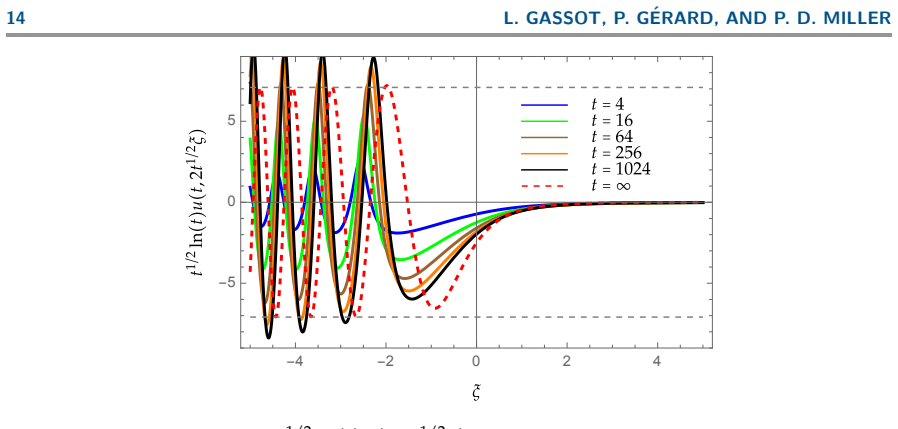
We obtain the leading term in the solution of the Cauchy problem for the Benjamin-Ono equation in the limit t to +∞ with x = O(t to the 1/2). We show that the rate of decay exceeds that of self-similar solutions and obtain an explicit universal profile for the decaying solution, relating it to the linearization of the profile equation for self-similar solutions. The proof assumes a class of rational initial data u0 in L2(R) cap L1(R) that exhibit generic behavior of the reflection coefficient at the origin.
What carries the argument
The linearization of the profile equation for self-similar solutions, linked to the generic value of the reflection coefficient at the origin.
If this is right
- The solution decays strictly faster than the self-similar rate in the indicated scaling window.
- The leading term is given by an explicit formula involving the linearized operator applied to data determined by the reflection coefficient.
- Universality holds whenever the reflection coefficient at zero satisfies the generic condition.
- Higher-order corrections can in principle be obtained by further linearization around this profile.
Where Pith is reading between the lines
- The same linearization technique might yield sharper asymptotics for other integrable equations that possess self-similar solutions.
- Iterating the linearization could produce a full asymptotic series in the sqrt(t) region.
- Direct numerical tests with rational data would provide an immediate check on the predicted profile shape.
Load-bearing premise
The initial data must belong to a class of rational functions whose reflection coefficient at the origin is generic.
What would settle it
Compute the solution numerically at successively larger times for one such rational initial datum, rescale in the region x ~ sqrt(t), and check whether the profile converges to the explicit linearized expression or deviates from it.
Figures



read the original abstract
We obtain the leading term in the solution of the Cauchy problem for the Benjamin-Ono equation in the limit $t\to+\infty$ with $x=O(t^{1/2})$. We show that the rate of decay exceeds that of self-similar solutions and obtain an explicit universal profile for the decaying solution, relating it to the linearization of the profile equation for self-similar solutions. The proof assumes a class of rational initial data $u_0$ in $L^2(\mathbb{R})\cap L^1(\mathbb{R})$ that exhibit generic behavior of the reflection coefficient at the origin.
Editorial analysis
A structured set of objections, weighed in public.
Referee Report
Summary. The paper claims to derive the leading asymptotic term for solutions of the Cauchy problem for the Benjamin-Ono equation as t → +∞ with x = O(t^{1/2}), showing that the decay rate exceeds that of self-similar solutions and obtaining an explicit universal profile obtained by linearizing the profile equation for self-similar solutions. The result is established under the assumption of rational initial data u₀ ∈ L²(ℝ) ∩ L¹(ℝ) whose reflection coefficient r(k) exhibits generic behavior at k = 0.
Significance. If the derivation holds under the stated assumptions, the result would provide a precise and explicit description of the long-time dispersive decay for the Benjamin-Ono equation in the indicated scaling regime, connecting it directly to the linearized self-similar dynamics. This could strengthen the understanding of universality phenomena in integrable dispersive equations, particularly through the explicit profile construction.
major comments (1)
- [Abstract and §1] Abstract and §1 (assumption on data class): The leading-term result and universality claim are obtained only for the subclass of rational data whose scattering data satisfy the generic condition on r(k) at k=0. The manuscript states the theorem under this assumption but does not show that the condition holds on a dense subset of the rational data class in L² ∩ L¹, nor does it provide a density argument or measure-theoretic justification. Because the linearization step relies on this condition to capture the leading term, the scope of the universality statement remains unclear without further justification of the assumption.
Simulated Author's Rebuttal
We thank the referee for the careful reading and the constructive comment on the scope of our assumptions. We address the point below.
read point-by-point responses
-
Referee: [Abstract and §1] Abstract and §1 (assumption on data class): The leading-term result and universality claim are obtained only for the subclass of rational data whose scattering data satisfy the generic condition on r(k) at k=0. The manuscript states the theorem under this assumption but does not show that the condition holds on a dense subset of the rational data class in L² ∩ L¹, nor does it provide a density argument or measure-theoretic justification. Because the linearization step relies on this condition to capture the leading term, the scope of the universality statement remains unclear without further justification of the assumption.
Authors: We agree that the manuscript states the result under the generic condition on r(k) at k=0 without an explicit density argument in the rational data class. The theorem is formulated precisely for data satisfying this condition, which is the regime in which the linearized self-similar profile furnishes the leading term. To clarify the scope of the universality claim, we will add a brief paragraph in §1 showing that the generic condition defines an open dense subset of the space of admissible rational reflection coefficients (by small perturbations of poles and residues that preserve rationality and the L² ∩ L¹ properties). This revision will make the genericity explicit. revision: yes
Circularity Check
No significant circularity; derivation is self-contained under stated assumptions
full rationale
The paper derives the leading long-time asymptotic term and explicit universal profile for the Benjamin-Ono Cauchy problem by relating the decaying solution to the linearization of the self-similar profile equation. This is done explicitly for a restricted class of rational initial data in L2 ∩ L1 whose scattering data satisfy a stated generic condition on the reflection coefficient at k=0. The assumption is declared upfront in the abstract and is not hidden or derived from the target result itself. No step reduces a prediction to a fitted input by construction, renames a known empirical pattern, or relies on a load-bearing self-citation whose content is unverified. The central claim therefore retains independent mathematical content from the PDE, the data class, and the linearization step.
Axiom & Free-Parameter Ledger
axioms (1)
- standard math The Benjamin-Ono equation is integrable via the inverse scattering transform for the given class of initial data.
Reference graph
Works this paper leans on
-
[1]
M. J. ABLOWITZ ANDH. SEGUR,Asymptotic solutions of the Korteweg-de Vries equation, Stud. Appl. Math., 57 (1976/77), pp. 13–44, https://doi.org/10.1002/sapm197757113
-
[2]
E. BLACKSTONE, L. GASSOT, P. G ´ERARD,ANDP. D. MILLER,The Benjamin-Ono initial-value problem for rational data with application to long-time asymptotics and scattering, Ann. Inst. H. Poincar ´e C Anal. Non Lin´eare, (2025), https://doi.org/10.4171/AIHPC/169. Published online first. arXiv:2410.14870
-
[3]
BLACKSTONE, P
E. BLACKSTONE, P. D. MILLER,ANDM. D. MITCHELL,Universality in the small-dispersion limit of the Benjamin-Ono equation, Comm. Math. Phys., 407 (2026), pp. 1–69, https://doi.org/10.1007/ s00220-025-05506-z. Paper No. 60
2026
-
[4]
P. A. DEIFT, S. VENAKIDES,ANDX. ZHOU,The collisionless shock region for the long-time behavior of solutions of the KdV equation, Comm. Pure Appl. Math., 47 (1994), pp. 199–206, https://doi.org/10.1002/cpa. 3160470204. LINEARIZED SELF-SIMILAR UNIVERSALITY FOR BENJAMIN-ONO 33 [5]NIST Digital Library of Mathematical Functions. https://dlmf.nist.gov/, Release...
work page doi:10.1002/cpa 1994
-
[5]
L. GASSOT ANDP. G ´ERARD,Infinite-order multisoliton solutions to the Benjamin-Ono equation and soliton reso- lution, 2026, https://arxiv.org/abs/2603.15419
arXiv 2026
-
[6]
GASSOT, P
L. GASSOT, P. G ´ERARD,ANDP. D. MILLER. In preparation
- [7]
-
[8]
G ´ERARD,An explicit formula for the Benjamin-Ono equation, Tunis
P. G ´ERARD,An explicit formula for the Benjamin-Ono equation, Tunis. J. Math., 5 (2023), pp. 593–603, https: //doi.org/10.2140/tunis.2023.5.593
-
[9]
D. J. KAUP ANDY. MATSUNO,The inverse scattering transform for the Benjamin-Ono equation, Stud. Appl. Math., 101 (1998), pp. 73–98, https://doi.org/10.1111/1467-9590.00086
-
[10]
P. D. MILLER ANDA. N. WETZEL,Direct scattering for the Benjamin-Ono equation with rational initial data, Stud. Appl. Math., 137 (2015), pp. 53–69, https://doi.org/10.1111/sapm.12101
-
[11]
Physica D: Nonlinear Phenomena , volume =
H. SEGUR ANDM. J. ABLOWITZ,Asymptotic solutions of non-linear evolution-equations and a Painlev´ e tran- scendent, Phys. D, 3 (1981), pp. 165–184, https://doi.org/10.1016/0167-2789(81)90124-X
-
[12]
SUN,Complete integrability of the Benjamin-Ono equation on the multi-soliton manifolds, Comm
R. SUN,Complete integrability of the Benjamin-Ono equation on the multi-soliton manifolds, Comm. Math. Phys., 383 (2021), pp. 1051–1092, https://doi.org/10.1007/s00220-021-03996-1
-
[13]
WU,Jost solutions the direct scattering problem of the Benjamin-Ono equation, SIAM J
Y. WU,Jost solutions the direct scattering problem of the Benjamin-Ono equation, SIAM J. Math. Anal., 49 (2017), pp. 5158–5206, https://doi.org/10.1137/17M1124528
discussion (0)
Sign in with ORCID, Apple, or X to comment. Anyone can read and Pith papers without signing in.