Bridging Auxiliary Constraints to Resolve Instruction Following in Large Reasoning Models
Pith reviewed 2026-06-28 09:52 UTC · model grok-4.3
The pith
Representing instructions as a constraint graph and adding bridge constraints from the model's knowledge reduces violations by 39% in large reasoning models.
A machine-rendered reading of the paper's core claim, the machinery that carries it, and where it could break.
Core claim
The central claim is that the Constraint Relationship Graph Completion framework solves the Constraint Adherence Problem by representing instructions as a structured knowledge graph of constraints, explicitly modeling relationships between them, identifying adherence challenges, and discovering bridge constraints that help the model better focus on and reconcile primary requirements.
What carries the argument
Constraint Relationship Graph Completion (CRGC), which builds a knowledge graph of constraints and completes it with bridge constraints drawn from the model's own knowledge to improve salience and compatibility.
If this is right
- Large reasoning models can handle multiple competing instructions with fewer violations.
- Constraint satisfaction improves by leveraging the model's existing knowledge rather than general retraining.
- Reasoning abilities remain intact after the method is applied.
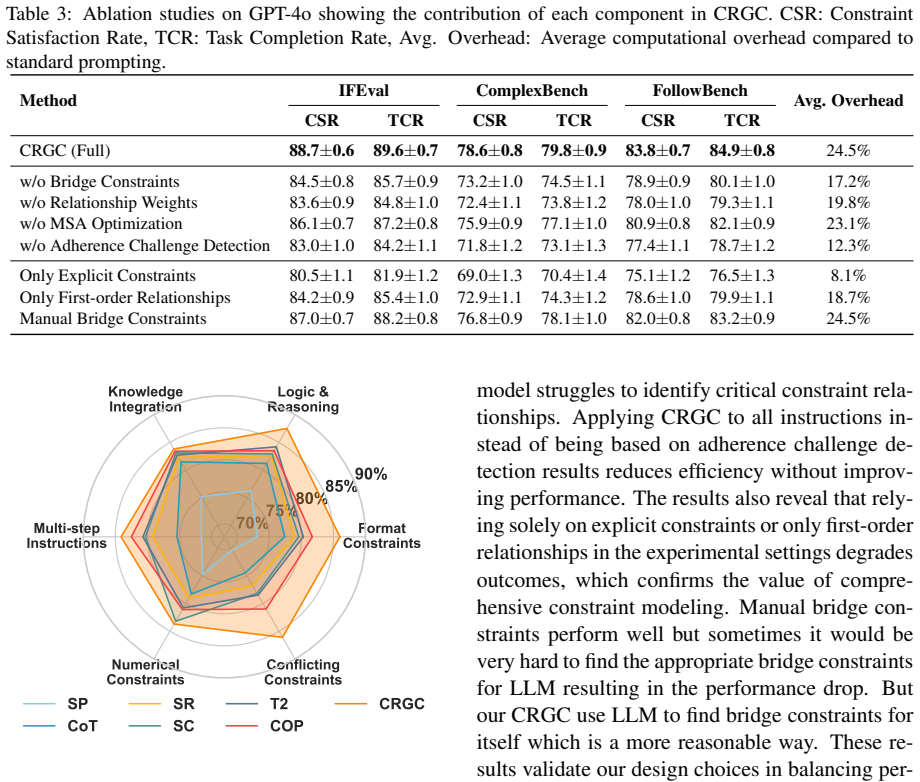
- The approach works across three standard instruction-following datasets.
Where Pith is reading between the lines
- Bridge constraints could serve as a diagnostic tool to surface hidden conflicts inside a set of instructions.
- The graph-completion step might reduce the need for task-specific fine-tuning on instruction-following benchmarks.
- The same structure could apply to other multi-constraint generation tasks such as code synthesis or planning.
Load-bearing premise
The assumption that a structured knowledge graph of constraints plus bridge constraints discovered from the model's own knowledge will reliably make primary constraints more salient and compatible without introducing new violations or degrading performance.
What would settle it
Running CRGC on the three instruction-following datasets and finding that it produces the same number or more constraint violations than standard prompting.
Figures



read the original abstract
Large Reasoning Models (LRMs) have demonstrated impressive capabilities in many tasks, yet they struggle with reliably following multiple instructions, either by failing to satisfy individual constraints or by struggling to balance competing constraints simultaneously. We formalize this challenge as the Constraint Adherence Problem (CAP). This paper introduces a novel framework that addresses CAP by representing instructions as a structured knowledge graph of constraints. Our approach, Constraint Relationship Graph Completion (CRGC), explicitly models relationships between constraints, identifies adherence challenges, and discovers ``bridge constraints'' that help the model better focus on and reconcile requirements. Bridge constraints act as auxiliary instructions that make primary constraints more salient and compatible. Unlike existing approaches that enhance instruction following through general training methods, CRGC specifically improves constraint satisfaction by leveraging the model's own knowledge to create better pathways for generation. Experiments across three popular instruction following datasets demonstrate that our approach reduces constraint violations by 39% compared to standard prompting while maintaining reasoning abilities of large reasoning models.
Editorial analysis
A structured set of objections, weighed in public.
Referee Report
Summary. The paper formalizes the Constraint Adherence Problem (CAP) in Large Reasoning Models (LRMs), where models fail to satisfy or balance multiple instructions. It proposes Constraint Relationship Graph Completion (CRGC), which represents instructions as a knowledge graph of constraints, models inter-constraint relationships, identifies challenges, and discovers 'bridge constraints' generated from the LRM's own knowledge to make primary constraints more salient and compatible. Experiments on three instruction-following datasets are claimed to show a 39% reduction in constraint violations relative to standard prompting, without degrading reasoning performance.
Significance. If the empirical results and the reliability of the self-generated auxiliaries are substantiated, the approach would supply a training-free technique for improving multi-constraint instruction following in LRMs by constructing auxiliary pathways from the model's existing knowledge, addressing a deployment-relevant limitation.
major comments (2)
- [Abstract] Abstract: the central claim of a 39% reduction in constraint violations supplies no information on experimental design, chosen datasets, baselines, number of examples, statistical significance, or error bars, so the quantitative result cannot be evaluated.
- [Method] Method description (CRGC framework): the construction of the constraint knowledge graph and the discovery of bridge constraints are performed by the same LRM that the paper states struggles with CAP; no ablation, verification step, or analysis is described to demonstrate that systematic adherence failures do not propagate into the auxiliary structures and thereby leave violations unchanged or introduce new ones.
minor comments (1)
- [Abstract] The acronym LRM is introduced without an explicit definition or reference to prior literature on large reasoning models.
Simulated Author's Rebuttal
We thank the referee for the constructive feedback. We address the two major comments point by point below and commit to revisions that improve the manuscript's clarity and substantiation of claims.
read point-by-point responses
-
Referee: [Abstract] Abstract: the central claim of a 39% reduction in constraint violations supplies no information on experimental design, chosen datasets, baselines, number of examples, statistical significance, or error bars, so the quantitative result cannot be evaluated.
Authors: We agree the abstract is too concise and omits key experimental details needed to evaluate the 39% claim. In the revised version we will expand the abstract to name the three instruction-following datasets, identify the baselines (standard prompting and any others), state the evaluation scale, and report statistical significance together with error bars. revision: yes
-
Referee: [Method] Method description (CRGC framework): the construction of the constraint knowledge graph and the discovery of bridge constraints are performed by the same LRM that the paper states struggles with CAP; no ablation, verification step, or analysis is described to demonstrate that systematic adherence failures do not propagate into the auxiliary structures and thereby leave violations unchanged or introduce new ones.
Authors: This is a substantive concern. The CRGC design intentionally elicits bridge constraints from the LRM's own knowledge to increase salience and compatibility of primary constraints. Nevertheless, the current manuscript provides no explicit verification or ablation of the generated auxiliaries. We will add a dedicated analysis subsection (including an ablation on graph-construction quality) to the revised method section to examine whether adherence failures propagate into the auxiliary structures. revision: yes
Circularity Check
No circularity; empirical method validated on external datasets
full rationale
The paper presents CRGC as a framework that builds a constraint knowledge graph and discovers bridge constraints by querying the LRM itself, then reports a 39% reduction in violations on three instruction-following datasets relative to standard prompting. No equations, fitted parameters, or derivations appear in the text that would make the performance gain equivalent to the inputs by construction. The central result is measured against external benchmarks and remains falsifiable; the use of the model's own knowledge is an explicit modeling choice whose effectiveness is tested rather than assumed by definition or self-citation. No load-bearing self-citations, ansatzes, or renamings of known results are present.
Axiom & Free-Parameter Ledger
Reference graph
Works this paper leans on
-
[1]
Zhang, Zhihan and Li, Shiyang and Zhang, Zixuan and Liu, Xin and Jiang, Haoming and Tang, Xianfeng and Gao, Yifan and Li, Zheng and Wang, Haodong and Tan, Zhaoxuan and others , booktitle=
-
[2]
I n F o B ench: Evaluating Instruction Following Ability in Large Language Models
Qin, Yiwei and Song, Kaiqiang and Hu, Yebowen and Yao, Wenlin and Cho, Sangwoo and Wang, Xiaoyang and Wu, Xuansheng and Liu, Fei and Liu, Pengfei and Yu, Dong. I n F o B ench: Evaluating Instruction Following Ability in Large Language Models. Findings of the Association for Computational Linguistics: ACL 2024. 2024. doi:10.18653/v1/2024.findings-acl.772
-
[3]
2025 , url=
Alessandro Stolfo and Vidhisha Balachandran and Safoora Yousefi and Eric Horvitz and Besmira Nushi , booktitle=. 2025 , url=
2025
-
[4]
Wu, Xiaodong and Wang, Minhao and Liu, Yichen and Shi, Xiaoming and Yan, He and Xiangju, Lu and Zhu, Junmin and Zhang, Wei. LIFB ench: E valuating the I nstruction F ollowing P erformance and S tability of L arge L anguage M odels in L ong- C ontext S cenarios. P roceedings of the 63rd A nnual M eeting of the A ssociation for C omputational L inguistics (...
-
[5]
2024 , url=
Juyeon Heo and Christina Heinze-Deml and Oussama Elachqar and Shirley You Ren and Kwan Ho Ryan Chan and Udhyakumar Nallasamy and Andrew Miller and Jaya Narain , booktitle=. 2024 , url=
2024
-
[6]
Ouyang, Long and Wu, Jeffrey and Jiang, Xu and Almeida, Diogo and Wainwright, Carroll and Mishkin, Pamela and Zhang, Chong and Agarwal, Sandhini and Slama, Katarina and Ray, Alex and others , journal=
-
[7]
Dai and Quoc V Le , booktitle=
Jason Wei and Maarten Bosma and Vincent Zhao and Kelvin Guu and Adams Wei Yu and Brian Lester and Nan Du and Andrew M. Dai and Quoc V Le , booktitle=. 2022 , url=
2022
-
[8]
Chung, Hyung Won and Hou, Le and Longpre, Shayne and Zoph, Barret and Tay, Yi and Fedus, William and Li, Yunxuan and Wang, Xuezhi and Dehghani, Mostafa and Brahma, Siddhartha and others , journal=
-
[9]
2023 , url=
Longpre, Shayne and Hou, Le and Vu, Tu and Webson, Albert and Chung, Hyung Won and Tay, Yi and Zhou, Denny and Le, Quoc V and Zoph, Barret and Wei, Jason and others , booktitle=. 2023 , url=
2023
-
[10]
2024 , url=
Wei Liu and Weihao Zeng and Keqing He and Yong Jiang and Junxian He , booktitle=. 2024 , url=
2024
-
[11]
J I ^2 S : J oint I nfluence - A ware I nstruction D ata S election for E fficient F ine - T uning
Wei, Jingyu and Liu, Bo and Wan, Tianjiao and Peng, Baoyun and Ma, Xingkong and Guo, Mengmeng. J I ^2 S : J oint I nfluence - A ware I nstruction D ata S election for E fficient F ine - T uning. P roceedings of the 2025 C onference on E mpirical M ethods in N atural L anguage P rocessing. 2025
2025
-
[12]
Luo, Ziyang and Li, Kaixin and Lin, Hongzhan and Tian, Yuchen and Kankanhalli, Mohan and Ma, Jing. T ree-of- E volution: T ree- S tructured I nstruction E volution for C ode G eneration in L arge L anguage M odels. P roceedings of the 63rd A nnual M eeting of the A ssociation for C omputational L inguistics ( V olume 1: L ong P apers). 2025. doi:10.18653/...
-
[13]
A nswer is A ll Y ou N eed: I nstruction-following T ext E mbedding via A nswering the Q uestion
Peng, Letian and Zhang, Yuwei and Wang, Zilong and Srinivasa, Jayanth and Liu, Gaowen and Wang, Zihan and Shang, Jingbo. A nswer is A ll Y ou N eed: I nstruction-following T ext E mbedding via A nswering the Q uestion. P roceedings of the 62nd A nnual M eeting of the A ssociation for C omputational L inguistics ( V olume 1: L ong P apers). 2024. doi:10.18...
-
[14]
Honovich, Or and Shaham, Uri and Bowman, Samuel R. and Levy, Omer. I nstruction I nduction: F rom F ew E xamples to N atural L anguage T ask D escriptions. P roceedings of the 61st A nnual M eeting of the A ssociation for C omputational L inguistics ( V olume 1: L ong P apers). 2023. doi:10.18653/v1/2023.acl-long.108
-
[15]
F act- C hecking C omplex C laims with P rogram- G uided R easoning
Pan, Liangming and Wu, Xiaobao and Lu, Xinyuan and Luu, Anh Tuan and Wang, William Yang and Kan, Min-Yen and Nakov, Preslav. F act- C hecking C omplex C laims with P rogram- G uided R easoning. P roceedings of the 61st A nnual M eeting of the A ssociation for C omputational L inguistics ( V olume 1: L ong P apers). 2023. doi:10.18653/v1/2023.acl-long.386
-
[16]
Li, Jiaqi and Li, Yanming and Shen, Xiaoli and Zhang, Chuanyi and Qi, Guilin and Bi, Sheng. O pen- W orld A ttribute M ining for E - C ommerce P roducts with M ultimodal S elf- C orrection I nstruction T uning. P roceedings of the 63rd A nnual M eeting of the A ssociation for C omputational L inguistics ( V olume 1: L ong P apers). 2025. doi:10.18653/v1/2...
-
[17]
M ath F usion: E nhancing M athematical P roblem-solving of LLM through I nstruction F usion
Pei, Qizhi and Wu, Lijun and Pan, Zhuoshi and Li, Yu and Lin, Honglin and Ming, Chenlin and Gao, Xin and He, Conghui and Yan, Rui. M ath F usion: E nhancing M athematical P roblem-solving of LLM through I nstruction F usion. P roceedings of the 63rd A nnual M eeting of the A ssociation for C omputational L inguistics ( V olume 1: L ong P apers). 2025. doi...
-
[18]
RAG - I nstruct: B oosting LLM s with D iverse R etrieval- A ugmented I nstructions
Liu, Wanlong and Chen, Junying and Ji, Ke and Zhou, Li and Chen, Wenyu and Wang, Benyou. RAG - I nstruct: B oosting LLM s with D iverse R etrieval- A ugmented I nstructions. P roceedings of the 2025 C onference on E mpirical M ethods in N atural L anguage P rocessing. 2025
2025
-
[19]
L earning A ction C onditions from I nstructional M anuals for I nstruction U nderstanding
Wu, Te-Lin and Zhang, Caiqi and Hu, Qingyuan and Spangher, Alexander and Peng, Nanyun. L earning A ction C onditions from I nstructional M anuals for I nstruction U nderstanding. P roceedings of the 61st A nnual M eeting of the A ssociation for C omputational L inguistics ( V olume 1: L ong P apers). 2023. doi:10.18653/v1/2023.acl-long.170
-
[20]
Du, Yulun and Chilton, Lydia. S tory W ars: A D ataset and I nstruction T uning B aselines for C ollaborative S tory U nderstanding and G eneration. P roceedings of the 61st A nnual M eeting of the A ssociation for C omputational L inguistics ( V olume 1: L ong P apers). 2023. doi:10.18653/v1/2023.acl-long.171
-
[21]
Yin, Fan and Vig, Jesse and Laban, Philippe and Joty, Shafiq and Xiong, Caiming and Wu, Chien-Sheng. D id Y ou R ead the I nstructions? R ethinking the E ffectiveness of T ask D efinitions in I nstruction L earning. P roceedings of the 61st A nnual M eeting of the A ssociation for C omputational L inguistics ( V olume 1: L ong P apers). 2023. doi:10.18653...
-
[22]
OPE x: A C omponent- W ise A nalysis of LLM - C entric A gents in E mbodied I nstruction F ollowing
Shi, Haochen and Sun, Zhiyuan and Yuan, Xingdi and C \^o t \'e , Marc-Alexandre and Liu, Bang. OPE x: A C omponent- W ise A nalysis of LLM - C entric A gents in E mbodied I nstruction F ollowing. P roceedings of the 62nd A nnual M eeting of the A ssociation for C omputational L inguistics ( V olume 1: L ong P apers). 2024. doi:10.18653/v1/2024.acl-long.37
-
[23]
H ow O ften A re E rrors in N atural L anguage R easoning D ue to P araphrastic V ariability?
Srikanth, Neha and Carpuat, Marine and Rudinger, Rachel. H ow O ften A re E rrors in N atural L anguage R easoning D ue to P araphrastic V ariability?. Transactions of the Association for Computational Linguistics. 2024. doi:10.1162/tacl_a_00692
-
[24]
D istilling an E nd-to- E nd V oice A ssistant W ithout I nstruction T raining D ata
Held, William and Zhang, Yanzhe and Li, Minzhi and Shi, Weiyan and Ryan, Michael J and Yang, Diyi. D istilling an E nd-to- E nd V oice A ssistant W ithout I nstruction T raining D ata. P roceedings of the 63rd A nnual M eeting of the A ssociation for C omputational L inguistics ( V olume 1: L ong P apers). 2025. doi:10.18653/v1/2025.acl-long.388
-
[25]
Zhang, Linhai and Wu, Jialong and Zhou, Deyu and Xu, Guoqiang. STAR : C onstraint L o RA with D ynamic A ctive L earning for D ata- E fficient F ine- T uning of L arge L anguage M odels. F indings of the A ssociation for C omputational L inguistics: A C L 2024. 2024. doi:10.18653/v1/2024.findings-acl.209
-
[26]
Shi, Yu-Zhe and Hou, Haofei and Bi, Zhangqian and Meng, Fanxu and Wei, Xiang and Ruan, Lecheng and Wang, Qining. A uto DSL : A utomated D omain-specific L anguage D esign for S tructural R epresentation of P rocedures with C onstraints. P roceedings of the 62nd A nnual M eeting of the A ssociation for C omputational L inguistics ( V olume 1: L ong P apers...
-
[27]
Jiang, Yuxin and Wang, Yufei and Zeng, Xingshan and Zhong, Wanjun and Li, Liangyou and Mi, Fei and Shang, Lifeng and Jiang, Xin and Liu, Qun and Wang, Wei. F ollow B ench: A M ulti-level F ine-grained C onstraints F ollowing B enchmark for L arge L anguage M odels. P roceedings of the 62nd A nnual M eeting of the A ssociation for C omputational L inguisti...
-
[28]
M eme R ea C on: P robing C ontextual M eme U nderstanding in L arge V ision- L anguage M odels
Zhao, Zhengyi and Zhang, Shubo and Zhang, Yuxi and Zhao, Yanxi and Zhang, Yifan and Wang, Zezhong and Wang, Huimin and Zhao, Yutian and Liang, Bin and Zheng, Yefeng and Li, Binyang and Wong, Kam-Fai and Wu, Xian. M eme R ea C on: P robing C ontextual M eme U nderstanding in L arge V ision- L anguage M odels. P roceedings of the 2025 C onference on E mpiri...
2025
-
[29]
T ^2 : A n A daptive T est- T ime S caling S trategy for C ontextual Q uestion A nswering
Zhao, Zhengyi and Zhang, Shubo and Wang, Zezhong and Wang, Huimin and Zhao, Yutian and Liang, Bin and Zheng, Yefeng and Li, Binyang and Wong, Kam-Fai and Wu, Xian. T ^2 : A n A daptive T est- T ime S caling S trategy for C ontextual Q uestion A nswering. P roceedings of the 2025 C onference on E mpirical M ethods in N atural L anguage P rocessing. 2025
2025
-
[30]
Findings of the Association for Computational Linguistics: EMNLP 2024 , pages=
LLM self-correction with DeCRIM: Decompose, critique, and refine for enhanced following of instructions with multiple constraints , author=. Findings of the Association for Computational Linguistics: EMNLP 2024 , pages=
2024
-
[31]
Findings of the Association for Computational Linguistics: ACL 2025 , pages=
Divide-Verify-Refine: Can LLMs Self-Align with Complex Instructions? , author=. Findings of the Association for Computational Linguistics: ACL 2025 , pages=
2025
-
[32]
Wei, Jason and Wang, Xuezhi and Schuurmans, Dale and Bosma, Maarten and Xia, Fei and Chi, Ed and Le, Quoc V and Zhou, Denny and others , journal=
-
[33]
Chi and Sharan Narang and Aakanksha Chowdhery and Denny Zhou , booktitle=
Xuezhi Wang and Jason Wei and Dale Schuurmans and Quoc V Le and Ed H. Chi and Sharan Narang and Aakanksha Chowdhery and Denny Zhou , booktitle=. 2023 , url=
2023
-
[34]
Towards Mitigating LLM Hallucination via Self Reflection
Ji, Ziwei and Yu, Tiezheng and Xu, Yan and Lee, Nayeon and Ishii, Etsuko and Fung, Pascale. T owards M itigating LLM H allucination via S elf R eflection. F indings of the A ssociation for C omputational L inguistics: E M N L P 2023. 2023. doi:10.18653/v1/2023.findings-emnlp.123
-
[35]
Prompt Optimization via Adversarial In-Context Learning
Do, Xuan Long and Zhao, Yiran and Brown, Hannah and Xie, Yuxi and Zhao, James Xu and Chen, Nancy F. and Kawaguchi, Kenji and Shieh, Michael and He, Junxian. P rompt O ptimization via A dversarial I n- C ontext L earning. P roceedings of the 62nd A nnual M eeting of the A ssociation for C omputational L inguistics ( V olume 1: L ong P apers). 2024. doi:10....
-
[36]
2024 , url=
OpenAI , journal=. 2024 , url=
2024
-
[37]
2025 , url=
Google , journal=. 2025 , url=
2025
-
[38]
arXiv preprint arXiv:2412.15115v1 , url=
Alibaba , year=. arXiv preprint arXiv:2412.15115v1 , url=
-
[39]
arXiv preprint arXiv:2401.04088v1 , url=
Mixtral , year=. arXiv preprint arXiv:2401.04088v1 , url=
-
[40]
Zhou, Jeffrey and Lu, Tianjian and Mishra, Swaroop and Brahma, Siddhartha and Basu, Sujoy and Luan, Yi and Zhou, Denny and Hou, Le , journal=
-
[41]
doi:10.52202/079017-4371 , editor =
Wen, Bosi and Ke, Pei and Gu, Xiaotao and Wu, Lindong and Huang, Hao and Zhou, Jinfeng and Li, Wenchuang and Hu, Binxin and Gao, Wendy and Xu, Jiaxin and Liu, Yiming and Tang, Jie and Wang, Hongning and Huang, Minlie , booktitle =. doi:10.52202/079017-4371 , editor =
-
[42]
2021 , url=
Dan Hendrycks and Collin Burns and Steven Basart and Andy Zou and Mantas Mazeika and Dawn Song and Jacob Steinhardt , booktitle=. 2021 , url=
2021
-
[43]
Cobbe, Karl and Kosaraju, Vineet and Bavarian, Mohammad and Chen, Mark and Jun, Heewoo and Kaiser, Lukasz and Plappert, Matthias and Tworek, Jerry and Hilton, Jacob and Nakano, Reiichiro and others , journal=
-
[44]
Suzgun, Mirac and Scales, Nathan and Sch. C hallenging BIG - B ench T asks and W hether C hain-of- T hought C an S olve T hem. F indings of the A ssociation for C omputational L inguistics: A C L 2023. 2023. doi:10.18653/v1/2023.findings-acl.824
-
[45]
and Schult, Daniel A
Hagberg, Aric A. and Schult, Daniel A. and Swart, Pieter J. , booktitle=. 2008 , url=
2008
-
[46]
Gonzalez and Hao Zhang and Ion Stoica , booktitle=
Woosuk Kwon and Zhuohan Li and Siyuan Zhuang and Ying Sheng and Lianmin Zheng and Cody Hao Yu and Joseph E. Gonzalez and Hao Zhang and Ion Stoica , booktitle=
-
[47]
Edmonds, Jack and others , journal=
-
[48]
2020 , url=
Sumanth Dathathri and Andrea Madotto and Janice Lan and Jane Hung and Eric Frank and Piero Molino and Jason Yosinski and Rosanne Liu , booktitle=. 2020 , url=
2020
-
[49]
G e D i: G enerative D iscriminator G uided S equence G eneration
Krause, Ben and Gotmare, Akhilesh Deepak and McCann, Bryan and Keskar, Nitish Shirish and Joty, Shafiq and Socher, Richard and Rajani, Nazneen Fatema. G e D i: G enerative D iscriminator G uided S equence G eneration. Findings of the Association for Computational Linguistics: EMNLP 2021. 2021. doi:10.18653/v1/2021.findings-emnlp.424
-
[50]
Extracting Latent Steering Vectors from Pretrained Language Models
Subramani, Nishant and Suresh, Nivedita and Peters, Matthew. E xtracting L atent S teering V ectors from P retrained L anguage M odels. Findings of the Association for Computational Linguistics: ACL 2022. 2022. doi:10.18653/v1/2022.findings-acl.48
-
[51]
2024 , publisher=
Wang, Shiyu and Du, Yuanqi and Guo, Xiaojie and Pan, Bo and Qin, Zhaohui and Zhao, Liang , journal=. 2024 , publisher=
2024
discussion (0)
Sign in with ORCID, Apple, or X to comment. Anyone can read and Pith papers without signing in.