TeX-1500: A Paired Real-World LWIR Hyperspectral Dataset and Benchmark for Temperature-Emissivity-Texture Decomposition
Pith reviewed 2026-06-28 10:35 UTC · model grok-4.3
The pith
TeX-1500 supplies 1522 real paired LWIR hyperspectral scenes with aligned temperature, emissivity, and texture labels.
A machine-rendered reading of the paper's core claim, the machinery that carries it, and where it could break.
Core claim
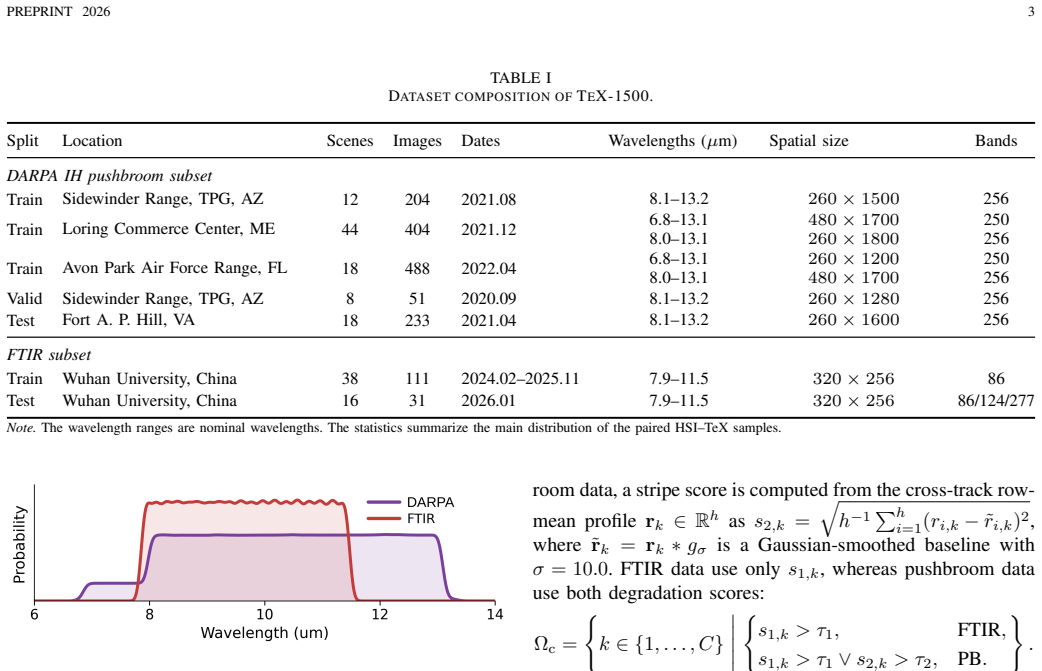
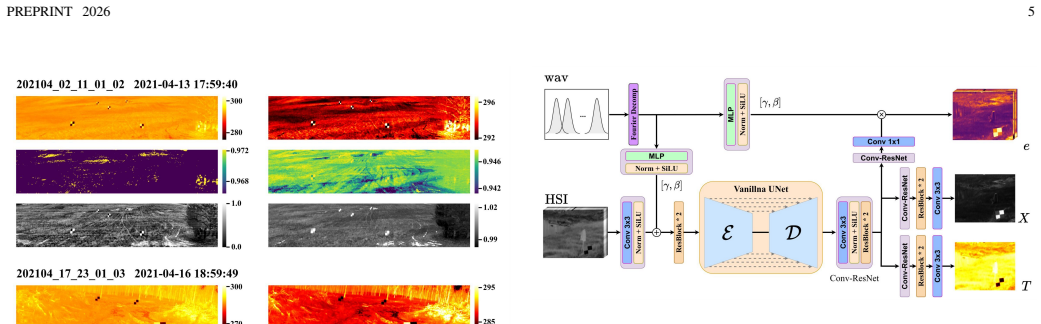
TeX-1500 contains 1,522 calibrated real-scene pairs of LWIR hyperspectral imagery and their temperature-emissivity-texture decompositions, drawn from DARPA IH pushbroom and FTIR acquisitions across five locations and four seasons. Each pair stores a valid-band radiance cube, wavelength positions, and aligned supervision labels produced by a consistent restoration and TeX-construction protocol. A simple TeX-UNet baseline maps the input bands and wavelengths to the three output fields, and experiments on held-out scenes plus zero- and few-shot transfer confirm that the pairs supply usable supervision for data-driven decomposition.
What carries the argument
The TeX-1500 paired dataset, which supplies real LWIR hyperspectral radiance cubes together with constructed temperature, emissivity, and texture supervision.
If this is right
- Supervised models can be trained end-to-end to map LWIR hyperspectral cubes directly to temperature, emissivity, and texture fields.
- Data-driven decomposition becomes feasible as an alternative to per-scene inverse solvers.
- Performance of different decomposition algorithms can be compared quantitatively on the same held-out real scenes.
- Models trained on the dataset can be tested for transfer to new sensors and wavelength layouts without retraining from scratch.
- Physical-property recovery in thermal perception can shift from purely optimization-based methods to learned ones.
Where Pith is reading between the lines
- The dataset construction protocol could be reused or adapted to create similar paired supervision in other spectral ranges or imaging modalities.
- Models trained on TeX-1500 might improve downstream tasks such as material classification or anomaly detection that rely on accurate emissivity or temperature estimates.
- The benchmark could encourage development of architectures that explicitly handle variable numbers of spectral bands.
- Larger-scale collection using the same protocol might reduce reliance on any single sensor family.
Load-bearing premise
The temperature, emissivity, and texture labels built by the consistent restoration and TeX-construction protocol are accurate enough to act as reliable supervision.
What would settle it
Independent high-precision measurements on a subset of the same scenes that show systematic, repeatable differences from the dataset's constructed TeX labels.
Figures



read the original abstract
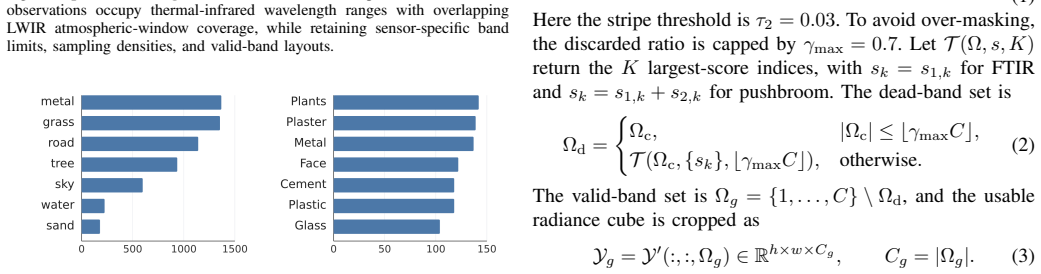
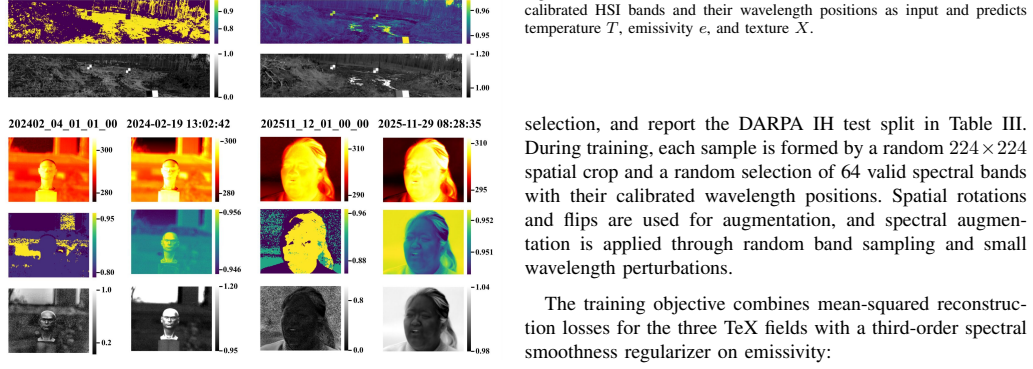
Temperature-emissivity-texture (TeX) decomposition seeks to recover object heat state, material spectral response, and visible-like geometric texture from long-wave infrared hyperspectral imaging (LWIR HSI). Existing TeX pipelines are mainly scene-specific inverse solvers, and the lack of paired LWIR HSI-TeX supervision has limited learning-based decomposition. To address this gap, we introduce TeX-1500, a large-scale paired LWIR HSI-TeX dataset and benchmark for supervised HSI-to-TeX decomposition. TeX-1500 contains 1,522 calibrated real-scene pairs from DARPA Invisible Headlights (DARPA IH) pushbroom imagery and our FTIR acquisitions, covering five locations, four seasons, diverse acquisition times, heterogeneous wavelength layouts, and two sensor families. Each sample stores a calibrated valid-band radiance cube, calibrated wavelength positions, and aligned temperature, emissivity, and texture supervision constructed through a consistent restoration and TeX-construction protocol. We further provide TeX-UNet, a simple wavelength-aware baseline that maps calibrated HSI bands and wavelength positions to TeX fields. Experiments on the held-out DARPA IH pushbroom scenes and zero-/few-shot transfer to FTIR scenes show that TeX-1500 provides usable paired supervision and a measurable benchmark for data-driven physical-property-centered thermal perception.
Editorial analysis
A structured set of objections, weighed in public.
Referee Report
Summary. The paper introduces TeX-1500, a dataset of 1,522 real-world paired LWIR hyperspectral images and aligned temperature-emissivity-texture (TeX) fields constructed from DARPA IH pushbroom and FTIR data across diverse scenes, seasons, and sensors. It describes a consistent restoration and TeX-construction protocol for generating the supervision, releases a wavelength-aware TeX-UNet baseline, and reports held-out and transfer experiments to argue that the dataset enables supervised learning for physical-property-centered thermal perception.
Significance. If the constructed TeX labels are shown to be accurate, the contribution would be significant: it supplies the first large-scale, real-scene paired supervision for data-driven TeX decomposition, where prior work relied on scene-specific inverse solvers. The diversity of acquisition conditions and the inclusion of zero-/few-shot transfer results to a second sensor family strengthen the benchmark value. The release of calibrated radiance cubes, wavelength metadata, and a reproducible baseline further supports downstream use.
major comments (1)
- [Dataset construction / TeX-construction protocol] Section describing the TeX-construction protocol (referenced in the abstract and dataset section): the central claim that TeX-1500 supplies 'usable paired supervision' rests on the accuracy of the constructed temperature, emissivity, and texture fields, yet the manuscript provides no quantitative error characterization, cross-validation against independent physical measurements (e.g., contact thermometry or calibrated blackbody references), or sensitivity analysis of residual calibration/inversion errors. This is load-bearing because unquantified systematic bias in the labels would render the benchmark self-referential rather than an external test of learned decomposition.
minor comments (2)
- [Dataset description] The description of wavelength layouts and valid-band selection across the two sensor families could be expanded with an explicit table or figure showing band counts and spectral coverage per subset.
- [Figures] Figure captions for the example TeX fields should include the specific scene ID, acquisition time, and sensor to allow direct correspondence with the reported transfer results.
Simulated Author's Rebuttal
We thank the referee for the constructive review and for emphasizing the need to substantiate the accuracy of the constructed TeX labels. We address the major comment below and will revise the manuscript accordingly.
read point-by-point responses
-
Referee: [Dataset construction / TeX-construction protocol] Section describing the TeX-construction protocol (referenced in the abstract and dataset section): the central claim that TeX-1500 supplies 'usable paired supervision' rests on the accuracy of the constructed temperature, emissivity, and texture fields, yet the manuscript provides no quantitative error characterization, cross-validation against independent physical measurements (e.g., contact thermometry or calibrated blackbody references), or sensitivity analysis of residual calibration/inversion errors. This is load-bearing because unquantified systematic bias in the labels would render the benchmark self-referential rather than an external test of learned decomposition.
Authors: We agree that quantitative characterization of label accuracy is essential to support the claim of usable paired supervision. The current manuscript details the restoration and TeX-construction protocol but does not include error metrics or sensitivity analysis. In the revised version we will add a dedicated subsection that (i) propagates reported calibration uncertainties from the DARPA IH pushbroom and FTIR source data into the derived temperature, emissivity, and texture fields, (ii) presents a sensitivity study over key inversion parameters (atmospheric correction, emissivity priors, and band selection), and (iii) compares the constructed fields against the blackbody reference measurements that were part of the original DARPA IH and FTIR calibration protocols. While independent contact thermometry was not collected during the field campaigns, the added analysis will quantify residual errors and bound potential systematic bias, thereby addressing the concern that the benchmark could be self-referential. revision: yes
Circularity Check
No circularity: dataset construction with external sources and no self-referential derivation
full rationale
The paper introduces TeX-1500 as a paired dataset constructed from DARPA IH and FTIR acquisitions via a described restoration protocol, with a simple baseline model TeX-UNet. No mathematical derivation chain, fitted parameters renamed as predictions, or self-citation load-bearing uniqueness theorems exist. The contribution is the dataset and benchmark itself rather than any prediction that reduces to its inputs by construction. The protocol is applied to independent external data, and no equations or self-referential steps are present that would trigger the enumerated circularity patterns.
Axiom & Free-Parameter Ledger
axioms (1)
- domain assumption The restoration and TeX-construction protocol produces accurate temperature, emissivity, and texture supervision from the radiance cubes.
Reference graph
Works this paper leans on
-
[1]
Learning Continuous Wasserstein Barycenter Space for Generalized All-in-One Image Restoration ,
X. Tang, X. He, J. Xu, X. Gu, and J. Sun, “ Learning Continuous Wasserstein Barycenter Space for Generalized All-in-One Image Restoration ,”IEEE Transactions on Pattern Analysis & Machine Intelligence, no. 01, pp. 1–16, Feb. 5555. [Online]. Available: https://doi.ieeecomputersociety.org/10.1109/TPAMI.2026.3669121
-
[2]
Single image haze removal using dark channel prior,
K. He, J. Sun, and X. Tang, “Single image haze removal using dark channel prior,”IEEE Transactions on Pattern Analysis and Machine Intelligence, vol. 33, no. 12, pp. 2341–2353, 2011
2011
-
[3]
Visual-in-Visual: A Unified and Efficient Baseline for Image Restoration ,
Y . Cui, W. Ren, B. Shi, and A. Knoll, “ Visual-in-Visual: A Unified and Efficient Baseline for Image Restoration ,”IEEE Transactions on Pattern Analysis & Machine Intelligence, no. 01, pp. 1–18, Mar
-
[4]
Available: https://doi.ieeecomputersociety.org/10.1109/ TPAMI.2026.3669720
[Online]. Available: https://doi.ieeecomputersociety.org/10.1109/ TPAMI.2026.3669720
-
[5]
Heat-assisted detection and ranging,
F. Bao, X. Wang, S. H. Sureshbabu, G. Sreekumar, L. Yang, V . Aggar- wal, V . N. Boddeti, and Z. Jacob, “Heat-assisted detection and ranging,” Nature, vol. 619, no. 7971, pp. 743–748, 2023
2023
-
[6]
Seeing through fog without seeing fog: Deep multi- modal sensor fusion in unseen adverse weather,
M. Bijelic, T. Gruber, F. Mannan, F. Kraus, W. Ritter, K. Dietmayer, and F. Heide, “Seeing through fog without seeing fog: Deep multi- modal sensor fusion in unseen adverse weather,” inProceedings of the IEEE/CVF Conference on Computer Vision and Pattern Recognition, 2020, pp. 11 682–11 692
2020
-
[7]
Rethinking data augmentation for robust lidar semantic segmentation in adverse weather,
J. Park, K. Kim, and H. Shim, “Rethinking data augmentation for robust lidar semantic segmentation in adverse weather,” inComputer Vision – ECCV 2024. Springer, 2024, pp. 320–336
2024
-
[8]
Deep learning- based robust positioning for all-weather autonomous driving,
Y . Almalioglu, M. Turan, N. Trigoni, and A. Markham, “Deep learning- based robust positioning for all-weather autonomous driving,”Nature machine intelligence, vol. 4, no. 9, pp. 749–760, 2022
2022
-
[9]
Non-line-of-sight imaging with picosecond temporal resolution,
B. Wang, M.-Y . Zheng, J.-J. Han, X. Huang, X.-P. Xie, F. Xu, Q. Zhang, and J.-W. Pan, “Non-line-of-sight imaging with picosecond temporal resolution,”Physical Review Letters, vol. 127, no. 5, p. 053602, 2021
2021
-
[10]
Real-time non-line-of-sight computational imaging using spectrum filtering and motion compensation,
J.-T. Ye, Y . Sun, W. Li, J.-W. Zeng, Y . Hong, Z.-P. Li, X. Huang, X. Xue, X. Yuan, F. Xuet al., “Real-time non-line-of-sight computational imaging using spectrum filtering and motion compensation,”Nature Computational Science, vol. 4, no. 12, pp. 920–927, 2024
2024
-
[11]
Why thermal images are blurry,
F. Bao, S. Jape, A. Schramka, J. Wang, T. E. McGraw, and Z. Jacob, “Why thermal images are blurry,”Optics Express, vol. 32, no. 3, pp. 3852–3865, 2024
2024
-
[12]
HADAR-Based Thermal Infrared Hyperspectral Image Restoration
C. Dai, J. Lin, B. Song, Y . Chen, J. Chen, X. Yuan, and F. Bao, “Hadar-based thermal infrared hyperspectral image restoration,” 2026. [Online]. Available: https://arxiv.org/abs/2605.13664
work page internal anchor Pith review Pith/arXiv arXiv 2026
-
[13]
Universal computational thermal imaging overcoming the ghosting effect,
H. Xu, D. Wang, C. Zhao, J. Chen, J. Lin, L. Cao, Y . Zhong, Y . She, and F. Bao, “Universal computational thermal imaging overcoming the ghosting effect,” 2026. [Online]. Available: https: //arxiv.org/abs/2604.01542
-
[14]
Concurrent band selection and traversability estimation from long-wave hyperspec- tral imagery in off-road settings,
F. Yellin, S. McCloskey, C. Hill, E. Smith, and B. Clipp, “Concurrent band selection and traversability estimation from long-wave hyperspec- tral imagery in off-road settings,” inProceedings of the IEEE/CVF Winter Conference on Applications of Computer Vision, 2024, pp. 7483– 7492
2024
-
[15]
Generalized assorted pixel camera: postcapture control of resolution, dynamic range, and spectrum,
F. Yasuma, T. Mitsunaga, D. Iso, and S. K. Nayar, “Generalized assorted pixel camera: postcapture control of resolution, dynamic range, and spectrum,”IEEE transactions on image processing, vol. 19, no. 9, pp. 2241–2253, 2010
2010
-
[16]
Statistics of real-world hyperspectral images,
A. Chakrabarti and T. Zickler, “Statistics of real-world hyperspectral images,” inCVPR 2011, 2011, pp. 193–200
2011
-
[17]
Sparse recovery of hyperspectral signal from natural rgb images,
B. Arad and O. Ben-Shahar, “Sparse recovery of hyperspectral signal from natural rgb images,” inEuropean conference on computer vision. Springer, 2016, pp. 19–34
2016
-
[18]
Ntire 2022 spectral recovery challenge and data set,
B. Arad, R. Timofte, R. Yahel, N. Morag, A. Bernat, Y . Cai, J. Lin, Z. Lin, H. Wang, Y . Zhanget al., “Ntire 2022 spectral recovery challenge and data set,” inProceedings of the IEEE/CVF Conference on Computer Vision and Pattern Recognition, 2022, pp. 863–881
2022
-
[19]
Hyperspectral and lidar data fusion: Outcome of the 2013 grss data fusion contest,
C. Debes, A. Merentitis, R. Heremans, J. Hahn, N. Frangiadakis, T. van Kasteren, W. Liao, R. Bellens, A. Pi ˇzurica, S. Gautama, W. Philips, S. Prasad, Q. Du, and F. Pacifici, “Hyperspectral and lidar data fusion: Outcome of the 2013 grss data fusion contest,”IEEE Journal of Selected Topics in Applied Earth Observations and Remote Sensing, vol. 7, no. 6, ...
2013
-
[20]
X. Hu, Y . Zhong, C. Luo, and X. Wang, “Whu-hi: Uav-borne hy- perspectral with high spatial resolution (h2) benchmark datasets for hyperspectral image classification,”arXiv preprint arXiv:2012.13920, 2020
-
[21]
Satmae: Pre-training transformers for temporal and multi-spectral satellite imagery,
Y . Cong, S. Khanna, C. Meng, P. Liu, E. Rozi, Y . He, M. Burke, D. Lo- bell, and S. Ermon, “Satmae: Pre-training transformers for temporal and multi-spectral satellite imagery,”Advances in Neural Information Processing Systems, vol. 35, pp. 197–211, 2022
2022
-
[22]
Spectralgpt: Spectral remote sensing foun- dation model,
D. Hong, B. Zhang, X. Li, Y . Li, C. Li, J. Yao, N. Yokoya, H. Li, P. Ghamisi, X. Jiaet al., “Spectralgpt: Spectral remote sensing foun- dation model,”IEEE transactions on pattern analysis and machine intelligence, vol. 46, no. 8, pp. 5227–5244, 2024
2024
-
[23]
Spectralearth: Training hyperspectral foundation models at scale,
N. A. A. Braham, C. M. Albrecht, J. Mairal, J. Chanussot, Y . Wang, and X. X. Zhu, “Spectralearth: Training hyperspectral foundation models at scale,”IEEE Journal of Selected Topics in Applied Earth Observations and Remote Sensing, 2025
2025
-
[24]
Hypersigma: Hyperspectral intelligence comprehension foundation model,
D. Wang, M. Hu, Y . Jin, Y . Miao, J. Yang, Y . Xu, X. Qin, J. Ma, L. Sun, C. Li, C. Fu, H. Chen, C. Han, N. Yokoya, J. Zhang, M. Xu, L. Liu, L. Zhang, C. Wu, B. Du, D. Tao, and L. Zhang, “Hypersigma: Hyperspectral intelligence comprehension foundation model,”IEEE Transactions on Pattern Analysis and Machine Intelligence, vol. 47, no. 8, pp. 6427–6444, 2025
2025
-
[25]
Multispectral pedestrian detection: Benchmark dataset and baseline,
S. Hwang, J. Park, N. Kim, Y . Choi, and I. So Kweon, “Multispectral pedestrian detection: Benchmark dataset and baseline,” inProceedings of the IEEE conference on computer vision and pattern recognition, 2015, pp. 1037–1045
2015
-
[26]
Pedestrian detection at day/night time with visible and fir cameras: A comparison,
A. Gonz ´alez, Z. Fang, Y . Socarras, J. Serrat, D. V ´azquez, J. Xu, and A. M. L ´opez, “Pedestrian detection at day/night time with visible and fir cameras: A comparison,”Sensors, vol. 16, no. 6, p. 820, 2016
2016
-
[27]
The tno multiband image data collection,
A. Toet, “The tno multiband image data collection,”Data in brief, vol. 15, p. 249, 2017
2017
-
[28]
Mfnet: Towards real-time semantic segmentation for autonomous vehicles with multi-spectral scenes,
Q. Ha, K. Watanabe, T. Karasawa, Y . Ushiku, and T. Harada, “Mfnet: Towards real-time semantic segmentation for autonomous vehicles with multi-spectral scenes,” in2017 IEEE/RSJ International Conference on Intelligent Robots and Systems (IROS). IEEE, 2017, pp. 5108–5115
2017
-
[29]
Heatnet: Bridging the day-night domain gap in semantic segmentation with thermal images,
J. Vertens, J. Z ¨urn, and W. Burgard, “Heatnet: Bridging the day-night domain gap in semantic segmentation with thermal images,” in2020 IEEE/RSJ International Conference on Intelligent Robots and Systems (IROS). IEEE, 2020, pp. 8461–8468
2020
-
[30]
Llvip: A visible-infrared paired dataset for low-light vision,
X. Jia, C. Zhu, M. Li, W. Tang, and W. Zhou, “Llvip: A visible-infrared paired dataset for low-light vision,” inProceedings of the IEEE/CVF international conference on computer vision, 2021, pp. 3496–3504
2021
-
[31]
Long-range uav thermal geo-localization with satellite imagery,
J. Xiao, D. Tortei, E. Roura, and G. Loianno, “Long-range uav thermal geo-localization with satellite imagery,” in2023 IEEE/RSJ International Conference on Intelligent Robots and Systems (IROS). IEEE, 2023, pp. 5820–5827
2023
-
[32]
Piafusion: A progres- sive infrared and visible image fusion network based on illumination aware,
L. Tang, J. Yuan, H. Zhang, X. Jiang, and J. Ma, “Piafusion: A progres- sive infrared and visible image fusion network based on illumination aware,”Information Fusion, vol. 83, pp. 79–92, 2022
2022
-
[33]
Mask-difuser: A masked diffusion model for unified unsupervised image fusion,
L. Tang, C. Li, and J. Ma, “Mask-difuser: A masked diffusion model for unified unsupervised image fusion,”IEEE Transactions on Pattern Analysis and Machine Intelligence, vol. 48, no. 1, pp. 591–608, 2026
2026
-
[34]
Ddfm: Denoising diffusion model for multi-modality image fusion,
Z. Zhao, H. Bai, Y . Zhu, J. Zhang, S. Xu, Y . Zhang, K. Zhang, D. Meng, R. Timofte, and L. Van Gool, “Ddfm: Denoising diffusion model for multi-modality image fusion,” inProceedings of the IEEE/CVF international conference on computer vision, 2023, pp. 8082–8093
2023
-
[35]
Thermalgen: Style-disentangled flow-based generative models for rgb-to-thermal im- age translation,
J. Xiao, R. Nayak, N. Zhang, D. Tortei, and G. Loianno, “Thermalgen: Style-disentangled flow-based generative models for rgb-to-thermal im- age translation,”Advances in Neural Information Processing Systems, vol. 38, pp. 33 111–33 133, 2026
2026
-
[36]
Processing of multires- olution thermal hyperspectral and digital color data: Outcome of the 2014 ieee grss data fusion contest,
W. Liao, X. Huang, F. Van Coillie, S. Gautama, A. Pi ˇzurica, W. Philips, H. Liu, T. Zhu, M. Shimoni, G. Moseret al., “Processing of multires- olution thermal hyperspectral and digital color data: Outcome of the 2014 ieee grss data fusion contest,”IEEE Journal of Selected Topics in Applied Earth Observations and Remote Sensing, vol. 8, no. 6, pp. 2984–2996, 2015
2014
-
[37]
Spectral noise resistance split window atmospheric compensation for airborne thermal infrared hyperspectral,
D. Wang, L. Cao, L. Gao, F. Ye, and Y . Zhong, “Spectral noise resistance split window atmospheric compensation for airborne thermal infrared hyperspectral,” inIGARSS 2025-2025 IEEE International Geoscience and Remote Sensing Symposium. IEEE, 2025, pp. 1244–1248
2025
-
[38]
Toward noise-resilient retrieval of land surface temperature and emissivity using airborne thermal infrared hyperspectral imagery,
D. Wang, L.-Q. Cao, Y .-H. Du, H.-Y . Xiong, F.-W. Ye, and Y .-F. Zhong, “Toward noise-resilient retrieval of land surface temperature and emissivity using airborne thermal infrared hyperspectral imagery,”ISPRS Journal of Photogrammetry and Remote Sensing, vol. 231, pp. 532–551, 2026
2026
-
[39]
Absorption-based, passive range imaging from hyperspectral thermal measurements,
U. Dorken Gallastegi, H. Rueda-Chac ´on, M. J. Stevens, and V . K. Goyal, “Absorption-based, passive range imaging from hyperspectral thermal measurements,”IEEE Transactions on Pattern Analysis and Machine Intelligence, vol. 47, no. 5, pp. 4044–4060, 2025
2025
-
[40]
Lwir hyperspectral image classification based on a temperature-emissivity residual network and conditional random field model,
L. Cao, J. He, L. Gao, Y . Zhong, X. Hu, and Z. Li, “Lwir hyperspectral image classification based on a temperature-emissivity residual network and conditional random field model,”International Journal of Remote Sensing, vol. 43, no. 10, pp. 3744–3768, 2022. PREPRINT 2026 15
2022
-
[41]
Physics-integrated inference for signal recovery in non-gaussian regimes,
M. A. Mousa, L. Bauer, Z. Yang, U. Singh, A. Deka, and Z. Jacob, “Physics-integrated inference for signal recovery in non-gaussian regimes,”Applied Physics Letters, vol. 128, no. 17, p. 171101, 2026. [Online]. Available: https://doi.org/10.1063/5.0324166
-
[42]
Pid: Physics-informed diffusion model for infrared image generation,
F. Mao, J. Mei, S. Lu, F. Liu, L. Chen, F. Zhao, and Y . Hu, “Pid: Physics-informed diffusion model for infrared image generation,”Pat- tern Recognition, vol. 169, p. 111816, 2026
2026
-
[43]
Thermal-physics-informed 3d gaussian splatting for infrared images rendering,
Y . Zhao, H. Sun, C. Liu, and Z. Qi, “Thermal-physics-informed 3d gaussian splatting for infrared images rendering,”Infrared Physics & Technology, p. 106593, 2026
2026
-
[44]
G. Meng, Z. Cai, J. Tu, Y . Wang, C. Li, Y . Huang, and X. Ding, “Pcmamba: Physics-informed cross-modal state space model for dual-camera compressive hyperspectral imaging,”arXiv preprint arXiv:2505.16373, 2025
-
[45]
Convergence of a block coordinate descent method for nondifferentiable minimization,
P. Tseng, “Convergence of a block coordinate descent method for nondifferentiable minimization,”Journal of Optimization Theory and Applications, vol. 109, no. 3, pp. 475–494, 2001
2001
-
[46]
Hyperspectral subspace identification,
J. M. Bioucas-Dias and J. M. P. Nascimento, “Hyperspectral subspace identification,”IEEE Transactions on Geoscience and Remote Sensing, vol. 46, no. 8, pp. 2435–2445, 2008
2008
-
[47]
Fast hyperspectral image denoising and inpainting based on low-rank and sparse representations,
L. Zhuang and J. M. Bioucas-Dias, “Fast hyperspectral image denoising and inpainting based on low-rank and sparse representations,”IEEE Journal of Selected Topics in Applied Earth Observations and Remote Sensing, vol. 11, no. 3, pp. 730–742, 2018
2018
-
[48]
The libradtran software package for radiative transfer calculations (version 2.0.1),
C. Emde, R. Buras-Schnell, A. Kylling, B. Mayer, J. Gasteiger, U. Hamann, J. Kylling, B. Richter, C. Pause, T. Dowlinget al., “The libradtran software package for radiative transfer calculations (version 2.0.1),”Geoscientific Model Development, vol. 9, no. 5, pp. 1647–1672, 2016
2016
-
[49]
Baseline correction with asymmetric least squares smoothing,
P. H. C. Eilers and H. F. M. Boelens, “Baseline correction with asymmetric least squares smoothing,”Leiden University Medical Centre Report, vol. 1, no. 1, p. 5, 2005
2005
discussion (0)
Sign in with ORCID, Apple, or X to comment. Anyone can read and Pith papers without signing in.