DiffUNet²: Bidirectional Prediction, Probabilistic Generation and Collaborative Visual Discovery for Scientific Data
Pith reviewed 2026-06-28 08:09 UTC · model grok-4.3
The pith
A conditional diffusion model generates any-to-any bidirectional predictions for scientific time series while modeling multiple plausible outcomes.
A machine-rendered reading of the paper's core claim, the machinery that carries it, and where it could break.
Core claim
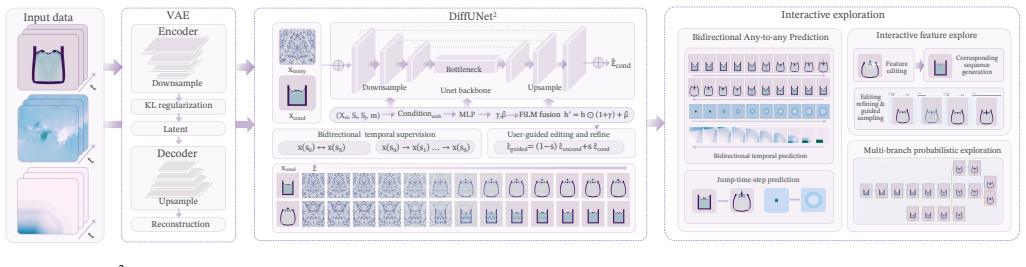
DiffUNet^2 is a conditional diffusion model that performs bidirectional any-to-any generation across time and captures distributions of plausible system evolutions. The accompanying interactive system supports branching timeline exploration, user-guided state editing, and probability-space navigation, allowing scientists to explore alternative hypotheses in temporal scientific data rather than receiving only deterministic forward predictions.
What carries the argument
DiffUNet^2 conditional diffusion model for bidirectional any-to-any generation across time steps
If this is right
- The model supports generation of multiple plausible future and past states from any time point in a time series.
- Users can edit states and observe resulting changes in the probability space of outcomes.
- Evaluation across five datasets confirms predictive accuracy and quality of the captured ensembles.
- Expert collaboration shows the combined modeling and visualization approach fits practical scientific temporal analysis tasks.
Where Pith is reading between the lines
- The same bidirectional generation approach could apply to simulation domains not covered in the five evaluated datasets.
- Interactive navigation of probability space might reduce reliance on post-hoc uncertainty quantification methods in scientific software.
- This framing suggests generative models can serve as editable hypothesis generators rather than fixed forecasters in data analysis pipelines.
Load-bearing premise
The model accurately captures the true distributions of scientific system evolutions and the interactive features meaningfully support domain experts' workflows.
What would settle it
A test on held-out data where the model's generated probability distributions fail to match observed variability in the scientific systems, or domain experts report that the interactive features do not improve their ability to analyze temporal data.
Figures







read the original abstract
Modeling temporal evolution is important to analyzing and reasoning about scientific phenomena, yet most machine learning methods provide deterministic forward predictions that overlook multiple plausible outcomes and rarely support backward reasoning, limiting their usefulness in practical scientific workflows. We present a framework that integrates diffusion-based generative modeling with interactive visual analytics for scientific exploration. We introduce DiffUNet^2, a conditional diffusion model that enables bidirectional, any-to-any generation across time and captures distributions of plausible system evolutions. Built upon the model, our interactive system supports branching timeline exploration, user-guided state editing, and probability-space navigation, enabling scientists to actively explore alternative hypotheses rather than passively observe predictions. We evaluate the model on 5 datasets across different scientific domains to validate its predictive accuracy and probability-space ensemble quality. In collaboration with domain experts, we demonstrate the effectiveness of our approach in supporting practical scientific temporal data analysis workflows. By integrating modeling and visual interaction, our approach enables scientists to interactively explore system dynamics, transforming generative models into tools for hypothesis-driven scientific analysis.
Editorial analysis
A structured set of objections, weighed in public.
Referee Report
Summary. The manuscript introduces DiffUNet^2, a conditional diffusion model for bidirectional any-to-any temporal generation across time that captures distributions of plausible system evolutions. It integrates this model with an interactive visual analytics system supporting branching timeline exploration, user-guided state editing, and probability-space navigation. The approach is evaluated on 5 datasets across scientific domains for predictive accuracy and ensemble quality, and demonstrated via collaboration with domain experts for practical scientific workflows.
Significance. If the technical claims are substantiated with appropriate methods and results, the work could meaningfully advance scientific temporal analysis by combining probabilistic generative modeling with interactive tools, allowing hypothesis-driven exploration of multiple plausible evolutions rather than deterministic forward predictions alone.
major comments (1)
- [Abstract] Abstract: The manuscript claims evaluation on 5 datasets to validate predictive accuracy and probability-space ensemble quality, yet supplies no methods, architecture details, loss functions, sampling procedures, quantitative results, baselines, error bars, or validation metrics. This absence is load-bearing for the central claim that the model enables effective bidirectional generation and distribution capture.
Simulated Author's Rebuttal
We thank the referee for the constructive feedback. We address the major comment below and outline revisions to strengthen the manuscript.
read point-by-point responses
-
Referee: [Abstract] Abstract: The manuscript claims evaluation on 5 datasets to validate predictive accuracy and probability-space ensemble quality, yet supplies no methods, architecture details, loss functions, sampling procedures, quantitative results, baselines, error bars, or validation metrics. This absence is load-bearing for the central claim that the model enables effective bidirectional generation and distribution capture.
Authors: The abstract is a concise summary; the full manuscript details the DiffUNet^2 architecture (Section 3), bidirectional conditional diffusion formulation with loss functions (Section 3.2), sampling procedures (Section 3.3), and quantitative evaluation across the five datasets including baselines, metrics for accuracy and ensemble quality, and results (Section 4). To address the concern, we will revise the abstract to briefly reference the evaluation metrics and bidirectional generation approach, making the central claims more self-contained while preserving length constraints. revision: yes
Circularity Check
No significant circularity detected
full rationale
The provided abstract and description introduce DiffUNet^2 as a conditional diffusion model for bidirectional any-to-any temporal generation, with an interactive analytics layer. No equations, fitted parameters, or derivation steps are visible. No self-definitional claims, predictions that reduce to fitted inputs, load-bearing self-citations, uniqueness theorems imported from authors, ansatzes smuggled via citation, or renamings of known results appear. The central claims rest on standard diffusion modeling practices plus evaluation on external datasets and expert collaboration, remaining self-contained without reduction to inputs by construction.
Axiom & Free-Parameter Ledger
Reference graph
Works this paper leans on
- [1]
-
[2]
R. Anirudh, J. J. Thiagarajan, P.-T. Bremer, and B. K. Spears. Improved surrogates in inertial confinement fusion with manifold and cycle consis- tencies.Proceedings of the National Academy of Sciences, 117(18):9741– 9746, 2020. doi: 10.1073/pnas.1916634117 1
-
[3]
D. Banesh, S. Chakrabarti, S. De, G. Egozi, K. Hickmann, W. S. Hlavacek et al. The high explosives & affected targets (heat) dataset. 7 2025. doi: 10.25583/2571471 2, 4, 6
-
[4]
A. Biswas and T. Turton. Cloverleaf data artifacts for artimis ldrd. 1 2026. doi: 10.25583/3022785 2, 6
-
[6]
G. Casiraghi and G. Andres. Disentangling the timescales of a complex system: A bayesian approach to temporal network analysis, 2024. doi: 10. 48550/arXiv.2403.05343 1
arXiv 2024
-
[7]
Y .-T. Chen, H. Li, N. Shi, X. Luo, W. Xu, and H.-W. Shen. Explorable INR: An Implicit Neural Representation for Ensemble Simulation En- abling Efficient Spatial and Parameter Exploration .IEEE Transactions on Visualization & Computer Graphics, 31(06):3758–3770, June 2025. doi: 10.1109/TVCG.2025.3567052 1
-
[8]
I. J. Goodfellow, J. Pouget-Abadie, M. Mirza, B. Xu, D. Warde-Farley, S. Ozair et al. Generative adversarial nets. In Z. Ghahramani, M. Welling, C. Cortes, N. Lawrence, and K. Weinberger, eds.,Advances in Neural Information Processing Systems, vol. 27. Curran Associates, Inc., 2014. doi: 10.48550/arXiv.1406.2661 2
work page internal anchor Pith review Pith/arXiv arXiv doi:10.48550/arxiv.1406.2661 2014
-
[9]
J. Ho, A. Jain, and P. Abbeel. Denoising diffusion probabilistic models. In Proceedings of the 34th International Conference on Neural Information Processing Systems, NIPS ’20, 2020. doi: 10.48550/arXiv.2006.11239 2, 4, 9
work page internal anchor Pith review Pith/arXiv arXiv doi:10.48550/arxiv.2006.11239 2020
-
[10]
P. Hu, H. Feng, H. Liu, T. Yan, W. Deng, T. Gao et al. Realpdebench: A benchmark for complex physical systems with real-world data. InThe Fourteenth International Conference on Learning Representations, 2026. Oral Presentation. doi: 10.48550/arXiv.2601.01829 2, 6, 7
-
[11]
Y . Kawakami, D. Cayan, D. Liu, and K.-L. Ma. ClimateSOM: A Visual Analysis Workflow for Climate Ensemble Datasets .IEEE Transactions on Visualization & Computer Graphics, 32(01):473–483, Jan. 2026. doi: 10.1109/TVCG.2025.3634788 2
-
[12]
D. P. Kingma and M. Welling. An introduction to variational autoencoders. Foundations and Trends in Machine Learning, 12(4):307–392, 11 2019. doi: 10.1561/2200000056 2
-
[13]
R. Lam, A. Sanchez-Gonzalez, M. Willson, P. Wirnsberger, M. Fortunato, F. Alet et al. Learning skillful medium-range global weather forecasting. Science, 382(6677):1416–1421, 2023. doi: 10.1126/science.adi2336 2
-
[15]
L. Li, R. Carver, I. Lopez-Gomez, F. Sha, and J. Anderson. Generative emulation of weather forecast ensembles with diffusion models.Science Advances, 10:eadk4489, 2024. doi: 10.1126/sciadv.adk4489 2, 9
-
[16]
Z. Li, N. Kovachki, K. Azizzadenesheli, B. Liu, K. Bhattacharya, A. Stuart et al. Fourier neural operator for parametric partial differential equations,
-
[17]
doi: 10.48550/arXiv.2010.08895 2
work page internal anchor Pith review Pith/arXiv arXiv doi:10.48550/arxiv.2010.08895 2010
-
[18]
H. Liu, C. Liu, J. T. L. Wang, and H. Wang. Predicting solar flares using a long short-term memory network.The Astrophysical Journal, 877(2):121, jun 2019. doi: 10.3847/1538-4357/ab1b3c 2
-
[19]
L. Lu, P. Jin, G. Pang, Z. Zhang, and G. E. Karniadakis. Learning nonlinear operators via deeponet based on the universal approximation theorem of operators.Nature Machine Intelligence, 3(3):218–229, Mar. 2021. doi: 10 .1038/s42256-021-00302-5 2
2021
-
[20]
Ma and J
X. Ma and J. Li. Latentzoom: Seamless scaling in generative latent space for visual exploration of local performance in deep neural networks.IEEE Transactions on Visualization and Computer Graphics, 32(3):2709–2725,
-
[21]
doi: 10.1109/TVCG.2026.3654030 2
-
[22]
Moreland
K. Moreland. A survey of visualization pipelines.IEEE Transactions on Visualization and Computer Graphics, 19(3):367–378, 2013. doi: 10. 1109/TVCG.2012.133 1
2013
-
[23]
Improved Denoising Diffusion Probabilistic Models
A. Nichol and P. Dhariwal. Improved denoising diffusion probabilistic models, 2021. doi: 10.48550/arXiv.2102.09672 2
work page internal anchor Pith review Pith/arXiv arXiv doi:10.48550/arxiv.2102.09672 2021
-
[24]
O’Shea and R
K. O’Shea and R. Nash. An introduction to convolutional neural networks,
-
[25]
doi: 10.48550/arXiv.1511.08458 1
work page internal anchor Pith review Pith/arXiv arXiv doi:10.48550/arxiv.1511.08458
-
[26]
E. Perez, F. Strub, H. De Vries, V . Dumoulin, and A. Courville. Film: Visual reasoning with a general conditioning layer. InProceedings of the AAAI conference on artificial intelligence, vol. 32, 2018. doi: 10.1609/aaai .v32i1.11671 4
-
[27]
T. Pfaff, M. Fortunato, A. Sanchez-Gonzalez, and P. Battaglia. Learning mesh-based simulation with graph networks. InInternational Conference on Learning Representations (ICLR), 2021. doi: 10.48550/arXiv.2010. 03409 2
-
[28]
M. Raissi, P. Perdikaris, and G. Karniadakis. Physics-informed neural networks: A deep learning framework for solving forward and inverse problems involving nonlinear partial differential equations.Journal of Computational Physics, 378:686–707, 2019. doi: 10.1016/j.jcp.2018.10. 045 1
-
[29]
S. Rühling Cachay, B. Zhao, H. Joren, and R. Yu. Dyffusion: A dynamics- informed diffusion model for spatiotemporal forecasting. In A. Oh, T. Nau- mann, A. Globerson, K. Saenko, M. Hardt, and S. Levine, eds.,Advances in Neural Information Processing Systems, vol. 36, pp. 45259–45287. Curran Associates, Inc., 2023. doi: 10.48550/arXiv.2306.01984 2
-
[30]
A. Sanchez-Gonzalez, J. Godwin, T. Pfaff, R. Ying, J. Leskovec, and P. W. Battaglia. Learning to simulate complex physics with graph networks. In Proceedings of the 37th International Conference on Machine Learning, ICML’20, art. no. 784, 10 pages. JMLR.org, 2020. doi: 10.48550/arXiv. 2002.09405 2
work page internal anchor Pith review doi:10.48550/arxiv 2020
-
[31]
Schneider, J
T. Schneider, J. Teixeira, C. S. Bretherton, et al. Climate goals and computing the future of clouds.Nature Climate Change, 7(1):3–5, Jan
-
[32]
doi: 10.1038/nclimate3190 1
-
[33]
D. Shu and A. B. Farimani. Zero-shot uncertainty quantification using diffusion probabilistic models, 2024. doi: 10.48550/arXiv.2408.04718 2, 9
-
[34]
Q. Shu, H. Guo, J. Liang, L. Che, J. Liu, and X. Yuan. Ensemblegraph: Interactive visual analysis of spatiotemporal behaviors in ensemble simu- lation data. In2016 IEEE Pacific Visualization Symposium (PacificVis), pp. 56–63, 2016. doi: 10.1109/PACIFICVIS.2016.7465251 2
-
[35]
J. Song, C. Meng, and S. Ermon. Denoising diffusion implicit models,
-
[36]
doi: 10.48550/arXiv.2010.02502 2
work page internal anchor Pith review Pith/arXiv arXiv doi:10.48550/arxiv.2010.02502 2010
-
[37]
Y . Song, J. Sohl-Dickstein, D. P. Kingma, A. Kumar, S. Ermon, and B. Poole. Score-based generative modeling through stochastic differential equations. In9th International Conference on Learning Representations, ICLR 2021, Virtual Event, Austria, May 3-7, 2021. OpenReview.net, 2021. doi: 10.48550/arXiv.2011.13456 2
work page internal anchor Pith review Pith/arXiv arXiv doi:10.48550/arxiv.2011.13456 2021
-
[38]
S. H. Strogatz.Nonlinear Dynamics and Chaos: With Applications to Physics, Biology, Chemistry, and Engineering (3rd ed.). Chapman and Hall/CRC., 2024. doi: 10.1201/9780429398490 1
-
[39]
M. Takamoto, T. Praditia, R. Leiteritz, D. MacKinlay, F. Alesiani, D. Pflüger et al. Pdebench: an extensive benchmark for scientific machine learning. InProceedings of the 36th International Conference on Neural Information Processing Systems, NIPS ’22, art. no. 117, 16 pages. Curran Associates Inc., Red Hook, NY , USA, 2022. doi: 10.48550/arXiv.2210. 07182 2, 6
-
[40]
A. Vaswani, N. Shazeer, N. Parmar, J. Uszkoreit, L. Jones, A. N. Gomez et al. Attention is all you need, 2023. doi: 10.48550/arXiv.1706.03762 1
work page internal anchor Pith review Pith/arXiv arXiv doi:10.48550/arxiv.1706.03762 2023
-
[41]
J. Wang, S. Hazarika, C. Li, and H.-W. Shen. Visualization and visual analysis of ensemble data: A survey.IEEE Transactions on Visualization and Computer Graphics, 25(9):2853–2872, 2019. doi: 10.1109/TVCG. 2018.2853721 2
-
[42]
W. Yu, A. Ghosh, T. S. Finn, R. Arcucci, M. Bocquet, and S. Cheng. A probabilistic approach to wildfire spread prediction using a denoising diffusion surrogate model.Geoscientific Model Development, 19(2):1027– 1054, 2026. doi: 10.5194/gmd-19-1027-2026 2, 6, 7, 9
-
[43]
A. Zhou, Z. Li, M. Schneier, J. R. B. Jr, and A. B. Farimani. Text2PDE: Latent diffusion models for accessible physics simulation. InThe Thir- teenth International Conference on Learning Representations, 2025. doi: 10.48550/arXiv.2410.01153 2 A APPENDIX This section provides supplementary results and figures that complement the main paper. s=1 s=2 s=3 s=4...
discussion (0)
Sign in with ORCID, Apple, or X to comment. Anyone can read and Pith papers without signing in.