Diocotron Modes in Pulsar Magnetospheres: Charge Diffusion and Implications for Radio Emission Variability
Pith reviewed 2026-06-28 08:45 UTC · model grok-4.3
The pith
Diocotron instability drives stochastic charge diffusion across pulsar closed zones and perturbs emission beam angle.
A machine-rendered reading of the paper's core claim, the machinery that carries it, and where it could break.
Core claim
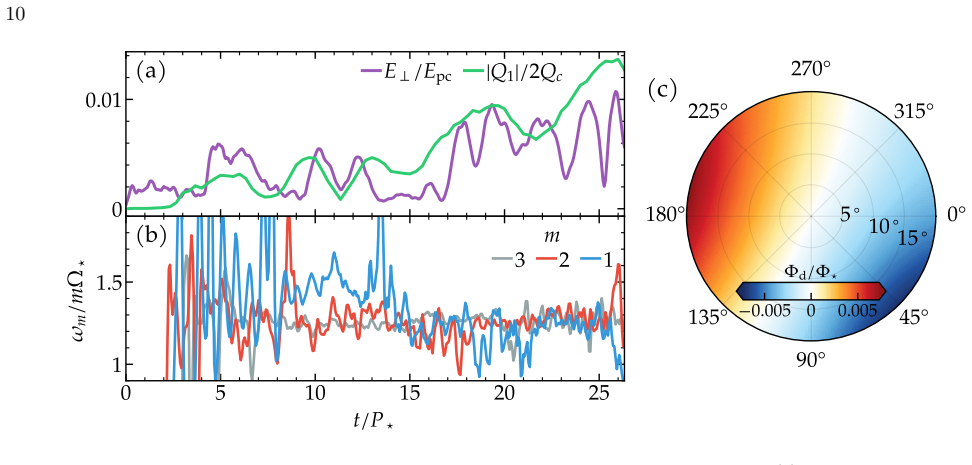
The diocotron instability is a non-axisymmetric plasma instability that occurs generically in the differentially rotating equatorial plane of pulsar magnetospheres. Simulations show it grows on timescales of the rotation period and develops a strong, stable m=1 mode corresponding to a rotating, dipolar charge asymmetry in the equatorial disk. Stochastic fluctuations in the diocotron mode amplitude and pattern speed drive cross-field diffusion that can rapidly transport charges through the closed zone toward the light cylinder. In the nonlinear stage, the m=1 mode produces electric field perturbations which can modulate the polar cap potential drop and the emission beam angle, with possible c
What carries the argument
The m=1 diocotron mode, a rotating dipolar charge asymmetry in the equatorial disk whose amplitude and pattern-speed fluctuations generate cross-field diffusion and electric-field perturbations.
If this is right
- Charges are transported rapidly through the closed zone toward the light cylinder.
- The polar cap potential drop is modulated by the mode's electric field perturbations.
- The emission beam angle varies in response to the same perturbations.
- These effects can produce nulling, periodic amplitude modulation, and drifting subpulses.
Where Pith is reading between the lines
- The diffusion process may alter the supply of charges available to open field lines beyond the closed zone.
- Mode fluctuations could interact with other plasma instabilities near the light cylinder.
- The same mechanism may operate across a range of pulsar obliquities and spin periods.
Load-bearing premise
The diocotron instability occurs generically in the differentially rotating equatorial plane of pulsar magnetospheres and grows on timescales of the rotation period to produce a stable m=1 mode.
What would settle it
A 3D PIC simulation of differentially rotating pulsar plasma that shows no growth of the diocotron instability or no dominant m=1 mode on rotation-period timescales would falsify the reported mechanism.
Figures



read the original abstract
The diocotron instability is a non-axisymmetric plasma instability that should occur generically in the differentially rotating equatorial plane of pulsar magnetospheres. We present a series of 3D particle-in-cell (PIC) simulations of the diocotron instability in aligned and oblique pulsars. The instability grows on timescales of the rotation period and develops a strong, stable $m=1$ mode, corresponding to a rotating, dipolar charge asymmetry in the equatorial disk. Stochastic fluctuations in the diocotron mode amplitude and pattern speed drive cross-field diffusion that can rapidly transport charges through the closed zone toward the light cylinder. In the nonlinear stage, the $m=1$ mode produces electric field perturbations which can modulate the polar cap potential drop and the emission beam angle, with possible connections to pulsar variability such as nulling, periodic amplitude modulation, and drifting subpulses.
Editorial analysis
A structured set of objections, weighed in public.
Referee Report
Summary. The manuscript presents 3D particle-in-cell simulations of the diocotron instability in aligned and oblique pulsar magnetospheres. It reports that the instability grows on rotation-period timescales and saturates into a stable m=1 mode, which drives stochastic cross-field diffusion transporting charges through the closed zone to the light cylinder; in the nonlinear regime the mode generates electric-field perturbations capable of modulating the polar-cap potential drop and emission beam angle, offering a possible explanation for observed variability including nulling, periodic amplitude modulation, and drifting subpulses.
Significance. If the simulation results are robust, the work supplies a concrete plasma mechanism linking differential rotation in the equatorial magnetosphere to both charge transport and radio-emission variability, potentially unifying several classes of pulsar timing and pulse-shape phenomena under a single instability. The 3D treatment of both aligned and oblique geometries is a methodological advance over prior 2D studies.
major comments (2)
- [Abstract/Methods] Abstract and Methods: no information is supplied on grid resolution, macroparticle number, boundary conditions at the stellar surface or light cylinder, or any quantitative validation (growth rates, saturation amplitudes, diffusion coefficients) against analytic diocotron dispersion relations or earlier 2D simulations; without these the support for the central claims of rapid diffusion and potential modulation cannot be assessed.
- [Results] Results section: the assertion that the m=1 mode is 'stable' and that diffusion is 'rapid' requires explicit demonstration that both outcomes survive changes in numerical parameters; the current presentation leaves open the possibility that the reported behavior is resolution- or particle-number-dependent.
Simulated Author's Rebuttal
We thank the referee for their thorough review and constructive feedback on our manuscript. We address each major comment below and will revise the manuscript to incorporate additional numerical details where feasible.
read point-by-point responses
-
Referee: [Abstract/Methods] Abstract and Methods: no information is supplied on grid resolution, macroparticle number, boundary conditions at the stellar surface or light cylinder, or any quantitative validation (growth rates, saturation amplitudes, diffusion coefficients) against analytic diocotron dispersion relations or earlier 2D simulations; without these the support for the central claims of rapid diffusion and potential modulation cannot be assessed.
Authors: We agree that the current Methods section does not explicitly detail grid resolution, macroparticle number, boundary conditions, or quantitative validation against analytic relations and prior 2D work. In the revised manuscript we will expand the Methods section to include these parameters and add comparisons of growth rates and saturation amplitudes to analytic diocotron dispersion relations and earlier 2D simulations, thereby strengthening the evidential basis for the reported diffusion and potential modulation. revision: yes
-
Referee: [Results] Results section: the assertion that the m=1 mode is 'stable' and that diffusion is 'rapid' requires explicit demonstration that both outcomes survive changes in numerical parameters; the current presentation leaves open the possibility that the reported behavior is resolution- or particle-number-dependent.
Authors: The presented simulations exhibit a persistent m=1 mode and cross-field diffusion across the runs performed. We will add a brief discussion in the revised Results section noting the consistency of these features with the chosen numerical setup and referencing the standard resolution and particle counts employed. However, a systematic parameter survey to demonstrate full independence from resolution and particle number lies beyond the existing data. revision: partial
- Explicit demonstration that the m=1 mode stability and rapid diffusion survive arbitrary changes in numerical parameters would require additional convergence simulations not present in the current study.
Circularity Check
No significant circularity identified
full rationale
The paper's claims rest on direct outcomes from 3D PIC simulations of the diocotron instability in aligned and oblique pulsar magnetospheres. The growth on rotation-period timescales, saturation into a stable m=1 mode, cross-field diffusion, and modulation of polar-cap potential are reported as numerical results rather than quantities defined in terms of themselves, fitted to target observables, or justified solely via self-citation chains. No load-bearing steps reduce by construction to the inputs; the simulation framework is independent of the variability implications drawn from it.
Axiom & Free-Parameter Ledger
axioms (1)
- domain assumption The diocotron instability occurs generically in the differentially rotating equatorial plane of pulsar magnetospheres.
Reference graph
Works this paper leans on
-
[1]
Fichtenbauer, T. D. J. 2023, ApJ, 948, 32, doi: 10.3847/1538-4357/acbb68
-
[2]
Backer, D. C. 1970, Nature, 228, 42, doi: 10.1038/228042a0
-
[3]
Basu, R., Mitra, D., & Melikidze, G. I. 2017, ApJ, 846, 109, doi: 10.3847/1538-4357/aa862d
-
[4]
Basu, R., Mitra, D., & Melikidze, G. I. 2020, ApJ, 889, 133, doi: 10.3847/1538-4357/ab63c9
-
[5]
Basu, R., Mitra, D., & Melikidze, G. I. 2025, Characterizing the Nature of Periodic Amplitude Modulation in Pulsars, arXiv, doi: 10.48550/arXiv.2509.04262
-
[6]
Bransgrove, A., Beloborodov, A. M., & Levin, Y. 2023, The Astrophysical Journal Letters, 958, L9, doi: 10.3847/2041-8213/ad0556
-
[7]
Briggs, R. J., Daugherty, J. D., & Levy, R. H. 1970, Physics of Fluids, 13, 421, doi: 10.1063/1.1692936
-
[8]
Chandrasekhar, Stochastic problems in physics and astronomy
Chandrasekhar, S. 1943, Rev. Mod. Phys., 15, 1, doi: 10.1103/RevModPhys.15.1
-
[9]
Chen, A. Y., & Beloborodov, A. M. 2014, The Astrophysical Journal Letters, 795, L22, doi: 10.1088/2041-8205/795/1/L22
-
[10]
Chen, A. Y., Cruz, F., & Spitkovsky, A. 2020, The Astrophysical Journal, 889, 69, doi: 10.3847/1538-4357/ab5c20
-
[11]
Chim, C. Y., & O’Neil, T. M. 2016, Physics of Plasmas, 23, 072113, doi: 10.1063/1.4958317
-
[12]
Chirikov, B. V. 1979, PhR, 52, 263, doi: 10.1016/0370-1573(79)90023-1
-
[13]
Cordes, J. M. 2013, ApJ, 775, 47, doi: 10.1088/0004-637X/775/1/47
-
[14]
2024, Astronomy & Astrophysics, 690, A229, doi: 10.1051/0004-6361/202347926
Cruz, F., Grismayer, T., Torres, R., et al. 2024, Astronomy & Astrophysics, 690, A229, doi: 10.1051/0004-6361/202347926
-
[15]
Davidson, R. C. 1985, The Physics of Fluids, 28, 1937, doi: 10.1063/1.864938
-
[16]
Davidson, R. C. 1990, An introduction to the physics of nonneutral plasmas. (World Scientific Publishing Company)
1990
-
[17]
C., Chan, H.-W., Chen, C., & Lund, S
Davidson, R. C., Chan, H.-W., Chen, C., & Lund, S. 1991, Reviews of Modern Physics, 63, 341, doi: 10.1103/RevModPhys.63.341
-
[18]
Driscoll, C. F., & Fine, K. S. 1990, Physics of Fluids B: Plasma Physics, 2, 1359, doi: 10.1063/1.859556
-
[19]
Fine, K. S. 1988, PhD thesis, University of California, San Diego
1988
-
[20]
Fine, K. S., Driscoll, C. F., & Malmberg, J. H. 1989, Physical Review Letters, 63, 2232, doi: 10.1103/PhysRevLett.63.2232
-
[21]
2014, ApJ, 797, 18, doi: 10.1088/0004-637X/797/1/18
Smits, R. 2014, ApJ, 797, 18, doi: 10.1088/0004-637X/797/1/18
-
[22]
Goldreich, P., & Julian, W. H. 1969, ApJ, 157, 869, doi: 10.1086/150119
-
[23]
2023, ApJ, 943, 105, doi: 10.3847/1538-4357/acab05
Hakobyan, H., Philippov, A., & Spitkovsky, A. 2023, ApJ, 943, 105, doi: 10.3847/1538-4357/acab05
-
[24]
2023, PrincetonUniversity/tristan-mp-v2: v2.6, v2.6 Zenodo, doi: 10.5281/zenodo.7566725
Hakobyan, H., Spitkovsky, A., Chernoglazov, A., et al. 2023, PrincetonUniversity/tristan-mp-v2: v2.6, v2.6 Zenodo, doi: 10.5281/zenodo.7566725
-
[25]
Herfindal, J. L., & Rankin, J. M. 2009, MNRAS, 393, 1391, doi: 10.1111/j.1365-2966.2008.14119.x
-
[26]
Holloway, N. J. 1973, Nature Physical Science, 246, 6, doi: 10.1038/physci246006a0
-
[27]
2006, Journal of the Physical Society of Japan, 75, 104502, doi: 10.1143/JPSJ.75.104502
Kawai, Y., Kiwamoto, Y., Ito, K., et al. 2006, Journal of the Physical Society of Japan, 75, 104502, doi: 10.1143/JPSJ.75.104502
-
[28]
2003, A&A, 397, 969, doi: 10.1051/0004-6361:20021583
Kijak, J., & Gil, J. 2003, A&A, 397, 969, doi: 10.1051/0004-6361:20021583
-
[29]
Lorimer, D. R. 2006, Science, 312, 549, doi: 10.1126/science.1124060
-
[30]
Krause-Polstorff, J., & Michel, F. C. 1985a, MNRAS, 213, 43, doi: 10.1093/mnras/213.1.43P
-
[31]
Kulsrud, R. M. 2005, Plasma Physics for Astrophysics
2005
-
[32]
D., & Lifshitz, E
Landau, L. D., & Lifshitz, E. M. 1975, The classical theory of fields
1975
-
[33]
Mackay, R. S., Meiss, J. D., & Percival, I. C. 1984, PhRvL, 52, 697, doi: 10.1103/PhysRevLett.52.697
-
[34]
Michel, F. C. 1979, ApJ, 227, 579, doi: 10.1086/156768
-
[35]
Michel, F. C. 1991, Theory of neutron star magnetospheres O’Neil, T. M., & Smith, R. A. 1992, Physics of Fluids B: Plasma Physics, 4, 2720, doi: 10.1063/1.860142
-
[36]
2022, ARA&A, 60, 495, doi: 10.1146/annurev-astro-052920-112338
Philippov, A., & Kramer, M. 2022, ARA&A, 60, 495, doi: 10.1146/annurev-astro-052920-112338
-
[37]
2020, Physical Review Letters, 124, 245101, doi: 10.1103/PhysRevLett.124.245101
Philippov, A., Timokhin, A., & Spitkovsky, A. 2020, Physical Review Letters, 124, 245101, doi: 10.1103/PhysRevLett.124.245101
-
[38]
2015, The Astrophysical Journal Letters, 815, L19, doi: 10.1088/2041-8205/815/2/L19 17
Spitkovsky, A. 2015, The Astrophysical Journal Letters, 815, L19, doi: 10.1088/2041-8205/815/2/L19 17
-
[39]
Philippov, A. A., & Spitkovsky, A. 2014, The Astrophysical Journal Letters, 785, L33, doi: 10.1088/2041-8205/785/2/L33
-
[40]
Pilipp, W. G. 1974, ApJ, 190, 391, doi: 10.1086/152890 P´ etri, J. 2007a, Astronomy & Astrophysics, 464, 135, doi: 10.1051/0004-6361:20066298 P´ etri, J. 2007b, Astronomy & Astrophysics, 469, 843, doi: 10.1051/0004-6361:20066985 P´ etri, J. 2009, Astronomy & Astrophysics, 503, 1, doi: 10.1051/0004-6361/200911778 P´ etri, J., Heyvaerts, J., & Bonazzola, S....
-
[41]
Smith, I. A., Michel, F. C., & Thacker, P. D. 2001, Monthly Notices of the Royal Astronomical Society, 322, 209, doi: 10.1046/j.1365-8711.2001.04045.x
-
[42]
2023, MNRAS, 520, 4562, doi: 10.1093/mnras/stad135
Song, X., Weltevrede, P., Szary, A., et al. 2023, MNRAS, 520, 4562, doi: 10.1093/mnras/stad135
-
[43]
Simulations of pulsar wind formation
Spitkovsky, A., & Arons, J. 2002, in Astronomical Society of the Pacific Conference Series, Vol. 271, Neutron Stars in Supernova Remnants, ed. P. O. Slane & B. M. Gaensler, 81, doi: 10.48550/arXiv.astro-ph/0201360
work page internal anchor Pith review Pith/arXiv arXiv doi:10.48550/arxiv.astro-ph/0201360 2002
-
[44]
D., Michel, F
Thacker, P. D., Michel, F. C., & Smith, I. A. 1998, in Revista Mexicana de Astronomia y Astrofisica Conference Series, Vol. 7, Revista Mexicana de Astronomia y Astrofisica Conference Series, ed. R. J. Dufour & S. Torres-Peimbert, 211
1998
-
[45]
Wang, N., Manchester, R. N., & Johnston, S. 2007, Monthly Notices of the Royal Astronomical Society, 377, 1383, doi: 10.1111/j.1365-2966.2007.11703.x
-
[46]
Wen, Z. G., Wang, N., Yuan, J. P., et al. 2016, A&A, 592, A127, doi: 10.1051/0004-6361/201628214
-
[47]
Wen, Z. G., Chen, J. L., Hao, L. F., et al. 2020a, ApJ, 900, 168, doi: 10.3847/1538-4357/abaab7
discussion (0)
Sign in with ORCID, Apple, or X to comment. Anyone can read and Pith papers without signing in.