The Cosmological Hart-Tipler Conjecture
Pith reviewed 2026-06-28 09:06 UTC · model grok-4.3
The pith
A minimal cosmological model shows self-propagating probes would infect most of the universe unless spawn rates are below one per million galaxies.
A machine-rendered reading of the paper's core claim, the machinery that carries it, and where it could break.
Core claim
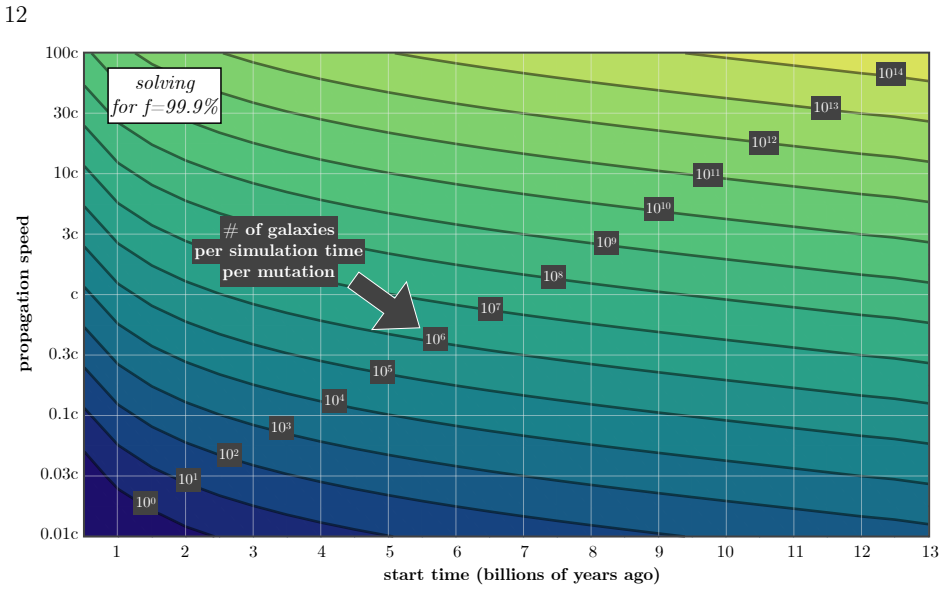
Accounting for cosmological expansion, half the Universe is infected by today for u=0.1c propagation starting 4.5 Gyr after the Big Bang if the spawn rate exceeds approximately once per million galaxies. For near-c propagation, this becomes a billion galaxies. Over 99.9% of cosmological volumes are filled with 0.1c if even 1-in-100,000 galaxies have ever spawned an infection. The cosmological Hart-Tipler problem therefore offers a remarkably sharp minimal-model constraint on the prevalence of aggressive, self-propagating technological behavior.
What carries the argument
The three-parameter bare-bones model of spontaneous spawn rate, propagation speed u, and start time, which tracks the fraction of cosmological volume reached by infections in an expanding universe.
Load-bearing premise
Spontaneous spawn events occur at a constant average rate across galaxies with propagation at fixed speed u and no interactions or termination.
What would settle it
A survey finding that the fraction of galaxies at moderate redshift showing technological activity is far below the model's predicted infected volume for spawn rates above one per million would directly test the claimed threshold.
Figures

read the original abstract
Self-reproducing automata, so-called von Neumann machines, have been repeatedly estimated to be capable of traversing the Galaxy many times given its age. Our mere existence thus seems to exclude an aggressive variant of such a probe having ever been launched in the Milky Way. The Hart-Tipler conjecture considers this to represent contra-positive evidence to the hypothesis that other extra-terrestrial technological entities have emerged in our galaxy. Recently, several authors have extended interstellar colonization calculations to cosmological volumes, but these models are loaded with specific assumptions about behavior and emergence times. Here, we present a bare-bones model of generic artificial infections (such as but not limited to von Neumann probes) at cosmological scale in order to maximize interpretability, an approach closer to the original spirit of the Hart-Tipler calculations. Our model has just three parameters, a spontaneous spawn rate, a propagation speed (u) and a start time for the calculation. Accounting for cosmological expansion, we find that half the Universe is infected by today for u=0.1c propagation starting 4.5 Gyr after the Big Bang if the spawn rate exceeds approximately once per million galaxies. For near-c propagation, this becomes a billion galaxies. Over 99.9% of cosmological volumes are filled with 0.1c if even 1-in-100,000 galaxies have ever spawned an infection. The "cosmological Hart-Tipler" problem therefore offers a remarkably sharp minimal-model constraint on the prevalence of aggressive, self-propagating technological behavior. We explore its implications, such as how anthropic reasoning implies such infections occur and its fine-tuning nature.
Editorial analysis
A structured set of objections, weighed in public.
Referee Report
Summary. The paper presents a minimal three-parameter model (spontaneous spawn rate, propagation speed u, start time) for the cosmological spread of self-reproducing automata, accounting for expansion. It reports that for u=0.1c and a start time 4.5 Gyr after the Big Bang, spawn rates exceeding ~1 per million galaxies infect half the Universe by today, with near-c speeds tightening this to ~1 per billion galaxies; over 99.9% infection occurs at 1-in-100,000 for u=0.1c. The central claim is that this yields a sharp minimal-model constraint on aggressive self-propagating technological behavior, with discussion of anthropic and fine-tuning implications.
Significance. If the volume integrals and expansion accounting are correctly implemented, the work supplies an interpretable baseline for bounding the emergence rate of von Neumann probes using observable cosmological volumes rather than Galaxy-specific assumptions. Credit is due for the deliberate choice of a bare-bones parametrization that isolates the effect of expansion and for stating the three free parameters explicitly.
major comments (2)
- [model description / results] Model description (implicit in abstract and results): the quoted thresholds (one per million galaxies, one per billion, etc.) are obtained by direct substitution of chosen values for the three free parameters into the infection-fraction calculation; the resulting 'constraint' therefore restates the input assumptions rather than deriving an independent bound from cosmological observables or data.
- [implications] Implications section: the assertion that 'anthropic reasoning implies such infections occur' is not derived from the three-parameter model and requires additional premises (e.g., observer selection effects across infected vs. uninfected volumes) that are not formalized or tested within the presented framework.
minor comments (2)
- [abstract] The abstract states results for specific numerical choices (4.5 Gyr, u=0.1c, 0.999c) without indicating how sensitive the infection fractions are to modest variations in start time or u; a brief sensitivity table would improve clarity.
- [model] Notation for the propagation speed u and the precise definition of 'infected comoving volume' should be introduced once in the model section and used consistently.
Simulated Author's Rebuttal
We thank the referee for the detailed report and the positive assessment of the model's minimal parametrization. We address the two major comments point by point below, agreeing where the critique is accurate and indicating revisions to improve clarity without altering the core results.
read point-by-point responses
-
Referee: [model description / results] Model description (implicit in abstract and results): the quoted thresholds (one per million galaxies, one per billion, etc.) are obtained by direct substitution of chosen values for the three free parameters into the infection-fraction calculation; the resulting 'constraint' therefore restates the input assumptions rather than deriving an independent bound from cosmological observables or data.
Authors: We agree that the quoted thresholds arise from direct evaluation of the infection-fraction integral at specific parameter values rather than from fitting to observational data. The manuscript frames these as outcomes of a minimal three-parameter model that isolates the effects of expansion and propagation speed, intended as an illustrative baseline rather than an empirical upper limit. We will revise the abstract, results, and discussion to explicitly state that the numbers are model-derived illustrations under the stated assumptions and do not constitute data-driven bounds. revision: yes
-
Referee: [implications] Implications section: the assertion that 'anthropic reasoning implies such infections occur' is not derived from the three-parameter model and requires additional premises (e.g., observer selection effects across infected vs. uninfected volumes) that are not formalized or tested within the presented framework.
Authors: The anthropic discussion is presented as an interpretive extension in the final section rather than a formal consequence of the three-parameter calculation. The model itself demonstrates the rapidity of infection for modest spawn rates; linking this to observer selection requires external premises about the distribution of observers across infected and uninfected regions. We will revise the implications section to clarify that this connection is exploratory, to list the additional assumptions explicitly, and to avoid any implication that the model alone derives the anthropic conclusion. revision: partial
Circularity Check
No significant circularity
full rationale
The paper introduces a three-parameter minimal model (spawn rate, propagation speed u, start time) and directly computes resulting infection fractions under cosmological expansion. The reported thresholds (e.g., once per million galaxies for 50% infection at u=0.1c) are explicit outputs of this parametric calculation for selected input values, not fitted parameters renamed as predictions or self-definitional relations. No self-citations, uniqueness theorems, or ansatzes are invoked in the provided text to justify load-bearing steps. The derivation is self-contained as a bare-bones theoretical exploration whose results follow from the stated assumptions and volume integrals by construction, without reducing any central claim to an unverified input or prior author work.
Axiom & Free-Parameter Ledger
free parameters (3)
- spontaneous spawn rate
- propagation speed u =
0.1c
- start time =
4.5 Gyr after Big Bang
axioms (2)
- domain assumption Cosmological expansion must be included when computing propagation distances
- domain assumption Infections propagate outward at constant speed u from each spawn site
Reference graph
Works this paper leans on
-
[1]
1994, Classical and Quantum Gravity, 11, L73, doi: 10.1088/0264-9381/11/5/001
Alcubierre, M. 1994, Classical and Quantum Gravity, 11, L73, doi: 10.1088/0264-9381/11/5/001
-
[2]
2013, Acta Astronautica, 89, 1, doi: 10.1016/j.actaastro.2013.04.002
Armstrong, S., & Sandberg, A. 2013, Acta Astronautica, 89, 1, doi: 10.1016/j.actaastro.2013.04.002
-
[3]
2014, Journal of the British Interplanetary Society, 67, 224
Ashworth, S. 2014, Journal of the British Interplanetary Society, 67, 224
2014
-
[4]
Ball, J. A. 1973, Icarus, 19, 347, doi: 10.1016/0019-1035(73)90111-5
-
[5]
Batalha, N. M., Borucki, W. J., Bryson, S. T., et al. 2011, ApJ, 729, 27, doi: 10.1088/0004-637X/729/1/27 Bjørk, R. 2007, International Journal of Astrobiology, 6, 89, doi: 10.1017/S1473550407003709
-
[6]
Boley, K. M., Christiansen, J. L., Zink, J., et al. 2024, AJ, 168, 128, doi: 10.3847/1538-3881/ad6570
-
[7]
Borgue, O., & Hein, A. M. 2021, Acta Astronautica, 187, 546, doi: 10.1016/j.actaastro.2021.03.004
-
[8]
2013, Anthropic Bias: Observation Selection Effects in Science and Philosophy (New York: Routledge)
Bostrom, N. 2013, Anthropic Bias: Observation Selection Effects in Science and Philosophy (New York: Routledge)
2013
-
[9]
Box, G. E. P. 1976, Journal of the American Statistical Association, 71, 791
1976
-
[10]
Bracewell, R. N. 1960, Nature, 186, 670, doi: 10.1038/186670a0
-
[11]
Brin, G. D. 1983, QJRAS, 24, 283
1983
-
[12]
Buchhave, L. A., & Latham, D. W. 2015, ApJ, 808, 187, doi: 10.1088/0004-637X/808/2/187
-
[13]
2019, A&A, 630, A126, doi: 10.1051/0004-6361/201936126
Buldgen, G., Farnir, M., Pezzotti, C., et al. 2019, A&A, 630, A126, doi: 10.1051/0004-6361/201936126
-
[14]
Campante, T. L., Barclay, T., Swift, J. J., et al. 2015, ApJ, 799, 170, doi: 10.1088/0004-637X/799/2/170
-
[15]
Carr, B. J., & Rees, M. J. 1979, Nature, 278, 605, doi: 10.1038/278605a0
-
[16]
2019, AJ, 158, 117, doi: 10.3847/1538-3881/ab31a3
Carroll-Nellenback, J., Frank, A., Wright, J., & Scharf, C. 2019, AJ, 158, 117, doi: 10.3847/1538-3881/ab31a3
-
[17]
1974, in IAU Symposium, Vol
Carter, B. 1974, in IAU Symposium, Vol. 63, Confrontation of Cosmological Theories with Observational Data, ed. M. S. Longair, 291–298
1974
-
[18]
2008, International Journal of Astrobiology, 7, 177, doi: 10.1017/S1473550408004023
Carter, B. 2008, International Journal of Astrobiology, 7, 177, doi: 10.1017/S1473550408004023
-
[19]
2003, PASP, 115, 763, doi: 10.1086/376392
Chabrier, G. 2003, PASP, 115, 763, doi: 10.1086/376392
work page internal anchor Pith review doi:10.1086/376392 2003
-
[20]
1999, Life on Mars: The Complete Story (London: Blandford)
Chambers, P. 1999, Life on Mars: The Complete Story (London: Blandford)
1999
-
[21]
Cirkovic, M. M. 2001, arXiv e-prints, gr, doi: 10.48550/arXiv.gr-qc/0110002
work page internal anchor Pith review Pith/arXiv arXiv doi:10.48550/arxiv.gr-qc/0110002 2001
-
[22]
Cotta, C., & Morales, A. 2009, Journal of the British Interplanetary Society, 62, 82, doi: 10.48550/arXiv.0907.0345
work page internal anchor Pith review Pith/arXiv arXiv doi:10.48550/arxiv.0907.0345 2009
-
[23]
1973, Icarus, 19, 341, doi: https://doi.org/10.1016/0019- 1035(73)90110-3
Crick, F., & Orgel, L. 1973, Icarus, 19, 341, doi: https://doi.org/10.1016/0019- 1035(73)90110-3
-
[24]
Dalrymple, G. B. 2001, Geological Society of London Special Publications, 190, 205, doi: 10.1144/GSL.SP.2001.190.01.14 26
-
[25]
2000, Analysis, 60, 143, doi: 10.1111/1467-8284.00215
Elga, A. 2000, Analysis, 60, 143, doi: 10.1111/1467-8284.00215
-
[26]
2016, Journal of Spacecraft and Rockets, 53, 317, doi: 10.2514/1.A33409
Ellery, A. 2016, Journal of Spacecraft and Rockets, 53, 317, doi: 10.2514/1.A33409
-
[27]
2022, International Journal of Astrobiology, 21, 212, doi: 10.1017/S1473550422000234
Ellery, A. 2022, International Journal of Astrobiology, 21, 212, doi: 10.1017/S1473550422000234
-
[28]
Fischer, D. A., & Valenti, J. 2005, ApJ, 622, 1102, doi: 10.1086/428383
-
[29]
Forgan, D. H. 2009, International Journal of Astrobiology, 8, 121, doi: 10.1017/S1473550408004321
-
[30]
Forgan, D. H. 2017, International Journal of Astrobiology, 16, 349, doi: 10.1017/S1473550416000392
-
[31]
Forgan, D. H. 2019, International Journal of Astrobiology, 18, 552, doi: 10.1017/S1473550419000053
-
[32]
Freitas, Jr., R. A. 1980, Journal of the British Interplanetary Society, 33, 251
1980
-
[33]
Gallazzi, A., Brinchmann, J., Charlot, S., & White, S. D. M. 2008, MNRAS, 383, 1439, doi: 10.1111/j.1365-2966.2007.12632.x
-
[34]
Expanding advanced civilizations in the universe
Gros, C. 2005, Journal of the British Interplanetary Society, 58, 108, doi: 10.48550/arXiv.astro-ph/0501119
work page internal anchor Pith review Pith/arXiv arXiv doi:10.48550/arxiv.astro-ph/0501119 2005
-
[35]
Hair, T. W., & Hedman, A. D. 2013, International Journal of Astrobiology, 12, 45, doi: 10.1017/S1473550412000420
-
[36]
2021, ApJ, 922, 182, doi: 10.3847/1538-4357/ac2369
Paulson, J. 2021, ApJ, 922, 182, doi: 10.3847/1538-4357/ac2369
-
[37]
Hart, M. H. 1975, QJRAS, 16, 128
1975
-
[38]
Johnson, J. A., Aller, K. M., Howard, A. W., & Crepp, J. R. 2010, PASP, 122, 905, doi: 10.1086/655775
-
[39]
Johnson, J. L., & Li, H. 2012, ApJ, 751, 81, doi: 10.1088/0004-637X/751/2/81
-
[40]
Jones, E. M. 1976, Icarus, 28, 421, doi: 10.1016/0019-1035(76)90156-1
-
[41]
2025, International Journal of Astrobiology, 24, e5, doi: 10.1017/S1473550424000235
Kipping, D., & Lewis, G. 2025, International Journal of Astrobiology, 24, e5, doi: 10.1017/S1473550424000235
-
[42]
Kroupa, P. 2001, MNRAS, 322, 231, doi: 10.1046/j.1365-8711.2001.04022.x
-
[43]
Landis, G. A. 1998, Journal of the British Interplanetary Society, 51, 163
1998
-
[44]
Li, C., & White, S. D. M. 2009, MNRAS, 398, 2177, doi: 10.1111/j.1365-2966.2009.15268.x
-
[45]
2014, ARA&A, 52, 415, doi: 10.1146/annurev-astro-081811- 125615
Madau, P., & Dickinson, M. 2014, ARA&A, 52, 415, doi: 10.1146/annurev-astro-081811- 125615
-
[46]
Martel, H., Shapiro, P. R., & Weinberg, S. 1998, ApJ, 492, 29, doi: 10.1086/305016
-
[47]
Wright, J. T. 2025, Science Advances, 11, 5698, doi: 10.1126/sciadv.ads5698
-
[48]
Moustakas, J., Coil, A. L., Aird, J., et al. 2013, ApJ, 767, 50, doi: 10.1088/0004-637X/767/1/50
-
[49]
Olson, S. J. 2015, Classical and Quantum Gravity, 32, 215025, doi: 10.1088/0264-9381/32/21/215025
-
[50]
Parkin, K. L. G. 2018, Acta Astronautica, 152, 370, doi: 10.1016/j.actaastro.2018.08.035
-
[51]
Sagan, C., & Newman, W. I. 1983, QJRAS, 24, 113
1983
-
[52]
Shmueli, G. 2011, arXiv e-prints, arXiv:1101.0891, doi: 10.48550/arXiv.1101.0891
work page internal anchor Pith review Pith/arXiv arXiv doi:10.48550/arxiv.1101.0891 2011
-
[53]
Stull, M. A. 1979, Journal of the British Interplanetary Society, 32, 221
1979
-
[54]
C., Agrawal, A., Ackermann, R., et al
Tarter, J. C., Agrawal, A., Ackermann, R., et al. 2010, in Society of Photo-Optical Instrumentation Engineers (SPIE) Conference Series, Vol. 7819, Instruments, Methods, and Missions for Astrobiology XIII, ed. R. B. Hoover, G. V. Levin, A. Y. Rozanov, & P. C. W. Davies, 781902, doi: 10.1117/12.863128
-
[55]
Murray-Clay, R. A., & Lopez, E. D. 2016, ApJ, 831, 64, doi: 10.3847/0004-637X/831/1/64
work page internal anchor Pith review doi:10.3847/0004-637x/831/1/64 2016
-
[56]
Tipler, F. J. 1980, QJRAS, 21, 267
1980
-
[57]
Tipler, F. J. 1982, Physics Today, 35, 34, doi: 10.1063/1.2914966
-
[58]
Tipler, F. J. 1983, Science, 219, 110,112, doi: 10.1126/science.219.4581.110.a von Neumann, J. 1966, Theory of Self-Reproducing Automata (University of Illinois Press, Urbana and London) 27
-
[59]
Wang, J., & Fischer, D. A. 2015, AJ, 149, 14, doi: 10.1088/0004-6256/149/1/14
-
[60]
Wang, Z.-W., & Braunstein, S. L. 2023, Nature Astronomy, 7, 755, doi: 10.1038/s41550-023-02014-9
-
[61]
Anthropic bound on the cosmological constant,
Weinberg, S. 1987, PhRvL, 59, 2607, doi: 10.1103/PhysRevLett.59.2607
-
[62]
22 [27] [28] [29] [30] [31] [32] [33] [34] [35] [36] [37] [38] [39] [40] Luis P
Weinberg, S. 1989, Reviews of Modern Physics, 61, 1, doi: 10.1103/RevModPhys.61.1
-
[63]
Weiss, L. M., Dai, F., Huber, D., et al. 2021, AJ, 161, 56, doi: 10.3847/1538-3881/abd409
-
[64]
Wright, J. T., Kanodia, S., & Lubar, E. 2018, AJ, 156, 260, doi: 10.3847/1538-3881/aae099
-
[65]
T., Mullan, B., Sigurdsson, S., & Povich, M
Wright, J. T., Mullan, B., Sigurdsson, S., & Povich, M. S. 2014, ApJ, 792, 26, doi: 10.1088/0004-637X/792/1/26
discussion (0)
Sign in with ORCID, Apple, or X to comment. Anyone can read and Pith papers without signing in.