Rotational Modulation and Long-Term Variability of Magnetic Fields in T-Tauri Stars with IGRINS
Pith reviewed 2026-06-28 08:03 UTC · model grok-4.3
The pith
T-Tauri stars show magnetic field strength and rotational modulation amplitude changing together over yearly timescales.
A machine-rendered reading of the paper's core claim, the machinery that carries it, and where it could break.
Core claim
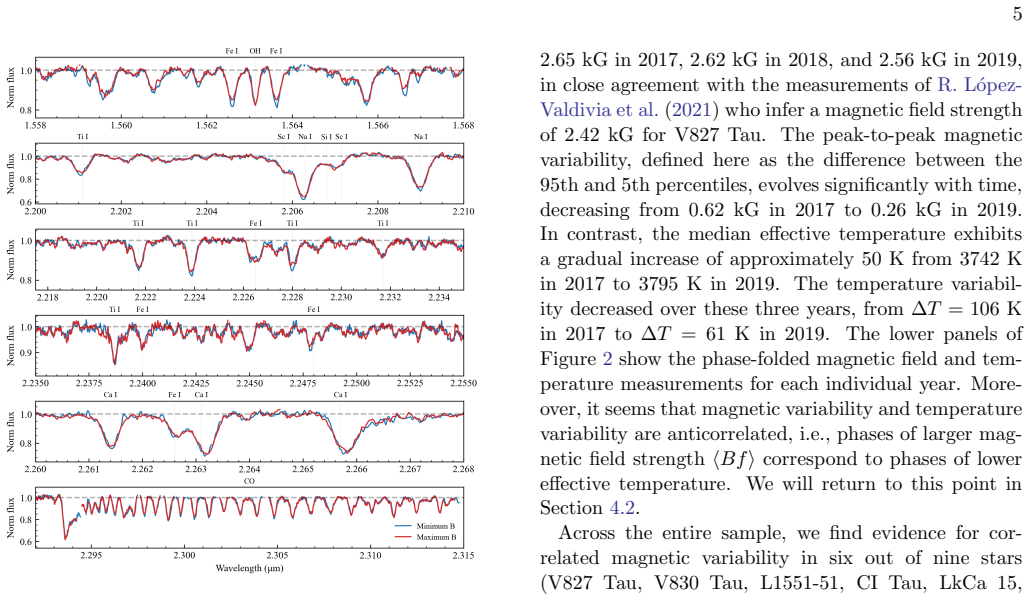
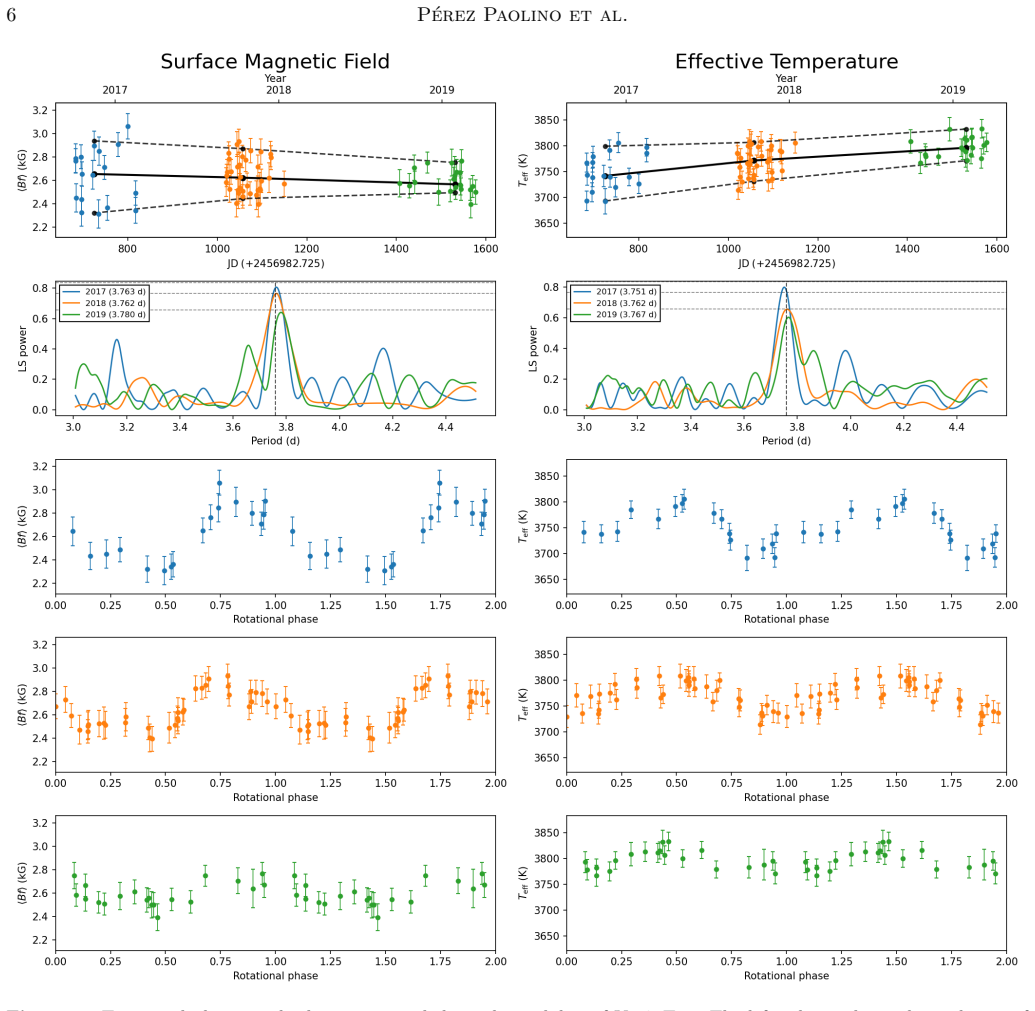
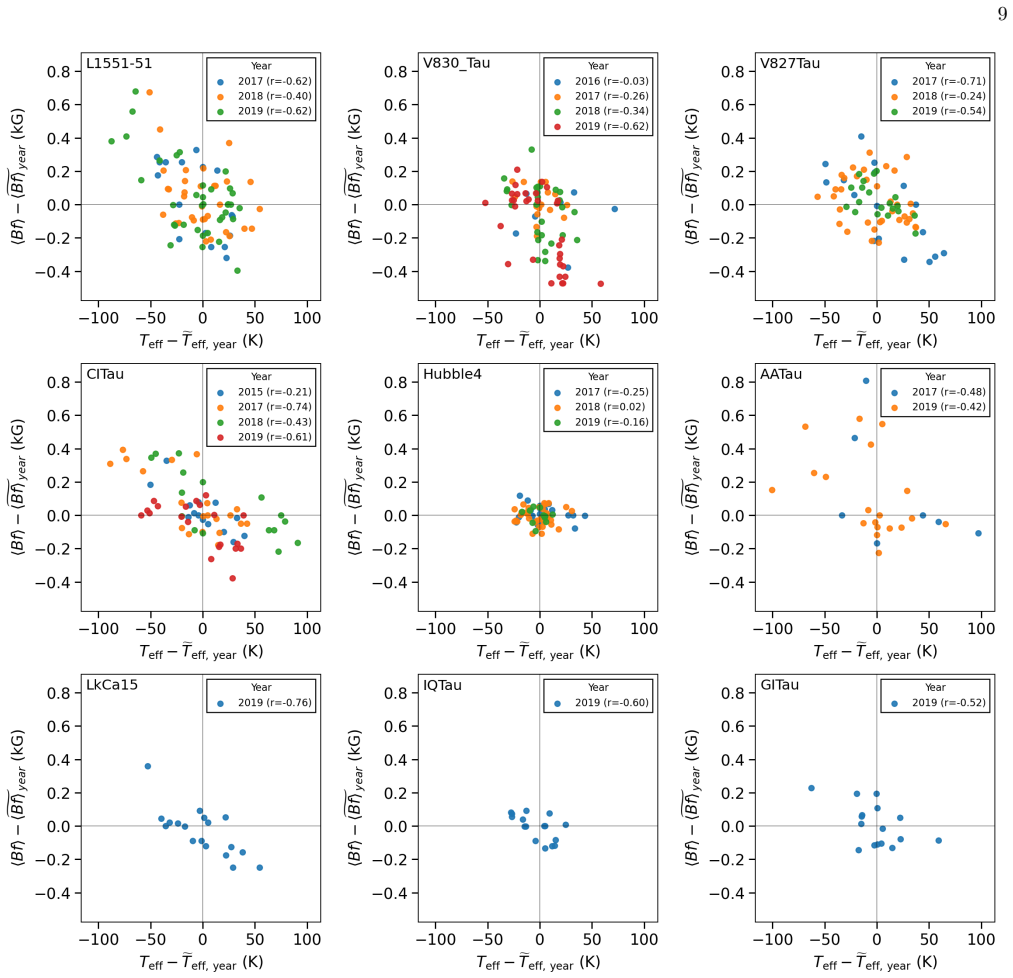
Fitting magnetic synthetic spectra to each of 489 IGRINS epochs yields the mean surface magnetic field strength <Bf> for nine T-Tauri stars. Six stars display correlated changes in <Bf> and effective temperature, with the amplitude of rotational modulation also evolving on year-long baselines and in some cases weakening or disappearing. This pattern demonstrates that magnetic variability arises from simultaneous changes in total magnetic flux and in the spatial distribution plus contrast of surface magnetic inhomogeneities. For the two stars with existing starspot data, the magnetic filling factors exceed the temperature-derived values, indicating that magnetic regions extend beyond the cool
What carries the argument
Mean surface magnetic field strength <Bf> obtained by fitting magnetic synthetic spectra to high-resolution near-infrared observations at multiple epochs.
If this is right
- Magnetic variability on these stars is produced by changes in both total flux and the arrangement of surface features.
- The amplitude of the rotationally modulated signal can weaken or vanish over time.
- Magnetic filling factors are larger than those inferred from temperature alone.
- PMS magnetic variability is structured, rotationally modulated, and evolves on year timescales.
Where Pith is reading between the lines
- Dynamo models for young stars may need to incorporate time-variable flux emergence and redistribution on yearly scales.
- Star-disk interaction calculations could be affected by the observed changes in both field strength and surface coverage.
- Higher-cadence monitoring might reveal whether specific magnetic features migrate or decay between seasons.
- Temperature-based spot maps likely underestimate the total magnetically active surface area.
Load-bearing premise
Fitting each epoch with magnetic synthetic spectra isolates the true mean surface magnetic field strength without substantial systematic bias from model assumptions or data choices.
What would settle it
Independent measurements of <Bf> from optical Zeeman broadening or from spectropolarimetry on the same stars and epochs would either match the infrared values or reveal a consistent offset.
Figures
read the original abstract
Magnetic fields play a central role in the evolution of pre-main-sequence (PMS) stars, yet direct observational constraints on their variability over rotational and multi-year timescales remain scarce. We investigate the temporal behavior of surface magnetic fields in a sample of nine PMS stars observed with the Immersion GRating INfrared Spectrometer (IGRINS), using 489 high-resolution near-infrared spectra drawn from the Raw and Reduced IGRINS Spectral Archive. We fit each epoch with magnetic synthetic spectra to derive the mean surface magnetic field strength $\langle Bf \rangle$ and detect correlated magnetic and thermal variability in six of the nine stars while being able to recover the known stellar rotation period in at least one observing season for all six. We find that not only the mean magnetic field strength and effective temperature evolve on year-long baselines, but so does the amplitude of the rotational modulation signal (which in some cases weakens or disappears entirely). This behavior indicates that magnetic variability is driven by both changes in the total magnetic flux and the spatial distribution and contrast of surface magnetic inhomogeneities. For two stars in the sample with starspot measurements, we find that the magnetic filling factors are systematically larger than those inferred from temperature, implying that magnetic regions extend beyond the coolest spotted areas and occupy a broader fraction of the stellar surface (i.e., plages). These results provide direct evidence that PMS magnetic variability is structured, rotationally modulated, and evolves on year timescales.
Editorial analysis
A structured set of objections, weighed in public.
Referee Report
Summary. The manuscript analyzes 489 IGRINS near-IR spectra of nine T Tauri stars. Each epoch is fit with magnetic synthetic spectra to derive mean field strength ⟨Bf⟩ and Teff. The authors report detections of correlated magnetic and thermal variability in six of nine stars, recovery of the known rotation period in at least one season for those six, year-scale evolution of both mean ⟨Bf⟩ and the amplitude of its rotational modulation (sometimes weakening or vanishing), and—for two stars with independent starspot data—magnetic filling factors systematically larger than spot filling factors, interpreted as evidence that magnetic regions extend beyond the coolest spots (i.e., plages).
Significance. If robust, the results supply direct observational constraints on the temporal structure of PMS magnetic fields, showing that variability arises from both changes in total flux and in the spatial distribution/contrast of surface inhomogeneities. This is relevant to models of angular-momentum evolution and dynamo action in young stars. The archival multi-epoch approach is a positive feature, but the absence of quantitative validation for the spectral fits limits the strength of the conclusions.
major comments (2)
- [Abstract] Abstract: the claim of detections in 6/9 stars, period recovery, and evolution of modulation amplitude is presented without error budgets, exclusion criteria for the six stars, or validation of the synthetic-spectrum fits; the post-hoc selection and lack of quantitative uncertainty on the filling-factor comparison therefore weaken support for the central claim.
- [Fitting procedure] Fitting procedure (paragraph referenced in abstract): the assumption that epoch-by-epoch magnetic synthetic spectra isolate ⟨Bf⟩ without substantial systematic bias from model-atmosphere assumptions, line-formation details, veiling, or data-reduction choices is load-bearing for every reported variability result, yet no line list, atmosphere grid, Zeeman-broadening treatment, or goodness-of-fit metric is supplied.
minor comments (1)
- Clarify how the six stars were chosen from the nine and whether any quantitative threshold on detection significance was applied.
Simulated Author's Rebuttal
We thank the referee for their careful and constructive review of our manuscript. Their comments highlight important areas where additional detail and clarity will strengthen the presentation of our results. We address each major comment below and commit to revisions that directly respond to the concerns raised.
read point-by-point responses
-
Referee: [Abstract] Abstract: the claim of detections in 6/9 stars, period recovery, and evolution of modulation amplitude is presented without error budgets, exclusion criteria for the six stars, or validation of the synthetic-spectrum fits; the post-hoc selection and lack of quantitative uncertainty on the filling-factor comparison therefore weaken support for the central claim.
Authors: We agree that the abstract, being a concise summary, does not convey the supporting details needed to evaluate the robustness of the claims. In the revised manuscript we will expand the abstract to reference the error budgets (derived from the covariance matrices of the spectral fits and bootstrap resampling of the time series) and the explicit selection criteria for the six stars (variability detected at >3 sigma in at least one season with adequate phase coverage). The period recovery is performed via Lomb-Scargle periodograms with false-alarm probabilities assessed by bootstrap; we will cite these quantitative results. For the filling-factor comparison we will report the formal uncertainties on both magnetic and temperature-derived filling factors and will move the quantitative comparison to a dedicated subsection with error propagation. The selection of the six stars follows pre-defined thresholds on data quality and variability significance that are applied uniformly; we will state these thresholds explicitly in the methods to remove any appearance of post-hoc selection. revision: yes
-
Referee: [Fitting procedure] Fitting procedure (paragraph referenced in abstract): the assumption that epoch-by-epoch magnetic synthetic spectra isolate ⟨Bf⟩ without substantial systematic bias from model-atmosphere assumptions, line-formation details, veiling, or data-reduction choices is load-bearing for every reported variability result, yet no line list, atmosphere grid, Zeeman-broadening treatment, or goodness-of-fit metric is supplied.
Authors: We acknowledge that the current methods description is insufficiently detailed for independent assessment of possible systematic biases. The revised manuscript will include: (1) the atomic and molecular line list (VALD3 supplemented with IGRINS-specific near-IR lines), (2) the model-atmosphere grid (PHOENIX models with magnetic field effects incorporated via the Unno-Rachkovsky analytic solution for Zeeman broadening), (3) the precise treatment of veiling (a single-parameter continuum dilution fitted simultaneously with ⟨Bf⟩ and Teff), and (4) the goodness-of-fit metric (reduced chi-squared with an additional penalty term for veiling). We have performed dedicated sensitivity tests in which we vary the assumed veiling law, switch between two independent data-reduction pipelines, and perturb the model-atmosphere parameters within their uncertainties; these tests show that the reported rotational modulation and year-scale changes in ⟨Bf⟩ remain statistically significant. A concise summary of these tests and the associated figures will be added to the methods section. revision: yes
Circularity Check
No significant circularity detected
full rationale
The paper reports empirical measurements obtained by independently fitting magnetic synthetic spectra to each of 489 archival IGRINS spectra, yielding epoch-wise values of ⟨Bf⟩ and Teff. The reported rotational modulation, year-scale evolution, and filling-factor comparisons are direct outputs of these per-epoch fits rather than quantities derived from any internal equation or self-citation that reduces them to the inputs by construction. No load-bearing mathematical steps, uniqueness theorems, or ansatzes are invoked that would create a circular reduction; the chain is therefore self-contained observational analysis.
Axiom & Free-Parameter Ledger
free parameters (1)
- spectral fitting parameters for <Bf>
axioms (1)
- domain assumption Magnetic synthetic spectra accurately reproduce the observed line profiles in T-Tauri atmospheres
Reference graph
Works this paper leans on
-
[1]
Airapetian, V. S., Glocer, A., Khazanov, G. V., et al. 2017, ApJL, 836, L3, doi: 10.3847/2041-8213/836/1/L3 Astropy Collaboration, Robitaille, T. P., Tollerud, E. J., et al. 2013, A&A, 558, A33, doi: 10.1051/0004-6361/201322068
-
[2]
Baliunas, S. L., Donahue, R. A., Soon, W. H., et al. 1995, ApJ, 438, 269, doi: 10.1086/175072
-
[3]
2021, An Introduction to Stellar Magnetic Activity, doi: 10.1088/2514-3433/ac2956
Basri, G. 2021, An Introduction to Stellar Magnetic Activity, doi: 10.1088/2514-3433/ac2956
-
[4]
Bouvier, J., Alencar, S. H. P., Boutelier, T., et al. 2007, A&A, 463, 1017, doi: 10.1051/0004-6361:20066021
-
[5]
Brun, A. S., & Browning, M. K. 2017, Living Reviews in Solar Physics, 14, 4, doi: 10.1007/s41116-017-0007-8
-
[6]
Cao, L., & Pinsonneault, M. H. 2022, MNRAS, 517, 2165, doi: 10.1093/mnras/stac2706
-
[7]
Carvalho, A., Johns-Krull, C. M., Prato, L., & Anderson, J. 2021, ApJ, 910, 33, doi: 10.3847/1538-4357/abe237
-
[8]
2010, Living Reviews in Solar Physics, 7, 3, doi: 10.12942/lrsp-2010-3
Charbonneau, P. 2010, Living Reviews in Solar Physics, 7, 3, doi: 10.12942/lrsp-2010-3
-
[9]
I., Donati, J.-F., Bellotti, S., et al
Cristofari, P. I., Donati, J.-F., Bellotti, S., et al. 2025, A&A, 702, A111, doi: 10.1051/0004-6361/202554902
-
[10]
2019, ApJL, 877, L3, doi: 10.3847/2041-8213/ab1b42
Currie, T., Marois, C., Cieza, L., et al. 2019, ApJL, 877, L3, doi: 10.3847/2041-8213/ab1b42
-
[11]
Damasso, M., Lanza, A. F., Benatti, S., et al. 2020, A&A, 642, A133, doi: 10.1051/0004-6361/202038864
-
[12]
2013, MoogStokes: Zeeman polarized radiative transfer,, Astrophysics Source Code Library, record ascl:1308.018
Deen, C. 2013, MoogStokes: Zeeman polarized radiative transfer,, Astrophysics Source Code Library, record ascl:1308.018
2013
-
[13]
Donati, J. F., & Landstreet, J. D. 2009, ARA&A, 47, 333, doi: 10.1146/annurev-astro-082708-101833
-
[14]
Additional planets and stellar models
Donati, J.-F., Skelly, M. B., Bouvier, J., et al. 2010, MNRAS, 409, 1347, doi: 10.1111/j.1365-2966.2010.17409.x
-
[15]
Donati, J.-F., H´ ebrard, E., Hussain, G. A. J., et al. 2015, Monthly Notices of the Royal Astronomical Society, 453, 3707, doi: 10.1093/mnras/stv1837
-
[16]
Donati, J. F., Bouvier, J., Alencar, S. H., et al. 2019, MNRAS, 483, L1, doi: 10.1093/mnrasl/sly207
-
[17]
Donati, J.-F., Bouvier, J., Alencar, S. H., et al. 2020, MNRAS, 491, 5660, doi: 10.1093/mnras/stz3368
-
[18]
Donati, J.-F., Finociety, B., Cristofari, P. I., et al. 2024, MNRAS, 530, 264, doi: 10.1093/mnras/stae675
-
[19]
Magnetic field measurements in a sample of Class I and flat-spectrum protostars observed with SPIRou
Drouglazet, L., Alecian, E., Sousa, A., et al. 2026, Magnetic field measurements in a sample of Class I and flat-spectrum protostars observed with SPIRou, arXiv, doi: 10.48550/arXiv.2603.17482
work page internal anchor Pith review Pith/arXiv arXiv doi:10.48550/arxiv.2603.17482 2026
-
[20]
Eilers, P. H. C. 2003, Analytical Chemistry, 75, 3631, doi: 10.1021/ac034173t
-
[21]
Fetherolf, T., Welter, S. G., Ostberg, C. M., et al. 2025, arXiv e-prints, arXiv:2511.19646, doi: 10.48550/arXiv.2511.19646
-
[22]
S., Reipurth, B., & Boogert, A
Flores, C., Connelley, M. S., Reipurth, B., & Boogert, A. 2019, The Astrophysical Journal, 882, 75, doi: 10.3847/1538-4357/ab35d4
-
[23]
S., Reipurth, B., & Duchˆ ene, G
Flores, C., Connelley, M. S., Reipurth, B., & Duchˆ ene, G. 2022, ApJ, 925, 21, doi: 10.3847/1538-4357/ac37bd
-
[24]
Foreman-Mackey, D., Hogg, D. W., Lang, D., & Goodman, J. 2013, PASP, 125, 306, doi: 10.1086/670067
-
[25]
Grankin, K. N. 2013, Astronomy Letters, 39, 251, doi: 10.1134/S1063773713040038
-
[26]
N., Bouvier, J., Herbst, W., & Melnikov, S
Grankin, K. N., Bouvier, J., Herbst, W., & Melnikov, S. Y. 2008, A&A, 479, 827, doi: 10.1051/0004-6361:20078476
-
[27]
G., Donati, J.-F., Morin, J., et al
Gregory, S. G., Donati, J.-F., Morin, J., et al. 2012, The Astrophysical Journal, 755, 97, doi: 10.1088/0004-637X/755/2/97
-
[28]
Grevesse, N., Asplund, M., & Sauval, A. J. 2007, SSRv, 130, 105, doi: 10.1007/s11214-007-9173-7
-
[29]
2008, A&A, 486, 951, doi: 10.1051/0004-6361:200809724
Gustafsson, B., Edvardsson, B., Eriksson, K., et al. 2008, A&A, 486, 951, doi: 10.1051/0004-6361:200809724
-
[30]
2026, A&A, 706, A138, doi: 10.1051/0004-6361/202556874
Lavail, A. 2026, A&A, 706, A138, doi: 10.1051/0004-6361/202556874
-
[31]
Han, E., L´ opez-Valdivia, R., Mace, G. N., & Jaffe, D. T. 2023, The Astronomical Journal, 166, 4, doi: 10.3847/1538-3881/acd2dd
-
[32]
Hartigan, P., Kenyon, S. J., Hartmann, L., et al. 1991, ApJ, 382, 617, doi: 10.1086/170749
-
[33]
Herczeg, G. J., & Hillenbrand, L. A. 2014, The Astrophysical Journal, 786, 97, doi: 10.1088/0004-637X/786/2/97
-
[34]
2022, in American Astronomical Society Meeting Abstracts, Vol
Johns-Krull, C., Prato, L., Stahl, A., et al. 2022, in American Astronomical Society Meeting Abstracts, Vol. 240, American Astronomical Society Meeting #240, 406.13
2022
-
[35]
Johns-Krull, C. M., McLane, J. N., Prato, L., et al. 2016, ApJ, 826, 206, doi: 10.3847/0004-637X/826/2/206
-
[36]
Johnstone, C. P., Bartel, M., & G¨ udel, M. 2021, A&A, 649, A96, doi: 10.1051/0004-6361/202038407
-
[37]
Johns-Krull, C. M. 2007, The Astrophysical Journal, 664, 975, doi: 10.1086/519017
-
[38]
2024, igrins/plp, 3.0.0 Zenodo, doi: 10.5281/zenodo.11080095
Kaplan, K., Lee, J.-J., Sawczynec, E., & Kim, H.-J. 2024, igrins/plp, 3.0.0 Zenodo, doi: 10.5281/zenodo.11080095
-
[39]
Kochukhov, O., Hackman, T., Lehtinen, J. J., & Wehrhahn, A. 2020, Astronomy & Astrophysics, 635, A142, doi: 10.1051/0004-6361/201937185 15
-
[40]
Lavail, A., Kochukhov, O., & Hussain, G. A. J. 2019, Astronomy & Astrophysics, 630, A99, doi: 10.1051/0004-6361/201935695 L´ opez-Valdivia, R., Sokal, K. R., Mace, G. N., et al. 2021, ApJ, 921, 53, doi: 10.3847/1538-4357/ac1a7b L´ opez-Valdivia, R. 2021, Codes and tools for IGRINS data: Synthetic grid, V1 Harvard Dataverse, doi: 10.7910/DVN/ALOPIS L´ opez...
-
[41]
Mace, G., Kim, H., Jaffe, D. T., et al. 2016, in Society of Photo-Optical Instrumentation Engineers (SPIE) Conference Series, Vol. 9908, Ground-based and Airborne Instrumentation for Astronomy VI, ed. C. J. Evans, L. Simard, & H. Takami, 99080C, doi: 10.1117/12.2232780
-
[42]
Owen, J. E., & Jackson, A. P. 2012, MNRAS, 425, 2931, doi: 10.1111/j.1365-2966.2012.21481.x
-
[43]
Park, C., Jaffe, D. T., Yuk, I.-S., et al. 2014, in Society of Photo-Optical Instrumentation Engineers (SPIE) Conference Series, Vol. 9147, Ground-based and Airborne Instrumentation for Astronomy V, ed. S. K. Ramsay, I. S. McLean, & H. Takami, 91471D, doi: 10.1117/12.2056431 P´ erez Paolino, F., Bary, J. S., Hillenbrand, L. A., Horner, B., & Carvalho, A. ...
-
[44]
Press, W. H., & Rybicki, G. B. 1989, ApJ, 338, 277, doi: 10.1086/167197
-
[45]
Rebull, L. M., Stauffer, J. R., Cody, A. M., et al. 2020, AJ, 159, 273, doi: 10.3847/1538-3881/ab893c
-
[46]
Ribas, I., Guinan, E. F., G¨ udel, M., & Audard, M. 2005, ApJ, 622, 680, doi: 10.1086/427977
-
[47]
Ryabchikova, T., Piskunov, N., Kurucz, R. L., et al. 2015, PhyS, 90, 054005, doi: 10.1088/0031-8949/90/5/054005
-
[48]
Sawczynec, E., Kaplan, K. F., Mace, G. N., et al. 2025, PASP, 137, 034505, doi: 10.1088/1538-3873/adba89
-
[49]
See, V., Jardine, M., Vidotto, A. A., et al. 2016, MNRAS, 462, 4442, doi: 10.1093/mnras/stw2010
-
[50]
2019, A&A, 626, A86, doi: 10.1051/0004-6361/201935315
Shulyak, D., Reiners, A., Nagel, E., et al. 2019, A&A, 626, A86, doi: 10.1051/0004-6361/201935315
-
[51]
Sokal, K. R., Johns-Krull, C. M., Mace, G. N., et al. 2020, The Astrophysical Journal, 888, 116, doi: 10.3847/1538-4357/ab59d8
-
[52]
Tang, S.-Y., Johns-Krull, C. M., Prato, L., & Stahl, A. G. 2024, ApJ, 973, 124, doi: 10.3847/1538-4357/ad5e7f
-
[53]
Tu, L., Johnstone, C. P., G¨ udel, M., & Lammer, H. 2015, A&A, 577, L3, doi: 10.1051/0004-6361/201526146
-
[54]
Willamo, T., Lehtinen, J. J., Hackman, T., et al. 2022, A&A, 659, A71, doi: 10.1051/0004-6361/202141649
-
[55]
Yang, H., Johns-Krull, C. M., & Valenti, J. A. 2008, The Astronomical Journal, 136, 2286, doi: 10.1088/0004-6256/136/6/2286 16P ´erez Paolino et al. Figure A1.Example corner plot for V830 Tau with 3σuncertainties APPENDIX
discussion (0)
Sign in with ORCID, Apple, or X to comment. Anyone can read and Pith papers without signing in.