Thinking Through Signs: PEEL as a Semiotic Scaffolding for Epistemically Accountable AI-Enabled Research
Pith reviewed 2026-06-28 09:45 UTC · model grok-4.3
The pith
PEEL combines deterministic reading tools with LLM interpretation to expose systematic distortions in AI-generated research condensations.
A machine-rendered reading of the paper's core claim, the machinery that carries it, and where it could break.
Core claim
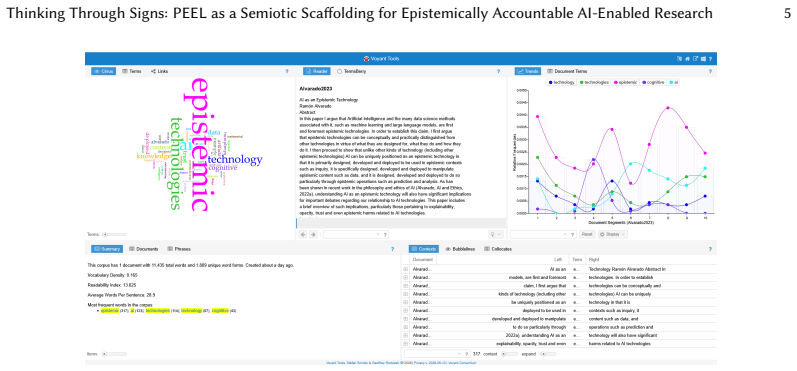
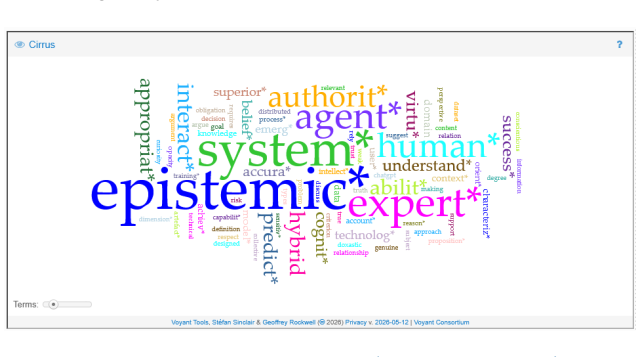
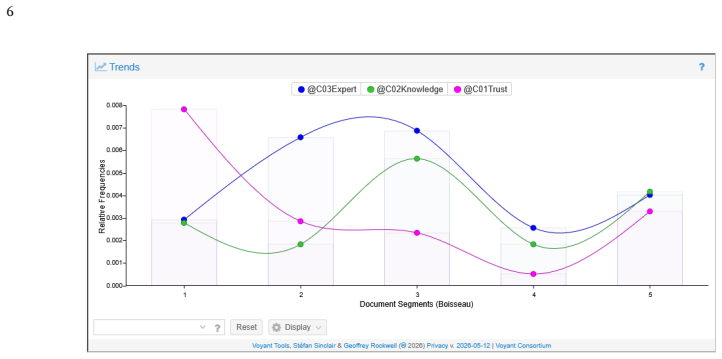
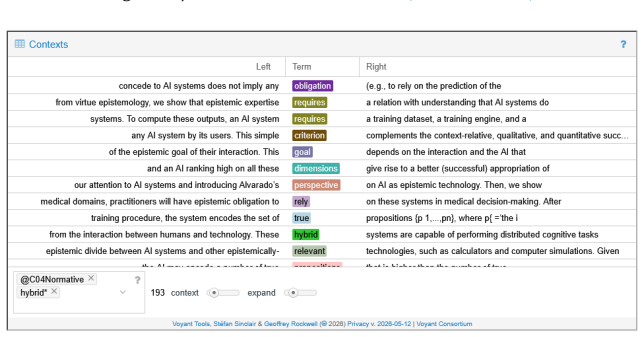
PEEL is a working scaffolding that combines deterministic distant reading via Voyant Tools with LLM interpretation via Claude, grounded in Peircean semiotics and abductive reasoning. Applied to AI-generated condensations of three source texts, PEEL reveals systematic distortions in quantity, term frequency, and epistemic voice that are invisible without non-AI measurement and yields three design implications: deterministic instruments must accompany AI tools; fluency is not fidelity; epistemic authority must be designed in, not assumed.
What carries the argument
PEEL (Protocols for Epistemically Engaged Literacy in AI), a semiotic scaffolding that pairs deterministic distant reading with LLM interpretation to measure and interpret AI condensations.
If this is right
- Deterministic instruments must accompany AI tools when researchers use them for text work.
- Fluency in AI output does not guarantee fidelity to the original text's content or voice.
- Epistemic authority in AI-assisted research must be actively designed rather than assumed to emerge.
Where Pith is reading between the lines
- PEEL could be adapted to audit AI outputs in literature review or hypothesis generation tasks.
- Similar measurement approaches might reveal distortions in non-academic AI writing such as journalism summaries.
- Extending the method to track how distortions evolve across multiple rounds of AI editing would test its diagnostic reach.
Load-bearing premise
The observed distortions are caused by the LLM condensation process itself rather than by the choice of three source texts, the specific prompts used, or the interpretation steps in PEEL.
What would settle it
Re-running PEEL on a larger and more varied collection of source texts and prompts to check whether the same patterns of distortion in quantity, term frequency, and epistemic voice persist.
Figures
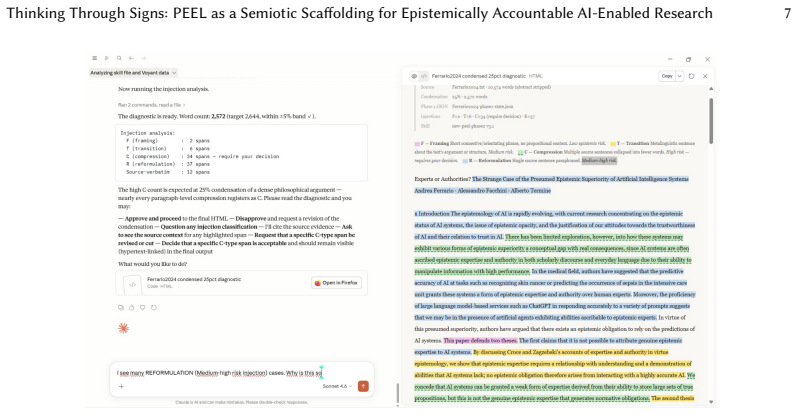
read the original abstract
Large language models are reshaping research practice while quietly eroding researchers epistemic accountability. This commentary introduces PEEL - Protocols for Epistemically Engaged Literacy in AI, a working scaffolding that combines deterministic distant reading via Voyant Tools with LLM interpretation via Claude, grounded in Peircean semiotics and abductive reasoning. Applied to AI-generated condensations of three source texts, PEEL reveals systematic distortions in quantity, term frequency, and epistemic voice that are invisible without non-AI measurement -- and yields three design implications: deterministic instruments must accompany AI tools; fluency is not fidelity; epistemic authority must be designed in, not assumed.
Editorial analysis
A structured set of objections, weighed in public.
Referee Report
Summary. The paper introduces PEEL (Protocols for Epistemically Engaged Literacy in AI), a scaffolding combining Voyant Tools for deterministic distant reading, Claude for LLM interpretation, and Peircean semiotics/abductive reasoning. Applied to AI-generated condensations of three source texts, PEEL identifies systematic distortions in quantity, term frequency, and epistemic voice invisible without non-AI measurement, and derives three design implications: deterministic instruments must accompany AI tools; fluency is not fidelity; epistemic authority must be designed in, not assumed.
Significance. If the distortions can be shown to arise specifically from the LLM condensation process and to generalize, the work offers a practical semiotic protocol for preserving epistemic accountability in AI-assisted research and supplies concrete, testable design principles that address a timely gap between LLM fluency and research fidelity.
major comments (2)
- [Application to three source texts] Application section (three source texts): the claim that PEEL 'reveals systematic distortions' rests on condensations of only three texts with no control conditions (human summarization, alternative prompts, or non-LLM baselines) or statistical tests for consistency; without these, the causal attribution to the LLM condensation process itself versus text selection, prompt wording, or the Voyant+Claude+Peircean steps cannot be established.
- [Design implications] Design implications paragraph: the three implications are presented as following directly from the observed distortions, yet the small n and absence of larger-corpus validation or falsification tests leave the scope of 'systematic' unsupported, weakening the load-bearing link between the empirical illustration and the prescriptive claims.
minor comments (1)
- The protocol description would benefit from an explicit step-by-step enumeration of how Voyant outputs are fed into Claude and how Peircean categories are applied, to allow readers to assess reproducibility.
Simulated Author's Rebuttal
We thank the referee for the constructive comments, which highlight important limitations in the scope of our illustrative commentary. We address each major comment below and indicate planned revisions.
read point-by-point responses
-
Referee: [Application to three source texts] Application section (three source texts): the claim that PEEL 'reveals systematic distortions' rests on condensations of only three texts with no control conditions (human summarization, alternative prompts, or non-LLM baselines) or statistical tests for consistency; without these, the causal attribution to the LLM condensation process itself versus text selection, prompt wording, or the Voyant+Claude+Peircean steps cannot be established.
Authors: We agree that the application to three texts provides an illustration rather than controlled evidence for causality or generality. The manuscript frames PEEL as a protocol demonstrated through a concrete case; we will revise the application section to describe the three condensations explicitly as an illustrative example, replace 'systematic distortions' with 'observed distortions in these cases,' and add a sentence noting the absence of controls or statistical tests. This will prevent over-attribution while preserving the demonstration of the method. revision: partial
-
Referee: [Design implications] Design implications paragraph: the three implications are presented as following directly from the observed distortions, yet the small n and absence of larger-corpus validation or falsification tests leave the scope of 'systematic' unsupported, weakening the load-bearing link between the empirical illustration and the prescriptive claims.
Authors: The implications are derived from the specific application shown. We will revise the design implications paragraph to present the three points as considerations suggested by the case study, with an explicit statement that they remain hypotheses requiring larger-scale validation and falsification testing. This change will make the inferential step from illustration to prescription transparent and appropriately scoped. revision: yes
Circularity Check
No circularity: PEEL applies external deterministic tools and semiotics to produce observations
full rationale
The paper introduces PEEL as a scaffolding that combines Voyant Tools (deterministic distant reading), Claude LLM interpretation, and Peircean semiotics/abductive reasoning. It applies this protocol to condensations of three source texts and reports observed patterns in quantity, term frequency, and epistemic voice, from which three design implications are drawn. No equations, fitted parameters, or predictions are defined such that any result reduces to the inputs by construction. No self-citations are invoked as load-bearing uniqueness theorems or ansatzes. The method is self-contained against external benchmarks (Voyant is an independent tool; Peircean semiotics is a pre-existing framework), and the central claims rest on the application rather than self-definition or renaming of known results.
Axiom & Free-Parameter Ledger
Reference graph
Works this paper leans on
-
[1]
Ramón Alvarado. 2023. AI as an Epistemic Technology. Science and Engineering Ethics 29, 5 (Aug. 2023), 32. doi:10. 1007/s11948-023-00451-3
2023
-
[2]
and Gebru, Timnit and McMillan-Major, Angelina and Shmitchell, Shmargaret
Emily M. Bender, Timnit Gebru, Angelina McMillan-Major, and Shmargaret Shmitchell. 2021. On the Dangers of Stochastic Parrots: Can Language Models Be Too Big? . In Proceedings of the 2021 ACM Conference on Fairness, Accountability, and Transparency (Virtual Event, Canada) (FAccT ’21). Association for Computing Machinery, New York, NY, USA, 610–623. doi:10...
-
[3]
and Koller, Alexander , title =
Emily M. Bender and Alexander Koller. 2020. Climbing towards NLU: On Meaning, Form, and Understanding in the Age of Data. In Proceedings of the 58th Annual Meeting of the Association for Computational Linguistics, Dan Jurafsky, Joyce Chai, Natalie Schluter, and Joel Tetreault (Eds.). Association for Computational Linguistics, Online, 5185–5198. doi:10.186...
-
[4]
Ivo Blohm, Shaila Miranda, Shuk Ying Ho, and Jan Marco Leimeister. 2025. Next-generation IS research methods – towards a better understanding of complex and dynamic phenomena . . . and generative AI as the elephant in the room. 40, 2 (2025), 102–121. doi:10.1177/02683962251340699
-
[5]
Éloïse Boisseau. 2026. Expertise, opacity, and trust in AI systems. Synthese 207, 3 (Feb. 2026), 104. doi:10.1007/s11229- 026-05484-2
-
[6]
2014.Basics of qualitative research: Techniques and procedures for developing grounded theory
Juliet Corbin and Anselm Strauss. 2014.Basics of qualitative research: Techniques and procedures for developing grounded theory. Sage publications
2014
-
[7]
Andrea Ferrario, Alessandro Facchini, and Alberto Termine. 2024. Experts or Authorities? The Strange Case of the Presumed Epistemic Superiority of Artificial Intelligence Systems. Minds and Machines 34, 3 (July 2024), 1–27. doi:10.1007/s11023-024-09681-1
-
[8]
Ram D. Gopal, Jingjing Li, Kai Riemer, Suprateek Sarker, Param Vir Singh, Anjana Susarla, Martin Bichler, and Jason Bennett Thatcher. 2025. Inventing with Machines: Generative AI and the Evolving Landscape of IS Research. Information Systems Research 36, 4 (2025), 1949–1967. arXiv:https://doi.org/10.1287/isre.2025.editorial.v36.n4 doi:10. 1287/isre.2025.e...
-
[9]
Rudy Hirschheim, Heinz K. Klein, and Kalle Lyytinen. 1996. Exploring the intellectual structures of information systems development: A social action theoretic analysis. Accounting, Management and Information Technologies 6, 1-2 (Jan. 1996), 1–64. doi:10.1016/0959-8022(96)00004-5 10
-
[10]
Hobbs, Mark Stickel, Paul Martin, and Douglas Edwards
Jerry R. Hobbs, Mark Stickel, Paul Martin, and Douglas Edwards. 1988. Interpretation as Abduction. In Proceedings of the 26th Annual Meeting on Association for Computational Linguistics (Buffalo, New York)(ACL ’88). Association for Computational Linguistics, Stroudsburg, PA, USA, 95–103. doi:10.3115/982023.982035
-
[11]
Chris Lu, Cong Lu, Robert Tjarko Lange, Jakob Foerster, Jeff Clune, and David Ha. 2024. The AI Scientist: Towards Fully Automated Open-Ended Scientific Discovery. (Aug. 2024). arXiv:2408.06292 [cs.AI] doi:10.48550/ARXIV.2408.06292
work page internal anchor Pith review Pith/arXiv arXiv doi:10.48550/arxiv.2408.06292 2024
-
[12]
Lorenzo Magnani. 2004. Model-Based and Manipulative Abduction in Science. 9, 3 (2004), 219–247. doi:10.1023/B: FODA.0000042841.18507.22
work page doi:10.1023/b: 2004
-
[13]
Manning and H
C. Manning and H. Schutze. 1999. Foundations of Statistical Natural Language Processing. MIT Press
1999
-
[14]
Lisa Messeri and M. J. Crockett. 2024. Artificial intelligence and illusions of understanding in scientific research. Local eLibrary. Nature 627, 8002 (March 2024), 49–58. doi:10.1038/s41586-024-07146-0
-
[15]
George A. Miller. 1995. WordNet: A Lexical Database for English. Commun. ACM 38, 11 (1995), 39–41
1995
-
[16]
Franco Moretti. 2013. Distant Reading. Verso, New York
2013
-
[17]
Charles Sanders Peirce. 1992. The fixation of Belief. In The Essential Peirce Volume I (1867-1893), Nathan Houser and Christian Kloesel (Eds.). Indiana University Press, Bloomington, IN, 109–123
1992
-
[18]
Charles Sanders Peirce. 1998. The essential Peirce - Seleceted Philosophical Writings Vol. II (1893-1913). Indiana University Press, Bloomington, IN. http://www.iupress.indiana.edu/product_info.php?products_id=21333
1998
-
[19]
Jo Reichertz. 2013. Induction, Deduction, Abduction. SAGE Publications, Inc., 123–135. doi:10.4135/9781446282243.n9
-
[20]
Geoffrey Rockwell and Stéfan Sinclair. 2016. Hermeneutica: Computer-Assisted Interpretation in the Humanities. The MIT Press, Cambridge, MA
2016
-
[21]
Donald A. Schön. 1983. The reflective practitioner: how professionals think in action. Basic Books, New York, NY
1983
-
[22]
Iddo Tavory and Stefan Timmermans. 2014. Abductive Analysis - Theorizing Qualitative Research (kindle ed.). The University of Chicago Press, Chicago, Illinois.https://www.press.uchicago.edu/ucp/books/book/chicago/A/bo18785947. html
2014
-
[23]
Megan Woods, Rob Macklin, and Gemma K. Lewis. 2016. Researcher reflexivity: exploring the im- pacts of CAQDAS use. International Journal of Social Research Methodology 19, 4 (2016), 385–403. arXiv:https://doi.org/10.1080/13645579.2015.1023964 doi:10.1080/13645579.2015.1023964
discussion (0)
Sign in with ORCID, Apple, or X to comment. Anyone can read and Pith papers without signing in.