HETDEX Public Data Release 1: Source Catalog 2 and Data Cubes from ~90 sq deg of Integral-Field Optical Spectroscopy
Pith reviewed 2026-06-28 08:54 UTC · model grok-4.3
The pith
HETDEX Public Data Release 1 catalogs 426,654 LAEs plus 491,411 OII emitters with positions, redshifts and spectra
A machine-rendered reading of the paper's core claim, the machinery that carries it, and where it could break.
Core claim
HPSC2 contains 426,654 LAEs, 491,411 [O II] emitters, 19,457 low-z galaxies, 18,303 active galactic nuclei, and 150,608 stars, providing coordinates, redshifts or stellar velocities, and 1D spectra for each source. The catalog derives from 431,713 IFU observations covering 86.67 sq deg and incorporates improved quality control plus new machine learning classifiers on four additional years of data.
What carries the argument
HPSC2, the reprocessed source catalog that applies machine learning classifiers and quality control to integral-field spectra to separate and characterize emission-line sources.
If this is right
- The catalog supplies ready positions and spectra for statistical studies of LAE clustering over large volumes at 1.88 < z < 3.52.
- 1D spectra enable direct measurement of line properties and velocities for each classified object.
- Inclusion of legacy fields such as COSMOS allows direct cross-matching with multi-wavelength data from other surveys.
- Public data cubes support searches for faint emission lines, though local sky subtraction limits use for absolute surface brightness or very extended sources.
Where Pith is reading between the lines
- The scale of the LAE sample may support tighter constraints on the growth of structure once clustering measurements are performed.
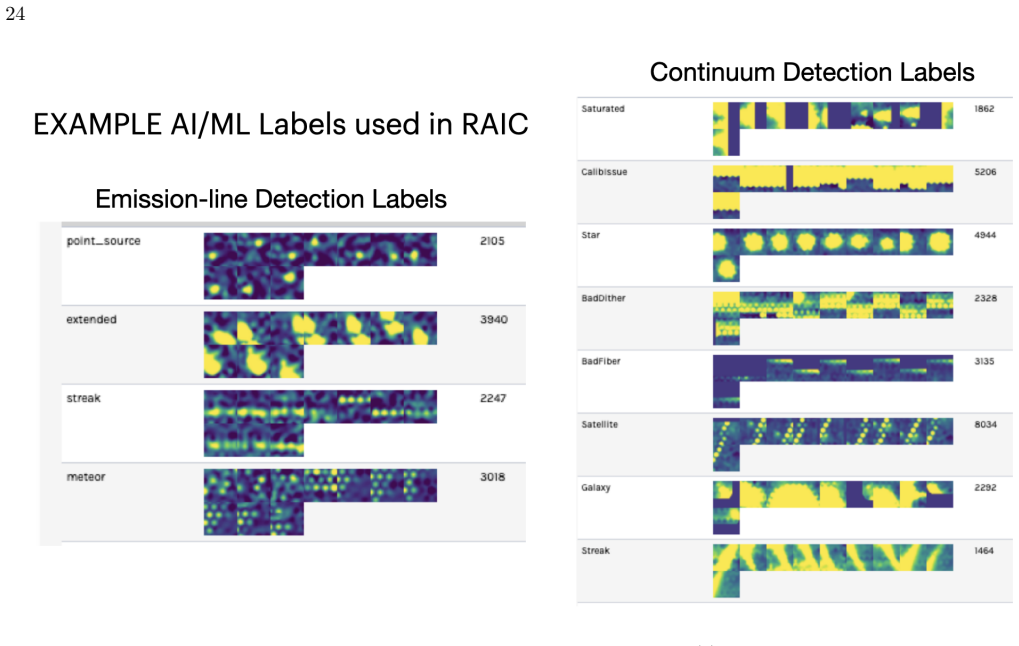
- Raw detection databases released with the catalog allow external teams to test alternative classification methods.
- The non-contiguous sky coverage suggests that future contiguous extensions could improve measurements of very large-scale modes.
Load-bearing premise
The machine learning classifiers and quality control procedures correctly separate the different source classes with low contamination.
What would settle it
Independent spectroscopic follow-up of a random subsample from each class that finds contamination rates substantially above those implied by the catalog would falsify the separation.
Figures







read the original abstract
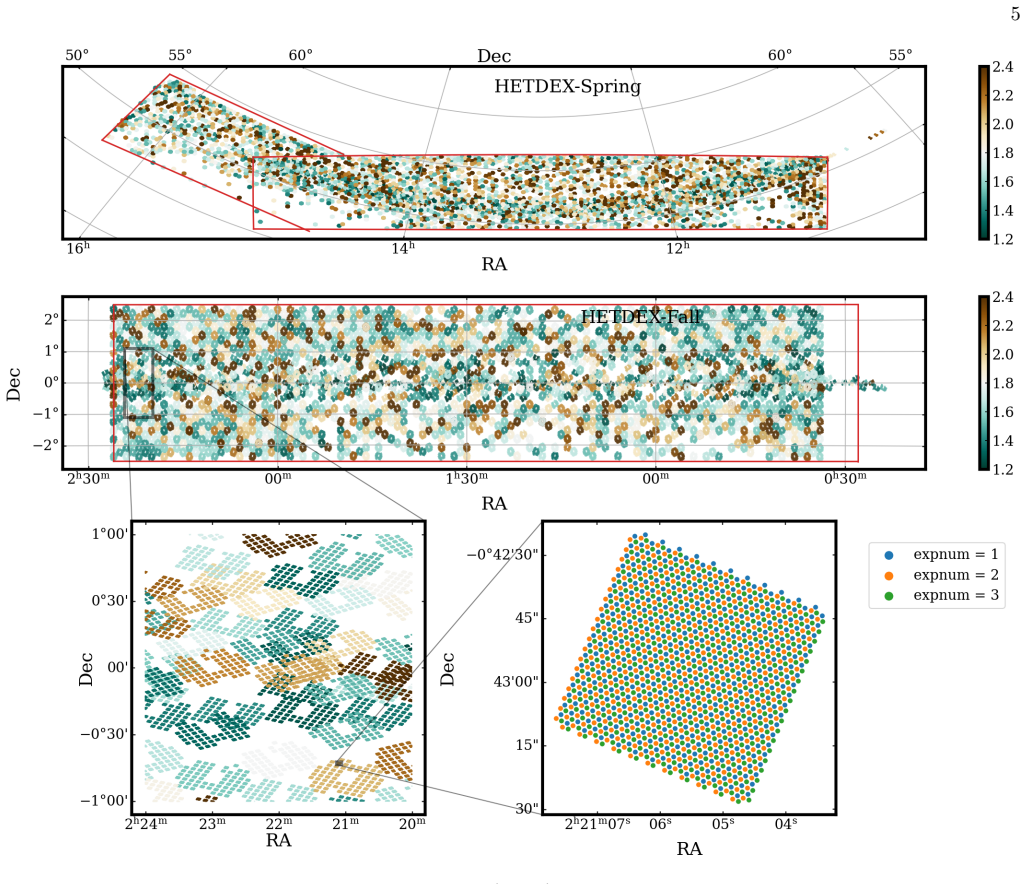
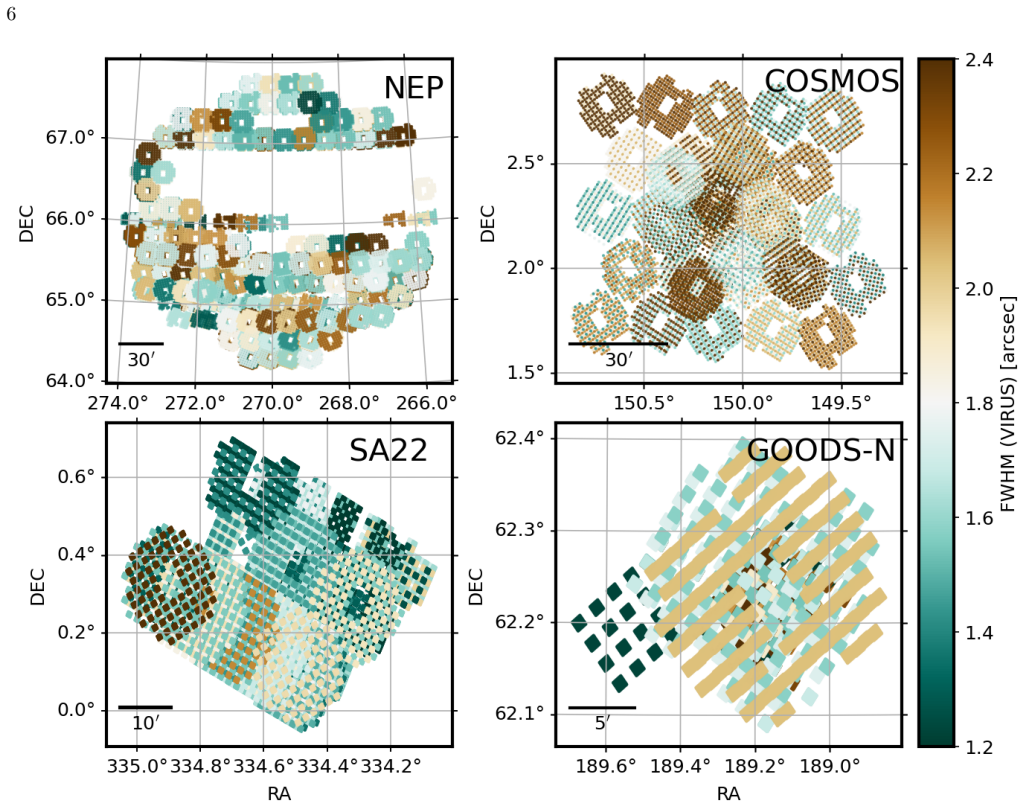
The Hobby-Eberly Telescope Dark Energy Experiment (HETDEX) is a wide-field, integral-field spectroscopic survey designed to map the large-scale distribution of Lyman-alpha emitting galaxies (LAEs) at 1.88 < z < 3.52 and constrain dark energy at cosmic noon. Using the 10-m Hobby-Eberly Telescope and the Visible Integral-Field Replicable Unit (IFU) Spectrograph, HETDEX obtains >35,000 spectra per exposure over 3500-5500 {\AA} at R~800 with ~1.8 arcsec image quality, enabling an untargeted census of emission-line galaxies across 540 sq deg. We present HETDEX Public Data Release 1 (PDR1), comprising 431,713 IFU observations covering 86.67 sq deg of noncontiguous sky in the Spring (13h, +51{\deg}) and Fall (1.5h, 0{\deg}) fields, along with legacy regions (COSMOS, GOODS-N, NEP, SA22). PDR1 includes the HETDEX Public Source Catalog 2 (HPSC2), an expanded and reprocessed version of Mentuch Cooper et al. (2023) incorporating four additional years of data, improved quality control, and new machine learning classifiers. HPSC2 contains 426,654 LAEs, 491,411 [O II] emitters, 19,457 low-z galaxies, 18,303 active galactic nuclei, and 150,608 stars, providing coordinates, redshifts or stellar velocities, and 1D spectra for each source. Because the data cubes use local sky subtraction optimized for faint emission-line detection, they are not suited for absolute surface-brightness measurements or very extended nearby galaxies. Appendix materials include the full detection catalog, the 1.6 million-candidate LAE sample, and raw detection databases. All products are publicly accessible through the HETDEX data portal (https://hetdex.org/data-results/), including access to a public JupyterLab. HPSC2 is also publicly available via Zenodo (DOI: 10.5281/zenodo.19581262).
Editorial analysis
A structured set of objections, weighed in public.
Referee Report
Summary. The manuscript presents HETDEX Public Data Release 1 (PDR1), consisting of 431,713 IFU observations over 86.67 sq deg and the HETDEX Public Source Catalog 2 (HPSC2). HPSC2 reports 426,654 LAEs, 491,411 [O II] emitters, 19,457 low-z galaxies, 18,303 AGN, and 150,608 stars, each with coordinates, redshifts/velocities, and 1D spectra, derived from new ML classifiers and improved QC on four additional years of data. Data cubes, a 1.6M-candidate LAE sample, and raw databases are also released via the HETDEX portal and Zenodo.
Significance. If the source classifications hold, PDR1 supplies one of the largest public samples of high-redshift LAEs for large-scale structure and dark-energy studies at cosmic noon, together with supporting [O II] and stellar samples. Public access to cubes, spectra, and a JupyterLab environment directly supports community re-use and reproducibility.
major comments (1)
- [Abstract / HPSC2 description] Abstract and HPSC2 processing description: the headline source counts (426,654 LAEs etc.) are the direct output of the new ML classifiers and QC pipeline, yet no purity, completeness, contamination fractions, training-set sizes, or test-set performance metrics are supplied. Without these numbers the reliability of the class separations cannot be assessed and the catalog contents remain unverifiable.
Simulated Author's Rebuttal
We thank the referee for their careful review of the manuscript. We address the single major comment below and will make the requested additions to improve the verifiability of the catalog.
read point-by-point responses
-
Referee: [Abstract / HPSC2 description] Abstract and HPSC2 processing description: the headline source counts (426,654 LAEs etc.) are the direct output of the new ML classifiers and QC pipeline, yet no purity, completeness, contamination fractions, training-set sizes, or test-set performance metrics are supplied. Without these numbers the reliability of the class separations cannot be assessed and the catalog contents remain unverifiable.
Authors: We agree that quantitative performance metrics are necessary to allow readers to assess the reliability of the ML-based classifications in HPSC2. In the revised manuscript we will add a dedicated subsection (placed after the description of the new classifiers) that reports: (i) sizes of the training and validation sets used for each classifier, (ii) test-set performance metrics including precision, recall, F1-score, and confusion-matrix summaries obtained via cross-validation, and (iii) estimated purity, completeness, and contamination fractions for the five source classes. These values will be presented both in the text and in a summary table. The added material will be drawn from the internal validation analyses already performed during classifier development and will be placed in the main text rather than an appendix so that the headline counts can be interpreted in context. revision: yes
Circularity Check
No circularity: observational catalog release with no derivation chain
full rationale
This is a data-release paper presenting an observational catalog (HPSC2) derived from raw IFU spectra via processing pipelines, ML classifiers, and QC. No equations, first-principles derivations, fitted parameters renamed as predictions, or self-citation chains are present in the provided text. The source counts are direct outputs of the described pipeline applied to new observations; they do not reduce to prior results by construction. External validation metrics are absent, but that is a correctness issue, not circularity. The paper is self-contained as an empirical release.
Axiom & Free-Parameter Ledger
axioms (1)
- domain assumption Standard assumptions in astronomical data reduction and source detection for integral-field spectroscopy hold for the HETDEX pipeline.
Reference graph
Works this paper leans on
-
[3]
Detection of Lyman Continuum from 3.0 < z < 3.5 Galaxies in the HETDEX Survey. , keywords =. doi:10.3847/1538-4357/ac1598 , archivePrefix =. 2107.11319 , primaryClass =
-
[7]
, title =
Van Rossum, Guido and Drake, Fred L. , title =. 2009 , isbn =
2009
-
[8]
Atomic Data for Resonance Absorption Lines. I. Wavelengths Longward of the Lyman Limit. , keywords =. doi:10.1086/191601 , adsurl =
-
[11]
The Evolution of the Galaxy Rest-frame Ultraviolet Luminosity Function over the First Two Billion Years. , keywords =. doi:10.1088/0004-637X/810/1/71 , archivePrefix =. 1410.5439 , primaryClass =
work page internal anchor Pith review Pith/arXiv arXiv doi:10.1088/0004-637x/810/1/71
-
[14]
First HETDEX Spectroscopic Determinations of Ly and UV Luminosity Functions at z = 2-3: Bridging a Gap between Faint AGNs and Bright Galaxies. , keywords =. doi:10.3847/1538-4357/ac1e97 , archivePrefix =. 2105.11497 , primaryClass =
-
[15]
The Spitzer-HETDEX Exploratory Large Area Survey. II. The Dark Energy Camera and Spitzer/IRAC Multiwavelength Catalog. , keywords =. doi:10.3847/1538-4365/aaee85 , archivePrefix =. 1812.04646 , primaryClass =
work page internal anchor Pith review Pith/arXiv arXiv doi:10.3847/1538-4365/aaee85
-
[17]
The Great Observatories Origins Deep Survey: Initial Results From Optical and Near-Infrared Imaging
The Great Observatories Origins Deep Survey: Initial Results from Optical and Near-Infrared Imaging. , keywords =. doi:10.1086/379232 , archivePrefix =. astro-ph/0309105 , primaryClass =
work page internal anchor Pith review Pith/arXiv arXiv doi:10.1086/379232
-
[20]
arXiv e-prints , keywords =
The DESI Experiment Part I: Science,Targeting, and Survey Design. arXiv e-prints , keywords =
-
[21]
Third Reference Catalogue of Bright Galaxies
-
[22]
Uppsala general catalogue of galaxies
-
[23]
The Seventh Data Release of the Sloan Digital Sky Survey
The Seventh Data Release of the Sloan Digital Sky Survey. , keywords =. doi:10.1088/0067-0049/182/2/543 , archivePrefix =. 0812.0649 , primaryClass =
work page internal anchor Pith review Pith/arXiv arXiv doi:10.1088/0067-0049/182/2/543
-
[33]
2004, MNRAS, 347, 74, doi: 10.1111/j.1365-2966.2004.07173.x
The physical properties of star-forming galaxies in the low-redshift Universe. , keywords =. doi:10.1111/j.1365-2966.2004.07881.x , archivePrefix =. astro-ph/0311060 , primaryClass =
-
[34]
Low/High Redshift Classification of Emission Line Galaxies in the HETDEX Survey
Low/High Redshift Classification of Emission Line Galaxies in the HETDEX survey. Statistical Challenges in 21st Century Cosmology , year = 2014, volume =. doi:10.1017/S1743921314013805 , archivePrefix =. 1411.2651 , primaryClass =
work page internal anchor Pith review Pith/arXiv arXiv doi:10.1017/s1743921314013805 2014
-
[36]
doi:10.1086/115487 , keywords =
Measures of Location and Scale for Velocities in Clusters of Galaxies---A Robust Approach. , keywords =. doi:10.1086/115487 , adsurl =
-
[37]
The Hyper Suprime-Cam Software Pipeline
doi:10.1093/pasj/psx080 , Eid =. arXiv , Author =:1705.06766 , Journal =
work page internal anchor Pith review Pith/arXiv arXiv doi:10.1093/pasj/psx080
-
[38]
The HETDEX Pilot Survey. IV. The Evolution of [O II] Emitting Galaxies from z ~ 0.5 to z ~ 0
doi:10.1088/0004-637X/769/1/83 , Eid =. arXiv , Arxivurl =:1304.5537 , Journal =
work page internal anchor Pith review Pith/arXiv arXiv doi:10.1088/0004-637x/769/1/83
-
[39]
The Evolution of Ly-alpha Emitting Galaxies Between z = 2.1 and z = 3.1
The Evolution of Ly -emitting Galaxies between z = 2.1 and z = 3.1. , keywords =. doi:10.1088/0004-637X/744/2/110 , archivePrefix =. 1109.4685 , primaryClass =
work page internal anchor Pith review Pith/arXiv arXiv doi:10.1088/0004-637x/744/2/110
-
[40]
Correcting correlation functions for redshift-dependent interloper contamination. , keywords =. doi:10.1093/mnras/stab1986 , archivePrefix =. 2104.04613 , primaryClass =
-
[41]
Foreman-Mackey, Daniel and Hogg, David W. and Lang, Dustin and Goodman, Jonathan , year=. emcee: The MCMC Hammer , volume=. Publications of the Astronomical Society of the Pacific , publisher=. doi:10.1086/670067 , number=
-
[43]
Verhamme, A and Garel, T and Ventou, E and Contini, T and Bouché, N and Herenz, EC and Richard, J and Bacon, R and Schmidt, KB and Maseda, M and et al. , year=. Recovering the systemic redshift of galaxies from their Lyman alpha line profile , volume=. Monthly Notices of the Royal Astronomical Society: Letters , publisher=. doi:10.1093/mnrasl/sly058 , number=
-
[44]
in prep , doi =
, journal =. in prep , doi =
-
[48]
Stellar Populations of Ly -emitting Galaxies in the HETDEX Survey. I. An Analysis of LAEs in the GOODS-N Field. , keywords =. doi:10.3847/1538-4357/ac8546 , archivePrefix =. 2208.01660 , primaryClass =
-
[49]
Jean-Charles J. Cuillandre and Kanoa Withington and Patrick Hudelot and Yuliana Goranova and Henry McCracken and Frédéric Magnard and Yannick Mellier and Nicolas Regnault and Marc Bétoule and Hervé Aussel and J. J. Kavelaars and Pierre Fernique and François Bonnarel and Francois Ochsenbein and Olivier Ilbert , title =. Observatory Operations: Strategies, ...
2012
-
[50]
Norman A. Grogin and Dale D. Kocevski and S. M. Faber and Henry C. Ferguson and Anton M. Koekemoer and Adam G. Riess and Viviana Acquaviva and David M. Alexander and Omar Almaini and Matthew L. N. Ashby and Marco Barden and Eric F. Bell and Fr. doi:10.1088/0067-0049/197/2/35 , url =
-
[52]
The Hyper Suprime-Cam SSP Survey: Overview and Survey Design
The Hyper Suprime-Cam SSP Survey: Overview and survey design. , keywords =. doi:10.1093/pasj/psx066 , archivePrefix =. 1704.05858 , primaryClass =
work page internal anchor Pith review Pith/arXiv arXiv doi:10.1093/pasj/psx066
-
[53]
The COSMOS2015 Catalog: Exploring the 1<z<6 Universe with half a million galaxies
The COSMOS2015 Catalog: Exploring the 1 < z < 6 Universe with Half a Million Galaxies. , keywords =. doi:10.3847/0067-0049/224/2/24 , archivePrefix =. 1604.02350 , primaryClass =
work page internal anchor Pith review Pith/arXiv arXiv doi:10.3847/0067-0049/224/2/24
-
[54]
2019 , eprint=
The Pan-STARRS1 Surveys , author=. 2019 , eprint=
2019
-
[55]
The Sloan Digital Sky Survey Quasar Catalog: Fourteenth Data Release
The Sloan Digital Sky Survey Quasar Catalog: Fourteenth data release. , keywords =. doi:10.1051/0004-6361/201732445 , archivePrefix =. 1712.05029 , primaryClass =
work page internal anchor Pith review Pith/arXiv arXiv doi:10.1051/0004-6361/201732445
-
[56]
The 16th Data Release of the Sloan Digital Sky Surveys: First Release from the APOGEE-2 Southern Survey and Full Release of eBOSS Spectra. , keywords =. doi:10.3847/1538-4365/ab929e , archivePrefix =. 1912.02905 , primaryClass =
-
[57]
and Haberland, Matt and Reddy, Tyler and Cournapeau, David and Burovski, Evgeni and Peterson, Pearu and Weckesser, Warren and Bright, Jonathan and
Virtanen, Pauli and Gommers, Ralf and Oliphant, Travis E. and Haberland, Matt and Reddy, Tyler and Cournapeau, David and Burovski, Evgeni and Peterson, Pearu and Weckesser, Warren and Bright, Jonathan and. Nature Methods , year =
-
[58]
2020 , journal=
speclite , author=. 2020 , journal=
2020
-
[59]
1996, A&AS, 117, 393, doi: 10.1051/aas:1996164
SExtractor: Software for source extraction. , keywords =. doi:10.1051/aas:1996164 , adsurl =
-
[63]
The DEIMOS 10k spectroscopic survey catalog of the COSMOS field
The DEIMOS 10K Spectroscopic Survey Catalog of the COSMOS Field. , keywords =. doi:10.3847/1538-4357/aabacf , archivePrefix =. 1803.09251 , primaryClass =
work page internal anchor Pith review Pith/arXiv arXiv doi:10.3847/1538-4357/aabacf
-
[64]
The MOSFIRE Deep Evolution Field (MOSDEF) Survey: Rest-frame Optical Spectroscopy for -0.5ex 1500 H-selected Galaxies at 1.37 < z < 3.8. , keywords =. doi:10.1088/0067-0049/218/2/15 , archivePrefix =. 1412.1835 , primaryClass =
work page internal anchor Pith review Pith/arXiv arXiv doi:10.1088/0067-0049/218/2/15
-
[65]
The zCOSMOS 10k-Bright Spectroscopic Sample. , keywords =. doi:10.1088/0067-0049/184/2/218 , adsurl =
-
[66]
The DEEP3 Galaxy Redshift Survey: Keck/DEIMOS Spectroscopy in the GOODS-N Field
The DEEP3 Galaxy Redshift Survey: Keck/DEIMOS Spectroscopy in the GOODS-N Field. , keywords =. doi:10.1088/0067-0049/193/1/14 , archivePrefix =. 1101.4018 , primaryClass =
work page internal anchor Pith review Pith/arXiv arXiv doi:10.1088/0067-0049/193/1/14
-
[67]
The 3D-HST Survey: Hubble Space Telescope WFC3/G141 Grism Spectra, Redshifts, and Emission Line Measurements for -0.5ex 100,000 Galaxies. , keywords =. doi:10.3847/0067-0049/225/2/27 , archivePrefix =. 1510.02106 , primaryClass =
work page internal anchor Pith review Pith/arXiv arXiv doi:10.3847/0067-0049/225/2/27
-
[68]
The Team Keck Treasury Redshift Survey of the GOODS-North Field
The Team Keck Treasury Redshift Survey of the GOODS-North Field. , keywords =. doi:10.1086/420999 , archivePrefix =. astro-ph/0401353 , primaryClass =
work page internal anchor Pith review Pith/arXiv arXiv doi:10.1086/420999
-
[69]
The Team Keck Redshift Survey 2: MOSFIRE Spectroscopy of the GOODS-North Field
The Team Keck Redshift Survey 2: MOSFIRE Spectroscopy of the GOODS-North Field. , keywords =. doi:10.1088/0004-6256/150/5/153 , archivePrefix =. 1509.07172 , primaryClass =
work page internal anchor Pith review Pith/arXiv arXiv doi:10.1088/0004-6256/150/5/153
-
[70]
Early-type galaxies in the PEARS survey: Probing the stellar populations at moderate redshift
Early-Type Galaxies in the PEARS Survey: Probing the Stellar Populations at Moderate Redshift. , keywords =. doi:10.1088/0004-637X/706/1/158 , archivePrefix =. 0908.0739 , primaryClass =
work page internal anchor Pith review Pith/arXiv arXiv doi:10.1088/0004-637x/706/1/158
-
[71]
Emission-line Galaxies from the Hubble Space Telescope Probing Evolution and Reionization Spectroscopically (PEARS) Grism Survey. II. The Complete Sample. , keywords =. doi:10.1088/0004-637X/772/1/48 , archivePrefix =. 1208.5535 , primaryClass =
work page internal anchor Pith review Pith/arXiv arXiv doi:10.1088/0004-637x/772/1/48
-
[72]
A Spectroscopic Survey of Redshift 1.4< -0.5ex < -0.5ex 3.0 Galaxies in the GOODS-North Field: Survey Description, Catalogs, and Properties. , keywords =. doi:10.1086/508851 , archivePrefix =. astro-ph/0609296 , primaryClass =
work page internal anchor Pith review Pith/arXiv arXiv doi:10.1086/508851
-
[73]
A Highly Complete Spectroscopic Survey of the GOODS-N Field
A Highly Complete Spectroscopic Survey of the GOODS-N Field. , keywords =. doi:10.1086/592735 , archivePrefix =. 0812.2481 , primaryClass =
work page internal anchor Pith review Pith/arXiv arXiv doi:10.1086/592735
-
[75]
COSMOS2020: A Panchromatic View of the Universe to z 10 from Two Complementary Catalogs. , keywords =. doi:10.3847/1538-4365/ac3078 , archivePrefix =. 2110.13923 , primaryClass =
-
[78]
, year = 1974, month = feb, volume =
Absolute Spectral Energy Distributions for White Dwarfs. , year = 1974, month = feb, volume =. doi:10.1086/190287 , adsurl =
-
[79]
The Origin of the Mass-Metallicity Relation: Insights from 53,000 Star-forming Galaxies in the Sloan Digital Sky Survey. , keywords =. doi:10.1086/423264 , archivePrefix =. astro-ph/0405537 , primaryClass =
work page internal anchor Pith review Pith/arXiv arXiv doi:10.1086/423264
-
[80]
The Completed SDSS-IV extended Baryon Oscillation Spectroscopic Survey: Large-scale structure catalogues for cosmological analysis. , keywords =. doi:10.1093/mnras/staa2416 , archivePrefix =. 2007.09000 , primaryClass =
-
[81]
, year = 1969, month = dec, volume =
A Theoretical Investigation of Focal Stellar Images in the Photographic Emulsion and Application to Photographic Photometry. , year = 1969, month = dec, volume =
1969
-
[83]
astropy/photutils: 1.0.0 , month = sep, year = 2020, publisher =
Larry Bradley and Brigitta Sip. astropy/photutils: 1.0.0 , month = sep, year = 2020, publisher =. doi:10.5281/zenodo.4044744 , url =
-
[85]
Hyper Suprime-Cam: System design and verification of image quality. , keywords =. doi:10.1093/pasj/psx063 , adsurl =
-
[97]
2007, ApJ, 671, 278, doi: 10.1086/522955
Ly -Emitting Galaxies at z = 3.1: L* Progenitors Experiencing Rapid Star Formation. , keywords =. doi:10.1086/522955 , archivePrefix =. 0710.2697 , primaryClass =
-
[102]
Unbiased Cosmological Parameter Estimation from Emission Line Surveys with Interlopers
Unbiased Cosmological Parameter Estimation from Emission-line Surveys with Interlopers. , keywords =. doi:10.3847/1538-4357/ab12d5 , archivePrefix =. 1811.06982 , primaryClass =
work page internal anchor Pith review Pith/arXiv arXiv doi:10.3847/1538-4357/ab12d5
-
[103]
The Evolution of the Galaxy Stellar Mass Function at z = 4-8: A Steepening Low-mass-end Slope with Increasing Redshift. , keywords =. doi:10.3847/0004-637X/825/1/5 , archivePrefix =. 1507.05636 , primaryClass =
work page internal anchor Pith review Pith/arXiv arXiv doi:10.3847/0004-637x/825/1/5
-
[104]
The Spectrally Resolved Ly Emission of Three Ly -selected Field Galaxies at z -0.5ex 2.4 from the HETDEX Pilot Survey. , keywords =. doi:10.1088/0004-637X/775/2/99 , archivePrefix =. 1308.1957 , primaryClass =
work page internal anchor Pith review Pith/arXiv arXiv doi:10.1088/0004-637x/775/2/99 1957
-
[105]
The Kinematics of Multiple-Peaked Ly-alpha Emission in Star-Forming Galaxies at z~2-3
The Kinematics of Multiple-peaked Ly Emission in Star-forming Galaxies at z -0.5ex 2-3. , keywords =. doi:10.1088/0004-637X/745/1/33 , archivePrefix =. 1107.4367 , primaryClass =
work page internal anchor Pith review Pith/arXiv arXiv doi:10.1088/0004-637x/745/1/33
-
[106]
and Milvang-Jensen, Bo and Dunlop, James S
The Evolution of the Stellar Mass Functions of Star-forming and Quiescent Galaxies to z = 4 from the COSMOS/UltraVISTA Survey. , keywords =. doi:10.1088/0004-637X/777/1/18 , archivePrefix =. 1303.4409 , primaryClass =
work page internal anchor Pith review Pith/arXiv arXiv doi:10.1088/0004-637x/777/1/18
-
[107]
The Evolution of the Stellar Mass Function of Galaxies from z = 4.0 and the First Comprehensive Analysis of its Uncertainties: Evidence for Mass-Dependent Evolution. , keywords =. doi:10.1088/0004-637X/701/2/1765 , archivePrefix =. 0811.1773 , primaryClass =
work page internal anchor Pith review Pith/arXiv arXiv doi:10.1088/0004-637x/701/2/1765
-
[109]
A Spectroscopic Follow-up Program of Very Massive Galaxies at 3 < z < 4: Confirmation of Spectroscopic Redshifts, and a High Fraction of Powerful AGNs. , keywords =. doi:10.3847/1538-4357/aa7206 , archivePrefix =. 1606.05350 , primaryClass =
work page internal anchor Pith review Pith/arXiv arXiv doi:10.3847/1538-4357/aa7206
-
[110]
A Near-Infrared Spectroscopic Survey of K-Selected Galaxies at z -0.5ex 2.3: Redshifts and Implications for Broadband Photometric Studies. , keywords =. doi:10.1086/528945 , archivePrefix =. 0801.1110 , primaryClass =
work page internal anchor Pith review Pith/arXiv arXiv doi:10.1086/528945
-
[112]
arXiv e-prints , keywords =
J-PAS: The Javalambre-Physics of the Accelerated Universe Astrophysical Survey. arXiv e-prints , keywords =
-
[115]
Third data release of the Hyper Suprime-Cam Subaru Strategic Program. , keywords =. doi:10.1093/pasj/psab122 , archivePrefix =. 2108.13045 , primaryClass =
-
[116]
Ground-based and Airborne Instrumentation for Astronomy II , year = 2008, editor =
Design, construction, and performance of VIRUS-P: the prototype of a highly replicated integral-field spectrograph for HET. Ground-based and Airborne Instrumentation for Astronomy II , year = 2008, editor =. doi:10.1117/12.790235 , adsurl =
-
[120]
Dr Dobb's J Software Tools Prof Program , volume=
HDF: The hierarchical data format , author=. Dr Dobb's J Software Tools Prof Program , volume=
-
[121]
HEALPix: A Framework for High-Resolution Discretization and Fast Analysis of Data Distributed on the Sphere. , keywords =. doi:10.1086/427976 , archivePrefix =. astro-ph/0409513 , primaryClass =
work page internal anchor Pith review Pith/arXiv arXiv doi:10.1086/427976
-
[125]
2002 , url =
PyTables: Hierarchical Datasets in Python , author =. 2002 , url =
2002
-
[130]
, year = 1981, month = jun, volume =
FITS - a Flexible Image Transport System. , year = 1981, month = jun, volume =
1981
-
[133]
Diagnose: Spectral classification code
-
[143]
and Varoquaux, G
Pedregosa, F. and Varoquaux, G. and Gramfort, A. and Michel, V. and Thirion, B. and Grisel, O. and Blondel, M. and Prettenhofer, P. and Weiss, R. and Dubourg, V. and Vanderplas, J. and Passos, A. and Cournapeau, D. and Brucher, M. and Perrot, M. and Duchesnay, E. , journal=. Scikit-learn: Machine Learning in
-
[154]
2022, , 164, 207, 10.3847/1538-3881/ac882b
Abareshi , B., Aguilar , J., Ahlen , S., et al. 2022, , 164, 207, 10.3847/1538-3881/ac882b
-
[155]
Adams , J. J., Blanc , G. A., Hill , G. J., et al. 2011, , 192, 5, 10.1088/0067-0049/192/1/5
-
[156]
2002, PyTables: Hierarchical Datasets in Python
Alted, F., Vilata, I., et al. 2002, PyTables: Hierarchical Datasets in Python. https://www.pytables.org/
2002
-
[157]
Astropy Collaboration , Robitaille , T. P., Tollerud , E. J., et al. 2013, , 558, A33, 10.1051/0004-6361/201322068
-
[158]
doi:10.3847/1538-3881/aabc4f , eid =
Astropy Collaboration , Price-Whelan , A. M., Sip o cz , B. M., et al. 2018, , 156, 123, 10.3847/1538-3881/aabc4f
-
[159]
2015, , 575, A75, 10.1051/0004-6361/201425419
Bacon , R., Brinchmann , J., Richard , J., et al. 2015, , 575, A75, 10.1051/0004-6361/201425419
-
[160]
2016, Journal of Open Source Software, 1, 58, doi:10.21105/joss.00058
Barbary, K. 2016, Journal of Open Source Software, 1, 58, 10.21105/joss.00058
-
[161]
2014, arXiv e-prints, arXiv:1403.5237
Benitez , N., Dupke , R., Moles , M., et al. 2014, arXiv e-prints, arXiv:1403.5237. 1403.5237
Pith/arXiv arXiv 2014
-
[162]
2021, , 653, A31, 10.1051/0004-6361/202038841
Bonoli , S., Mar \' n-Franch , A., Varela , J., et al. 2021, , 653, A31, 10.1051/0004-6361/202038841
-
[163]
2021, Python, 10.5281/zenodo.5796924
Bradley, L., Sip o cz, B., Robitaille, T., et al. 2021, Python, 10.5281/zenodo.5796924
-
[164]
Overview of the SDSS-IV MaNGA Survey: Mapping Nearby Galaxies at Apache Point Observatory
Bundy , K., Bershady , M. A., Law , D. R., et al. 2015, , 798, 7, 10.1088/0004-637X/798/1/7
work page internal anchor Pith review doi:10.1088/0004-637x/798/1/7 2015
-
[165]
J., Groves, B., Kauffmann, G., et al.\ 2006, , 372, 961, doi:10.1111/j.1365-2966.2006.10859.x
Cenarro , A. J., Peletier , R. F., S \'a nchez-Bl \'a zquez , P., et al. 2007, , 374, 664, 10.1111/j.1365-2966.2006.11196.x
discussion (0)
Sign in with ORCID, Apple, or X to comment. Anyone can read and Pith papers without signing in.