A Planetary Nebula from a 5.7 M_(odot) Progenitor in a 90 Myr M31 Star Cluster
Pith reviewed 2026-06-28 04:49 UTC · model grok-4.3
The pith
A planetary nebula in M31 is tied to a 5.7 solar mass progenitor in a 90 Myr cluster.
A machine-rendered reading of the paper's core claim, the machinery that carries it, and where it could break.
Core claim
The PN and cluster are associated, so isochrone fitting to the cluster CMD yields a progenitor initial mass of 5.66^{+0.42}_{-0.37} M_⊙ at near-solar metallicity; the nebula is nitrogen-enhanced with N/O ~7 times solar, consistent with hot bottom burning.
What carries the argument
Isochrone fitting to the cluster color-magnitude diagram, supported by spatial proximity and radial-velocity match from spectral decomposition.
If this is right
- Planetary nebulae can form from stars with initial masses at least as high as 5.7 solar masses.
- Nucleosynthesis models must produce strong nitrogen enrichment at this progenitor mass through hot bottom burning.
- The lower edge of the super-AGB regime for planetary nebula production receives a direct empirical anchor.
- The initial-to-final mass relation for intermediate-mass stars gains a new high-mass calibration point.
Where Pith is reading between the lines
- Searches for similar cluster-PN pairs in other galaxies could quickly enlarge the sample of high-mass progenitors.
- The system offers a laboratory to track how the nebula's chemistry and the cluster's stellar population evolve together.
- If the mass holds, current upper limits on planetary nebula progenitor masses in some population synthesis codes may need revision upward.
Load-bearing premise
The nebula and cluster are physically associated rather than aligned by chance.
What would settle it
A radial-velocity or distance measurement that places the nebula clearly outside the cluster would break the association and remove the mass constraint.
Figures

read the original abstract
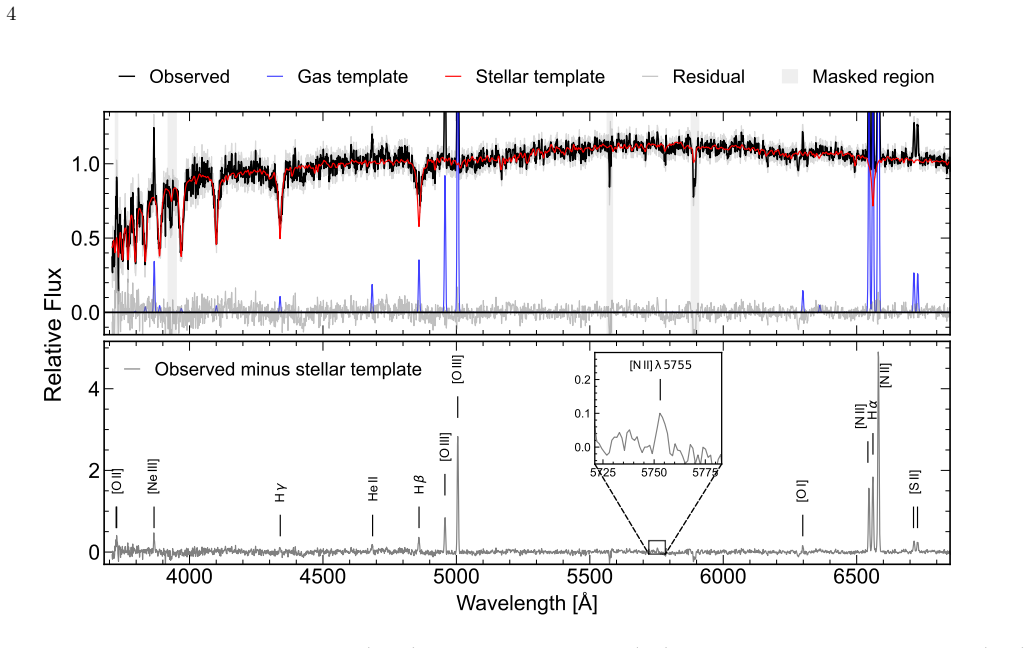
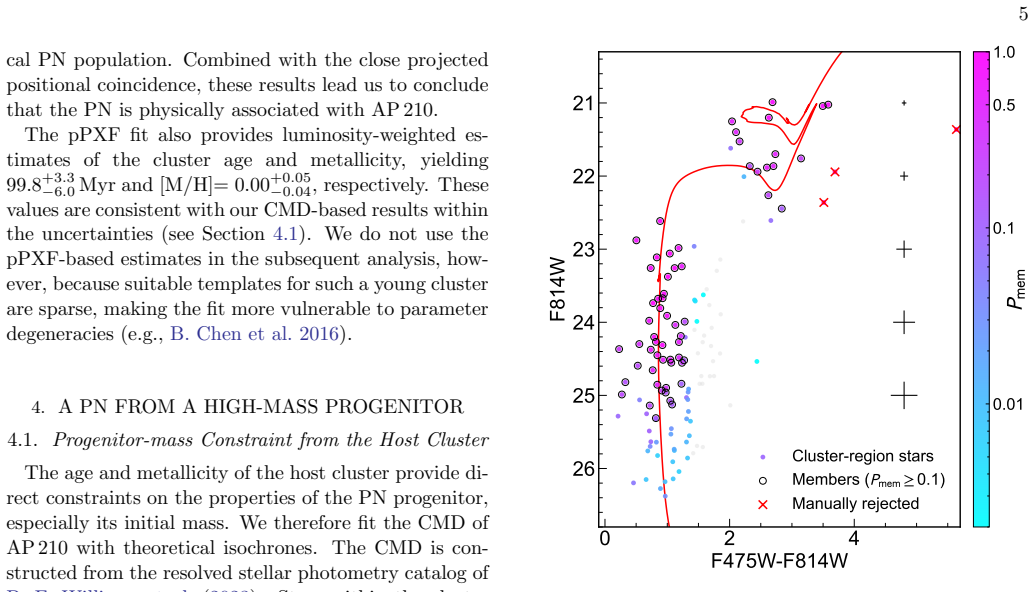
Planetary nebulae (PNe) trace the late evolution of low-to-intermediate-mass stars, yet the masses of their progenitors are rarely measured directly. Here we present a PN physically associated with a young star cluster in M31, providing an unprecedented extragalactic empirical anchor in the poorly constrained high-mass regime of PN progenitors. High-resolution Hubble Space Telescope imaging shows that the nebula lies near the cluster center, and spectral decomposition of the blended cluster-plus-nebula spectrum yields consistent stellar and nebular radial velocities, strongly supporting a physical association. Isochrone fitting to the color-magnitude diagram indicates a cluster age of ~90 Myr and a near-solar metallicity, implying a progenitor initial mass of $5.66^{+0.42}_{-0.37}\,M_{\odot}$. This value is among the highest empirical progenitor-mass constraints yet reported for any PN and approaches the lower boundary of the super-asymptotic giant branch (super-AGB) regime. We further find that the nebula is strongly nitrogen-enhanced, with an N/O ratio ~7 times the solar value, broadly consistent with hot bottom burning in a relatively massive AGB progenitor. This system therefore provides a rare opportunity to test PN formation and nucleosynthesis at the high-mass end of the PN progenitor distribution.
Editorial analysis
A structured set of objections, weighed in public.
Referee Report
Summary. The manuscript reports the identification of a planetary nebula spatially coincident with the center of a young star cluster in M31. Spectral decomposition of the blended cluster-plus-nebula spectrum is used to demonstrate consistent stellar and nebular radial velocities, supporting physical association. Isochrone fitting to the cluster color-magnitude diagram yields a cluster age of ~90 Myr and near-solar metallicity, from which a progenitor initial mass of 5.66^{+0.42}_{-0.37} M_⊙ is inferred. The nebula is found to be strongly nitrogen-enhanced (N/O ~7 times solar), interpreted as evidence for hot-bottom burning in a relatively massive AGB star. The result is presented as one of the highest empirical PN progenitor masses yet obtained.
Significance. If the association holds, the work supplies a rare direct empirical anchor for PN progenitor masses near the upper end of the AGB range and approaching the super-AGB boundary, a regime where theoretical predictions remain uncertain. The reported nitrogen enhancement provides an independent consistency check on nucleosynthesis models for stars in this mass range.
major comments (2)
- [spectral decomposition of the blended cluster-plus-nebula spectrum] The physical association is load-bearing for the entire mass determination. The radial-velocity consistency is obtained solely from spectral decomposition of blended light, yet the manuscript provides no formal velocity uncertainties, reduced-χ² of the decomposition, or robustness tests against alternative stellar templates or single-component assumptions (see the description of the blended-spectrum analysis).
- [isochrone fitting to the color-magnitude diagram] The quoted progenitor mass of 5.66^{+0.42}_{-0.37} M_⊙ rests on isochrone fitting to the cluster CMD, but the manuscript supplies no quantitative description of the fitting procedure, handling of field contamination, choice of isochrone library, or full error budget (see the isochrone-fitting paragraph).
minor comments (2)
- [abstract] The abstract states that velocities are 'consistent' without quoting the measured values or their uncertainties; adding these numbers would improve clarity.
- [HST imaging description] Figure captions and text should explicitly state the spatial offset of the nebula from the cluster center in arcseconds or parsecs.
Simulated Author's Rebuttal
We thank the referee for their detailed and constructive report. The two major comments correctly identify areas where the manuscript would benefit from expanded methodological descriptions. We address each point below and will revise the manuscript to incorporate the requested details.
read point-by-point responses
-
Referee: [spectral decomposition of the blended cluster-plus-nebula spectrum] The physical association is load-bearing for the entire mass determination. The radial-velocity consistency is obtained solely from spectral decomposition of blended light, yet the manuscript provides no formal velocity uncertainties, reduced-χ² of the decomposition, or robustness tests against alternative stellar templates or single-component assumptions (see the description of the blended-spectrum analysis).
Authors: We agree that formal uncertainties, goodness-of-fit metrics, and robustness tests are necessary to substantiate the spectral decomposition. The revised manuscript will report the reduced-χ² of the two-component fit, the formal velocity uncertainties derived from the decomposition, and the outcomes of tests using alternative stellar templates as well as single-component models. These additions will be placed in the section describing the blended-spectrum analysis. revision: yes
-
Referee: [isochrone fitting to the color-magnitude diagram] The quoted progenitor mass of 5.66^{+0.42}_{-0.37} M_⊙ rests on isochrone fitting to the cluster CMD, but the manuscript supplies no quantitative description of the fitting procedure, handling of field contamination, choice of isochrone library, or full error budget (see the isochrone-fitting paragraph).
Authors: We acknowledge that the isochrone-fitting section lacks the quantitative details needed for reproducibility. The revised manuscript will expand this paragraph to describe the fitting algorithm employed, the treatment of field-star contamination, the specific isochrone library and version used, and the full error budget (including contributions from photometry, distance, reddening, and model systematics) that underlies the reported age, metallicity, and progenitor mass with its asymmetric uncertainties. revision: yes
Circularity Check
No significant circularity; derivation self-contained
full rationale
The progenitor mass is obtained from standard isochrone fitting to the cluster CMD, an independent procedure whose inputs (photometry) do not include PN properties. Association is established by direct observables (spatial position and velocity match from decomposition) that serve only as a membership gate and do not enter the mass calculation or create feedback. No equations reduce by construction, no fitted parameters are relabeled as predictions, and no load-bearing self-citations are invoked to justify the central result. The chain is externally falsifiable via CMD data and spectra.
Axiom & Free-Parameter Ledger
free parameters (1)
- cluster age =
~90 Myr
axioms (1)
- domain assumption The nebula and cluster stars are at the same distance and formed at the same time.
Reference graph
Works this paper leans on
-
[1]
Bellini, A., Bond, H. E., & Sahu, K. C. 2025, AJ, 169, 199, doi: 10.3847/1538-3881/adb034
-
[2]
2019, A&A, 624, A132, doi: 10.1051/0004-6361/201834579
Bhattacharya, S., Arnaboldi, M., Hartke, J., et al. 2019, A&A, 624, A132, doi: 10.1051/0004-6361/201834579
-
[3]
Bonatto, C., Bica, E., & Santos, J. F. C. 2008, MNRAS, 386, 324, doi: 10.1111/j.1365-2966.2008.13042.x
-
[4]
Bond, H. E. 2015, AJ, 149, 132, doi: 10.1088/0004-6256/149/4/132 9
-
[5]
E., Bastian, N., Bellini, A., et al
Bond, H. E., Bastian, N., Bellini, A., et al. 2025, PASP, 137, 114202, doi: 10.1088/1538-3873/ae1664
-
[6]
Bressan, A., Marigo, P., Girardi, L., et al. 2012, MNRAS, 427, 127, doi: 10.1111/j.1365-2966.2012.21948.x
-
[7]
2017, MNRAS, 466, 798, doi: 10.1093/mnras/stw3020
Cappellari, M. 2017, MNRAS, 466, 798, doi: 10.1093/mnras/stw3020
work page internal anchor Pith review doi:10.1093/mnras/stw3020 2017
-
[8]
2023, MNRAS, 526, 3273, doi: 10.1093/mnras/stad2597
Cappellari, M. 2023, MNRAS, 526, 3273, doi: 10.1093/mnras/stad2597
-
[9]
2004, PASP, 116, 138, doi: 10.1086/381875
Cappellari, M., & Emsellem, E. 2004, PASP, 116, 138, doi: 10.1086/381875
work page internal anchor Pith review doi:10.1086/381875 2004
-
[10]
Cardelli, J. A., Clayton, G. C., & Mathis, J. S. 1989, ApJ, 345, 245, doi: 10.1086/167900
-
[11]
2016, AJ, 152, 45, doi: 10.3847/0004-6256/152/2/45
Chen, B., Liu, X., Xiang, M., et al. 2016, AJ, 152, 45, doi: 10.3847/0004-6256/152/2/45
-
[12]
MESA Isochrones and Stellar Tracks (MIST). I: Solar-Scaled Models
Choi, J., Dotter, A., Conroy, C., et al. 2016, ApJ, 823, 102, doi: 10.3847/0004-637X/823/2/102
work page internal anchor Pith review doi:10.3847/0004-637x/823/2/102 2016
-
[13]
Dalcanton, J. J., Williams, B. F., Lang, D., et al. 2012, ApJS, 200, 18, doi: 10.1088/0067-0049/200/2/18
-
[14]
2008, Journal of Econometrics, 146, 162
Davidson, R., & Flachaire, E. 2008, Journal of Econometrics, 146, 162
2008
-
[15]
Davis, B. D., Bond, H. E., Ciardullo, R., & Jacoby, G. H. 2019, ApJ, 884, 115, doi: 10.3847/1538-4357/ab44d4
-
[16]
Davis, B. D., Ciardullo, R., Jacoby, G. H., Feldmeier, J. J., & Indahl, B. L. 2018, ApJ, 863, 189, doi: 10.3847/1538-4357/aad3c4
-
[17]
2014, MNRAS, 440, 536, doi: 10.1093/mnras/stu341
Delgado-Inglada, G., Morisset, C., & Stasi´ nska, G. 2014, MNRAS, 440, 536, doi: 10.1093/mnras/stu341
-
[18]
L., Gil-Pons, P., Siess, L., & Lattanzio, J
Doherty, C. L., Gil-Pons, P., Siess, L., & Lattanzio, J. C. 2017, PASA, 34, e056, doi: 10.1017/pasa.2017.52
-
[19]
Dolphin, A. E. 2002, MNRAS, 332, 91, doi: 10.1046/j.1365-8711.2002.05271.x
-
[20]
Dopita, M. A., Jacoby, G. H., & Vassiliadis, E. 1992, ApJ, 389, 27, doi: 10.1086/171186
-
[21]
2016, ApJS, 222, 8, doi: 10.3847/0067-0049/222/1/8
Dotter, A. 2016, ApJS, 222, 8, doi: 10.3847/0067-0049/222/1/8
work page internal anchor Pith review doi:10.3847/0067-0049/222/1/8 2016
-
[22]
2005, PASP, 117, 1411, doi: 10.1086/497385
Fabricant, D., Fata, R., Roll, J., et al. 2005, PASP, 117, 1411, doi: 10.1086/497385
-
[23]
Foreman-Mackey, D., Hogg, D. W., Lang, D., & Goodman, J. 2013, PASP, 125, 306, doi: 10.1086/670067
-
[24]
Fragkou, V., Parker, Q. A., & Gon¸ calves, D. R. 2026, ApJ, 996, 90, doi: 10.3847/1538-4357/ae1f0c
-
[25]
A., Zijlstra, A., Shaw, R., & Lykou, F
Fragkou, V., Parker, Q. A., Zijlstra, A., Shaw, R., & Lykou, F. 2019a, MNRAS, 484, 3078, doi: 10.1093/mnras/stz108
-
[26]
2019b, Nature Astronomy, 3, 851, doi: 10.1038/s41550-019-0796-x
Barker, H. 2019b, Nature Astronomy, 3, 851, doi: 10.1038/s41550-019-0796-x
-
[27]
Fragkou, V., Parker, Q. A., Zijlstra, A. A., et al. 2022a, Galaxies, 10, 44, doi: 10.3390/galaxies10020044
-
[28]
Fragkou, V., Parker, Q. A., Zijlstra, A. A., et al. 2022b, ApJL, 935, L35, doi: 10.3847/2041-8213/ac88c1
-
[29]
Fragkou, V., V´ azquez, R., Parker, Q. A., Gon¸ calves, D. R., & Lomel´ ı-N´ u˜ nez, L. 2025, A&A, 696, A146, doi: 10.1051/0004-6361/202453031
-
[30]
Frew, D. J., Parker, Q. A., & Bojiˇ ci´ c, I. S. 2016, MNRAS, 455, 1459, doi: 10.1093/mnras/stv1516
-
[31]
Geller, A. M., Mathieu, R. D., Braden, E. K., et al. 2010, AJ, 139, 1383, doi: 10.1088/0004-6256/139/4/1383
-
[32]
Gesicki, K., Zijlstra, A. A., & Miller Bertolami, M. M. 2018, Nature Astronomy, 2, 580, doi: 10.1038/s41550-018-0453-9 Gonz´ alez-D´ ıaz, D., Moni Bidin, C., Silva-Villa, E., et al. 2019, A&A, 626, A10, doi: 10.1051/0004-6361/201935243
-
[33]
Henry, R. B. C., Stephenson, B. G., Miller Bertolami, M. M., Kwitter, K. B., & Balick, B. 2018, MNRAS, 473, 241, doi: 10.1093/mnras/stx2286
-
[34]
Jacoby, G. H. 1989, ApJ, 339, 39, doi: 10.1086/167274
-
[35]
Jacoby, G. H., & Ciardullo, R. 2025, ApJ, 983, 129, doi: 10.3847/1538-4357/adc0fb
-
[36]
H., Ciardullo, R., De Marco, O., et al
Jacoby, G. H., Ciardullo, R., De Marco, O., et al. 2013, ApJ, 769, 10, doi: 10.1088/0004-637X/769/1/10
-
[37]
Johnson, L. C., Seth, A. C., Dalcanton, J. J., et al. 2015, ApJ, 802, 127, doi: 10.1088/0004-637X/802/2/127
-
[38]
Johnson, L. C., Seth, A. C., Dalcanton, J. J., et al. 2016, ApJ, 827, 33, doi: 10.3847/0004-637X/827/1/33
-
[39]
Johnson, L. C., Wainer, T. M., Torresvillanueva, E. E., et al. 2022, ApJ, 938, 81, doi: 10.3847/1538-4357/ac8def
-
[40]
Karakas, A. I., & Lattanzio, J. C. 2014, PASA, 31, e030, doi: 10.1017/pasa.2014.21
-
[41]
Karakas, A. I., & Lugaro, M. 2016, ApJ, 825, 26, doi: 10.3847/0004-637X/825/1/26
-
[42]
Kingsburgh, R. L., & Barlow, M. J. 1994, MNRAS, 271, 257, doi: 10.1093/mnras/271.2.257
-
[43]
Kwitter, K. B., & Henry, R. B. C. 2022, PASP, 134, 022001, doi: 10.1088/1538-3873/ac32b1
-
[44]
Larsen, S. S., & Richtler, T. 2006, A&A, 459, 103, doi: 10.1051/0004-6361:20065816
-
[45]
Li, S., Riess, A. G., Busch, M. P., et al. 2021, ApJ, 920, 84, doi: 10.3847/1538-4357/ac1597
-
[46]
Liu, X.-W., Storey, P. J., Barlow, M. J., et al. 2000, MNRAS, 312, 585, doi: 10.1046/j.1365-8711.2000.03167.x
-
[47]
Luridiana, V., Morisset, C., & Shaw, R. A. 2015, A&A, 573, A42, doi: 10.1051/0004-6361/201323152
-
[48]
Majaess, D. J., Turner, D. G., & Lane, D. J. 2007, PASP, 119, 1349, doi: 10.1086/524414
-
[49]
2017, ApJ, 835, 77, doi: 10.3847/1538-4357/835/1/77
Marigo, P., Girardi, L., Bressan, A., et al. 2017, ApJ, 835, 77, doi: 10.3847/1538-4357/835/1/77
-
[50]
Mathieu, R. D. 2000, in Astronomical Society of the Pacific Conference Series, Vol. 198, Stellar Clusters and Associations: Convection, Rotation, and Dynamos, ed. R. Pallavicini, G. Micela, & S. Sciortino, 517 10
2000
-
[51]
Merrett, H. R., Merrifield, M. R., Douglas, N. G., et al. 2006, MNRAS, 369, 120, doi: 10.1111/j.1365-2966.2006.10268.x Miller Bertolami, M. M. 2016, A&A, 588, A25, doi: 10.1051/0004-6361/201526577 Moni Bidin, C., Majaess, D., Bonatto, C., et al. 2014, A&A, 561, A119, doi: 10.1051/0004-6361/201220802 Moraga Baez, P., Kastner, J. H., Balick, B., Montez, R., &
-
[52]
2023, ApJ, 942, 15, doi: 10.3847/1538-4357/aca401
Bublitz, J. 2023, ApJ, 942, 15, doi: 10.3847/1538-4357/aca401
-
[53]
Morisset, C. 2017, in IAU Symposium, Vol. 323, Planetary Nebulae: Multi-Wavelength Probes of Stellar and Galactic Evolution, ed. X. Liu, L. Stanghellini, & A. Karakas, 43–50, doi: 10.1017/S1743921317001004
-
[54]
Morisset, C., Corradi, R. L. M., Garc´ ıa-Rojas, J., et al. 2023, A&A, 674, L6, doi: 10.1051/0004-6361/202346296
-
[55]
Neugent, K. F., & Massey, P. 2014, ApJ, 789, 10, doi: 10.1088/0004-637X/789/1/10
-
[56]
Neugent, K. F., & Massey, P. 2015, in IAU Symposium, Vol. 307, New Windows on Massive Stars, ed. G. Meynet, C. Georgy, J. Groh, & P. Stee, 127–128, doi: 10.1017/S1743921314006516
-
[57]
Neugent, K. F., Massey, P., & Georgy, C. 2012, ApJ, 759, 11, doi: 10.1088/0004-637X/759/1/11
-
[58]
Parker, Q. A., Frew, D. J., Miszalski, B., et al. 2011, MNRAS, 413, 1835, doi: 10.1111/j.1365-2966.2011.18259.x
-
[59]
1978, in IAU Symposium, Vol
Peimbert, M. 1978, in IAU Symposium, Vol. 76, Planetary Nebulae, ed. Y. Terzian, 215–224
1978
-
[60]
1969, Boletin de los Observatorios Tonantzintla y Tacubaya, 5, 3
Peimbert, M., & Costero, R. 1969, Boletin de los Observatorios Tonantzintla y Tacubaya, 5, 3
1969
-
[61]
1983, in IAU
Peimbert, M., & Torres-Peimbert, S. 1983, in IAU
1983
-
[62]
Pignata, R. A., Weidmann, W. A., Schmidt, E. O., Mudrik, A., & Mast, D. 2024, MNRAS, 528, 459, doi: 10.1093/mnras/stad3568
-
[63]
Roth, M. M., Jacoby, G. H., Ciardullo, R., et al. 2021, ApJ, 916, 21, doi: 10.3847/1538-4357/ac02ca Sch¨ onberner, D., Jacob, R., Sandin, C., & Steffen, M. 2010, A&A, 523, A86, doi: 10.1051/0004-6361/200913427
-
[64]
Smith-Perez, C., Hembruff, A., Peeters, E., Tielens, A. G. G. M., & Ricca, A. 2026, A&A, 707, A201, doi: 10.1051/0004-6361/202557653
-
[65]
Soemitro, A. A., Valenzuela, L. M., Roth, M. M., et al. 2025, A&A, 704, A303, doi: 10.1051/0004-6361/202557218
-
[66]
1997, in IAU
Torres-Peimbert, S., & Peimbert, M. 1997, in IAU
1997
-
[67]
2016, MNRAS, 463, 3409, doi: 10.1093/mnras/stw2231
Vazdekis, A., Koleva, M., Ricciardelli, E., R¨ ock, B., & Falc´ on-Barroso, J. 2016, MNRAS, 463, 3409, doi: 10.1093/mnras/stw2231
work page internal anchor Pith review doi:10.1093/mnras/stw2231 2016
-
[68]
Ventura, P., Stanghellini, L., Dell’Agli, F., & Garc´ ıa-Hern´ andez, D. A. 2017, MNRAS, 471, 4648, doi: 10.1093/mnras/stx1907
-
[69]
2023, A&A, 678, A89, doi: 10.1051/0004-6361/202347217
Werner, K., Reindl, N., Raddi, R., et al. 2023, A&A, 678, A89, doi: 10.1051/0004-6361/202347217
-
[70]
Williams, B. F., Lang, D., Dalcanton, J. J., et al. 2014, ApJS, 215, 9, doi: 10.1088/0067-0049/215/1/9
-
[71]
F., Durbin, M., Lang, D., et al
Williams, B. F., Durbin, M., Lang, D., et al. 2023, ApJS, 268, 48, doi: 10.3847/1538-4365/acea61
-
[72]
Wu, C. F. J. 1986, The Annals of Statistics, 14, 1261 , doi: 10.1214/aos/1176350142
discussion (0)
Sign in with ORCID, Apple, or X to comment. Anyone can read and Pith papers without signing in.