Motion-Guided Causal Disentanglement for Robust Multi-View Cine Cardiac MRI Diagnosis
Pith reviewed 2026-06-28 06:45 UTC · model grok-4.3
The pith
A motion-guided framework disentangles view-specific anatomy from disease features in multi-view cardiac MRI using dual contrastive objectives and adversarial constraints.
A machine-rendered reading of the paper's core claim, the machinery that carries it, and where it could break.
Core claim
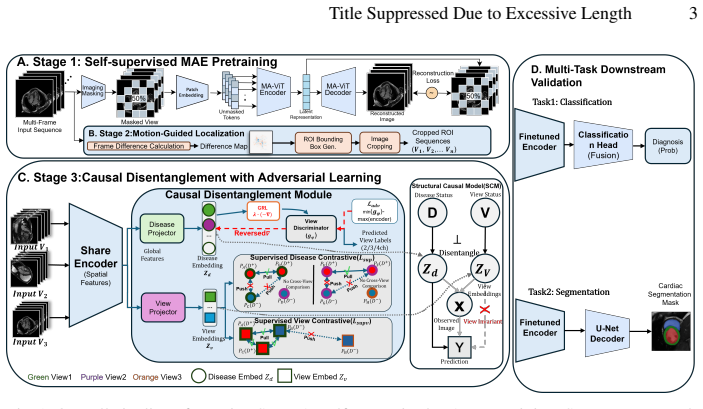
The MoViD framework explicitly factorizes latent representations into view-specific and disease-discriminative components using dual-branch supervised contrastive objectives and a gradient-reversal adversarial constraint that minimizes disease leakage into the view embedding. An annotation-free temporal motion feature derived from inter-frame difference maps localizes the beating heart region and suppresses background artifacts, with focal reweighting added to the contrastive loss to handle class imbalance.
What carries the argument
Motion-Guided View-Disease Disentanglement framework on a ViT-MAE backbone that splits representations via dual-branch supervised contrastive losses plus gradient-reversal adversarial training, guided by inter-frame difference maps.
If this is right
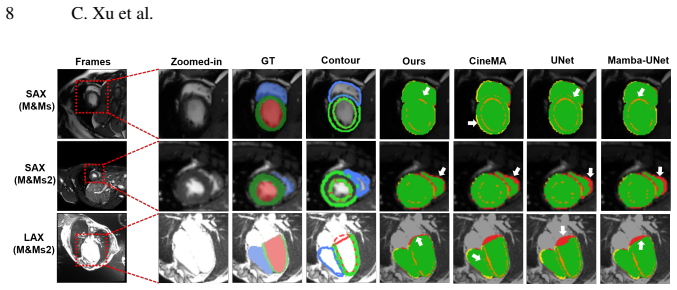
- The model outperforms standard transformer baselines on disease classification and cardiac segmentation across a private venous thrombosis dataset and the M&Ms and M&Ms2 benchmarks.
- Performance remains competitive with large-scale pretrained foundation models despite using a smaller backbone.
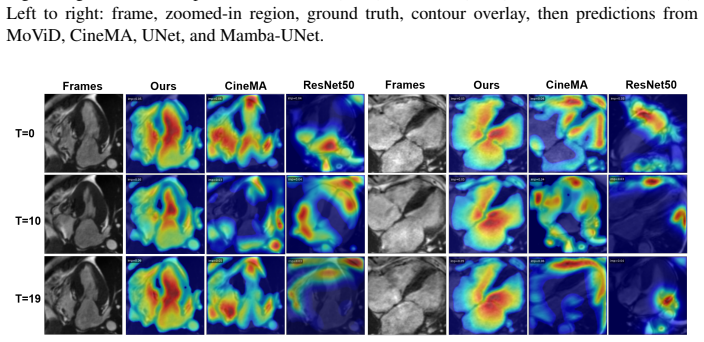
- The approach reduces shortcut learning and view-dependent boundaries especially in low-data regimes for underrepresented conditions.
- Focal reweighting within the contrastive loss mitigates the effect of class imbalance during training.
Where Pith is reading between the lines
- The same motion-plus-adversarial split could be tested on other multi-view modalities such as ultrasound or CT where anatomical pose varies independently of pathology.
- If the view embedding truly contains no disease signal, swapping view labels across patients should leave disease prediction unchanged, providing a direct check on leakage.
- Extending the motion guidance to 3D cine volumes might further stabilize the heart localization when through-plane motion is present.
Load-bearing premise
Inter-frame difference maps can localize the heart and remove background without adding new biases or needing extra labels.
What would settle it
An ablation that removes the motion feature or the adversarial constraint and measures whether disease-classification accuracy falls back to standard transformer levels on the same test sets.
Figures
read the original abstract
Multi-view cardiac magnetic resonance (CMR) imaging provides complementary anatomical information and is widely used for noninvasive disease assessment. Recent transformer-based models have demonstrated strong representation learning capabilities for CMR analysis; however, they typically learn unified latent embeddings that entangle view-specific anatomical variations with disease-related features. Such entanglement biases classifiers toward structural attributes rather than view-invariant pathological patterns. This issue is exacerbated in low-data regimes, particularly for underrepresented cardiac conditions, where limited samples increase the susceptibility to shortcut learning and view-dependent decision boundaries. To address this, we propose a Motion-Guided View--Disease Disentanglement framework MoViD built upon a ViT-MAE backbone. The model explicitly factorizes latent representations into view-specific and disease-discriminative components using dual-branch supervised contrastive objectives and a gradient-reversal adversarial constraint that minimizes disease leakage into the view embedding. Additionally, an annotation-free temporal motion feature, derived from inter-frame difference maps, is introduced to localize the beating heart region and suppress background artifacts. A focal reweighting mechanism is incorporated into the contrastive loss to mitigate class imbalance. We evaluate the framework on a private clinical venous thrombosis dataset and two public benchmarks (M&Ms, M&Ms2). Across disease classification and cardiac segmentation tasks, our approach consistently outperforms standard transformer baselines and demonstrates competitive performance against large-scale pretrained foundation models, validating the efficacy of structural disentanglement in medical image analysis.
Editorial analysis
A structured set of objections, weighed in public.
Referee Report
Summary. The paper proposes MoViD, a Motion-Guided View-Disease Disentanglement framework built on a ViT-MAE backbone for multi-view cine cardiac MRI. It factorizes latent representations into view-specific and disease-discriminative components via dual-branch supervised contrastive objectives and a gradient-reversal adversarial constraint to minimize disease leakage into view embeddings. An annotation-free temporal motion feature from inter-frame difference maps localizes the beating heart and suppresses artifacts, with focal reweighting for class imbalance. The framework is evaluated on a private venous thrombosis dataset and public M&Ms/M&Ms2 benchmarks, claiming consistent outperformance over standard transformer baselines on disease classification and cardiac segmentation tasks, with competitive results against large pretrained models.
Significance. If the claimed performance gains hold under rigorous validation, the work could contribute to more robust representation learning in multi-view CMR by reducing view-dependent biases and shortcut learning, particularly in low-data regimes for rare conditions. The structured use of motion guidance alongside contrastive and adversarial objectives offers a concrete mechanism for disentanglement that may generalize to other multi-view medical imaging tasks.
major comments (2)
- [Abstract] Abstract: The central claim of consistent outperformance on disease classification and cardiac segmentation is load-bearing for the manuscript's contribution, yet the abstract (and visible description) supplies no quantitative results, error bars, statistical tests, baseline details, or ablation studies. This prevents verification of whether the disentanglement components deliver the asserted gains over transformer baselines.
- [Abstract] Abstract: The annotation-free temporal motion feature derived from inter-frame difference maps is presented as localizing the beating heart region and guiding the view embedding without new biases or supervision. This assumption is load-bearing for the disentanglement pipeline and the adversarial constraint. However, difference maps are known to be sensitive to global patient motion, frame-rate variation, arrhythmias, or low SNR, which could allow spurious activations or background leakage; no validation, robustness analysis, or ablation of this component is described.
minor comments (1)
- [Abstract] Abstract: The title refers to 'Causal Disentanglement' but the description relies on supervised contrastive losses and gradient reversal without stating causal assumptions, identifiability conditions, or interventions.
Simulated Author's Rebuttal
We thank the referee for the constructive feedback on the abstract and the motion feature component. We address each major comment below and will revise the manuscript to strengthen the presentation of results and component validation.
read point-by-point responses
-
Referee: [Abstract] Abstract: The central claim of consistent outperformance on disease classification and cardiac segmentation is load-bearing for the manuscript's contribution, yet the abstract (and visible description) supplies no quantitative results, error bars, statistical tests, baseline details, or ablation studies. This prevents verification of whether the disentanglement components deliver the asserted gains over transformer baselines.
Authors: We agree that the abstract would benefit from concrete metrics to support the claims. In the revised manuscript, we will add key quantitative results (e.g., classification accuracy gains and segmentation Dice improvements over ViT-MAE baselines on M&Ms and the private dataset) while keeping the abstract concise. Detailed error bars, statistical tests, and full ablations remain in the main text and supplementary material, as is standard for abstract length limits. revision: yes
-
Referee: [Abstract] Abstract: The annotation-free temporal motion feature derived from inter-frame difference maps is presented as localizing the beating heart region and guiding the view embedding without new biases or supervision. This assumption is load-bearing for the disentanglement pipeline and the adversarial constraint. However, difference maps are known to be sensitive to global patient motion, frame-rate variation, arrhythmias, or low SNR, which could allow spurious activations or background leakage; no validation, robustness analysis, or ablation of this component is described.
Authors: The referee correctly notes that inter-frame difference maps can be affected by non-cardiac factors. Our current experiments implicitly rely on the downstream contrastive and adversarial losses to focus on cardiac motion, but we acknowledge the lack of explicit robustness checks. We will add a dedicated ablation subsection with qualitative examples and quantitative localization metrics (e.g., overlap with annotated heart regions) under simulated motion and SNR variations in the revision. revision: yes
Circularity Check
No significant circularity in derivation chain
full rationale
The paper introduces an architectural framework (MoViD) with dual-branch contrastive losses, gradient-reversal adversarial training, and an inter-frame difference map for motion guidance. These are presented as design choices evaluated empirically on external datasets (private venous thrombosis, M&Ms, M&Ms2), without any equations, fitted parameters, or predictions that reduce by construction to the inputs themselves. No self-citation chains, uniqueness theorems, or ansatzes imported from prior author work are invoked as load-bearing justifications. The central claims rest on comparative performance metrics rather than self-referential definitions, making the derivation self-contained against external benchmarks.
Axiom & Free-Parameter Ledger
Reference graph
Works this paper leans on
-
[1]
IEEE Transactions on Medical Imaging40(12), 3543–3554 (2021)
Campello, V .M., Gkontra, P., Izquierdo, C., Martin-Isla, C., Soez, A., Full, P.M., et al.: Multi- centre, multi-vendor and multi-disease cardiac segmentation: the M&Ms challenge. IEEE Transactions on Medical Imaging40(12), 3543–3554 (2021)
2021
-
[2]
In: ICLR (2021)
Dosovitskiy, A., Beyer, L., Kolesnikov, A., et al.: An image is worth 16x16 words: Trans- formers for image recognition at scale. In: ICLR (2021)
2021
-
[3]
Diagnostics12(1), 69 (2022)
Duffy, G., Vulliard, L., Defined, M., Itié-Hafez, S., Camarasa, R., Boccalini, S., Si- Mohamed, S., Chevalier, P., Defined2, J.F., Defined3, L.: Deep learning supplants visual analysis by experienced operators for the diagnosis of cardiac amyloidosis by cine-CMR. Diagnostics12(1), 69 (2022)
2022
-
[4]
arXiv preprint arXiv:2506.00679 (2025)
Fu, Y ., Bai, W., Yi, W., Manisty, C., Bhuva, A.N., Treibel, T.A., Moon, J.C., Clarkson, M.J., Davies, R.H., Hu, Y .: A versatile foundation model for cine cardiac magnetic resonance image analysis tasks. arXiv preprint arXiv:2506.00679 (2025)
-
[5]
In: Journal of Machine Learning Research
Ganin, Y ., Ustinova, E., Ajakan, H., Germain, P., Larochelle, H., Laviolette, F., Marchand, M., Lempitsky, V .: Domain-adversarial training of neural networks. In: Journal of Machine Learning Research. vol. 17, pp. 1–35 (2016)
2016
-
[6]
European Heart Journal42(16), 1554–1568 (2021)
Garcia-Pavia, P., Rapezzi, C., Adler, Y ., Arad, M., Basso, C., Brucato, A., Burazor, I., Caforio, A.L.P., Damy, T., Eriksson, U., et al.: Diagnosis and treatment of cardiac amyloido- sis: a position statement of the ESC working group on myocardial and pericardial diseases. European Heart Journal42(16), 1554–1568 (2021)
2021
-
[7]
In: Proceedings of the IEEE/CVF Conference on Computer Vision and Pattern Recognition (CVPR)
He, K., Chen, X., Xie, S., Li, Y ., Dollár, P., Girshick, R.: Masked autoencoders are scal- able vision learners. In: Proceedings of the IEEE/CVF Conference on Computer Vision and Pattern Recognition (CVPR). pp. 16000–16009 (2022)
2022
-
[8]
In: Pro- ceedings of the IEEE Conference on Computer Vision and Pattern Recognition (CVPR)
He, K., Zhang, X., Ren, S., Sun, J.: Deep residual learning for image recognition. In: Pro- ceedings of the IEEE Conference on Computer Vision and Pattern Recognition (CVPR). pp. 770–778 (2016)
2016
-
[9]
arXiv preprint arXiv:2410.01665 (2024)
Jacob, A.J., Borgohain, I., Chitiboi, T., Sharma, P., Comaniciu, D., Rueckert, D.: Towards a vision foundation model for comprehensive assessment of cardiac MRI. arXiv preprint arXiv:2410.01665 (2024)
-
[10]
In: Advances in Neural Information Processing Systems (NeurIPS)
Khosla, P., Teterwak, P., Wang, C., Sarna, A., Tian, Y ., Isola, P., Maschinot, A., Liu, C., Kr- ishnan, D.: Supervised contrastive learning. In: Advances in Neural Information Processing Systems (NeurIPS). vol. 33, pp. 18661–18673 (2020)
2020
-
[11]
In: Proceedings of the IEEE International Conference on Computer Vision (ICCV)
Lin, T.Y ., Goyal, P., Girshick, R., He, K., Dollár, P.: Focal loss for dense object detection. In: Proceedings of the IEEE International Conference on Computer Vision (ICCV). pp. 2980– 2988 (2017)
2017
-
[12]
In: International Confer- ence on Learning Representations (ICLR) (2019) 10 C
Loshchilov, I., Hutter, F.: Decoupled weight decay regularization. In: International Confer- ence on Learning Representations (ICLR) (2019) 10 C. Xu et al
2019
-
[13]
IEEE Journal of Biomed- ical and Health Informatics27(7), 3302–3313 (2023)
Martin-Isla, C., Campello, V .M., Izquierdo, C., Kushibar, K., et al.: Deep learning segmenta- tion of the right ventricle in cardiac MRI: the M&Ms-2 challenge. IEEE Journal of Biomed- ical and Health Informatics27(7), 3302–3313 (2023)
2023
-
[14]
Journal of Cardiovascular Magnetic Resonance22(1), 84 (2020)
Martini, N., Aimo, A., Barison, A., Della Latta, D., Vergaro, G., Aquaro, G.D., Ripoli, A., Emdin, M., Passino, C.: Deep learning to diagnose cardiac amyloidosis from cardiovascular magnetic resonance. Journal of Cardiovascular Magnetic Resonance22(1), 84 (2020)
2020
-
[15]
In: Medical Image Com- puting and Computer Assisted Intervention – MICCAI 2024
Robinet, L., Berjaoui, A., Kheil, Z., Cohen-Jonathan Moyal, E.: DRIM: Learning disentan- gled representations from incomplete multimodal healthcare data. In: Medical Image Com- puting and Computer Assisted Intervention – MICCAI 2024. LNCS, vol. 15003, pp. 163–
2024
-
[16]
In: International Conference on Medical image computing and computer- assisted intervention
Ronneberger, O., Fischer, P., Brox, T.: U-net: Convolutional networks for biomedical im- age segmentation. In: International Conference on Medical image computing and computer- assisted intervention. pp. 234–241. Springer (2015)
2015
-
[17]
In: Proceedings of the IEEE international conference on computer vision
Tran, D., Bourdev, L., Fergus, R., Torresani, L., Paluri, M.: Learning spatiotemporal features with 3d convolutional networks. In: Proceedings of the IEEE international conference on computer vision. pp. 4489–4497 (2015)
2015
-
[18]
arXiv preprint arXiv:2402.05079 , year=
Wang, Z., Zheng, J.Q., Zhang, Y ., Cui, G., Li, L.: Mamba-unet: Unet-like pure visual mamba for medical image segmentation. arXiv preprint arXiv:2402.05079 (2024)
discussion (0)
Sign in with ORCID, Apple, or X to comment. Anyone can read and Pith papers without signing in.