Tree-Based Formalization of Multi-Agent Complementarity in Human-AI Interactions
Pith reviewed 2026-06-28 05:59 UTC · model grok-4.3
The pith
A tree-based protocol model shows multi-agent human-AI complementarity is attainable in regression but obstructed in classification under standard losses.
A machine-rendered reading of the paper's core claim, the machinery that carries it, and where it could break.
Core claim
An HAI protocol is an ordered agent-role configuration together with a rooted planar binary tree whose leaves are decorated by prediction vectors; a local binary composition rule is evaluated recursively along the tree to yield a tree-relative complementarity functional relative to a pointwise-min oracle benchmark. Selector-based protocols cannot achieve complementarity. In squared-loss regression complementarity is equivalent to Euclidean distance minimization from the ground-truth vector, with a closed-form optimal weight for N=2. Under linear local composition every protocol tree defines a barycentric coordinate chart on the simplex of leaf weights, Tamari-cover reparameterizations preser
What carries the argument
Rooted planar binary tree with leaves as prediction vectors, composed recursively by a local binary rule to define a tree-relative complementarity functional relative to a pointwise-min oracle.
If this is right
- Selector-based HAIs, including self-reliance or full AI-reliance, cannot achieve complementarity for any task or loss.
- In regression under squared loss, complementarity is exactly Euclidean distance minimization from the ground-truth vector.
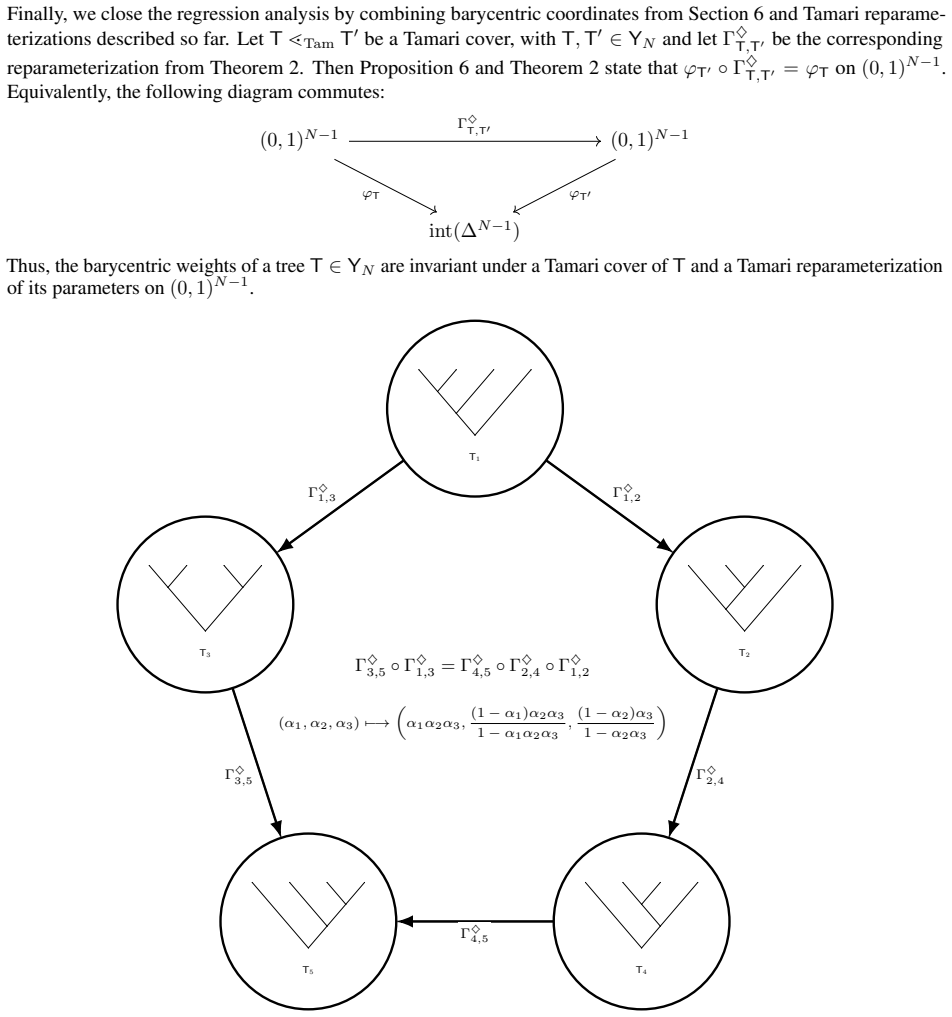
- Under linear local composition, protocol trees induce barycentric coordinates on the simplex and remain invariant under Tamari covers.
- No internal composition rule achieves complementarity in binary classification under endpoint-monotone losses or in multiclass under cross-entropy.
Where Pith is reading between the lines
- The obstruction in classification suggests that HAI system designers should prefer regression-style tasks or redesign losses when the goal is complementarity.
- The barycentric coordinate view may connect the framework to existing ensemble weighting methods in statistics, allowing transfer of known simplex results.
- Testing the closed-form N=2 regression weight on real human-AI data would check whether the Euclidean-distance equivalence holds outside synthetic settings.
- Extending the tree model to allow non-binary internal nodes could reveal whether the classification obstruction persists beyond binary trees.
Load-bearing premise
Every HAI protocol can be represented by an ordered agent-role configuration together with a rooted planar binary tree whose leaves are decorated by prediction vectors, with complementarity measured relative to a pointwise-min oracle benchmark.
What would settle it
An explicit local composition rule and loss function pair in binary classification that produces a combined prediction strictly better than the pointwise-min oracle under an endpoint-monotone loss would falsify the obstruction theorem.
Figures
read the original abstract
Complementarity is the case in which a human--AI interaction (HAI) outperforms the best prediction benchmark available among its members. Although this idea is central in HAI research, formal work on complementarity remains limited. Existing frameworks do not model how agents' predictions compose into workflow-sensitive multi-agent protocols. We close this gap by introducing a tree-based formalization of complementarity in multi-agent HAI. An HAI protocol is represented by an ordered agent-role configuration together with a rooted planar binary tree whose leaves are decorated by prediction vectors. A local binary composition rule is evaluated recursively along the tree, yielding a tree-relative complementarity functional relative to a pointwise-min oracle benchmark. We prove four results. First, selector-based HAIs, including self- or AI-reliance, cannot achieve complementarity regardless of task, loss, or prediction quality. Second, in regression under squared loss, complementarity is equivalent to Euclidean distance minimization from the ground-truth vector; for $N=2$, the optimal linear-pooling weight has a closed form and a residual-correction interpretation. Third, under linear local composition, every protocol tree defines a barycentric coordinate chart on the simplex of leaf weights; Tamari-cover reparameterizations of protocol trees preserve complementarity, and for $N=4$, they satisfy the pentagon identity. Fourth, in binary classification, no internal local composition can achieve complementarity under endpoint-monotone losses, including standard Bregman and many finite Bernoulli $f$-divergence losses; an analogous obstruction holds for multiclass aggregation under cross-entropy. In summary, our framework shows that complementarity is attainable in multi-agent regression, but obstructed in classification under natural conditions on local aggregation and loss functions.
Editorial analysis
A structured set of objections, weighed in public.
Referee Report
Summary. The paper introduces a tree-based formalization of complementarity in multi-agent human-AI (HAI) interactions. HAI protocols are represented as ordered agent-role configurations together with rooted planar binary trees whose leaves are decorated by prediction vectors. Local binary composition rules are evaluated recursively along the tree to yield a tree-relative complementarity functional relative to a pointwise-min oracle benchmark. Four theorems are proved: selector-based HAIs cannot achieve complementarity; in regression under squared loss, complementarity is equivalent to Euclidean distance minimization from the ground-truth vector (with closed-form optimal linear-pooling weight for N=2); under linear local composition every protocol tree defines a barycentric coordinate chart on the simplex of leaf weights, Tamari-cover reparameterizations preserve complementarity, and the pentagon identity holds for N=4; and in binary classification no internal local composition achieves complementarity under endpoint-monotone losses (including standard Bregman and many finite Bernoulli f-divergence losses), with an analogous obstruction for multiclass aggregation under cross-entropy. In summary, complementarity is attainable in multi-agent regression but obstructed in classification under the stated conditions.
Significance. If the theorems hold, the work supplies a precise formal framework for studying complementarity in multi-agent HAI settings, an area where existing research has been limited. The clean separation between attainability results in regression and obstruction results in classification under natural conditions on losses and compositions is a substantive contribution. The explicit link to barycentric coordinates and Tamari covers, together with the provision of machine-checkable-style theorems, strengthens the paper; these elements allow the claims to be stated and potentially verified without post-hoc parameter fitting.
minor comments (2)
- The abstract is dense with specialized terminology (e.g., "tree-relative complementarity functional," "endpoint-monotone losses"); a brief definitional paragraph or glossary in the introduction would improve accessibility for readers outside the immediate subfield.
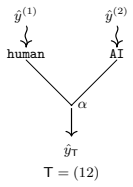
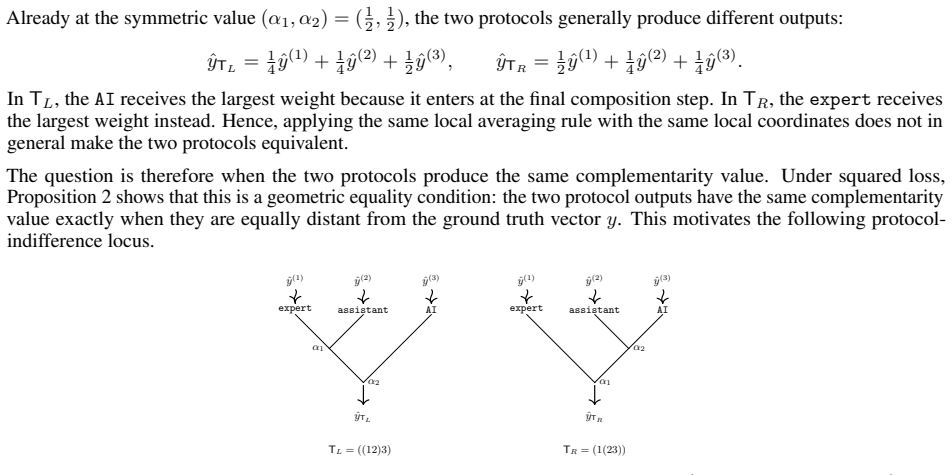
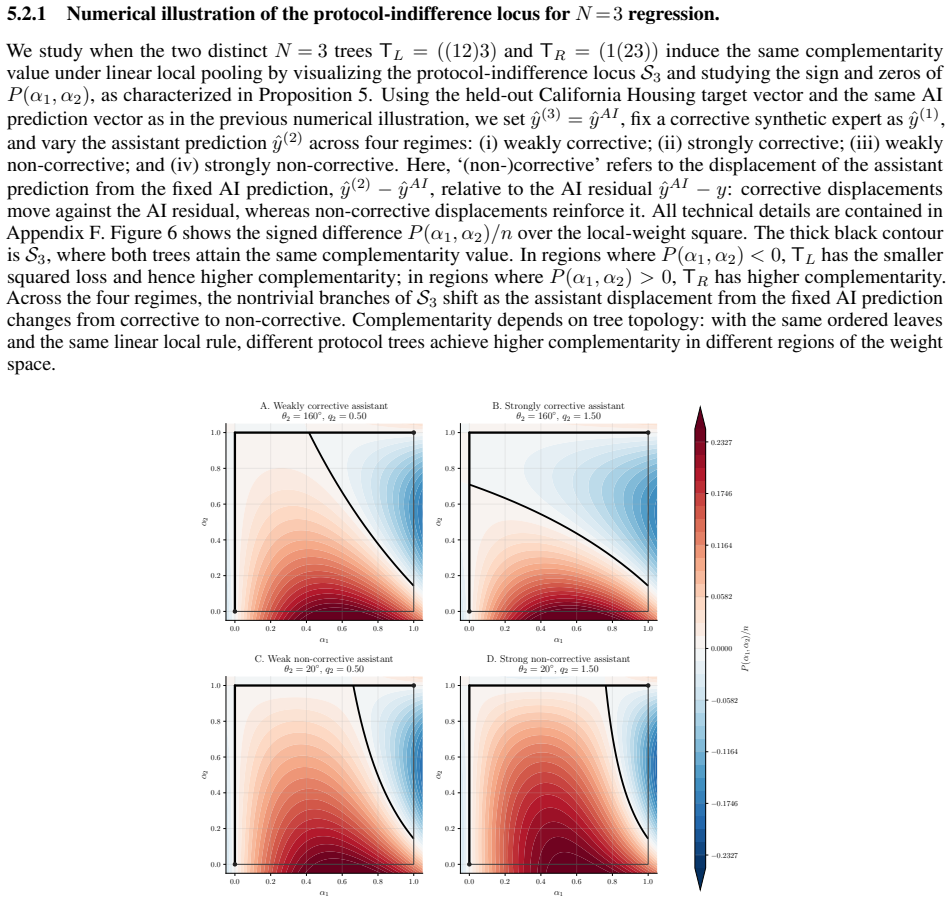
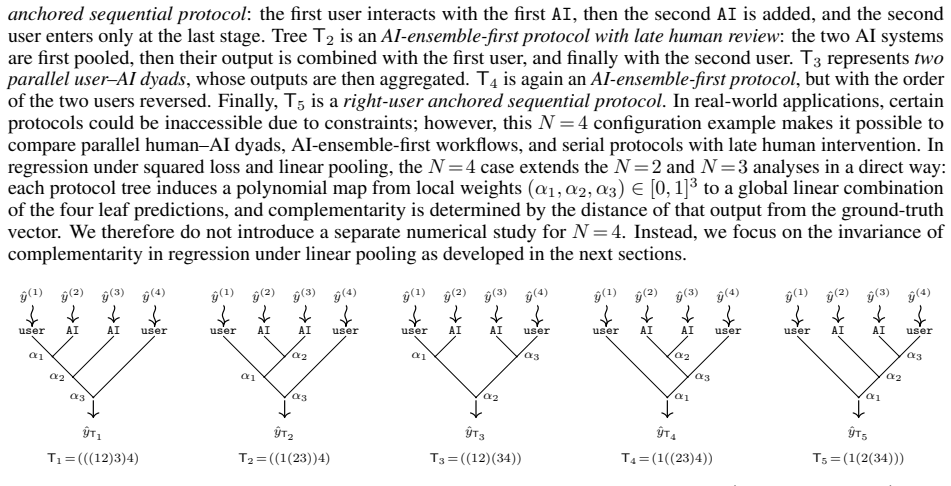
- A concrete small-N example (e.g., N=2 or N=3) with an explicit tree diagram, agent roles, and numerical predictions would make the protocol representation and recursive evaluation easier to follow.
Simulated Author's Rebuttal
We thank the referee for the detailed and accurate summary of our manuscript, the positive assessment of its significance, and the recommendation for minor revision. No specific major comments were raised in the report.
Circularity Check
No significant circularity; framework is self-contained formal model
full rationale
The paper defines an HAI protocol via ordered agent-role configurations and rooted planar binary trees with recursive local composition rules, then measures complementarity relative to a pointwise-min oracle. All four theorems are stated as formal consequences inside this model (selector-based HAIs cannot achieve complementarity; regression equivalence to Euclidean minimization; barycentric charts and Tamari reparameterizations; obstructions under endpoint-monotone losses in classification). No parameter fitting, no self-citation chains, and no reduction of a claimed prediction to its own inputs by construction. The modeling choices are explicit definitions, not hidden premises that collapse the derivations.
Axiom & Free-Parameter Ledger
axioms (2)
- domain assumption HAI protocols are represented by ordered agent-role configurations together with rooted planar binary trees whose leaves hold prediction vectors
- domain assumption Complementarity is measured relative to a pointwise-min oracle benchmark
invented entities (1)
-
tree-relative complementarity functional
no independent evidence
Reference graph
Works this paper leans on
-
[1]
2026 , publisher=
Beyond transparency: Computational reliabilism as an externalist epistemology of algorithms , author=. 2026 , publisher=
2026
-
[2]
Social science & medicine , volume=
The use of QALYs in health care decision making , author=. Social science & medicine , volume=. 1989 , publisher=
1989
-
[3]
Does the whole exceed its parts?
Bansal, Gagan and Wu, Tongshuang and Zhou, Joyce and Fok, Raymond and Nushi, Besmira and Kamar, Ece and Ribeiro, Marco Tulio and Weld, Daniel , booktitle=. Does the whole exceed its parts?
-
[4]
Is the most accurate
Bansal, Gagan and Nushi, Besmira and Kamar, Ece and Horvitz, Eric and Weld, Daniel S , booktitle=. Is the most accurate
-
[5]
Proceedings of the 2022 ACM Conference on Fairness, Accountability, and Transparency , pages=
Human-algorithm collaboration: Achieving complementarity and avoiding unfairness , author=. Proceedings of the 2022 ACM Conference on Fairness, Accountability, and Transparency , pages=
2022
-
[6]
When combinations of humans and
Vaccaro, Michelle and Almaatouq, Abdullah and Malone, Thomas , journal=. When combinations of humans and. 2024 , publisher=
2024
-
[7]
Complementarity in human-
Philipp Hemmer and Michael Schemmer and Niklas K. Complementarity in human-. 2025 , pages =
2025
-
[8]
2025 , volume =
Michaela Benk and Sophie Kerstan and Florian von Wangenheim and Andrea Ferrario , title =. 2025 , volume =
2025
-
[9]
Grounds for Trust:
Juan Manuel Dur. Grounds for Trust:. 2018 , volume =
2018
-
[10]
Proceedings of the 2020 CHI conference on human factors in computing systems , pages=
A human-centered evaluation of a deep learning system deployed in clinics for the detection of diabetic retinopathy , author=. Proceedings of the 2020 CHI conference on human factors in computing systems , pages=
2020
-
[11]
The Algorithmic Automation Problem: Prediction, Triage, and Human Effort
The algorithmic automation problem: Prediction, triage, and human effort , author=. arXiv preprint arXiv:1903.12220 , year=
work page internal anchor Pith review Pith/arXiv arXiv 1903
-
[12]
2024 , volume =
Andrea Ferrario , title =. 2024 , volume =
2024
-
[13]
Investigating Human + Machine Complementarity for Recidivism Predictions
Investigating human+ machine complementarity for recidivism predictions , author=. arXiv preprint arXiv:1808.09123 , year=
work page internal anchor Pith review Pith/arXiv arXiv
-
[14]
Studying human-AI collaboration protocols:
Cabitza, Federico and Campagner, Andrea and Sconfienza, Luca Maria , journal=. Studying human-AI collaboration protocols:. 2021 , publisher=
2021
-
[15]
Communications of the Association for Information Systems , volume=
Reflecting on the ``dark side''' of information technology use , author=. Communications of the Association for Information Systems , volume=
-
[16]
Cognitive challenges in human--artificial intelligence collaboration:
F. Cognitive challenges in human--artificial intelligence collaboration:. Information Systems Research , volume=. 2022 , publisher=
2022
-
[17]
Prejudiced against the machine?
Turel, Ofir and Kalhan, Shivam , journal=. Prejudiced against the machine?. 2023 , publisher=
2023
-
[18]
Hemmer, Patrick and Schemmer, Max and V. Human-. PACIS , volume=
-
[19]
Communications of the ACM , volume=
The effects of mixing machine learning and human judgment , author=. Communications of the ACM , volume=. 2019 , publisher=
2019
-
[20]
Effect of confidence and explanation on accuracy and trust calibration in
Zhang, Yunfeng and Liao, Q Vera and Bellamy, Rachel KE , booktitle=. Effect of confidence and explanation on accuracy and trust calibration in
-
[21]
Proceedings of the 28th International Conference on Intelligent User Interfaces , pages =
Schemmer, Max and Kuehl, Niklas and Benz, Carina and Bartos, Andrea and Satzger, Gerhard , title =. Proceedings of the 28th International Conference on Intelligent User Interfaces , pages =. 2023 , publisher =
2023
-
[22]
Finding consensus on trust in
Starke, Georg and Gille, Felix and Termine, Alberto and Aquino, Yves Saint James and Chavarriaga, Ricardo and Ferrario, Andrea and Hastings, Janna and Jongsma, Karin and Kellmeyer, Philipp and Kulynych, Bogdan and others , journal=. Finding consensus on trust in. 2025 , publisher=
2025
-
[23]
Experts or authorities?
Ferrario, Andrea and Facchini, Alessandro and Termine, Alberto , journal=. Experts or authorities?. 2024 , publisher=
2024
-
[24]
Explainable
Miller, Tim , booktitle=. Explainable
-
[25]
A Well-Founded Solution to the Generality Problem , journal =
Juan Comesa. A Well-Founded Solution to the Generality Problem , journal =. 2006 , volume =
2006
-
[26]
Beebe , title =
James R. Beebe , title =. No. 2004 , volume =
2004
-
[27]
Goldman , title =
Alvin I. Goldman , title =. 1986 , publisher =
1986
-
[28]
Midwest Studies in Philosophy , year =
Laurence BonJour , title =. Midwest Studies in Philosophy , year =
-
[29]
1995 , publisher=
Cognition in the Wild , author=. 1995 , publisher=
1995
-
[30]
2023 , publisher=
AI as an epistemic technology , author=. 2023 , publisher=
2023
-
[31]
2015 , publisher=
Dimensions of integration in embedded and extended cognitive systems , author=. 2015 , publisher=
2015
-
[32]
Analysis , volume=
The extended mind , author=. Analysis , volume=. 1998 , publisher=
1998
-
[33]
The Extended Mind , editor =
Sutton, John , title =. The Extended Mind , editor =. 2010 , publisher =
2010
-
[34]
Australasian Journal of Philosophy , year =
Holton, Richard , title =. Australasian Journal of Philosophy , year =
-
[35]
Analyse & Kritik , year =
Pettit, Philip , title =. Analyse & Kritik , year =
-
[36]
The Routledge Handbook of Trust and Philosophy , pages=
Trust and reliance 1 , author=. The Routledge Handbook of Trust and Philosophy , pages=. 2020 , publisher=
2020
-
[37]
2000 , publisher=
Distributed cognition: Toward a new foundation for human-computer interaction research , author=. 2000 , publisher=
2000
-
[38]
Minds and Machines , year =
Andrea Ferrario and Alessandro Facchini and Alberto Termine , title =. Minds and Machines , year =
-
[39]
Philosophy & Technology , volume=
Trust and Trustworthiness in AI , author=. Philosophy & Technology , volume=. 2025 , publisher=
2025
-
[40]
Science and Engineering Ethics , volume=
In AI we trust: ethics, artificial intelligence, and reliability , author=. Science and Engineering Ethics , volume=. 2020 , publisher=
2020
-
[41]
Enhancing the reliability and accuracy of
Dvijotham, Krishnamurthy and Winkens, Jim and Barsbey, Melih and Ghaisas, Sumedh and Stanforth, Robert and Pawlowski, Nick and Strachan, Patricia and Ahmed, Zahra and Azizi, Shekoofeh and Bachrach, Yoram and others , journal=. Enhancing the reliability and accuracy of. 2023 , publisher=
2023
-
[42]
Who should I trust:
Ma, Shuai and Lei, Ying and Wang, Xinru and Zheng, Chengbo and Shi, Chuhan and Yin, Ming and Ma, Xiaojuan , booktitle=. Who should I trust:
-
[43]
Advances in Neural Information Processing Systems , volume=
Partial success in closing the gap between human and machine vision , author=. Advances in Neural Information Processing Systems , volume=
-
[44]
Proceedings of the AAAI Conference on Artificial Intelligence , volume=
Does explainable artificial intelligence improve human decision-making? , author=. Proceedings of the AAAI Conference on Artificial Intelligence , volume=
-
[45]
Advancing human-
Inkpen, Kori and Chappidi, Shreya and Mallari, Keri and Nushi, Besmira and Ramesh, Divya and Michelucci, Pietro and Mandava, Vani and Vep. Advancing human-. ACM Transactions on Computer-Human Interaction , volume=. 2023 , publisher=
2023
-
[46]
European Journal for Philosophy of Science , volume=
In defense of reliabilist epistemology of algorithms , author=. European Journal for Philosophy of Science , volume=. 2025 , publisher=
2025
-
[47]
Grounds for trust:
Dur. Grounds for trust:. 2018 , publisher=
2018
-
[48]
How explainability contributes to trust in
Ferrario, Andrea and Loi, Michele , booktitle=. How explainability contributes to trust in
-
[49]
Forensic Science International: Synergy , volume=
From understanding to justifying: Computational reliabilism for AI-based forensic evidence evaluation , author=. Forensic Science International: Synergy , volume=. 2024 , publisher=
2024
-
[50]
AI and Ethics , volume=
What kind of trust does AI deserve, if any? , author=. AI and Ethics , volume=. 2023 , publisher=
2023
-
[51]
2025 , publisher=
Being pragmatic about reliance and trust in artificial intelligence , author=. 2025 , publisher=
2025
-
[52]
Challenges for computational reliabilism in
Alvarado, Ram. Challenges for computational reliabilism in. 2026 , publisher=
2026
-
[53]
2024 , month = jun, institution =
2024
-
[54]
The generality problem, statistical relevance and the tri-level hypothesis , author=. No. 2004 , publisher=
2004
-
[55]
Philosophical Studies: An International Journal for Philosophy in the Analytic Tradition , volume=
A well-founded solution to the generality problem , author=. Philosophical Studies: An International Journal for Philosophy in the Analytic Tradition , volume=. 2006 , publisher=
2006
-
[56]
Midwest studies in philosophy , volume=
Externalist theories of empirical knowledge , author=. Midwest studies in philosophy , volume=. 1980 , publisher=
1980
-
[57]
1986 , publisher=
Epistemology and cognition , author=. 1986 , publisher=
1986
-
[58]
Philosophical Topics , volume=
How to think about reliability , author=. Philosophical Topics , volume=. 1995 , publisher=
1995
-
[59]
Philosophy Compass , volume=
Reliability in machine learning , author=. Philosophy Compass , volume=. 2024 , publisher=
2024
-
[60]
A taxonomy of human and ML strengths in decision-making to investigate human-
Rastogi, Charvi and Leqi, Liu and Holstein, Kenneth and Heidari, Hoda , booktitle=. A taxonomy of human and ML strengths in decision-making to investigate human-
-
[61]
Toward a science of human--
Gonzalez, Cleotilde and Donahue, Kate and Goldstein, Daniel G and Heidari, Hoda and Jalali, Mohammad S and Schelble, Beau and Singh, Aarti and Woolley, Anita Williams , journal=. Toward a science of human--. 2026 , publisher=
2026
-
[62]
Advances in Neural Information Processing Systems , volume=
Human expertise in algorithmic prediction , author=. Advances in Neural Information Processing Systems , volume=
-
[63]
Tamari, Dov , journal=. Probl
-
[64]
Epistemology gives a Future to Complementarity in Human-AI Interactions
Ferrario, Andrea and Facchini, Alessandro and Dur. Epistemology gives a future to complementarity in human-. arXiv preprint arXiv:2601.09871 , year=
work page internal anchor Pith review Pith/arXiv arXiv
-
[65]
Transactions of the American Mathematical Society , volume =
Stasheff, James Dillon , title =. Transactions of the American Mathematical Society , volume =
-
[66]
On the notion of mean , author=
-
[67]
No-regret learning with unbounded losses:
Neyman, Eric and Roughgarden, Tim , journal=. No-regret learning with unbounded losses:
-
[68]
Operations Research , volume=
From proper scoring rules to max-min optimal forecast aggregation , author=. Operations Research , volume=. 2023 , publisher=
2023
-
[69]
Fundamental properties of
Furuichi, Shigeru and Yanagi, Kenjiro and Kuriyama, Ken , journal=. Fundamental properties of. 2004 , publisher=
2004
-
[70]
Possible generalization of
Tsallis, Constantino , journal=. Possible generalization of. 1988 , publisher=
1988
-
[71]
USSR Computational Mathematics and Mathematical Physics , volume=
The relaxation method of finding the common point of convex sets and its application to the solution of problems in convex programming , author=. USSR Computational Mathematics and Mathematical Physics , volume=. 1967 , publisher=
1967
-
[72]
Proceedings of the fourth Berkeley symposium on mathematical statistics and probability, volume 1: contributions to the theory of statistics , volume=
On measures of entropy and information , author=. Proceedings of the fourth Berkeley symposium on mathematical statistics and probability, volume 1: contributions to the theory of statistics , volume=. 1961 , organization=
1961
-
[73]
1930 , organization=
Nagumo, Mitio , booktitle=. 1930 , organization=
1930
-
[74]
Forming Effective Human-
Hemmer, Patrick and Schellhammer, Sebastian and V. Forming Effective Human-. Proceedings of the Thirty-First International Joint Conference on Artificial Intelligence , pages =
-
[75]
International Conference on Artificial Intelligence and Statistics , pages=
Learning to defer to multiple experts: Consistent surrogate losses, confidence calibration, and conformal ensembles , author=. International Conference on Artificial Intelligence and Statistics , pages=. 2023 , organization=
2023
-
[76]
Conformal Set-based Human-
Paat, Helbert and Shen, Guohao , journal=. Conformal Set-based Human-
-
[77]
A no free lunch theorem for human-
Peng, Kenny and Garg, Nikhil and Kleinberg, Jon , booktitle=. A no free lunch theorem for human-
-
[78]
Journal of the Royal Statistical Society: Series B (Methodological) , volume=
A general class of coefficients of divergence of one distribution from another , author=. Journal of the Royal Statistical Society: Series B (Methodological) , volume=. 1966 , publisher=
1966
-
[79]
Yanofsky, Noson S , year=
discussion (0)
Sign in with ORCID, Apple, or X to comment. Anyone can read and Pith papers without signing in.