Learning While Acting: A Skill-Enhanced Test-Time Co-Evolution Framework for Online Lifelong Learning Agents
Pith reviewed 2026-06-28 07:03 UTC · model grok-4.3
The pith
LifeSkill lets LLM agents extract skills from test-time rollouts and internalize them into parameters rather than retrieving experiences.
A machine-rendered reading of the paper's core claim, the machinery that carries it, and where it could break.
Core claim
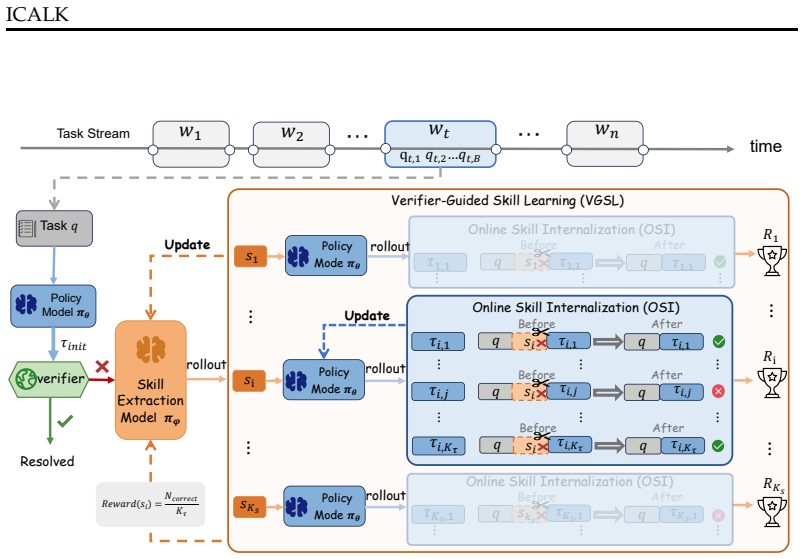
LifeSkill is a two-stage reinforcement learning framework in which Verifier-Guided Skill Learning rewards candidate skills according to the average verifier success of multiple skill-conditioned policy rollouts, and Online Skill Internalization continuously improves the policy model at test time by transforming skill-conditioned trajectories into reward signals, thereby enabling the agent to internalize reasoning capabilities into its parameters and avoid context bloat from experience retrieval.
What carries the argument
Verifier-Guided Skill Learning that supplies a training signal for skill extraction via average verifier success on multiple rollouts, combined with Online Skill Internalization that turns trajectories into parameter-updating rewards.
If this is right
- Agents can improve long-horizon performance without the context bloat that comes from retrieving past experiences.
- Extracted skills are more likely to be useful for solving tasks because they are selected by empirical rollout success.
- The policy model receives direct parameter updates from test-time interaction rather than remaining static.
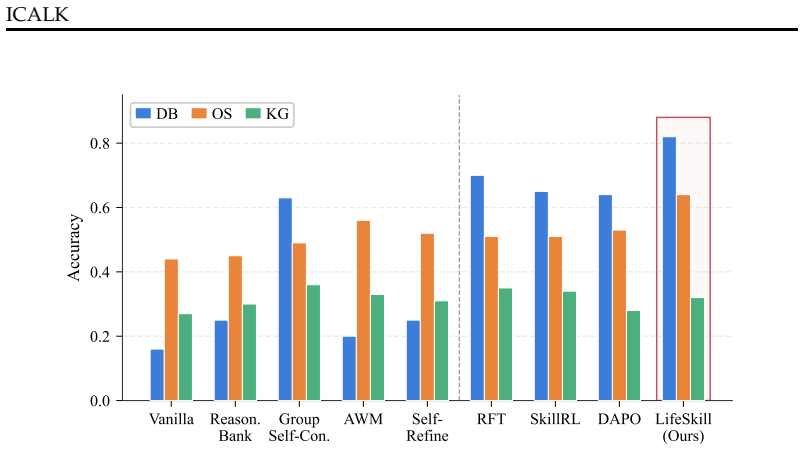
- Average performance on LifelongAgentBench rises by 7 absolute points relative to retrieval-based lifelong baselines.
Where Pith is reading between the lines
- The same verifier-plus-internalization loop could be tested in environments whose dynamics change over time to measure robustness to distribution shift.
- If the approach generalizes, agents might accumulate increasingly general internal capabilities across successive tasks without external memory growth.
- Replacing the verifier with a learned critic trained on the same rollouts might reduce dependence on an external success signal.
- Applying the framework to multi-agent settings could let agents co-evolve shared skills through joint rollouts.
Load-bearing premise
The average verifier success across multiple skill-conditioned policy rollouts supplies a reliable training signal for skills that are actually useful rather than merely textually plausible.
What would settle it
An ablation experiment in which skills selected without the verifier signal produce equivalent or higher downstream task success rates than verifier-selected skills would falsify the claim that the verifier provides a useful training signal.
Figures
read the original abstract
Lifelong learning is essential for Large Language Model (LLM) agents operating in dynamic, interactive environments. However, existing lifelong learning agents for long-horizon tasks typically depend on discrete skill or past experiences retrieval with static parameters during inference, which prevents them from continuously internalizing test-time feedback like human learners. To bridge this gap, we propose Skill-enhanced Test-Time Co-Evolution (\texttt{LifeSkill}), a two-stage reinforcement learning framework for Online Lifelong Learning Agents. Specifically, we design Verifier-Guided Skill Learning that addresses the lack of direct supervision for skill extraction by rewarding candidate skills according to the average verifier success of multiple skill-conditioned policy rollouts, encouraging the model to generate skills that are useful for solving tasks rather than merely plausible in text. Furthermore, we introduce Online Skill Internalization, which continuously improves the policy model during test-time interaction by transforming skill-conditioned trajectories into reward signals. This enables the agent to directly internalize reasoning capabilities into its parameters, avoiding the context bloat of experience retrieval. Experiments on LifelongAgentBench show that LifeSkill improves average performance by 7 absolute points by comparing with existing lifelong agent baselines.
Editorial analysis
A structured set of objections, weighed in public.
Referee Report
Summary. The manuscript introduces LifeSkill, a two-stage RL framework for online lifelong learning LLM agents. It consists of Verifier-Guided Skill Learning, which extracts skills by rewarding candidates according to the average verifier success rate across multiple skill-conditioned policy rollouts, and Online Skill Internalization, which converts skill-conditioned trajectories into reward signals to update the policy parameters during test-time interaction. The central empirical claim is a 7 absolute point average performance gain on LifelongAgentBench relative to existing lifelong agent baselines.
Significance. If the empirical result holds after addressing the verifier-signal concern, the framework could meaningfully advance test-time adaptation for agents by enabling direct parameter internalization rather than retrieval-based methods. The verifier-guided reward addresses the lack of direct supervision for skill extraction, and the approach avoids context bloat. However, the absence of ablations, error bars, implementation details on reward stabilization, and independent validation of skill utility limits the assessed significance at present.
major comments (2)
- [Abstract (Verifier-Guided Skill Learning)] Abstract, Verifier-Guided Skill Learning paragraph: the central 7-point gain on LifelongAgentBench rests on the assumption that average verifier success over skill-conditioned rollouts supplies a reliable causal training signal. No description is given of how the verifier is constructed, whether it shares parameters or training distribution with the policy, or any independent (human/oracle) validation of extracted skill utility; this leaves open the possibility that reported gains reflect verifier-policy alignment on surface patterns rather than transferable capability.
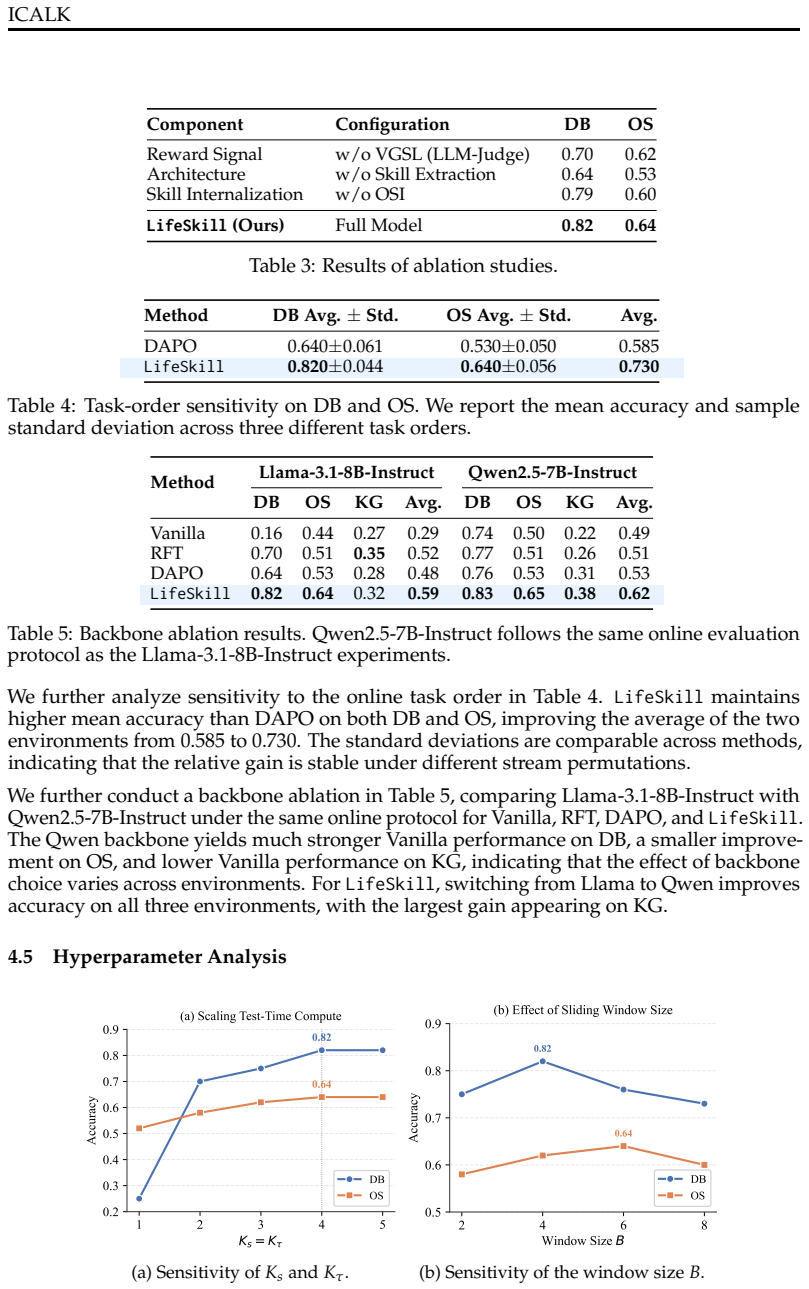
- [Abstract (experiments and Online Skill Internalization)] Abstract, Online Skill Internalization paragraph and experiments: the manuscript provides no ablation results, no error bars, and no details on how trajectories are converted into stable reward signals or how the two stages interact during online operation. Without these, the contribution of each component to the 7-point delta cannot be isolated, undermining the claim that the framework enables continuous internalization.
minor comments (2)
- [Abstract] The abstract does not specify the base models, number of rollouts per skill, or exact LifelongAgentBench tasks used; these details are needed for reproducibility even if full implementation is in the body.
- [Abstract] Notation for the two-stage process and reward formulation is introduced only at a high level; clearer pseudocode or equations would improve clarity.
Simulated Author's Rebuttal
We thank the referee for their thorough review and constructive suggestions. We address each major comment below and will incorporate the necessary revisions into the manuscript.
read point-by-point responses
-
Referee: [Abstract (Verifier-Guided Skill Learning)] Abstract, Verifier-Guided Skill Learning paragraph: the central 7-point gain on LifelongAgentBench rests on the assumption that average verifier success over skill-conditioned rollouts supplies a reliable causal training signal. No description is given of how the verifier is constructed, whether it shares parameters or training distribution with the policy, or any independent (human/oracle) validation of extracted skill utility; this leaves open the possibility that reported gains reflect verifier-policy alignment on surface patterns rather than transferable capability.
Authors: We thank the referee for this comment. We will revise the abstract and methods section to include a full description of how the verifier is constructed, its parameter sharing (or lack thereof), and training distribution. Regarding independent validation, the manuscript does not include human or oracle validation of skill utility beyond the verifier, and we will add this as an explicit limitation while arguing that the gains on held-out tasks support the claim of transferable capability rather than surface alignment. We believe the current results provide initial evidence, and additional validation can be considered in future work. revision: yes
-
Referee: [Abstract (experiments and Online Skill Internalization)] Abstract, Online Skill Internalization paragraph and experiments: the manuscript provides no ablation results, no error bars, and no details on how trajectories are converted into stable reward signals or how the two stages interact during online operation. Without these, the contribution of each component to the 7-point delta cannot be isolated, undermining the claim that the framework enables continuous internalization.
Authors: We agree that these details are necessary for a complete evaluation. In the revised version, we will include ablation studies that isolate the contribution of Verifier-Guided Skill Learning and Online Skill Internalization, report error bars based on multiple random seeds, and provide implementation details on converting trajectories to reward signals (using the average verifier success rate as the reward) and the online interaction between the two stages. These additions will allow readers to assess the individual contributions to the observed 7-point improvement. revision: yes
Circularity Check
No circularity; empirical framework with independent benchmark results
full rationale
The paper proposes a two-stage RL framework (Verifier-Guided Skill Learning and Online Skill Internalization) and reports an empirical 7-point gain on LifelongAgentBench against baselines. No equations, fitted parameters presented as predictions, self-definitional quantities, or load-bearing self-citation chains appear in the text. The performance delta is framed as an external benchmark comparison rather than a derivation that reduces to its own inputs by construction. The method is self-contained against the stated benchmark.
Axiom & Free-Parameter Ledger
invented entities (2)
-
Verifier-Guided Skill Learning
no independent evidence
-
Online Skill Internalization
no independent evidence
Reference graph
Works this paper leans on
-
[1]
Yuxuan Cai, Yipeng Hao, Jie Zhou, Hang Yan, Zhikai Lei, Rui Zhen, Zhenhua Han, Yutao Yang, Junsong Li, Qianjun Pan, et al. Building self-evolving agents via experience-driven lifelong learning: A framework and benchmark.arXiv preprint arXiv:2508.19005,
-
[2]
DeepSeek-R1: Incentivizing Reasoning Capability in LLMs via Reinforcement Learning
DeepSeek-AI. Deepseek-r1: Incentivizing reasoning capability in llms via reinforcement learning.CoRR, abs/2501.12948,
work page internal anchor Pith review Pith/arXiv arXiv
-
[4]
Huan-ang Gao, Jiayi Geng, Wenyue Hua, Mengkang Hu, Xinzhe Juan, Hongzhang Liu, Shilong Liu, Jiahao Qiu, Xuan Qi, Yiran Wu, et al. A survey of self-evolving agents: What, when, how, and where to evolve on the path to artificial super intelligence.arXiv preprint arXiv:2507.21046, 1,
work page internal anchor Pith review Pith/arXiv arXiv
-
[5]
VisualWebArena: Evaluating Multimodal Agents on Realistic Visual Web Tasks
Jing Yu Koh, Robert Lo, Lawrence Jang, Vikram Duvvur, Ming Chong Lim, Po-Yu Huang, et al. Visualwebarena: Evaluating multimodal agents on realistic visual web tasks.arXiv preprint arXiv:2401.13649,
work page internal anchor Pith review Pith/arXiv arXiv
-
[6]
Zhiyu Li, Shichao Song, Hanyu Wang, Simin Niu, Ding Chen, Jiawei Yang, et al. Memos: An operating system for memory-augmented generation in large language models.arXiv preprint arXiv:2505.22101,
-
[7]
Narasimhan, and Shunyu Yao
Yitao Liu, Chenglei Si, Karthik R. Narasimhan, and Shunyu Yao. Contextual experience replay for self-improvement of language agents. In Wanxiang Che, Joyce Nabende, Ekaterina Shutova, and Mohammad Taher Pilehvar (eds.),Proceedings of the 63rd Annual Meeting of the Association for Computational Linguistics (Volume 1: Long Papers), ACL 2025, Vienna, Austria...
2025
-
[8]
URLhttps://aclanthology.org/2025.acl-long.694/. Aman Madaan, Niket Tandon, Prakhar Gupta, Skyler Hallinan, Luyu Gao, Sarah Wiegr- effe, Uri Alon, Nouha Dziri, Shrimai Prabhumoye, Yiming Yang, Shashank Gupta, Bod- hisattwa Prasad Majumder, Katherine Hermann, Sean Welleck, Amir Yazdanbakhsh, and Peter Clark. Self-refine: Iterative refinement with self-feedb...
2025
-
[9]
Long Ouyang, Jeff Wu, Xu Jiang, Diogo Almeida, Carroll L
URL http://papers.nips.cc/paper_files/paper/2023/hash/ 91edff07232fb1b55a505a9e9f6c0ff3-Abstract-Conference.html. Long Ouyang, Jeff Wu, Xu Jiang, Diogo Almeida, Carroll L. Wainwright, Pamela Mishkin, et al. Training language models to follow instructions with human feedback. InAdvances in Neural Information Processing Systems,
2023
-
[10]
ReasoningBank: Scaling Agent Self-Evolving with Reasoning Memory
Siru Ouyang, Jun Yan, I-Hung Hsu, Yanfei Chen, Ke Jiang, Zifeng Wang, Rujun Han, Long T. Le, Samira Daruki, Xiangru Tang, Vishy Tirumalashetty, George Lee, Mahsan Rofouei, Hangfei Lin, Jiawei Han, Chen-Yu Lee, and Tomas Pfister. Reasoningbank: Scaling agent self-evolving with reasoning memory.CoRR, abs/2509.25140,
work page internal anchor Pith review Pith/arXiv arXiv
-
[12]
Proximal Policy Optimization Algorithms
John Schulman, Filip Wolski, Prafulla Dhariwal, Alec Radford, and Oleg Klimov. Proximal policy optimization algorithms.arXiv preprint arXiv:1707.06347,
work page internal anchor Pith review Pith/arXiv arXiv
-
[13]
Reflexion: language agents with verbal reinforcement learning
Noah Shinn, Federico Cassano, Ashwin Gopinath, Karthik Narasimhan, and Shunyu Yao. Reflexion: language agents with verbal reinforcement learning. In Alice Oh, Tristan Naumann, Amir Globerson, Kate Saenko, Moritz Hardt, and Sergey Levine (eds.),Advances in Neural Information Processing Systems 36: Annual Conference on Neu- ral Information Processing System...
2023
-
[14]
12 ICALK Yu Sun, Xiaolong Wang, Zhuang Liu, John Miller, Alexei A
URL http://papers.nips.cc/paper_files/paper/2023/hash/ 1b44b878bb782e6954cd888628510e90-Abstract-Conference.html. 12 ICALK Yu Sun, Xiaolong Wang, Zhuang Liu, John Miller, Alexei A. Efros, and Moritz Hardt. Test-time training with self-supervision for generalization under distribution shifts. In International Conference on Machine Learning,
2023
-
[15]
Dynamic cheatsheet: Test-time learning with adaptive memory.arXiv preprint arXiv:2504.07952,
Mirac Suzgun, Mert Yuksekgonul, Federico Bianchi, Dan Jurafsky, and James Zou. Dynamic cheatsheet: Test-time learning with adaptive memory.arXiv preprint arXiv:2504.07952,
-
[16]
arXiv preprint arXiv:2507.06229 , year=
Xiangru Tang, Tianrui Qin, Tianhao Peng, Ziyang Zhou, Daniel Shao, Tingting Du, Xinming Wei, Peng Xia, Fang Wu, He Zhu, Ge Zhang, Jiaheng Liu, Xingyao Wang, Sirui Hong, Chenglin Wu, Hao Cheng, Chi Wang, and Wangchunshu Zhou. Agent KB: leveraging cross-domain experience for agentic problem solving.CoRR, abs/2507.06229,
-
[18]
Voyager: An Open-Ended Embodied Agent with Large Language Models
Guanzhi Wang, Yuqi Xie, Yunfan Jiang, Ajay Mandlekar, Chaowei Xiao, Yuke Zhu, Linxi Fan, and Anima Anandkumar. Voyager: An open-ended embodied agent with large language models.arXiv preprint arXiv:2305.16291, 2023a. Lei Wang, Chengbang Ma, Xueyang Feng, Zeyu Zhang, Hao Yang, Jingsen Zhang, et al. A survey on large language model based autonomous agents.Fr...
work page internal anchor Pith review Pith/arXiv arXiv
-
[19]
Self- consistency improves chain of thought reasoning in language models
Xuezhi Wang, Jason Wei, Dale Schuurmans, Quoc Le, Ed Chi, Sharan Narang, et al. Self- consistency improves chain of thought reasoning in language models. InInternational Conference on Learning Representations, 2023b. Zora Zhiruo Wang, Jiayuan Mao, Daniel Fried, and Graham Neubig. Agent workflow mem- ory. In Aarti Singh, Maryam Fazel, Daniel Hsu, Simon Lac...
2025
-
[20]
SkillRL: Evolving Agents via Recursive Skill-Augmented Reinforcement Learning
URL https://arxiv.org/abs/2602.08234. Yutao Yang, Jie Zhou, Xuanwen Ding, Tianyu Huai, Shunyu Liu, Qin Chen, Yuan Xie, and Liang He. Recent advances of foundation language models-based continual learning: A survey.ACM Computing Surveys, 57(5):1–38,
work page internal anchor Pith review Pith/arXiv arXiv
-
[21]
Tree of Thoughts: Deliberate Problem Solving with Large Language Models
Shunyu Yao, Dian Yu, Jeffrey Zhao, Izhak Shafran, Thomas L. Griffiths, Yuan Cao, and Karthik Narasimhan. Tree of thoughts: Deliberate problem solving with large language models.arXiv preprint arXiv:2305.10601, 2023a. Shunyu Yao, Jeffrey Zhao, Dian Yu, Nan Du, Izhak Shafran, Karthik Narasimhan, and Yuan Cao. ReAct: Synergizing reasoning and acting in langu...
work page internal anchor Pith review Pith/arXiv arXiv
-
[23]
Scaling Relationship on Learning Mathematical Reasoning with Large Language Models
doi: 10.48550/ARXIV .2308.01825. URL https: //doi.org/10.48550/arXiv.2308.01825. Eric Zelikman, Yuhuai Wu, Jesse Mu, and Noah Goodman. Star: Bootstrapping reasoning with reasoning.Advances in Neural Information Processing Systems, 35:15476–15488,
work page internal anchor Pith review Pith/arXiv arXiv doi:10.48550/arxiv
-
[24]
Lifelongagentbench: Evaluating llm agents as lifelong learners, 2025
URL https://arxiv.org/abs/2505.11942. Lianmin Zheng, Wei-Lin Chiang, Ying Sheng, Siyuan Zhuang, Zhanghao Wu, Yonghao Zhuang, Zi Lin, Zhuohan Li, Dacheng Li, Eric P . Xing, Hao Zhang, Joseph E. Gon- zalez, and Ion Stoica. Judging llm-as-a-judge with mt-bench and chatbot arena. In Alice Oh, Tristan Naumann, Amir Globerson, Kate Saenko, Moritz Hardt, and Ser...
-
[25]
Longtao Zheng, Rundong Wang, Xinrun Wang, and Bo An
URL http://papers.nips.cc/paper_files/paper/2023/hash/ 91f18a1287b398d378ef22505bf41832-Abstract-Datasets_and_Benchmarks.html. Longtao Zheng, Rundong Wang, Xinrun Wang, and Bo An. Synapse: Trajectory-as-exemplar prompting with memory for computer control. InThe Twelfth International Conference on Learning Representations, ICLR 2024, Vienna, Austria, May 7-11,
2023
-
[26]
WebArena: A Realistic Web Environment for Building Autonomous Agents
Denny Zhou, Nathanael Schärli, Le Hou, Jason Wei, Nathan Scales, Xuezhi Wang, et al. Least- to-most prompting enables complex reasoning in large language models. InInternational Conference on Learning Representations, 2023a. Shuyan Zhou, Frank F. Xu, Hao Zhu, Xuhui Zhou, Robert Lo, Abishek Sridhar, et al. Webarena: A realistic web environment for building...
work page internal anchor Pith review Pith/arXiv arXiv
discussion (0)
Sign in with ORCID, Apple, or X to comment. Anyone can read and Pith papers without signing in.