BEATS: Bootstrapping E-commerce Attribute Taxonomies for Search through Iterative Human-AI Collaboration
Pith reviewed 2026-06-28 04:00 UTC · model grok-4.3
The pith
Iterative human-AI collaboration generates product attribute taxonomies from scratch that improve search retrieval models.
A machine-rendered reading of the paper's core claim, the machinery that carries it, and where it could break.
Core claim
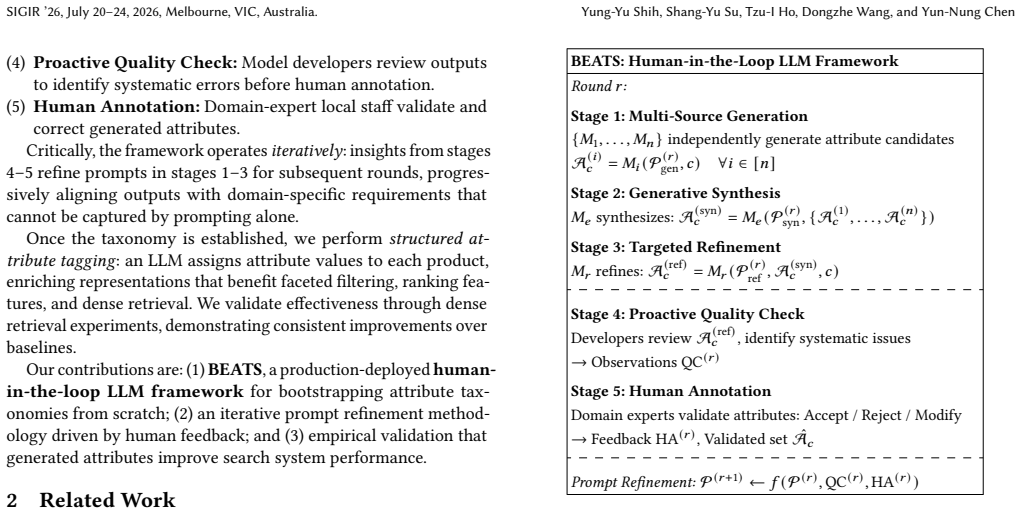
The central claim is that a human-in-the-loop LLM framework can bootstrap complete product attribute taxonomies entirely from scratch. The pipeline incorporates proactive quality checking by model developers and validation by local domain experts, with successive rounds of prompt refinement driven by their feedback. Once established, the taxonomies support structured attribute tagging of individual products. When dense retrieval models are trained on the resulting attribute-enriched catalog data, they demonstrate consistent improvements over baselines that rely solely on the original catalog information.
What carries the argument
The multi-stage LLM generation pipeline extended with quality checking and human annotation stages for iterative prompt refinement.
If this is right
- Granular attribute-based filtering becomes available in search interfaces.
- Ranking models gain access to structured attribute features.
- Semantic representations used by dense retrieval improve.
- The approach supports large-scale deployment across thousands of sub-categories and millions of products.
Where Pith is reading between the lines
- The iterative loop could be adapted to bootstrap structured schemas in other data-scarce domains such as specialized knowledge bases.
- Repeated human feedback cycles might generate reusable examples that reduce reliance on expert annotators in later applications.
- The generated taxonomies could surface attribute patterns that differ from those in manually designed schemas.
Load-bearing premise
Iterative refinements based on quality checks and annotator feedback will produce attributes that are accurate and useful for downstream search without introducing systematic biases.
What would settle it
Training dense retrieval models on the attribute-enriched product data and finding no improvement or a decrease in performance relative to models trained only on the original catalog information.
Figures
read the original abstract
E-commerce platforms in emerging markets often operate with underdeveloped product catalogs that contain only category taxonomies but lack structured attribute schemas. This absence of fine-grained product attributes limits search capabilities -- preventing faceted filtering, degrading query understanding, and weakening semantic representations used by search systems. We present BEATS, a human-in-the-loop LLM framework for bootstrapping product attribute taxonomies entirely from scratch. Our approach extends a multi-stage LLM generation pipeline with two critical production stages: (1) proactive quality checking by model developers to filter erroneous outputs, and (2) human annotation by domain-expert local staff to validate generated attributes. The framework operates iteratively -- prompts at each generation stage are refined based on quality check observations and annotator feedback across successive rounds, progressively improving attribute quality. Once the attribute taxonomy is established, we employ LLMs to perform structured attribute tagging on individual product items, enriching their contextual representations. The enriched catalog directly benefits multiple components of the search system: enabling granular attribute-based filtering, providing structured features for ranking models, and improving semantic representations for dense retrieval. We validate the generated taxonomy by training dense retrieval models on attribute-enriched product data, demonstrating consistent improvements over baselines using original catalog information. Our system has been deployed at Rakuten Taiwan, enriching 9 major categories spanning 2,694 sub-categories with 67,277 generated attributes, and over 5.4 million products have been tagged with the generated attributes, with plans to enrich the entire product catalog.
Editorial analysis
A structured set of objections, weighed in public.
Referee Report
Summary. The manuscript presents BEATS, a human-in-the-loop LLM pipeline for generating product attribute taxonomies from scratch in e-commerce catalogs that lack structured attributes. The framework combines multi-stage LLM generation with proactive developer quality checks and iterative domain-expert human annotation, refining prompts across rounds based on feedback. Generated attributes are then used for LLM-based tagging of individual products to enrich catalog representations. The enriched data is claimed to improve multiple search components, with validation via training dense retrieval models that show consistent gains over baselines using only original catalog information. The system is reported as deployed at Rakuten Taiwan, enriching 9 categories (2,694 sub-categories) with 67,277 attributes and tagging >5.4 million products.
Significance. If the retrieval improvements are robustly quantified and generalizable, the work offers a practical, deployable method for bootstrapping fine-grained attributes in underdeveloped e-commerce catalogs, directly addressing limitations in faceted search and semantic representations. The real-world deployment at Rakuten Taiwan and the scale (millions of tagged products) constitute concrete evidence of applicability. The iterative human-AI loop with explicit quality gates is a methodological strength that could inform similar bootstrapping efforts in other domains.
major comments (1)
- [Validation / Results] Validation / Results section: the central claim that attribute-enriched data yields 'consistent improvements' in dense retrieval models is load-bearing for the paper's empirical contribution, yet the manuscript supplies no quantitative metrics (e.g., MRR, Recall@K, NDCG deltas), baseline descriptions, training details, statistical tests, or error bars, preventing assessment of effect size or reproducibility.
minor comments (1)
- [Abstract] Abstract: the description of the iterative refinement loop would benefit from a brief schematic or enumerated stages to clarify the flow from generation to tagging.
Simulated Author's Rebuttal
We thank the referee for highlighting the need for stronger empirical grounding in the validation section. We agree that quantitative details are essential for assessing the claimed improvements and will revise accordingly.
read point-by-point responses
-
Referee: [Validation / Results] Validation / Results section: the central claim that attribute-enriched data yields 'consistent improvements' in dense retrieval models is load-bearing for the paper's empirical contribution, yet the manuscript supplies no quantitative metrics (e.g., MRR, Recall@K, NDCG deltas), baseline descriptions, training details, statistical tests, or error bars, preventing assessment of effect size or reproducibility.
Authors: We acknowledge this gap in the submitted manuscript. The Validation section currently states only that 'consistent improvements' were observed without reporting specific numbers or experimental details. In the revision we will add: (1) exact deltas for MRR, Recall@K and NDCG@10/100 on the held-out test sets, (2) full baseline descriptions (category-only BM25, category-only dense retrieval, and any other controls), (3) training hyperparameters and data splits, (4) results from at least three random seeds with standard deviation/error bars, and (5) statistical significance tests (paired t-test or Wilcoxon). These additions will be placed in a new subsection with a table and will be cross-referenced from the abstract and introduction. revision: yes
Circularity Check
No significant circularity
full rationale
The paper presents a methodological pipeline for bootstrapping attribute taxonomies via iterative LLM generation, quality checks, and human annotation, followed by empirical validation on downstream dense retrieval tasks using real deployment data at Rakuten Taiwan. No equations, fitted parameters, predictions, or first-principles derivations are described that could reduce to inputs by construction. The central claim rests on observed improvements in retrieval metrics rather than any self-referential loop or self-citation load-bearing premise. The framework is self-contained as an applied system description with external empirical grounding.
Axiom & Free-Parameter Ledger
Reference graph
Works this paper leans on
-
[1]
Emily M Bender, Timnit Gebru, Angelina McMillan-Major, and Shmargaret Shmitchell. 2021. On the Dangers of Stochastic Parrots: Can Language Models Be Too Big?. InProceedings of the 2021 ACM Conference on Fairness, Accountability, and Transparency. 610–623
2021
-
[2]
Jacob Devlin, Ming-Wei Chang, Kenton Lee, and Kristina Toutanova. 2019. BERT: Pre-training of Deep Bidirectional Transformers for Language Understanding. In NAACL-HLT. 4171–4186
2019
-
[3]
Xin Luna Dong, Xiang He, Andrey Kan, Xian Li, Yan Yan, Jingping Yin, Jiawei Yu, Qi Zhang, and Hao Zheng. 2020. AutoKnow: Self-Driving Knowledge Collection for Products of Thousands of Types. InProceedings of the 26th ACM SIGKDD International Conference on Knowledge Discovery & Data Mining. 2724–2734
2020
-
[4]
Dongfu Jiang, Xiang Ren, and Bill Yuchen Lin. 2023. LLM-Blender: Ensembling Large Language Models with Pairwise Ranking and Generative Fusion. InProceed- ings of the 61st Annual Meeting of the Association for Computational Linguistics. 14165–14178
2023
-
[5]
Vladimir Karpukhin, Barlas Oğuz, Sewon Min, Patrick Lewis, Ledell Wu, Sergey Edunov, Danqi Chen, and Wen-tau Yih. 2020. Dense Passage Retrieval for Open- Domain Question Answering. InProceedings of the 2020 Conference on Empirical Methods in Natural Language Processing. 6769–6781
2020
- [6]
-
[7]
Woosuk Kwon, Zhuohan Li, Siyuan Zhuang, Ying Sheng, Lianmin Zheng, Cody Hao Yu, Joseph E Gonzalez, Hao Zhang, and Ion Stoica. 2023. Efficient Memory Management for Large Language Model Serving with PagedAttention. InSOSP
2023
-
[8]
Ji-Ung Lee, Jan-Christoph Klie, and Iryna Gurevych. 2022. Annotation Curricula to Implicitly Train Non-Expert Annotators.Computational Linguistics48, 2 (2022), 343–373
2022
- [9]
-
[10]
Yuning Mao, Tong Zhao, Andrey Kan, Chenwei Zhang, Xin Luna Dong, Christos Faloutsos, and Jiawei Han. 2020. Octet: Online Catalog Taxonomy Enrichment with Self-Supervision. InProceedings of the 26th ACM SIGKDD International Conference on Knowledge Discovery & Data Mining. 2037–2047
2020
- [11]
-
[12]
2021.Human-in-the-Loop Machine Learning: Active Learning and Annotation for Human-Centered AI
Robert Monarch. 2021.Human-in-the-Loop Machine Learning: Active Learning and Annotation for Human-Centered AI. Manning Publications
2021
-
[13]
Viktor Moskvoretskii, Ekaterina Neminova, Alina Lobanova, Alexander Panchenko, and Irina Nikishina. 2024. TaxoLLaMA: WordNet-based Model for Solving Multiple Lexical Semantic Tasks. InProceedings of the 62nd Annual Meeting of the Association for Computational Linguistics
2024
- [14]
- [15]
-
[16]
David Rau, Hervé Déjean, Nadezhda Chirkova, Thibault Formal, Shuai Wang, Stéphane Clinchant, and Vassilina Nikoulina. 2024. BERGEN: A Benchmarking Library for Retrieval-Augmented Generation. InFindings of the Association for Computational Linguistics: EMNLP 2024. 7640–7663
2024
-
[17]
2012.Active Learning
Burr Settles. 2012.Active Learning. Morgan & Claypool Publishers
2012
-
[18]
Xiaojie Sun, Keping Bi, Jiafeng Guo, Xinyu Ma, Yixing Fan, Hongyu Shan, Qishen Zhang, and Zhongyi Liu. 2023. Pre-training with Aspect-Content Text Mutual Prediction for Multi-Aspect Dense Retrieval. InProceedings of the 32nd ACM International Conference on Information and Knowledge Management. 2379–2383
2023
- [19]
-
[20]
Liang Wang, Nan Yang, and Furu Wei. 2023. Query2Doc: Query Expansion with Large Language Models. InProceedings of the 2023 Conference on Empirical Methods in Natural Language Processing. 9414–9423
2023
-
[21]
Xingjiao Wu, Luwei Xiao, Yixuan Sun, Junhang Zhang, Tao Ma, and Liang He
-
[22]
A Survey of Human-in-the-Loop Machine Learning.Future Generation Computer Systems135 (2022), 364–381
2022
-
[23]
Lee Xiong, Chenyan Xiong, Ye Li, Kwok-Fung Tang, Jialin Liu, Paul Bennett, Junaid Ahmed, and Arnold Overwijk. 2021. Approximate Nearest Neighbor Neg- ative Contrastive Learning for Dense Text Retrieval. InInternational Conference on Learning Representations
2021
-
[24]
Huimin Xu, Wenting He, Jiwei Tan, Bing Ma, Shoucheng Li, and Yu Zheng. 2019. Scaling up Open Tagging from Tens to Thousands: Comprehension Empowered Attribute Value Extraction from Product Title. InProceedings of the 57th Annual Meeting of the Association for Computational Linguistics. 5214–5223
2019
-
[25]
Guineng Zheng, Subhabrata Mukherjee, Xin Luna Dong, and Feijun Li. 2018. OpenTag: Open Attribute Value Extraction from Product Profiles. InProceedings of the 24th ACM SIGKDD International Conference on Knowledge Discovery & Data Mining. 1049–1058
2018
-
[26]
Lianmin Zheng, Wei-Lin Chiang, Ying Sheng, Siyuan Zhuang, Zhanghao Wu, Yonghao Zhuang, Zi Lin, Zhuohan Li, Dacheng Li, Eric P Xing, Hao Zhang, Joseph E Gonzalez, and Ion Stoica. 2023. Judging LLM-as-a-Judge with MT-Bench and Chatbot Arena. InNeurIPS
2023
-
[27]
Junchen Zhi, Zhijun Chen, et al . 2025. Harnessing Multiple Large Language Models: A Survey on LLM Ensemble.arXiv preprint arXiv:2502.18036(2025)
work page internal anchor Pith review Pith/arXiv arXiv 2025
discussion (0)
Sign in with ORCID, Apple, or X to comment. Anyone can read and Pith papers without signing in.