SMUGGLE-Ring: Evolutionary link between nuclear star cluster and nuclear disk
Pith reviewed 2026-06-28 05:21 UTC · model grok-4.3
The pith
A hydrodynamical simulation shows that bar-driven inflows create linked growth between a nuclear stellar disk and nuclear star cluster in a Milky Way-mass galaxy.
A machine-rendered reading of the paper's core claim, the machinery that carries it, and where it could break.
Core claim
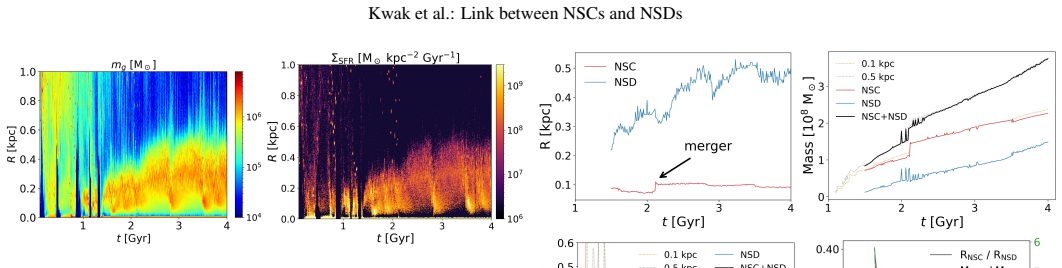
In the simulation, a bar of length approximately 5 kpc forms in isolation and drives sustained gas inflows that form a nuclear stellar disk and nuclear star cluster. Considering only post-bar stars reveals inside-out growth of the disk, with feedback inducing shocks that regulate the gas disk size and channel gas to the cluster. The disk and cluster share similar growth histories except during the accretion of a cluster with mass about 3 times 10^7 solar masses. The results indicate that the bar's evolutionary timescale and star cluster accretion history are key to tighter scaling relations, favoring a bulge-to-disk ratio of about 0.045 for the Milky Way to match the compact nuclear disk.
What carries the argument
The isolated hydrodynamical simulation with the SMUGGLE multiphase ISM and stellar feedback model, which produces bar-driven gas inflows and shared post-bar growth histories for the nuclear disk and cluster.
If this is right
- The evolutionary timescale of the bar and the accretion history of star clusters are essential for obtaining tighter scaling relations among nuclear structures and their host galaxies.
- Stellar feedback induces repeated shocks that regulate the size of the nuclear gas disk and drive gas from its outer edge toward the nuclear star cluster region.
- The nuclear stellar disk and nuclear star cluster share similar mass growth and star formation histories after bar formation, except during massive cluster accretion.
- A lower bulge mass for the Milky Way than assumed in the model (B/D approximately 0.045) is needed to explain the compact size of its nuclear disk.
Where Pith is reading between the lines
- If bar evolutionary timescale controls nuclear scaling relations, then galaxies with longer-lived bars should show correspondingly larger nuclear disks relative to their host mass.
- The occasional accretion of a massive cluster that temporarily decouples the cluster and disk histories implies that dynamical capture events can produce outliers in observed nuclear structure relations.
- Extending the same isolated simulation setup to include minor mergers or external gas inflows would test whether the inside-out disk growth pattern survives realistic perturbations.
- The clean separation of post-bar stars in the simulation suggests that chemical or kinematic tagging of young stars in real galaxies could isolate nuclear disk growth from older bulge populations.
Load-bearing premise
The isolated simulation with the SMUGGLE multiphase ISM and stellar feedback model accurately represents the real formation and evolution of nuclear structures in a Milky Way-mass galaxy without external perturbations.
What would settle it
Direct measurement of the Milky Way bulge-to-disk ratio together with the observed size and growth pattern of its nuclear disk, or detection of a recent massive cluster accretion event near the nuclear star cluster.
Figures

read the original abstract
We present a high-resolution hydrodynamical simulation of the formation and evolution of nuclear structures in a Milky Way-mass galaxy using the SMUGGLE multiphase ISM and stellar feedback model. The system naturally develops a bar of length $\approx5$ kpc in isolation, driving sustained gas inflows toward the center that lead to the formation of a nuclear stellar disk (NSD) and a nuclear star cluster (NSC). By considering only stars born after bar formation, we cleanly isolate the nuclear structures and recover a clear inside-out growth of the NSD. Consistent with observational studies, we find that stellar feedback induces repeated shocks that regulate the size of the nuclear gas disk and drive gas from its outer edge toward the NSC region. Over time, the NSD and NSC share similar mass growth and star formation histories, except during accretion of a massive star cluster with mass $\approx 3\times 10^{7}\Msun$, comparable to the most massive cluster observed near the NSC of NGC 4654. Our results suggest that both the evolutionary timescale of the bar (and thus of the NSD) and the accretion history of star clusters are essential for obtaining tighter scaling relations among nuclear structures and their host galaxies. Finally, our results favor a lower bulge mass for the Milky Way than in our model ($B/D\approx 0.045$) to explain the compact size of its nuclear disk.
Editorial analysis
A structured set of objections, weighed in public.
Referee Report
Summary. The manuscript reports results from a single high-resolution hydrodynamical simulation of an isolated Milky Way-mass galaxy evolved with the SMUGGLE multiphase ISM and stellar feedback model. The simulation develops a ~5 kpc bar that drives gas inflows, leading to formation of a nuclear stellar disk (NSD) and nuclear star cluster (NSC). By restricting analysis to stars formed after bar onset, the authors recover inside-out NSD growth, repeated feedback-driven shocks regulating the nuclear gas disk, and broadly similar mass and star-formation histories for the NSD and NSC except during accretion of a ~3e7 Msun cluster. From this trajectory the authors conclude that bar evolutionary timescale and cluster accretion history are essential for tighter nuclear-structure scaling relations and that the Milky Way requires a bulge-to-disk ratio lower than the model's B/D≈0.045 to match the observed compact NSD.
Significance. A well-resolved case study of bar-driven nuclear structure formation with explicit multiphase ISM and feedback physics offers a concrete evolutionary pathway that can be compared to observations of NSD/NSC co-evolution. The methodological choice to isolate post-bar stars provides a clean view of inside-out growth. However, because the central inferences about necessity of specific timescales and accretion histories rest on a single isolated run without parameter variations, the broader significance for scaling relations remains provisional pending controlled experiments.
major comments (2)
- [Abstract] Abstract: The assertion that 'both the evolutionary timescale of the bar (and thus of the NSD) and the accretion history of star clusters are essential for obtaining tighter scaling relations' is not demonstrated by the single evolutionary trajectory shown. No comparative runs with altered bar growth rates, different initial conditions, or suppressed cluster accretion are presented to establish that these factors are required rather than merely consistent with the observed inside-out growth and single accretion event.
- [Abstract] Abstract: The inference that the Milky Way requires a lower bulge mass than the model's B/D≈0.045 to produce a compact NSD is drawn from the NSD size realized in this specific simulation. Without additional runs that systematically vary the initial bulge mass (or other structural parameters) while holding other aspects fixed, the quantitative preference for a lower B/D remains an extrapolation from one data point rather than a constrained result.
minor comments (1)
- [Abstract] The abstract does not summarize numerical resolution, softening lengths, or any convergence tests performed; these details should be stated concisely so readers can assess the robustness of the reported nuclear structures.
Simulated Author's Rebuttal
We thank the referee for the constructive and detailed comments. We agree that the abstract claims regarding the essential role of bar timescales/accretion history and the preference for a lower Milky Way bulge mass are inferences from a single simulation and should be qualified more carefully. We will revise the abstract to address both points.
read point-by-point responses
-
Referee: [Abstract] Abstract: The assertion that 'both the evolutionary timescale of the bar (and thus of the NSD) and the accretion history of star clusters are essential for obtaining tighter scaling relations' is not demonstrated by the single evolutionary trajectory shown. No comparative runs with altered bar growth rates, different initial conditions, or suppressed cluster accretion are presented to establish that these factors are required rather than merely consistent with the observed inside-out growth and single accretion event.
Authors: We agree that the single trajectory cannot demonstrate necessity without comparative experiments varying bar growth or accretion. The manuscript uses 'suggest' to frame this as an inference from the inside-out growth and the clear effect of the ~3e7 Msun cluster accretion event. We will revise the abstract to state that the results indicate these factors may be important for tighter relations, while explicitly noting the limitation of the single run and the need for future controlled simulations. revision: yes
-
Referee: [Abstract] Abstract: The inference that the Milky Way requires a lower bulge mass than the model's B/D≈0.045 to produce a compact NSD is drawn from the NSD size realized in this specific simulation. Without additional runs that systematically vary the initial bulge mass (or other structural parameters) while holding other aspects fixed, the quantitative preference for a lower B/D remains an extrapolation from one data point rather than a constrained result.
Authors: We acknowledge this is an extrapolation from one model. The statement compares the NSD size produced at B/D≈0.045 to the more compact observed Milky Way NSD. We will revise the abstract to present this as a qualitative suggestion that a lower bulge-to-disk ratio may better match the compact NSD, rather than a firm requirement, and will add text noting the single-simulation limitation. revision: yes
Circularity Check
No circularity: claims follow directly from single simulation trajectory
full rationale
The paper's central results on inside-out NSD growth, shared SFH with NSC, and the suggested importance of bar timescale plus cluster accretion are obtained by post-processing the stellar particles and gas flows produced in one isolated SMUGGLE run. No parameter is fitted to observations and then relabeled a prediction; no uniqueness theorem or ansatz is imported via self-citation to force the outcome; the simulation itself supplies the evolutionary sequence that is then interpreted. Self-citations to the SMUGGLE ISM/feedback implementation are methodological and not load-bearing for the nuclear-structure claims.
Axiom & Free-Parameter Ledger
Reference graph
Works this paper leans on
-
[1]
Star cluster formation and feedback in different environments of a Milky Way-like galaxy. , keywords =. doi:10.1093/mnras/stad1917 , archivePrefix =. 2306.12945 , primaryClass =
-
[2]
On the rotation of nuclear star clusters formed by cluster-inspirals
On the rotation of nuclear star clusters formed by cluster inspirals. , keywords =. doi:10.1093/mnras/stw2593 , archivePrefix =. 1610.01162 , primaryClass =
work page internal anchor Pith review Pith/arXiv arXiv doi:10.1093/mnras/stw2593
-
[3]
Dynamical modelling of the galactic bulge and bar: the Milky Way's pattern speed, stellar and dark matter mass distribution. , keywords =. doi:10.1093/mnras/stw2819 , archivePrefix =. 1608.07954 , primaryClass =
work page internal anchor Pith review Pith/arXiv arXiv doi:10.1093/mnras/stw2819
-
[4]
E pur si muove: Galilean-invariant cosmological hydrodynamical simulations on a moving mesh. , keywords =. doi:10.1111/j.1365-2966.2009.15715.x , archivePrefix =. 0901.4107 , primaryClass =
-
[5]
Nuclear Star Clusters in Cosmological Simulations
Nuclear Star Clusters in Cosmological Simulations. , keywords =. doi:10.3847/1538-4357/aad595 , archivePrefix =. 1804.09819 , primaryClass =
work page internal anchor Pith review Pith/arXiv arXiv doi:10.3847/1538-4357/aad595
-
[6]
Formation and Evolution of Nuclear Star Clusters with In Situ Star Formation: Nuclear Cores and Age Segregation. , keywords =. doi:10.1088/0004-637X/799/2/185 , archivePrefix =. 1409.5121 , primaryClass =
work page internal anchor Pith review Pith/arXiv arXiv doi:10.1088/0004-637x/799/2/185
-
[7]
The effect on the observed stellar populations
Close stellar encounters at the Galactic Centre - I. The effect on the observed stellar populations. , keywords =. doi:10.1093/mnras/stab1409 , archivePrefix =. 2104.00686 , primaryClass =
-
[8]
Probing the formation history of the nuclear star cluster at the Galactic Centre with millisecond pulsars. , keywords =. doi:10.1093/mnras/stx2364 , archivePrefix =. 1708.01627 , primaryClass =
work page internal anchor Pith review Pith/arXiv arXiv doi:10.1093/mnras/stx2364
-
[9]
Constraining the role of star cluster mergers in nuclear cluster formation: simulations confront integral-field data. , keywords =. doi:10.1111/j.1365-2966.2011.19659.x , archivePrefix =. 1103.5464 , primaryClass =
-
[10]
New insights on the formation of nuclear star clusters
New insights on the formation of nuclear star clusters. , keywords =. doi:10.1093/mnras/stw1570 , archivePrefix =. 1606.09537 , primaryClass =
work page internal anchor Pith review Pith/arXiv arXiv doi:10.1093/mnras/stw1570
-
[11]
Dark Gaps and Resonances in Barred Galaxies. , keywords =. doi:10.3847/1538-4357/ae113a , archivePrefix =. 2510.10427 , primaryClass =
-
[12]
Orbits in barred galaxies. , keywords =. doi:10.1007/BF00873080 , adsurl =
-
[13]
Nuclear star clusters. , keywords =. doi:10.1007/s00159-020-00125-0 , archivePrefix =. 2001.03626 , primaryClass =
-
[14]
Inside-out formation of nuclear discs and the absence of old central spheroids in barred galaxies of the TIMER survey. , keywords =. doi:10.1051/0004-6361/202038450 , archivePrefix =. 2009.01856 , primaryClass =
-
[15]
The existence and shapes of dust lanes in galactic bars. , keywords =. doi:10.1093/mnras/259.2.345 , adsurl =
-
[16]
2003, MNRAS, 344, 1000, doi: 10.1046/j.1365-8711.2003.06897.x
What determines the strength and the slowdown rate of bars?. , keywords =. doi:10.1046/j.1365-8711.2003.06473.x , archivePrefix =. astro-ph/0302519 , primaryClass =
-
[17]
The Frequency of Barred Spiral Galaxies in the Near-IR
The Frequency of Barred Spiral Galaxies in the Near-Infrared. , keywords =. doi:10.1086/301203 , archivePrefix =. astro-ph/9910479 , primaryClass =
work page internal anchor Pith review Pith/arXiv arXiv doi:10.1086/301203
-
[18]
Time Inference with MUSE in Extragalactic Rings (TIMER): properties of the survey and high-level data products. , keywords =. doi:10.1093/mnras/sty2666 , archivePrefix =. 1810.01425 , primaryClass =
work page internal anchor Pith review Pith/arXiv arXiv doi:10.1093/mnras/sty2666
-
[19]
arXiv e-prints , keywords =
A nuclear disc at Cosmic Noon: evidence of early bar-driven galaxy evolution. arXiv e-prints , keywords =
-
[20]
Molecular gas and star formation in central rings across nearby galaxies. , keywords =. doi:10.1051/0004-6361/202557430 , archivePrefix =. 2601.11127 , primaryClass =
-
[21]
Stellar Bars in Isolated Gas-rich Spiral Galaxies Do Not Slow Down. , keywords =. doi:10.3847/1538-4357/ace2b9 , archivePrefix =. 2209.03364 , primaryClass =
-
[22]
Identification and Analysis of Galactic Bars in DESI Legacy Imaging Surveys. , keywords =. doi:10.3847/1538-4357/adbcac , archivePrefix =. 2503.22075 , primaryClass =
-
[23]
Structural properties of pseudo-bulges, classical bulges and elliptical galaxies: a Sloan Digital Sky Survey perspective. , keywords =. doi:10.1111/j.1365-2966.2008.14257.x , archivePrefix =. 0810.1953 , primaryClass =
-
[24]
Diversity of nuclear star cluster formation mechanisms revealed by their star formation histories. , keywords =. doi:10.1051/0004-6361/202140644 , archivePrefix =. 2104.06412 , primaryClass =
-
[25]
Formation and evolution of young massive clusters in galaxy mergers: the SMUGGLE view. , keywords =. doi:10.1093/mnras/stac1136 , archivePrefix =. 2109.10356 , primaryClass =
-
[26]
Modelling feedback from stars and black holes in galaxy mergers. , keywords =. doi:10.1111/j.1365-2966.2005.09238.x , archivePrefix =. astro-ph/0411108 , primaryClass =
-
[27]
The Gaia-ESO Survey: New constraints on the Galactic disc velocity dispersion and its chemical dependencies. , keywords =. doi:10.1051/0004-6361/201525883 , archivePrefix =. 1509.05271 , primaryClass =
work page internal anchor Pith review Pith/arXiv arXiv doi:10.1051/0004-6361/201525883
-
[28]
Kinematic modelling of the Milky Way using the RAVE and GCS stellar surveys
Kinematic Modeling of the Milky Way Using the RAVE and GCS Stellar Surveys. , keywords =. doi:10.1088/0004-637X/793/1/51 , archivePrefix =. 1405.7435 , primaryClass =
work page internal anchor Pith review Pith/arXiv arXiv doi:10.1088/0004-637x/793/1/51
-
[29]
A theoretical unifying scheme for gamma-ray bright blazars.Mon
The formation of galactic discs. , keywords =. doi:10.1046/j.1365-8711.1998.01227.x , archivePrefix =. astro-ph/9707093 , primaryClass =
-
[30]
An iterative method for the construction of N-body galaxy models in collisionless equilibrium
An iterative method for the construction of N-body galaxy models in collisionless equilibrium. , keywords =. doi:10.1093/mnras/stu1421 , archivePrefix =. 1402.1623 , primaryClass =
work page internal anchor Pith review Pith/arXiv arXiv doi:10.1093/mnras/stu1421
-
[31]
1990, ApJ, 356, 359, doi: 10.1086/168845
An Analytical Model for Spherical Galaxies and Bulges. , keywords =. doi:10.1086/168845 , adsurl =
-
[32]
Growing a nuclear star cluster from star formation and cluster mergers: The JWST NIRSpec view of NGC 4654. , keywords =. doi:10.1051/0004-6361/202449629 , archivePrefix =. 2404.08910 , primaryClass =
-
[33]
Disentangling the formation mechanisms of nuclear star clusters. , keywords =. doi:10.1051/0004-6361/202039778 , archivePrefix =. 2112.05610 , primaryClass =
-
[34]
Age dating the Galactic bar with the nuclear stellar disc. , keywords =. doi:10.1093/mnras/staa140 , archivePrefix =. 1909.07548 , primaryClass =
-
[35]
Bar ages derived for the first time in nearby galaxies: Insights into secular evolution from the TIMER sample (Corrigendum). , keywords =. doi:10.1051/0004-6361/202557798e , adsurl =
-
[36]
Early formation and recent starburst activity in the nuclear disk of the Milky Way. Nature Astronomy , keywords =. doi:10.1038/s41550-019-0967-9 , archivePrefix =. 1910.06968 , primaryClass =
-
[37]
Star formation in the centre of NGC 1808 as observed by ALMA. , keywords =. doi:10.1093/mnras/stad2450 , archivePrefix =. 2308.08598 , primaryClass =
-
[38]
Bar ages derived for the first time in nearby galaxies: Insights into secular evolution from the TIMER sample. , keywords =. doi:10.1051/0004-6361/202453367 , archivePrefix =. 2503.20864 , primaryClass =
-
[39]
Chemical analysis of the Milky Way's nuclear star cluster: Evidence for a metallicity gradient. , keywords =. doi:10.1051/0004-6361/202557723 , archivePrefix =. 2512.08387 , primaryClass =
-
[40]
The spheroidal bulge of the Milky Way: Chemodynamically distinct from the inner-thick disc and bar. , keywords =. doi:10.1051/0004-6361/202556326 , archivePrefix =. 2507.06863 , primaryClass =
-
[41]
Insights from super-metal-rich stars: Is the Milky Way bar young?. , keywords =. doi:10.1051/0004-6361/202348365 , archivePrefix =. 2311.16993 , primaryClass =
-
[42]
Self-consistent modelling of the Milky Way's Nuclear Stellar Disc
Self-consistent modelling of the Milky Way's nuclear stellar disc. , keywords =. doi:10.1093/mnras/stac639 , archivePrefix =. 2111.12713 , primaryClass =
work page internal anchor Pith review Pith/arXiv arXiv doi:10.1093/mnras/stac639
-
[43]
Nuclear stellar discs. , keywords =. doi:10.1007/s00159-025-00163-6 , archivePrefix =. 2509.04562 , primaryClass =
-
[44]
Chemical abundances in the Milky Way's nuclear stellar disc. , keywords =. doi:10.1051/0004-6361/202554791 , archivePrefix =. 2505.15924 , primaryClass =
-
[45]
Effects of Magnetic Fields on Gas Dynamics and Star Formation in Nuclear Rings. , keywords =. doi:10.3847/1538-4357/acc250 , archivePrefix =. 2303.04206 , primaryClass =
-
[46]
Smooth kinematic and metallicity gradients reveal that the Milky Way's nuclear star cluster and disc might be part of the same structure. , keywords =. doi:10.1051/0004-6361/202347421 , archivePrefix =. 2309.07219 , primaryClass =
-
[47]
The epoch of the Milky Way's bar formation: dynamical modelling of Mira variables in the nuclear stellar disc. , keywords =. doi:10.1093/mnras/stae711 , archivePrefix =. 2311.00035 , primaryClass =
-
[48]
Nuclear star cluster formation in star-forming dwarf galaxies. , keywords =. doi:10.1051/0004-6361/202244932 , archivePrefix =. 2210.01556 , primaryClass =
-
[49]
, keywords =
Spiral structure of molecular clouds in response to bar forcing: a particle simulation. , keywords =
-
[50]
, year = 1993, month = apr, volume =
Bars in early- and late-type galaxies. , year = 1993, month = apr, volume =
1993
-
[51]
The AREPO Public Code Release. , keywords =. doi:10.3847/1538-4365/ab908c , archivePrefix =. 1909.04667 , primaryClass =
-
[52]
Simulating the interstellar medium and stellar feedback on a moving mesh: implementation and isolated galaxies. , keywords =. doi:10.1093/mnras/stz2391 , archivePrefix =. 1905.08806 , primaryClass =
-
[53]
The TIMER view on NGC1433's old bar and the inside-out growth of its nuclear disc
A new method for age-dating the formation of bars in disc galaxies. The TIMER view on NGC1433's old bar and the inside-out growth of its nuclear disc. , keywords =. doi:10.1051/0004-6361/202244667 , archivePrefix =. 2211.07670 , primaryClass =
-
[54]
Discovery of the smallest nuclear discs and their young stellar bars
Disc galaxies are still settling. Discovery of the smallest nuclear discs and their young stellar bars. , keywords =. doi:10.1051/0004-6361/202347028 , archivePrefix =. 2308.04482 , primaryClass =
-
[55]
Composite Bulges -- V. Detecting signatures of gas inflows in IFU data: The MUSE view of ionised gas kinematics in nearby galaxies. arXiv e-prints , keywords =. doi:10.48550/arXiv.2601.02534 , archivePrefix =. 2601.02534 , primaryClass =
work page internal anchor Pith review Pith/arXiv arXiv doi:10.48550/arxiv.2601.02534
-
[56]
Composite bulges - IV. Detecting signatures of gas inflows in the IFU data: the MUSE view of ionized gas kinematics in NGC 1097. , keywords =. doi:10.1093/mnras/stad1896 , archivePrefix =. 2306.11091 , primaryClass =
-
[57]
Classical Cepheid Pulsation Models. X. The Period-Age Relation. , keywords =. doi:10.1086/427744 , archivePrefix =. astro-ph/0411756 , primaryClass =
work page internal anchor Pith review Pith/arXiv arXiv doi:10.1086/427744
-
[58]
Cepheids as distance indicators and stellar tracers. , keywords =. doi:10.1007/s00159-024-00153-0 , archivePrefix =. 2405.04893 , primaryClass =
-
[59]
First metallicity determination from near-infrared spectra for five obscured Cepheids discovered in the inner disc. , keywords =. doi:10.1093/mnras/sty2661 , archivePrefix =. 1805.03212 , primaryClass =
work page internal anchor Pith review Pith/arXiv arXiv doi:10.1093/mnras/sty2661
-
[60]
Survival of molecular gas in a stellar feedback-driven outflow witnessed with the MUSE TIMER project and ALMA. , keywords =. doi:10.1093/mnras/stz1844 , archivePrefix =. 1907.13142 , primaryClass =
-
[61]
The SMUGGLE-Ring project: Bar and bulge effects on nuclear disk and ring formation
The SMUGGLE-Ring project: Bar and bulge effects on nuclear disk and ring formation. arXiv e-prints , keywords =. doi:10.48550/arXiv.2603.12379 , archivePrefix =. 2603.12379 , primaryClass =
work page internal anchor Pith review Pith/arXiv arXiv doi:10.48550/arxiv.2603.12379
-
[62]
Effects of Resolution and Local Stability on Galactic Disks: 2. Halo Resolution and Softening on Bar Formation. arXiv e-prints , keywords =. doi:10.48550/arXiv.2603.02494 , archivePrefix =. 2603.02494 , primaryClass =
work page internal anchor Pith review Pith/arXiv arXiv doi:10.48550/arxiv.2603.02494
-
[63]
Effects of Resolution and Local Stability on Galactic Disks: I. Multiple Spiral Mode Formation via Swing Amplification. arXiv e-prints , keywords =. doi:10.48550/arXiv.2511.21805 , archivePrefix =. 2511.21805 , primaryClass =
work page internal anchor Pith review Pith/arXiv arXiv doi:10.48550/arxiv.2511.21805
-
[64]
Origin of Nonaxisymmetric Features of Virgo Cluster Early-type Dwarf Galaxies. II. Tidal Effects on Disk Features and Stability. , keywords =. doi:10.3847/1538-4357/ab5716 , archivePrefix =. 1911.05094 , primaryClass =
-
[65]
Effects of Gas on Formation and Evolution of Stellar Bars and Nuclear Rings in Disk Galaxies
Effects of Gas on Formation and Evolution of Stellar Bars and Nuclear Rings in Disk Galaxies. , keywords =. doi:10.3847/1538-4357/aafc5f , archivePrefix =. 1901.02021 , primaryClass =
work page internal anchor Pith review Pith/arXiv arXiv doi:10.3847/1538-4357/aafc5f 1901
-
[66]
Origin of Non-axisymmetric Features of Virgo Cluster Early-type Dwarf Galaxies. I. Bar Formation and Recurrent Buckling. , keywords =. doi:10.3847/1538-4357/aa674c , archivePrefix =. 1703.10285 , primaryClass =
work page internal anchor Pith review Pith/arXiv arXiv doi:10.3847/1538-4357/aa674c
-
[67]
Nuclear discs in disc galaxies: structural properties and scaling relations. , keywords =. doi:10.1093/mnrasl/slaf099 , archivePrefix =. 2509.14319 , primaryClass =
discussion (0)
Sign in with ORCID, Apple, or X to comment. Anyone can read and Pith papers without signing in.