REVIEW 5 major objections 5 minor 14 references
Streaming Communication in Multi-Agent Reasoning
T0 review · 5 major / 5 minor · reviewed 2026-08-04 · deepseek-v4-flash
Pith's one-line read The paper claims that streaming each reasoning step to the next agent as soon as it is generated — instead of waiting for the full chain — reduces latency and improves accuracy, because early reasoning steps are more reliable than late ones
desk verdict The streaming protocol and its latency bound are worth knowing; the headline accuracy gain is not a clean test because Stream’s root prompt differs from Serial’s, so treat the +7.3 pp as promising but unproven. read the letter →
The pith
A machine-rendered reading of the paper's core claim, the machinery that carries it, and where it could break.
The reading
What carries the argument
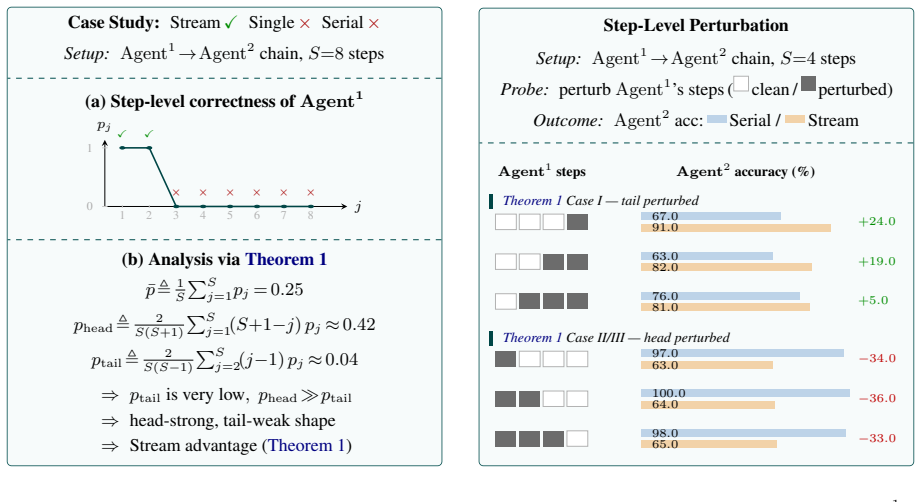
The load-bearing object is Theorem 1's effectiveness ordering, expressed through the sCorr proxy, the mean expected downstream step-level correctness. For each upstream step j with correctness probability p_j, the model assigns a benefit δ to a correct step and a penalty ε to an incorrect one, so the net effect is µ_j = p_j δ − (1−p_j)ε, beneficial only when p_j exceeds the breakeven threshold p* = ε/(δ+ε). The ordering among Stream, Serial, and Single depends on three weighted averages of the p_j: the uniform mean p̄, the head-weighted mean p_head, and the tail-weighted mean p_tail. In the Stream-advantage regime (p_head > p* but p_tail < p*), the downstream agent is best off starting from
What would settle it
Measure the per-step correctness profile p_1,...,p_S on each benchmark by scoring intermediate reasoning steps, estimate the breakeven threshold p* from small head/tail perturbation experiments, and check whether most questions fall in the Stream-advantage regime. A concrete negative result would be a benchmark where p_tail > p*, so Theorem 1 predicts Serial (or Single) should beat Stream; finding such a benchmark where Stream still wins would falsify the mechanism, while confirming the profile would corroborate it.
Extended reading notes
Core claim
The paper's central claim is that the timing of inter-agent communication is a first-class design axis in multi-agent reasoning. By shifting the transmission unit from complete responses to individual reasoning steps, the Stream protocol pipelines adjacent agents: downstream agents begin reasoning on a prefix while upstream agents continue generating. The counter-intuitive part is effectiveness: because LLM reasoning quality decays with position, early steps being reliable and later steps degrading, a downstream agent conditioned on a reliable prefix can outperform one forced to ingest the error-prone tail. Theorem 1 formalizes exactly when this happens: comparing head- and tail-weighted ste
Load-bearing premise
The claim depends on two linked premises: that on the target tasks early reasoning steps are systematically more reliable than later ones (p_head > p* and p_tail < p*), and that the theoretical proxy 'step-level correctness' tracks final-answer accuracy; if either fails — e.g., a task where later steps are more reliable — the predicted ordering inverts.
Editorial extensions
If this is right
- If correct, the same prompts, models, and topology run measurably better simply by changing when context is delivered; communication timing becomes a tuning knob.
- The step-level scaling law implies per-agent step count is a new scaling axis, composable with agent-count scaling: raising steps per agent from 2 to 64 adds accuracy beyond what agent-count scaling alone provides.
- Theorem 1 doubles as a protocol selector: given a measured step-correctness profile, a practitioner can choose Stream, Serial, or Single in closed form.
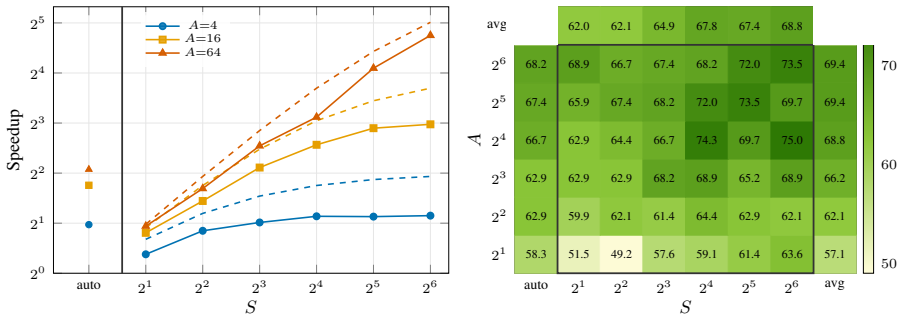
- The speedup bound AS/(S+A−1) shows pipelining gains grow with both agent count and step count, approaching A as S grows large.
- The cost theorem predicts streaming is cheaper than serial under decode-dominated pricing with prefix-cache hits, and more expensive without caching, so infrastructure choices determine whether the protocol saves money.
Reading between the lines
- The head-strong/tail-weak premise could be tested cheaply on any new dataset by scoring intermediate steps; if a task instead shows later steps more reliable (self-correction), the theorem predicts Serial should win, making the framework a usable diagnostic rather than a universal recipe.
- The same 'early reliable, late degraded' structure appears in human expert pipelines, hierarchical planning, and staged code generation, so streaming partial artifacts may transfer beyond LLM multi-agent systems.
- The step-level scaling law suggests an automatic controller could adapt per-agent step count per question to balance cost and accuracy; the paper reports the law but leaves the adaptive allocation problem open.
- The bridge between the theoretical proxy sCorr and measured final-answer accuracy is asserted, not proved; if the correlation is weak on some benchmark, the theorem's quantitative ordering could diverge from observed task accuracy.
Editorial analysis
A structured set of objections, weighed in public.
Referee Report
Summary. The paper introduces StreamMA, a multi-agent reasoning protocol in which each agent streams its reasoning steps to downstream agents as soon as they are generated, rather than waiting for a complete response. The authors claim this both reduces latency and improves final-answer effectiveness, because early reasoning steps tend to be more reliable than later ones and downstream agents benefit from forming their own trajectory before error-prone late steps arrive. The theoretical contribution is a closed-form analysis: Theorem 1 classifies six regimes under which Stream, Serial, or Single has the highest step-level correctness, Theorem 2 derives a speedup upper bound, and Theorem 3 derives a cost ratio. Empirically, the paper reports gains over Serial on eight benchmarks, two LLMs, and three topologies (average +7.3 pp on Claude Opus 4.6, up to +22.4 pp on HMMT 2026), a controlled step-perturbation experiment, and a step-level scaling law showing that increasing per-agent steps improves both accuracy and speedup.
Significance. If the central claim is correct, the paper identifies a genuinely new design axis: when inter-agent context arrives matters, not just what context is exchanged. The first closed-form comparison of streaming, serial, and single-agent communication is a useful formal scaffold, and the perturbation experiment in Sec. 4.2.3 is a well-aimed attempt to isolate the head/tail asymmetry predicted by Theorem 1. The authors also make code and evaluation configurations available, which supports reproducibility. However, the empirical support for the headline effectiveness claim is currently confounded: the Stream and Serial conditions differ in prompt structure and in the number of downstream calls, not only in transmission granularity. The theorem's regime variables are post-hoc constructions, and the bridge between the theoretical step-level quantity sCorr and the measured final-answer accuracy is never quantified. These issues affect the load-bearing empirical and theoretical claims and need to be addressed before the paper's conclusions can be accepted.
major comments (5)
- [Sec. 4.1 vs App. A.9] The assertion that Stream and Serial differ 'only in transmission granularity' (Sec. 4.1) is contradicted by the paper's own prompts (App. A.9). The Stream system prompt for agent A adds 'Divide your response into 3 roughly equal parts. End each part (including the last) with END_STEP...' and each downstream agent receives 'After your response, output END_STEP on its own line' in the Stream condition only. Explicit step decomposition is a formatting/reasoning intervention that can affect quality independently of timing. In addition, Alg. 2 gives each downstream agent S incremental calls with growing context, whereas Alg. 1 uses a single blocking call; the gain could come from iterative per-step prompting rather than from receiving early steps before late steps exist. The perturbation experiment (Sec. 4.2.3) does control step content, but it is one hand-constructed GPQA question and canno
- [App. A.2.2, Theorem 1] The definitions of p_head, p_bar, and p_tail are 'not prescribed a priori but derived from the proof below' (App. A.2.2 Remark). Consequently the six regimes in Theorem 1 are the sign conditions of identities (a)-(c) restated in weighted-mean notation. This makes the theorem consistent but weakens its predictive content: any observed sCorr ordering can be assigned post hoc to a regime. To make Theorem 1 empirically falsifiable, the paper should estimate p_j profiles from upstream traces independently and then test whether the predicted ordering holds, rather than deriving the regime boundaries from the same weighted sums that define the ordering.
- [App. A.2; Sec. 4.2] Theorem 1 is stated for sCorr, a 'theoretical quantity positively correlated with task-level accuracy' (App. A.2), but all headline experimental results are final-answer accuracies (Table 1). The paper never derives, measures, or quantifies this correlation. The case study in App. A.3 scores Agent1's steps but does not report sCorr for Agent2 or relate it to the final accuracy. Without this bridge, Theorem 1 does not logically support the accuracy numbers in Table 1. The authors should report sCorr alongside accuracy or provide a calibration of the proxy on the evaluated benchmarks.
- [Sec. 3.2 / App. A.2.3; Table 1] The paper's explanation of the benchmark results assumes that the eight evaluated tasks lie in the Stream-advantage regimes (Case I.a or I.b). The support for this is the assertion that these cases are 'the most frequently observed in our experiments' (App. A.2.3), backed by the error-accumulation result of Wu et al. (2025) and a direct measurement on exactly one GPQA question (App. A.3). No step-correctness profiles are measured on AIME, HMMT, HLE, or LiveCodeBench. If any benchmark is closer to Case II.b (self-correction) or Case III.b, Theorem 1 predicts Serial or Single should be better. The paper needs direct p_j measurements, or perturbation probes applied per benchmark, to establish that the observed regimes match the claimed cases.
- [Table 1; Sec. 4.2.1] No error bars, confidence intervals, or significance tests are reported for any effectiveness table. For GPT-5.4 the average advantage over Serial is only +1.5 pp, and AIME 2025/26 and HMMT 2026 test sets are only 30-33 questions; a single question is several percentage points. Without variance estimates or per-run values, the claimed effect cannot be distinguished from noise, especially for the smaller GPT-5.4 gains. The authors should report standard deviations, per-run scores, or paired significance tests for the headline comparisons.
minor comments (5)
- [Table 1] The Tree/Serial row for GPT-5.4 contains a spacing typo: '59.1775.8356.07' should be separated as '59.17 75.83 56.07'.
- [Throughout] The system name is inconsistent: 'StreamMA' in the title and abstract, 'STREAMMA' elsewhere. Please unify.
- [Sec. 4.3.1] Speedup is defined as 'the sum of per-agent API call times divided by Stream's measured wall-clock runtime.' This is a proxy for Serial wall-clock time, not an actual Serial measurement. The paper should state this explicitly, since it affects how the 26.9× figure is interpreted.
- [App. A.3 / A.4] The perturbation study and case study use a single GPQA question. Please state more prominently in Sec. 4.2.3 that this is one hand-constructed example, not a benchmark-level evaluation.
- [App. A.9] The prompt appendix is clear and useful, but the 'bolded text' notation is not visible in the rendered text. Please indicate the Stream-only additions with brackets or color that survives typesetting.
Circularity Check
Theorem 1's stream-advantage regime is reverse-engineered from the sCorr identities, so the effectiveness explanation partly reduces to an assumed step-correctness profile; the Stream-vs-Serial comparison also includes a prompt confound.
-
self definitional
[App. A.2.2, Remark after Theorem 1; Sec. 3.2]
"These variables are not prescribed a priori but derived from the proof below; their parametric definitions (Tab. 2) absorb the resulting coefficients."
The proof derives sCorr differences as (a)=(S+1)/2[(δ+ε)p_head−ε], (b)=S[(δ+ε)p̄−ε], (c)=(S−1)/2[(δ+ε)p_tail−ε], then enumerates the six cases by the signs of (a)–(c). Thus Case I ('Stream advantage') is defined as p_head>p* and p_tail<p*, which is exactly the condition making sCorr_stream exceed the other modes. The theorem does not independently predict when streaming wins; it restates the weighted-mean definitions. The paper then explains the benchmark +7.3 pp by asserting (App. A.2.3) that real profiles are 'Cases I.a and I.b', verified on only one GPQA question (App. A.3), not measured on the eight benchmarks. The explanation therefore reduces to assuming the very regime that produces the observed ordering.
full rationale
The algebra in App. A.2.1 is internally correct, but Theorem 1's regime taxonomy is constructed by inverting identities (a)–(c), and the paper's own remark concedes the regime variables are derived from the proof rather than prescribed independently. The theorem is therefore a rearrangement of the definitions rather than an empirical prediction. The bridge from sCorr to final-answer accuracy is also asserted without derivation ('sCorr is positively correlated with task-level accuracy'), so the ordering result does not by itself certify the Table 1 gains. Separately, Sec. 4.1's statement that StreamMA 'inherit[s] Serial's prompts and decoding, differing only in transmission granularity' is contradicted by App. A.9, where the Stream root prompt adds 'Divide your response into 3 roughly equal parts. End each part (including the last) with END_STEP' and downstream agents receive an END_STEP instruction. That is a confound for the headline effectiveness claim, though it is an experimental validity issue rather than a circular derivation. The efficiency theorems (2 and 3) are derived from stated serving parameters and measured API constants, with no fitted-input circularity. On balance, the effectiveness explanation has a partial definitional circularity, while latency and cost analyses are self-contained.
Assumptions & free parameters
free parameters (4)
- δ (per-correct-step correctness gain) =
not estimated (symbolic throughout)
- ε (per-incorrect-step correctness loss) =
not estimated (symbolic throughout)
- p_j (per-step correctness profiles of the eight benchmarks) =
measured on 1 GPQA question; hand-built in 6 masks
- ρ (Stream-to-Serial output-token length ratio) =
assumed 1 in the worked example; never measured
assumptions (6)
- domain assumption Each upstream step's effect on downstream step-level correctness is linear and additive: correct step adds δ, incorrect step subtracts ε, with δ, ε position-independent (µ_j = p_jδ − (1−p_j)ε)
- domain assumption sCorr (mean step-level correctness of the downstream agent) is positively correlated with task-level accuracy
- domain assumption Real trajectories on the eight benchmarks are head-strong/tail-weak (p_head > p*, p_tail < p*), placing them in the Stream-advantage cases of Theorem 1
- domain assumption LLMs reliably emit parseable END_STEP-delimited reasoning steps, and each step is approximately equal-length
- domain assumption KV-cache behavior is captured by hit rates h_a^s, and a full-cache regime (h=1 for non-root agents) is achievable on current serving stacks
- domain assumption Cited external serving parameters are accurate (v_d ≈ 39 t/s, v_p ≈ 6000 t/s; prices $5/$25/$0.50 per MTok)
Cite this review
Pith. "Pith review of Streaming Communication in Multi-Agent Reasoning." pith.science (2026). https://pith.science/paper/FDVJ3IQG
@misc{pith2026260605158,
  author       = {Pith},
  title        = {Pith review of: Streaming Communication in Multi-Agent Reasoning},
  year         = {2026},
  howpublished = {\url{https://pith.science/paper/FDVJ3IQG}},
  note         = {Machine review of arXiv:2606.05158}
}
read the original abstract
Multi-agent reasoning systems adopt a "generate-then-transfer" paradigm that forces end-to-end latency to scale linearly with pipeline depth. We introduce StreamMA, a multi-agent reasoning system that streams each reasoning step to downstream agents as soon as it is generated, pipelining adjacent agents and thus reducing latency. Surprisingly, this pipelining also improves effectiveness: because multi-step reasoning quality is non-uniform and early steps are more reliable than later ones, working with these reliable early steps instead of the full chain prevents error-prone late steps from misleading downstream agents. We formalize both advantages with the first closed-form joint analysis of stream, serial, and single protocols, deriving the effectiveness ordering, speedup upper bound, and cost ratio. Across eight reasoning benchmarks spanning mathematics, science, and code, two frontier LLMs (Claude Opus 4.6 and GPT-5.4), and three topologies (Chain, Tree, Graph), StreamMA outperforms both baselines (avg. +7.3 pp, max +22.4 pp on HMMT 2026; Claude Opus 4.6-high). Beyond these contributions, we discover a "step-level scaling law": increasing per-agent steps consistently improves both effectiveness and efficiency, a new scaling dimension orthogonal to and composable with agent-count scaling.
Figures

Figures from the paper (2 more)


Reference graph
Works this paper leans on
-
[1]
ERROR: [description]
YOU MUST CORRECT ERRORS: When found, state “ERROR: [description]” then “CORRECTION: [corrected step]”
-
[2]
After all steps, provide DETAILED overall summary with thorough analysis and any corrections made
Pass forward the MOST ACCURATE version (original if correct, your correction if not). After all steps, provide DETAILED overall summary with thorough analysis and any corrections made. [Stream only] After your response, output END_STEP on its own line. C [Topology: Chain A→B→C→D] You are Agent_C. You receive Agent_B’s output. You are a reviewer-and-correc...
-
[3]
InInternational Conference on Learning Representations, volume 2024, pages 39578–39601
Let’s verify step by step. InInternational Conference on Learning Representations, volume 2024, pages 39578–39601. Yuhan Liu, Yuyang Huang, Jiayi Yao, Shaoting Feng, Zhuohan Gu, Kuntai Du, Hanchen Li, Yihua Cheng, Junchen Jiang, Shan Lu, Madan Musuvathi, and Esha Choukse. 2026. Droidspeak: KV cache sharing across fine-tuned model variants. In23rd USENIX S...
arXiv 2024
-
[5]
Math-shepherd: Verify and reinforce llms step- by-step without human annotations. InProceedings of the 62nd Annual Meeting of the Association for Computational Linguistics (Volume 1: Long Papers), pages 9426–9439. Jason Wei, Xuezhi Wang, Dale Schuurmans, Maarten Bosma, Brian Ichter, Fei Xia, Ed H. Chi, Quoc V . Le, and Denny Zhou. 2022. Chain-of-thought p...
arXiv 2022
-
[6]
Tree of thoughts: Deliberate problem solving with large language models.Advances in neural information processing systems, 36:11809–11822. Hancheng Ye, Zhengqi Gao, Mingyuan Ma, Qinsi Wang, Yuzhe Fu, Ming-Yu Chung, Yueqian Lin, Zhijian Liu, Jianyi Zhang, Danyang Zhuo, and Yiran Chen. 2025a. KVCOMM: online cross-context kv-cache communication for efficient...
-
[7]
two methine protons, each coupling to three different sets of neighboring hydrogens
Exchange-of-thought: Enhancing large lan- guage model capabilities through cross-model com- munication. InProceedings of the 2023 Conference on Empirical Methods in Natural Language Process- ing, pages 15135–15153. Jiayi Zhang, Jinyu Xiang, Zhaoyang Yu, Fengwei Teng, Xionghui Chen, Jiaqi Chen, Mingchen Zhuge, Xin Cheng, Sirui Hong, Jinlin Wang, Bingnan Zh...
2023
-
[8]
The original problem is:
Prefix caching, as a special case of (2)( rpo ≈0 , ha s = 1 for a≥2 , h1 s = 0 ): App. A.5 gives α≈1/Aandβ≈(A−1)S/A. Substituting into condition (2) withr po ≈0: 1 A +r ccp · (A−1)S A <1⇐ ⇒1 +r ccp(A−1)S < A⇐ ⇒rccp S <1. Numerical Example: Cost Ratio withA=S= 4(Claude Opus 4.6 Pricing) To give intuition for Eq. 14, we instantiate it with Claude Opus 4.6 p...
2023
-
[11]
ERROR: [description]
YOU CAN OVERRULE PREVIOUS AGENTS: When you find errors, state “ERROR: [description]” then “CORRECTION: [corrected step]”
Show all 14 references
-
[12]
After all steps, provide DETAILED overall summary with thorough analysis and any corrections made
Pass forward the MOST ACCURATE version. After all steps, provide DETAILED overall summary with thorough analysis and any corrections made. [Stream only] After your response, output END_STEP on its own line. D [Topology: Chain A→B→C→D] You are Agent_D. You receive Agent_C’s out...
-
[13]
ERROR: [description]
YOU HAVE FINAL CORRECTION AUTHORITY: This is the last chance to fix errors. State “ERROR: [description]” then “CORRECTION: [corrected step]”
-
[14]
You receive . . . output
You are responsible for final answer accuracy. FINAL ANSWER: Must directly address the original problem. Base on CORRECTED versions. After all steps, provide DETAILED final answer with thorough analysis. [Stream only] After your response, output END_STEP on its own line. Tree ...
2025
-
[2023]
InInternational Conference on Machine Learning, pages 19274–19286
Fast inference from transformers via spec- ulative decoding. InInternational Conference on Machine Learning, pages 19274–19286. PMLR. Guohao Li, Hasan Hammoud, Hani Itani, Dmitrii Khizbullin, and Bernard Ghanem. 2023. Camel: Communicative agents for" mind" exploration of large...
2023 arXiv
-
[2024]
Break the sequential dependency of llm in- ference using lookahead decoding.arXiv preprint arXiv:2402.02057. Sirui Hong, Mingchen Zhuge, Jonathan Chen, Xiawu Zheng, Yuheng Cheng, Jinlin Wang, Ceyao Zhang, Zili Wang, Steven Ka Shing Yau, Zijuan Lin, Liyang Zhou, Chenyu Ran, Lin...
2024 arXiv
-
[2025]
InThe Thirteenth International Conference on Learning Representations, ICLR 2025, Singapore, April 24-28, 2025
Scaling large language model-based multi- agent collaboration. InThe Thirteenth International Conference on Learning Representations, ICLR 2025, Singapore, April 24-28, 2025. OpenReview.net. David Rein, Betty Li Hou, Asa Cooper Stickland, Jack- son Petty, Richard Yuanzhe Pang,...
2025 arXiv
Reviewed August 4, 2026 · model on record in the stance chip above.
Discussion (0). Sign in to comment.