The free-streaming length of dark matter from JWST observations of 28 strong gravitational lenses
Pith reviewed 2026-06-28 04:41 UTC · model grok-4.3
The pith
JWST observations of 28 quadruple lenses limit dark matter free-streaming length to below 7 kpc.
A machine-rendered reading of the paper's core claim, the machinery that carries it, and where it could break.
Core claim
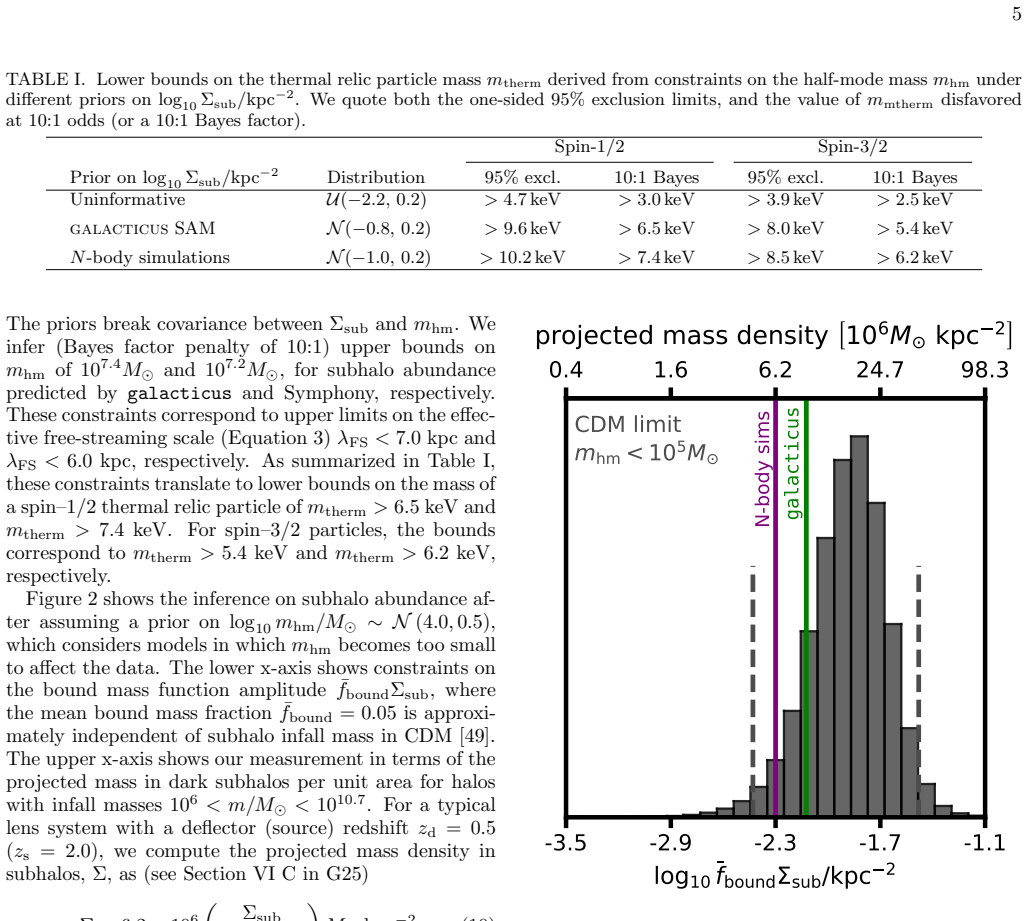
Simultaneous reconstruction of extended lensed arcs together with image positions and magnifications in 28 systems rules out deviations from cold dark matter subhalo abundance above 10^{7.2} and 10^{7.4} solar masses according to N-body simulations and semi-analytic models. These bounds translate to free-streaming lengths below 6.0 kpc and 7.0 kpc, and to lower limits on the mass of a spin-1/2 thermal relic particle of 7.4 keV and 6.5 keV. Assuming negligible free-streaming as in cold dark matter, the data yield a projected subhalo mass density of 1.7_{-1.2}^{+2.6} imes 10^7 solar masses per square kiloparsec around elliptical galaxies at 95 percent .
What carries the argument
Strong gravitational lensing perturbations from subhalos detected via joint reconstruction of arcs, positions, and magnifications in quadruple-image systems.
If this is right
- Warm dark matter models with free-streaming lengths above 6-7 kpc are excluded.
- The measured subhalo mass density around elliptical galaxies matches simulation expectations under cold dark matter.
- The data confirm that halo formation proceeds as predicted by cold dark matter down to 10^7 solar mass scales.
- The same lensing data set can be used to test other dark matter models that alter small-halo abundance.
Where Pith is reading between the lines
- Extending the sample beyond 28 systems would tighten the free-streaming bound further if the same reconstruction method holds.
- The lensing constraints could be combined with other probes such as Lyman-alpha forest or satellite counts to cross-check thermal relic mass limits.
- If baryonic feedback alters subhalo survival in real galaxies more than assumed, the reported particle mass bounds would shift.
Load-bearing premise
The number and spatial distribution of observable subhalos in the lens galaxies match the cited simulations without major baryonic or selection effects changing the perturbations.
What would settle it
A larger sample of lenses showing either substantially more or fewer small-scale image perturbations than the cold dark matter prediction, or a measured subhalo mass density inconsistent with the reported value.
Figures

read the original abstract
The formation of gravitationally bound overdensities of dark matter (DM), or \textit{halos}, is a generic prediction of theories with particle DM. We present a measurement of halo properties in 28 quadruple image strong lens systems recently observed by JWST, and use these observations to constrain the free-streaming length, $\lambda_{\rm{FS}}$, of DM, a quantity that depends on the DM particle mass and formation mechanism. We improve on previous lensing analyses by simultaneously reconstructing extended lensed arcs with image positions and relative magnifications, enhancing sensitivity to perturbations by halos. Our analysis rules out deviations from the predictions of cold dark matter (CDM) on scales above $10^{7.2} M_{\odot}$ and $10^{7.4} M_{\odot}$ for subhalo abundance predicted by cosmological $N$-body simulations and semi-analytic models, respectively. These bounds correspond to upper limits $\lambda_{\rm{FS}}<6.0 \ \rm{kpc}$ and $\lambda_{\rm{FS}}<7.0 \ \rm{kpc}$, and lower limits on the mass of a spin--1/2 thermal relic DM particle $m_{\rm{therm}}>7.4 \ \rm{keV}$ and $m_{\rm{therm}}>6.5 \ \rm{keV}$. Conversely, assuming a negligible free-streaming length, as predicted by CDM, we measure a projected mass in subhalos around elliptical galaxies $1.7_{-1.2}^{+2.6} \times 10^7 \ \mathrm{M}_{\odot} \ \rm{kpc^{-2}}$ at $95 \%$ confidence. These inferences confirm key predictions of the CDM paradigm.
Editorial analysis
A structured set of objections, weighed in public.
Referee Report
Summary. The manuscript analyzes JWST observations of 28 quadruple-image strong gravitational lens systems, using simultaneous reconstruction of extended arcs, image positions, and magnifications to measure subhalo perturbations. It derives upper limits on the dark matter free-streaming length (λ_FS < 6.0 kpc and < 7.0 kpc) and lower limits on thermal relic mass (m_therm > 7.4 keV and > 6.5 keV) by ruling out deviations from CDM-predicted subhalo abundances above 10^{7.2}–10^{7.4} M_⊙, while reporting a projected subhalo mass density of 1.7_{-1.2}^{+2.6} × 10^7 M_⊙ kpc^{-2} under the CDM assumption.
Significance. If the central assumptions hold, the result supplies competitive observational bounds on DM particle properties from strong lensing, using an improved reconstruction technique that enhances sensitivity to small-scale perturbations. The work credits the simultaneous fitting approach and the large JWST sample as advances over prior lensing analyses, and the reported subhalo mass density provides a direct, falsifiable test of CDM on sub-galactic scales.
major comments (3)
- [§4] §4 (comparison to N-body and semi-analytic models): The headline exclusion of λ_FS > 6–7 kpc rests on the observed perturbation statistics being fully consistent with CDM predictions from dark-matter-only simulations; no quantitative assessment is provided of how baryonic processes (tidal stripping, AGN feedback) in massive ellipticals would modify subhalo survival or central densities relative to the CDM–WDM difference.
- [§5] §5 (derivation of λ_FS and m_therm limits): The reported bounds are obtained by direct comparison to external simulation benchmarks rather than an internal derivation from the lens data; this makes the limits sensitive to the accuracy of those benchmarks for the specific sample of 28 massive ellipticals, without an explicit test of sample variance or selection effects.
- [Abstract and §3] Abstract and §3 (sample selection): The analysis assumes that the quadruple-image morphology selection does not introduce differential biases in perturbation detectability between CDM and WDM scenarios; no Monte Carlo test or comparison of line-of-sight vs. host properties is shown to support this.
minor comments (2)
- [Figure 3] Figure 3: The error bars on the projected mass density do not visibly separate statistical from systematic contributions; adding a breakdown would improve clarity.
- [§2] Notation: The symbol λ_FS is introduced without an explicit equation linking it to the particle mass for the spin-1/2 thermal relic case; a short definition in §2 would aid readers.
Simulated Author's Rebuttal
We thank the referee for their careful reading and valuable comments on our manuscript. We address each of the major comments below and have revised the manuscript accordingly to strengthen the presentation and address potential concerns.
read point-by-point responses
-
Referee: [§4] §4 (comparison to N-body and semi-analytic models): The headline exclusion of λ_FS > 6–7 kpc rests on the observed perturbation statistics being fully consistent with CDM predictions from dark-matter-only simulations; no quantitative assessment is provided of how baryonic processes (tidal stripping, AGN feedback) in massive ellipticals would modify subhalo survival or central densities relative to the CDM–WDM difference.
Authors: We agree that baryonic processes could in principle affect the comparison. However, the key point is that the difference between CDM and WDM subhalo populations is driven by the suppression of small-scale power in WDM, which occurs before baryonic effects become dominant. Recent hydrodynamical simulations of WDM show that the relative suppression due to baryons is not significantly different from CDM on the mass scales relevant here (>10^7 M_sun). We will add a dedicated paragraph in the revised §4 to discuss this and reference the relevant simulation literature. revision: yes
-
Referee: [§5] §5 (derivation of λ_FS and m_therm limits): The reported bounds are obtained by direct comparison to external simulation benchmarks rather than an internal derivation from the lens data; this makes the limits sensitive to the accuracy of those benchmarks for the specific sample of 28 massive ellipticals, without an explicit test of sample variance or selection effects.
Authors: The limits are indeed obtained by comparing the measured perturbation rate to the predictions from external N-body and semi-analytic models for varying free-streaming lengths. This is the established methodology for such constraints. Regarding sample variance, the use of 28 independent lens systems provides a statistical sample that averages over cosmic variance. We will expand §5 to include a brief discussion of how the sample selection from the JWST archive minimizes selection biases and note the consistency with previous lensing samples. revision: partial
-
Referee: [Abstract and §3] Abstract and §3 (sample selection): The analysis assumes that the quadruple-image morphology selection does not introduce differential biases in perturbation detectability between CDM and WDM scenarios; no Monte Carlo test or comparison of line-of-sight vs. host properties is shown to support this.
Authors: The selection criterion is the presence of four images, which depends on the overall lens potential and source position, not on the small-scale DM fluctuations that differ between CDM and WDM. Therefore, the detectability of perturbations should not be differentially biased. To make this explicit, we will include a short Monte Carlo simulation in the revised §3 demonstrating that the image multiplicity selection efficiency is insensitive to the DM model at the subhalo level. revision: yes
Circularity Check
No circularity: constraints derived from external simulation benchmarks
full rationale
The paper measures subhalo perturbations from JWST lensing data and compares the inferred abundance to independent predictions from cosmological N-body simulations and semi-analytic models (cited as external). The λ_FS upper limits and m_therm lower limits follow from the observed statistics being consistent with CDM predictions but inconsistent with WDM models that suppress small-scale structure; the CDM assumption is used only to report a mass density value under that hypothesis, not to derive the exclusion itself. No self-citation chain, self-definitional loop, fitted input renamed as prediction, or ansatz imported from prior author work appears in the derivation. The central result remains falsifiable against the external benchmarks.
Axiom & Free-Parameter Ledger
free parameters (1)
- projected subhalo mass density
axioms (1)
- domain assumption Subhalo abundance and distribution around elliptical galaxies match the cited cosmological N-body simulations and semi-analytic models
Forward citations
Cited by 1 Pith paper
-
A differentiable forward model for weakly perturbed stellar streams: substructure forecasts from density and kinematics spectra
A differentiable forward model for weakly perturbed stellar streams forecasts that adding kinematics to density spectra improves dark matter free-streaming cutoff precision from 1.2 dex to 0.25 dex for a 5 Gyr stream.
Reference graph
Works this paper leans on
-
[1]
We render halos in the mass range 106 −1010.7M⊙
to predict the density profile of each subhalo, which we model as a tidally truncated NFW profile [50, 51]. We render halos in the mass range 106 −1010.7M⊙. Ha- los less massive than 10 6M⊙ are too small to affect the data, while halos more massive than 10 10.7M⊙ host de- tectable galaxies, and we include these objects explicitly the lens model at their o...
-
[2]
This region is observed at low redshifts to be∼1–10 pc in size with little dependence on the quasar luminosity [26–28]
consists of observations of quadruply imaged quasars with MIRI targeting emission from the warm dust region surrounding the background quasar. This region is observed at low redshifts to be∼1–10 pc in size with little dependence on the quasar luminosity [26–28]. The warm dust region is compact enough to experience millilensing perturbations by halos, but ...
-
[3]
CAREER: An order of magnitude improvement in measurements of the physical properties of dark matter
and Keeleyet al.[30] describe the lens selection cri- teria for the survey, and detail the spectral energy dis- tribution fitting procedure used to separate warm dust emission from potentially microlensed emission emanat- ing from the more compact hot dust torus and quasar accretion disk. We supplement the 26 lenses observed by JWST with 2 systems that we...
2046
-
[4]
M. R. Buckley and A. H. G. Peter, Gravitational probes of dark matter physics, Phys. Rept.761, 1 (2018), arXiv:1712.06615 [astro-ph.CO]
Pith/arXiv arXiv 2018
-
[5]
K. K. Boddy, M. Lisanti, S. D. McDermott, N. L. Rodd, C. Weniger, Y. Ali-Ha¨ ımoud, M. Buschmann, I. Cho- lis, D. Croon, A. L. Erickcek, V. Gluscevic, R. K. Leane, S. Mishra-Sharma, J. B. Mu˜ noz, E. O. Nadler, P. Natara- jan, A. Price-Whelan, S. Vegetti, and S. J. Witte, Snow- mass2021 theory frontier white paper: Astrophysical and cosmological probes of...
arXiv 2022
-
[6]
A. Drlica-Wagner, C. Prescod-Weinstein, H.-B. Yu, A. Albert, M. Amin, A. Banerjee, M. Baryakhtar, K. Bechtol, S. Bird, S. Birrer, T. Bringmann, R. Caputo, S. Chakrabarti, T. Y. Chen, D. Croon, F.-Y. Cyr-Racine, W. A. Dawson, C. Dvorkin, V. Gluscevic, D. Gilman, D. Grin, R. Hloˇ zek, R. K. Leane, T. S. Li, Y.-Y. Mao, J. Meyers, S. Mishra-Sharma, J. B. Mu˜ ...
arXiv 2021
-
[7]
J. R. Bond and A. S. Szalay, The collisionless damping of density fluctuations in an expanding universe, ApJ274, 443 (1983)
1983
-
[8]
V. Avila-Reese, P. Col´ ın, O. Valenzuela, E. D’Onghia, and C. Firmani, Formation and Structure of Halos in a Warm Dark Matter Cosmology, ApJ559, 516 (2001), arXiv:astro-ph/0010525 [astro-ph]
Pith/arXiv arXiv 2001
-
[9]
P. Bode, J. P. Ostriker, and N. Turok, Halo Forma- tion in Warm Dark Matter Models, ApJ556, 93 (2001), arXiv:astro-ph/0010389 [astro-ph]. 4 http://www.astropy.org 5 https://github.com/lenstronomy/lenstronomy 6 https://github.com/dangilman/pyHalo 7 https://github.com/dangilman/trikde 8 https://github.com/dangilman/samana
Pith/arXiv arXiv 2001
-
[10]
A. Schneider, R. E. Smith, and D. Reed, Halo mass func- tion and the free streaming scale, MNRAS433, 1573 (2013), arXiv:1303.0839 [astro-ph.CO]
Pith/arXiv arXiv 2013
-
[11]
S. Bose, W. A. Hellwing, C. S. Frenk, A. Jenkins, M. R. Lovell, J. C. Helly, and B. Li, The Copernicus Complexio: statistical properties of warm dark matter haloes, MN- RAS455, 318 (2016), arXiv:1507.01998 [astro-ph.CO]
Pith/arXiv arXiv 2016
-
[12]
A. D. Ludlow, S. Bose, R. E. Angulo, L. Wang, W. A. Hellwing, J. F. Navarro, S. Cole, and C. S. Frenk, The mass-concentration-redshift relation of cold and warm dark matter haloes, MNRAS460, 1214 (2016), arXiv:1601.02624 [astro-ph.CO]
Pith/arXiv arXiv 2016
-
[13]
M. W. Auger, T. Treu, A. S. Bolton, R. Gavazzi, L. V. E. Koopmans, P. J. Marshall, L. A. Moustakas, and S. Burles, The Sloan Lens ACS Survey. X. Stellar, Dy- namical, and Total Mass Correlations of Massive Early- type Galaxies, ApJ724, 511 (2010), arXiv:1007.2880 [astro-ph.CO]
Pith/arXiv arXiv 2010
-
[14]
N. Dalal and C. S. Kochanek, Direct Detection of Cold Dark Matter Substructure, ApJ572, 25 (2002), arXiv:astro-ph/0111456 [astro-ph]
Pith/arXiv arXiv 2002
-
[15]
S. Vegetti, D. J. Lagattuta, J. P. McKean, M. W. Auger, C. D. Fassnacht, and L. V. E. Koopmans, Gravitational detection of a low-mass dark satellite galaxy at cosmo- logical distance, Nat481, 341 (2012), arXiv:1201.3643 [astro-ph.CO]
Pith/arXiv arXiv 2012
-
[16]
Y. D. Hezaveh, N. Dalal, D. P. Marrone, Y.-Y. Mao, W. Morningstar, D. Wen, R. D. Blandford, J. E. Carl- strom, C. D. Fassnacht, G. P. Holder, A. Kemball, P. J. Marshall, N. Murray, L. Perreault Levasseur, J. D. Vieira, and R. H. Wechsler, Detection of Lensing Sub- structure Using ALMA Observations of the Dusty Galaxy SDP.81, ApJ823, 37 (2016), arXiv:1601....
Pith/arXiv arXiv 2016
-
[17]
S. Birrer, A. Amara, and A. Refregier, Lensing sub- structure quantification in RXJ1131-1231: a 2 keV lower bound on dark matter thermal relic mass, JCAP2017, 037 (2017), arXiv:1702.00009 [astro-ph.CO]
Pith/arXiv arXiv 2017
-
[18]
G. Despali, S. Vegetti, S. D. M. White, C. Giocoli, and F. C. van den Bosch, Modelling the line-of-sight contribu- tion in substructure lensing, MNRAS475, 5424 (2018), arXiv:1710.05029 [astro-ph.CO]. 8
Pith/arXiv arXiv 2018
-
[19]
D. Gilman, S. Birrer, T. Treu, A. Nierenberg, and A. Ben- son, Probing dark matter structure down to 10 7 so- lar masses: flux ratio statistics in gravitational lenses with line-of-sight haloes, MNRAS487, 5721 (2019), arXiv:1901.11031 [astro-ph.CO]
Pith/arXiv arXiv 2019
-
[20]
D. Gilman, S. Birrer, A. Nierenberg, T. Treu, X. Du, and A. Benson, Warm dark matter chills out: con- straints on the halo mass function and the free-streaming length of dark matter with eight quadruple-image strong gravitational lenses, MNRAS491, 6077 (2020), arXiv:1908.06983 [astro-ph.CO]
arXiv 2020
-
[21]
J. W. Hsueh, W. Enzi, S. Vegetti, M. W. Auger, C. D. Fassnacht, G. Despali, L. V. E. Koopmans, and J. P. McKean, SHARP - VII. New constraints on the dark matter free-streaming properties and substructure abun- dance from gravitationally lensed quasars, MNRAS492, 3047 (2020), arXiv:1905.04182 [astro-ph.CO]
arXiv 2020
- [22]
-
[23]
D. Gilman, Y.-M. Zhong, and J. Bovy, Constrain- ing resonant dark matter self-interactions with strong gravitational lenses, PhysRevD107, 103008 (2023), arXiv:2207.13111 [astro-ph.CO]
arXiv 2023
-
[24]
D. M. Powell, J. P. McKean, S. Vegetti, C. Sp- ingola, S. D. M. White, and C. D. Fassnacht, A million-solar-mass object detected at a cosmological dis- tance using gravitational imaging, Nature Astronomy 10.1038/s41550-025-02651-2 (2025)
-
[25]
G. Dobler and C. R. Keeton, Finite source effects in strong lensing: implications for the substructure mass scale, MNRAS365, 1243 (2006), arXiv:astro-ph/0502436 [astro-ph]
Pith/arXiv arXiv 2006
- [26]
-
[27]
Wambsganss, Gravitational microlensing, arXiv e- prints , astro (2006), arXiv:astro-ph/0604278
J. Wambsganss, Gravitational microlensing, arXiv e- prints , astro (2006), arXiv:astro-ph/0604278
Pith/arXiv arXiv 2006
-
[28]
D. Sluse, M. Kishimoto, T. Anguita, O. Wucknitz, and J. Wambsganss, Mid-infrared microlensing of accretion disc and dusty torus in quasars: effects on flux ratio anomalies, AA553, A53 (2013), arXiv:1303.1176 [astro- ph.CO]
Pith/arXiv arXiv 2013
-
[29]
Burtscher, K
L. Burtscher, K. Meisenheimer, K. R. W. Tristram, W. Jaffe, S. F. H¨ onig, R. I. Davies, M. Kishimoto, J. U. Pott, H. R¨ ottgering, M. Schartmann, G. Weigelt, and S. Wolf, A diversity of dusty AGN tori. Data release for the VLTI/MIDI AGN Large Program and first results for 23 galaxies, Astronomy and Astrophysics558, A149 (2013)
2013
-
[30]
J. H. Leftley, S. F. H¨ onig, D. Asmus, K. R. W. Tris- tram, P. Gandhi, M. Kishimoto, M. Venanzi, and D. J. Williamson, Parsec-scale Dusty Winds in Active Galac- tic Nuclei: Evidence for Radiation Pressure Driving, ApJ 886, 55 (2019)
2019
-
[31]
S. F. H¨ onig, Redefining the Torus: A Unifying View of AGNs in the Infrared and Submillimeter, ApJ884, 171 (2019)
2019
-
[32]
A. M. Nierenberg, R. E. Keeley, D. Sluse, D. Gilman, S. Birrer, T. Treu, K. N. Abazajian, T. Anguita, A. J. Benson, V. N. Bennert, S. G. Djorgovski, X. Du, C. D. Fassnacht, S. F. Hoenig, A. Kusenko, C. Lemon, M. Malkan, V. Motta, L. A. Moustakas, D. Stern, and R. H. Wechsler, JWST lensed quasar dark matter sur- vey - I. Description and first results, MNRA...
arXiv 2024
-
[33]
R. E. Keeley, A. M. Nierenberg, D. Gilman, T. Treu, X. Du, C. Gannon, P. Mozumdar, K. C. Wong, H. Paug- nat, S. Birrer, M. Malkan, A. J. Benson, K. N. Abaza- jian, T. Anguita, V. N. Bennert, S. G. Djorgovski, S. F. Hoenig, A. Kusenko, H. R. Larsson, T. Mor- ishita, V. Motta, L. A. Moustakas, W. Sheu, D. Sluse, D. Stern, M. Stiavelli, and D. Williams, JWST...
arXiv 2025
-
[34]
D. Gilman, A. M. Nierenberg, T. Treu, C. Gannon, X. Du, H. Paugnat, S. Birrer, A. J. Benson, P. Mozum- dar, K. C. Wong, D. Williams, R. E. Keeley, K. N. Abazajian, T. Anguita, V. N. Bennert, S. G. Djorgov- ski, S. H. Hoenig, A. Kusenko, M. Malkan, T. Mor- ishita, V. Motta, L. A. Moustakas, W. Sheu, D. Sluse, D. Stern, and M. Stiavelli, JWST lensed quasar ...
Pith/arXiv arXiv 2025
-
[35]
M. Viel, J. Lesgourgues, M. G. Haehnelt, S. Matarrese, and A. Riotto, Constraining warm dark matter candi- dates including sterile neutrinos and light gravitinos with WMAP and the Lyman-αforest, PhysRevD71, 063534 (2005), arXiv:astro-ph/0501562 [astro-ph]
Pith/arXiv arXiv 2005
-
[36]
E. W. Kolb and M. S. Turner,The early universe, Vol. 69 (1990)
1990
-
[37]
Planck Collaboration, N. Aghanim, Y. Akrami, M. Ash- down, J. Aumont, C. Baccigalupi, M. Ballardini, A. J. Banday, R. B. Barreiro, N. Bartolo, S. Basak, R. Battye, K. Benabed, J. P. Bernard, M. Bersanelli, P. Bielewicz, J. J. Bock, J. R. Bond, J. Borrill, F. R. Bouchet, F. Boulanger, M. Bucher, C. Burigana, R. C. Butler, E. Calabrese, J. F. Cardoso, J. Ca...
Pith/arXiv arXiv 2018
-
[38]
C. M. Vogel and K. N. Abazajian, Entering the era of measuring sub-Galactic dark matter structure: Accurate transfer functions for axino, gravitino, and sterile neu- trino thermal warm dark matter, PhysRevD108, 043520 (2023), arXiv:2210.10753 [hep-ph]
arXiv 2023
-
[39]
A. Kusenko, Sterile neutrinos, dark matter, and the pul- sar velocities in models with a Higgs singlet, Phys. Rev. Lett.97, 241301 (2006), arXiv:hep-ph/0609081
Pith/arXiv arXiv 2006
-
[40]
K. Petraki and A. Kusenko, Dark-matter sterile neutrinos in models with a gauge singlet in the Higgs sector, Phys. Rev. D77, 065014 (2008), arXiv:0711.4646 [hep-ph]
Pith/arXiv arXiv 2008
-
[41]
K. Petraki, Small-scale structure formation properties of chilled sterile neutrinos as dark matter, Phys. Rev. D77, 105004 (2008), arXiv:0801.3470 [hep-ph]
Pith/arXiv arXiv 2008
-
[42]
Kusenko, Sterile neutrinos: The Dark side of the light fermions, Phys
A. Kusenko, Sterile neutrinos: The Dark side of the light fermions, Phys. Rept.481, 1 (2009), arXiv:0906.2968 [hep-ph]
Pith/arXiv arXiv 2009
-
[43]
K. N. Abazajian and A. Kusenko, Hidden treasures: Ster- ile neutrinos as dark matter with miraculous abundance, structure formation for different production mechanisms, and a solution to theσ 8 problem, Phys. Rev. D100, 103513 (2019), arXiv:1907.11696 [hep-ph]
arXiv 2019
-
[44]
I. A. Zelko, T. Treu, K. N. Abazajian, D. Gilman, A. J. Benson, S. Birrer, A. M. Nierenberg, and A. Kusenko, Constraints on Sterile Neutrino Models from Strong Gravitational Lensing, Milky Way Satellites, and the Lyman-αForest, Phys. Rev. Lett.129, 191301 (2022), arXiv:2205.09777 [hep-ph]
arXiv 2022
-
[45]
J. St¨ ucker, R. E. Angulo, O. Hahn, and S. D. M. White, Simulating the complexity of the dark matter sheet - II. Halo and subhalo mass functions for non-cold dark mat- ter models, MNRAS509, 1703 (2022), arXiv:2109.09760 [astro-ph.CO]
arXiv 2022
-
[46]
M. R. Lovell, Toward a General Parameterization of the Warm Dark Matter Halo Mass Function, ApJ897, 147 (2020), arXiv:2003.01125 [astro-ph.CO]
arXiv 2020
-
[47]
B. Diemer and M. Joyce, An Accurate Physical Model for Halo Concentrations, ApJ871, 168 (2019), arXiv:1809.07326 [astro-ph.CO]
Pith/arXiv arXiv 2019
-
[48]
J. F. Navarro, C. S. Frenk, and S. D. M. White, A Uni- versal Density Profile from Hierarchical Clustering, ApJ 490, 493 (1997), arXiv:astro-ph/9611107 [astro-ph]
Pith/arXiv arXiv 1997
-
[49]
R. K. Sheth, H. J. Mo, and G. Tormen, Ellipsoidal col- lapse and an improved model for the number and spa- tial distribution of dark matter haloes, MNRAS323, 1 (2001), arXiv:astro-ph/9907024 [astro-ph]
Pith/arXiv arXiv 2001
- [50]
- [51]
-
[52]
X. Du, D. Gilman, T. Treu, A. Benson, and C. Gan- non, Empirical model for the tidal evolution of dark matter substructure around strong gravitational lenses, PhysRevD112, 023009 (2025), arXiv:2503.07728 [astro- ph.CO]
arXiv 2025
-
[53]
E. A. Baltz, P. Marshall, and M. Oguri, Analytic models of plausible gravitational lens potentials, JCAP2009, 015 (2009), arXiv:0705.0682 [astro-ph]
Pith/arXiv arXiv 2009
-
[54]
X. Du, A. Benson, Z. C. Zeng, T. Treu, A. H. G. Pe- ter, C. Mace, F. Jiang, S. Yang, C. Gannon, D. Gilman, A. M. Nierenberg, and E. O. Nadler, Tidal evolution of cored and cuspy dark matter halos, PhysRevD110, 023019 (2024), arXiv:2403.09597 [astro-ph.GA]
arXiv 2024
-
[55]
A. M. Nierenberg, T. Treu, S. A. Wright, C. D. Fass- nacht, and M. W. Auger, Detection of substructure with adaptive optics integral field spectroscopy of the grav- itational lens B1422+231, MNRAS442, 2434 (2014), arXiv:1402.1496 [astro-ph.GA]
Pith/arXiv arXiv 2014
-
[56]
A. M. Nierenberg, D. Gilman, T. Treu, G. Brammer, S. Birrer, L. Moustakas, A. Agnello, T. Anguita, C. D. Fassnacht, V. Motta, A. H. G. Peter, and D. Sluse, Dou- ble dark matter vision: twice the number of compact- source lenses with narrow-line lensing and the WFC3 grism, MNRAS492, 5314 (2020), arXiv:1908.06344 [astro-ph.GA]
arXiv 2020
-
[57]
L. A. Moustakas and R. B. Metcalf, Detecting dark mat- ter substructure spectroscopically in strong gravitational lenses, MNRAS339, 607 (2003), arXiv:astro-ph/0206176 [astro-ph]
Pith/arXiv arXiv 2003
-
[58]
F. M¨ uller-S´ anchez, M. A. Prieto, E. K. S. Hicks, H. Vives- Arias, R. I. Davies, M. Malkan, L. J. Tacconi, and R. Genzel, Outflows from Active Galactic Nuclei: Kine- matics of the Narrow-line and Coronal-line Regions in Seyfert Galaxies, ApJ739, 69 (2011), arXiv:1107.3140 [astro-ph.CO]
Pith/arXiv arXiv 2011
-
[59]
A. M. Nierenberg, T. Treu, G. Brammer, A. H. G. Pe- ter, C. D. Fassnacht, C. R. Keeton, C. S. Kochanek, K. B. Schmidt, D. Sluse, and S. A. Wright, Probing dark matter substructure in the gravitational lens HE 0435- 1223 with the WFC3 grism, MNRAS471, 2224 (2017), arXiv:1701.05188 [astro-ph.CO]
Pith/arXiv arXiv 2017
-
[60]
Bender, S
R. Bender, S. Doebereiner, and C. Moellenhoff, Isophote shapes of elliptical galaxies. I. The data., AAPS74, 385 (1988)
1988
-
[61]
R. Gavazzi, T. Treu, J. D. Rhodes, L. V. E. Koopmans, A. S. Bolton, S. Burles, R. J. Massey, and L. A. Mous- takas, The Sloan Lens ACS Survey. IV. The Mass Density Profile of Early-Type Galaxies out to 100 Effective Radii, ApJ667, 176 (2007), arXiv:astro-ph/0701589 [astro-ph]
Pith/arXiv arXiv 2007
-
[62]
M. S. H. Oh, A. Nierenberg, D. Gilman, and S. Bir- rer, Joint Semi-Analytic Multipole Priors from Galaxy Isophotes and Constraints from Lensed Arcs, arXiv e-prints , arXiv:2404.17124 (2024), arXiv:2404.17124 [astro-ph.CO]. 10
arXiv 2024
-
[63]
H. Paugnat, T. Treu, and D. Gilman, Macromodel- free flux-ratio prediction in quadruply imaged quasars with local constraints from lensed arcs, arXiv e-prints , arXiv:2509.05416 (2025), arXiv:2509.05416 [astro- ph.CO]
arXiv 2025
-
[64]
C. S. Trotter, J. N. Winn, and J. N. Hewitt, A Multipole- Taylor Expansion for the Potential of the Gravitational Lens MG J0414+0534, ApJ535, 671 (2000), arXiv:astro- ph/0001022 [astro-ph]
arXiv 2000
-
[65]
A. B. Congdon and C. R. Keeton, Multipole models of four-image gravitational lenses with anomalous flux ra- tios, MNRAS364, 1459 (2005), arXiv:astro-ph/0510232 [astro-ph]
Pith/arXiv arXiv 2005
-
[66]
J. S. Cohen, C. D. Fassnacht, C. M. O’Riordan, and S. Vegetti, General multipoles and their implications for dark matter inference, MNRAS531, 3431 (2024), arXiv:2403.08895 [astro-ph.CO]
arXiv 2024
- [67]
-
[68]
V. Springel, J. Wang, M. Vogelsberger, A. Ludlow, A. Jenkins, A. Helmi, J. F. Navarro, C. S. Frenk, and S. D. M. White, The Aquarius Project: the sub- haloes of galactic haloes, MNRAS391, 1685 (2008), arXiv:0809.0898 [astro-ph]
Pith/arXiv arXiv 2008
-
[69]
D. Fiacconi, P. Madau, D. Potter, and J. Stadel, Cold Dark Matter Substructures in Early-type Galaxy Halos, ApJ824, 144 (2016), arXiv:1602.03526 [astro-ph.GA]
Pith/arXiv arXiv 2016
-
[70]
A. J. Benson, The normalization and slope of the dark matter (sub-)halo mass function on sub-galactic scales, MNRAS493, 1268 (2020), arXiv:1911.04579 [astro- ph.GA]
arXiv 2020
-
[71]
E. O. Nadler, P. Mansfield, Y. Wang, X. Du, S. Ad- hikari, A. Banerjee, A. Benson, E. Darragh-Ford, Y.- Y. Mao, S. Wagner-Carena, R. H. Wechsler, and H.-Y. Wu, Symphony: Cosmological Zoom-in Simulation Suites over Four Decades of Host Halo Mass, ApJ945, 159 (2023), arXiv:2209.02675 [astro-ph.CO]
arXiv 2023
- [72]
-
[73]
S. Birrer and A. Amara, lenstronomy: Multi-purpose gravitational lens modelling software package, Physics of the Dark Universe22, 189 (2018), arXiv:1803.09746 [astro-ph.CO]
Pith/arXiv arXiv 2018
-
[74]
S. Birrer, A. Shajib, D. Gilman, A. Galan, J. Aalbers, M. Millon, R. Morgan, G. Pagano, J. Park, L. Teodori, N. Tessore, M. Ueland, L. Van de Vyvere, S. Wagner- Carena, E. Wempe, L. Yang, X. Ding, T. Schmidt, D. Sluse, M. Zhang, and A. Amara, lenstronomy II: A gravitational lensing software ecosystem, The Journal of Open Source Software6, 3283 (2021), arX...
arXiv 2021
-
[75]
A. J. Benson, G ALACTICUS: A semi-analytic model of galaxy formation, NewA17, 175 (2012), arXiv:1008.1786 [astro-ph.CO]
Pith/arXiv arXiv 2012
-
[76]
M. Oguri and P. J. Marshall, Gravitationally lensed quasars and supernovae in future wide-field optical imag- ing surveys, MNRAS405, 2579 (2010), arXiv:1001.2037 [astro-ph.CO]
Pith/arXiv arXiv 2010
-
[77]
A. J. Shajib, G. P. Smith, S. Birrer, A. Verma, N. Arendse, T. Collett, T. Daylan, S. Serjeant, and LSST Strong Lensing Science Collaboration, Strong gravita- tional lenses from the Vera C. Rubin Observatory, Philo- sophical Transactions of the Royal Society of London Series A383, 20240117 (2025), arXiv:2406.08919 [astro- ph.CO]
arXiv 2025
-
[78]
W. J. R. Enzi, C. M. Krawczyk, D. J. Ballard, and T. E. Collett, The overconcentrated dark halo in the strong lens SDSS J0946 + 1006 is a subhalo: evidence for self-interacting dark matter?, MNRAS540, 247 (2025), arXiv:2411.08565 [astro-ph.CO]
arXiv 2025
-
[79]
A. R. Zentner and J. S. Bullock, Halo Substructure and the Power Spectrum, ApJ598, 49 (2003), arXiv:astro- ph/0304292 [astro-ph]
arXiv 2003
-
[80]
E. O. Nadler, V. Gluscevic, and A. Benson, The Effects of Linear Matter Power Spectrum Enhancement on Dark Matter Substructure, arXiv e-prints , arXiv:2507.16889 (2025), arXiv:2507.16889 [astro-ph.CO]
arXiv 2025
discussion (0)
Sign in with ORCID, Apple, or X to comment. Anyone can read and Pith papers without signing in.