Metal-Poor Gas Accretion Drives Giant Clump Formation at 0.6 < z < 2.6
Pith reviewed 2026-06-28 05:11 UTC · model grok-4.3
The pith
Clumpy galaxies at cosmic noon form when metal-poor gas accretes and dilutes their metallicities.
A machine-rendered reading of the paper's core claim, the machinery that carries it, and where it could break.
Core claim
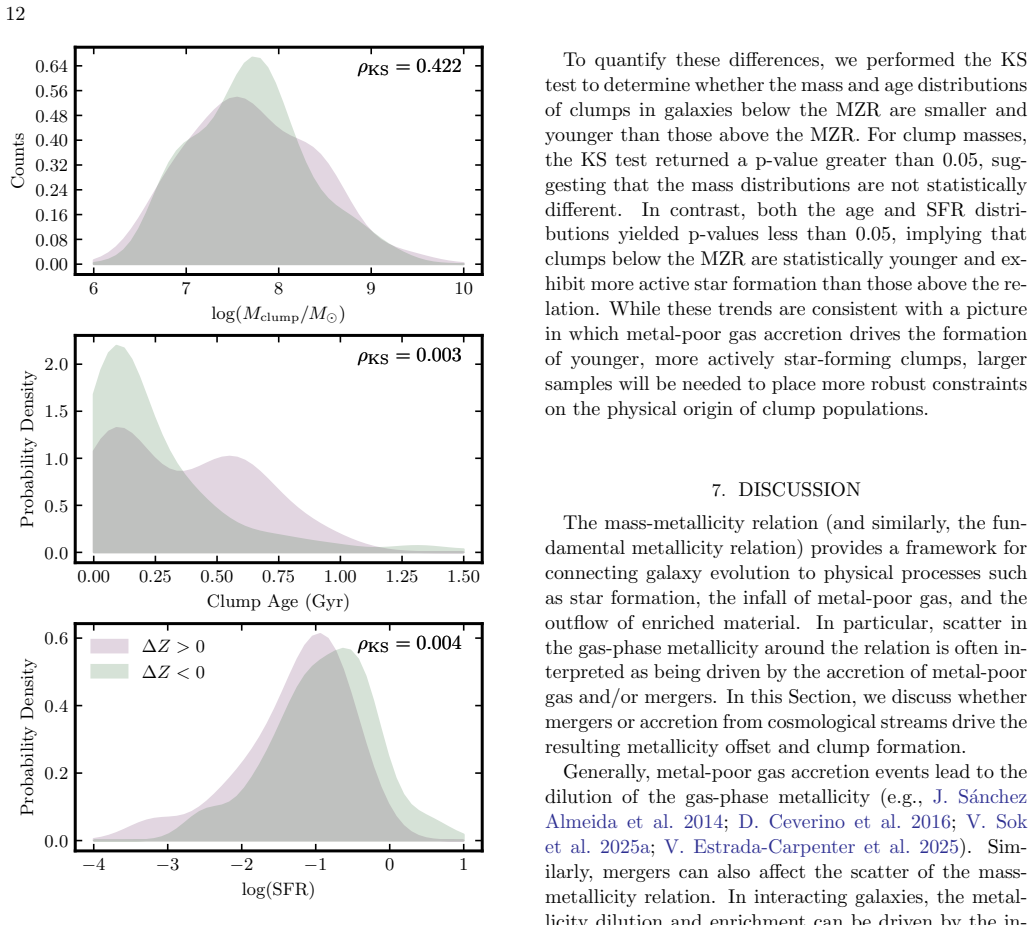
In a sample of ~300 SFGs observed with LEGA-C, MOSDEF and CANUCS, clumpy galaxies generally lie below the mass-metallicity relation while non-clumpy galaxies lie above it. Clumps whose host galaxies have ΔZ ≤ 0 are younger and have higher SFRs than clumps whose hosts have ΔZ > 0, with no significant mass difference between the two populations. The majority of clumpy galaxies are not classified as mergers by Gini-M20 parameters on stellar mass maps. The results indicate that the clumpy nature of cosmic noon galaxies is linked to metal-poor gas accretion events that trigger star formation and dilute metallicities.
What carries the argument
The metallicity offset ΔZ relative to the mass-metallicity relation, which tracks whether a galaxy's integrated gas is diluted by recent metal-poor accretion and correlates with the age and SFR of its resolved clumps.
If this is right
- Giant clump formation at these redshifts is driven primarily by external gas supply rather than major mergers.
- Metallicity dilution serves as an observable signature of the accretion events that build clumps.
- The scatter in the high-redshift mass-metallicity relation partly reflects recent accretion history.
- Clump properties can be used to identify galaxies that have recently accreted metal-poor gas.
Where Pith is reading between the lines
- Models of galaxy assembly at cosmic noon should include episodic metal-poor inflows to reproduce the observed clump statistics and metallicity offsets.
- Deep HI or CO mapping of the same galaxies could test whether low-metallicity clumpy systems show higher neutral gas fractions.
- If the pattern holds at higher redshift, the same accretion mechanism may explain the even clumpier appearance of galaxies at z > 3.
Load-bearing premise
The observed metallicity offset below the mass-metallicity relation is produced by recent metal-poor gas accretion rather than differences in star-formation efficiency, outflow loading, or selection effects in the samples.
What would settle it
A direct measurement showing that clumpy galaxies below the mass-metallicity relation lack enhanced gas inflow rates or HI reservoirs compared with non-clumpy galaxies at the same mass and redshift would falsify the accretion interpretation.
Figures



read the original abstract
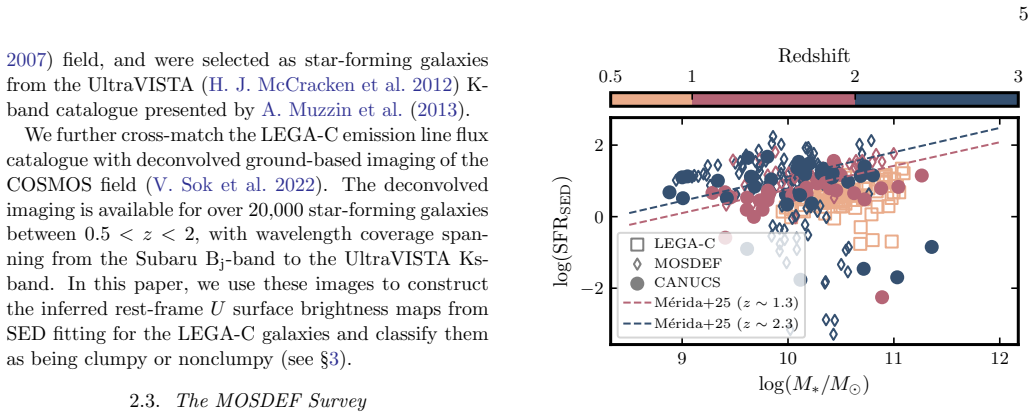
The physical properties of kiloparsec-scale clumps in high-redshift star-forming galaxies (SFGs) contain crucial constraints on how they assemble. Building on recent work that indicates the presence of a metallicity offset in clumpy galaxies compared to nonclumpy SFGs, we analyze the chemical abundance in a large sample of ${\sim}300$ SFGs between $0.6<z<2.6$ using LEGA-C, MOSDEF and CANUCS near-infrared spectroscopic observations. We find that clumpy galaxies generally have lower gas-phase metallcities compared to the mass-metallicity relation, while nonclumpy galaxies have higher metallicities. We further investigate the relationship between the resolved stellar properties of clumps and the integrated gas-phase metallicity of the host galaxies using a subset of galaxies observed in the CANUCS fields. In particular, clumps in SFGs with metallicity below the mass-metallicity relation (i.e., $\Delta Z \leq 0$) are generally younger and have higher SFRs, compared to clumps whose host galaxies have $\Delta Z > 0$. We do not find a significant mass difference between these two clump populations. Finally, we compute the merger statistic using the Gini-M20 morphological parameters and find that the majority of clumpy galaxies are not classified as mergers based on their stellar mass maps. The results suggest that the clumpy nature of cosmic noon galaxies is linked to metal-poor gas accretion events that trigger star formation and dilute metallicities.
Editorial analysis
A structured set of objections, weighed in public.
Referee Report
Summary. The manuscript analyzes gas-phase metallicities in a sample of approximately 300 star-forming galaxies at 0.6 < z < 2.6 using LEGA-C, MOSDEF, and CANUCS near-IR spectroscopy. It reports that clumpy galaxies generally lie below the mass-metallicity relation while non-clumpy galaxies lie above it. In the CANUCS resolved subset, clumps hosted by galaxies with ΔZ ≤ 0 are younger and have higher SFRs than those in ΔZ > 0 hosts, with no significant mass difference. Gini-M20 morphological analysis indicates that the majority of clumpy galaxies are not classified as mergers. The authors conclude that the clumpy nature of cosmic-noon galaxies is linked to metal-poor gas accretion events that trigger star formation and dilute metallicities.
Significance. If the reported correlations hold after addressing methodological details, the work would offer useful observational constraints on the connection between clump formation, metallicity offsets, and non-merger morphologies at cosmic noon. The multi-survey sample size and inclusion of resolved clump properties are positive features that could help distinguish accretion-driven from merger-driven clump formation scenarios in galaxy evolution models.
major comments (3)
- [Abstract] Abstract and central interpretation: The claim that the observed ΔZ ≤ 0 offset in clumpy galaxies is produced by metal-poor accretion is presented as the driving mechanism, yet the manuscript provides no quantitative comparison to alternative channels (e.g., variations in outflow loading factors or star-formation efficiency) that could generate the same metallicity offset, younger clumps, and higher SFRs; this leaves the causal link as an untested interpretation rather than a demonstrated result.
- [Results (resolved CANUCS subset)] Resolved subset analysis: The reported differences in clump age and SFR between ΔZ ≤ 0 and ΔZ > 0 hosts depend on clump identification thresholds and derived stellar properties, but without explicit details on how these thresholds were chosen or how systematics in age/SFR estimates were controlled, it is unclear whether the differences are robust or could arise from selection effects in the CANUCS data.
- [Morphological analysis] Morphological classification: The Gini-M20 analysis concludes that most clumpy galaxies are non-mergers, but the manuscript does not specify the exact parameter cuts, calibration against simulations, or application to stellar mass maps versus light maps, which is load-bearing for the claim that accretion (rather than mergers) drives the observed clump population.
minor comments (2)
- [Abstract] The abstract introduces ΔZ without an explicit equation or definition, although the context (offset from the mass-metallicity relation) is inferable.
- [Abstract] The exact number of galaxies in the resolved CANUCS subset and the breakdown by survey are not stated in the abstract, which would aid assessment of statistical power.
Simulated Author's Rebuttal
We thank the referee for their thoughtful comments on our manuscript. We address each of the major comments below and indicate the revisions made to the manuscript.
read point-by-point responses
-
Referee: [Abstract] Abstract and central interpretation: The claim that the observed ΔZ ≤ 0 offset in clumpy galaxies is produced by metal-poor accretion is presented as the driving mechanism, yet the manuscript provides no quantitative comparison to alternative channels (e.g., variations in outflow loading factors or star-formation efficiency) that could generate the same metallicity offset, younger clumps, and higher SFRs; this leaves the causal link as an untested interpretation rather than a demonstrated result.
Authors: We agree that the interpretation of metal-poor gas accretion as the driver is based on the observed correlations rather than a quantitative exclusion of alternatives. In the revised manuscript, we have added a paragraph in the discussion section addressing possible alternative explanations, such as variations in outflow loading factors or star-formation efficiency. We have also revised the abstract to more clearly frame the conclusion as a suggested link rather than a definitive demonstration. A full quantitative comparison would require additional modeling not possible with the present data. revision: partial
-
Referee: [Results (resolved CANUCS subset)] Resolved subset analysis: The reported differences in clump age and SFR between ΔZ ≤ 0 and ΔZ > 0 hosts depend on clump identification thresholds and derived stellar properties, but without explicit details on how these thresholds were chosen or how systematics in age/SFR estimates were controlled, it is unclear whether the differences are robust or could arise from selection effects in the CANUCS data.
Authors: We have revised the methods section to provide explicit details on the clump identification thresholds used in the CANUCS imaging data and the criteria for selecting clumps. Additionally, we have included an analysis of potential systematics in the stellar age and SFR estimates, such as the impact of different star formation histories and dust attenuation assumptions, to demonstrate the robustness of the reported differences. revision: yes
-
Referee: [Morphological analysis] Morphological classification: The Gini-M20 analysis concludes that most clumpy galaxies are non-mergers, but the manuscript does not specify the exact parameter cuts, calibration against simulations, or application to stellar mass maps versus light maps, which is load-bearing for the claim that accretion (rather than mergers) drives the observed clump population.
Authors: The revised manuscript now specifies the exact Gini-M20 parameter cuts employed for merger classification, references the calibration against hydrodynamic simulations, and clarifies that the analysis was performed on stellar mass maps rather than light maps. These additions ensure the morphological results are presented with full methodological transparency. revision: yes
Circularity Check
No significant circularity; observational correlations are self-contained
full rationale
The paper reports empirical measurements from LEGA-C, MOSDEF, and CANUCS spectroscopy: clumpy galaxies show lower gas-phase metallicities relative to the mass-metallicity relation, clumps in ΔZ ≤ 0 hosts are younger with higher SFRs, and Gini-M20 statistics indicate most clumpy systems are non-mergers. The suggestion that these patterns link to metal-poor accretion is an interpretive inference from the correlations, not a derivation that reduces by construction to fitted inputs, self-definitions, or load-bearing self-citations. No equations, parameters, or uniqueness theorems are invoked that collapse the central claim to its own assumptions.
Axiom & Free-Parameter Ledger
axioms (2)
- domain assumption Gas-phase metallicity derived from strong-line ratios accurately reflects the oxygen abundance of the ionized gas.
- domain assumption Gini-M20 parameters measured on stellar-mass maps correctly identify major mergers.
Reference graph
Works this paper leans on
-
[1]
2021, ApJS, 254, 15, doi: 10.3847/1538-4365/abebe2
Abdurro’uf, Lin, Y.-T., Wu, P.-F., & Akiyama, M. 2021, ApJS, 254, 15, doi: 10.3847/1538-4365/abebe2
-
[2]
Adamo, A., Bradley, L. D., Vanzella, E., et al. 2024, Nature, 632, 513, doi: 10.1038/s41586-024-07703-7
-
[3]
2024, A&A, 687, A115, doi: 10.1051/0004-6361/202449925 Bradaˇ c, M., Judeˇ z, J., Willott, C., et al
Bacchini, C., Nipoti, C., Iorio, G., et al. 2024, A&A, 687, A115, doi: 10.1051/0004-6361/202449925 Bradaˇ c, M., Judeˇ z, J., Willott, C., et al. 2025, arXiv e-prints, arXiv:2509.20446, doi: 10.48550/arXiv.2509.20446
-
[4]
Brammer, G. B., van Dokkum, P. G., & Coppi, P. 2008, ApJ, 686, 1503, doi: 10.1086/591786
work page internal anchor Pith review doi:10.1086/591786 2008
-
[5]
Brammer, G. B., van Dokkum, P. G., Franx, M., et al. 2012, ApJS, 200, 13, doi: 10.1088/0067-0049/200/2/13
-
[6]
Bustamante, S., Ellison, S. L., Patton, D. R., & Sparre, M. 2020, MNRAS, 494, 3469, doi: 10.1093/mnras/staa1025
-
[7]
Bustamante, S., Sparre, M., Springel, V., & Grand, R. J. J. 2018, MNRAS, 479, 3381, doi: 10.1093/mnras/sty1692 Calabr` o, A., Daddi, E., Fensch, J., et al. 2019, A&A, 632, A98, doi: 10.1051/0004-6361/201935778
-
[8]
The Dust Content and Opacity of Actively Star-Forming Galaxies
Calzetti, D., Armus, L., Bohlin, R. C., et al. 2000, ApJ, 533, 682, doi: 10.1086/308692
work page internal anchor Pith review doi:10.1086/308692 2000
-
[9]
2003, MNRAS, 344, 1000, doi: 10.1046/j.1365-8711.2003.06897.x
Cappellari, M., & Copin, Y. 2003, MNRAS, 342, 345, doi: 10.1046/j.1365-8711.2003.06541.x
-
[10]
2016, MNRAS, 457, 2605, doi: 10.1093/mnras/stw064
Ceverino, D., S´ anchez Almeida, J., Mu˜ noz Tu˜ n´ on, C., et al. 2016, MNRAS, 457, 2605, doi: 10.1093/mnras/stw064
-
[11]
2003, PASP, 115, 763, doi: 10.1086/376392
Chabrier, G. 2003, PASP, 115, 763, doi: 10.1086/376392
work page internal anchor Pith review doi:10.1086/376392 2003
-
[12]
Chugunov, I. V., & Marchuk, A. A. 2026, MNRAS, doi: 10.1093/mnras/stag940 Cid Fernandes, R., Stasi´ nska, G., Schlickmann, M. S., et al. 2010, MNRAS, 403, 1036, doi: 10.1111/j.1365-2966.2009.16185.x Cid Fernandes, R., P´ erez, E., Garc´ ıa Benito, R., et al. 2013, A&A, 557, A86, doi: 10.1051/0004-6361/201220616
-
[13]
2025, MNRAS, 537, 2535, doi: 10.1093/mnras/staf058
Claeyssens, A., Adamo, A., Messa, M., et al. 2025, MNRAS, 537, 2535, doi: 10.1093/mnras/staf058
-
[14]
2023, MNRAS, 520, 2180, doi: 10.1093/mnras/stac3791
Claeyssens, A., Adamo, A., Richard, J., et al. 2023, MNRAS, 520, 2180, doi: 10.1093/mnras/stac3791
-
[15]
2020, MNRAS, 491, 944, doi: 10.1093/mnras/stz2910
Curti, M., Mannucci, F., Cresci, G., & Maiolino, R. 2020, MNRAS, 491, 944, doi: 10.1093/mnras/stz2910
-
[16]
The Fraction of Clumpy Galaxies in JADES Over $2<z<9$
Davis, M., Guhathakurta, P., Konidaris, N. P., et al. 2007, ApJL, 660, L1, doi: 10.1086/517931 de la Vega, A., Mobasher, B., Manesh, F., et al. 2025, arXiv e-prints, arXiv:2508.14972. https://arxiv.org/abs/2508.14972
work page internal anchor Pith review Pith/arXiv arXiv doi:10.1086/517931 2007
-
[17]
2009a, ApJ, 703, 785, doi: 10.1088/0004-637X/703/1/785
Dekel, A., Sari, R., & Ceverino, D. 2009a, ApJ, 703, 785, doi: 10.1088/0004-637X/703/1/785
-
[18]
Cold streams in early massive hot haloes as the main mode of galaxy formation
Dekel, A., Birnboim, Y., Engel, G., et al. 2009b, Nature, 457, 451, doi: 10.1038/nature07648
work page internal anchor Pith review doi:10.1038/nature07648
-
[19]
2025, arXiv e-prints, arXiv:2508.00985, doi: 10.48550/arXiv.2508.00985
Estrada-Carpenter, V., Sawicki, M., Abraham, R., et al. 2025, arXiv e-prints, arXiv:2508.00985, doi: 10.48550/arXiv.2508.00985
-
[20]
L., Yang, L., Brinch, M., et al
Faisst, A. L., Yang, L., Brinch, M., et al. 2025, ApJ, 980, 204, doi: 10.3847/1538-4357/ada566
-
[21]
2021, MNRAS, 505, 3579, doi: 10.1093/mnras/stab1489 F¨ orster Schreiber, N
Fensch, J., & Bournaud, F. 2021, MNRAS, 505, 3579, doi: 10.1093/mnras/stab1489 F¨ orster Schreiber, N. M., Shapley, A. E., Genzel, R., et al. 2011, ApJ, 739, 45, doi: 10.1088/0004-637X/739/1/45 15
-
[22]
2025, Nature Astronomy, doi: 10.1038/s41550-025-02592-w
Fujimoto, S., Ouchi, M., Kohno, K., et al. 2025, Nature Astronomy, doi: 10.1038/s41550-025-02592-w
-
[23]
2011, ApJ, 733, 101, doi: 10.1088/0004-637X/733/2/101
Genzel, R., Newman, S., Jones, T., et al. 2011, ApJ, 733, 101, doi: 10.1088/0004-637X/733/2/101
-
[24]
The Great Observatories Origins Deep Survey: Initial Results From Optical and Near-Infrared Imaging
Giavalisco, M., Ferguson, H. C., Koekemoer, A. M., et al. 2004, ApJL, 600, L93, doi: 10.1086/379232
work page internal anchor Pith review doi:10.1086/379232 2004
-
[25]
2018, A&A, 619, A15, doi: 10.1051/0004-6361/201833533
Girard, M., Dessauges-Zavadsky, M., Schaerer, D., et al. 2018, A&A, 619, A15, doi: 10.1051/0004-6361/201833533
-
[26]
Grogin, N. A., Kocevski, D. D., Faber, S. M., et al. 2011, ApJS, 197, 35, doi: 10.1088/0067-0049/197/2/35 Grønnow, A. E., Finlator, K., & Christensen, L. 2015, MNRAS, 451, 4005, doi: 10.1093/mnras/stv1232
-
[27]
Koekemoer, A. M. 2012, ApJ, 757, 120, doi: 10.1088/0004-637X/757/2/120
-
[28]
Guo, Y., Ferguson, H. C., Bell, E. F., et al. 2015, ApJ, 800, 39, doi: 10.1088/0004-637X/800/1/39
-
[29]
Guo, Y., Rafelski, M., Bell, E. F., et al. 2018, ApJ, 853, 108, doi: 10.3847/1538-4357/aaa018
-
[30]
1986, , 98, 609, 10.1086/131801
Horne, K. 1986, PASP, 98, 609, doi: 10.1086/131801
-
[31]
2019, ApJ, 886, 31, doi: 10.3847/1538-4357/ab4902
Huang, C., Zou, H., Kong, X., et al. 2019, ApJ, 886, 31, doi: 10.3847/1538-4357/ab4902
-
[32]
2017, ApJ, 838, 127, doi: 10.3847/1538-4357/aa63f0
Iyer, K., & Gawiser, E. 2017, ApJ, 838, 127, doi: 10.3847/1538-4357/aa63f0
-
[33]
Iyer, K. G., Gawiser, E., Faber, S. M., et al. 2019, ApJ, 879, 116, doi: 10.3847/1538-4357/ab2052
-
[34]
Juneau, S., Dickinson, M., Alexander, D. M., & Salim, S. 2011, ApJ, 736, 104, doi: 10.1088/0004-637X/736/2/104
-
[35]
Kalita, B. S., Silverman, J. D., Daddi, E., et al. 2025a, MNRAS, 537, 402, doi: 10.1093/mnras/staf031
-
[36]
Kalita, B. S., Suzuki, T. L., Kashino, D., et al. 2025b, MNRAS, 536, 3090, doi: 10.1093/mnras/stae2781 Kereˇ s, D., Katz, N., Fardal, M., Dav´ e, R., & Weinberg, D. H. 2009, MNRAS, 395, 160, doi: 10.1111/j.1365-2966.2009.14541.x Kereˇ s, D., Katz, N., Weinberg, D. H., & Dav´ e, R. 2005, MNRAS, 363, 2, doi: 10.1111/j.1365-2966.2005.09451.x
-
[37]
Kewley, L. J., & Ellison, S. L. 2008, ApJ, 681, 1183, doi: 10.1086/587500
-
[38]
Kewley, L. J., Nicholls, D. C., & Sutherland, R. S. 2019, ARA&A, 57, 511, doi: 10.1146/annurev-astro-081817-051832
-
[39]
Kobulnicky, H. A., & Kewley, L. J. 2004, ApJ, 617, 240, doi: 10.1086/425299
-
[40]
Koekemoer, A. M., Faber, S. M., Ferguson, H. C., et al. 2011, ApJS, 197, 36, doi: 10.1088/0067-0049/197/2/36
-
[41]
Kriek, M., Shapley, A. E., Reddy, N. A., et al. 2015, ApJS, 218, 15, doi: 10.1088/0067-0049/218/2/15 Le F` evre, O., Saisse, M., Mancini, D., et al. 2003, in Society of Photo-Optical Instrumentation Engineers (SPIE) Conference Series, Vol. 4841, Instrument Design and Performance for Optical/Infrared Ground-based Telescopes, ed. M. Iye & A. F. M. Moorwood,...
-
[42]
Lotz, J. M., Jonsson, P., Cox, T. J., & Primack, J. R. 2008, MNRAS, 391, 1137, doi: 10.1111/j.1365-2966.2008.14004.x
-
[43]
Additional planets and stellar models
Lotz, J. M., Jonsson, P., Cox, T. J., & Primack, J. R. 2010, MNRAS, 404, 575, doi: 10.1111/j.1365-2966.2010.16268.x
-
[44]
Lotz, J. M., Primack, J., & Madau, P. 2004, AJ, 128, 163, doi: 10.1086/421849 Ma´ ız Apell´ aniz, J. 2006, AJ, 131, 1184, doi: 10.1086/499158
work page internal anchor Pith review doi:10.1086/421849 2004
-
[45]
2017, MNRAS, 464, 635, doi: 10.1093/mnras/stw2358
Mandelker, N., Dekel, A., Ceverino, D., et al. 2017, MNRAS, 464, 635, doi: 10.1093/mnras/stw2358
-
[46]
2014, MNRAS, 443, 3675, doi: 10.1093/mnras/stu1340
Mandelker, N., Dekel, A., Ceverino, D., et al. 2014, MNRAS, 443, 3675, doi: 10.1093/mnras/stu1340
-
[47]
J., Milvang-Jensen, B., Dunlop, J., et al
McCracken, H. J., Milvang-Jensen, B., Dunlop, J., et al. 2012, A&A, 544, A156, doi: 10.1051/0004-6361/201219507
-
[48]
S., Steidel, C
McLean, I. S., Steidel, C. C., Epps, H. W., et al. 2012, in Society of Photo-Optical Instrumentation Engineers (SPIE) Conference Series, Vol. 8446, Ground-based and Airborne Instrumentation for Astronomy IV, ed. I. S
2012
-
[49]
McLean, S. K. Ramsay, & H. Takami, 84460J, doi: 10.1117/12.924794
-
[50]
Melchior, P., Moolekamp, F., Jerdee, M., et al. 2018, Astronomy and Computing, 24, 129, doi: 10.1016/j.ascom.2018.07.001 Men´ endez-Delmestre, K., Blain, A. W., Swinbank, M., et al. 2013, ApJ, 767, 151, doi: 10.1088/0004-637X/767/2/151 M´ erida, R. M., Sawicki, M., Iyer, K. G., et al. 2025, arXiv e-prints, arXiv:2509.22871, doi: 10.48550/arXiv.2509.22871
-
[51]
2024, MNRAS, 529, 2162, doi: 10.1093/mnras/stae565
Messa, M., Dessauges-Zavadsky, M., Adamo, A., Richard, J., & Claeyssens, A. 2024, MNRAS, 529, 2162, doi: 10.1093/mnras/stae565
-
[52]
Tissera, P. 2008, MNRAS, 386, L82, doi: 10.1111/j.1745-3933.2008.00466.x
-
[53]
Montuori, M., Di Matteo, P., Lehnert, M. D., Combes, F., & Semelin, B. 2010, A&A, 518, A56, doi: 10.1051/0004-6361/201014304
-
[54]
2024, Nature, 636, 332, doi: 10.1038/s41586-024-08293-0
Mowla, L., Iyer, K., Asada, Y., et al. 2024, Nature, 636, 332, doi: 10.1038/s41586-024-08293-0
-
[55]
2013, ApJS, 206, 8, doi: 10.1088/0067-0049/206/1/8
Muzzin, A., Marchesini, D., Stefanon, M., et al. 2013, ApJS, 206, 8, doi: 10.1088/0067-0049/206/1/8
-
[56]
2024, ApJ, 975, 238, doi: 10.3847/1538-4357/ad7d0b 16
Nakazato, Y., Ceverino, D., & Yoshida, N. 2024, ApJ, 975, 238, doi: 10.3847/1538-4357/ad7d0b 16
-
[57]
2013, MNRAS, 429, 3353, doi: 10.1093/mnras/sts595
Nelson, D., Vogelsberger, M., Genel, S., et al. 2013, MNRAS, 429, 3353, doi: 10.1093/mnras/sts595
-
[58]
Oke, J. B., & Gunn, J. E. 1983, ApJ, 266, 713, doi: 10.1086/160817
-
[59]
Omori, K. C., & Takeuchi, T. T. 2022, A&A, 660, A145, doi: 10.1051/0004-6361/202142858
-
[60]
Pettini, M., & Pagel, B. E. J. 2004, MNRAS, 348, L59, doi: 10.1111/j.1365-2966.2004.07591.x
-
[61]
Additional planets and stellar models
Puech, M. 2010, MNRAS, 406, 535, doi: 10.1111/j.1365-2966.2010.16689.x
-
[62]
Renaud, F., Agertz, O., & Romeo, A. B. 2024, A&A, 687, A91, doi: 10.1051/0004-6361/202449721
-
[63]
2015, MNRAS, 446, 2038, doi: 10.1093/mnras/stu2208
Renaud, F., Bournaud, F., & Duc, P.-A. 2015, MNRAS, 446, 2038, doi: 10.1093/mnras/stu2208
-
[64]
2017, A&A, 608, A16, doi: 10.1051/0004-6361/201630057
Ribeiro, B., Le F` evre, O., Cassata, P., et al. 2017, A&A, 608, A16, doi: 10.1051/0004-6361/201630057
-
[65]
Rodriguez-Gomez, V., Snyder, G. F., Lotz, J. M., et al. 2019, MNRAS, 483, 4140, doi: 10.1093/mnras/sty3345
work page internal anchor Pith review doi:10.1093/mnras/sty3345 2019
-
[66]
Additional planets and stellar models
Romeo, A. B., Burkert, A., & Agertz, O. 2010, MNRAS, 407, 1223, doi: 10.1111/j.1365-2966.2010.16975.x
-
[67]
Romeo, A. B., & Wiegert, J. 2011, MNRAS, 416, 1191, doi: 10.1111/j.1365-2966.2011.19120.x S´ anchez Almeida, J., Morales-Luis, A. B., Mu˜ noz-Tu˜ n´ on, C., et al. 2014, ApJ, 783, 45, doi: 10.1088/0004-637X/783/1/45
-
[68]
Sanders, R. L., Shapley, A. E., Kriek, M., et al. 2018, ApJ, 858, 99, doi: 10.3847/1538-4357/aabcbd
-
[69]
Sarrouh, G. T. E., Muzzin, A., Iyer, K. G., et al. 2024, ApJL, 967, L17, doi: 10.3847/2041-8213/ad43e8
-
[70]
Sarrouh, G. T. E., Asada, Y., Martis, N. S., et al. 2025, arXiv e-prints, arXiv:2506.21685, doi: 10.48550/arXiv.2506.21685
-
[71]
2023, ApJ, 951, 147, doi: 10.3847/1538-4357/acd5d6
Sattari, Z., Mobasher, B., Chartab, N., et al. 2023, ApJ, 951, 147, doi: 10.3847/1538-4357/acd5d6
-
[72]
2007, , 172, 1, 10.1086/516585
Scoville, N., Aussel, H., Brusa, M., et al. 2007, ApJS, 172, 1, doi: 10.1086/516585
-
[73]
2016, ApJ, 821, 72, doi: 10.3847/0004-637X/821/2/72
Shibuya, T., Ouchi, M., Kubo, M., & Harikane, Y. 2016, ApJ, 821, 72, doi: 10.3847/0004-637X/821/2/72
-
[74]
Skelton, R. E., Whitaker, K. E., Momcheva, I. G., et al. 2014, ApJS, 214, 24, doi: 10.1088/0067-0049/214/2/24
-
[75]
2022, ApJ, 924, 7, doi: 10.3847/1538-4357/ac2f40
Sok, V., Muzzin, A., Jablonka, P., et al. 2022, ApJ, 924, 7, doi: 10.3847/1538-4357/ac2f40
-
[76]
2025a, ApJ, 979, 14, doi: 10.3847/1538-4357/ad96bb
Sok, V., Muzzin, A., Jablonka, P., et al. 2025a, ApJ, 979, 14, doi: 10.3847/1538-4357/ad96bb
-
[77]
Sok, V., Muzzin, A., Tan, V. Y. Y., et al. 2025b, arXiv e-prints, arXiv:2509.25363. https://arxiv.org/abs/2509.25363
-
[78]
2015, MNRAS, 452, 235, doi: 10.1093/mnras/stv1235
Sorba, R., & Sawicki, M. 2015, MNRAS, 452, 235, doi: 10.1093/mnras/stv1235
-
[79]
2018, MNRAS, 476, 1532, doi: 10.1093/mnras/sty186
Sorba, R., & Sawicki, M. 2018, MNRAS, 476, 1532, doi: 10.1093/mnras/sty186
-
[80]
Tan, V. Y. Y., Muzzin, A., Sarrouh, G. T. E., et al. 2024, arXiv e-prints, arXiv:2412.07829, doi: 10.48550/arXiv.2412.07829
discussion (0)
Sign in with ORCID, Apple, or X to comment. Anyone can read and Pith papers without signing in.