The WISSHFUL program: the highest redshift UFO discovered in a non-lensed QSO
Pith reviewed 2026-06-28 04:46 UTC · model grok-4.3
The pith
X-ray observations detect ultra-fast outflows in the highest-redshift non-lensed quasar
A machine-rendered reading of the paper's core claim, the machinery that carries it, and where it could break.
Core claim
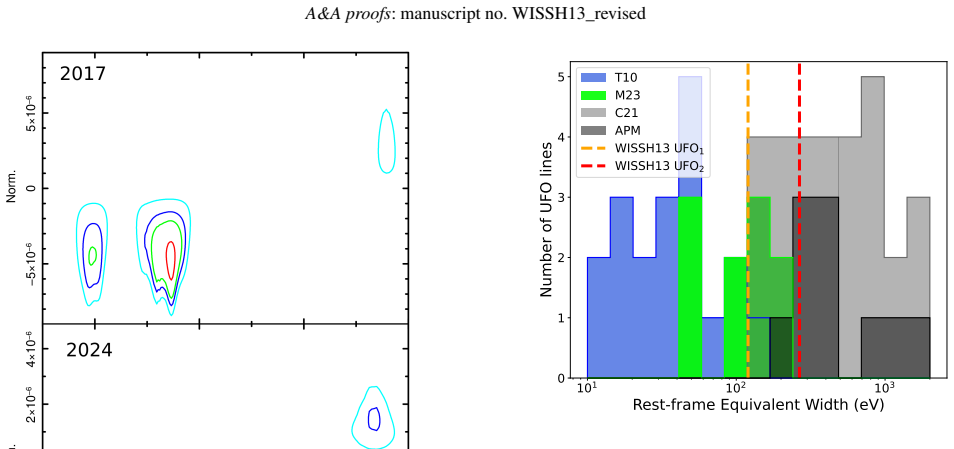
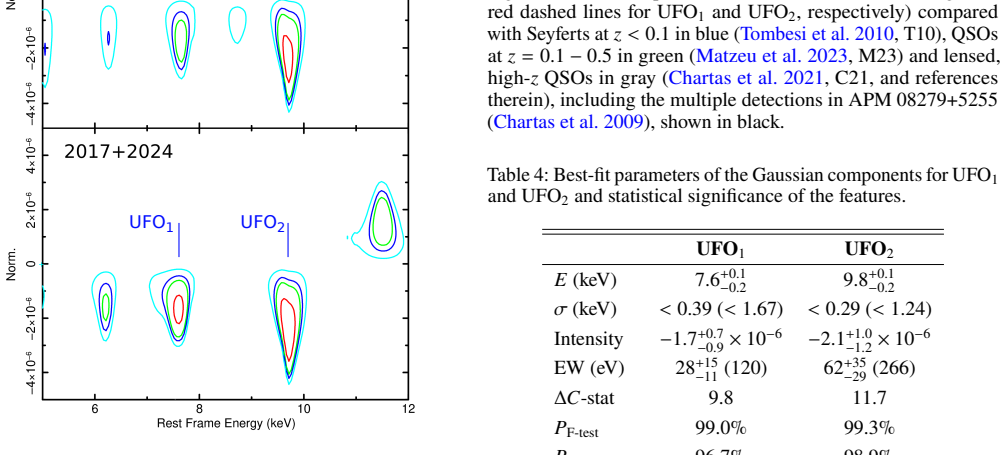
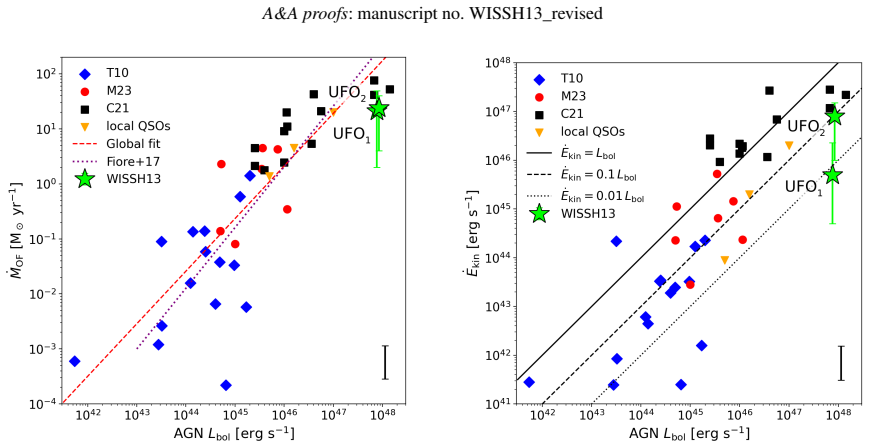
The central claim is the detection of two significant absorption features at ∼7.5 and ∼10 keV rest-frame, interpreted as a blueshifted blend of Fe XXV Heα and Fe XXVI Lyα, indicating two kinematic components of a highly ionized, high-column ultra-fast outflow with velocities ∼0.1c and ∼0.3c. The slower component is seen in both 2017 and 2024 data while the faster one appears only in 2024; each carries a mass outflow rate ∼20 M⊙ yr⁻¹ (15% of the accretion rate) and kinetic power of order 1% or 10% of bolometric luminosity.
What carries the argument
Blueshifted absorption lines of highly ionized iron (Fe XXV and Fe XXVI) that trace the velocity, ionization, and column of the two ultra-fast outflow components.
If this is right
- The slower wind component persists across multiple years while the faster component varies on year timescales.
- Each outflow component expels mass at a rate corresponding to 15% of the black-hole accretion rate.
- The kinetic power injected by the winds is 1% and 10% of the quasar's bolometric luminosity.
- These relative kinetic-power fractions are similar to those measured in lower-redshift AGN.
- The detection extends the study of ultra-fast outflows to the peak epoch of quasar activity at cosmic noon.
Where Pith is reading between the lines
- If outflows with these properties are common at z∼3, they could supply the mechanical feedback needed to regulate star formation in massive galaxies during the era when most black-hole growth occurred.
- The observed variability between epochs suggests the wind structure changes on timescales of years, which could be mapped with repeated observations.
- The low coronal temperature implied by the cutoff energy may be a signature of super-Eddington accretion disks and could be tested against disk-corona models.
Load-bearing premise
The absorption features at ∼7.5 and ∼10 keV are correctly identified as blueshifted highly ionized iron lines from an outflow rather than other spectral components, instrumental effects, or modeling artifacts.
What would settle it
A new broadband X-ray observation with comparable or better signal-to-noise that shows no significant absorption features at the reported rest-frame energies would falsify the ultra-fast outflow detection.
Figures




read the original abstract
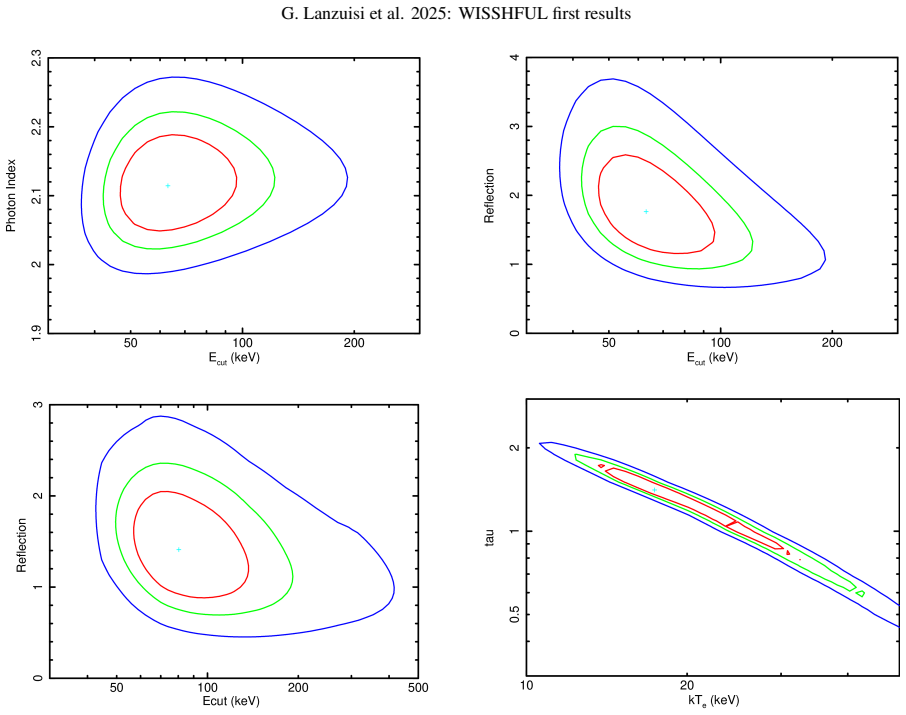
We present the first results from the WISSHFUL program, an XMM-Newton heritage program targeting luminous QSOs at Cosmic Noon. We report on recent simultaneous XMM-Newton and NuSTAR observations of the Super-Eddington accreting quasar WISSH13 at z=3.294, which provide the highest quality broadband X-ray spectrum to date for a non-lensed QSO at this redshift. Physical modeling of the continuum reveals a soft photon index ($\Gamma\sim2$) and strong reflection ($R\sim1.4-1.8$), despite the weak narrow Fe emission, and a low high-energy cut-off ($E_{cut}\sim60-80$ keV, $kTe = 15-20$ keV, depending on the model adopted). Most notably, we detect two significant (at $96.7\%$ and $98.9\%$ confidence level, respectively) absorption features at $\sim7.5$ and $\sim10$ keV rest-frame, interpreted as a blueshifted blend of Fe XXV He$\alpha$ and Fe XXVI Ly$\alpha$. These features indicate the presence of two kinematic components of a highly ionized, high column Ultra-Fast Outflow (UFO) with a velocity of $v_{out}\sim0.1c$ and $v_{out}\sim0.3c$, respectively. The slower wind is consistently detected in an archival 2017 XMM-Newton observation, whereas the faster wind is detected only in 2024. This stratified and variable wind exhibits extreme energetics, with a mass outflow rate of $\dot{M}_{out}\sim20M_{\odot}/yr$ (corresponding to $15\% \dot{M}_{acc}$) for each component, and a kinetic power of the order of $\sim1$ and $\sim10\%$ of the bolometric luminosity, respectively. While this represents one of the most powerful UFOs ever detected, its kinetic power is a similar fraction of the QSO's bolometric luminosity compared to lower-redshift AGN. We present several theoretical frameworks to explain the peculiar accretion and ejection properties of this remarkable QSO at Cosmic Noon.
Editorial analysis
A structured set of objections, weighed in public.
Referee Report
Summary. The manuscript reports simultaneous XMM-Newton and NuSTAR observations of the z=3.294 quasar WISSH13 from the WISSHFUL program. It claims detection of two absorption features at ~7.5 keV and ~10 keV (rest-frame) at 96.7% and 98.9% confidence, interpreted as blueshifted Fe XXV Heα and Fe XXVI Lyα from a stratified UFO with v_out ~0.1c and ~0.3c. Continuum modeling yields Γ~2, R~1.4-1.8, E_cut~60-80 keV; derived outflow properties include Ṁ_out~20 M_⊙ yr⁻¹ per component (~15% of Ṁ_acc) and kinetic powers ~1% and ~10% of L_bol. The faster component appears only in the 2024 epoch.
Significance. If the line identifications hold after rigorous statistical tests, the result would establish the highest-redshift non-lensed UFO detection and demonstrate that extreme outflow energetics are already in place at Cosmic Noon with fractions of L_bol comparable to lower-redshift AGN. The XMM+NuSTAR broadband coverage for an unlensed z>3 source is a technical strength, as is the reported epoch-to-epoch variability.
major comments (3)
- [Abstract and spectral fitting section] Abstract and spectral fitting section: the reported 96.7% and 98.9% confidence levels correspond to marginal (~2σ) detections. The manuscript must supply Monte-Carlo-derived false-alarm probabilities that incorporate the look-elsewhere effect across the full 5–15 keV search window and the discrete choices of reflection model and cutoff energy.
- [Physical modeling section] Physical modeling section: the continuum is parameterized by Γ≈2, R≈1.4–1.8 and E_cut≈60–80 keV. No contour plots or alternative-model tests are described to quantify possible degeneracies between these parameters and the narrow absorption residuals; such tests are required to confirm that the features are not artifacts of continuum mismatch.
- [Outflow energetics paragraph] Outflow energetics paragraph: Ṁ_out~20 M_⊙ yr⁻¹ and the quoted kinetic powers assume specific values for ionization parameter, covering fraction and launch radius. The paper should state how these quantities are constrained by the X-ray data alone and propagate the resulting uncertainties into the reported percentages of L_bol.
minor comments (2)
- [Abstract] Abstract: the exact statistical method used to obtain the 96.7% and 98.9% confidence levels (Δχ², F-test, etc.) is not stated and should be specified.
- [Figures and text] Figure captions and text: ensure all energies are consistently quoted in the rest frame and that residual plots are shown with the same energy scale as the data/model panels.
Simulated Author's Rebuttal
We thank the referee for the constructive comments on our manuscript. We address each major point below and will incorporate revisions to strengthen the statistical and modeling sections as outlined.
read point-by-point responses
-
Referee: [Abstract and spectral fitting section] Abstract and spectral fitting section: the reported 96.7% and 98.9% confidence levels correspond to marginal (~2σ) detections. The manuscript must supply Monte-Carlo-derived false-alarm probabilities that incorporate the look-elsewhere effect across the full 5–15 keV search window and the discrete choices of reflection model and cutoff energy.
Authors: We agree that the detections are marginal and that a rigorous assessment of the false-alarm probability is required. In the revised manuscript we will add Monte Carlo simulations that scan the full 5–15 keV band and vary the reflection model and cutoff energy to properly account for the look-elsewhere effect. revision: yes
-
Referee: [Physical modeling section] Physical modeling section: the continuum is parameterized by Γ≈2, R≈1.4–1.8 and E_cut≈60–80 keV. No contour plots or alternative-model tests are described to quantify possible degeneracies between these parameters and the narrow absorption residuals; such tests are required to confirm that the features are not artifacts of continuum mismatch.
Authors: We recognize the need to demonstrate that the absorption lines are robust against continuum degeneracies. The revised version will include contour plots of Γ, R and E_cut together with fits using alternative reflection models to show that the residuals at ~7.5 and ~10 keV persist. revision: yes
-
Referee: [Outflow energetics paragraph] Outflow energetics paragraph: Ṁ_out~20 M_⊙ yr⁻¹ and the quoted kinetic powers assume specific values for ionization parameter, covering fraction and launch radius. The paper should state how these quantities are constrained by the X-ray data alone and propagate the resulting uncertainties into the reported percentages of L_bol.
Authors: The ionization parameter is constrained by the observed line centroid energies and the lack of lower-ionization absorption in the spectrum. Covering fraction and launch radius, however, rely on standard UFO assumptions. We will explicitly state these constraints and assumptions in the revised text and propagate the associated uncertainties into the reported Ṁ_out and kinetic-power fractions. revision: partial
Circularity Check
No circularity: purely observational line detection from new X-ray data
full rationale
The paper reports XMM-Newton + NuSTAR spectral fitting on fresh observations of WISSH13, identifying two absorption features at ~7.5 and ~10 keV rest-frame and converting their energies to outflow velocities via the standard relativistic Doppler formula. No parameter is fitted to a subset of the data and then re-labeled as a prediction; no self-citation supplies a uniqueness theorem or ansatz that the present analysis depends upon; the continuum model (power-law + reflection + cutoff) is chosen from standard XSPEC components and the line identifications are presented as an interpretation of the residuals rather than a quantity forced by the fit itself. The claimed velocities and energetics are therefore independent outputs of the data reduction, not reductions of the inputs by construction.
Axiom & Free-Parameter Ledger
free parameters (5)
- outflow velocities =
0.1c and 0.3c
- photon index Gamma =
~2
- reflection fraction R =
1.4-1.8
- high-energy cutoff E_cut =
60-80 keV
- mass outflow rate =
~20 M_sun/yr per component
axioms (2)
- domain assumption Standard AGN X-ray continuum and reflection models apply at z=3.294
- domain assumption Absorption features originate from blueshifted highly ionized Fe in an outflow
Reference graph
Works this paper leans on
-
[1]
2014, ARA&A, 52, 415, doi: 10.1146/annurev-astro-081811-125615
Cosmic Star-Formation History. , keywords =. doi:10.1146/annurev-astro-081811-125615 , archivePrefix =. 1403.0007 , primaryClass =
work page internal anchor Pith review Pith/arXiv arXiv doi:10.1146/annurev-astro-081811-125615
-
[2]
The WISSH quasars project. III. X-ray properties of hyper-luminous quasars. , keywords =. doi:10.1051/0004-6361/201731314 , archivePrefix =. 1708.00452 , primaryClass =
work page internal anchor Pith review Pith/arXiv arXiv doi:10.1051/0004-6361/201731314
-
[3]
Kinetic Energy Transfer from X-Ray Ultrafast Outflows to Millimeter/Submillimeter Cold Molecular Outflows in Seyfert Galaxies. , keywords =. doi:10.3847/1538-4357/aaf814 , archivePrefix =. 1812.04316 , primaryClass =
work page internal anchor Pith review Pith/arXiv arXiv doi:10.3847/1538-4357/aaf814
-
[4]
NuSTAR view of the black hole wind in the galaxy merger IRAS F11119$+$3257
NuSTAR View of the Black Hole Wind in the Galaxy Merger IRAS F11119+3257. , keywords =. doi:10.3847/1538-4357/aa9579 , archivePrefix =. 1710.07485 , primaryClass =
work page internal anchor Pith review Pith/arXiv arXiv doi:10.3847/1538-4357/aa9579
-
[5]
Quasar Feedback in the Ultraluminous Infrared Galaxy F11119+3257: Connecting the Accretion Disk Wind with the Large-scale Molecular Outflow. , keywords =. doi:10.3847/1538-4357/aa767d , archivePrefix =. 1706.00443 , primaryClass =
work page internal anchor Pith review Pith/arXiv arXiv doi:10.3847/1538-4357/aa767d
-
[6]
2023, RMxAA, 59, 327, doi: 10.22201/ia.01851101p.2023.59.02.12
The 2023 Release of Cloudy. , keywords =. doi:10.22201/ia.01851101p.2023.59.02.12 , archivePrefix =. 2308.06396 , primaryClass =
-
[7]
X-ray studies of quasars with the Einstein Observatory. , keywords =. doi:10.1086/183100 , adsurl =
-
[8]
Spectroscopic Properties of QSOs Selected from Ultraluminous Infrared Galaxy Samples
Spectroscopic Properties of QSOs Selected from Ultraluminous Infrared Galaxy Samples. , keywords =. doi:10.1086/340964 , archivePrefix =. astro-ph/0203456 , primaryClass =
work page internal anchor Pith review Pith/arXiv arXiv doi:10.1086/340964
-
[9]
Connecting X-ray nuclear winds with galaxy-scale ionised outflows in two z 1.5 lensed quasars. , keywords =. doi:10.1051/0004-6361/202040190 , archivePrefix =. 2102.07789 , primaryClass =
-
[10]
Fast Molecular Outflows in Luminous Galaxy Mergers: Evidence for Quasar Feedback from Herschel
Fast Molecular Outflows in Luminous Galaxy Mergers: Evidence for Quasar Feedback from Herschel. , keywords =. doi:10.1088/0004-637X/776/1/27 , archivePrefix =. 1308.3139 , primaryClass =
work page internal anchor Pith review Pith/arXiv arXiv doi:10.1088/0004-637x/776/1/27
-
[11]
, keywords =
Quasars and galaxy formation. , keywords =
-
[12]
What Drives the Growth of Black Holes?
What drives the growth of black holes?. , keywords =. doi:10.1016/j.newar.2011.11.003 , archivePrefix =. 1112.1949 , primaryClass =
work page internal anchor Pith review Pith/arXiv arXiv doi:10.1016/j.newar.2011.11.003 2011
-
[13]
A Unified, Merger-driven Model of the Origin of Starbursts, Quasars, the Cosmic X-Ray Background, Supermassive Black Holes, and Galaxy Spheroids. , keywords =. doi:10.1086/499298 , archivePrefix =. astro-ph/0506398 , primaryClass =
work page internal anchor Pith review Pith/arXiv arXiv doi:10.1086/499298
-
[14]
arXiv e-prints , keywords =
Nested Sampling Methods. arXiv e-prints , keywords =
-
[15]
IACHEC Cross-calibration of Chandra, NuSTAR, Swift, Suzaku, XMM-Newton with 3C 273 and PKS 2155-304. , keywords =. doi:10.3847/1538-3881/153/1/2 , archivePrefix =. 1609.09032 , primaryClass =
work page internal anchor Pith review Pith/arXiv arXiv doi:10.3847/1538-3881/153/1/2
-
[16]
Astronomy & Astrophysics , author =
X-ray spectral modelling of the AGN obscuring region in the CDFS: Bayesian model selection and catalogue. , keywords =. doi:10.1051/0004-6361/201322971 , archivePrefix =. 1402.0004 , primaryClass =
work page internal anchor Pith review Pith/arXiv arXiv doi:10.1051/0004-6361/201322971
-
[17]
, year = 1984, volume = 22, pages =
Black Hole Models for Active Galactic Nuclei. , year = 1984, volume = 22, pages =. doi:10.1146/annurev.aa.22.090184.002351 , adsurl =
-
[18]
PDS 456: an extreme accretion rate quasar?. , eprint =. doi:10.1046/j.1365-8711.2000.03282.x , adsurl =
-
[19]
Nature , year =
Di Matteo, Tiziana and Springel, Volker and Hernquist, Lars , title =. Nature , year =
-
[20]
, year =
Reeves, J N and O'Brien, P T and Ward, M J , title =. , year =
-
[21]
, archivePrefix = "arXiv", eprint =
A Compton-thick Wind in the High-luminosity Quasar, PDS 456. , archivePrefix = "arXiv", eprint =. doi:10.1088/0004-637X/701/1/493 , adsurl =
-
[22]
, archivePrefix = "arXiv", eprint =
Variability of the High-velocity Outflow in the Quasar PDS 456. , archivePrefix = "arXiv", eprint =. doi:10.1088/0004-637X/780/1/45 , adsurl =
-
[23]
Astrophysical Journal , year =
Haardt, Francesco and Maraschi, Laura , title =. Astrophysical Journal , year =
-
[24]
A two-phase model for the X-ray emission from Seyfert galaxies. , keywords =. doi:10.1086/186171 , adsurl =
-
[25]
, archivePrefix = "arXiv", eprint =
X-Ray Characteristics of NGC 3516: A View through the Complex Absorber. , archivePrefix = "arXiv", eprint =. doi:10.1088/0004-637X/733/1/48 , adsurl =
-
[26]
, archivePrefix = "arXiv", eprint =
The shocked outflow in NGC 4051 - momentum-driven feedback, ultrafast outflows and warm absorbers. , archivePrefix = "arXiv", eprint =. doi:10.1093/mnras/stt807 , adsurl =
-
[27]
, archivePrefix = "arXiv", eprint =
Remarkable Spectral Variability of PDS 456. , archivePrefix = "arXiv", eprint =. doi:10.1088/0004-637X/712/1/26 , adsurl =
-
[28]
Evidence for Gravitational Infall of Matter onto the Supermassive Black Hole in the Quasar PG 1211+143?. , eprint =. doi:10.1086/498568 , adsurl =
-
[29]
, archivePrefix = "arXiv", eprint =
An absorption origin for the X-ray spectral variability of MCG-6-30-15. , archivePrefix = "arXiv", eprint =. doi:10.1051/0004-6361:200809590 , adsurl =
-
[30]
, archivePrefix = "arXiv", eprint =
Suzaku Observation of a Hard Excess in 1H 0419 - 577: Detection of a Compton-Thick Partial-Covering Absorber. , archivePrefix = "arXiv", eprint =. doi:10.1088/0004-637X/698/1/99 , adsurl =
-
[31]
Contemporaneous Chandra HETG and Suzaku X-ray observations of NGC 4051. , archivePrefix = "arXiv", eprint =. doi:10.1111/j.1365-2966.2011.18513.x , adsurl =
-
[32]
The effects of X-ray absorption variability in NGC 4395. , archivePrefix = "arXiv", eprint =. doi:10.1111/j.1365-2966.2011.19423.x , adsurl =
-
[33]
A reflection origin for the soft and hard X-ray excess of Ark 120. , archivePrefix = "arXiv", eprint =. doi:10.1111/j.1365-2966.2010.17518.x , adsurl =
-
[34]
, archivePrefix = "arXiv", eprint =
A Strong Excess in the 20-100 keV Emission of NGC 1365. , archivePrefix = "arXiv", eprint =. doi:10.1088/0004-637X/705/1/L1 , adsurl =
-
[35]
, archivePrefix = "arXiv", eprint =
Significant X-ray Line Emission in the 5-6 keV Band of NGC 4051. , archivePrefix = "arXiv", eprint =. doi:10.1088/0004-637X/712/1/209 , adsurl =
-
[36]
On the Absorption of X-rays in the Interstellar Medium
On the Absorption of X-Rays in the Interstellar Medium. , eprint =. doi:10.1086/317016 , adsurl =
work page internal anchor Pith review doi:10.1086/317016
-
[37]
The XSTAR Atomic Database. , keywords =. doi:10.1086/320363 , adsurl =
-
[38]
Extreme galactic wind and Wolf-Rayet features in infrared mergers and infrared quasi-stellar objects. , keywords =. doi:10.1046/j.1365-8711.2003.06309.x , archivePrefix =. astro-ph/0007316 , primaryClass =
-
[39]
XMM-Newton campaign on ultraluminous X-ray source NGC 1313 X-1: wind versus state variability. , keywords =. doi:10.1093/mnras/staa118 , archivePrefix =. 1911.09568 , primaryClass =
-
[40]
Warm Absorbers in Active Galactic Nuclei: A Multitemperature Wind. , keywords =. doi:10.1086/323442 , adsurl =
-
[41]
Simultaneous XMM-Newton and HST-COS observation of 1H0419-577. The absorbing and emitting ionized gas. , keywords =. doi:10.1051/0004-6361/201321416 , archivePrefix =. 1305.6232 , primaryClass =
work page internal anchor Pith review Pith/arXiv arXiv doi:10.1051/0004-6361/201321416
-
[42]
Multiwavelength campaign on Mrk 509. VIII. Location of the X-ray absorber. , keywords =. doi:10.1051/0004-6361/201118161 , archivePrefix =. 1201.1855 , primaryClass =
work page internal anchor Pith review Pith/arXiv arXiv doi:10.1051/0004-6361/201118161
-
[43]
Detection of a variable ultrafast outflow in the narrow-line Seyfert 1 galaxy PG 1448+273. , keywords =. doi:10.1093/mnras/staa1425 , archivePrefix =. 2005.09982 , primaryClass =
-
[44]
Three-dimensional simulations of supercritical black hole accretion discs - luminosities, photon trapping and variability. , keywords =. doi:10.1093/mnras/stv2941 , archivePrefix =. 1509.03168 , primaryClass =
work page internal anchor Pith review Pith/arXiv arXiv doi:10.1093/mnras/stv2941
-
[45]
Linking macro-, meso- and microscales in multiphase AGN feeding and feedback. Nature Astronomy , keywords =. doi:10.1038/s41550-019-0970-1 , archivePrefix =. 2001.04985 , primaryClass =
-
[46]
X-Ray Emission from Radio-Quiet Quasars in the Sloan Digital Sky Survey Early Data Release: The _ ox Dependence upon Ultraviolet Luminosity. , keywords =. doi:10.1086/345973 , archivePrefix =. astro-ph/0211125 , primaryClass =
work page internal anchor Pith review Pith/arXiv arXiv doi:10.1086/345973
-
[47]
Discovery of a Luminous Quasar in the Nearby Universe. , eprint =. doi:10.1086/310913 , adsurl =
-
[48]
Discovery of an Ionized Fe K Edge in the z=3.91 Broad Absorption Line Quasar APM 08279+5255 with XMM-Newton. , keywords =. doi:10.1086/342191 , archivePrefix =. astro-ph/0207005 , primaryClass =
work page internal anchor Pith review Pith/arXiv arXiv doi:10.1086/342191
-
[49]
Detection of high velocity outflows in Seyfert 1 galaxy Mrk 590
Detection of High Velocity Outflows in the Seyfert 1 Galaxy Mrk 590. , keywords =. doi:10.1088/0004-637X/798/1/4 , archivePrefix =. 1406.5968 , primaryClass =
work page internal anchor Pith review Pith/arXiv arXiv doi:10.1088/0004-637x/798/1/4
-
[50]
Dynamics of Line-driven Disk Winds in Active Galactic Nuclei. , eprint =. doi:10.1086/317154 , adsurl =
-
[51]
Dynamics of Line-driven Disk Winds in Active Galactic Nuclei. II. Effects of Disk Radiation. , eprint =. doi:10.1086/425117 , adsurl =
-
[52]
Extreme X-ray variability in the luminous quasar PDS 456. , eprint =. doi:10.1046/j.1365-8711.2002.06038.x , adsurl =
-
[53]
The X-Ray Observatory Suzaku. , keywords =. doi:10.1093/pasj/59.sp1.S1 , adsurl =
-
[54]
X-Ray Imaging Spectrometer (XIS) on Board Suzaku. , keywords =. doi:10.1093/pasj/59.sp1.S23 , adsurl =
-
[55]
Hard X-Ray Detector (HXD) on Board Suzaku. , eprint =. doi:10.1093/pasj/59.sp1.S35 , adsurl =
-
[56]
Astronomical Data Analysis Software and Systems V , year = 1996, editor =
XSPEC: The First Ten Years. Astronomical Data Analysis Software and Systems V , year = 1996, editor =
1996
-
[57]
Linear Regression for Astronomical Data with Measurement Errors and Intrinsic Scatter. , eprint =. doi:10.1086/177901 , adsurl =
-
[58]
, archivePrefix = "arXiv", eprint =
Unification of X-ray winds in Seyfert galaxies: from ultra-fast outflows to warm absorbers. , archivePrefix = "arXiv", eprint =. doi:10.1093/mnras/sts692 , adsurl =
-
[59]
Evidence for ultra-fast outflows in radio-quiet AGNs. I. Detection and statistical incidence of Fe K-shell absorption lines. , archivePrefix = "arXiv", eprint =. doi:10.1051/0004-6361/200913440 , adsurl =
-
[60]
, archivePrefix = "arXiv", eprint =
Evidence for ultrafast outflows in radio-quiet AGNs - III. Location and energetics. , archivePrefix = "arXiv", eprint =. doi:10.1111/j.1745-3933.2012.01221.x , adsurl =
-
[61]
Statistical detection and global absorber properties
The Suzaku view of highly ionized outflows in AGN - I. Statistical detection and global absorber properties. , archivePrefix = "arXiv", eprint =. doi:10.1093/mnras/sts481 , adsurl =
-
[62]
Final data release of the combined LDS and IAR surveys with improved stray-radiation corrections
The Leiden/Argentine/Bonn (LAB) Survey of Galactic HI. Final data release of the combined LDS and IAR surveys with improved stray-radiation corrections. , eprint =. doi:10.1051/0004-6361:20041864 , adsurl =
-
[63]
, keywords =
On the nature of rapid X-ray variability in active galactic nuclei. , keywords =
-
[64]
, keywords =
The variability of X-ray emission from active galaxies. , keywords =
-
[65]
, archivePrefix = "arXiv", eprint =
The XMM-Newton long look of NGC 1365: uncovering of the obscured X-ray source. , archivePrefix = "arXiv", eprint =. doi:10.1111/j.1745-3933.2008.00580.x , adsurl =
-
[66]
ArXiv e-prints , archivePrefix = "arXiv", eprint =
Observational characteristics of accretion onto black holes. ArXiv e-prints , archivePrefix = "arXiv", eprint =
-
[67]
Intrinsic disc emission and the soft X-ray excess in active galactic nuclei. , archivePrefix = "arXiv", eprint =. doi:10.1111/j.1365-2966.2011.19779.x , adsurl =
-
[68]
, archivePrefix = "arXiv", eprint =
Black hole outflows. , archivePrefix = "arXiv", eprint =. doi:10.1111/j.1365-2966.2009.16013.x , adsurl =
-
[69]
, archivePrefix = "arXiv", eprint =
Black hole wind speeds and the M - relation. , archivePrefix = "arXiv", eprint =. doi:10.1093/mnras/stt1101 , adsurl =
-
[70]
A high-velocity ionized outflow and XUV photosphere in the narrow emission line quasar PG1211+143. , eprint =. doi:10.1046/j.1365-8711.2003.07006.x , adsurl =
-
[71]
Black hole winds. , eprint =. doi:10.1046/j.1365-8711.2003.06980.x , adsurl =
-
[72]
, eprint =
X-ray absorption lines in the Seyfert 1 galaxy NGC 5548 discovered with Chandra-LETGS. , eprint =
-
[73]
The nature and origin of Seyfert warm absorbers. , eprint =. doi:10.1051/0004-6361:20041775 , adsurl =
-
[74]
A soft X-ray study of type I active galactic nuclei observed with Chandra high-energy transmission grating spectrometer. , archivePrefix = "arXiv", eprint =. doi:10.1111/j.1365-2966.2007.11993.x , adsurl =
-
[75]
, archivePrefix = "arXiv", eprint =
Quasar feedback: more bang for your buck. , archivePrefix = "arXiv", eprint =. doi:10.1111/j.1365-2966.2009.15643.x , adsurl =
-
[76]
, archivePrefix = "arXiv", eprint =
Global Radiation-Magnetohydrodynamic Simulations of Black-Hole Accretion Flow and Outflow: Unified Model of Three States. , archivePrefix = "arXiv", eprint =. doi:10.1093/pasj/61.3.L7 , adsurl =
-
[77]
, archivePrefix = "arXiv", eprint =
Global Structure of Three Distinct Accretion Flows and Outflows around Black Holes from Two-dimensional Radiation-magnetohydrodynamic Simulations. , archivePrefix = "arXiv", eprint =. doi:10.1088/0004-637X/736/1/2 , adsurl =
-
[78]
Occultation Measurement of the Size of the X-Ray-emitting Region in the Active Galactic Nucleus of NGC 1365. , eprint =. doi:10.1086/517884 , adsurl =
-
[79]
Hard X-ray spectrum of CYG X-1. , keywords =. doi:10.1038/279506a0 , adsurl =
-
[80]
On characterizing the variability properties of X-ray light curves from active galaxies. , eprint =. doi:10.1046/j.1365-2966.2003.07042.x , adsurl =
discussion (0)
Sign in with ORCID, Apple, or X to comment. Anyone can read and Pith papers without signing in.