Unravelling Challenges in Heating Power Measurements for Magnetic Hyperthermia -- the RADIOMAG Round Robin Study Revisited
Pith reviewed 2026-06-27 22:49 UTC · model grok-4.3
The pith
Re-examining the RADIOMAG dataset shows that correcting four common instrumentation errors in non-adiabatic AC calorimetry reduces inter-laboratory ILP variation from 30-40% to 18-30%.
A machine-rendered reading of the paper's core claim, the machinery that carries it, and where it could break.
Core claim
By uncovering instrumentation issues such as insufficient temperature resolution, AC-field sensitive thermometers, non-physical temperature oscillations, and apparent non-linear heat loss in the existing RADIOMAG data, and by re-estimating ILP using the initial slope method, the inter-laboratory standard deviation falls to 18-30%. This reduction of up to 38% occurs when the quality criteria are applied, while the corrected slope method is noted as preferable only under confirmed linear heat loss conditions.
What carries the argument
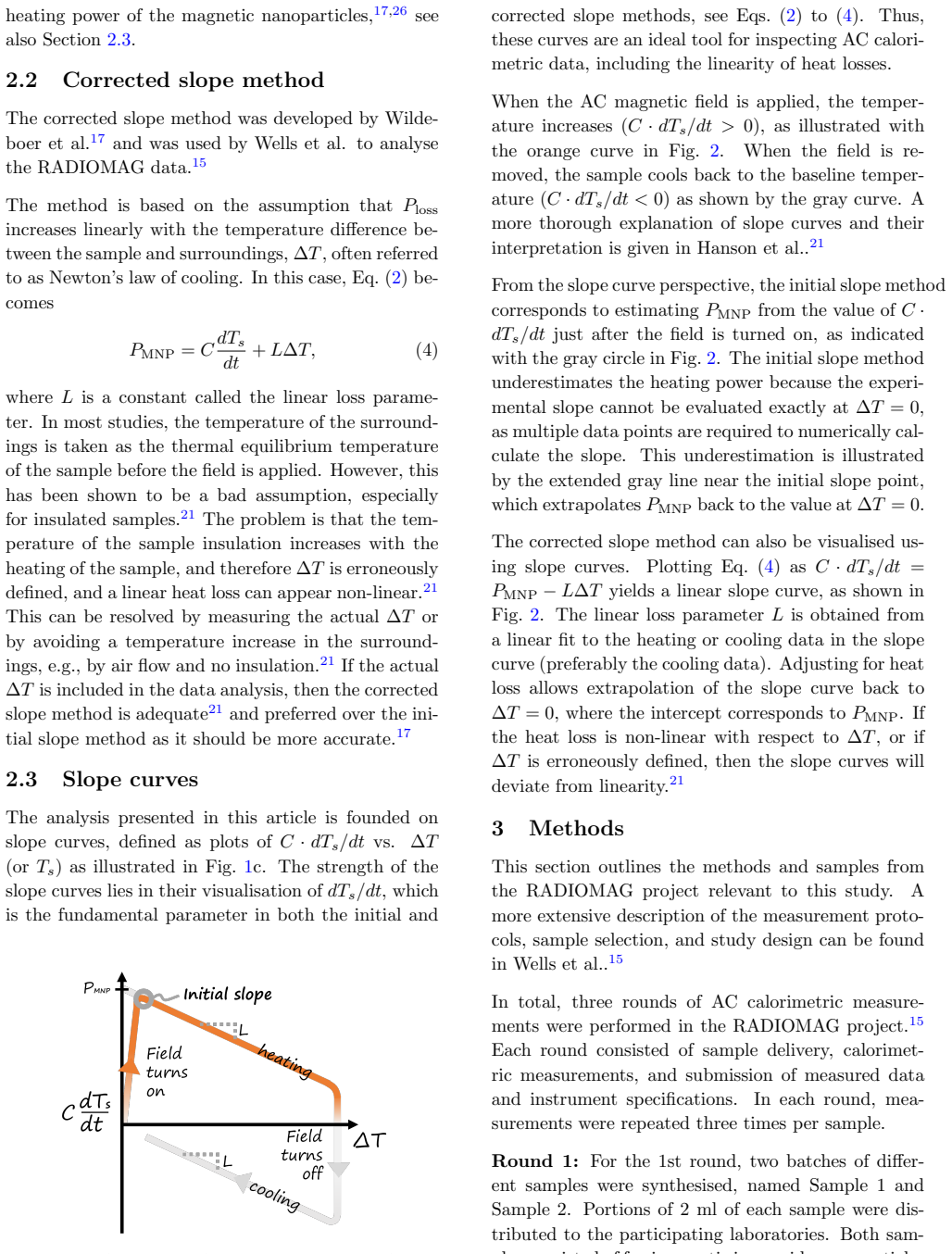
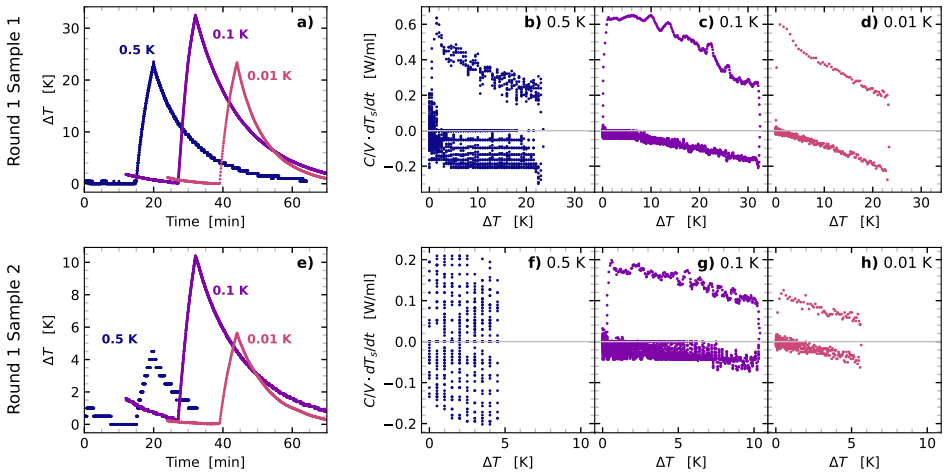
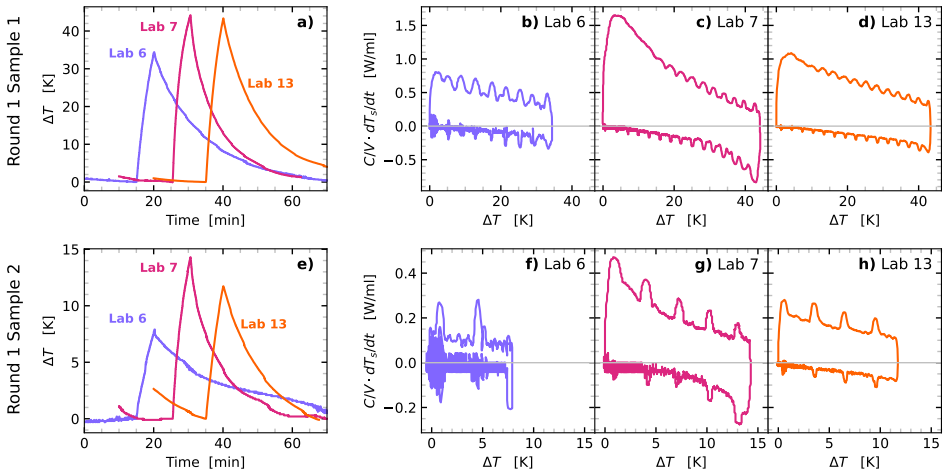
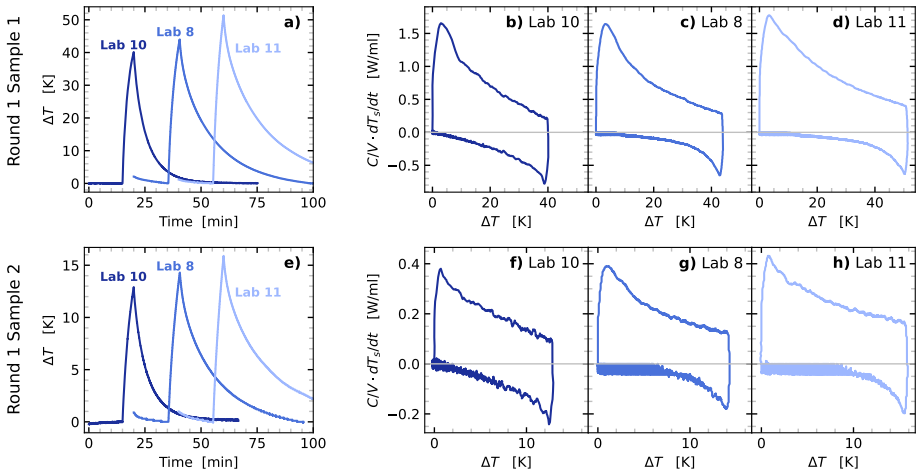
Slope curves, a plot of temperature change rate versus time or field parameters, used as a diagnostic to flag the four error sources before or during acquisition and to guide selection between initial slope and corrected slope analysis methods.
If this is right
- Re-estimated ILP values from the filtered dataset exhibit a standard deviation of 18-30%.
- The initial slope method avoids misleading interpretations when non-linear heat losses are present.
- The corrected slope method remains the preferred analysis only when heat loss is demonstrably linear.
- Slope curves enable proactive identification of instrumentation problems prior to full data collection.
- Application of the quality criteria across labs produces more consistent heating power estimates.
Where Pith is reading between the lines
- Laboratories could incorporate the slope-curve check into standard operating procedures to reduce wasted runs.
- The findings suggest that many reported discrepancies in magnetic hyperthermia heating data may stem from measurement artifacts rather than sample differences.
- Extending the protocol to other calorimetry setups outside hyperthermia could test whether similar error patterns appear in different temperature ranges or field strengths.
- Consistent ILP values would allow clearer comparisons of nanoparticle performance across published studies.
Load-bearing premise
That the four listed error sources account for most of the original variation and that re-applying the initial slope method plus quality criteria to the existing data produces unbiased ILP values rather than new systematic offsets.
What would settle it
New simultaneous measurements across multiple labs using thermometers with at least 0.01 K resolution and verified AC-field immunity, under conditions confirmed to have linear heat loss, that still yield >25% standard deviation in ILP.
Figures



read the original abstract
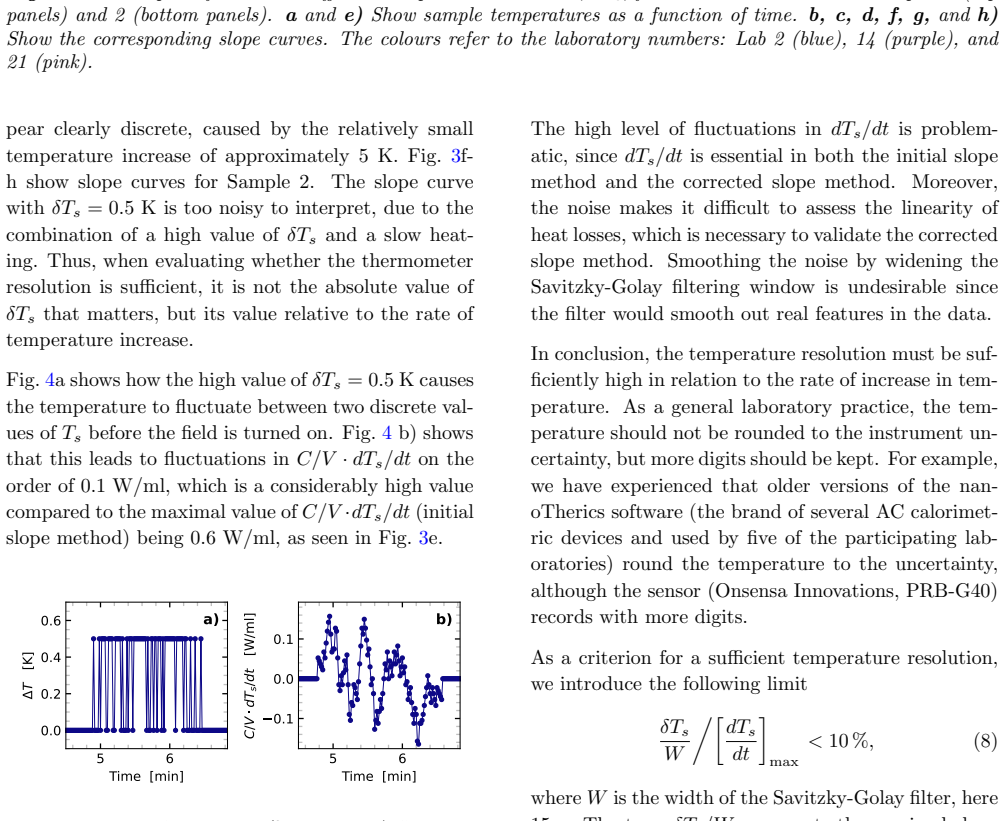
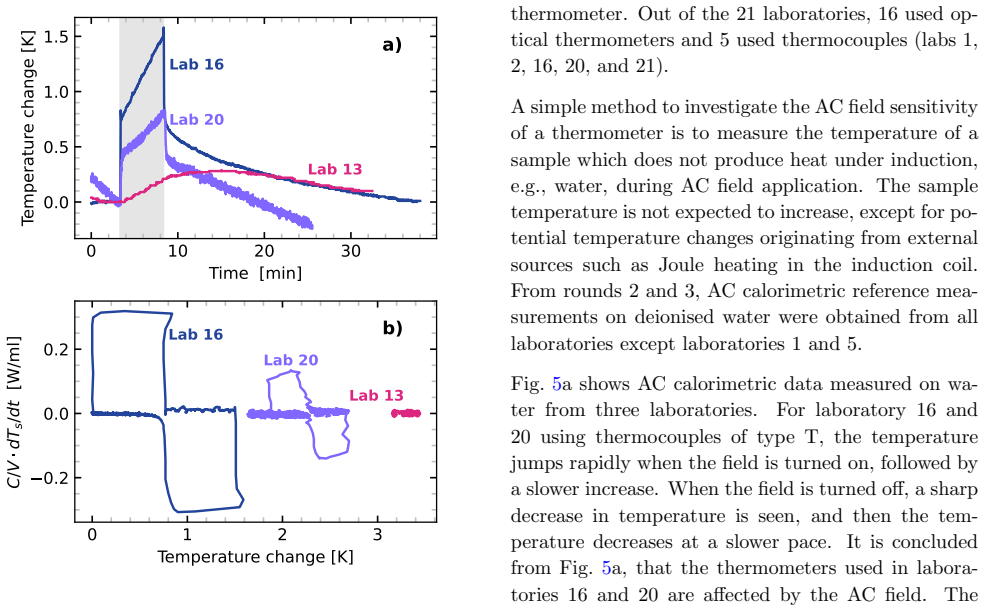
Non-adiabatic AC calorimetry is the most widely used technique for estimating the heating power of magnetic nanoparticles in magnetic hyperthermia. However, it is prone to systematic errors which lead to a standard deviation in the intrinsic loss power (ILP) of approximately 30-40%, as revealed by the RADIOMAG EU COST Action TD1402 round-robin study involving 21 European laboratories. In this study, we re-examine the RADIOMAG dataset to both uncover previously unreported instrumentation issues, and to explore more deeply some of the reported instrumentation issues. We identify four common sources of error: i) Insufficient temperature resolution, ii) AC-field sensitive thermometers, iii) Non-physical temperature oscillations, and iv) Apparent non-linear heat loss. Based on these findings, we propose criteria for sufficient measurement quality and apply them to re-estimate the ILP values. These results have a standard deviation of 18-30%., demonstrating that addressing instrumentation and analysis issues can improve measurement reliability and decrease the inter-laboratory deviation by up to 38%. When re-estimating ILP, we used the initial slope method, arguing that the corrected slope method, which was previously used to investigate the RADIOMAG data, could introduce misleading interpretations of systematic ILP deviations due to sub-optimal measurement conditions and the unnoticed influence of non-linear heat losses. However, we emphasise that the corrected slope method is preferred, given a linear heat loss. Based on our analysis, we introduce a diagnostic protocol by using slope curves - a simple yet effective plot type - for identifying and solving common instrumentation challenges proactively before the data acquisition phase.
Editorial analysis
A structured set of objections, weighed in public.
Referee Report
Summary. The paper re-examines the RADIOMAG round-robin dataset from 21 European laboratories on intrinsic loss power (ILP) measurements using non-adiabatic AC calorimetry for magnetic hyperthermia. It identifies four common sources of systematic error (insufficient temperature resolution, AC-field sensitive thermometers, non-physical temperature oscillations, and apparent non-linear heat loss), proposes quality criteria to filter the data, switches to the initial slope method for ILP re-estimation (arguing the corrected slope method can mislead under non-linear conditions), and reports a reduction in inter-laboratory standard deviation from ~30-40% to 18-30% (up to 38% improvement). The work also introduces slope curves as a diagnostic protocol for proactive issue identification.
Significance. If the filtering rules and re-estimation hold, the result is significant because it quantifies how specific, addressable instrumentation issues contribute to variability in a widely used technique and demonstrates a measurable improvement via re-analysis of an independent dataset. The provision of explicit criteria, per-lab recalculations, and a simple diagnostic plot type offers practical value for standardization. Credit is due for reusing the prior round-robin data without circularity and for distinguishing the preferred method under linear vs. non-linear heat loss conditions.
major comments (2)
- [ILP re-estimation procedure] The central claim of an up to 38% reduction in deviation rests on both the quality criteria and the switch to the initial slope method. However, the manuscript does not isolate the numerical contribution of the method change by reporting ILP values and SD on the filtered dataset under both the initial slope and corrected slope approaches. This comparison is needed to substantiate that the method switch (rather than filtering alone) meaningfully affects the reported improvement.
- [Discussion of error sources and re-estimation results] The four identified error sources are presented as the primary causes of the original 30-40% spread, with the post-filter SD reduction offered as supporting evidence. The text does not quantify or rule out the possible persistence of other lab-to-lab differences (e.g., field amplitude calibration or sample batch variations) in the retained data, which bears on whether instrumentation issues alone account for the observed improvement.
minor comments (2)
- [Abstract] The abstract states the SD reduction to 18-30% but does not indicate how many laboratories or individual measurements remain after applying the four quality criteria; adding this information (or a summary table) would clarify the statistical basis of the improvement claim.
- [Diagnostic protocol section] The construction and interpretation of 'slope curves' for diagnostics is described conceptually but would benefit from an explicit example (e.g., a figure with labeled axes and annotations) to ensure other groups can implement the protocol uniformly.
Simulated Author's Rebuttal
We thank the referee for the constructive comments and positive assessment of the manuscript. We address the major comments point by point below.
read point-by-point responses
-
Referee: [ILP re-estimation procedure] The central claim of an up to 38% reduction in deviation rests on both the quality criteria and the switch to the initial slope method. However, the manuscript does not isolate the numerical contribution of the method change by reporting ILP values and SD on the filtered dataset under both the initial slope and corrected slope approaches. This comparison is needed to substantiate that the method switch (rather than filtering alone) meaningfully affects the reported improvement.
Authors: We agree that isolating the contributions of filtering versus the method switch would strengthen the central claim. The initial slope method was selected because the corrected slope approach can produce misleading ILP estimates when non-linear heat loss is present, as demonstrated by the slope-curve diagnostics in the manuscript. In the revised manuscript we will add ILP values and standard deviations computed on the filtered dataset under both methods, thereby quantifying the separate numerical impact of the method change. revision: yes
-
Referee: [Discussion of error sources and re-estimation results] The four identified error sources are presented as the primary causes of the original 30-40% spread, with the post-filter SD reduction offered as supporting evidence. The text does not quantify or rule out the possible persistence of other lab-to-lab differences (e.g., field amplitude calibration or sample batch variations) in the retained data, which bears on whether instrumentation issues alone account for the observed improvement.
Authors: The scope of the work is limited to instrumentation and analysis issues that are directly identifiable in the RADIOMAG dataset. With the information provided we cannot quantify or exclude contributions from other sources such as field calibration or sample batch variations. The observed reduction in standard deviation after applying the quality criteria nevertheless indicates that the four identified issues were substantial contributors. We will revise the discussion to explicitly acknowledge these limitations and to state that the reported improvement is attributable to addressing the instrumentation-related errors. revision: partial
Circularity Check
No significant circularity
full rationale
The paper performs a re-analysis of the independent RADIOMAG round-robin dataset by applying four explicitly stated quality criteria (insufficient temperature resolution, AC-field sensitive thermometers, non-physical oscillations, apparent non-linear heat loss) and switching to the initial-slope method. The reported reduction in inter-lab SD (to 18-30 %) follows directly from the filtering rules and per-lab recalculations supplied in the manuscript; no equation, fitted parameter, or central claim reduces to its own input by construction. No self-citation chain is load-bearing, no uniqueness theorem is invoked, and no ansatz is smuggled. The derivation chain is therefore self-contained against the external benchmark dataset.
Axiom & Free-Parameter Ledger
axioms (1)
- domain assumption The RADIOMAG dataset accurately represents the measurements performed by the 21 participating laboratories
Reference graph
Works this paper leans on
-
[1]
Lise Hanson , title =
-
[2]
Wildeboer, R R and Southern, P and Pankhurst, Q A , year =. On the Reliable Measurement of Specific Absorption Rates and Intrinsic Loss Parameters in Magnetic Hyperthermia Materials , volume =. Journal of Physics D: Applied Physics , publisher =. doi:10.1088/0022-3727/47/49/495003 , number =
-
[3]
Chang, David and Lim, May and Goos, Jeroen A. C. M. and Qiao, Ruirui and Ng, Yun Yee and Mansfeld, Friederike M. and Jackson, Michael and Davis, Thomas P. and Kavallaris, Maria , year =. Biologically Targeted Magnetic Hyperthermia: Potential and Limitations , volume =. doi:10.3389/fphar.2018.00831 , journal =
-
[4]
Maier-Hauff, Klaus and Ulrich, Frank and Nestler, Dirk and Niehoff, Hendrik and Wust, Peter and Thiesen, Burghard and Orawa, Helmut and Budach, Volker and Jordan, Andreas , year =. Efficacy and Safety of Intratumoral Thermotherapy Using Magnetic Iron-Oxide Nanoparticles Combined with External Beam Radiotherapy on Patients with Recurrent Glioblastoma Multi...
-
[5]
(1957), ``Selective inductive heating of lymph nodes, '' Ann
Selective Inductive Heating of Lymph Nodes , author=. Annals of Surgery , publisher =. 1957 , publisher=. doi:10.1097/00000658-195710000-00007 , number =
-
[6]
Houlding, Thomas K. and Rebrov, Evgeny V. , year =. Application of Alternative Energy Forms in Catalytic Reactor Engineering , volume =. Green Process Synthesis , publisher =. doi:10.1515/greenps-2011-0502 , number =
-
[7]
Mortensen, Peter Mølgaard and Engbæk, Jakob Soland and Vendelbo, Søren Bastholm and Hansen, Mikkel Fougt and Østberg, Martin , year =. Direct Hysteresis Heating of Catalytically Active Ni–Co Nanoparticles as Steam Reforming Catalyst , volume =. Industrial & Engineering Chemistry Research , publisher =. doi:10.1021/acs.iecr.7b02331 , number =
-
[8]
Improving Performance of Induction-Heated Steam Methane Reforming , volume =
Almind, Mads Radmer and Vendelbo, Søren Bastholm and Hansen, Mikkel Fougt and Vinum, Morten Gotthold and Frandsen, Cathrine and Mortensen, Peter Mølgaard and Engbæk, Jakob Soland , year =. Improving Performance of Induction-Heated Steam Methane Reforming , volume =. doi:10.1016/j.cattod.2019.05.005 , journal =
-
[9]
and Chamness, Owen and Glisson, Nicolas and Bruce, Bridget and Lee, Sungsik and Zachman, Michael J
Adogwa, Alexander and Chukwu, Ewa and Malaj, Alexander and Punyapu, Venkata R. and Chamness, Owen and Glisson, Nicolas and Bruce, Bridget and Lee, Sungsik and Zachman, Michael J. and Bruce, David A. and Getman, Rachel B. and Mefford, O. Thompson and Yang, Ming , year =. Catalytic Reaction Triggered by Magnetic Induction Heating Mechanistically Distinguish...
-
[10]
Induction Heating as an Alternative Electrified Heating Method for Carbon Capture Process , volume =
Gholami, Mohsen and Verougstraete, Brieuc and Vanoudenhoven, Rapha. Induction Heating as an Alternative Electrified Heating Method for Carbon Capture Process , volume =. 2022 , month = mar, pages =. doi:10.1016/j.cej.2021.133380 , journal =
-
[11]
Munir and Li, Haiqing and Hill, Anita J
Sadiq, M. Munir and Li, Haiqing and Hill, Anita J. and Falcaro, Paolo and Hill, Matthew R. and Suzuki, Kiyonori , year =. Magnetic Induction Swing Adsorption: An Energy Efficient Route to Porous Adsorbent Regeneration , volume =. Chemistry of Materials , publisher =. doi:10.1021/acs.chemmater.6b02409 , number =
-
[12]
and Van Assche, Tom and Denayer, Joeri F.M
Schoukens, Matthias and Gholami, Mohsen and Baron, Gino V. and Van Assche, Tom and Denayer, Joeri F.M. , year =. Hybrid Induction Vacuum Swing Adsorption, a Rapid and Fully Electrified Carbon Capture Process , volume =. doi:10.1016/j.cej.2023.141587 , journal =
-
[13]
and Luo, Addie and Taratula, Olena R
Park, Youngrong and Demessie, Ananiya A. and Luo, Addie and Taratula, Olena R. and Moses, Abraham S. and Do, Peter and Campos, Leonardo and Jahangiri, Younes and Wyatt, Cory R. and Albarqi, Hassan A. and Farsad, Khashayar and Slayden, Ov D. and Taratula, Oleh , year =. Targeted Nanoparticles with High Heating Efficiency for the Treatment of Endometriosis ...
-
[14]
Moses, Abraham S. and Demessie, Ananiya A. and Taratula, Olena and Korzun, Tetiana and Slayden, Ov D. and Taratula, Oleh , year =. Nanomedicines for Endometriosis: Lessons Learned from Cancer Research , volume =. Small , publisher =. doi:10.1002/smll.202004975 , number =
-
[15]
Talukdar, Souvanik and Singh, Santosh K. and Mishra, Manoj K. and Singh, Rajesh , year =. Emerging Trends in Nanotechnology for Endometriosis: Diagnosis to Therapy , volume =. Nanomaterials , publisher =. doi:10.3390/nano14110976 , number =
-
[16]
Wells, J. and Ortega, D. and Steinhoff, U. and Dutz, S. and Garaio, E. and Sandre, O. and Natividad, E. and Cruz, M. M. and Brero, F. and Southern, P. and Pankhurst, Q. A. and Spassov, S. , year =. Challenges and Recommendations for Magnetic Hyperthermia Characterization Measurements , volume =. International Journal of Hyperthermia , publisher =. doi:10....
-
[17]
Andreu, Irene and Natividad, Eva , year =. Accuracy of Available Methods for Quantifying the Heat Power Generation of Nanoparticles for Magnetic Hyperthermia , volume =. International Journal of Hyperthermia , publisher =. doi:10.3109/02656736.2013.826825 , number =
-
[18]
Chapter 5 - Instrumentation for Magnetic Hyperthermia , booktitle =
D Cabrera and I Rubia-Rodríguez and E Garaio and F Plazaola and L Dupré and N Farrow and F Terán and D Ortega , DOI =. Chapter 5 - Instrumentation for Magnetic Hyperthermia , booktitle =. 2019 , isbn =
2019
-
[19]
1997 , publisher=
Heat transfer , author=. 1997 , publisher=
1997
-
[20]
Contemporary Physics , volume=
Newton's law of cooling , author=. Contemporary Physics , volume=. 1999 , publisher=
1999
-
[21]
1959 , publisher=
Conduction of heat in solids , author=. 1959 , publisher=
1959
-
[22]
miltenyibiotec.com , howpublished =
-
[23]
Hanson, Lise G. and Hansen, Bianca L. and Veile, Thomas and Zambach, Mathias and Christensen, Niels B. and Frandsen, Cathrine , year =. The Impact of Sample Insulation on Estimating the Heating Power of Magnetic Nanoparticles by AC Calorimetry , volume =. doi:10.1109/lmag.2023.3279778 , journal =
-
[24]
Carlton, Hayden and Ivkov, Robert , year =. A New Method to Measure Magnetic Nanoparticle Heating Efficiency in Non-Adiabatic Systems Using Transient Pulse Analysis , volume =. Journal of Applied Physics , publisher =. doi:10.1063/5.0131058 , number =
-
[25]
Huang, S and Wang, S-Y and Gupta, A and Borca-Tasciuc, D-A and Salon, S J , year =. On the measurement technique for specific absorption rate of nanoparticles in an alternating electromagnetic field , volume =. Measurement Science and Technology , publisher =. doi:10.1088/0957-0233/23/3/035701 , number =
-
[26]
(2020), ``Magnetic fluid hyperthermia simulations in evaluation of SAR calculation methods,'' Phys
Papadopoulos, Costas and Efthimiadou, Eleni K. and Pissas, Michael and Fuentes, David and Boukos, Nikolaos and Psycharis, Vassilis and Kordas, George and Loukopoulos, Vassilios C. and Kagadis, George C. , year =. Magnetic Fluid Hyperthermia Simulations in Evaluation of SAR Calculation Methods , volume =. doi:10.1016/j.ejmp.2020.02.011 , journal =
-
[27]
Landi, G.T. , year =. Simple Models for the Heating Curve in Magnetic Hyperthermia Experiments , volume =. doi:10.1016/j.jmmm.2012.08.034 , journal =
-
[28]
Carrey, J. and Mehdaoui, B. and Respaud, M. , year =. Simple Models for Dynamic Hysteresis Loop Calculations of Magnetic Single-Domain Nanoparticles: Application to Magnetic hyperthermia Optimization , volume =. Journal of Applied Physics , publisher =. doi:10.1063/1.3551582 , number =
-
[29]
Chemometrics and intelligent laboratory systems , volume=
The validation of measurement through interlaboratory studies , author=. Chemometrics and intelligent laboratory systems , volume=. 1991 , publisher=
1991
-
[30]
Ruta, Sergiu and Fernández-Afonso, Yilian and Rannala, Samuel E. and Morales, M. Puerto and Veintemillas-Verdaguer, Sabino and Jones, Carlton and Gutiérrez, Lucía and Chantrell, Roy W. and Serantes, David , year =. Beyond Newton’s law of Cooling in Evaluating Magnetic Hyperthermia Performance: a Device-Independent Procedure , volume =. Nanoscale Advances ...
-
[31]
Wells, James and Ortega, Daniel and Steinhoff, Uwe and Dutz, Silvio and Garaio, Eneko and Sandre, Olivier and Natividad, Eva and Cruz, Maria Margarida and Brero, Francesca and Southern, Paul and Pankhurst, Quentin and Spassov, Simo and. Radiomag Interlaboratory Comparison of Magnetic Hyperthermia Characterisation Measurements: Data , publisher =. 2020 , c...
-
[32]
Youden, W. J. , year =. Graphical Diagnosis of Interlaboratory Test Results , volume =. Journal of Quality Technology , publisher =. doi:10.1080/00224065.1972.11980509 , number =
-
[33]
Chan, K. W. and Chou, C. K. , year =. Use of Thermocouples in the Intense Fields of Ferromagnetic Implant Hyperthermia , volume =. International Journal of Hyperthermia , publisher =. doi:10.3109/02656739309034986 , number =
-
[34]
Bordet, A. and Leitner, W. and Chaudret, B. , year =. Magnetically Induced Catalysis: Definition, Advances, and Potential , volume =. Angewandte Chemie International Edition , publisher =. doi:10.1002/anie.202424151 , number =
discussion (0)
Sign in with ORCID, Apple, or X to comment. Anyone can read and Pith papers without signing in.