Deterring Searches for Child Sexual Abuse Material on Google Search and Promoting Help-Seeking
Pith reviewed 2026-06-27 23:35 UTC · model grok-4.3
The pith
Google's revised Onebox messaging on CSAM searches cuts same-session follow-up queries by 3.8 percentage points and draws 0.73 percent clicks to help resources.
A machine-rendered reading of the paper's core claim, the machinery that carries it, and where it could break.
Core claim
The revised Onebox intervention, which highlights repercussions and therapeutic resources rather than reporting, produced a 3.8 percentage point reduction relative to the prior version in subsequent CSAM-related queries within the same search session, alongside a 0.73 percent average click-through rate on buttons linking to help-providing resources; the authors interpret this as convergent evidence that some individuals can be deterred from ongoing CSAM-seeking and redirected to therapeutic services.
What carries the argument
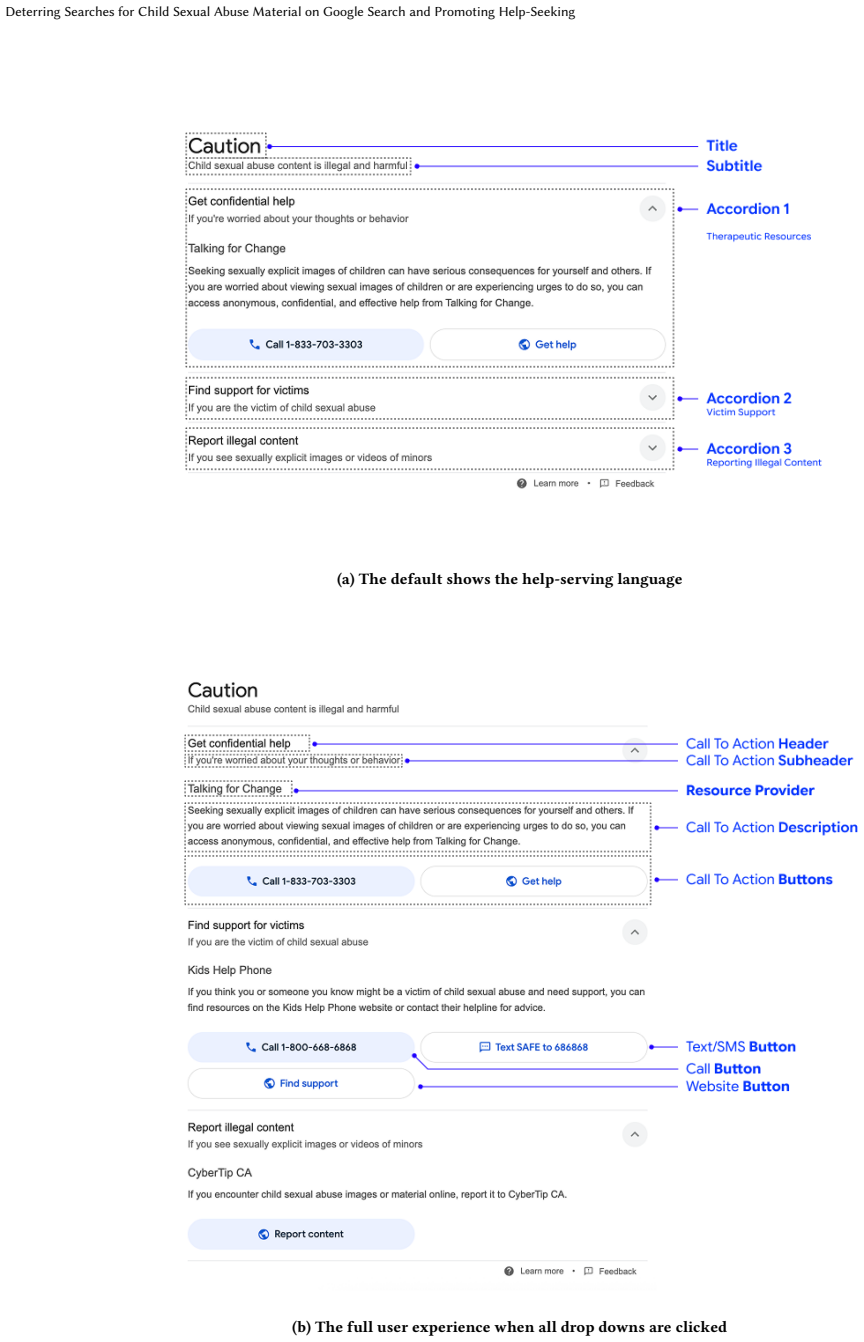
The revised Onebox feature that replaces reporting-focused messaging with emphasis on legal repercussions and links to therapeutic resources.
If this is right
- The messaging shift deters some users from continuing CSAM-related searches in the same session.
- A measurable fraction of users engage with the provided links to therapeutic resources.
- Convergent evidence supports that deterrence and redirection are achievable through search-interface changes.
- The approach demonstrates one concrete way online platforms can respond to harmful search behavior.
Where Pith is reading between the lines
- Similar interface interventions could be tested on other search engines or for different categories of prohibited content.
- Combining the messaging with direct handoffs to therapy providers might increase the observed click-through rate.
- Longer-term tracking could reveal whether the session-level reduction translates into fewer overall CSAM searches over days or weeks.
Load-bearing premise
The difference-in-differences analysis on internal search logs isolates the causal effect of the messaging change without other platform updates or external events affecting the treatment versus control periods.
What would settle it
A controlled test that randomly assigns the new versus old messaging to matched users and finds no reduction in follow-up CSAM queries would falsify the claimed effect.
Figures

read the original abstract
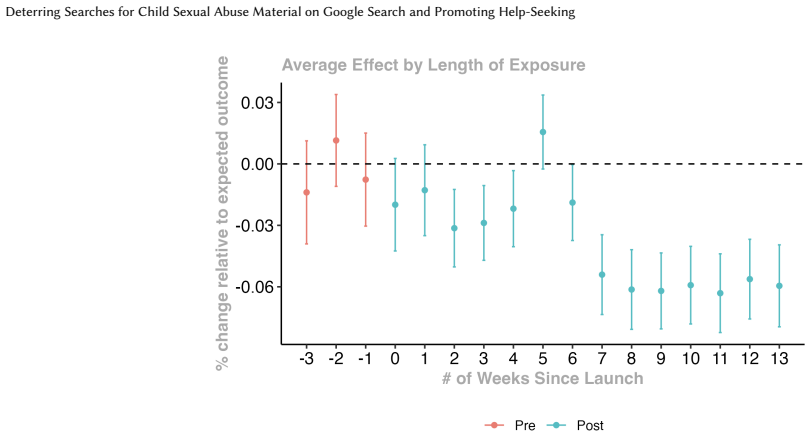
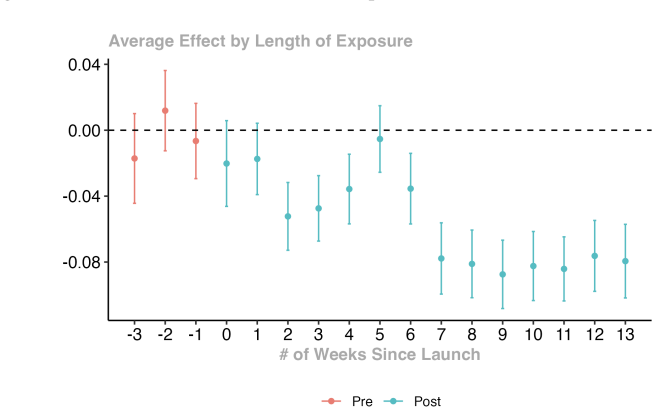
Google Search deploys a "Onebox" feature at the top of the results page when users conduct searches for Child Sexual Abuse Material. This study evaluates the impact of a strategic shift in this feature, comparing a revised intervention, focused on repercussions and therapeutic resources, to a previous iteration that focused on reporting. Using a difference-in-differences analysis of internal Google Search logs data, we found the new messaging resulted in a 3.8 percentage point reduction as compared to the status quo in subsequent CSAM-related queries within the same Search session. We found an average click through rate of 0.73% on any of the hyperlinked buttons to help-providing resources. Together, this research presents convergent evidence that a subset of individuals can be deterred from ongoing CSAM-seeking and redirected to therapeutic services.
Editorial analysis
A structured set of objections, weighed in public.
Referee Report
Summary. The paper evaluates a change to Google Search's Onebox feature for CSAM queries, shifting from reporting-focused messaging to content emphasizing legal repercussions and therapeutic resources. Using difference-in-differences on internal search logs, it claims the revision produced a 3.8 percentage point reduction in follow-on CSAM queries within the same session relative to the prior version, alongside a 0.73% click-through rate on help-resource links.
Significance. If the identification strategy holds, the result supplies platform-level evidence that messaging can reduce continued harmful searches while increasing help-seeking, with direct relevance to content-moderation and safety interventions. The proprietary nature of the logs, however, precludes independent replication or external validation of effect sizes.
major comments (2)
- [Abstract / Methods] Abstract and Methods: the reported 3.8 pp reduction is presented without sample sizes, confidence intervals, the precise DiD specification (e.g., fixed effects, clustering), parallel-trends diagnostics, or any discussion of concurrent Search changes that could confound the treatment-control contrast.
- [DiD Analysis] DiD Analysis: the claim that the messaging revision alone accounts for the decline requires that no other alterations to query classification, ranking, or logging occurred during the rollout window and that no external shocks differentially affected CSAM-seeking behavior; the manuscript supplies none of the standard robustness checks (placebo tests, alternative event windows, or covariate balance) needed to support this isolation.
minor comments (2)
- Define the exact operationalization of a 'CSAM-related query' and of 'within the same Search session' so that the outcome variable is reproducible from the description alone.
- Report the click-through rate denominator (impressions or unique users) and any variation across the two messaging versions.
Simulated Author's Rebuttal
We thank the referee for their constructive comments on our manuscript. We address each major point below. Due to the proprietary and privacy-sensitive nature of the internal Google Search logs, certain details (such as exact sample sizes) cannot be disclosed even in revision. We will make targeted additions to the methods and analysis sections where feasible.
read point-by-point responses
-
Referee: [Abstract / Methods] Abstract and Methods: the reported 3.8 pp reduction is presented without sample sizes, confidence intervals, the precise DiD specification (e.g., fixed effects, clustering), parallel-trends diagnostics, or any discussion of concurrent Search changes that could confound the treatment-control contrast.
Authors: We agree these elements should be reported. In revision we will expand the Methods section to specify the DiD model (including fixed effects and clustering), report confidence intervals around the 3.8 pp estimate, and summarize internal parallel-trends checks. We will also add a brief discussion of the rollout window noting that, per internal records, no concurrent changes to query classification, ranking, or logging occurred. Exact sample sizes cannot be provided because of privacy and proprietary constraints on the search logs. revision: partial
-
Referee: [DiD Analysis] DiD Analysis: the claim that the messaging revision alone accounts for the decline requires that no other alterations to query classification, ranking, or logging occurred during the rollout window and that no external shocks differentially affected CSAM-seeking behavior; the manuscript supplies none of the standard robustness checks (placebo tests, alternative event windows, or covariate balance) needed to support this isolation.
Authors: We concur that additional robustness evidence would strengthen the identification argument. The revised manuscript will incorporate placebo tests on non-CSAM queries, results from alternative event windows, and available covariate-balance checks. We will also explicitly state the assumption that no other internal changes coincided with the messaging update. Full external validation or release of the underlying logs remains impossible for proprietary and privacy reasons. revision: yes
- Disclosure of exact sample sizes or raw search-log data for independent replication, due to Google privacy and proprietary-data policies.
- External validation or re-analysis of the proprietary logs by third parties.
Circularity Check
No circularity: empirical DiD on logged data with no derivation or fitted parameters defining outcomes by construction
full rationale
The paper reports an empirical difference-in-differences analysis of internal Google Search logs comparing pre- and post-messaging-change periods for CSAM-related queries. No equations, first-principles derivations, parameter fitting, or self-citation chains are present that reduce the 3.8pp reduction claim or CTR to inputs by definition. The central result is a statistical estimate from observed data, not a tautology or renamed fit. This matches the default case of a self-contained empirical study with no load-bearing circular steps.
Axiom & Free-Parameter Ledger
axioms (1)
- domain assumption Difference-in-differences identifying assumptions (parallel trends, no anticipation effects, stable unit treatment value) hold for the search log data.
Reference graph
Works this paper leans on
-
[1]
We’re not allowed to have experienced trauma. We’re not allowed to go through the grieving process
Rachel Armitage, Nadia Wager, Dawn Wibberley, Lara Flynn Hudspith, and Victoria Gall. 2024. “We’re not allowed to have experienced trauma. We’re not allowed to go through the grieving process”-Exploring the indirect harms associated with Child Sexual Abuse Material (CSAM) offending and its impacts on non-offending family members.Victims & Offenders19, 5 (...
2024
-
[2]
Klaus M Beier, Dorit Grundmann, Laura F Kuhle, Gerold Scherner, Anna Konrad, and Till Amelung. 2015. The German Dunkelfeld Project: A pilot study to prevent child sexual abuse and the use of child abusive images.The journal of sexual medicine12, 2 (2015), 529–542
2015
-
[3]
Thomas Berger. 2006. Analysis of Current VPN Technologies. InProceedings of the First International Conference on A vailability, Reliability and Security (ARES ’06). IEEE Computer Society, USA, 108–115. doi:10.1109/ARES.2006.30 Deterring Searches for Child Sexual Abuse Material on Google Search and Promoting Help-Seeking
-
[4]
Paul J Brantingham and Frederic L Faust. 1976. A conceptual model of crime prevention.Crime & delinquency22, 3 (1976), 284–296
1976
-
[5]
Elifff, Nick Hsu, Lindsey Olson, John Shehan, Madhukar Thakur, Kurt Thomas, and Travis Bright
Elie Bursztein, Einat Clarke, Michelle DeLaune, David M. Elifff, Nick Hsu, Lindsey Olson, John Shehan, Madhukar Thakur, Kurt Thomas, and Travis Bright. 2019. Rethinking the Detection of Child Sexual Abuse Imagery on the Internet. InThe World Wide Web Conference(San Francisco, CA, USA)(WWW ’19). Association for Computing Machinery, New York, NY, USA, 2601–...
-
[6]
Michael Cahill, Timothy Cubitt, Heather Wolbers, Sarah Napier, Matthew Ball, John Hancock, and Roderic Broadhurst. 2025. Self-reported desistance and help-seeking approaches of child sexual offenders on the darknet.Trends and Issues in Crime and Criminal Justice716 (08 2025). doi:10.52922/ti77925
-
[7]
Brantly Callaway and Pedro Sant’Anna. 2021. Getting started with the did package
2021
-
[8]
Kristie Canegallo. 2021. Our efforts to fight child sexual abuse online. The Keyword (Google Blog). https://blog.google/technology/safety-security/our- efforts-fight-child-sexual-abuse-online/
2021
-
[9]
James M Cantor and Ian V McPhail. 2016. Non-offending pedophiles.Current Sexual Health Reports8, 3 (2016), 121–128
2016
-
[10]
2021.Talking for Change
Centre for Addiction and Mental Health (CAMH). 2021.Talking for Change. https://talkingforchange.ca/
2021
-
[11]
Alan Chamberlain, Andy Crabtree, Tom Rodden, Matt Jones, and Yvonne Rogers
-
[12]
Research in the wild: understanding ’in the wild’ approaches to design and development. InProceedings of the Designing Interactive Systems Conference (Newcastle Upon Tyne, United Kingdom)(DIS ’12). Association for Computing Machinery, New York, NY, USA, 795–796. doi:10.1145/2317956.2318078
-
[13]
Katrin Chauviré-Geib and Jörg M Fegert. 2024. Victims of technology-assisted child sexual abuse: A scoping review.Trauma, Violence, & Abuse25, 2 (2024), 1335–1348
2024
-
[14]
Agatha Chronos, Sara Jahnke, and Nicholas Blagden. 2024. The treatment needs and experiences of pedohebephiles: a systematic review.Archives of sexual behavior53, 9 (2024), 3329–3346
2024
-
[15]
2017.Routine Activity and Rational Choice: Volume 5
Ronald V Clarke and Marcus Felson. 2017.Routine Activity and Rational Choice: Volume 5. Routledge, New Brunswick, New Jersey
2017
-
[16]
Lawrence E. Cohen and Marcus Felson. 1979. Social Change and Crime Rate Trends: A Routine Activity Approach.American Sociological Review44, 4 (1979), 588–608. http://www.jstor.org/stable/2094589
-
[17]
2007.Council of Europe Convention on the Protection of Children against Sexual Exploitation and Sexual Abuse
Council of Europe. 2007.Council of Europe Convention on the Protection of Children against Sexual Exploitation and Sexual Abuse. CETS No. 201
2007
-
[18]
Cristina Cretu-Adatte, Josselin Wilfred Azi, Olivier Beaudet-Labrecque, Hazel Bunning, Luca Brunoni, and Renaud Zbinden. 2024. Unravelling the organisa- tion of Ivorian cyberfraudsters: Criminal networks or organised crime?Journal of Economic Criminology3 (2024), 100056
2024
-
[19]
Meghan Donevan, Linda S Jonsson, and Carl Göran Svedin. 2025. The experience of individuals filmed for pornography production: a history of continuous polyvictimization and ongoing mental health challenges.Nordic Journal of Psychiatry79, 2 (2025), 156–165
2025
-
[20]
Loek Essers. 2013. Google to warn users of 13,000 search terms associated with child pornography. PCWorld
2013
-
[21]
Hany Farid. 2021. An overview of perceptual hashing.Journal of Online Trust and Safety1, 1 (2021), 22 pages
2021
-
[22]
David Finkelhor, Heather Turner, and Deirdre Colburn. 2024. The prevalence of child sexual abuse with online sexual abuse added.Child abuse & neglect149 (2024), 106634
2024
-
[23]
Rebecca L Fix, Alex T Newman, and Elizabeth J Letourneau. 2025. Messaging to promote the public’s understanding of child sexual violence as preventable, not inevitable.Child Abuse & Neglect169 (2025), 107700
2025
-
[24]
2023.Preventing child sexual abuse material offending: An international review of initiatives
Alexandra Gannoni, Alexandra Voce, Sarah Napier, Hayley Boxall, and Dana Thomsen. 2023.Preventing child sexual abuse material offending: An international review of initiatives. Research Report 28. Australian Institute of Criminology, Canberra. doi:10.52922/rr78764
-
[25]
Sanjay Ghemawat, Howard Gobioff, and Shun-Tak Leung. 2003. The Google file system.SIGOPS Oper. Syst. Rev.37, 5 (Oct. 2003), 29–43. doi:10.1145/116538 9.945450
-
[26]
Google. 2020. Written evidence submitted by Google (COR0170). Home Affairs Committee, House of Commons. https://committees.parliament.uk/writtenev idence/5471/pdf/ Written evidence to the Home Affairs Committee inquiry: Home Office preparedness for Covid-19 (Coronavirus)
2020
-
[27]
Google. 2025. Google Transparency Report: Combating Child Sexual Abuse Material. https://transparencyreport.google.com/child-sexual-abuse- material/reporting. Accessed: March 30, 2026
2025
-
[28]
Google. 2025. Google Trends: Explore (date=2025-03-19 to 2025-03-25 &geo=DK&hl=en). https://trends.google.com/trends/explore?date=2025-03- 19%202025-03-25&geo=DK&hl=en
2025
-
[29]
2026.Google Privacy Policy
Google. 2026.Google Privacy Policy. Google. https://web.archive.org/web/2026 0101001958/https://policies.google.com/privacy
2026
-
[30]
2026.How Google anonymizes data
Google. 2026.How Google anonymizes data. Google. https://web.archive.org/ web/20260205194142/https://policies.google.com/technologies/anonymizati on?hl=en-US
-
[31]
Google Safety Center. 2025. How hash matching technology helps NCMEC. https://safety.google/stories/hash-matching-to-help-ncmec/
2025
-
[32]
I didn’t know where to go
Billie-Jo Grant, Ryan T Shields, Joan Tabachnick, and Jenny Coleman. 2019. “I didn’t know where to go”: An examination of Stop It Now!’s sexual abuse prevention helpline.Journal of Interpersonal Violence34, 20 (2019), 4225–4253
2019
-
[33]
2025.AI-Generated Child Sexual Abuse Material: Insights from Educators, Platforms, Law Enforcement, Legislators, and Victims
Shelby Grossman, Riana Pfefferkorn, and Serena Liu. 2025.AI-Generated Child Sexual Abuse Material: Insights from Educators, Platforms, Law Enforcement, Legislators, and Victims. Technical Report. Stanford Digital Repository. doi:10.2 5740/mn692xc5736
2025
-
[34]
Shelby Grossman, Riana Pfefferkorn, David Thiel, Sara Shah, Alex Stamos, Renee DiResta, John Perrino, Elena Cryst, and Jeffrey Hancock. 2024. How to Fix the Online Child Exploitation Reporting System. https://cyber.fsi.stanford .edu/news/cybertipline-report
2024
-
[35]
Miguel Guevara. 2019. Enabling developers and organizations to use differential privacy. Google Developers Blog. https://developers.googleblog.com/enabling- developers-and-organizations-to-use-differential-privacy/
2019
-
[36]
Craig A Harper, Ross M Bartels, and Todd E Hogue. 2018. Reducing stigma and punitive attitudes toward pedophiles through narrative humanization.Sexual Abuse30, 5 (2018), 533–555
2018
-
[37]
Claire Henry. 2020. Designing effective digital advertisements to prevent online consumption of child sexual exploitation material.Journal of child sexual abuse 29, 8 (2020), 877–899
2020
-
[38]
Jana Hillert, Lina Sophie Haubrock, Arne Dekker, and Peer Briken. 2024. Web- based initiatives to prevent sexual offense perpetration: a systematic review. Current psychiatry reports26, 4 (2024), 121–133
2024
-
[39]
Salla Huikuri. 2023. Users of online child sexual abuse material.Journal of Police and Criminal Psychology38, 4 (2023), 904–913
2023
-
[40]
Catherine Hunn, Paul Watters, Jeremy Prichard, Richard Wortley, Joel Scanlan, Caroline Spiranovic, and Tony Krone. 2023. How to implement online warnings to prevent the use of child sexual abuse material.Trends and Issues in Crime and Criminal Justice669 (2023), 1–14. doi:10.52922/ti78894
-
[41]
Tegan Insoll, Valeriia Soloveva, Eva Diaz Bethencourt, Anna Ovaska, and Nina Vaaranen-Valkonen. 2024. Tech Platforms Used by Online Child Sexual Abuse Offenders. https://www.suojellaanlapsia.fi/en/post/tech-platforms-child- sexual-abuse. Accessed: 2025-09-29
2024
-
[42]
Tegan Insoll, Valeriia Soloveva, Eva Díaz Bethencourt, Anna Katariina Ovaska, Juha Nurmi, Arttu Paju, Mikko Aaltonen, and Nina Vaaranen-Valkonen. 2024. Factors associated with help-seeking among online child sexual abuse material offenders: Results of an anonymous survey on the dark web.Journal of Online Trust and Safety2, 4 (2024), 43 pages
2024
-
[43]
2024.AI CSAM Report Update: What has changed in the AI CSAM landscape?Report
Internet Watch Foundation. 2024.AI CSAM Report Update: What has changed in the AI CSAM landscape?Report. Internet Watch Foundation. https://www. iwf.org.uk/media/nadlcb1z/iwf-ai-csam-report_update-public-jul24v13.pdf
2024
-
[44]
Internet Watch Foundation. 2024. A Pornhub Chatbot Stopped Millions From Searching for Child Abuse Videos. https://www.iwf.org.uk/news-media/iwf- in-the-news/a-pornhub-chatbot-stopped-millions-from-searching-for-child- abuse-videos/. Accessed: 2024-09-15
2024
-
[45]
2024.Measuring digital development - Facts and Figures 2024
ITU. 2024.Measuring digital development - Facts and Figures 2024. resreport. International Telecommunication Union
2024
-
[46]
Sarah J Jones, Caoilte Ó Ciardha, and Ian A Elliott. 2021. Identifying the coping strategies of nonoffending pedophilic and hebephilic individuals from their online forum posts.Sexual Abuse33, 7 (2021), 793–815
2021
-
[47]
Your world, every- thing just implodes, it really is a life-changing experience
Elaine Kavanagh, Elaine L Kinsella, and Patrick Ryan. 2024. “Your world, every- thing just implodes, it really is a life-changing experience”: how do relatives of Child Sexual Abuse Material (CSAM) offenders navigate life following discovery of the offence?Journal of Sexual Aggression31, 3 (2024), 1–17
2024
-
[48]
Evangelos Kontopantelis, Tim Doran, David A Springate, Iain Buchan, and David Reeves. 2015. Regression based quasi-experimental approach when randomisation is not an option: interrupted time series analysis.bmj350 (2015), 1–4
2015
-
[49]
Radha Kothari, Rebecca Key, Jane Lawrenson, Tom Squire, Frank Farnham, and Alan Underwood. 2021. Understanding Risk of Suicide among perpetrators who view child sexual abuse material (CSAM).Journal of forensic and legal medicine 81 (2021), 102188
2021
-
[50]
Hanna-Mari Lahtinen, Kirsi Honkalampi, Tegan Insoll, Juha Nurmi, Ethel Quayle, Anna Katariina Ovaska, and Nina Vaaranen-Valkonen. 2025. Investi- gating the disparities among child sexual abuse material users: Anonymous self-reports from both charged and uncharged individuals.Child Abuse & Neglect161 (2025), 107299
2025
-
[51]
Johanna Lätth, Valdemar Landgren, Allison McMahan, Charlotte Sparre, Ju- lia Eriksson, Kinda Malki, Elin Söderquist, Katarina Görts Öberg, Alexander Rozental, Gerhard Andersson, et al. 2022. Effects of internet-delivered cogni- tive behavioral therapy on use of child sexual abuse material: A randomized placebo-controlled trial on the Darknet.Internet Inte...
2022
-
[52]
Edward O Laumann, DB Glasser, Raimundo CS Neves, and ED Moreira. 2009. A population-based survey of sexual activity, sexual problems and associated help-seeking behavior patterns in mature adults in the United States of America. Umbach et al. International journal of impotence research21, 3 (2009), 171–178
2009
-
[53]
Elizabeth J Letourneau, Derek S Brown, Xiangming Fang, Ahmed Hassan, and James A Mercy. 2018. The economic burden of child sexual abuse in the United States.Child abuse & neglect79 (2018), 413–422
2018
-
[54]
Elizabeth J Letourneau, William W Eaton, Judith Bass, Frederick S Berlin, and Stephen G Moore. 2014. The need for a comprehensive public health approach to preventing child sexual abuse
2014
-
[55]
Jill S Levenson, Gwenda M Willis, and Claudia P Vicencio. 2017. Obstacles to help-seeking for sexual offenders: Implications for prevention of sexual abuse. Journal of child sexual abuse26, 2 (2017), 99–120
2017
-
[56]
Toby Lockhurt. 2025. Gang used social media to lure and attack gay people - Austrian police. https://www.bbc.com/news/articles/c5yr37r8605o
2025
-
[57]
Alan McKee and Catharine Lumby. 2022. Pornhub, child sexual abuse materials and anti-pornography campaigning.Porn Studies9, 4 (2022), 464–476
2022
-
[58]
Sergey Melnik, Andrey Gubarev, Jing Jing Long, Geoffrey Romer, Shiva Shivakumar, Matt Tolton, and Theo Vassilakis. 2011. Dremel: interactive analysis of web-scale datasets.Commun. ACM54, 6 (June 2011), 114–123. doi:10.1145/1953122.1953148
-
[59]
Anne Merritt. 2022. Suicide prevention resources on Google Search. https://bl og.google/products/search/suicide-prevention-resources-on-google-search/. Accessed: 2025-12-17
2022
-
[60]
Meta. 2025. Online Child Protection. https://www.meta.com/safety/topics/onl ine-child-protection/ Accessed: 2025-11-03
2025
-
[61]
David Middleton, Rebecca Mandeville-Norden, and Elizabeth Hayes. 2009. Does treatment work with internet sex offenders? Emerging findings from the Inter- net Sex Offender Treatment Programme (i-SOTP).Journal of Sexual Aggression 15, 1 (2009), 5–19
2009
-
[62]
Sarah Morgan and Ian Lambie. 2018. Understanding men who access sexualised images of children: exploratory interviews with offenders.Journal of Sexual Aggression25, 1 (2018), 60–73. doi:10.1080/13552600.2018.1551502
-
[63]
Rachel Murphy. 2024. A pilot study: Exploring suicidal ideation among non- offending adults with sexual attraction to minors, through their online forum posts.Journal of Social Work24, 6 (2024), 777–794
2024
-
[64]
Sarah Skye Napier, Michael C Seto, Judith Cashmore, and Rita Shackel. 2024. Characteristics that predict exposure to and subsequent intentional viewing of child sexual abuse material among a community sample of Internet users. Child Abuse & Neglect156 (2024), 106977
2024
-
[65]
National Center for Missing & Exploited Children. 2025.2024 CyberTipline Report. Technical Report. National Center for Missing & Exploited Children. https://www.missingkids.org/gethelpnow/cybertipline/cybertiplinedata Accessed: 2025-09-29
-
[66]
Emily F Newman, Erifili Efthymiadou, Ethel Quayle, Tom Squire, Deborah Denis, Richard Wortley, Klaus M Beier, and Nikolaos Koukopoulos. 2024. The impact of a public health campaign to deter viewing of child sexual abuse images online: a case study of the UK stop it now! campaign.Sexual Abuse36, 6 (2024), 635–661
2024
-
[67]
Marie H Nielsen, Line Aaskov, and Jørgen E Larsen. 2022. When virtuous paedophiles meet online: A sociological study of a paedophile community. Sexualities25, 5-6 (2022), 598–614
2022
-
[68]
boy love
Elaine O’Halloran and Ethel Quayle. 2010. A content analysis of a “boy love” support forum: Revisiting Durkin and Bryant.Journal of Sexual Aggression16, 1 (2010), 71–85
2010
-
[69]
Sandersan Onie, Patrick Berlinquette, Sarah Holland, Nicola Livingstone, Coco Finemore, Nyree Gale, Emma Elder, George Laggis, Cassandra Heffernan, Su- sanne Oliver Armstrong, et al . 2023. Suicide prevention using Google Ads: randomized controlled trial measuring engagement.JMIR mental health10 (2023), e42316
2023
-
[70]
Sabrina Page, Ashleigh McFeeters, Nurul Hasyimah Mat Rani, Carleigh Slater, James Stevenson, Ethel Quayle, and Deborah Fry. 2025. Psychological and Emotional Harms of Online Child Sexual Exploitation and Abuse in Children Under the Age of 18: A Systematic Review of the Evidence.Child Abuse Review 34, 4 (2025), e70048
2025
-
[71]
Bing Pan, Helene Hembrooke, Thorsten Joachims, Lori Lorigo, Geri Gay, and Laura Granka. 2007. In Google we trust: Users’ decisions on rank, position, and relevance.Journal of computer-mediated communication12, 3 (2007), 801–823
2007
-
[72]
2025.Addressing AI-Generated Child Sexual Abuse Material: Opportunities for Educational Policy
Riana Pfefferkorn. 2025.Addressing AI-Generated Child Sexual Abuse Material: Opportunities for Educational Policy. Policy Brief. Stanford Institute for Human- Centered Artificial Intelligence (HAI). https://hai.stanford.edu/policy/addressi ng-ai-generated-child-sexual-abuse-material-opportunities-for-educational- policy
2025
-
[73]
Stephanie Price, Nadine McKillop, Joel Scanlan, Susan Rayment-McHugh, Lara Christensen, and Jeremy Prichard. 2024. A Review of Digital Interventions as Secondary Prevention Measures to Combat Online Child Sexual Abuse Perpe- tration.Journal of Child Sexual Abuse33, 7 (2024), 869–890
2024
-
[74]
Jeremy Prichard, Joel Scanlan, Tony Krone, Caroline Spiranovic, Paul Watters, and Richard Wortley. 2022. Warning messages to prevent illegal sharing of sexual images: Results of a randomised controlled experiment.Trends and Issues in Crime and Criminal Justice647 (2022), 1–15. doi:10.52922/ti78559
-
[75]
Jeremy Prichard, Richard Wortley, Paul Watters, Caroline Spiranovic, and Joel Scanlan. 2024. The effect of therapeutic and deterrent messages on Internet users attempting to access ‘barely legal’pornography.Child Abuse & Neglect 155 (2024), 106955
2024
-
[76]
Jeremy Prichard, Richard Wortley, Paul A. Watters, Caroline Spiranovic, Cather- ine Hunn, and Tony Krone. 2022. Effects of automated messages on internet users attempting to access “barely legal” pornography.Sexual Abuse34, 1 (2022), 106–124. doi:10.1177/10790632211013809
-
[77]
2025.Online Warning Messages for CSAM Prevention: Evidence and Practice Mapping
Protect Children. 2025.Online Warning Messages for CSAM Prevention: Evidence and Practice Mapping. Technical Report. Protect Children. https://www.protec tchildren.fi/en/post/online-csam-warnings-report Accessed: 2025-12-16
2025
-
[78]
2025.Kein Täter werden
Präventionsnetzwerk Kein Täter werden. 2025.Kein Täter werden. Charité – Universitätsmedizin Berlin. https://kein-taeter-werden.de/
2025
-
[79]
Ethel Quayle. 2020. Prevention, disruption and deterrence of online child sexual exploitation and abuse.ERA Forum21, 3 (2020), 429–447. doi:10.1007/s12027- 020-00625-7
-
[80]
2004.Child pornography: An internet crime
Ethel Quayle and Max Taylor. 2004.Child pornography: An internet crime. Routledge, New York
2004
discussion (0)
Sign in with ORCID, Apple, or X to comment. Anyone can read and Pith papers without signing in.