Probing a new subclass of llGRB-SN transients: Insights from EP250304a and its associated supernova
Pith reviewed 2026-06-28 00:26 UTC · model grok-4.3
The pith
EP250304a and SN 2025fhm show evidence of belonging to a new subclass of low-luminosity GRB supernovae dominated by shocked cocoons.
A machine-rendered reading of the paper's core claim, the machinery that carries it, and where it could break.
Core claim
The paper presents EP250304a associated with SN 2025fhm and finds multi-wavelength evidence for a relativistic outflow consistent with a GRB-like jet. Spectral and photometric analysis, including light-curve modeling, shows early-time emission consistent with a thermal shocked cocoon. The event closely resembles known low-luminosity GRB-SNe, leading to the claim that EP250304A/SN 2025fhm belongs to an emerging subclass of shocked cocoon-dominated llGRB-SNe at the low-luminosity end of a broader continuum of engine-driven GRB-SN explosions.
What carries the argument
Multi-band light curve modeling combined with spectral analysis that identifies early thermal emission from a shocked cocoon and supports the presence of a relativistic outflow.
If this is right
- The event expands the sample of llGRB-SNe with clear cocoon signatures available for study.
- Wide-field X-ray monitors can now detect fainter members of this population that were previously missed.
- Such events sit at the low-luminosity end of a continuous sequence of engine-driven GRB-SN explosions.
- Shocked cocoon emission appears to be a common early feature in these faint engine-driven transients.
Where Pith is reading between the lines
- Additional detections could test whether cocoon domination marks a viewing-angle effect or a genuinely separate physical channel.
- If the subclass holds, models of jet propagation through stellar envelopes may need to emphasize cocoon interactions at lower energies.
- Routine follow-up of Einstein Probe triggers might reveal how common these faint relativistic outflows are among core-collapse supernovae.
Load-bearing premise
The multi-wavelength data establish a true GRB-like relativistic jet rather than another type of outflow, and the light-curve matches to prior events are strong enough to define a distinct subclass instead of ordinary variation within the known population.
What would settle it
New observations or re-modeling that place the light curves and spectra fully within the scatter of existing low-luminosity GRB-SNe without needing a separate cocoon-dominated category, or that fail to confirm any relativistic component.
Figures



read the original abstract
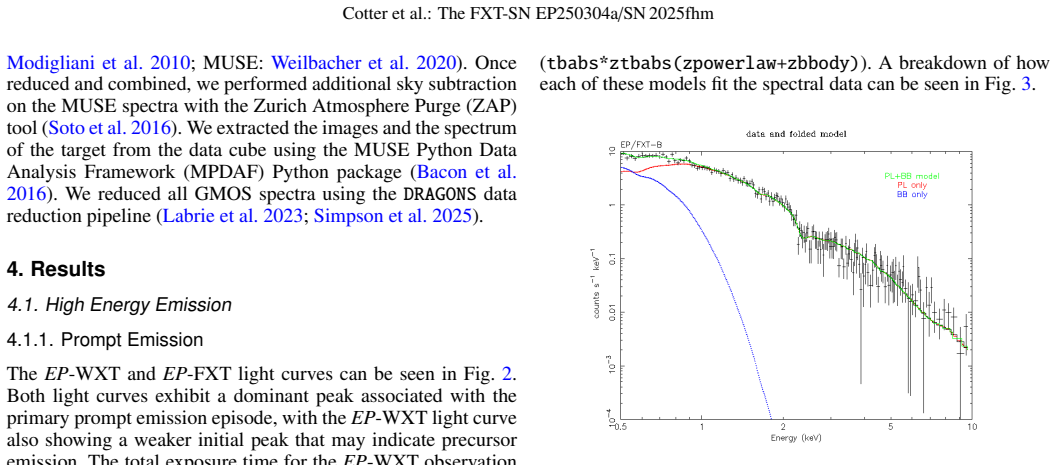
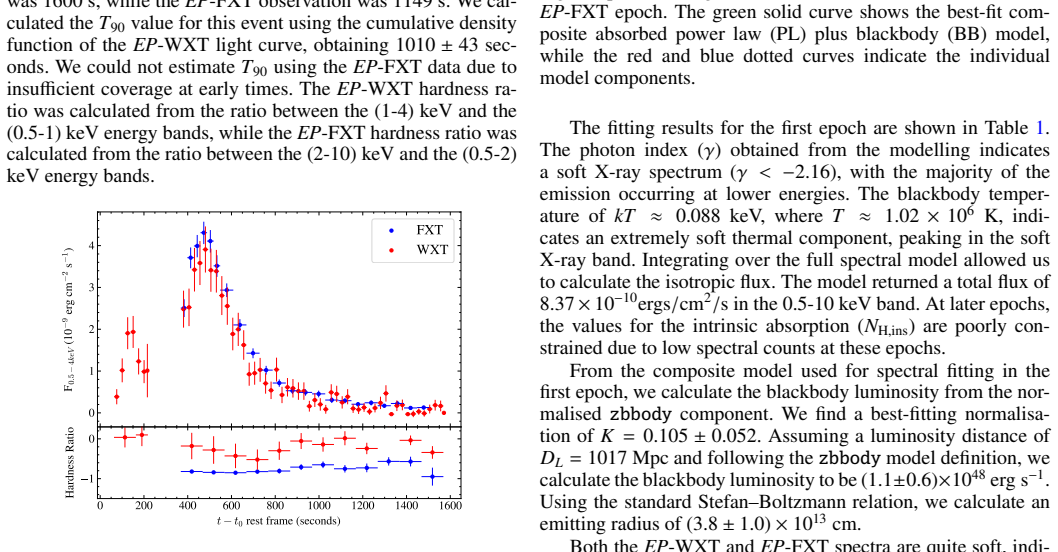
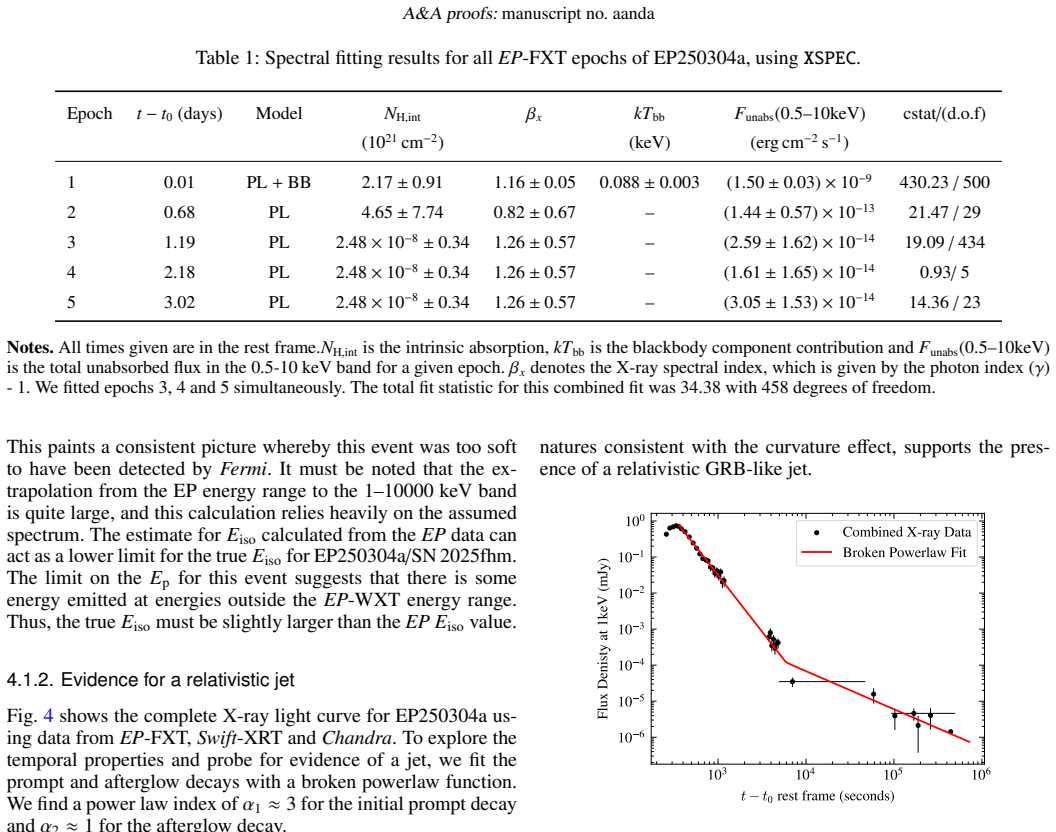
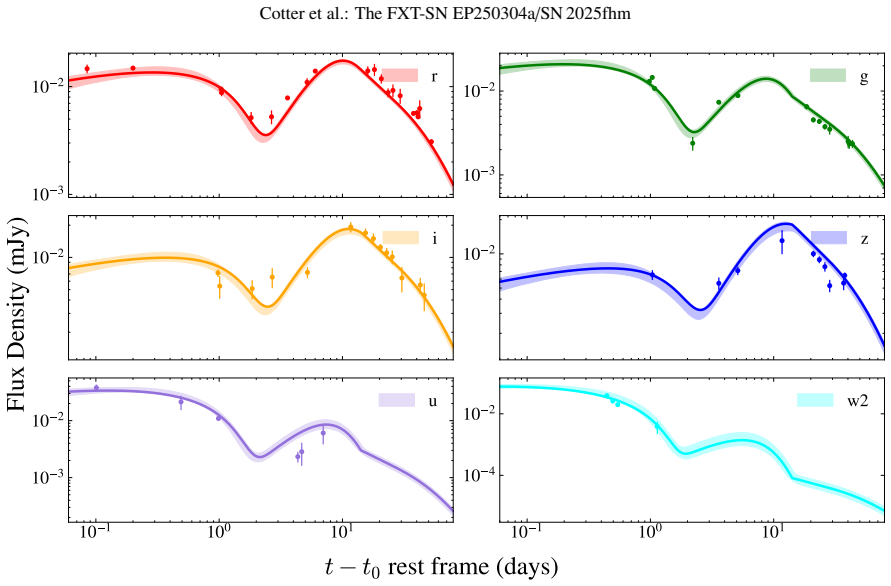
With the advent of the Einstein Probe (EP) mission, we are entering a new era in the study of gamma-ray bursts (GRBs), enabling the detection of faint, low-luminosity transients that would previously have gone undetected. EP250304a was an event discovered by EP associated with the broad-lined type Ic supernova (SN) SN 2025fhm located at z = 0.2. Despite no gamma-ray emission being detected at the time of the EP trigger, we identify evidence for a relativistic outflow consistent with a GRB-like jet across multiple wavelengths. We present a detailed spectral and photometric analysis of EP250304a/SN 2025fhm, including multi-band light curve modelling performed with the Redback Python package. We find that this event closely resembles low-luminosity GRB-SNe (llGRB-SNe) such as GRB 060218/SN 2006aj, GRB 100316D/SN 2010bh, and GRB 171205A/SN 2017iuk, all of which exhibit early-time emission consistent with a thermal shocked cocoon. These similarities suggest that EP250304A/SN 2025fhm may belong to an emerging subclass of shocked cocoon-dominated llGRB-SNe, representing the low-luminosity end of a broader continuum of engine-driven GRB-SN explosions.
Editorial analysis
A structured set of objections, weighed in public.
Referee Report
Summary. The manuscript analyzes EP250304a, an Einstein Probe transient at z=0.2 associated with broad-lined Ic SN 2025fhm. Despite the absence of detected gamma-ray emission, multi-wavelength photometry and spectroscopy are modeled with the Redback package to infer a relativistic outflow consistent with a GRB-like jet. The event is shown to resemble llGRB-SNe such as GRB 060218/SN 2006aj, GRB 100316D/SN 2010bh, and GRB 171205A/SN 2017iuk in early-time thermal emission, leading to the claim that it belongs to an emerging subclass of shocked cocoon-dominated llGRB-SNe at the low-luminosity end of a continuum of engine-driven explosions.
Significance. If the Redback-derived parameters and subclass assignment are robust, the work enlarges the sample of llGRB-SNe with cocoon signatures and strengthens the case for a continuous distribution of jet-cocoon properties across luminosities, with potential implications for the detection thresholds of future wide-field X-ray monitors.
major comments (2)
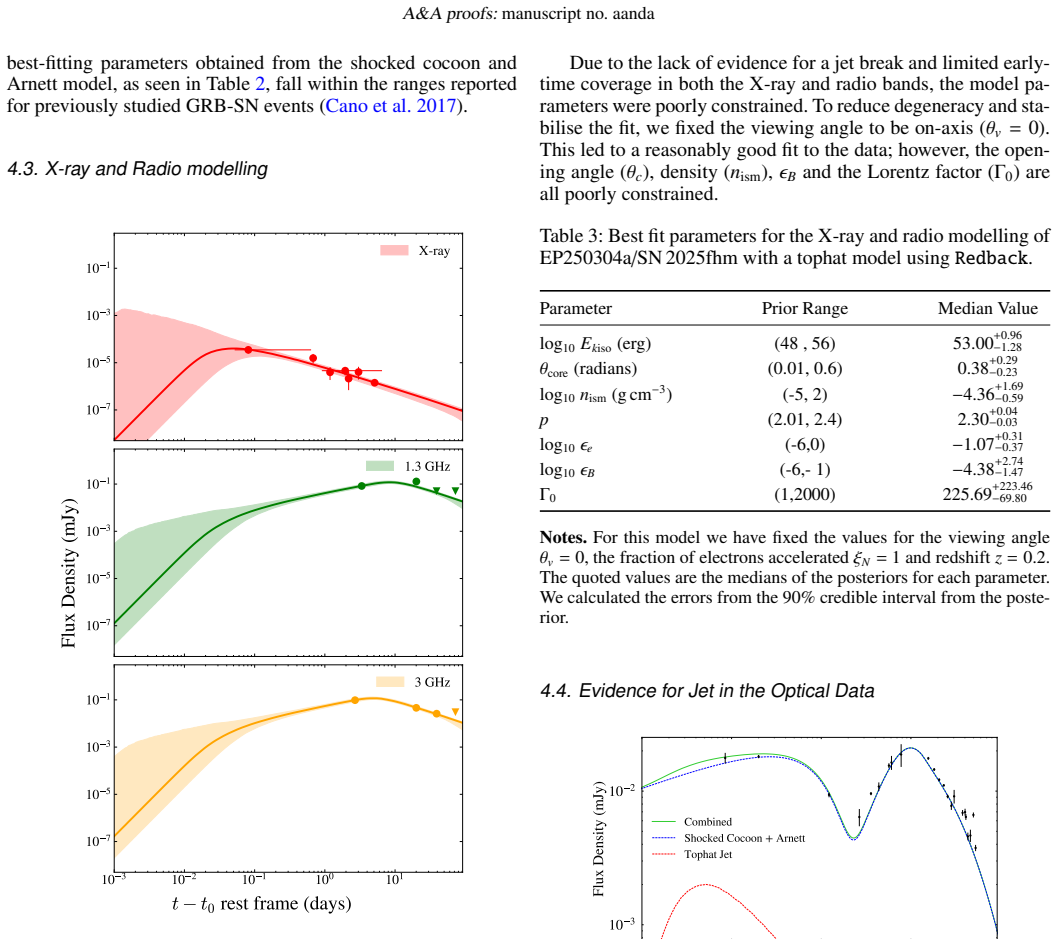
- [§4] §4 (Redback modeling section): The relativistic outflow claim (inferred Lorentz factor, cocoon energy, jet opening angle) rests on the best-fit parameters without an explicit degeneracy analysis or direct comparison to non-relativistic SN or pure-cocoon models; this is load-bearing for the GRB-like jet interpretation given the lack of gamma-ray detection.
- [§5] §5 (discussion of subclass): The 'shocked cocoon-dominated llGRB-SN' subclass is defined by qualitative resemblance of light curves and spectra to the three reference events; no quantitative metric (BIC difference, evidence ratio, or clustering statistic) is supplied to show separation from the broader llGRB-SN population rather than normal scatter.
minor comments (2)
- [Figure 2] Figure 2: The multi-band light-curve panels would benefit from explicit indication of which data points were excluded from the Redback fit and the rationale for exclusion.
- [Table 1] Table 1: The reported parameter uncertainties for the Redback fit should include the full posterior ranges or covariance information rather than only the 1σ values.
Simulated Author's Rebuttal
We thank the referee for their constructive and detailed comments on our manuscript. We address each major comment below, providing clarifications on our methodology and indicating revisions where appropriate to improve the robustness of the analysis.
read point-by-point responses
-
Referee: [§4] §4 (Redback modeling section): The relativistic outflow claim (inferred Lorentz factor, cocoon energy, jet opening angle) rests on the best-fit parameters without an explicit degeneracy analysis or direct comparison to non-relativistic SN or pure-cocoon models; this is load-bearing for the GRB-like jet interpretation given the lack of gamma-ray detection.
Authors: We agree that an explicit degeneracy analysis and direct model comparisons would strengthen the relativistic outflow interpretation, especially without a gamma-ray detection. The Redback package was selected for its ability to jointly model multi-wavelength data with relativistic jet and cocoon components, and the best-fit parameters align with those of established llGRB-SNe. To address this point, we will incorporate a degeneracy analysis and comparisons to non-relativistic and pure-cocoon models in the revised manuscript. revision: yes
-
Referee: [§5] §5 (discussion of subclass): The 'shocked cocoon-dominated llGRB-SN' subclass is defined by qualitative resemblance of light curves and spectra to the three reference events; no quantitative metric (BIC difference, evidence ratio, or clustering statistic) is supplied to show separation from the broader llGRB-SN population rather than normal scatter.
Authors: The proposed subclass relies on the shared distinctive features, particularly the early-time thermal emission and light-curve morphology, with the three reference events that are already established in the literature as cocoon-dominated. With the current small sample of llGRB-SNe, formal quantitative metrics such as BIC differences or clustering statistics are not yet statistically meaningful and are not standard for initial subclass identification in this field. We maintain that the qualitative approach, supported by the modeling, is appropriate for highlighting an emerging low-luminosity end of the continuum, though we can expand the discussion section for additional context. revision: no
Circularity Check
No significant circularity detected
full rationale
The paper's central claim—that EP250304a/SN 2025fhm belongs to an emerging subclass of shocked cocoon-dominated llGRB-SNe—is reached via external multi-wavelength comparisons to independently published events (GRB 060218/SN 2006aj, GRB 100316D/SN 2010bh, GRB 171205A/SN 2017iuk) and modeling performed with the external Redback package. No self-definitional steps, fitted inputs renamed as predictions, load-bearing self-citations, or ansatzes smuggled via prior author work are present. The derivation chain relies on external benchmarks and does not reduce to its own inputs by construction.
Axiom & Free-Parameter Ledger
Forward citations
Cited by 2 Pith papers
-
Failed jet breakout in the metal-poor broad-lined type Ic supernova 2026gzf
SN 2026gzf is interpreted as a choked-jet Ic-BL supernova in a circumstellar shell, the first such event with prompt high-energy emission but no jet breakout signature.
-
Discovery of a Supernova Following the Einstein Probe Transient EP250302a at z = 1.131
The paper identifies supernova emission matching a scaled SN 1998bw template in the late-time light curve of EP250302a at z=1.131, with early data constraining the jet Lorentz factor above 25.
Reference graph
Works this paper leans on
-
[1]
Society of Photo-Optical Instrumentation Engineers (SPIE) Conference Series , year = 2020, series =
Astrocook: your starred chef for spectral analysis. Society of Photo-Optical Instrumentation Engineers (SPIE) Conference Series , year = 2020, series =. doi:10.1117/12.2561343 , adsurl =
-
[2]
The ATLAS All-Sky Stellar Reference Catalog
The ATLAS All-Sky Stellar Reference Catalog. , keywords =. doi:10.3847/1538-4357/aae386 , archivePrefix =. 1809.09157 , primaryClass =
work page internal anchor Pith review Pith/arXiv arXiv doi:10.3847/1538-4357/aae386
-
[3]
, archivePrefix = "arXiv", eprint =
First Results from Pan-STARRS1: Faint, High Proper Motion White Dwarfs in the Medium-Deep Fields. , archivePrefix = "arXiv", eprint =. doi:10.1088/0004-637X/745/1/42 , adsurl =
-
[4]
The Pan-STARRS Data-processing System. , keywords =. doi:10.3847/1538-4365/abb829 , archivePrefix =. 1612.05240 , primaryClass =
-
[5]
Pan-STARRS Photometric and Astrometric Calibration. , keywords =. doi:10.3847/1538-4365/abb82a , archivePrefix =. 1612.05242 , primaryClass =
-
[6]
Pan-STARRS Pixel Processing: Detrending, Warping, Stacking. , keywords =. doi:10.3847/1538-4365/abb82b , archivePrefix =. 1612.05245 , primaryClass =
-
[7]
ArXiv e-prints , archivePrefix = "arXiv", eprint =
The Pan-STARRS1 Surveys. ArXiv e-prints , archivePrefix = "arXiv", eprint =
-
[8]
Handbook of X-ray and Gamma-ray Astrophysics , year = 2022, editor =
The Einstein Probe Mission. Handbook of X-ray and Gamma-ray Astrophysics , year = 2022, editor =. doi:10.1007/978-981-16-4544-0_151-1 , adsurl =
-
[9]
Einstein Probe - a small mission to monitor and explore the dynamic X-ray Universe
Einstein Probe - a small mission to monitor and explore the dynamic X-ray Universe. arXiv e-prints , keywords =. doi:10.48550/arXiv.1506.07735 , archivePrefix =. 1506.07735 , primaryClass =
work page internal anchor Pith review Pith/arXiv arXiv doi:10.48550/arxiv.1506.07735
-
[10]
Bellm, Eric C. and Kulkarni, Shrinivas R. and Barlow, Tom and Feindt, Ulrich and Graham, Matthew J. and Goobar, Ariel and Kupfer, Thomas and Ngeow, Chow-Choong and Nugent, Peter and Ofek, Eran and Prince, Thomas A. and Riddle, Reed and Walters, Richard and Ye, Quan-Zhi , year=. The Zwicky Transient Facility: Surveys and Scheduler , volume=. Publications o...
-
[11]
Two short lived X-ray transients at high galactic latitude. , keywords =. doi:10.1038/261564a0 , adsurl =
-
[12]
A fast transient source of hard X-rays at high galactic latitude. , keywords =. doi:10.1086/182152 , adsurl =
-
[13]
Jonker, P. G. and Glennie, A. and Heida, M. and Maccarone, T. and Hodgkin, S. and Nelemans, G. and Miller-Jones, J. C. A. and Torres, M. A. P. and Fender, R. , year=. DISCOVERY OF A NEW KIND OF EXPLOSIVE X-RAY TRANSIENT NEAR M86 , volume=. doi:10.1088/0004-637x/779/1/14 , journal=
-
[14]
Glennie, A. and Jonker, P. G. and Fender, R. P. and Nagayama, T. and Pretorius, M. L. , title =. , volume =. 2015 , month =. doi:10.1093/mnras/stv801 , url =
-
[15]
and Treister, Ezequiel and Schawinski, Kevin and Schulze, Steve and Luo, Bin and Alexander, David M
Bauer, Franz E. and Treister, Ezequiel and Schawinski, Kevin and Schulze, Steve and Luo, Bin and Alexander, David M. and Brandt, William N. and Comastri, Andrea and Forster, Francisco and Gilli, Roberto and Kann, David Alexander and Maeda, Keiichi and Nomoto, Ken’ichi and Paolillo, Maurizio and Ranalli, Piero and Schneider, Donald P. and Shemmer, Ohad and...
-
[16]
Discovery of Three Candidate Magnetar-powered Fast X-Ray Transients from Chandra Archival Data. , keywords =. doi:10.3847/1538-4357/ac4fc6 , archivePrefix =. 2201.06754 , primaryClass =
-
[17]
Quirola-Vásquez, J. and Bauer, F. E. and Jonker, P. G. and Brandt, W. N. and Yang, G. and Levan, A. J. and Xue, Y. Q. and Eappachen, D. and Zheng, X. C. and Luo, B. , year=. Extragalactic fast X-ray transient candidates discovered byChandra(2000–2014) , volume=. doi:10.1051/0004-6361/202243047 , journal=
-
[18]
Extragalactic fast X-ray transient candidates discovered by Chandra (2014-2022). , keywords =. doi:10.1051/0004-6361/202345912 , archivePrefix =. 2304.13795 , primaryClass =
-
[19]
Blasts from the Past: Supernova Shock Breakouts among X-Ray Transients in the XMM-Newton Archive. , keywords =. doi:10.3847/1538-4357/ab91ba , archivePrefix =. 2004.09519 , primaryClass =
-
[20]
Novara, Giovanni and Esposito, Paolo and Tiengo, Andrea and Vianello, Giacomo and Salvaterra, Ruben and Belfiore, Andrea and Luca, Andrea De and D’Avanzo, Paolo and Greiner, Jochen and Scodeggio, Marco and Rosen, Simon and Delvaux, Corentin and Pian, Elena and Campana, Sergio and Lisini, Gianni and Mereghetti, Sandro and Israel, G. L. , year=. A Supernova...
-
[21]
The Einstein Probe Transient EP240414a: Linking Fast X-Ray Transients, Gamma-Ray Bursts, and Luminous Fast Blue Optical Transients. , keywords =. doi:10.3847/2041-8213/adbc7e , archivePrefix =. 2409.19056 , primaryClass =
-
[22]
A fast X-ray transient from a weak relativistic jet associated with a type Ic-BL supernova. Nature Astronomy , keywords =. doi:10.1038/s41550-025-02571-1 , archivePrefix =. 2410.02315 , primaryClass =
-
[23]
GRB Coordinates Network , year = 2025, month = mar, volume =
EP250304a: Einstein Probe detection of an X-ray transient. GRB Coordinates Network , year = 2025, month = mar, volume =
2025
-
[24]
GRB Coordinates Network , year = 2025, month = mar, volume =
EP250304a: TRT optical counterpart detection. GRB Coordinates Network , year = 2025, month = mar, volume =
2025
-
[25]
GRB Coordinates Network , year = 2025, month = mar, volume =
EP250304a: Swift/UVOT detection of an optical counterpart with a rising light curve. GRB Coordinates Network , year = 2025, month = mar, volume =
2025
-
[26]
GRB Coordinates Network , year = 2025, month = mar, volume =
EP250304a: Swift-XRT detection of a fading X-ray source. GRB Coordinates Network , year = 2025, month = mar, volume =
2025
-
[27]
GRB Coordinates Network , year = 2025, month = mar, volume =
EP250304a: VLT/X-shooter redshift z = 0.200. GRB Coordinates Network , year = 2025, month = mar, volume =
2025
-
[28]
GRB Coordinates Network , year = 2025, month = jan, volume =
EP250108a / AT 2025kg (the ``kangaroo''): VLT/X-shooter spectroscopic redshift z = 0.176 and LFBOT classification. GRB Coordinates Network , year = 2025, month = jan, volume =
2025
-
[29]
EP250108a/SN 2025kg: A Jet-driven Stellar Explosion Interacting with Circumstellar Material. , keywords =. doi:10.3847/2041-8213/ade870 , archivePrefix =. 2504.17516 , primaryClass =
-
[30]
GRB Coordinates Network , year = 2025, month = jan, volume =
EP250108a / SN 2025kg: Refined Analysis of EP-WXT Detection. GRB Coordinates Network , year = 2025, month = jan, volume =
2025
-
[31]
The Kangaroo's First Hop: The Early Fast Cooling Phase of EP250108a/SN 2025kg. , keywords =. doi:10.3847/2041-8213/ade1d9 , archivePrefix =. 2504.08886 , primaryClass =
-
[32]
EP 250108a/SN 2025kg: Observations of the Most Nearby Broad-line Type Ic Supernova Following an Einstein Probe Fast X-Ray Transient. , keywords =. doi:10.3847/2041-8213/ade7f9 , archivePrefix =. 2504.08889 , primaryClass =
-
[33]
GRB Coordinates Network , year = 2025, month = mar, volume =
EP250304a: SVOM/VT optical observation. GRB Coordinates Network , year = 2025, month = mar, volume =
2025
-
[34]
GRB Coordinates Network , year = 2025, month = mar, volume =
EP250304a: Pan-STARRS r and i-band imaging and photometry. GRB Coordinates Network , year = 2025, month = mar, volume =
2025
-
[35]
Transient Name Server Discovery Report , keywords =
STARGATE Transient Discovery Report for 2025-03-23. Transient Name Server Discovery Report , keywords =
2025
-
[36]
The Swift Gamma-Ray Burst Mission
The Swift Gamma-Ray Burst Mission. , keywords =. doi:10.1086/422091 , archivePrefix =. astro-ph/0405233 , primaryClass =
work page internal anchor Pith review Pith/arXiv arXiv doi:10.1086/422091
-
[37]
Early X-ray and optical afterglow of gravitational wave bursts from mergers of binary neutron stars
Early X-Ray and Optical Afterglow of Gravitational Wave Bursts from Mergers of Binary Neutron Stars. , keywords =. doi:10.1088/2041-8205/763/1/L22 , archivePrefix =. 1212.0773 , primaryClass =
work page internal anchor Pith review Pith/arXiv arXiv doi:10.1088/2041-8205/763/1/l22 2041
-
[38]
Probing a magnetar origin for the population of extragalactic fast X-ray transients detected by Chandra. , keywords =. doi:10.1051/0004-6361/202347629 , archivePrefix =. 2401.01415 , primaryClass =
-
[39]
The Observable Signatures of GRB Cocoons
The Observable Signatures of GRB Cocoons. , keywords =. doi:10.3847/1538-4357/834/1/28 , archivePrefix =. 1610.05362 , primaryClass =
work page internal anchor Pith review Pith/arXiv arXiv doi:10.3847/1538-4357/834/1/28
-
[40]
Signatures of a jet cocoon in early spectra of a supernova associated with a $\gamma$-ray burst
Signatures of a jet cocoon in early spectra of a supernova associated with a -ray burst. , keywords =. doi:10.1038/s41586-018-0826-3 , archivePrefix =. 1901.05500 , primaryClass =
work page internal anchor Pith review Pith/arXiv arXiv doi:10.1038/s41586-018-0826-3 1901
-
[41]
X-ray flashes and X-ray rich Gamma Ray Bursts
X-Ray Flashes and X-Ray Counterparts of Gamma-Ray Bursts. Gamma-Ray Burst and Afterglow Astronomy 2001: A Workshop Celebrating the First Year of the HETE Mission , year = 2003, editor =. doi:10.1063/1.1579346 , archivePrefix =. astro-ph/0111246 , primaryClass =
work page internal anchor Pith review Pith/arXiv arXiv doi:10.1063/1.1579346 2001
-
[42]
Global Characteristics of X-Ray Flashes and X-Ray-Rich Gamma-Ray Bursts Observed by HETE-2. , keywords =. doi:10.1086/431235 , adsurl =
-
[43]
On the nature of X-Ray Flashes
On the nature of X-ray flashes. , keywords =. doi:10.1051/0004-6361:20041572 , archivePrefix =. astro-ph/0507173 , primaryClass =
work page internal anchor Pith review Pith/arXiv arXiv doi:10.1051/0004-6361:20041572
-
[44]
Virgili, Francisco J. and Liang, En-Wei and Zhang, Bing , year=. Low-luminosity gamma-ray bursts as a distinct GRB population: a firmer case from multiple criteria constraints , volume=. , publisher=. doi:10.1111/j.1365-2966.2008.14063.x , number=
-
[45]
Rise and fall of the X-ray flash 080330: an off-axis jet?
Rise and fall of the X-ray flash 080330: an off-axis jet?. , keywords =. doi:10.1051/0004-6361/200911719 , archivePrefix =. 0903.2958 , primaryClass =
work page internal anchor Pith review Pith/arXiv arXiv doi:10.1051/0004-6361/200911719
-
[46]
Failed gamma-ray bursts and orphan afterglows. , keywords =. doi:10.1046/j.1365-8711.2002.05334.x , archivePrefix =. astro-ph/0112469 , primaryClass =
-
[47]
Nature Astronomy , year = 2025, month = sep, volume =
Fast X-ray transient EP240315A from a Lyman-continuum-leaking galaxy at z 5. Nature Astronomy , year = 2025, month = sep, volume =. doi:10.1038/s41550-025-02612-9 , adsurl =
-
[48]
The shock break-out of GRB 060218/SN 2006aj
Campana, S. and others. The shock break-out of grb 060218/sn 2006aj. Nature. 2006. doi:10.1038/nature04892. arXiv:astro-ph/0603279
work page internal anchor Pith review Pith/arXiv arXiv doi:10.1038/nature04892 2006
-
[49]
An optical supernova associated with the X-ray flash XRF 060218
An optical supernova associated with the X-ray flash XRF 060218. , keywords =. doi:10.1038/nature05082 , archivePrefix =. astro-ph/0603530 , primaryClass =
work page internal anchor Pith review Pith/arXiv arXiv doi:10.1038/nature05082
-
[50]
A neutron-star-driven X-ray flash associated with supernova SN 2006aj
A neutron-star-driven X-ray flash associated with supernova SN 2006aj. , keywords =. doi:10.1038/nature05081 , archivePrefix =. astro-ph/0603567 , primaryClass =
work page internal anchor Pith review Pith/arXiv arXiv doi:10.1038/nature05081
-
[51]
Relativistic ejecta from XRF 060218 and the rate of cosmic explosions
Relativistic ejecta from X-ray flash XRF 060218 and the rate of cosmic explosions. , keywords =. doi:10.1038/nature05087 , archivePrefix =. astro-ph/0604389 , primaryClass =
work page internal anchor Pith review Pith/arXiv arXiv doi:10.1038/nature05087
-
[52]
An extremely luminous X-ray outburst at the birth of a supernova
An extremely luminous X-ray outburst at the birth of a supernova. , keywords =. doi:10.1038/nature06997 , archivePrefix =. 0802.1712 , primaryClass =
work page internal anchor Pith review Pith/arXiv arXiv doi:10.1038/nature06997
-
[53]
and Fryer, Chris and Brown, Peter J
Bayless, Amanda J. and Fryer, Chris and Brown, Peter J. and Young, Patrick A. and Roming, Peter W. A. and Davis, Michael and Lechner, Thomas and Slocum, Samuel and Echon, Janie D. and Froning, Cynthia S. , year=. Supernova Shock Breakout/Emergence Detection Predictions for a Wide-field X-Ray Survey , volume=. The Astrophysical Journal , publisher=. doi:10...
-
[54]
GRB Coordinates Network , year = 2025, month = mar, volume =
EP250304a: VLT/MUSE spectroscopic observation of its associated supernova SN 2025fhm. GRB Coordinates Network , year = 2025, month = mar, volume =
2025
-
[55]
GRB Coordinates Network , year = 2025, month = mar, volume =
EP250304a: Chandra detection. GRB Coordinates Network , year = 2025, month = mar, volume =
2025
-
[56]
GRB Coordinates Network , year = 2025, month = mar, volume =
EP250304a: refined analysis of the EP-WXT and EP-FXT observations. GRB Coordinates Network , year = 2025, month = mar, volume =
2025
-
[57]
HEAsoft: Unified Release of FTOOLS and XANADU
-
[58]
Further calibration of the Swift ultraviolet/optical telescope. , keywords =. doi:10.1111/j.1365-2966.2010.16832.x , archivePrefix =. 1004.2448 , primaryClass =
-
[59]
XRF 100316D / SN 2010bh and the Nature of Gamma Ray Burst Supernovae
XRF 100316D/SN 2010bh and the Nature of Gamma-Ray Burst Supernovae. , keywords =. doi:10.1088/0004-637X/740/1/41 , archivePrefix =. 1104.5141 , primaryClass =
work page internal anchor Pith review Pith/arXiv arXiv doi:10.1088/0004-637x/740/1/41
-
[60]
The Fast Evolution of SN 2010bh associated with XRF 100316D
The fast evolution of SN 2010bh associated with XRF 100316D. , keywords =. doi:10.1051/0004-6361/201117929 , archivePrefix =. 1110.4109 , primaryClass =
work page internal anchor Pith review Pith/arXiv arXiv doi:10.1051/0004-6361/201117929
-
[61]
The Highly Energetic Expansion of SN2010bh Associated with GRB 100316D
The Highly Energetic Expansion of SN 2010bh Associated with GRB 100316D. , keywords =. doi:10.1088/0004-637X/753/1/67 , archivePrefix =. 1111.4527 , primaryClass =
work page internal anchor Pith review Pith/arXiv arXiv doi:10.1088/0004-637x/753/1/67
-
[62]
GRB171205A/SN2017iuk: A local low-luminosity gamma-ray burst
GRB 171205A/SN 2017iuk: A local low-luminosity gamma-ray burst. , keywords =. doi:10.1051/0004-6361/201833847 , archivePrefix =. 1810.03339 , primaryClass =
work page internal anchor Pith review Pith/arXiv arXiv doi:10.1051/0004-6361/201833847
-
[63]
An online repository of Swift/XRT light curves of GRBs
An online repository of Swift/XRT light curves of -ray bursts. , keywords =. doi:10.1051/0004-6361:20077530 , archivePrefix =. 0704.0128 , primaryClass =
work page internal anchor Pith review Pith/arXiv arXiv doi:10.1051/0004-6361:20077530
-
[64]
Methods and results of an automatic analysis of a complete sample of Swift-XRT observations of GRBs. , keywords =. doi:10.1111/j.1365-2966.2009.14913.x , archivePrefix =. 0812.3662 , primaryClass =
-
[65]
Supernova 2006aj and the associated X-Ray Flash 060218
Supernova 2006aj and the associated X-Ray Flash 060218. , keywords =. doi:10.1051/0004-6361:20065226 , archivePrefix =. astro-ph/0603495 , primaryClass =
work page internal anchor Pith review Pith/arXiv arXiv doi:10.1051/0004-6361:20065226
-
[66]
Discovery of the peculiar supernova 1998bw in the error box of GRB980425
An unusual supernova in the error box of the -ray burst of 25 April 1998. , keywords =. doi:10.1038/27150 , archivePrefix =. astro-ph/9806175 , primaryClass =
work page internal anchor Pith review Pith/arXiv arXiv doi:10.1038/27150 1998
-
[67]
The Observer's Guide to the Gamma-Ray Burst-Supernova Connection
The Observer's Guide to the Gamma-Ray Burst Supernova Connection. Advances in Astronomy , keywords =. doi:10.1155/2017/8929054 , archivePrefix =. 1604.03549 , primaryClass =
work page internal anchor Pith review Pith/arXiv arXiv doi:10.1155/2017/8929054 2017
-
[68]
SkyMapper Southern Survey: Data release 4. , keywords =. doi:10.1017/pasa.2024.53 , archivePrefix =. 2402.02015 , primaryClass =
-
[69]
X-shooter, the new wide band intermediate resolution spectrograph at the ESO Very Large Telescope
X-shooter, the new wide band intermediate resolution spectrograph at the ESO Very Large Telescope. , keywords =. doi:10.1051/0004-6361/201117752 , archivePrefix =. 1110.1944 , primaryClass =
work page internal anchor Pith review Pith/arXiv arXiv doi:10.1051/0004-6361/201117752 1944
-
[70]
Observatory Operations: Strategies, Processes, and Systems III , year = 2010, editor =
The X-shooter pipeline. Observatory Operations: Strategies, Processes, and Systems III , year = 2010, editor =. doi:10.1117/12.857211 , adsurl =
-
[71]
The Messenger , keywords =
Successful commissioning of FORS1 - the first optical instrument on the VLT. The Messenger , keywords =
-
[72]
Observatory Operations: Strategies, Processes, and Systems III , year = 2010, editor =
The new FORS pipeline. Observatory Operations: Strategies, Processes, and Systems III , year = 2010, editor =. doi:10.1117/12.858043 , adsurl =
-
[73]
Ground-based and Airborne Instrumentation for Astronomy III , year = 2010, editor =
The MUSE second-generation VLT instrument. Ground-based and Airborne Instrumentation for Astronomy III , year = 2010, editor =. doi:10.1117/12.856027 , archivePrefix =. 2211.16795 , primaryClass =
-
[74]
The data processing pipeline for the MUSE instrument. , keywords =. doi:10.1051/0004-6361/202037855 , archivePrefix =. 2006.08638 , primaryClass =
-
[75]
The Gemini-North Multi-Object Spectrograph: Performance in Imaging, Long-Slit, and Multi-Object Spectroscopic Modes. , keywords =. doi:10.1086/383624 , adsurl =
-
[76]
Research Notes of the American Astronomical Society , keywords =
DRAGONS-A Quick Overview. Research Notes of the American Astronomical Society , keywords =. doi:10.3847/2515-5172/ad0044 , archivePrefix =. 2310.03048 , primaryClass =
-
[77]
doi:10.5281/zenodo.4025470 , version =
DRAGONS. doi:10.5281/zenodo.4025470 , version =
-
[78]
The Dark Energy Camera. , keywords =. doi:10.1088/0004-6256/150/5/150 , archivePrefix =. 1504.02900 , primaryClass =
work page internal anchor Pith review Pith/arXiv arXiv doi:10.1088/0004-6256/150/5/150
-
[79]
REDBACK: a Bayesian inference software package for electromagnetic transients. , keywords =. doi:10.1093/mnras/stae1238 , archivePrefix =. 2308.12806 , primaryClass =
-
[80]
nessai: Nested sampling with artificial intelligence
discussion (0)
Sign in with ORCID, Apple, or X to comment. Anyone can read and Pith papers without signing in.