Discovery of a Supernova Following the Einstein Probe Transient EP250302a at z = 1.131
Pith reviewed 2026-06-27 02:31 UTC · model grok-4.3
The pith
Late-time optical excess after EP250302a matches scaled SN 1998bw, linking the X-ray transient to a massive-star death at z=1.131
A machine-rendered reading of the paper's core claim, the machinery that carries it, and where it could break.
Core claim
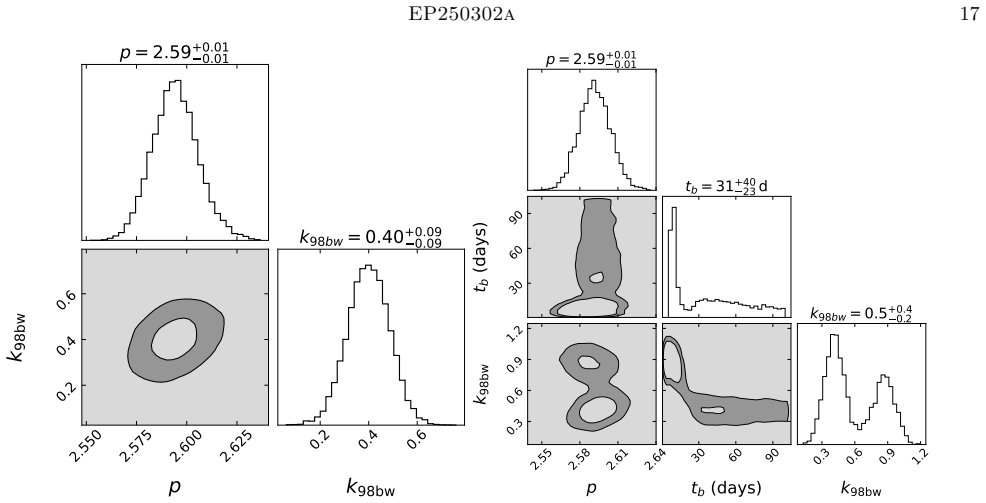
The event exhibits an optical excess at 20-30 days post-explosion that is interpreted as supernova emission and shows good agreement with the canonical broad-lined Ic SN 1998bw after a flux-scaling factor of k_98bw > 0.3, adding to evidence that the majority of EP FXTs are associated with the deaths of massive stars.
What carries the argument
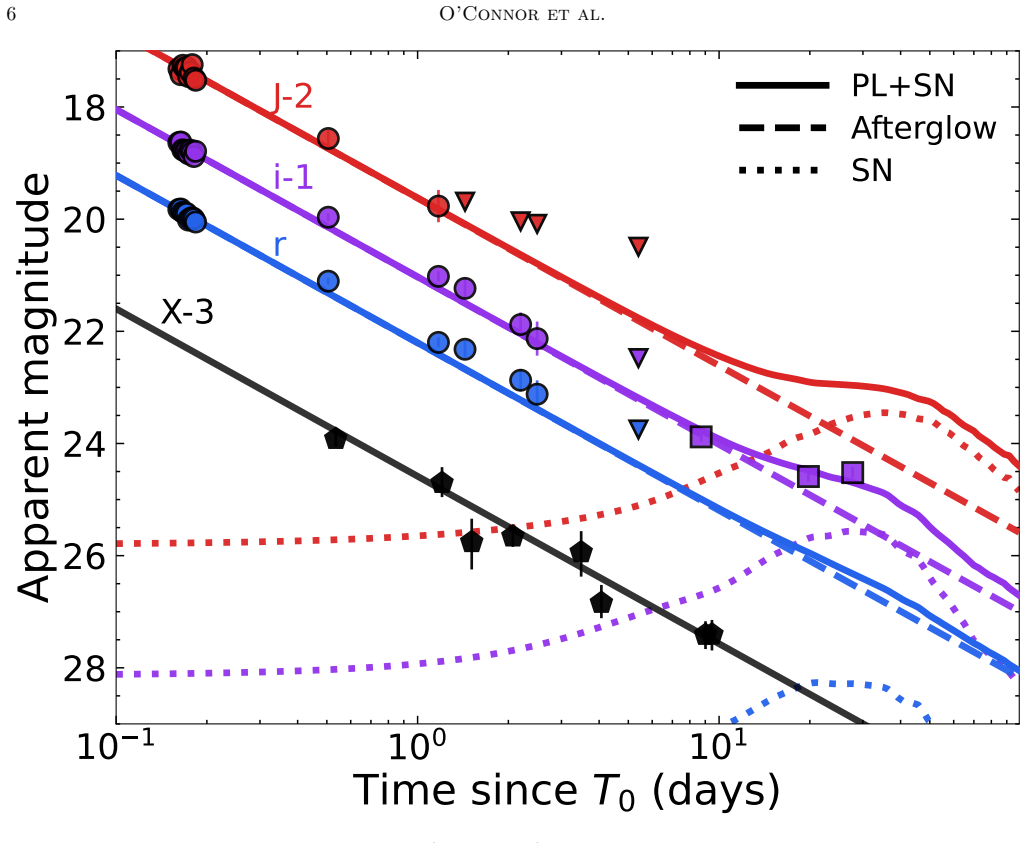
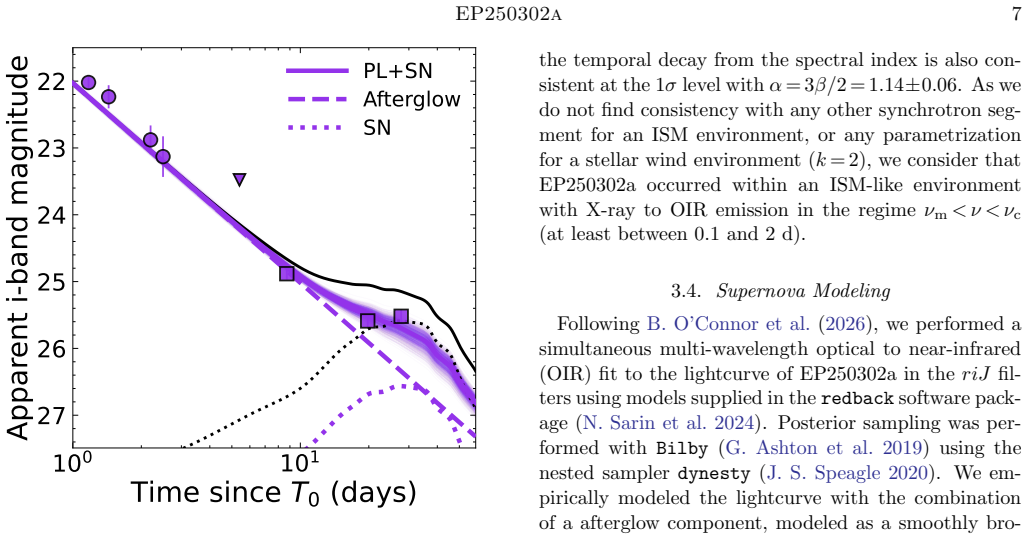
Late-time optical excess at 20-30 days, isolated from the afterglow decay and matched to the SN 1998bw template after redshift and extinction corrections.
If this is right
- The outflow must be ultrarelativistic with initial Lorentz factor greater than 25, constrained by the early optical data.
- The chromatic flare is consistent with either a refreshed shock from shell collision or reverse-shock emission.
- Most Einstein Probe fast X-ray transients are expected to arise from massive-star core collapse even when undetected in gamma rays.
- The absence of a gamma-ray counterpart does not preclude a supernova association for this class of events.
Where Pith is reading between the lines
- Targeted late-time monitoring campaigns on future EP FXTs could systematically test whether the supernova fraction approaches 100 percent.
- If the k > 0.3 scaling holds across the population, off-axis or low-energy jet models may unify these events with classical gamma-ray bursts.
- Host-galaxy spectroscopy at similar redshifts would allow direct comparison of explosion-site metallicities with local broad-lined Ic supernovae.
Load-bearing premise
The late-time optical excess is produced by supernova emission rather than residual afterglow, host-galaxy variability, or other contaminants.
What would settle it
A spectrum at 25 days showing no broad supernova features or a light curve that falls well below the scaled 1998bw template after the same corrections would rule out the supernova interpretation.
Figures


read the original abstract
We present a multi-wavelength analysis of the Einstein Probe (EP) fast X-ray transient (FXT) EP250302a located at redshift $z=1.131$. Despite its luminous prompt X-ray emission, the event was not detected in gamma-rays. Multi-wavelength follow-up identified a bright optical and X-ray source that displayed rapid chromatic flaring before returning to the standard decay of a gamma-ray burst afterglow. We interpret the chromatic flare as either due to a refreshed shock caused by a discrete shell collision or as reverse shock emission. Using the early optical data, we place constraints on the Lorentz factor of the outflow, requiring an ultrarelativistic jet with $\Gamma_0>25$. We additionally obtained deep late-time imaging with the Gemini North Telescope that reveals the presence of an optical excess at $20-30$ d post-explosion. We interpret this as supernova (SN) emission and find good agreement with the canonical broad-lined Ic SN 1998bw with a flux-scaling factor of $k_\textrm{98bw}>0.3$. This adds to the growing evidence that the majority of EP FXTs are associated with the deaths of massive stars.
Editorial analysis
A structured set of objections, weighed in public.
Referee Report
Summary. The paper reports multi-wavelength observations of the Einstein Probe FXT EP250302a at z=1.131, including chromatic flaring interpreted as refreshed shock or reverse shock emission, an ultrarelativistic outflow with Gamma_0>25 from early optical data, standard afterglow decay, and a late-time (20-30 d) optical excess from Gemini imaging interpreted as supernova emission matching a flux-scaled SN 1998bw template with k_98bw>0.3. This is presented as evidence linking EP FXTs to massive-star deaths.
Significance. If the supernova identification holds after quantitative validation, the result provides a high-redshift anchor point strengthening the association between EP FXTs and core-collapse events, complementing lower-z examples. The Lorentz-factor lower limit and chromatic-flare modeling also add to the parameter space of relativistic outflows in these transients.
major comments (3)
- [Abstract / late-time analysis] Abstract and late-time section: the claim of 'good agreement' with the SN 1998bw template scaled by k_98bw>0.3 supplies neither fit statistics (chi-squared, degrees of freedom, or residual plots) nor the explicit k-correction and extinction-correction procedure applied to the template at z=1.131, where observed optical bands sample rest-UV wavelengths.
- [Late-time imaging] Late-time imaging paragraph: no afterglow model parameters, decay indices, or extrapolation to 20-30 d are provided, nor is the host-subtraction method described, preventing assessment of whether the reported excess is isolated from residual afterglow or host variability.
- [Abstract] Abstract: alternative explanations for the 20-30 d excess (shallower afterglow decay, incomplete subtraction, or host contamination) receive no quantitative exclusion tests or upper limits, leaving the supernova interpretation without demonstrated robustness against these contaminants.
minor comments (1)
- [Abstract] The abstract refers to 'standard decay of a gamma-ray burst afterglow' without quoting the measured temporal index or citing the relevant light-curve figure or section.
Simulated Author's Rebuttal
We thank the referee for their constructive and detailed comments, which help clarify the presentation of our results on EP250302a. We address each major comment below and will revise the manuscript accordingly to strengthen the supernova identification and supporting analyses.
read point-by-point responses
-
Referee: [Abstract / late-time analysis] Abstract and late-time section: the claim of 'good agreement' with the SN 1998bw template scaled by k_98bw>0.3 supplies neither fit statistics (chi-squared, degrees of freedom, or residual plots) nor the explicit k-correction and extinction-correction procedure applied to the template at z=1.131, where observed optical bands sample rest-UV wavelengths.
Authors: We agree that the current manuscript lacks explicit quantitative support for the template comparison. In the revised version we will report chi-squared per degree of freedom for the scaled SN 1998bw match, include a residual plot or table of residuals, and provide a step-by-step description of the k-correction (using the SN 1998bw spectrum shifted to z=1.131) together with the adopted extinction corrections. The k_98bw>0.3 value already incorporates these steps; the added material will make the procedure fully reproducible. revision: yes
-
Referee: [Late-time imaging] Late-time imaging paragraph: no afterglow model parameters, decay indices, or extrapolation to 20-30 d are provided, nor is the host-subtraction method described, preventing assessment of whether the reported excess is isolated from residual afterglow or host variability.
Authors: We acknowledge the omission. The revised manuscript will tabulate the best-fit afterglow parameters (including the temporal decay index), show the extrapolated afterglow flux at 20–30 d, and describe the host-subtraction procedure (including the reference image used and the aperture photometry details). These additions will allow direct verification that the reported excess lies above the extrapolated afterglow plus any residual host contribution. revision: yes
-
Referee: [Abstract] Abstract: alternative explanations for the 20-30 d excess (shallower afterglow decay, incomplete subtraction, or host contamination) receive no quantitative exclusion tests or upper limits, leaving the supernova interpretation without demonstrated robustness against these contaminants.
Authors: We will add quantitative tests in the revised text. These will include (i) an upper limit on host-galaxy contamination derived from the depth of the Gemini imaging, (ii) a comparison of the observed decay index against the range allowed for a shallower afterglow component, and (iii) a check on subtraction residuals. The results will be presented as explicit upper limits or exclusion significance to demonstrate that the supernova interpretation remains the most parsimonious explanation. revision: yes
Circularity Check
No significant circularity; SN association rests on external template comparison
full rationale
The paper's central claim is that late-time optical excess matches the known SN 1998bw template after k-correction and scaling (k_98bw>0.3). This uses an external, independently observed supernova as benchmark rather than defining any quantity in terms of itself or renaming a fit as a prediction. No equations reduce the result to inputs by construction, and no load-bearing self-citations or ansatzes are invoked. The analysis is self-contained against external benchmarks, consistent with a low circularity score.
Axiom & Free-Parameter Ledger
free parameters (1)
- k_98bw
axioms (2)
- domain assumption Redshift z=1.131 corresponds to a known luminosity distance under standard cosmology
- domain assumption The optical excess at 20-30 days is not produced by afterglow, host variability, or instrumental artifacts
Reference graph
Works this paper leans on
-
[1]
2025, GRB Coordinates Network, 39560, 1
Adami, C., Schneider, B., Basa, S., et al. 2025, GRB Coordinates Network, 39560, 1
2025
-
[2]
2020, ApJ, 896, 39, doi: 10.3847/1538-4357/ab91ba
Alp, D., & Larsson, J. 2020, ApJ, 896, 39, doi: 10.3847/1538-4357/ab91ba
-
[3]
Arnaud, K. A. 1996, in Astronomical Society of the Pacific Conference Series, Vol. 101, Astronomical Data Analysis Software and Systems V, ed. G. H. Jacoby & J. Barnes, 17
1996
-
[4]
Ashton, G., H¨ ubner, M., Lasky, P. D., et al. 2019, ApJS, 241, 27, doi: 10.3847/1538-4365/ab06fc Astropy Collaboration, Price-Whelan, A. M., Sip˝ ocz, B. M., et al. 2018, AJ, 156, 123, doi: 10.3847/1538-3881/aabc4f Astropy Collaboration, Price-Whelan, A. M., Lim, P. L., et al. 2022, ApJ, 935, 167, doi: 10.3847/1538-4357/ac7c74
-
[5]
1993, ApJ, 413, 281, doi: 10.1086/172995
Band, D., Matteson, J., Ford, L., et al. 1993, ApJ, 413, 281, doi: 10.1086/172995
-
[6]
2016,, Astrophysics Source Code Library, record ascl:1611.017 http://ascl.net/1611.017
Barbary, K., Barclay, T., Biswas, R., et al. 2016,, Astrophysics Source Code Library, record ascl:1611.017 http://ascl.net/1611.017
2016
-
[7]
E., Treister, E., Schawinski, K., et al
Bauer, F. E., Treister, E., Schawinski, K., et al. 2017, MNRAS, 467, 4841, doi: 10.1093/mnras/stx417
-
[8]
2006, in Astronomical Society of the Pacific Conference Series, Vol
Bertin, E. 2006, in Astronomical Society of the Pacific Conference Series, Vol. 351, Astronomical Data Analysis Software and Systems XV, ed. C. Gabriel, C. Arviset, D. Ponz, & S. Enrique, 112
2006
-
[9]
2010, http://ascl.net/1010.068
Bertin, E. 2010, http://ascl.net/1010.068
2010
-
[10]
Bertin, E., & Arnouts, S. 1996, A&AS, 117, 393, doi: 10.1051/aas:1996164 EP250302a17 p = 2.59+0.01 0.01 2.550 2.575 2.600 2.625 p 0.2 0.4 0.6 k98bw 0.2 0.4 0.6 k98bw k98bw = 0.40+0.09 0.09 p = 2.59+0.01 0.01 30 60 90 tb (days) tb = 31+40 23 d 2.55 2.58 2.61 2.64 p 0.3 0.6 0.9 1.2 k98bw 30 60 90 tb (days) 0.3 0.6 0.9 1.2 k98bw k98bw = 0.5+0.4 0.2 Figure 7....
-
[11]
2024, astropy/photutils: 2.0.2, 2.0.2 Zenodo, 10.5281/zenodo.13989456
Bradley, L., Sip˝ ocz, B., Robitaille, T., et al. 2024,, 2.0.2 Zenodo, doi: 10.5281/zenodo.13989456
-
[12]
Breeveld, A. A., Landsman, W., Holland, S. T., et al. 2011, in American Institute of Physics Conference Series, Vol. 1358, Gamma Ray Bursts 2010, ed. J. E. McEnery, J. L. Racusin, & N. Gehrels, 373–376, doi: 10.1063/1.3621807
-
[13]
Robust constraints on neutrino properties
Breeveld, A. A., Curran, P. A., Hoversten, E. A., et al. 2010, MNRAS, 406, 1687, doi: 10.1111/j.1365-2966.2010.16832.x
-
[14]
Burrows, D. N., Hill, J. E., Nousek, J. A., et al. 2005a, SSRv, 120, 165, doi: 10.1007/s11214-005-5097-2
work page internal anchor Pith review doi:10.1007/s11214-005-5097-2
-
[15]
N., Romano, P., Falcone, A., et al
Burrows, D. N., Romano, P., Falcone, A., et al. 2005b, Science, 309, 1833, doi: 10.1126/science.1116168
-
[16]
2025b, arXiv e-prints, arXiv:2503.14588, doi: 10.48550/arXiv.2503.14588
Busmann, M., O’Connor, B., Sommer, J., et al. 2025b, arXiv e-prints, arXiv:2503.14588, doi: 10.48550/arXiv.2503.14588
-
[17]
2006, A&A, 454, 113, doi: 10.1051/0004-6361:20064856
Campana, S., Tagliaferri, G., Lazzati, D., et al. 2006, A&A, 454, 113, doi: 10.1051/0004-6361:20064856
-
[18]
2017, Advances in Astronomy, 2017, 8929054, doi: 10.1155/2017/8929054
Cano, Z., Wang, S.-Q., Dai, Z.-G., & Wu, X.-F. 2017, Advances in Astronomy, 2017, 8929054, doi: 10.1155/2017/8929054
-
[19]
2014, A&A, 568, A19, doi: 10.1051/0004-6361/201423920
Cano, Z., de Ugarte Postigo, A., Pozanenko, A., et al. 2014, A&A, 568, A19, doi: 10.1051/0004-6361/201423920
-
[20]
Cenko, S. B., Kelemen, J., Harrison, F. A., et al. 2009, ApJ, 693, 1484, doi: 10.1088/0004-637X/693/2/1484
-
[21]
Chambers, K. C., Magnier, E. A., Metcalfe, N., et al. 2016, arXiv e-prints, arXiv:1612.05560. https://arxiv.org/abs/1612.05560
Pith/arXiv arXiv 2016
-
[22]
Decadal pre-explosion activity and circumstellar interaction in a supernova
Chen, T.-W., Aryan, A., Yang, S., et al. 2026, arXiv e-prints, arXiv:2606.10009, doi: 10.48550/arXiv.2606.10009
work page internal anchor Pith review Pith/arXiv arXiv doi:10.48550/arxiv.2606.10009 2026
-
[23]
Cotter, L., Martin-Carrillo, A., Eyles-Ferris, R. A. J., et al. 2026, arXiv e-prints, arXiv:2606.06213. https://arxiv.org/abs/2606.06213
Pith/arXiv arXiv 2026
-
[24]
Y., Zhao, Y
Dai, C. Y., Zhao, Y. Q., Mao, X., et al. 2025, GRB Coordinates Network, 39556, 1
2025
-
[25]
Dainotti, M. G., De Simone, B., Malik, R. F. M., et al. 2024, MNRAS, doi: 10.1093/mnras/stae1484 de Ugarte Postigo, A., Th¨ one, C. C., Bensch, K., et al. 2018, A&A, 620, A190, doi: 10.1051/0004-6361/201833636 D’Elia, V., Campana, S., D’A` ı, A., et al. 2018, A&A, 619, A66, doi: 10.1051/0004-6361/201833847
-
[26]
P., et al
Eappachen, D., Swain, V., Saikia, A. P., et al. 2025, GRB Coordinates Network, 39575, 1
2025
-
[27]
Eyles-Ferris, R. A. J., Jonker, P. G., Levan, A. J., et al. 2025, arXiv e-prints, arXiv:2504.08886. https://arxiv.org/abs/2504.08886
arXiv 2025
-
[28]
D., Morris, D., Racusin, J., et al
Falcone, A. D., Morris, D., Racusin, J., et al. 2007, ApJ, 671, 1921, doi: 10.1086/523296
-
[29]
2011, A&A, 526, A113, doi: 10.1051/0004-6361/201015320
Filgas, R., Kr¨ uhler, T., Greiner, J., et al. 2011, A&A, 526, A113, doi: 10.1051/0004-6361/201015320
-
[30]
Foreman-Mackey, D. 2016, The Journal of Open Source Software, 1, 24, doi: 10.21105/joss.00024 18O’Connor et al
-
[31]
Foreman-Mackey, D., Hogg, D. W., Lang, D., & Goodman, J. 2013, PASP, 125, 306, doi: 10.1086/670067
-
[32]
Fruscione, A., McDowell, J. C., Allen, G. E., et al. 2006, in Society of Photo-Optical Instrumentation Engineers (SPIE) Conference Series, Vol. 6270, Observatory Operations: Strategies, Processes, and Systems, ed. D. R. Silva & R. E. Doxsey, 62701V, doi: 10.1117/12.671760
-
[33]
Fu, S.-Y., Dai, C.-Y., Wang, A.-L., et al. 2026, arXiv e-prints, arXiv:2604.14341, doi: 10.48550/arXiv.2604.14341
work page internal anchor Pith review Pith/arXiv arXiv doi:10.48550/arxiv.2604.14341 2026
-
[34]
Galama, T. J., Vreeswijk, P. M., van Paradijs, J., et al. 1998a, Nature, 395, 670, doi: 10.1038/27150
-
[35]
Galama, T. J., Groot, P. J., van Paradijs, J., et al. 1998b, ApJL, 497, L13, doi: 10.1086/311268
-
[36]
2015, ApJ, 810, 160, doi: 10.1088/0004-637X/810/2/160
Gao, H., Wang, X.-G., M´ esz´ aros, P., & Zhang, B. 2015, ApJ, 810, 160, doi: 10.1088/0004-637X/810/2/160
-
[37]
2024, arXiv e-prints, arXiv:2410.21687
Gao, H.-X., Geng, J.-J., Wu, X.-F., et al. 2024, arXiv e-prints, arXiv:2410.21687. https://arxiv.org/abs/2410.21687
arXiv 2024
-
[38]
2004, ApJ, 611, 1005, doi: 10.1086/422091
Gehrels, N., Chincarini, G., Giommi, P., et al. 2004, ApJ, 611, 1005, doi: 10.1086/422091
-
[39]
Ghirlanda, G., Ghisellini, G., Nava, L., et al. 2012, MNRAS, 422, 2553, doi: 10.1111/j.1365-2966.2012.20815.x
-
[40]
2018, A&A, 609, A112, doi: 10.1051/0004-6361/201731598
Ghirlanda, G., Nappo, F., Ghisellini, G., et al. 2018, A&A, 609, A112, doi: 10.1051/0004-6361/201731598
-
[41]
Ghisellini, G., Ghirlanda, G., Nava, L., & Celotti, A. 2010, MNRAS, 403, 926, doi: 10.1111/j.1365-2966.2009.16171.x
-
[42]
2025, arXiv e-prints, arXiv:2505.05444, doi: 10.48550/arXiv.2505.05444
Gianfagna, G., Piro, L., Bruni, G., et al. 2025, arXiv e-prints, arXiv:2505.05444, doi: 10.48550/arXiv.2505.05444
-
[43]
H., Rhodes, L., Srivastav, S., et al
Gillanders, J. H., Rhodes, L., Srivastav, S., et al. 2024, ApJL, 969, L14, doi: 10.3847/2041-8213/ad55cd
-
[44]
Pretorius, M. L. 2015, MNRAS, 450, 3765, doi: 10.1093/mnras/stv801
-
[45]
Gorbovskoy, E. S., Lipunova, G. V., Lipunov, V. M., et al. 2012, MNRAS, 421, 1874, doi: 10.1111/j.1365-2966.2012.20195.x G¨ ossl, C. A., & Riffeser, A. 2002, A&A, 381, 1095, doi: 10.1051/0004-6361:20011522
-
[46]
2001, ApJL, 551, L63, doi: 10.1086/319843
Granot, J., & Loeb, A. 2001, ApJL, 551, L63, doi: 10.1086/319843
-
[47]
2003, Nature, 426, 138, doi: 10.1038/426138a
Granot, J., Nakar, E., & Piran, T. 2003, Nature, 426, 138, doi: 10.1038/426138a
-
[48]
2002, ApJ, 568, 820, doi: 10.1086/338966
Granot, J., & Sari, R. 2002, ApJ, 568, 820, doi: 10.1086/338966
-
[49]
2013, A&A, 560, A70, doi: 10.1051/0004-6361/201321284
Greiner, J., Kr¨ uhler, T., Nardini, M., et al. 2013, A&A, 560, A70, doi: 10.1051/0004-6361/201321284
-
[50]
Grossan, B., Kumar, P., & Smoot, G. F. 2019, Journal of High Energy Astrophysics, 23, 14, doi: 10.1016/j.jheap.2019.08.001
-
[51]
2022, in Society of Photo-Optical Instrumentation Engineers (SPIE) Conference Series, Vol
Grossan, B., Maksut, Z., Komesh, T., & Krugov, M. 2022, in Society of Photo-Optical Instrumentation Engineers (SPIE) Conference Series, Vol. 12184, Ground-based and Airborne Instrumentation for Astronomy IX, ed. C. J
2022
-
[52]
Evans, J. J. Bryant, & K. Motohara, 121848A, doi: 10.1117/12.2630491
-
[53]
2025, arXiv e-prints, arXiv:2503.16243, doi: 10.48550/arXiv.2503.16243
Hamidani, H., Sato, Y., Kashiyama, K., et al. 2025, arXiv e-prints, arXiv:2503.16243, doi: 10.48550/arXiv.2503.16243
-
[54]
Hjorth, J., & Bloom, J. S. 2012, in Chapter 9 in ”Gamma-Ray Bursts, ed. C. Kouveliotou, R. A. M. J. Wijers, & S. Woosley, 169–190, doi: 10.48550/arXiv.1104.2274
work page internal anchor Pith review Pith/arXiv arXiv doi:10.48550/arxiv.1104.2274 2012
-
[55]
2003, Nature, 423, 847, doi: 10.1038/nature01750
Hjorth, J., Sollerman, J., Møller, P., et al. 2003, Nature, 423, 847, doi: 10.1038/nature01750
-
[56]
M., Jørgensen, I., Allington-Smith, J
Hook, I. M., Jørgensen, I., Allington-Smith, J. R., et al. 2004, PASP, 116, 425, doi: 10.1086/383624
-
[57]
2014, in Society of Photo-Optical Instrumentation Engineers (SPIE) Conference Series, Vol
Hopp, U., Bender, R., Grupp, F., et al. 2014, in Society of Photo-Optical Instrumentation Engineers (SPIE) Conference Series, Vol. 9145, Ground-based and Airborne Telescopes V, ed. L. M. Stepp, R. Gilmozzi, & H. J. Hall, 91452D, doi: 10.1117/12.2054498
-
[58]
2022, ApJ, 936, 157, doi: 10.3847/1538-4357/ac7394
Hu, L., Wang, L., Chen, X., & Yang, J. 2022, ApJ, 936, 157, doi: 10.3847/1538-4357/ac7394
-
[59]
2019, Nature, 565, 324, doi: 10.1038/s41586-018-0826-3
Izzo, L., de Ugarte Postigo, A., Maeda, K., et al. 2019, Nature, 565, 324, doi: 10.1038/s41586-018-0826-3
-
[60]
Jiang, S.-Q., Xu, D., van Hoof, A. P. C., et al. 2025, arXiv e-prints, arXiv:2503.04306, doi: 10.48550/arXiv.2503.04306
-
[61]
G., Glennie, A., Heida, M., et al
Jonker, P. G., Glennie, A., Heida, M., et al. 2013, ApJ, 779, 14, doi: 10.1088/0004-637X/779/1/14
-
[62]
2025, GRB Coordinates Network, 39612, 1
Junjie-Jin, Haiyang-Mu, Jinlei-Zhang, et al. 2025, GRB Coordinates Network, 39612, 1
2025
-
[63]
Kann, D. A., Klose, S., & Zeh, A. 2006, ApJ, 641, 993, doi: 10.1086/500652
-
[64]
A., Klose, S., Zhang, B., et al
Kann, D. A., Klose, S., Zhang, B., et al. 2010, ApJ, 720, 1513, doi: 10.1088/0004-637X/720/2/1513
-
[65]
A., Klose, S., Zhang, B., et al
Kann, D. A., Klose, S., Zhang, B., et al. 2011, ApJ, 734, 96, doi: 10.1088/0004-637X/734/2/96
-
[66]
Kann, D. A., Schady, P., Olivares, E. F., et al. 2018, A&A, 617, A122, doi: 10.1051/0004-6361/201731292
-
[67]
2000, ApJ, 545, 807, doi: 10.1086/317869 EP250302a19
Kobayashi, S. 2000, ApJ, 545, 807, doi: 10.1086/317869 EP250302a19
-
[68]
2003, ApJL, 582, L75, doi: 10.1086/367691
Kobayashi, S., & Zhang, B. 2003, ApJL, 582, L75, doi: 10.1086/367691
-
[69]
2025, GRB Coordinates Network, 39569, 1
Komesh, T., Abdullayev, Z., Maksut, Z., et al. 2025, GRB Coordinates Network, 39569, 1
2025
-
[70]
Kouveliotou, C., Meegan, C. A., Fishman, G. J., et al. 1993, ApJL, 413, L101, doi: 10.1086/186969
-
[71]
2000, ApJ, 532, 286, doi: 10.1086/308537
Kumar, P., & Piran, T. 2000, ApJ, 532, 286, doi: 10.1086/308537
-
[72]
Turner, J. E. H. 2019, in Astronomical Society of the Pacific Conference Series, Vol. 523, Astronomical Data Analysis Software and Systems XXVII, ed. P. J. Teuben, M. W. Pound, B. A. Thomas, & E. M. Warner, 321
2019
-
[73]
2023, Research Notes of the American Astronomical Society, 7, 214, doi: 10.3847/2515-5172/ad0044
Labrie, K., Simpson, C., Cardenes, R., et al. 2023, Research Notes of the American Astronomical Society, 7, 214, doi: 10.3847/2515-5172/ad0044
-
[74]
2016, in Society of Photo-Optical Instrumentation Engineers (SPIE) Conference Series, Vol
Lang-Bardl, F., Bender, R., Goessl, C., et al. 2016, in Society of Photo-Optical Instrumentation Engineers (SPIE) Conference Series, Vol. 9908, Ground-based and Airborne Instrumentation for Astronomy VI, ed. C. J
2016
-
[75]
Evans, L. Simard, & H. Takami, 990844, doi: 10.1117/12.2232039
-
[76]
2015, ApJ, 814, 1, doi: 10.1088/0004-637X/814/1/1
Laskar, T., Berger, E., Margutti, R., et al. 2015, ApJ, 814, 1, doi: 10.1088/0004-637X/814/1/1
-
[77]
Levan, A. J., Jonker, P. G., Saccardi, A., et al. 2024, arXiv e-prints, arXiv:2404.16350, doi: 10.48550/arXiv.2404.16350
-
[78]
Li, W. X., Zhu, Z. P., Zou, X. Z., et al. 2025, arXiv e-prints, arXiv:2504.17034. https://arxiv.org/abs/2504.17034
arXiv 2025
-
[79]
2025, Nature Astronomy, doi: 10.1038/s41550-024-02449-8
Liu, Y., Sun, H., Xu, D., et al. 2025, Nature Astronomy, doi: 10.1038/s41550-024-02449-8
-
[80]
1998, ApJ, 495, 597, doi: 10.1086/305337
Loeb, A., & Perna, R. 1998, ApJ, 495, 597, doi: 10.1086/305337
discussion (0)
Sign in with ORCID, Apple, or X to comment. Anyone can read and Pith papers without signing in.