Towards the Readability of LLM-Generated Codes through Multitask Representation Engineering
Pith reviewed 2026-06-28 00:16 UTC · model grok-4.3
The pith
Multitask RepE framework steers readability in LLM-generated code and analyzes its tradeoff with correctness.
A machine-rendered reading of the paper's core claim, the machinery that carries it, and where it could break.
Core claim
The central claim is that the multitask RepE framework enables control of code readability across multiple tasks, and that the multitask steering method impacts the tradeoff between readability and correctness in LLM-generated codes.
What carries the argument
The multitask RepE framework, which applies representation engineering across multiple tasks to steer code readability.
If this is right
- Readability becomes steerable at low data and computational cost compared with task-specific fine-tuning.
- A quantifiable tradeoff arises between readability gains and any loss in functional correctness under multitask steering.
- The same steering vectors can be reused across related code-generation tasks without retraining.
- Open-source implementations allow direct replication and extension to new code properties.
Where Pith is reading between the lines
- The same multitask steering approach could be tested on other subjective code attributes such as maintainability or security posture.
- Integration with existing LLM inference pipelines might reduce reliance on prompt engineering for style control.
- The tradeoff analysis could inform decisions about when to apply readability steering versus accepting default model output.
Load-bearing premise
Readability is a controllable property via representation engineering in a multitask setting and the theoretical tradeoff analysis holds without post-hoc adjustments.
What would settle it
An experiment in which the multitask steering vectors are applied and neither readability metrics improve nor the predicted tradeoff between readability and correctness appears.
Figures

read the original abstract
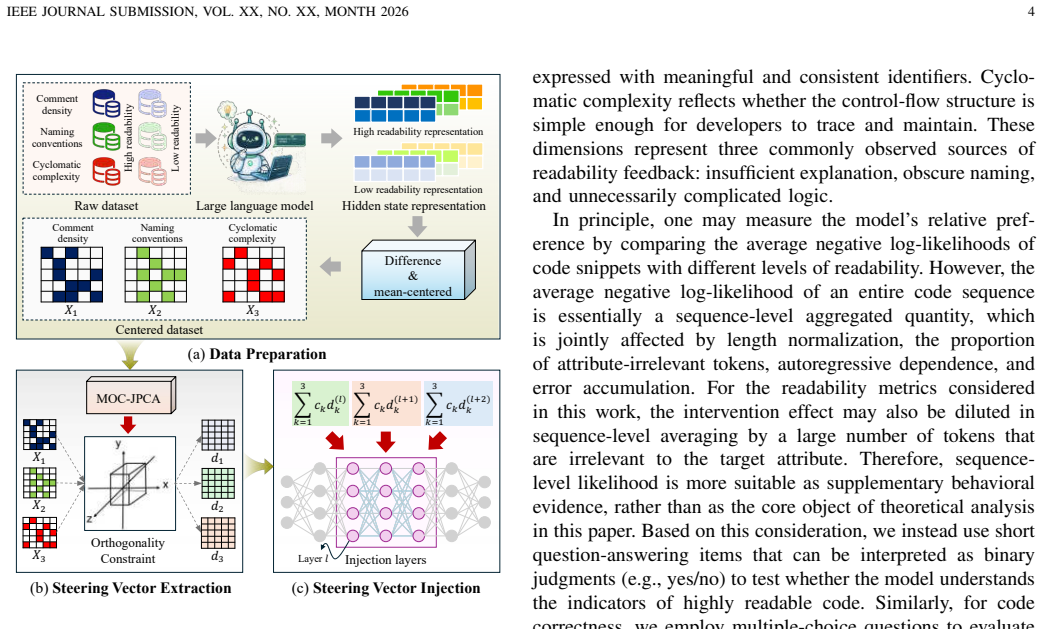
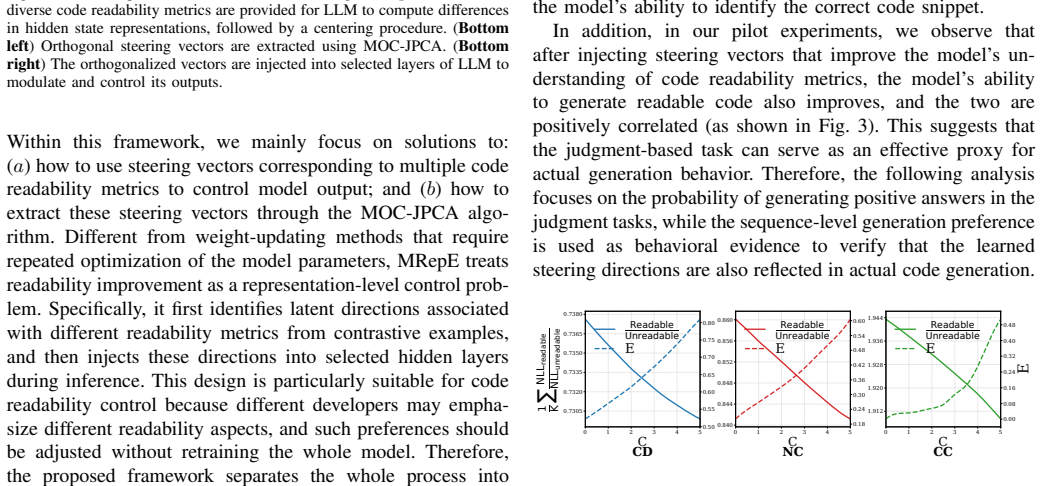
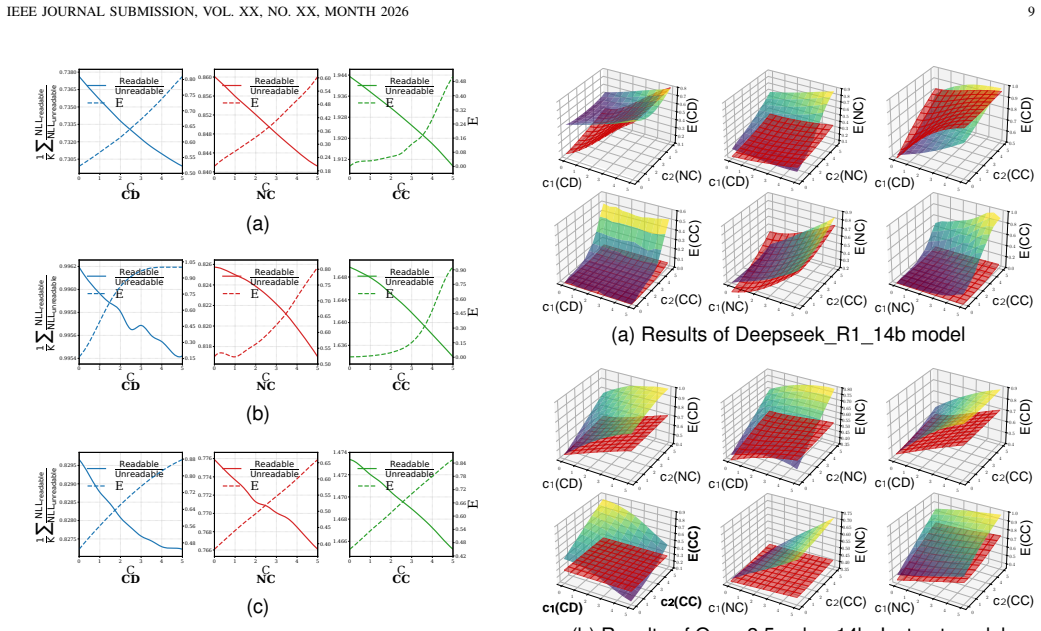
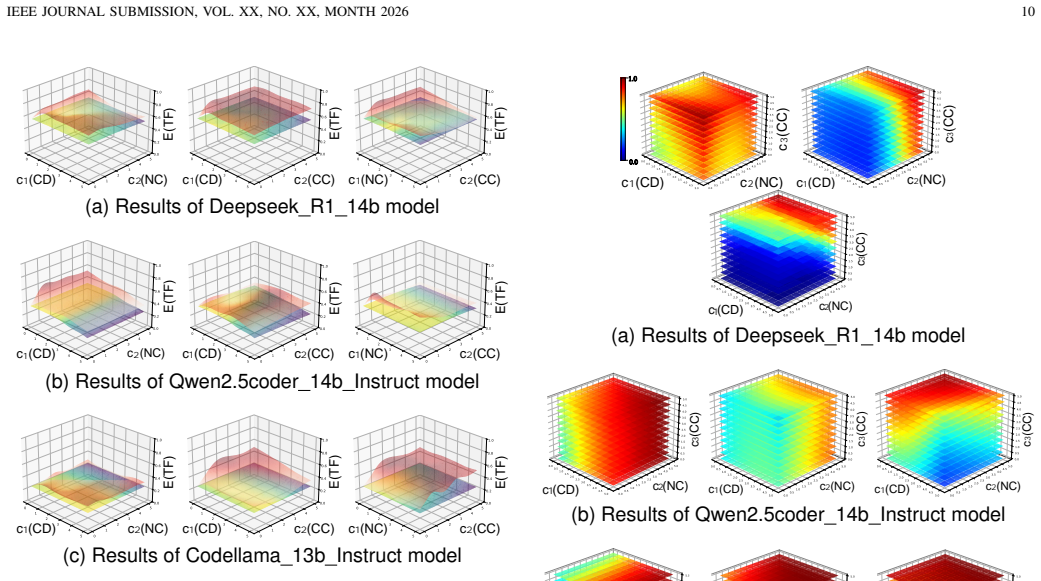
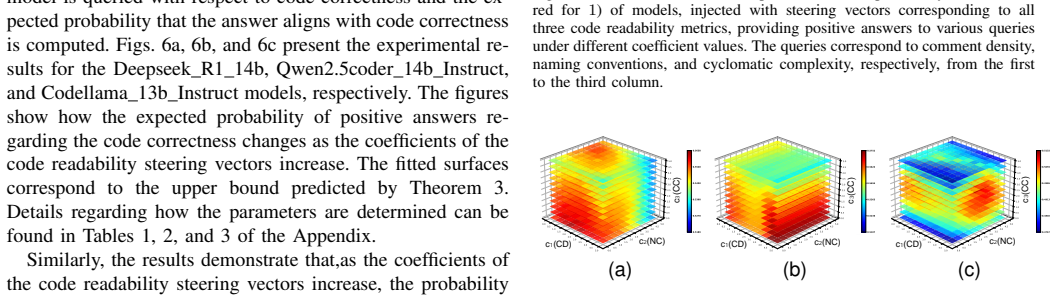
Correctness and readability are key measures of code quality, respectively ensuring functional fidelity and ease of comprehension. While most existing research focuses on improving the correctness of large language models~(LLMs) generated codes, readability remains under-addressed. Enhancing readability through targeted control is challenging due to its subjective nature. In this article, we employ representation engineering~(RepE) as the targeted control method given its characteristics of low data dependency and low computational cost. Prior work on RepE has primarily focused on the targeted control for a single task, but improving the code readability requires the control across multiple tasks. Accordingly we proposes the multitask RepE framework and theoretically discuss the impact of the multitask steering method on the tradeoff between the code readability and correctness. We further provide comprehensive experiments in support. All the relevant implementations are open-source and available upon request.
Editorial analysis
A structured set of objections, weighed in public.
Referee Report
Summary. The paper proposes a multitask Representation Engineering (RepE) framework to control readability of LLM-generated code across multiple tasks, theoretically discusses the impact of multitask steering on the readability-correctness tradeoff, and reports supporting experiments. Implementations are stated to be open-source.
Significance. If the multitask RepE enables controllable readability steering with a formally derived and empirically validated tradeoff against correctness, the approach could supply a low-data, low-compute method for jointly optimizing multiple code-quality dimensions in LLMs.
major comments (1)
- [Abstract / theoretical discussion] Abstract and theoretical discussion section: the manuscript asserts a 'theoretical discussion' of the multitask steering method's impact on the readability-correctness tradeoff, yet no explicit construction (combined steering vector formula, orthogonality condition, or bounded interference term between task-specific directions) is supplied. Without such a derivation the tradeoff claim remains qualitative rather than predictive, which is load-bearing for the central contribution.
minor comments (2)
- [Abstract] Abstract: 'we proposes the multitask RepE framework' is a subject-verb agreement error and should read 'we propose'.
- [Abstract] Abstract: the claim that 'all the relevant implementations are open-source and available upon request' should be accompanied by a concrete repository URL or DOI to enable immediate verification and reuse.
Simulated Author's Rebuttal
We thank the referee for the constructive feedback on our manuscript. We address the single major comment below and will incorporate the requested formalization in the revision.
read point-by-point responses
-
Referee: [Abstract / theoretical discussion] Abstract and theoretical discussion section: the manuscript asserts a 'theoretical discussion' of the multitask steering method's impact on the readability-correctness tradeoff, yet no explicit construction (combined steering vector formula, orthogonality condition, or bounded interference term between task-specific directions) is supplied. Without such a derivation the tradeoff claim remains qualitative rather than predictive, which is load-bearing for the central contribution.
Authors: We agree that the current theoretical discussion is qualitative and does not supply an explicit construction. In the revised manuscript we will add a formal derivation in the theoretical section: the multitask steering vector is defined as a convex combination of task-specific RepE directions, we state the orthogonality condition required for minimal interference, and we derive a simple bound on the interference term that quantifies the expected degradation in correctness. The abstract will be updated to reflect this explicit treatment. These additions will make the readability-correctness tradeoff predictive rather than descriptive. revision: yes
Circularity Check
No circularity; no equations, fits, or self-citation chains exhibited
full rationale
The provided abstract and description contain no equations, derivations, fitted parameters, or self-citations. The claim of a 'theoretical discussion' of the readability-correctness tradeoff is stated but not formalized with any model, vector formula, or reduction that could be inspected for equivalence to inputs. Per rules, circularity requires explicit quotes showing a step that reduces by construction; none exist here. The derivation chain is therefore not shown to be self-referential.
Axiom & Free-Parameter Ledger
Reference graph
Works this paper leans on
-
[1]
Spinellis,Code quality: the open source perspective
D. Spinellis,Code quality: the open source perspective. Adobe Press, 2006
2006
-
[2]
Improving source code readability: Theory and practice,
S. Fakhoury, D. Roy, A. Hassan, and V . Arnaoudova, “Improving source code readability: Theory and practice,” in2019 IEEE/ACM 27th International Conference on Program Comprehension (ICPC). IEEE, 2019, pp. 2–12
2019
-
[3]
Learning a metric for code readability,
R. P. Buse and W. R. Weimer, “Learning a metric for code readability,” IEEE Transactions on software engineering, vol. 36, no. 4, pp. 546–558, 2009
2009
-
[4]
A simpler model of software readability,
D. Posnett, A. Hindle, and P. Devanbu, “A simpler model of software readability,” inProceedings of the 8th working conference on mining software repositories, 2011, pp. 73–82
2011
-
[5]
Automatically assessing code understandability: How far are we?
S. Scalabrino, G. Bavota, C. Vendome, M. Linares-V ´asquez, D. Poshy- vanyk, and R. Oliveto, “Automatically assessing code understandability: How far are we?” in2017 32nd IEEE/ACM International Conference on Automated Software Engineering (ASE). IEEE, 2017, pp. 417–427
2017
-
[6]
Krzysztof and U
C. Krzysztof and U. W. Eisenecker,Generative Programming: Methods, Tools and Applications. Addison-Wesley, 2000
2000
-
[7]
A neural proba- bilistic language model,
Y . Bengio, R. Ducharme, P. Vincent, and C. Jauvin, “A neural proba- bilistic language model,”Journal of machine learning research, vol. 3, no. Feb, pp. 1137–1155, 2003
2003
-
[8]
code2vec: Learning distributed representations of code,
U. Alon, M. Zilberstein, O. Levy, and E. Yahav, “code2vec: Learning distributed representations of code,”Proceedings of the ACM on Pro- gramming Languages, vol. 3, no. POPL, pp. 1–29, 2019
2019
-
[9]
A review on code generation with llms: Application and evaluation,
J. Wang and Y . Chen, “A review on code generation with llms: Application and evaluation,” in2023 IEEE International Conference on Medical Artificial Intelligence (MedAI). IEEE, 2023, pp. 284–289
2023
-
[10]
A Survey on Large Language Models for Code Generation
J. Jiang, F. Wang, J. Shen, S. Kim, and S. Kim, “A survey on large language models for code generation,”arXiv preprint arXiv:2406.00515, 2024
work page internal anchor Pith review Pith/arXiv arXiv 2024
-
[11]
Code readability in the age of large language models: An industrial case study from atlassian,
W. Takerngsaksiri, C. Tantithamthavorn, M. Fu, J. Pasuksmit, K. Chen, and M. Wu, “Code readability in the age of large language models: An industrial case study from atlassian,” in2025 IEEE International Conference on Software Maintenance and Evolution (ICSME). IEEE, 2025, pp. 732–742
2025
-
[12]
D. Zhang, N. R. A. Arias, Y . He, and S. Kovalchuk, “Style2code: A style-controllable code generation framework with dual-modal con- trastive representation learning,”arXiv preprint arXiv:2505.19442, 2025
-
[13]
Representation Engineering: A Top-Down Approach to AI Transparency
A. Zou, L. Phan, S. Chen, J. Campbell, P. Guo, R. Ren, A. Pan, X. Yin, M. Mazeika, A.-K. Dombrowskiet al., “Representation en- gineering: a top-down approach to ai transparency,”ArXiv Preprint arXiv:2310.01405, 2023
work page internal anchor Pith review Pith/arXiv arXiv 2023
-
[14]
Tradeoffs between alignment and helpfulness in language models with steering methods,
Y . Wolf, N. Wies, D. Shteyman, B. Rothberg, Y . Levine, and A. Shashua, “Tradeoffs between alignment and helpfulness in language models with steering methods,” inICLR 2025 Workshop on Foundation Models in the Wild, 2025
2025
-
[15]
Badam: A memory efficient full parameter optimization method for large language models,
Q. Luo, H. Yu, and X. Li, “Badam: A memory efficient full parameter optimization method for large language models,”Advances in Neural Information Processing Systems, vol. 37, pp. 24 926–24 958, 2024
2024
-
[16]
Federated full- parameter tuning of billion-sized language models with communication cost under 18 kilobytes,
Z. Qin, D. Chen, B. Qian, B. Ding, Y . Li, and S. Deng, “Federated full- parameter tuning of billion-sized language models with communication cost under 18 kilobytes,” inInternational Conference on Machine Learning. PMLR, 2024, pp. 41 473–41 497
2024
-
[17]
Full parameter fine-tuning for large language models with limited resources,
K. Lv, Y . Yang, T. Liu, Q. Guo, and X. Qiu, “Full parameter fine-tuning for large language models with limited resources,” inProceedings of the 62nd Annual Meeting of the Association for Computational Linguistics (Volume 1: Long Papers), 2024, pp. 8187–8198
2024
-
[18]
Qlora: Efficient finetuning of quantized llms,
T. Dettmers, A. Pagnoni, A. Holtzman, and L. Zettlemoyer, “Qlora: Efficient finetuning of quantized llms,”Advances in neural information processing systems, vol. 36, pp. 10 088–10 115, 2023
2023
-
[19]
Adaptive budget allocation for parameter-efficient fine-tuning,
Q. Zhang, M. Chen, A. Bukharin, P. He, Y . Cheng, W. Chen, and T. Zhao, “Adaptive budget allocation for parameter-efficient fine-tuning,” inInternational Conference on Learning Representations. Openreview, 2023
2023
-
[20]
Llama-adapter: Efficient fine-tuning of large language models with zero-initialized attention,
R. Zhang, J. Han, C. Liu, A. Zhou, P. Lu, Y . Qiao, H. Li, and P. Gao, “Llama-adapter: Efficient fine-tuning of large language models with zero-initialized attention,” inThe Twelfth International Conference on Learning Representations, 2024. IEEE JOURNAL SUBMISSION, VOL. XX, NO. XX, MONTH 2026 12
2024
-
[21]
Training language models to follow instructions with human feedback,
L. Ouyang, J. Wu, X. Jiang, D. Almeida, C. Wainwright, P. Mishkin, C. Zhang, S. Agarwal, K. Slama, A. Rayet al., “Training language models to follow instructions with human feedback,”Advances in neural information processing systems, vol. 35, pp. 27 730–27 744, 2022
2022
-
[22]
Rrhf: Rank responses to align language models with human feedback,
H. Yuan, Z. Yuan, C. Tan, W. Wang, S. Huang, and F. Huang, “Rrhf: Rank responses to align language models with human feedback,”Ad- vances in Neural Information Processing Systems, vol. 36, pp. 10 935– 10 950, 2023
2023
-
[23]
Orpo: Monolithic preference optimiza- tion without reference model,
J. Hong, N. Lee, and J. Thorne, “Orpo: Monolithic preference optimiza- tion without reference model,” inProceedings of the 2024 Conference on Empirical Methods in Natural Language Processing, 2024, pp. 11 170– 11 189
2024
-
[24]
Richtungsfelder und fernparallelismus in n-dimensionalen mannigfaltigkeiten,
E. Stiefel, “Richtungsfelder und fernparallelismus in n-dimensionalen mannigfaltigkeiten,” Ph.D. dissertation, ETH Zurich, 1935
1935
-
[25]
Correctness assessment of code generated by large language models using internal representations,
T.-D. Bui, T. T. Vu, T.-T. Nguyen, S. Nguyen, and H. D. V o, “Correctness assessment of code generated by large language models using internal representations,”arXiv preprint arXiv:2501.12934, 2025
-
[26]
Towards understanding code readability and its impact on design quality,
U. A. Mannan, I. Ahmed, and A. Sarma, “Towards understanding code readability and its impact on design quality,” inProceedings of the 4th ACM SIGSOFT International Workshop on NLP for Software Engineering, 2018, pp. 18–21
2018
-
[27]
Extending activa- tion steering to broad skills and multiple behaviours,
T. van der Weij, M. Poesio, and N. Schoots, “Extending activa- tion steering to broad skills and multiple behaviours,”arXiv preprint arXiv:2403.05767, 2024
-
[28]
Program Synthesis with Large Language Models
J. Austin, A. Odena, M. Nye, M. Bosma, H. Michalewski, D. Dohan, E. Jiang, C. Cai, M. Terry, Q. Leet al., “Program synthesis with large language models,”arXiv preprint arXiv:2108.07732, 2021
work page internal anchor Pith review Pith/arXiv arXiv 2021
-
[29]
DeepSeek-R1: Incentivizing Reasoning Capability in LLMs via Reinforcement Learning
D. Guo, D. Yang, H. Zhang, J. Song, R. Zhang, R. Xu, Q. Zhu, S. Ma, P. Wang, X. Biet al., “Deepseek-r1: Incentivizing reasoning capability in llms via reinforcement learning,”arXiv preprint arXiv:2501.12948, 2025
work page internal anchor Pith review Pith/arXiv arXiv 2025
-
[30]
Qwen2.5-Coder Technical Report
B. Hui, J. Yang, Z. Cui, J. Yang, D. Liu, L. Zhang, T. Liu, J. Zhang, B. Yu, K. Luet al., “Qwen2. 5-coder technical report,”arXiv preprint arXiv:2409.12186, 2024
work page internal anchor Pith review Pith/arXiv arXiv 2024
-
[31]
Code Llama: Open Foundation Models for Code
B. Roziere, J. Gehring, F. Gloeckle, S. Sootla, I. Gat, X. E. Tan, Y . Adi, J. Liu, R. Sauvestre, T. Remezet al., “Code llama: Open foundation models for code,”arXiv preprint arXiv:2308.12950, 2023
work page internal anchor Pith review Pith/arXiv arXiv 2023
discussion (0)
Sign in with ORCID, Apple, or X to comment. Anyone can read and Pith papers without signing in.