EDIT: Evidence-Diagnosed Intervention Training for Rule-Faithful LLM Grading
Pith reviewed 2026-06-28 01:29 UTC · model grok-4.3
The pith
EDIT trains LLM graders to follow rubrics by using internal signals to locate and correct flawed reasoning steps.
A machine-rendered reading of the paper's core claim, the machinery that carries it, and where it could break.
Core claim
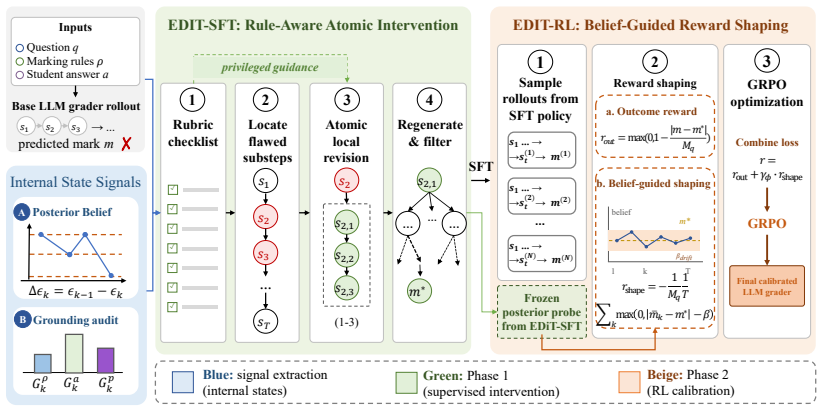
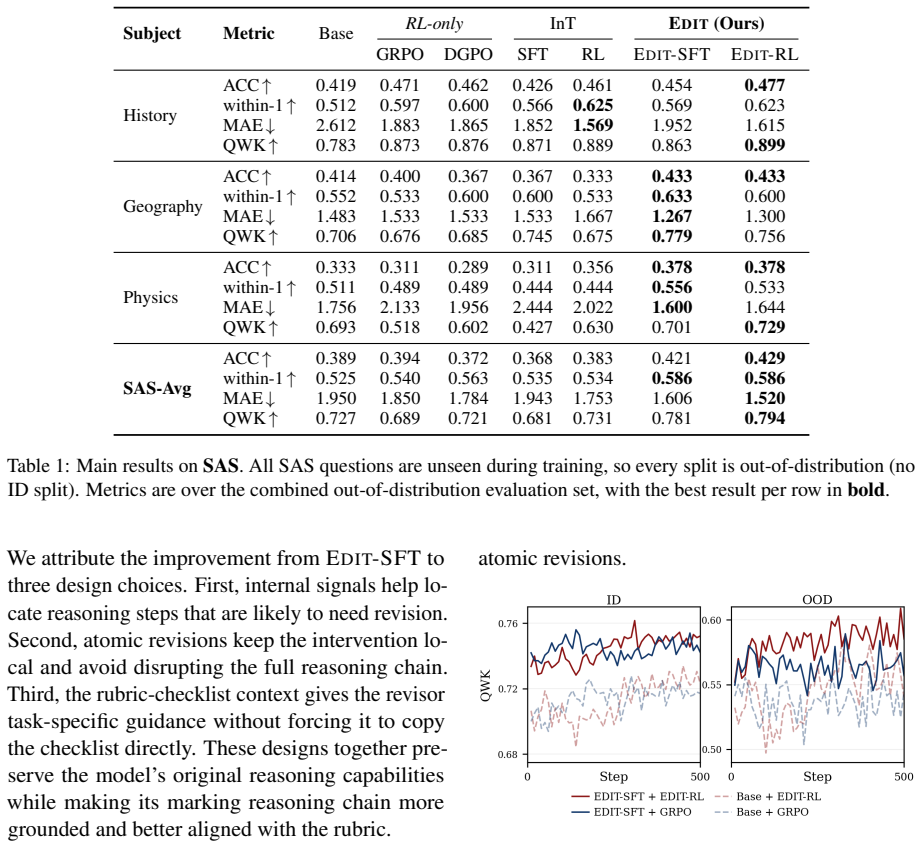
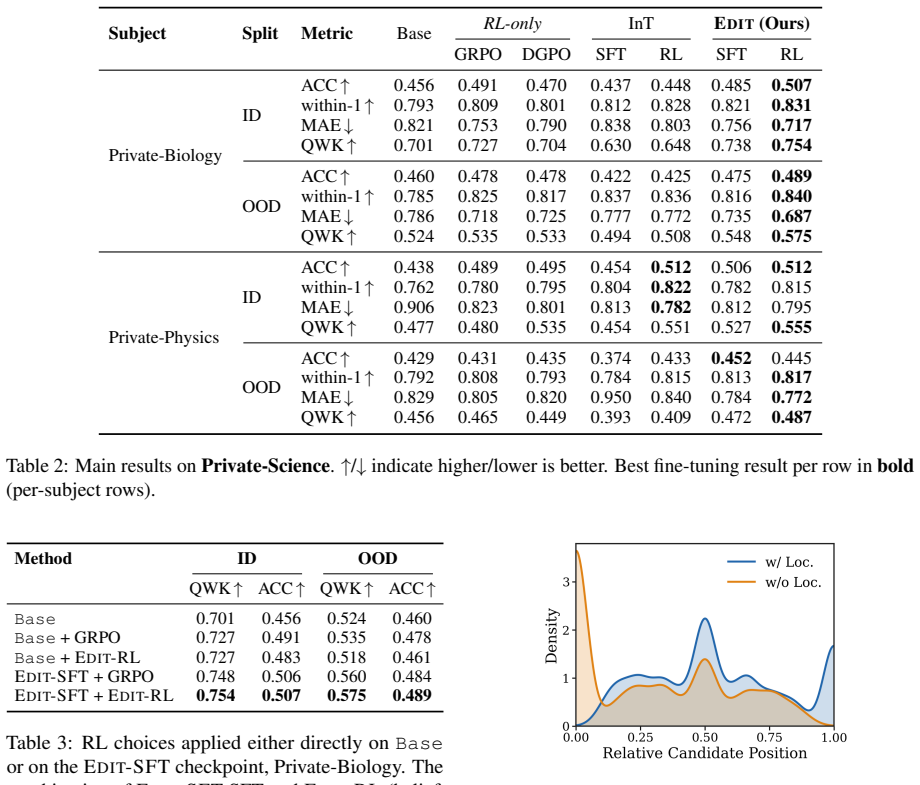
EDIT is a two-phase framework for training rubric-faithful LLM graders. EDIT-SFT locates problematic reasoning steps using posterior belief over the final mark and input-grounding scores, then revises only these local steps with help from a rubric checklist. EDIT-RL calibrates the grader with belief-guided reward shaping that penalises large harmful belief drifts while still allowing helpful exploration. On two real-world multi-subject grading benchmarks, EDIT consistently outperforms strong supervised fine-tuning and reinforcement learning baselines on both in-domain and out-of-domain splits.
What carries the argument
Evidence-Diagnosed Intervention Training (EDIT), a two-phase process that diagnoses grading errors via posterior belief over the final mark and input-grounding scores to enable targeted local revisions.
If this is right
- Only the identified problematic steps receive revision, avoiding unnecessary changes across the entire reasoning trace.
- Belief-guided reward shaping limits harmful mark-prediction drifts without blocking all exploration.
- Gains appear on both in-domain and out-of-domain test splits of real grading tasks.
- Ablations confirm that removing the internal-state diagnostics removes the performance advantage over baselines.
Where Pith is reading between the lines
- The same diagnostic signals could be tested on other rule-constrained LLM tasks such as legal document review or medical guideline checking.
- If the signals prove reliable, similar intervention training might reduce the volume of human-corrected examples needed for new grading domains.
- The approach suggests a route toward graders whose intermediate reasoning can be audited against the rubric at each step.
Load-bearing premise
Internal model signals consisting of posterior belief over the final mark and input-grounding scores can accurately identify the specific reasoning steps where grading goes wrong.
What would settle it
Running the same benchmarks with EDIT but replacing the internal diagnostics with random step selection and finding no performance gain over standard RL baselines.
Figures


read the original abstract
Reliable rubric grading requires more than accurate score prediction. Each judgement must be grounded in the mark scheme and evidence from the student answer. Existing credit-assignment and intervention methods, primarily designed for self-contained reasoning tasks such as mathematics reasoning, struggle in this setting because they do not identify where grading reasoning goes wrong or how the model's belief about the final mark changes during reasoning. We propose Evidence-Diagnosed Intervention Training (EDIT), a two-phase framework for training more rubric-faithful LLM graders. First, EDIT-SFT locates problematic reasoning steps using internal model signals: posterior belief over the final mark and input-grounding scores. It then revises only these local steps with help from a rubric checklist. Second, EDIT-RL calibrates the grader with belief-guided reward shaping, penalising large harmful belief drifts while still allowing helpful exploration. Experiments on two real-world, multi-subject grading benchmarks demonstrate that EDIT consistently outperforms strong supervised fine-tuning and reinforcement learning baselines on both in-domain and out-of-domain splits, with ablation studies confirming that internal-state diagnostics drive these gains.
Editorial analysis
A structured set of objections, weighed in public.
Referee Report
Summary. The paper proposes Evidence-Diagnosed Intervention Training (EDIT), a two-phase framework to train more rubric-faithful LLM graders. EDIT-SFT identifies problematic reasoning steps via internal signals (posterior belief over the final mark and input-grounding scores), revises only those steps using a rubric checklist, and EDIT-RL applies belief-guided reward shaping to penalize harmful belief drifts. Experiments on two real-world multi-subject grading benchmarks are claimed to show consistent outperformance over strong SFT and RL baselines on in-domain and out-of-domain splits, with ablations attributing gains to the internal diagnostics.
Significance. If the internal signals prove accurate at locating specific grading failures and the performance gains are confirmed with full experimental details, the work could offer a practical advance in reliable automated assessment by targeting reasoning errors rather than relying on end-to-end supervision alone. The combination of diagnostic intervention and belief-aware RL is a targeted contribution to rubric-grounded grading.
major comments (2)
- [Abstract] Abstract: The central claim that 'internal-state diagnostics drive these gains' and that EDIT outperforms baselines rests on the unvalidated assumption that posterior belief over the final mark and input-grounding scores accurately identify the precise reasoning steps where rubric faithfulness fails; no direct evidence (e.g., agreement with human-annotated error locations) is supplied to support this load-bearing premise.
- [Abstract] Abstract: The assertion of outperformance on in- and out-of-domain splits supplies no metrics, baseline details, dataset sizes, statistical tests, or ablation numbers, so the experimental claims cannot be evaluated and the soundness of the reported superiority remains unevaluable.
minor comments (1)
- [Abstract] The abstract would be strengthened by including at least one key quantitative result (e.g., accuracy delta or ablation drop) to allow readers to gauge effect size.
Simulated Author's Rebuttal
We thank the referee for the constructive feedback highlighting the need for stronger validation of the internal diagnostics and clearer experimental reporting. We address each major comment below, proposing targeted revisions to the abstract and discussion sections while defending the manuscript's use of ablation-based evidence.
read point-by-point responses
-
Referee: [Abstract] Abstract: The central claim that 'internal-state diagnostics drive these gains' and that EDIT outperforms baselines rests on the unvalidated assumption that posterior belief over the final mark and input-grounding scores accurately identify the precise reasoning steps where rubric faithfulness fails; no direct evidence (e.g., agreement with human-annotated error locations) is supplied to support this load-bearing premise.
Authors: We agree that direct human-annotated error location agreement would constitute stronger validation of the internal signals. The manuscript instead relies on ablation studies (detailed in Section 4.3) that isolate the diagnostic components and demonstrate statistically significant performance drops when they are removed, thereby providing causal evidence that these signals drive the observed gains in rubric faithfulness. We will revise the abstract and add a dedicated limitations paragraph to explicitly frame the ablations as indirect but rigorous validation while acknowledging the absence of direct human error-location annotations as a direction for future work. revision: partial
-
Referee: [Abstract] Abstract: The assertion of outperformance on in- and out-of-domain splits supplies no metrics, baseline details, dataset sizes, statistical tests, or ablation numbers, so the experimental claims cannot be evaluated and the soundness of the reported superiority remains unevaluable.
Authors: The abstract is written to be concise per venue guidelines and therefore omits specific numbers. The full manuscript supplies all requested details: dataset sizes and splits (Section 3.1), baseline descriptions (Section 4.1), metrics with standard deviations and statistical tests (Tables 1–2), and ablation numbers (Table 3 and Figure 3). We will revise the abstract to include the key headline results (e.g., average gains and significance) while preserving brevity, enabling readers to evaluate the claims at a glance. revision: yes
Circularity Check
No circularity; empirical claims rest on external benchmarks and ablations
full rationale
The paper presents EDIT as an empirical training framework whose performance claims are supported by comparisons to supervised fine-tuning and reinforcement learning baselines on in-domain and out-of-domain grading benchmarks, plus ablation studies. No mathematical derivation chain, equations, or self-referential definitions appear in the abstract or described method. Internal signals (posterior belief and grounding scores) are used as inputs to the intervention process, but the reported gains are measured against held-out data rather than being forced by construction from those signals. No self-citations, uniqueness theorems, or renamed known results are invoked as load-bearing steps. The work is therefore self-contained against external experimental evidence.
Axiom & Free-Parameter Ledger
Reference graph
Works this paper leans on
-
[1]
Aho and Jeffrey D
Alfred V. Aho and Jeffrey D. Ullman , title =. 1972
1972
-
[2]
Publications Manual , year = "1983", publisher =
1983
-
[3]
Ashok K. Chandra and Dexter C. Kozen and Larry J. Stockmeyer , year = "1981", title =. doi:10.1145/322234.322243
-
[4]
Scalable training of
Andrew, Galen and Gao, Jianfeng , booktitle=. Scalable training of
-
[5]
Dan Gusfield , title =. 1997
1997
-
[6]
Tetreault , title =
Mohammad Sadegh Rasooli and Joel R. Tetreault , title =. Computing Research Repository , volume =. 2015 , url =
2015
-
[7]
A Framework for Learning Predictive Structures from Multiple Tasks and Unlabeled Data , Volume =
Ando, Rie Kubota and Zhang, Tong , Issn =. A Framework for Learning Predictive Structures from Multiple Tasks and Unlabeled Data , Volume =. Journal of Machine Learning Research , Month = dec, Numpages =
-
[8]
Transactions on Machine Learning Research , year =
A Survey of Temporal Credit Assignment in Deep Reinforcement Learning , author =. Transactions on Machine Learning Research , year =
-
[9]
Advances in Neural Information Processing Systems (NeurIPS) , year =
Direct Preference Optimization: Your Language Model is Secretly a Reward Model , author =. Advances in Neural Information Processing Systems (NeurIPS) , year =
-
[10]
arXiv preprint arXiv:2402.03300 , year =
DeepSeekMath: Pushing the Limits of Mathematical Reasoning in Open Language Models , author =. arXiv preprint arXiv:2402.03300 , year =
-
[11]
Advances in Neural Information Processing Systems (NeurIPS) , year =
RUDDER: Return Decomposition for Delayed Rewards , author =. Advances in Neural Information Processing Systems (NeurIPS) , year =
-
[12]
arXiv preprint arXiv:2605.03327 , year =
DGPO: Distribution-Guided Policy Optimization for Fine-Grained Credit Assignment , author =. arXiv preprint arXiv:2605.03327 , year =
-
[13]
International Conference on Learning Representations (ICLR) , year =
Let's Verify Step by Step , author =. International Conference on Learning Representations (ICLR) , year =
-
[14]
Math-Shepherd: Verify and Reinforce
Wang, Peiyi and Li, Lei and Shao, Zhihong and Xu, Runxin and Dai, Damai and Li, Yifei and Chen, Deli and Wu, Yu and Sui, Zhifang , booktitle =. Math-Shepherd: Verify and Reinforce. 2024 , publisher =
2024
-
[15]
Advances in Neural Information Processing Systems (NeurIPS) , year =
Hindsight Experience Replay , author =. Advances in Neural Information Processing Systems (NeurIPS) , year =
-
[16]
Advances in Neural Information Processing Systems (NeurIPS) , year =
Hindsight Credit Assignment , author =. Advances in Neural Information Processing Systems (NeurIPS) , year =
-
[17]
arXiv preprint arXiv:2601.14209 , year =
InT: Self-Proposed Interventions Enable Credit Assignment in LLM Reasoning , author =. arXiv preprint arXiv:2601.14209 , year =
-
[18]
Findings of the Association for Computational Linguistics: ACL 2024 , pages =
Chain of Logic: Rule-Based Reasoning with Large Language Models , author =. Findings of the Association for Computational Linguistics: ACL 2024 , pages =. 2024 , publisher =
2024
-
[19]
Advances in Neural Information Processing Systems (NeurIPS) , year =
Chain-of-Thought Prompting Elicits Reasoning in Large Language Models , author =. Advances in Neural Information Processing Systems (NeurIPS) , year =
-
[20]
Findings of the Association for Computational Linguistics: EMNLP 2023 , pages =
Measuring and Narrowing the Compositionality Gap in Language Models , author =. Findings of the Association for Computational Linguistics: EMNLP 2023 , pages =. 2023 , publisher =
2023
-
[21]
Pan, Liangming and Albalak, Alon and Wang, Xinyi and Wang, William Yang , booktitle =. Logic-. 2023 , publisher =
2023
-
[22]
and Gu, Alex and Lipkin, Benjamin and Zhang, Cedegao E
Olausson, Theo X. and Gu, Alex and Lipkin, Benjamin and Zhang, Cedegao E. and Solar-Lezama, Armando and Tenenbaum, Joshua B. and Levy, Roger , booktitle =. 2023 , publisher =
2023
-
[23]
Improving Rule-based Reasoning in LLMs using Neurosymbolic Representations , author =. Proceedings of the 2025 Conference on Empirical Methods in Natural Language Processing (EMNLP) , year =. doi:10.18653/v1/2025.emnlp-main.1556 , note =
-
[24]
Proceedings of the 2019 Conference of the North American Chapter of the Association for Computational Linguistics: Human Language Technologies (NAACL-HLT) , pages =
A Structural Probe for Finding Syntax in Word Representations , author =. Proceedings of the 2019 Conference of the North American Chapter of the Association for Computational Linguistics: Human Language Technologies (NAACL-HLT) , pages =. 2019 , publisher =
2019
-
[25]
arXiv preprint arXiv:2506.08672 , year =
RuleReasoner: Reinforced Rule-based Reasoning via Domain-aware Dynamic Sampling , author =. arXiv preprint arXiv:2506.08672 , year =
-
[26]
International Conference on Learning Representations (ICLR) , year =
LogicReward: Incentivizing LLM Reasoning via Step-Wise Logical Supervision , author =. International Conference on Learning Representations (ICLR) , year =
-
[27]
Proceedings of the 2025 Conference on Empirical Methods in Natural Language Processing (EMNLP) , pages =
Two Heads Are Better Than One: Dual-Model Verbal Reflection at Inference-Time , author =. Proceedings of the 2025 Conference on Empirical Methods in Natural Language Processing (EMNLP) , pages =
2025
-
[28]
arXiv preprint arXiv:2505.07247 , year =
SAS-Bench: A Fine-Grained Benchmark for Evaluating Short Answer Scoring with Large Language Models , author =. arXiv preprint arXiv:2505.07247 , year =
-
[29]
Advances in Neural Information Processing Systems (NeurIPS) , volume =
Language Models Don't Always Say What They Think: Unfaithful Explanations in Chain-of-Thought Prompting , author =. Advances in Neural Information Processing Systems (NeurIPS) , volume =. 2023 , note =
2023
-
[30]
arXiv preprint arXiv:2307.13702 , year =
Measuring Faithfulness in Chain-of-Thought Reasoning , author =. arXiv preprint arXiv:2307.13702 , year =
-
[31]
arXiv preprint arXiv:2207.05221 , year =
Language Models (Mostly) Know What They Know , author =. arXiv preprint arXiv:2207.05221 , year =
-
[32]
Advances in Neural Information Processing Systems (NeurIPS) , volume =
Self-Refine: Iterative Refinement with Self-Feedback , author =. Advances in Neural Information Processing Systems (NeurIPS) , volume =
-
[33]
Advances in Neural Information Processing Systems (NeurIPS) , volume =
Reflexion: Language Agents with Verbal Reinforcement Learning , author =. Advances in Neural Information Processing Systems (NeurIPS) , volume =
-
[34]
, booktitle =
Zelikman, Eric and Wu, Yuhuai and Mu, Jesse and Goodman, Noah D. , booktitle =
-
[35]
arXiv preprint arXiv:1707.06347 , year =
Proximal Policy Optimization Algorithms , author =. arXiv preprint arXiv:1707.06347 , year =
-
[36]
Proceedings of the Sixteenth International Conference on Machine Learning (ICML) , pages =
Policy Invariance Under Reward Transformations: Theory and Application to Reward Shaping , author =. Proceedings of the Sixteenth International Conference on Machine Learning (ICML) , pages =
-
[37]
Lai, Xin and Tian, Zhuotao and Chen, Yukang and Yang, Senqiao and Peng, Xiangru and Jia, Jiaya , journal =. Step-
-
[38]
and Laflair, Geoffrey and Verardi, Anthony and Burstein, Jill , booktitle =
Yancey, Kevin P. and Laflair, Geoffrey and Verardi, Anthony and Burstein, Jill , booktitle =. Rating Short. 2023 , publisher =
2023
-
[39]
Proceedings of the 2024 Conference on Empirical Methods in Natural Language Processing (EMNLP) , pages =
Automated Essay Scoring: A Reflection on the State of the Art , author =. Proceedings of the 2024 Conference on Empirical Methods in Natural Language Processing (EMNLP) , pages =. 2024 , publisher =
2024
-
[40]
Distilling C hat GPT for Explainable Automated Student Answer Assessment
Li, Jiazheng and Gui, Lin and Zhou, Yuxiang and West, David and Aloisi, Cesare and He, Yulan. Distilling C hat GPT for Explainable Automated Student Answer Assessment. Findings of the Association for Computational Linguistics: EMNLP 2023. 2023. doi:10.18653/v1/2023.findings-emnlp.399
-
[41]
Li, Jiazheng and Xu, Hainiu and Sun, Zhaoyue and Zhou, Yuxiang and West, David and Aloisi, Cesare and He, Yulan. Calibrating LLM s with Preference Optimization on Thought Trees for Generating Rationale in Science Question Scoring. Findings of the Association for Computational Linguistics: EMNLP 2024. 2024. doi:10.18653/v1/2024.findings-emnlp.313
-
[42]
Two Heads Are Better Than One: Dual-Model Verbal Reflection at Inference-Time
Li, Jiazheng and Zhou, Yuxiang and Lu, Junru and Tyen, Gladys and Gui, Lin and Aloisi, Cesare and He, Yulan. Two Heads Are Better Than One: Dual-Model Verbal Reflection at Inference-Time. Proceedings of the 2025 Conference on Empirical Methods in Natural Language Processing. 2025. doi:10.18653/v1/2025.emnlp-main.155
-
[43]
Transactions on Machine Learning Research , issn=
A Survey of Temporal Credit Assignment in Deep Reinforcement Learning , author=. Transactions on Machine Learning Research , issn=. 2024 , url=
2024
-
[44]
Drift: Enhancing LLM Faithfulness in Rationale Generation via Dual-Reward Probabilistic Inference
Li, Jiazheng and Yan, Hanqi and He, Yulan. Drift: Enhancing LLM Faithfulness in Rationale Generation via Dual-Reward Probabilistic Inference. Proceedings of the 63rd Annual Meeting of the Association for Computational Linguistics (Volume 1: Long Papers). 2025. doi:10.18653/v1/2025.acl-long.340
-
[45]
BMC Medical Education , volume=
LLM-based automatic short answer grading in undergraduate medical education , author=. BMC Medical Education , volume=. 2024 , publisher=
2024
-
[46]
IEEE Signal Processing Magazine , volume=
Large language models for education: A survey and outlook , author=. IEEE Signal Processing Magazine , volume=. 2026 , publisher=
2026
discussion (0)
Sign in with ORCID, Apple, or X to comment. Anyone can read and Pith papers without signing in.