Breakeven demonstration of quantum low-density parity-check codes
Pith reviewed 2026-06-28 00:45 UTC · model grok-4.3
The pith
A trapped-ion qLDPC code encoding 4 logical qubits in 18 physical qubits reaches breakeven, with logical lifetimes matching or exceeding physical ones and error rates up to 9 times lower than prior superconducting demonstrations.
A machine-rendered reading of the paper's core claim, the machinery that carries it, and where it could break.
Core claim
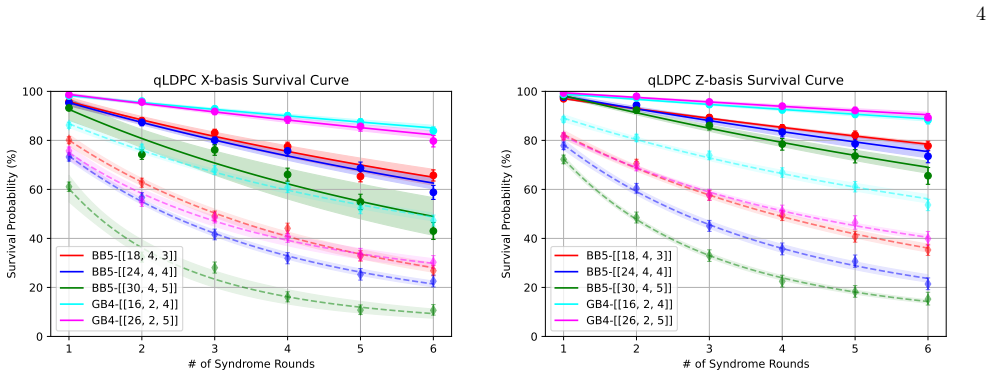
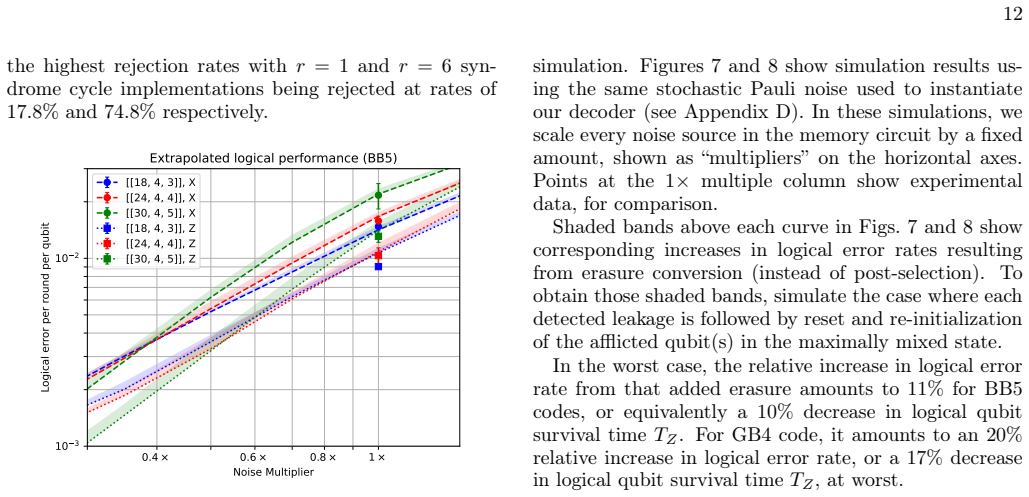
The central claim is that a quantum low-density parity-check code with 4 logical qubits encoded in 18 physical qubits, implemented on a trapped-ion processor, achieves breakeven performance: logical error rates are reduced by up to a factor of nine relative to a comparable prior demonstration on superconducting qubits, and selected logical instances exhibit lifetimes comparable to or slightly longer than the physical qubits themselves. This is accomplished by testing nine distinct error-correcting codes on one device through flexible connectivity and an optical-metastable-ground architecture that supports addressable mid-circuit measurement and reset without ion transport or dedicated coolan
What carries the argument
The qLDPC code (quantum low-density parity-check code) with its long-range connectivity requirements, executed via the optical-metastable-ground (OMG) architecture for mid-circuit measurement and reset.
If this is right
- Multiple code families with different connectivity demands can be benchmarked on the same trapped-ion hardware without reconfiguration.
- The reported qLDPC instance provides a concrete example where logical error suppression exceeds the physical error rate.
- The OMG architecture removes the runtime and ion-count overhead normally required for ion transport and coolant ions.
- Breakeven performance is achieved while encoding four logical qubits rather than one.
Where Pith is reading between the lines
- If the OMG technique scales without new error sources, larger qLDPC codes could be tested to check whether the observed error-rate advantage persists at higher distances.
- The single-device flexibility shown here could shorten the iteration cycle for comparing code families that would otherwise require separate hardware.
- The breakeven result invites direct comparison experiments on other platforms once they implement comparable mid-circuit capabilities.
Load-bearing premise
Mid-circuit measurements and resets performed with the OMG architecture introduce no correlated errors or calibration drifts that would change the measured logical error rates or invalidate the breakeven comparison.
What would settle it
Repeated runs in which every logical qubit instance shows a lifetime shorter than the physical trapped-ion qubit lifetime under identical conditions, or direct detection of correlated errors traceable to the mid-circuit operations.
Figures






read the original abstract
High-rate quantum low-density parity-check (qLDPC) codes are a leading candidate for fault-tolerant quantum computing. They feature higher encoding rates than planar alternatives such as the surface code, but their implementation often entails significant hardware hurdles like the need for long-range couplers. We leverage the flexibility of a trapped-ion quantum computer to demonstrate nine quantum error-correcting codes with starkly different qubit connectivity requirements on a single device without any hardware reconfiguration. These experiments span three families of quantum error-correcting codes: qLDPC codes, topological codes, and concatenated codes. With a qLDPC code encoding 4 logical qubits into 18 physical qubits, we achieve a logical error rate up to $9\times$ better than a previous demonstration of a similar code on superconducting solid-state qubits. Moreover, our implementation exhibits breakeven performance, with some instances achieving qubit lifetimes comparable to or slightly exceeding that of our trapped-ion qubits. We use a novel implementation of the optical-metastable-ground (OMG) architecture for addressable mid-circuit measurement and reset, which enables us to perform these experiments without any ion transport or dedicated coolant ions, requirements that typically consume a large fraction of the runtime or ion count of trapped-ion quantum computers.
Editorial analysis
A structured set of objections, weighed in public.
Referee Report
Summary. The manuscript reports an experimental demonstration on a trapped-ion quantum computer of nine quantum error-correcting codes spanning qLDPC, topological, and concatenated families. Using the optical-metastable-ground (OMG) architecture for addressable mid-circuit measurement and reset, a qLDPC code encoding 4 logical qubits into 18 physical qubits is shown to achieve logical error rates up to 9× lower than a prior superconducting implementation of a similar code, with breakeven performance in which some logical qubit lifetimes are comparable to or exceed those of the physical qubits, all without ion transport or dedicated coolant ions.
Significance. If the reported logical error rates and breakeven comparisons are robust, the work is significant for providing the first breakeven demonstration of a high-rate qLDPC code and for showing that trapped-ion hardware can flexibly realize codes with widely varying connectivity requirements on a single device. The OMG implementation is credited as enabling efficient syndrome extraction and reset. These results, if validated, strengthen the case for qLDPC codes as practical alternatives to planar codes for fault tolerance.
major comments (2)
- [Abstract] Abstract, final paragraph: the breakeven claim ('some instances achieving qubit lifetimes comparable to or slightly exceeding that of our trapped-ion qubits') and the 9× improvement are load-bearing on the assumption that OMG mid-circuit measurements and resets introduce no unmodeled correlated errors or calibration drifts. The manuscript must supply a quantitative error budget, cross-talk characterization, or leakage analysis for these operations during code execution to confirm they do not bias the extracted logical error rates relative to the physical-qubit benchmark.
- [Abstract] Abstract: the central performance claims cannot be verified without explicit description of how logical error rates were extracted, how breakeven was defined, circuit diagrams for the syndrome extraction rounds, or statistical methods and error bars on the reported rates; these details are required to assess whether the OMG operations preserve the validity of the comparison.
minor comments (1)
- [Abstract] The phrase 'up to 9× better' should be accompanied by the specific code instances, error-rate values, and conditions under which the factor is achieved.
Simulated Author's Rebuttal
We thank the referee for their careful reading and constructive comments on our manuscript. We address each major comment below and will incorporate clarifications to strengthen the presentation of our results.
read point-by-point responses
-
Referee: [Abstract] Abstract, final paragraph: the breakeven claim ('some instances achieving qubit lifetimes comparable to or slightly exceeding that of our trapped-ion qubits') and the 9× improvement are load-bearing on the assumption that OMG mid-circuit measurements and resets introduce no unmodeled correlated errors or calibration drifts. The manuscript must supply a quantitative error budget, cross-talk characterization, or leakage analysis for these operations during code execution to confirm they do not bias the extracted logical error rates relative to the physical-qubit benchmark.
Authors: We agree that a quantitative error budget is necessary to rigorously support the breakeven and 9× improvement claims. In the revised manuscript we will add a dedicated error budget subsection (in Methods or Supplementary Information) that includes cross-talk characterization, leakage analysis, and calibration data for the OMG mid-circuit measurement and reset operations performed during code execution. This will explicitly demonstrate that these operations do not introduce unmodeled correlated errors that bias the logical error rates relative to the physical-qubit benchmarks. revision: yes
-
Referee: [Abstract] Abstract: the central performance claims cannot be verified without explicit description of how logical error rates were extracted, how breakeven was defined, circuit diagrams for the syndrome extraction rounds, or statistical methods and error bars on the reported rates; these details are required to assess whether the OMG operations preserve the validity of the comparison.
Authors: The full manuscript already contains the requested details: logical error rate extraction methods, the definition of breakeven, circuit diagrams for syndrome extraction, and statistical methods with error bars (presented in the main text, figures, and supplementary sections). To address the referee's concern that these are not immediately verifiable from the abstract, we will revise the abstract to include a concise reference to the extraction and statistical procedures and will ensure all reported rates explicitly display error bars. No new data collection is required. revision: partial
Circularity Check
No circularity: experimental demonstration with no derivation chain
full rationale
This paper reports experimental results on trapped-ion hardware implementing qLDPC and other codes, including measured logical error rates and breakeven comparisons. No equations, predictions, or first-principles derivations are presented that could reduce to fitted inputs, self-definitions, or self-citation chains. All central claims (9× improvement, breakeven lifetimes) are direct empirical outcomes from device runs, not model outputs that loop back to the same data by construction. The OMG architecture is described as an enabling technique but is not used to derive the reported metrics.
Axiom & Free-Parameter Ledger
Reference graph
Works this paper leans on
-
[1]
P. W. Shor, Fault-tolerant quantum computation, inPro- ceedings of 37th conference on foundations of computer science(IEEE, 1996) pp. 56–65
1996
-
[2]
Dennis, A
E. Dennis, A. Kitaev, A. Landahl, and J. Preskill, Topological quantum memory, Journal of Mathematical Physics43, 4452 (2002)
2002
-
[3]
A. G. Fowler, M. Mariantoni, J. M. Martinis, and A. N. Cleland, Surface codes: Towards practical large-scale quantum computation, Physical Review A86, 032324 (2012)
2012
-
[4]
Leroux, C
S.Krinner, N.Lacroix, A.Remm, A.DiPaolo, E.Genois, C. Leroux, C. Hellings, S. Lazar, F. Swiadek, J. Her- rmann,et al., Realizing repeated quantum error correc- tion in a distance-three surface code, Nature605, 669 (2022)
2022
-
[5]
Y. Zhao, Y. Ye, H.-L. Huang, Y. Zhang, D. Wu, H. Guan, Q. Zhu, Z. Wei, T. He, S. Cao,et al., Realization of an error-correcting surface code with superconducting qubits, Physical Review Letters129, 030501 (2022)
2022
-
[6]
Bluvstein, S
D. Bluvstein, S. J. Evered, A. A. Geim, S. H. Li, H. Zhou, T. Manovitz, S. Ebadi, M. Cain, M. Kali- nowski, D. Hangleiter, J. P. Bonilla Ataides, N. Maskara, I. Cong, X. Gao, P. Sales Rodriguez, T. Karolyshyn, G. Semeghini, M. J. Gullans, M. Greiner, V. Vuletić, and M. D. Lukin, Logical quantum processor based on reconfigurable atom arrays, Nature626, 58 (2024)
2024
-
[7]
Google Quantum AI, Quantum error correction below the surface code threshold, Nature638, 920 (2025)
2025
-
[8]
T. He, W. Lin, R. Wang, Y. Li, J. Bei, J. Cai, S. Cao, D. Chen, K. Chen, X. Chen,et al., Experimental quan- tum error correction below the surface code threshold via all-microwave leakage suppression, Physical Review Let- ters135, 260601 (2025)
2025
-
[9]
D. J. MacKay, G. Mitchison, and P. L. McFadden, Sparse-graph codes for quantum error correction, IEEE Transactions on Information Theory50, 2315 (2004)
2004
-
[10]
N. P. Breuckmann and J. N. Eberhardt, Quantum low- density parity-check codes, PRX quantum2, 040101 (2021)
2021
-
[11]
Q. Xu, J. P. Bonilla Ataides, C. A. Pattison, N. Raveen- dran, D. Bluvstein, J. Wurtz, B. Vasić, M. D. Lukin, L. Jiang, and H. Zhou, Constant-overhead fault-tolerant quantum computation with reconfigurable atom arrays, Nature Physics20, 1084 (2024)
2024
-
[12]
T. J. Yoder, E. Schoute, P. Rall, E. Pritchett, J. M. Gam- betta, A. W. Cross, M. Carroll, and M. E. Beverland, Tour de gross: A modular quantum computer based on bivariate bicycle codes, arXiv preprint arXiv:2506.03094 (2025)
Pith/arXiv arXiv 2025
-
[13]
P. Webster, L. Berent, O. Chandra, E. T. Hockings, N. Baspin, F. Thomsen, S. C. Smith, and L. Z. Cohen, The pinnacle architecture: Reducing the cost of breaking rsa-2048 to 100 000 physical qubits using quantum ldpc codes, arXiv preprint arXiv:2602.11457 (2026)
Pith/arXiv arXiv 2048
-
[14]
M. Cain, Q. Xu, R. King, L. R. Picard, H. Levine, M. En- dres, J. Preskill, H.-Y. Huang, and D. Bluvstein, Shor’s algorithm is possible with as few as 10,000 reconfigurable atomic qubits, arXiv preprint arXiv:2603.28627 (2026)
Pith/arXiv arXiv 2026
-
[15]
F. Tripier, W. C. Chung, J. Young, S. Alam, B. Bjork, A. Brodutch, F. L. Buessen, N. J. Coble, T. Dellaert, D. Maslov,et al., Fault-tolerant quantum computing with trapped ions: The walking cat architecture, arXiv preprint arXiv:2604.19481 (2026)
Pith/arXiv arXiv 2026
-
[16]
M. A. Tremblay, N. Delfosse, and M. E. Beverland, Constant-overhead quantum error correction with thin planar connectivity, Physical Review Letters129, 050504 (2022)
2022
- [17]
-
[18]
Bravyi, A
S. Bravyi, A. W. Cross, J. M. Gambetta, D. Maslov, P. Rall, and T. J. Yoder, High-threshold and low- overhead fault-tolerant quantum memory, Nature627, 778 (2024)
2024
- [19]
-
[20]
T. R. Scruby, T. Hillmann, and J. Roffe, High-threshold, low-overhead and single-shot decodable fault-tolerant quantum memory, PRX Quantum7, 020310 (2026)
2026
-
[21]
K. Wang, Z. Lu, C. Zhang, G. Liu, J. Chen, Y. Wang, Y. Wu, S. Xu, X. Zhu, F. Jin, Y. Gao, Z. Tan, Z. Cui, N. Wang, Y. Zou, A. Zhang, T. Li, F. Shen, J. Zhong, Z. Bao, Z. Zhu, Y. Han, Y. He, J. Shen, H. Wang, J.- N. Yang, Z. Song, J. Deng, H. Dong, Z.-Z. Sun, W. Li, Q. Ye, S. Jiang, Y. Ma, P.-X. Shen, P. Zhang, H. Li, Q. Guo, Z. Wang, C. Song, H. Wang, and...
2026
-
[22]
Aasen, A
D. Aasen, A. Aeppli, S. Armstrong, S. Banerjee, K. Barnes, E. Becker, J. M. Bello-Rivas, T. Bjork- man, B. J. Bloom, I. Bloomfield, T. Bohdanowicz, and G. Booth, Quantum error correction with the toric code, Atom Computing (2026)
2026
-
[23]
C.Ryan-Anderson, N.C.Brown, M.S.Allman, B.Arkin, G. Asa-Attuah, C. Baldwin, J. Berg, J. G. Bohnet, S. Braxton, N. Burdick, J. P. Campora, A. Chernoguzov, J. Esposito, B. Evans, D. Francois, J. P. Gaebler, T. M. Gatterman, J. Gerber, K. Gilmore, D. Gresh, A. Hall, A. Hankin, J. Hostetter, D. Lucchetti, K. Mayer, J. My- ers, B. Neyenhuis, J. Santiago, J. Se...
arXiv 2022
-
[24]
L. Egan, D. M. Debroy, C. Noel, A. Risinger, D. Zhu, D. Biswas, M. Newman, M. Li, K. R. Brown, M. Cetina, and C. Monroe, Fault-tolerant control of an error- corrected qubit, Nature598, 281 (2021)
2021
-
[25]
Ryan-Anderson, N
C. Ryan-Anderson, N. Brown, C. Baldwin, J. Dreiling, C. Foltz, J. Gaebler, T. Gatterman, N. Hewitt, C. Hol- liman, C. Horst,et al., High-fidelity teleportation of a logical qubit using transversal gates and lattice surgery, Science385, 1327 (2024)
2024
-
[26]
A. Paetznick, M. P. d. Silva, C. Ryan-Anderson, J. M. Bello-Rivas, J. P. C. III, A. Chernoguzov, J. M. Dreil- ing, C. Foltz, F. Frachon, J. P. Gaebler, T. M. Gatter- man, L. Grans-Samuelsson, D. Gresh, D. Hayes, N. He- witt, C. Holliman, C. V. Horst, J. Johansen, D. Luc- chetti, Y.Matsuoka, M.Mills, S.A.Moses, B.Neyenhuis, A. Paz, J. Pino, P. Siegfried, A...
Pith/arXiv arXiv 2024
-
[27]
S. Dasu, M. DeCross, A. Y. Guo, A. Lavasani, J. Behrends, A. Benhemou, Y.-H. Chen, K. Mayer, C. N. Self, S. Simsek,et al., Computing with many en- coded logical qubits beyond break-even, arXiv preprint arXiv:2602.22211 (2026)
arXiv 2026
-
[28]
IonQ, Work in preparation. (2026)
2026
-
[29]
D. T. C. Allcock, W. C. Campbell, J. Chiaverini, I. L. Chuang, E. R. Hudson, I. D. Moore, A. Ransford, C. Ro- man, J. M. Sage, and D. J. Wineland, omg blueprint for trapped ion quantum computing with metastable states, Applied Physics Letters119, 214002 (2021)
2021
-
[30]
A. Ransford, M. Allman, J. Arkinstall, J. Campora III, S. F. Cooper, R. D. Delaney, J. M. Dreiling, B. Estey, C. Figgatt, A. Hall,et al., Helios: A 98-qubit trapped- ion quantum computer, arXiv preprint arXiv:2511.05465 (2025)
Pith/arXiv arXiv 2025
-
[31]
S. A. Moses, C. H. Baldwin, M. S. Allman, R. Ancona, L.Ascarrunz, C.Barnes, J.Bartolotta, B.Bjork, P.Blan- chard, M.Bohn,et al.,Arace-tracktrapped-ionquantum processor, Physical Review X13, 041052 (2023)
2023
-
[32]
S. Ma, G. Liu, P. Peng, B. Zhang, S. Jandura, J. Claes, A. P. Burgers, G. Pupillo, S. Puri, and J. D. Thompson, High-fidelity gates and mid-circuit erasure conversion in an atomic qubit, Nature622, 279–284 (2023)
2023
-
[33]
Y. Yu, K. Yan, D. Biswas, V. N. Zhang, B. Harraz, C. Noel, C. Monroe, and A. Kozhanov, In situ mid- circuit qubit measurement and reset in a single-species trapped-ion quantum computing system, Phys. Rev. Res. 7, 043355 (2025)
2025
-
[34]
Yang, J.-Y
H.-X. Yang, J.-Y. Ma, Y.-K. Wu, Y. Wang, M.-M. Cao, W.-X. Guo, Y.-Y. Huang, L. Feng, Z.-C. Zhou, and L.-M. Duan, Realizing coherently convertible dual-type qubitswiththesameionspecies,NaturePhysics18,1058 (2022)
2022
-
[35]
Z.-Y. Chen, I. Goetting, G. Toh, Y. Yu, M. Sha- laev, S. Saha, A. Kalakuntla, H. B. Shi, C. Monroe, A. Kozhanov, and C. Noel, Noninvasive mid-circuit mea- surement and reset on atomic qubits, Phys. Rev. A113, 012606 (2026)
2026
-
[36]
Gottesman,Stabilizer codes and quantum error cor- rection(California Institute of Technology, 1997)
D. Gottesman,Stabilizer codes and quantum error cor- rection(California Institute of Technology, 1997)
1997
-
[37]
S. B. Bravyi and A. Y. Kitaev, Quantum codes on a lattice with boundary, arXiv:quant-ph/9811052 (1998), _eprint: quant-ph/9811052
Pith/arXiv arXiv 1998
-
[38]
H.BombinandM.A.Martin-Delgado,Optimalresources for topological two-dimensional stabilizer codes: Com- parative study, Physical Review A76, 012305 (2007)
2007
-
[39]
A. A. Kovalev and L. P. Pryadko, Improved quantum hypergraph-product LDPC codes, in2012 IEEE Inter- national Symposium on Information Theory Proceedings (2012) pp. 348–352
2012
-
[40]
Zhang, W
X. Zhang, W. Jiang, J. Deng, K. Wang, J. Chen, P. Zhang, W. Ren, H. Dong, S. Xu, Y. Gao, F. Jin, X. Zhu, Q. Guo, H. Li, C. Song, A. V. Gorshkov, T. Iadecola, F. Liu, Z.-X. Gong, Z. Wang, D.-L. Deng, and H. Wang, Digital quantum simulation of Floquet symmetry-protected topological phases, Nature607, 468 (2022)
2022
-
[41]
M. Ye, D. Wecker, and N. Delfosse, Beam search decoder for quantum LDPC codes, arXiv:2512.07057 (2025)
arXiv 2025
-
[42]
L. H. Pedersen, N. M. Møller, and K. Mølmer, Fidelity of quantum operations, Physics Letters A367, 47 (2007)
2007
-
[43]
Malinowski, D
M. Malinowski, D. Allcock, and C. Ballance, How to wire a 1000-qubit trapped-ion quantum computer, PRX Quantum4, 040313 (2023)
2023
-
[44]
Löschnauer, J
C. Löschnauer, J. Mosca Toba, A. Hughes, S. King, M. Weber, R. Srinivas, R. Matt, R. Nourshargh, D. All- cock, C. Ballance,et al., Scalable, high-fidelity all- electronic control of trapped-ion qubits, PRX Quantum 6, 040313 (2025)
2025
- [45]
-
[46]
Vaidman, L
L. Vaidman, L. Goldenberg, and S. Wiesner, Error pre- vention scheme with four particles, Physical Review A 54, R1745 (1996)
1996
-
[47]
Nielsen, J
E. Nielsen, J. K. Gamble, K. Rudinger, T. Scholten, K. Young, and R. Blume-Kohout, Gate Set Tomography, Quantum5, 557 (2021)
2021
-
[48]
T. J. Proctor, A. Carignan-Dugas, K. Rudinger, E. Nielsen, R. Blume-Kohout, and K. Young, Direct randomized benchmarking for multiqubit devices, Phys. Rev. Lett.123, 030503 (2019)
2019
-
[49]
Nielsen, K
E. Nielsen, K. Rudinger, T. Proctor, A. Russo, K. Young, and R. Blume-Kohout, Probing quantum processor per- formance with pygsti, Quantum Science and Technology 5, 044002 (2020)
2020
-
[50]
D. C. McKay, I. Hincks, E. J. Pritchett, M. Car- roll, L. C. G. Govia, and S. T. Merkel, Benchmark- ing quantum processor performance at scale (2023), arXiv:2311.05933 [quant-ph]
arXiv 2023
-
[51]
Bloch, Nuclear Induction, Physical Review70, 460 (1946)
F. Bloch, Nuclear Induction, Physical Review70, 460 (1946)
1946
-
[52]
inner” copies, which usually occupy eight physical qubits, into the logical qubits of four “outer
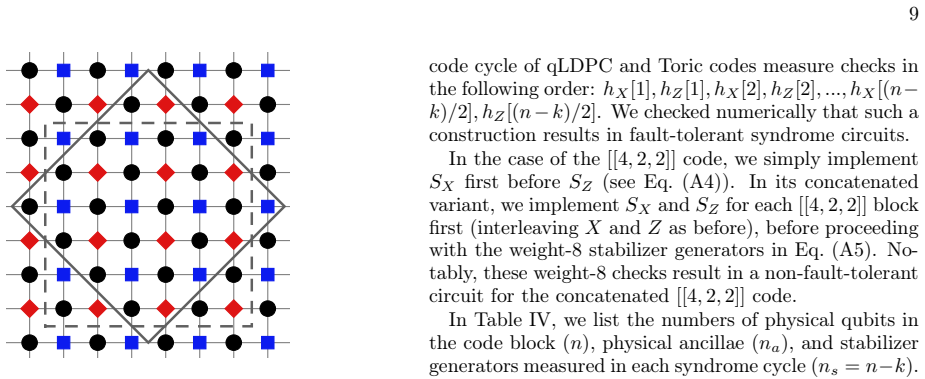
N. F. Ramsey, A Molecular Beam Resonance Method with Separated Oscillating Fields, Physical Review78, 695 (1950). 8 Appendix A: Code Definitions High-rate qLDPC Codes Code ℓ m A B BB[[18,4,3]] 3 3 1 +x 1 +y+xy 2BB[[24,4,4]] 4 3 BB[[30,4,5]] 5 3 GB[[16,2,4]] 1 8 1 +y 1 +y 5 GB[[26,2,4]] 1 13 1 +y 10 y9 +y 11 TABLE III: Table of quasi-cyclic code polynomial...
1950
discussion (0)
Sign in with ORCID, Apple, or X to comment. Anyone can read and Pith papers without signing in.