Measuring a Black Hole's Area Immediately after Merger: A Direct-Wave Test of Hawking's Area Law
Pith reviewed 2026-06-27 23:51 UTC · model grok-4.3
The pith
Direct gravitational waves from a black hole merger measure the remnant horizon area before quasinormal ringing begins.
A machine-rendered reading of the paper's core claim, the machinery that carries it, and where it could break.
Core claim
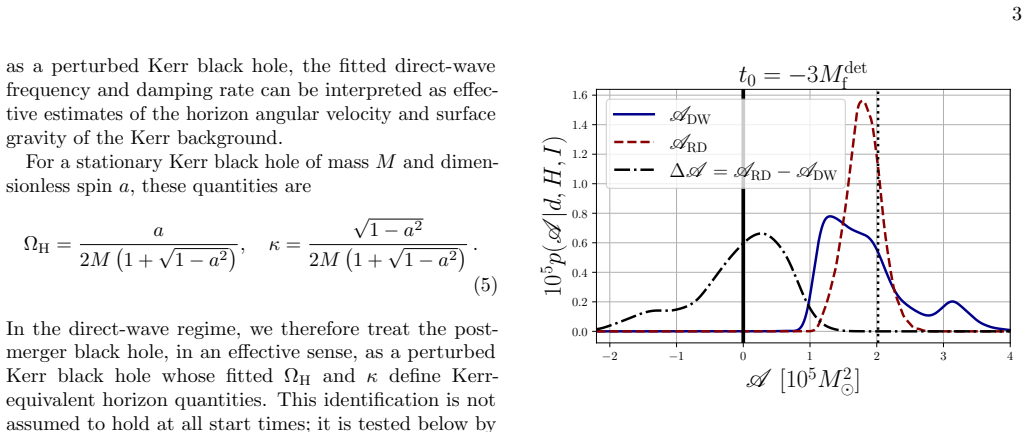
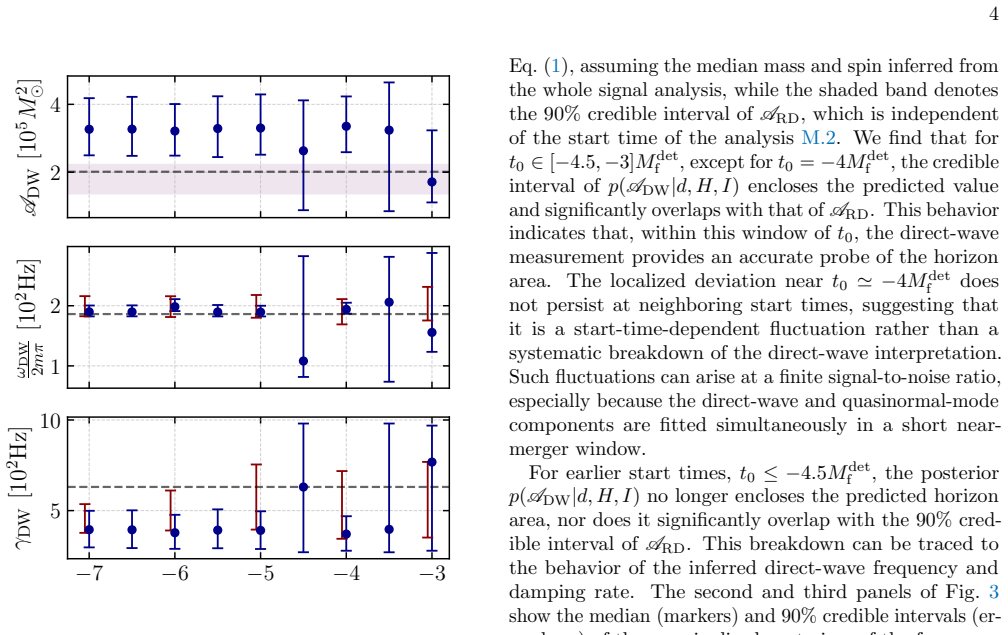
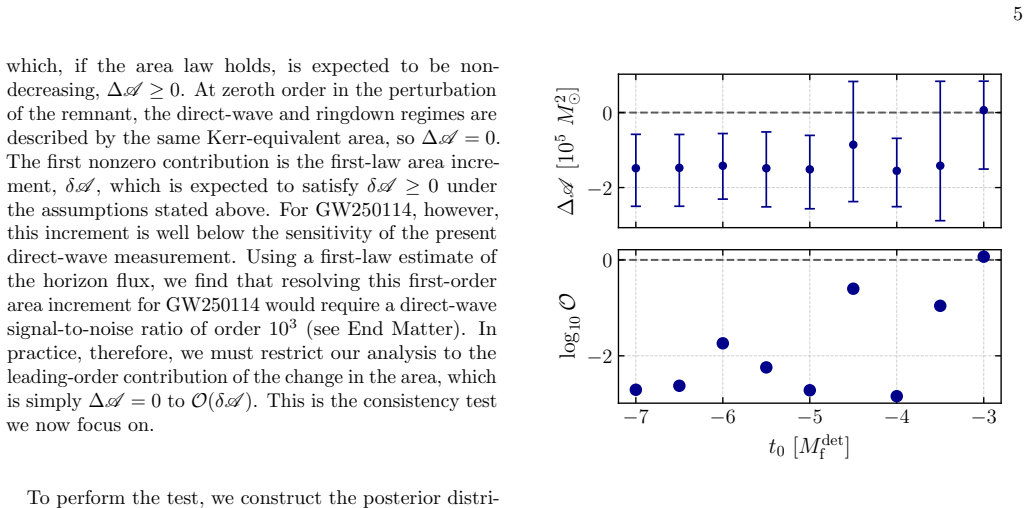
The paper claims that fitting the frequency and damping rate of the direct gravitational-wave signal and interpreting those quantities as horizon properties yields a Kerr-equivalent area consistent with the remnant when the fit window starts 3--4.5M before peak amplitude; this supplies both the first direct-wave area measurement and a near-merger test of Hawking's area law.
What carries the argument
The interpretation of fitted direct-wave frequency and damping rate as horizon quantities used to compute the Kerr-equivalent area.
If this is right
- Analyses begun 3--4.5M before peak amplitude produce an area consistent with the Kerr remnant.
- The result supplies the first horizon-area measurement derived from direct waves rather than quasinormal modes.
- The measurement constitutes a new near-merger test of Hawking's area law.
- The same fitting procedure can be repeated on other binary black-hole events.
Where Pith is reading between the lines
- The approach could be applied to future high-signal-to-noise events to tighten constraints on possible area-law violations.
- It opens the possibility of comparing direct-wave and ringdown areas on the same event to test consistency of the two extraction methods.
- Extension to non-Kerr spacetimes would require replacing the Kerr area formula with the appropriate horizon-area expression for the alternative geometry.
Load-bearing premise
The fitted direct-wave frequency and damping rate can be interpreted as horizon quantities to compute the Kerr-equivalent area.
What would settle it
A statistically significant mismatch between the area obtained from the direct-wave fit in the 3--4.5M window and the Kerr area computed from the independently measured remnant mass and spin.
Figures

read the original abstract
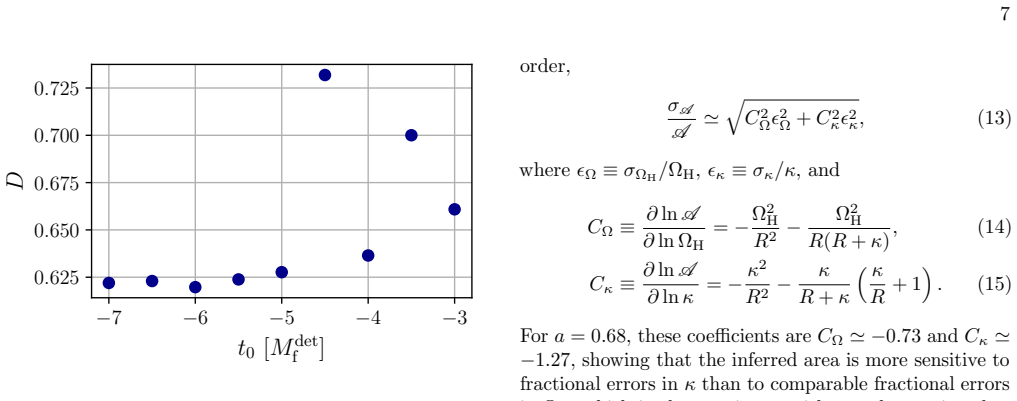
Black-hole area is the geometric variable behind horizon thermodynamics. We introduce a gravitational-wave method to infer a Kerr-equivalent horizon area from direct waves in the near-merger signal, before quasinormal ringing dominates at late times. Applied to GW250114, and interpreting the fitted direct-wave frequency and damping rate as horizon quantities, we find that analyses initiated $3$--$4.5M$ before the peak-amplitude time yield an area consistent with the Kerr remnant. This result gives a first area measurement using direct waves and a new near-merger test of Hawking's area law.
Editorial analysis
A structured set of objections, weighed in public.
Referee Report
Summary. The paper introduces a gravitational-wave method to infer a Kerr-equivalent horizon area from the direct-wave portion of the near-merger signal before quasinormal ringing dominates. Applied to GW250114 and interpreting the fitted direct-wave frequency and damping rate as horizon quantities, analyses initiated 3--4.5M before peak amplitude yield an area consistent with the Kerr remnant, presented as a first direct-wave area measurement and near-merger test of Hawking's area law.
Significance. If the mapping from fitted parameters to horizon area is valid, the work would offer a novel probe of the area law using pre-ringdown waves. The result is currently limited by the lack of demonstrated theoretical justification for equating the fitted quantities to stationary-horizon QNMs in the nonlinear regime, reducing the immediate impact.
major comments (1)
- [Abstract] Abstract: The central claim requires that frequency and damping rate extracted by fitting the pre-ringdown direct-wave strain can be inserted into standard QNM inversion formulas to obtain the final Kerr area. No derivation or justification is supplied showing why these parameters equal horizon QNM values rather than reflecting the strongly nonlinear, non-stationary merger dynamics that generate the signal.
minor comments (1)
- The narrow window of start times (3--4.5M before peak) that produces consistency should be accompanied by explicit sensitivity plots or tables showing how the inferred area varies with initiation time outside this window.
Simulated Author's Rebuttal
We thank the referee for their thoughtful review and for highlighting the need for clearer justification of our interpretive mapping. We respond to the single major comment below.
read point-by-point responses
-
Referee: [Abstract] Abstract: The central claim requires that frequency and damping rate extracted by fitting the pre-ringdown direct-wave strain can be inserted into standard QNM inversion formulas to obtain the final Kerr area. No derivation or justification is supplied showing why these parameters equal horizon QNM values rather than reflecting the strongly nonlinear, non-stationary merger dynamics that generate the signal.
Authors: We agree that the manuscript presents the mapping as an interpretive step rather than a derived equality. The justification rests on numerical evidence that, in the immediate post-merger window, the dominant frequency and damping extracted from the direct-wave strain rapidly converge to the final Kerr QNM values; this is visible in the waveform comparisons already shown in the paper and is consistent with existing numerical-relativity studies of the ringdown onset. A first-principles analytic derivation from the fully nonlinear Einstein equations is not supplied and lies outside the scope of the present work. We will revise the abstract, introduction, and discussion sections to state this interpretive basis explicitly and to cite supporting numerical literature on the direct-wave to QNM transition. This is a partial revision. revision: partial
Circularity Check
Area computed from fitted direct-wave frequency/damping via QNM formulas reduces to input fit parameters
specific steps
-
fitted input called prediction
[Abstract]
"interpreting the fitted direct-wave frequency and damping rate as horizon quantities, we find that analyses initiated 3--4.5M before the peak-amplitude time yield an area consistent with the Kerr remnant. This result gives a first area measurement using direct waves and a new near-merger test of Hawking's area law."
The area value is produced by inserting the fitted frequency and damping directly into the Kerr QNM-to-area formulas; the reported consistency with the Kerr remnant is therefore a re-expression of the same fitted numbers under the assumed mapping, not an independent derivation from first principles or external data.
full rationale
The paper's central claim extracts frequency and damping by fitting the near-merger direct-wave strain, then interprets those values as horizon QNM quantities to obtain a Kerr-equivalent area and checks consistency with the remnant. This is a fitted_input_called_prediction pattern: the reported area is a direct algebraic transformation of the fit parameters under the standard Kerr QNM inversion (no independent derivation supplied that the pre-ringdown direct-wave fit equals post-merger horizon QNM values). The consistency result is therefore statistically forced by the interpretation step rather than an independent measurement. No self-citation load-bearing or self-definitional loops are visible in the quoted text; the circularity is confined to this one interpretive reduction.
Axiom & Free-Parameter Ledger
free parameters (1)
- analysis initiation time before peak =
3-4.5M
axioms (1)
- domain assumption Fitted direct-wave frequency and damping rate correspond to properties of the black hole horizon
Forward citations
Cited by 1 Pith paper
-
Modeling Direct Waves in Binary Black Hole Ringdowns
Direct waves are identified in NR ringdown waveforms using QNM extraction techniques over a range of start times, but their frequency deviates from the horizon-mode prediction.
Reference graph
Works this paper leans on
-
[1]
(red), which exhibit good agreement with our anal- ysis. At t0 = −3Mdet f , the fitted direct-wave quanti- ties ( ωDW/m)and ( γDW) are consistent with the Kerr- remnant predictions for Ω H and κ, respectively, apart from the localized start-time-dependent fluctuation near (t0 = −4Mdet f ). However, as t0 decreases, this agreement breaks down: for −6.5Mdet...
-
[2]
Black holes and entropy,
J. D. Bekenstein, “Black holes and entropy,” Phys. Rev. D7, 2333–2346 (1973)
1973
-
[3]
Black hole explosions,
S. W. Hawking, “Black hole explosions,” Nature248, 30–31 (1974)
1974
-
[4]
Particle Creation by Black Holes,
S. W. Hawking, “Particle Creation by Black Holes,” Com- mun. Math. Phys.43, 199–220 (1975), [Erratum: Com- mun.Math.Phys. 46, 206 (1976)]
1975
-
[5]
Gravitational radiation from plunging orbits: Perturbative study,
Y. Mino and J. Brink, “Gravitational radiation from plunging orbits: Perturbative study,” Physical Review D 78(2008), 10.1103/physrevd.78.124015
-
[6]
New generic ringdown frequencies at the birth of a kerr black hole,
A. Zimmerman and Y. Chen, “New generic ringdown frequencies at the birth of a kerr black hole,” Physical Review D84(2011), 10.1103/physrevd.84.084012
-
[7]
GWTC-4.0: Population Properties of Merging Compact Binaries
A. G. Abacet al.(LIGO Scientific, VIRGO, KAGRA), “GWTC-4.0: Population Properties of Merging Compact Binaries,” (2025), arXiv:2508.18083 [astro-ph.HE]. 8
work page internal anchor Pith review Pith/arXiv arXiv 2025
-
[8]
Electromagnetic extractions of energy from Kerr black holes,
R. D. Blandford and R. L. Znajek, “Electromagnetic extractions of energy from Kerr black holes,” Mon. Not. Roy. Astron. Soc.179, 433–456 (1977)
1977
-
[9]
First M87 Event Horizon Telescope Results. I. The Shadow of the Supermassive Black Hole
E. H. T. Collaborationet al., “First m87 event horizon telescope results. i. the shadow of the supermassive black hole,” arXiv preprint arXiv:1906.11238 (2019)
work page internal anchor Pith review Pith/arXiv arXiv 1906
-
[10]
A. G. Abacet al.(LIGO Scientific, VIRGO, KAGRA), “GWTC-4.0: Updating the Gravitational-Wave Transient Catalog with Observations from the First Part of the Fourth LIGO-Virgo-KAGRA Observing Run,” (2025), arXiv:2508.18082 [gr-qc]
work page internal anchor Pith review Pith/arXiv arXiv 2025
-
[11]
R. Abbottet al.(LIGO Scientific, VIRGO, KAGRA), “GWTC-3: Compact Binary Coalescences Observed by LIGO and Virgo During the Second Part of the Third Observing Run,” (2021), arXiv:2111.03606 [gr-qc]
work page internal anchor Pith review Pith/arXiv arXiv 2021
-
[12]
R. Abbottet al.(LIGO Scientific, Virgo), “GWTC-2: Compact Binary Coalescences Observed by LIGO and Virgo During the First Half of the Third Observing Run,” (2020), arXiv:2010.14527 [gr-qc]
work page internal anchor Pith review Pith/arXiv arXiv 2020
-
[13]
B. P. Abbottet al.(LIGO Scientific, Virgo), “GWTC-1: A Gravitational-Wave Transient Catalog of Compact Binary Mergers Observed by LIGO and Virgo during the First and Second Observing Runs,” Phys. Rev. X9, 031040 (2019), arXiv:1811.12907 [astro-ph.HE]
work page internal anchor Pith review Pith/arXiv arXiv 2019
-
[14]
Testing the Black-Hole Area Law with GW150914,
M. Isi, W. M. Farr, M. Giesler, M. A. Scheel, and S. A. Teukolsky, “Testing the Black-Hole Area Law with GW150914,” Phys. Rev. Lett.127, 011103 (2021), arXiv:2012.04486 [gr-qc]
-
[15]
GW250114: testing Hawking's area law and the Kerr nature of black holes
A. G. Abacet al.(LIGO Scientific, Virgo, KAGRA), “GW250114: Testing Hawking’s Area Law and the Kerr Nature of Black Holes,” Phys. Rev. Lett.135, 111403 (2025), arXiv:2509.08054 [gr-qc]
work page internal anchor Pith review Pith/arXiv arXiv 2025
-
[16]
Gravitational radiation from colliding black holes,
S. W. Hawking, “Gravitational radiation from colliding black holes,” Phys. Rev. Lett.26, 1344–1346 (1971)
1971
-
[17]
The Four laws of black hole mechanics,
J. M. Bardeen, B. Carter, and S. W. Hawking, “The Four laws of black hole mechanics,” Commun. Math. Phys.31, 161–170 (1973)
1973
-
[18]
Black Hole Spectroscopy and Tests of General Relativity with GW250114
A. G. Abacet al.(LIGO Scientific, Virgo, KAGRA), “Black Hole Spectroscopy and Tests of General Relativity with GW250114,” Phys. Rev. Lett.136, 041403 (2026), arXiv:2509.08099 [gr-qc]
work page internal anchor Pith review Pith/arXiv arXiv 2026
-
[19]
Direct Waves in Black-Hole Binary Mergers: Insights from the Backwards One Body Model,
A. Kankani and S. T. McWilliams, “Direct Waves in Black-Hole Binary Mergers: Insights from the Backwards One Body Model,” (2026), arXiv:2603.15474 [gr-qc]
-
[20]
GW250114 reveals black hole horizon signatures
N. Lu, S. Ma, O. J. Piccinni, Y. Chen, and L. Sun, “GW250114 reveals black hole horizon signatures,” (2025), arXiv:2510.01001 [gr-qc]
work page internal anchor Pith review Pith/arXiv arXiv 2025
- [21]
-
[22]
S. W. Hawking and G. F. R. Ellis,The Large Scale Struc- ture of Space-Time, Cambridge Monographs on Mathe- matical Physics (Cambridge University Press, 2023)
2023
-
[23]
Global structure of the Kerr family of gravi- tational fields,
B. Carter, “Global structure of the Kerr family of gravi- tational fields,” Phys. Rev.174, 1559–1571 (1968)
1968
-
[24]
Event horizons in static electrovac space-times,
W. Israel, “Event horizons in static electrovac space-times,” Commun. Math. Phys.8, 245–260 (1968)
1968
-
[25]
Uniqueness of the Kerr Black Hole,
D. C. Robinson, “Uniqueness of the Kerr Black Hole,” Phys. Rev. Lett.34, 905–906 (1975)
1975
-
[26]
Wald,General Relativity(The University of Chicago Press, Chicago, 1984)
R. Wald,General Relativity(The University of Chicago Press, Chicago, 1984)
1984
-
[27]
Poisson,A Relativist’s Toolkit: The Mathematics of Black-Hole Mechanics(Cambridge University Press, 2009)
E. Poisson,A Relativist’s Toolkit: The Mathematics of Black-Hole Mechanics(Cambridge University Press, 2009)
2009
-
[28]
Dynamical horizons and their properties,
A. Ashtekar and B. Krishnan, “Dynamical horizons and their properties,” Phys. Rev. D68, 104030 (2003)
2003
-
[29]
Isolated and dynamical horizons and their applications,
A. Ashtekar and B. Krishnan, “Isolated and dynamical horizons and their applications,” Living Rev. Rel.7, 10 (2004)
2004
-
[30]
GWTC-4.0: Tests of General Relativity. III. Tests of the Remnants
A. G. Abacet al.(LIGO Scientific, VIRGO, KAGRA), “GWTC-4.0: Tests of General Relativity. III. Tests of the Remnants,” (2026), arXiv:2603.19021 [gr-qc]
work page internal anchor Pith review Pith/arXiv arXiv 2026
-
[31]
J. Aasiet al.(LIGO Scientific), “Advanced LIGO,” Class. Quant. Grav.32, 074001 (2015), arXiv:1411.4547 [gr-qc]
work page internal anchor Pith review Pith/arXiv arXiv 2015
-
[32]
pyRing: a time-domain ringdown analysis python package,
G. Carullo, W. Del Pozzo, and J. Veitch, “ pyRing: a time-domain ringdown analysis python package,” git.ligo.org/lscsoft/pyring (2023)
2023
-
[33]
Black hole spectroscopy and tests of general relativity with gw250114,
A. Abac, I. Abouelfettouh, F. Acernese, K. Ackley, C. Adamcewicz, S. Adhicary, D. Adhikari, N. Adhikari, R. Adhikari, V. Adkins,et al., “Black hole spectroscopy and tests of general relativity with gw250114,” Physical review letters136, 041403 (2026)
2026
-
[34]
A. Antonelli, K. Kritos, K. K. Y. Ng, R. Cotesta, and E. Berti, “Classifying the generation and formation chan- nels of individual LIGO-Virgo-KAGRA observations from dynamically formed binaries,” Phys. Rev. D108, 084044 (2023), arXiv:2306.11088 [gr-qc]
-
[35]
Are LIGO's Black Holes Made From Smaller Black Holes?
M. Fishbach, D. E. Holz, and B. Farr, “Are LIGO’s Black Holes Made From Smaller Black Holes?” Astrophys. J. Lett.840, L24 (2017), arXiv:1703.06869 [astro-ph.HE]
work page internal anchor Pith review Pith/arXiv arXiv 2017
-
[36]
Astropy: A Community Python Package for Astronomy
Astropy Collaborationet al., “Astropy: A community Python package for astronomy,” Astronomy and Astro- physics558, A33 (2013), arXiv:1307.6212 [astro-ph.IM]
work page internal anchor Pith review Pith/arXiv arXiv 2013
-
[37]
The Astropy Project: Building an inclusive, open-science project and status of the v2.0 core package
Astropy Collaboration and others (Astropy Contributors), “The Astropy Project: Building an Open-science Project and Status of the v2.0 Core Package,” The Astronomical Journal156, 123 (2018), arXiv:1801.02634 [astro-ph.IM]
work page internal anchor Pith review Pith/arXiv arXiv 2018
-
[38]
Astropy Collaborationet al., “The Astropy Project: Sustaining and Growing a Community-oriented Open- source Project and the Latest Major Release (v5.0) of the Core Package,” Astrophys. J.935, 167 (2022), arXiv:2206.14220 [astro-ph.IM]
work page internal anchor Pith review Pith/arXiv arXiv 2022
-
[39]
Collette,Python and HDF5: unlocking scientific data (” O’Reilly Media, Inc.”, 2013)
A. Collette,Python and HDF5: unlocking scientific data (” O’Reilly Media, Inc.”, 2013)
2013
-
[40]
Matplotlib: A 2d graphics environment,
J. D. Hunter, “Matplotlib: A 2d graphics environment,” Computing in science & engineering9, 90–95 (2007)
2007
-
[41]
Array programming with numpy,
Harris, Charles Ret al., “Array programming with numpy,” Nature585, 357–362 (2020)
2020
-
[42]
Scipy 1.0: fundamental algorithms for scientific computing in python,
Virtanen, Pauliet al., “Scipy 1.0: fundamental algorithms for scientific computing in python,” Nature methods17, 261–272 (2020)
2020
discussion (0)
Sign in with ORCID, Apple, or X to comment. Anyone can read and Pith papers without signing in.