VLA Observations Confirm AT 2023mfm as an Off-nuclear Tidal Disruption Event
Pith reviewed 2026-06-28 00:03 UTC · model grok-4.3
The pith
High-resolution radio imaging confirms the tidal disruption event AT 2023mfm lies 1.06 kpc from its host galaxy nucleus.
A machine-rendered reading of the paper's core claim, the machinery that carries it, and where it could break.
Core claim
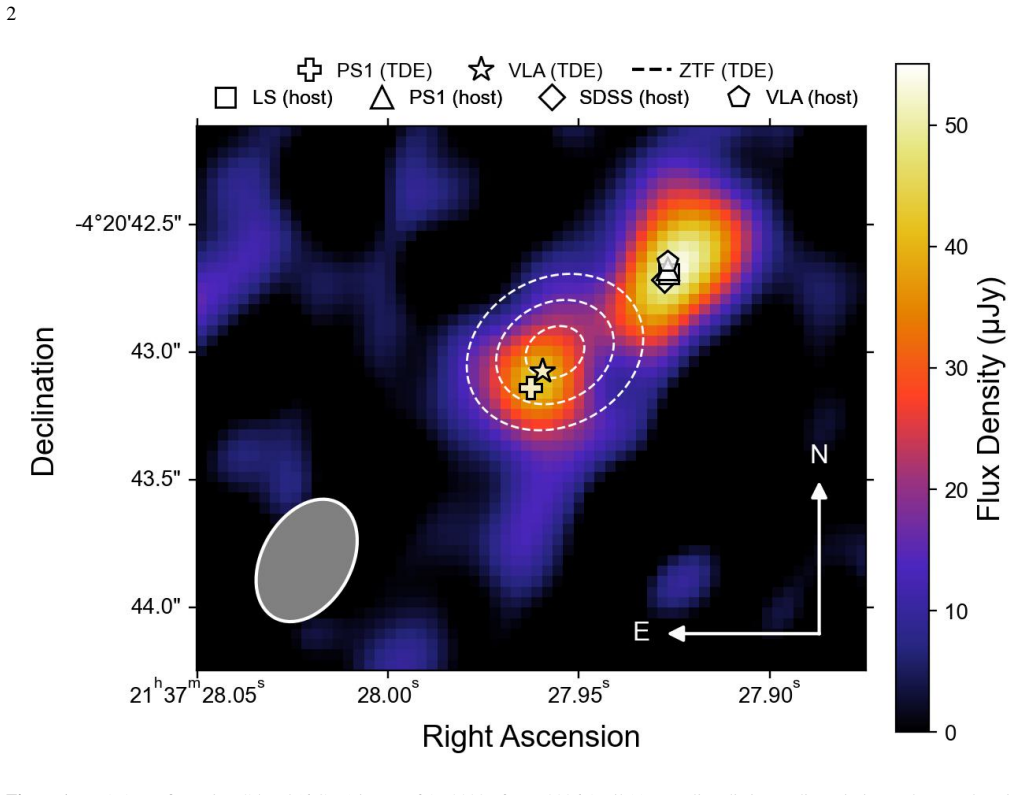
VLA C-band imaging resolves an offset radio source at 0.651±0.036 arcsec (1.06±0.06 kpc) from the host nucleus whose position coincides with the Zwicky Transient Facility and Pan-STARRS1 coordinates of AT 2023mfm, thereby confirming the transient as an off-nuclear tidal disruption event.
What carries the argument
High-resolution 6 GHz radio imaging that spatially separates the offset transient source from the galactic nucleus.
If this is right
- Off-nuclear TDE candidates identified in optical surveys can be validated as genuine events through radio follow-up.
- High-resolution radio imaging provides a practical route to locate massive black holes displaced from galaxy centers.
- The method can be applied to other transients to test whether they arise from off-nuclear black holes.
Where Pith is reading between the lines
- Similar radio offsets in future candidates would increase the known population of wandering black holes in nearby galaxies.
- If the offset persists across wavelengths, it would support models in which black holes are ejected or formed in satellite galaxies that later merge.
- Routine application of this technique could constrain the fraction of TDEs that occur outside galactic nuclei.
Load-bearing premise
The offset radio source belongs to the tidal disruption event rather than arising from a chance alignment or unrelated feature in the host galaxy.
What would settle it
A higher-resolution observation or multi-epoch monitoring showing the offset radio source remains steady while the optical transient fades, or a measured position mismatch exceeding the reported 0.036 arcsec uncertainty.
Figures
read the original abstract
We report new radio observations of the tidal disruption event (TDE) AT 2023mfm, which we identified as a high-confidence candidate in a systematic search for off-nuclear TDEs. High-resolution NSF Karl G. Jansky Very Large Array C-band (6 GHz) imaging resolves two radio sources: one consistent with the host-galaxy nucleus and one offset by $0.651\pm0.036^{\prime\prime}$ ($1.06\pm0.06$ kpc), consistent with the Zwicky Transient Facility and Pan-STARRS1 positions of AT 2023mfm. These observations confirm the off-nuclear nature of AT 2023mfm, demonstrating the power of high-resolution radio imaging to validate off-nuclear TDE candidates and reveal hidden off-nuclear massive black holes.
Editorial analysis
A structured set of objections, weighed in public.
Referee Report
Summary. The manuscript reports new VLA C-band (6 GHz) imaging of the candidate off-nuclear TDE AT 2023mfm. The observations resolve two radio sources within the host galaxy: one at the nucleus and one offset by 0.651 ± 0.036 arcsec (1.06 ± 0.06 kpc), with the offset position matching the optical coordinates from ZTF and Pan-STARRS1. The authors conclude that these data confirm the off-nuclear nature of the TDE.
Significance. If the physical association between the offset radio source and the optical transient is robust, the result adds a confirmed example to the small sample of off-nuclear TDEs and illustrates the value of high-resolution radio follow-up for validating such candidates and identifying candidate wandering or intermediate-mass black holes.
major comments (1)
- [Abstract / Results] Abstract and Results section: the claim that the VLA data 'confirm the off-nuclear nature' of AT 2023mfm rests on positional coincidence (0.651 ± 0.036 arcsec) alone. No surface-density estimate, Poisson probability of chance alignment, multi-epoch variability test, or spectral-index information is provided to demonstrate that the offset source is the TDE counterpart rather than a background AGN, star-forming region, or unrelated source. This probability calculation is load-bearing for the central confirmation claim.
minor comments (1)
- [Abstract] The offset is quoted both in arcseconds and kpc; the conversion assumes a specific cosmology and redshift that should be stated explicitly when first introduced.
Simulated Author's Rebuttal
We thank the referee for their careful reading and constructive feedback. We address the major comment below and will revise the manuscript accordingly to strengthen the statistical support for our conclusions.
read point-by-point responses
-
Referee: [Abstract / Results] Abstract and Results section: the claim that the VLA data 'confirm the off-nuclear nature' of AT 2023mfm rests on positional coincidence (0.651 ± 0.036 arcsec) alone. No surface-density estimate, Poisson probability of chance alignment, multi-epoch variability test, or spectral-index information is provided to demonstrate that the offset source is the TDE counterpart rather than a background AGN, star-forming region, or unrelated source. This probability calculation is load-bearing for the central confirmation claim.
Authors: We agree that a quantitative estimate of the chance-alignment probability would strengthen the manuscript and make the confirmation claim more robust. In the revised version we will add a surface-density calculation for 6 GHz radio sources (drawing on published VLA counts at comparable flux densities) and compute the Poisson probability of an unrelated source falling within the observed 0.65 arcsec offset. This will be presented in the Results section and referenced in the abstract. Our current data are single-epoch C-band continuum imaging, so multi-epoch variability and spectral-index information are not available; we will note this limitation explicitly. The positional match (within the quoted uncertainty) to the independently measured optical transient position, combined with the clear separation from the nuclear radio source, remains the primary evidence, but we accept that the additional statistic requested is warranted and will incorporate it. revision: yes
Circularity Check
No circularity: direct observational positional match with no derivation or fitted inputs
full rationale
The paper reports VLA C-band imaging that resolves an offset radio source whose measured position (0.651±0.036 arcsec) matches prior optical transient coordinates. This is a direct comparison of independent observational datasets; no equations, parameter fits, model predictions, or self-citations are invoked to derive the offset or the association. The central claim does not reduce to any input quantity by construction. No steps match any enumerated circularity pattern.
Axiom & Free-Parameter Ledger
Forward citations
Cited by 1 Pith paper
-
Late-time JWST/NIRCam Observations of the Extremely Long-duration GRB 250702B/EP 250702a and Its Host Galaxy
Late-time JWST/NIRCam data on GRB 250702B show a high-mass dusty host and possible ~3-sigma transient detections in two bands suggesting light-curve flattening.
Reference graph
Works this paper leans on
-
[1]
16 https://science.nrao.edu/facilities/vla/docs/manuals/oss/performance/ positional-accuracy CASA Team, Bean, B., Bhatnagar, S., et al. 2022, PASP, 134, 114501, doi: 10.1088/1538-3873/ac9642
work page internal anchor Pith review doi:10.1088/1538-3873/ac9642 2022
-
[2]
D., Chornock, R., et al.\ 2024, , 971, 185, doi:10.3847/1538-4357/ad5541
Cendes, Y ., Berger, E., Alexander, K. D., et al. 2024, ApJ, 971, 185, doi: 10.3847/1538-4357/ad5541 4
-
[3]
2023, Transient Name Server AstroNote, 250, 1
Chornock, R., Yao, Y ., LeBaron, N., et al. 2023, Transient Name Server AstroNote, 250, 1
2023
-
[4]
Cluver, M. E., Jarrett, T. H., Hopkins, A. M., et al. 2014, ApJ, 782, 90, doi: 10.1088/0004-637X/782/2/90 Förster, F., Cabrera-Vives, G., Castillo-Navarrete, E., et al. 2021, AJ, 161, 242, doi: 10.3847/1538-3881/abe9bc
-
[5]
2023, Transient Name Server Discovery Report, 2023-1546, 1
Fremling, C. 2023, Transient Name Server Discovery Report, 2023-1546, 1
2023
-
[6]
2026, arXiv e-prints, arXiv:2602.12970, doi: 10.48550/arXiv.2602.12970
Guolo, M. 2026, arXiv e-prints, arXiv:2602.12970, doi: 10.48550/arXiv.2602.12970
-
[7]
Jin, C. C., Li, D. Y ., Jiang, N., et al. 2025, arXiv e-prints, arXiv:2501.09580, doi: 10.48550/arXiv.2501.09580
-
[8]
Lin, D., Strader, J., Carrasco, E. R., et al. 2018, Nature Astronomy, 2, 656, doi: 10.1038/s41550-018-0493-1
-
[9]
2026, arXiv e-prints, arXiv:2601.14483, doi: 10.48550/arXiv.2601.14483
Mummery, A. 2026, arXiv e-prints, arXiv:2601.14483, doi: 10.48550/arXiv.2601.14483
-
[10]
Mummery, A., van Velzen, S., Nathan, E., et al. 2024, MNRAS, 527, 2452, doi: 10.1093/mnras/stad3001
-
[11]
2025, ApJL, 992, L18, doi: 10.3847/2041-8213/ae0a26
Sfaradi, I., Margutti, R., Chornock, R., et al. 2025, ApJL, 992, L18, doi: 10.3847/2041-8213/ae0a26
-
[12]
TDE 2025abcr: A Tidal Disruption Event in the Outskirts of a Massive Galaxy
Stein, R., Carney, J., Ward, C., et al. 2026, arXiv e-prints, arXiv:2602.10180, doi: 10.48550/arXiv.2602.10180
work page internal anchor Pith review Pith/arXiv arXiv doi:10.48550/arxiv.2602.10180 2026
-
[13]
Yao, Y ., Chornock, R., Ward, C., et al. 2025, ApJL, 985, L48, doi: 10.3847/2041-8213/add7de
-
[14]
, archivePrefix = "arXiv", eprint =
Zibetti, S., Charlot, S., & Rix, H.-W. 2009, MNRAS, 400, 1181, doi: 10.1111/j.1365-2966.2009.15528.x
discussion (0)
Sign in with ORCID, Apple, or X to comment. Anyone can read and Pith papers without signing in.