JWST absorption line spectroscopy with SPURS: ISM covering fractions and kinematics in individual galaxies at z=5-9
Pith reviewed 2026-06-28 00:11 UTC · model grok-4.3
The pith
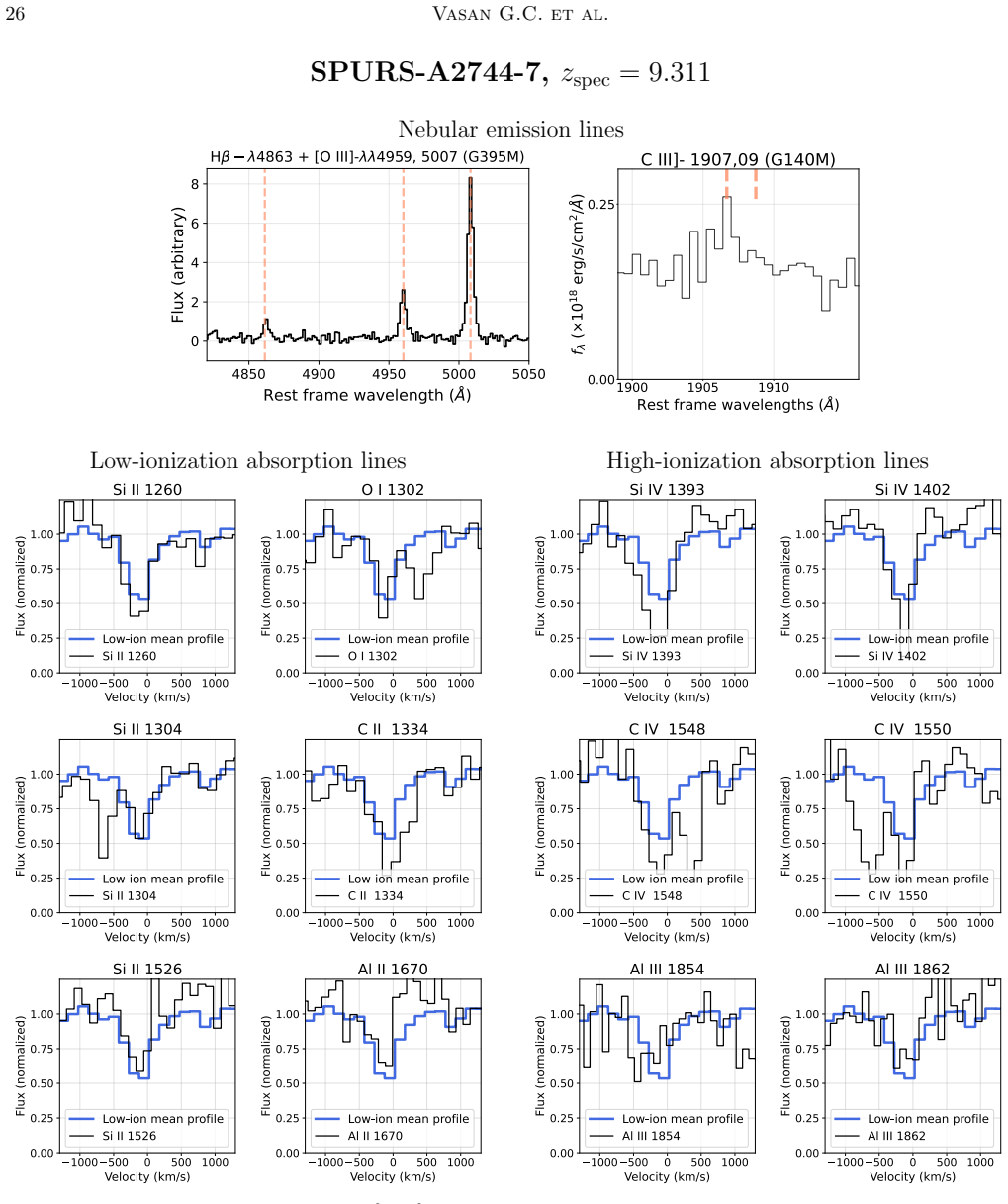
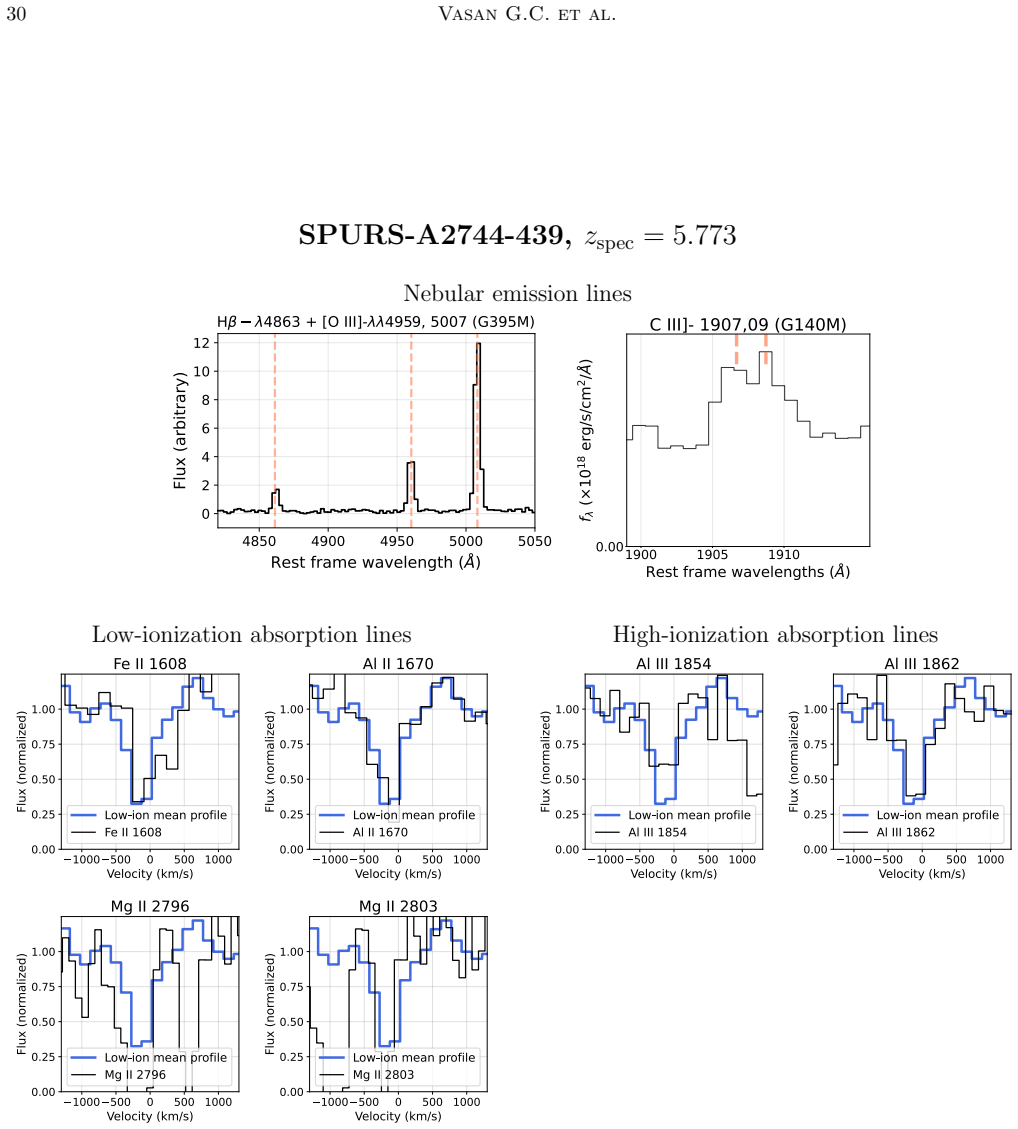
JWST spectra of six z=5-9 galaxies detect ISM metal lines showing covering fractions 0.2-0.9 and velocity centroids from +70 to -140 km/s with half near systemic.
A machine-rendered reading of the paper's core claim, the machinery that carries it, and where it could break.
Core claim
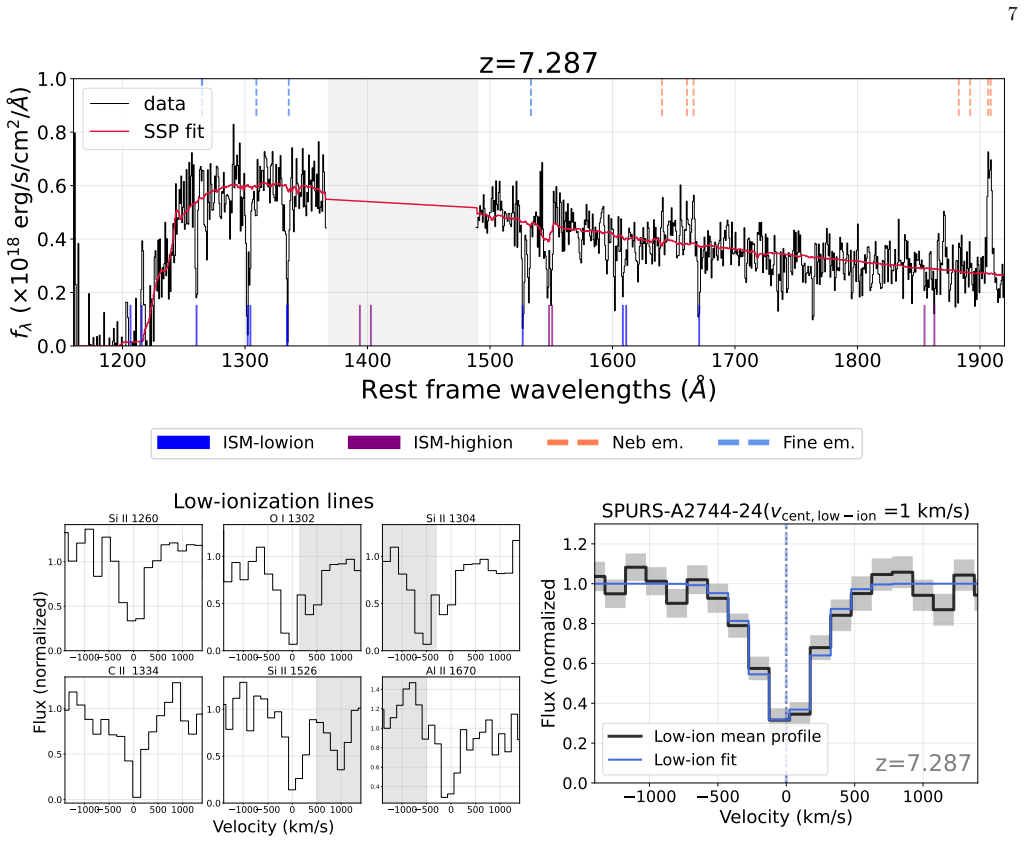
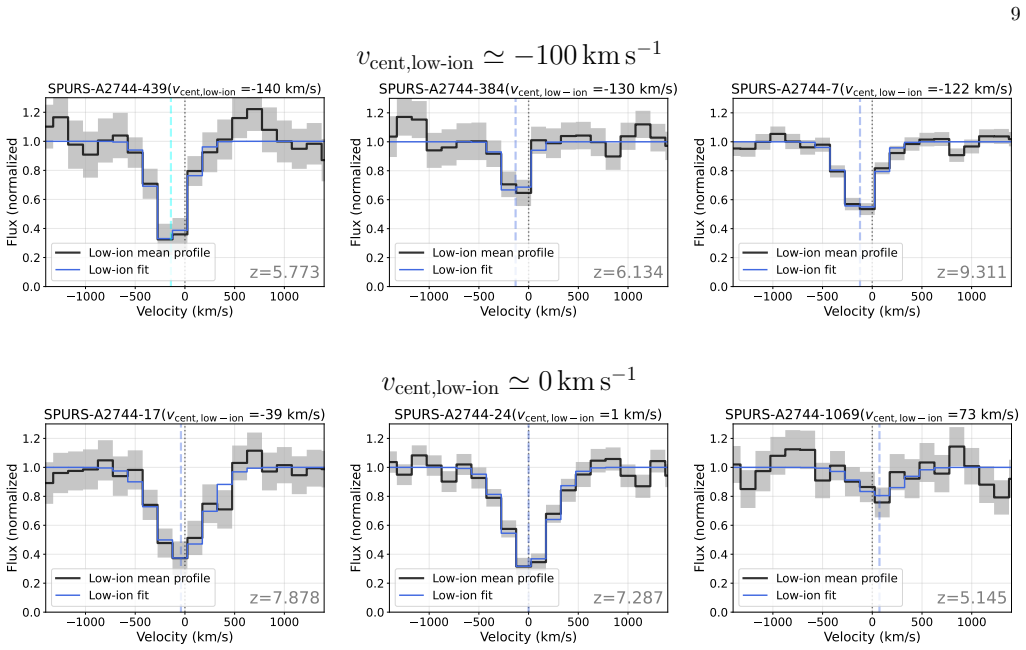
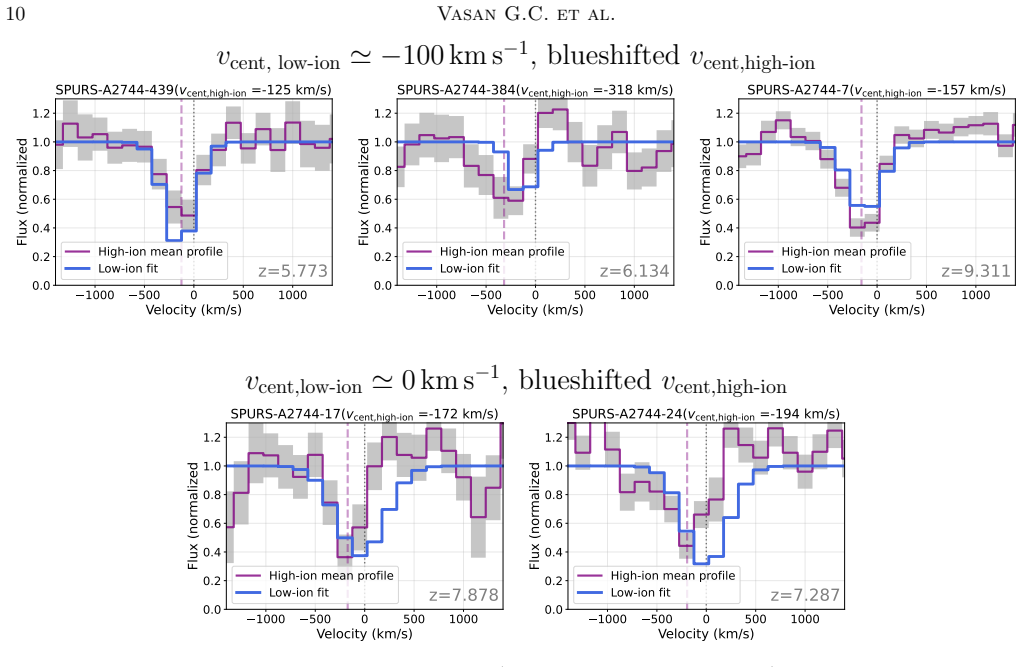
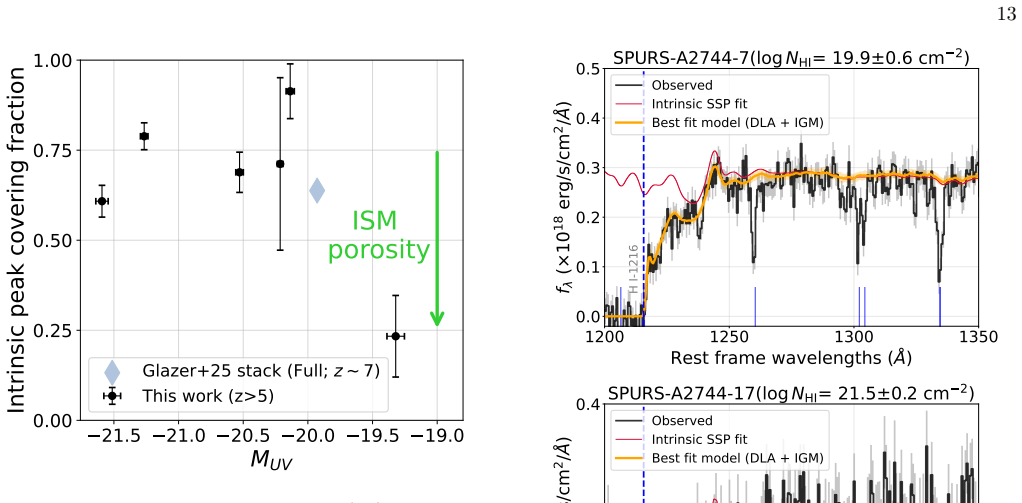
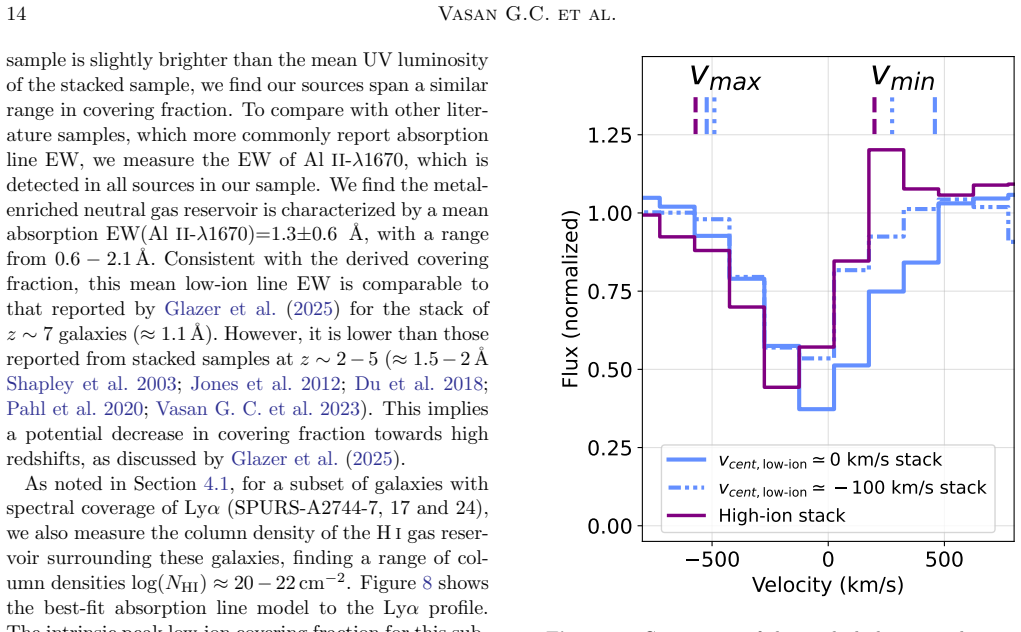
The individual galaxy spectra show unambiguous detections of ISM metal absorption lines from low- and high-ionization states of enriched gas. Low-ionization gas covering fractions range from 0.2 to 0.9, indicating a heterogeneous and patchy neutral ISM. The low-ionization kinematics show velocity centroid values ranging from +70 to -140 km s^{-1}, while the high-ion gas shows mostly blueshifted absorption indicating multiphase outflows. Half the sample, in particular those with the lowest stellar masses and highest sSFRs, have low-ionization velocity centroids close to systemic velocities, in contrast to near-ubiquitous bulk low-ionization gas outflows at lower redshifts.
What carries the argument
Rest-UV absorption line spectroscopy of low- and high-ionization metal lines to derive covering fractions from equivalent widths and kinematics from velocity centroids.
Load-bearing premise
The measured absorption profiles are produced solely by ISM gas in the target galaxies with no significant contribution from foreground systems, instrumental artifacts, or misidentified lines.
What would settle it
Higher-resolution spectra or multi-object observations that identify absorption components at redshifts or velocities inconsistent with the target galaxies or matching known foreground absorbers.
Figures







read the original abstract
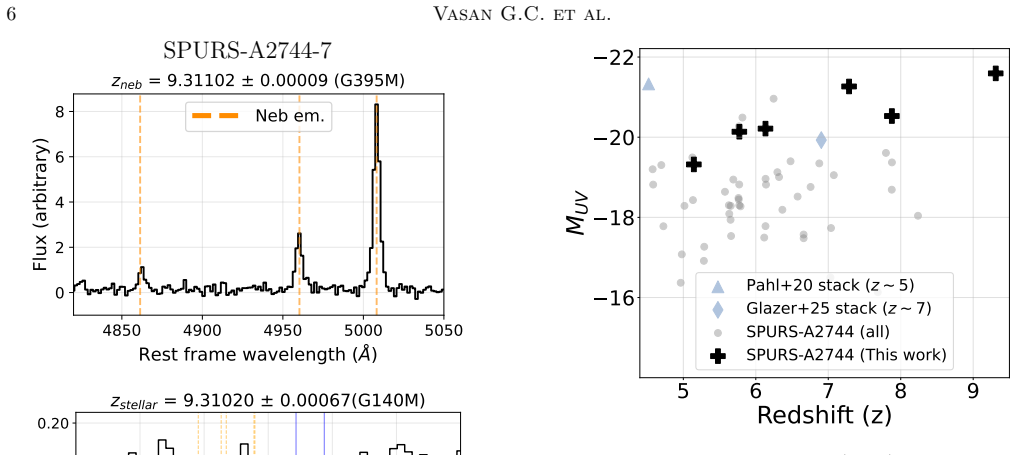
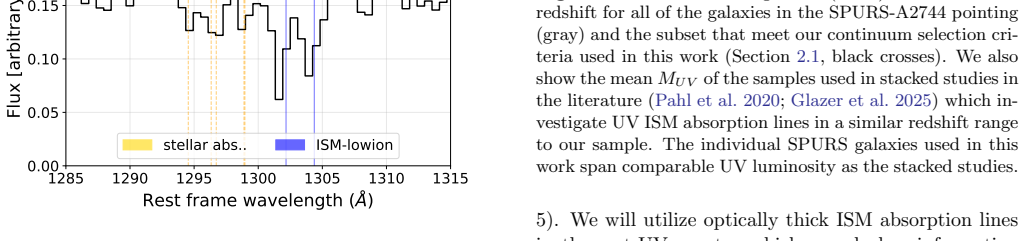
We present deep rest-ultraviolet (UV) spectra of six luminous $z=5$ -- 9 galaxies in the Abell-2744 field taken as part of the JWST Cycle 4 Large Program SPURS. The individual galaxy spectra show unambiguous detections of interstellar medium (ISM) metal absorption lines from low- and high-ionization states of enriched gas, which we use to probe the ISM gas porosity and kinematics. We find a striking diversity in the absorption profiles. We find low-ionization gas covering fractions ranging from 0.2 to 0.9, indicating a heterogeneous and patchy neutral ISM. The low-ionization kinematics also show a large diversity, with velocity centroid values ranging from $+$70 to a significantly blueshifted $-140$ km$\,$s$^{-1}$, while the high-ion gas shows mostly blueshifted absorption, indicating the presence of multiphase outflows. While all sources show outflow signatures in blueshifted wings, we also find that half of our sample, in particular those with the lowest stellar masses and highest sSFRs, have low-ionization velocity centroids close to systemic velocities. This is in contrast to near-ubiquitous bulk low-ionization gas outflows at lower redshifts. We suggest that this diversity of kinematics may be due to the bulk of the cold gas having low outflow velocities in the lowest mass and highest sSFR systems, potentially due to inefficient entrainment and/or an unresolved infalling component. These spectra reveal a metal-enriched ISM with complex gas geometry and kinematics, and highlight the potential of deep JWST grating spectroscopy to reveal the properties of the ISM during the reionization era.
Editorial analysis
A structured set of objections, weighed in public.
Referee Report
Summary. The manuscript presents deep JWST rest-UV grating spectra of six luminous galaxies at z=5-9 obtained as part of the SPURS program. It reports unambiguous detections of low- and high-ionization ISM metal absorption lines and derives low-ionization covering fractions ranging from 0.2 to 0.9 together with velocity centroids spanning +70 to -140 km s^{-1}. The work emphasizes diversity in the profiles, notes that half the sample (particularly the lowest-mass, highest-sSFR objects) shows low-ionization centroids near systemic velocity, and contrasts this with the near-ubiquitous bulk outflows seen at lower redshifts, suggesting implications for inefficient entrainment or unresolved infall in early galaxies.
Significance. If the line identifications are secure and the absorption can be attributed exclusively to the target galaxies, the results would supply rare, spatially integrated constraints on the porosity and multiphase kinematics of the ISM in individual reionization-era systems. The demonstration of greater kinematic diversity than at lower redshifts, obtained directly from grating spectroscopy, would highlight JWST's potential for such studies and provide a useful benchmark for models of cold-gas outflows during reionization.
major comments (2)
- The conversion of measured equivalent widths into covering fractions (0.2-0.9) and of line centroids into velocities (+70 to -140 km s^{-1}) rests on the assumption that every detected metal line arises solely from ISM gas inside the six target galaxies. The manuscript provides no explicit demonstration that absorption redshifts coincide with the galaxies' systemic redshifts to within the instrumental resolution, nor does it rule out plausible foreground metal absorbers at z<5 whose rest wavelengths fall inside the observed grating windows and slit positions. This attribution step is load-bearing for the reported ranges and the claimed contrast to lower-redshift samples.
- The abstract and results state specific numerical ranges for covering fractions and velocity centroids without accompanying uncertainties, details of the line-fitting procedure, continuum placement, or data-reduction steps. These omissions prevent quantitative assessment of whether the reported diversity is statistically significant or whether the half-sample near systemic velocity is robust.
minor comments (2)
- The abstract would benefit from a brief statement of the spectral resolution and typical S/N per resolution element to contextualize the claimed 'unambiguous detections'.
- A short table listing the six galaxies, their redshifts, stellar masses, and sSFRs would help readers connect the kinematic diversity to the galaxy properties mentioned in the discussion.
Simulated Author's Rebuttal
We thank the referee for their careful reading of the manuscript and constructive comments. We address each major comment below and have revised the manuscript accordingly to strengthen the attribution of the absorption features and to provide the requested methodological details.
read point-by-point responses
-
Referee: The conversion of measured equivalent widths into covering fractions (0.2-0.9) and of line centroids into velocities (+70 to -140 km s^{-1}) rests on the assumption that every detected metal line arises solely from ISM gas inside the six target galaxies. The manuscript provides no explicit demonstration that absorption redshifts coincide with the galaxies' systemic redshifts to within the instrumental resolution, nor does it rule out plausible foreground metal absorbers at z<5 whose rest wavelengths fall inside the observed grating windows and slit positions. This attribution step is load-bearing for the reported ranges and the claimed contrast to lower-redshift samples.
Authors: We agree that explicit verification is necessary. Systemic redshifts were measured from the [O III] λ5007 emission lines detected in the same NIRSpec grating spectra for all six galaxies. In the revised manuscript we add a new table (Table 2) that lists, for each target and each detected transition, the systemic redshift, the absorption-line redshift, the velocity offset, and the instrumental resolution. All offsets are consistent with zero within the ~80–120 km s^{-1} resolution. We also add a short paragraph discussing the low probability of foreground contamination: the specific combination of low- and high-ionization lines at the observed wavelengths would require an improbable alignment of multiple systems within the 0.2-arcsec slit, and no such systems are detected in the deep HST or JWST imaging. These additions directly address the load-bearing assumption. revision: yes
-
Referee: The abstract and results state specific numerical ranges for covering fractions and velocity centroids without accompanying uncertainties, details of the line-fitting procedure, continuum placement, or data-reduction steps. These omissions prevent quantitative assessment of whether the reported diversity is statistically significant or whether the half-sample near systemic velocity is robust.
Authors: We acknowledge that these details were insufficient in the submitted version. The revised manuscript expands the Methods section (new subsection 3.2) to describe: (i) the JWST pipeline reduction steps and custom 1D extraction, (ii) continuum placement via iterative spline fitting to line-free regions with bootstrap resampling, (iii) Gaussian line-profile fitting performed with emcee MCMC, and (iv) the propagation of posterior uncertainties into covering-fraction and velocity-centroid values. We now report 1σ uncertainties on all quoted ranges in both the abstract and results, and we include a supplementary figure showing example fits and posterior distributions. These changes allow readers to evaluate the robustness of the reported diversity. revision: yes
Circularity Check
No circularity: direct observational measurements from spectra
full rationale
The paper reports equivalent widths, covering fractions (0.2-0.9), and velocity centroids (+70 to -140 km/s) as direct extractions from the observed JWST grating spectra of six galaxies. These quantities follow from standard line-profile integration and centroid measurement applied to detected metal absorption features; no equation in the provided text defines one reported value in terms of another, fits a parameter to a subset and renames the output as a prediction, or invokes a self-citation chain to justify the core attribution step. The analysis is therefore self-contained against external benchmarks (the spectra themselves) and receives the default non-circularity finding.
Axiom & Free-Parameter Ledger
axioms (1)
- domain assumption Absorption lines can be unambiguously assigned to specific low- and high-ionization metal transitions in the rest-UV without significant blending or contamination.
Forward citations
Cited by 2 Pith papers
-
Chemical signatures from the first stars embedded in metal-poor gas in galaxies at cosmic dawn
JWST absorption spectra of galaxies at z~8-9 show metal-poor gas with high [C/O] suggesting enrichment by Population III supernovae.
-
JWST Absorption-Line Analysis of UV-Bright Galaxies at $z=7.2-10.6$: Early Chemical Enrichment Traced by C, O, Mg, Al, Si, and Fe
JWST spectra reveal that two z~7 galaxies already show near-solar iron-to-silicon ratios with no strong odd-even effect, favoring early Type Ia supernovae over pair-instability supernovae as the source of iron enrichment.
Reference graph
Works this paper leans on
-
[1]
John , year = 2008, month = jan, journal =
Ly damping wing constraints on inhomogeneous reionization. , keywords =. doi:10.1111/j.1365-2966.2007.12836.x , archivePrefix =. 0710.0371 , primaryClass =
-
[2]
The Transfer of Resonance-Line Radiation in Static Astrophysical Media. , keywords =. doi:10.1086/168375 , adsurl =
-
[3]
Lyman- escape through anisotropic media. , keywords =. doi:10.1093/mnras/stag330 , archivePrefix =. 2509.19184 , primaryClass =
-
[4]
JWST spectroscopy of z 5-8 UV-selected galaxies: new constraints on the evolution of the Ly escape fraction in the reionization era. , keywords =. doi:10.1093/mnras/stae455 , archivePrefix =. 2311.13683 , primaryClass =
-
[5]
The fraction of ionizing radiation from massive stars that escapes to the intergalactic medium
The fraction of ionizing radiation from massive stars that escapes to the intergalactic medium. , keywords =. doi:10.1093/mnras/sty3460 , archivePrefix =. 1805.07318 , primaryClass =
work page internal anchor Pith review Pith/arXiv arXiv doi:10.1093/mnras/sty3460
-
[6]
JWST Measurements of Neutral Hydrogen Fractions and Ionized Bubble Sizes at z = 7─12 Obtained with Ly Damping Wing Absorptions in 27 Bright Continuum Galaxies. , keywords =. doi:10.3847/1538-4357/ad554e , archivePrefix =. 2306.00487 , primaryClass =
-
[7]
All the Massive Galaxy Overdensities during Reionization: JWST Rest-Frame Optical Selection Reveals Young, Chemically Evolved Galaxies Embedded in Dense, Neutral Gas at z > 5. arXiv e-prints , keywords =. doi:10.48550/arXiv.2602.09091 , archivePrefix =. 2602.09091 , primaryClass =
work page internal anchor Pith review Pith/arXiv arXiv doi:10.48550/arxiv.2602.09091
-
[8]
The Launching of Galactic Winds from a Multiphase ISM
The launching of galactic winds from a multiphase ISM. , keywords =. doi:10.1093/mnras/stag539 , archivePrefix =. 2510.14829 , primaryClass =
work page internal anchor Pith review Pith/arXiv arXiv doi:10.1093/mnras/stag539
-
[9]
The growth and entrainment of cold gas in a hot wind
The growth and entrainment of cold gas in a hot wind. , keywords =. doi:10.1093/mnrasl/sly131 , archivePrefix =. 1806.02728 , primaryClass =
work page internal anchor Pith review Pith/arXiv arXiv doi:10.1093/mnrasl/sly131
-
[10]
Beacons into the Cosmic Dark Ages: Boosted Transmission of Ly from UV Bright Galaxies at z 7. , keywords =. doi:10.3847/2041-8213/aabbab , archivePrefix =. 1801.01891 , primaryClass =
work page internal anchor Pith review Pith/arXiv arXiv doi:10.3847/2041-8213/aabbab 2041
-
[11]
The detectability of Ly emission from galaxies during the epoch of reionization. , keywords =. doi:10.1111/j.1365-2966.2011.18530.x , archivePrefix =. 1101.5160 , primaryClass =
-
[12]
A first systematic study of [OIII] 88 μ m at z>8 : two luminous oxygen lines and a powerful ionized outflow in the first 600 million years. arXiv e-prints , keywords =. doi:10.48550/arXiv.2512.14486 , archivePrefix =. 2512.14486 , primaryClass =
-
[13]
The Spectroscopic Properties of Ly -Emitters at z 2.7: Escaping Gas and Photons from Faint Galaxies. , keywords =. doi:10.1088/0004-637X/809/1/89 , archivePrefix =. 1506.08205 , primaryClass =
work page internal anchor Pith review Pith/arXiv arXiv doi:10.1088/0004-637x/809/1/89
-
[14]
Ly emission in galaxies at z ≃ 5-6: new insight from JWST into the statistical distributions of Ly properties at the end of reionization. , keywords =. doi:10.1093/mnras/stae1338 , archivePrefix =. 2402.06070 , primaryClass =
-
[15]
Preparing for JWST observations
New high-precision strong lensing modeling of Abell 2744. Preparing for JWST observations. , keywords =. doi:10.1051/0004-6361/202244575 , archivePrefix =. 2207.09416 , primaryClass =
-
[16]
The Frontier Fields: Survey Design
The Frontier Fields: Survey Design and Initial Results. , keywords =. doi:10.3847/1538-4357/837/1/97 , archivePrefix =. 1605.06567 , primaryClass =
work page internal anchor Pith review Pith/arXiv arXiv doi:10.3847/1538-4357/837/1/97
-
[17]
Cold streams in early massive hot haloes as the main mode of galaxy formation
Cold streams in early massive hot haloes as the main mode of galaxy formation. , keywords =. doi:10.1038/nature07648 , archivePrefix =. 0808.0553 , primaryClass =
work page internal anchor Pith review Pith/arXiv arXiv doi:10.1038/nature07648
-
[18]
RUBIES: A complete census of the bright and red distant Universe with JWST/NIRSpec. , keywords =. doi:10.1051/0004-6361/202452186 , archivePrefix =. 2409.05948 , primaryClass =
-
[19]
Observing the End of Cold Flow Accretion using Halo Absorption Systems
Observing the End of Cold Flow Accretion Using Halo Absorption Systems. , keywords =. doi:10.1088/2041-8205/735/1/L1 , archivePrefix =. 1012.2128 , primaryClass =
work page internal anchor Pith review Pith/arXiv arXiv doi:10.1088/2041-8205/735/1/l1 2041
-
[20]
LyC escape from SPHINX galaxies in the Epoch of Reionization. , keywords =. doi:10.1093/mnras/stac1942 , archivePrefix =. 2207.03232 , primaryClass =
-
[21]
Galaxy Formation and Reionization: Key Unknowns and Expected Breakthroughs by the James Webb Space Telescope. , keywords =. doi:10.1146/annurev-astro-120221-044656 , archivePrefix =. 2110.13160 , primaryClass =
-
[22]
CLASSY VII Ly Profiles: The Structure and Kinematics of Neutral Gas and Implications for LyC Escape in Reionization-era Analogs. , keywords =. doi:10.3847/1538-4357/aceefd , archivePrefix =. 2307.04911 , primaryClass =
-
[23]
Neutral Gas Properties and Ly$\alpha$ Escape in Extreme Green Pea Galaxies
Neutral Gas Properties and Ly Escape in Extreme Green Pea Galaxies. , keywords =. doi:10.3847/1538-4357/ab08eb , archivePrefix =. 1902.08204 , primaryClass =
work page internal anchor Pith review Pith/arXiv arXiv doi:10.3847/1538-4357/ab08eb 1902
-
[24]
Constraints on the z 6 - 13 intergalactic medium from JWST spectroscopy of Lyman-alpha damping wings in galaxies. , keywords =. doi:10.1051/0004-6361/202553820 , archivePrefix =. 2501.11702 , primaryClass =
-
[25]
SPURS: Bursty Star Formation in an Extremely Luminous Weak Emission Line Galaxy at $z=9.3$
SPURS: Bursty Star Formation in an Extremely Luminous Weak Emission Line Galaxy at z=9.3. arXiv e-prints , keywords =. doi:10.48550/arXiv.2604.21516 , archivePrefix =. 2604.21516 , primaryClass =
work page internal anchor Pith review Pith/arXiv arXiv doi:10.48550/arxiv.2604.21516
-
[26]
I: Confirmation of Lensed z 7 Lyman-break Galaxies behind the Abell 2744 Cluster with NIRISS
Early Results from GLASS-JWST. I: Confirmation of Lensed z 7 Lyman-break Galaxies behind the Abell 2744 Cluster with NIRISS. , keywords =. doi:10.3847/2041-8213/ac8e6e , archivePrefix =. 2207.11387 , primaryClass =
-
[27]
Early metal-enriched baryon cycling before the midpoint of cosmic reionization
Early metal-enriched baryon cycling before the midpoint of cosmic reionization. arXiv e-prints , keywords =. doi:10.48550/arXiv.2604.21218 , archivePrefix =. 2604.21218 , primaryClass =
work page internal anchor Pith review Pith/arXiv arXiv doi:10.48550/arxiv.2604.21218
-
[28]
JADES: Probing interstellar medium conditions at z ∼ 5.5–9.5 with ultra-deep JWST/NIRSpec spectroscopy , DOI= "10.1051/0004-6361/202346107", url= "https://doi.org/10.1051/0004-6361/202346107", journal =
-
[29]
Sanders, Ryan L. and Shapley, Alice E. and Topping, Michael W. and Reddy, Naveen A. and Brammer, Gabriel B. , title =. The Astrophysical Journal , abstract =. 2023 , month =. doi:10.3847/1538-4357/acedad , url =
-
[30]
Unveiling the ISM properties of low-z Lyman-continuum emitters
The Low-Redshift Lyman Continuum Survey. Unveiling the ISM properties of low-z Lyman-continuum emitters. , keywords =. doi:10.1051/0004-6361/202141864 , archivePrefix =. 2201.11800 , primaryClass =
-
[31]
The Effects of Stellar Population and Gas Covering Fraction on the Emergent Ly Emission of High-redshift Galaxies. , keywords =. doi:10.3847/1538-4357/ac3b4c , archivePrefix =. 2108.05363 , primaryClass =
-
[32]
Neutral gas properties of Lyman continuum emitting galaxies: Column densities and covering fractions from UV absorption lines. , keywords =. doi:10.1051/0004-6361/201832759 , archivePrefix =. 1802.06378 , primaryClass =
work page internal anchor Pith review Pith/arXiv arXiv doi:10.1051/0004-6361/201832759
-
[33]
The Connection Between Reddening, Gas Covering Fraction, and the Escape of Ionizing Radiation at High Redshift. , keywords =. doi:10.3847/0004-637X/828/2/108 , archivePrefix =. 1606.03452 , primaryClass =
work page internal anchor Pith review Pith/arXiv arXiv doi:10.3847/0004-637x/828/2/108
-
[34]
Hot Gas Accretion and Angular Momentum in FIRE Simulations: From Halo to Galaxy Scales
Cold vs. Hot Gas Accretion and Angular Momentum in FIRE Simulations: From Halo to Galaxy Scales. arXiv e-prints , keywords =
-
[35]
Closing in on the sources of cosmic reionization: First results from the GLASS-JWST program. , keywords =. doi:10.1051/0004-6361/202345866 , archivePrefix =. 2301.02816 , primaryClass =
-
[36]
Multivariate Predictors of Lyman Continuum Escape. II. Predicting Lyman Continuum Escape Fractions for High-redshift Galaxies. , keywords =. doi:10.3847/1538-4357/ad5557 , archivePrefix =. 2406.10179 , primaryClass =
-
[37]
Early Results from GLASS-JWST. XIV. A Spectroscopically Confirmed Protocluster 650 Million Years after the Big Bang. , keywords =. doi:10.3847/2041-8213/acb99e , archivePrefix =. 2211.09097 , primaryClass =
-
[38]
HumVI: Human Viewable Image creation
-
[39]
The GLASS-JWST Early Release Science Program. I. Survey Design and Release Plans. , keywords =. doi:10.3847/1538-4357/ac8158 , archivePrefix =. 2206.07978 , primaryClass =
-
[40]
Ionised gas kinematics and dynamical masses of z 6 galaxies from JADES/NIRSpec high-resolution spectroscopy. , keywords =. doi:10.1051/0004-6361/202347755 , archivePrefix =. 2308.09742 , primaryClass =
-
[41]
JADES: Insights into the low-mass end of the mass-metallicity-SFR relation at 3 < z < 10 from deep JWST/NIRSpec spectroscopy. , keywords =. doi:10.1051/0004-6361/202346698 , archivePrefix =. 2304.08516 , primaryClass =
-
[42]
Unveiling the Cosmic Chemistry: Revisiting the Mass─Metallicity Relation with JWST/NIRSpec at 4 < z < 10. , keywords =. doi:10.3847/1538-4357/ad8f32 , archivePrefix =. 2408.07974 , primaryClass =
-
[43]
The Mass-Metallicity Relation at z~2
The Mass-Metallicity Relation at z> -0.5ex 2. , keywords =. doi:10.1086/503623 , archivePrefix =. astro-ph/0602473 , primaryClass =
work page internal anchor Pith review Pith/arXiv arXiv doi:10.1086/503623
-
[44]
The MOSDEF Survey: The Evolution of the Mass-Metallicity Relation from z = 0 to z 3.3. , keywords =. doi:10.3847/1538-4357/abf4c1 , archivePrefix =. 2009.07292 , primaryClass =
-
[45]
An accurate measurement of the spectral resolution of the JWST Near Infrared Spectrograph. , keywords =. doi:10.1051/0004-6361/202556281 , archivePrefix =. 2507.03746 , primaryClass =
-
[46]
In-orbit Performance of the Near-infrared Spectrograph NIRSpec on the James Webb Space Telescope. , keywords =. doi:10.1088/1538-3873/acb846 , archivePrefix =. 2301.13766 , primaryClass =
-
[47]
The Near-Infrared Spectrograph (NIRSpec) on the James Webb Space Telescope. I. Overview of the instrument and its capabilities. , keywords =. doi:10.1051/0004-6361/202142663 , archivePrefix =. 2202.03305 , primaryClass =
work page internal anchor Pith review Pith/arXiv arXiv doi:10.1051/0004-6361/202142663
-
[48]
Stellar Mass Growth in the First Galaxies: Theory and Observation. arXiv e-prints , keywords =. doi:10.48550/arXiv.2602.01549 , archivePrefix =. 2602.01549 , primaryClass =
-
[49]
The ALPINE-CRISTAL-JWST Survey: The Fast Metal Enrichment of Massive Galaxies at z~5
The ALPINE-CRISTAL-JWST Survey: The Fast Metal Enrichment of Massive Galaxies at z -0.5ex 5. arXiv e-prints , keywords =. doi:10.48550/arXiv.2510.16106 , archivePrefix =. 2510.16106 , primaryClass =
work page internal anchor Pith review Pith/arXiv arXiv doi:10.48550/arxiv.2510.16106
-
[50]
Astrophysics of gaseous nebulae and active galactic nuclei
-
[51]
A massive interacting galaxy 510 million years after the Big Bang. Nature Astronomy , keywords =. doi:10.1038/s41550-024-02218-7 , archivePrefix =. 2303.00306 , primaryClass =
-
[52]
Detection of Gas Inflow during the Onset of a Starburst in a Low-mass Galaxy at z = 2.45. , keywords =. doi:10.3847/2041-8213/ad93d0 , archivePrefix =. 2409.00308 , primaryClass =
-
[53]
A study of interstellar gas and stars in the gravitationally lensed galaxy `the Cosmic Eye' from rest-frame ultraviolet spectroscopy. , keywords =. doi:10.1111/j.1365-2966.2009.16005.x , archivePrefix =. 0910.0840 , primaryClass =
-
[54]
HST-Based Lens Model of SDSS J1226+2152, in Preparation for JWST-ERS TEMPLATES. arXiv e-prints , keywords =. doi:10.48550/arXiv.2207.05709 , archivePrefix =. 2207.05709 , primaryClass =
-
[55]
Simple Models of Metal-Line Absorption and Emission from Cool Gas Outflows
Simple Models of Metal-line Absorption and Emission from Cool Gas Outflows. , keywords =. doi:10.1088/0004-637X/734/1/24 , archivePrefix =. 1102.3444 , primaryClass =
work page internal anchor Pith review Pith/arXiv arXiv doi:10.1088/0004-637x/734/1/24
-
[56]
Starburst99: Synthesis Models for Galaxies with Active Star Formation
Starburst99: Synthesis Models for Galaxies with Active Star Formation. , keywords =. doi:10.1086/313233 , archivePrefix =. astro-ph/9902334 , primaryClass =
work page internal anchor Pith review Pith/arXiv arXiv doi:10.1086/313233
-
[57]
Kinematics of the Circumgalactic Medium of a z = 0.77 Galaxy from Mg II Tomography. , keywords =. doi:10.3847/1538-4357/abfa11 , archivePrefix =. 2006.00006 , primaryClass =
-
[58]
The Mass and Momentum Outflow Rates of Photoionized Galactic Outflows
The mass and momentum outflow rates of photoionized galactic outflows. , keywords =. doi:10.1093/mnras/stx1164 , archivePrefix =. 1702.07351 , primaryClass =
work page internal anchor Pith review Pith/arXiv arXiv doi:10.1093/mnras/stx1164
-
[59]
A theory of the interstellar medium: three components regulated by supernova explosions in an inhomogeneous substrate. , keywords =. doi:10.1086/155667 , adsurl =
-
[60]
The Structure of Multiphase Galactic Winds. , keywords =. doi:10.3847/1538-4357/ac2f41 , archivePrefix =. 2108.05355 , primaryClass =
-
[61]
The Keck Cosmic Web Imager Integral Field Spectrograph
Patrick Morrissey and Matuesz Matuszewski and D. Christopher Martin and James D. Neill and Harland Epps and Jason Fucik and Bob Weber and Behnam Darvish and Sean Adkins and Steve Allen and Randy Bartos and Justin Belicki and Jerry Cabak and Shawn Callahan and Dave Cowley and Marty Crabill and Willian Deich and Alex Delecroix and Greg Doppman and David Hil...
work page internal anchor Pith review doi:10.3847/1538-4357/aad597 2018
-
[62]
Ahmed Shaban and Rongmon Bordoloi and John Chisholm and Soniya Sharma and Keren Sharon and Jane R. Rigby and Michael G. Gladders and Matthew B. Bayliss and L. Felipe Barrientos and Sebastian Lopez and Nicolas Tejos and Cédric Ledoux and Michael K. Florian , title =. The Astrophysical Journal , abstract =. 2022 , month =. doi:10.3847/1538-4357/ac7c65 , url =
-
[63]
MAGIICAT III. Interpreting Self-similarity of the Circumgalactic Medium with Virial Mass Using Mg II Absorption. , keywords =. doi:10.1088/0004-637X/779/1/87 , archivePrefix =. 1308.2618 , primaryClass =
work page internal anchor Pith review Pith/arXiv arXiv doi:10.1088/0004-637x/779/1/87
-
[64]
A Glimpse of the Stellar Populations and Elemental Abundances of Gravitationally Lensed, Quiescent Galaxies at z 1 with Keck Deep Spectroscopy. , keywords =. doi:10.3847/1538-4357/acc79b , archivePrefix =. 2212.04731 , primaryClass =
-
[65]
Monthly Notices of the Royal Astronomical Society , volume =
Shaban, Ahmed and Bordoloi, Rongmon and Chisholm, John and Rigby, Jane R and Sharma, Soniya and Sharon, Keren and Tejos, Nicolas and Bayliss, Matthew B and Barrientos, L Felipe and Lopez, Sebastian and Ledoux, Cédric and Gladders, Michael G and Florian, Michael K , title = ". Monthly Notices of the Royal Astronomical Society , volume =. 2023 , month =. do...
-
[66]
Resolved Velocity Profiles of Galactic Winds at Cosmic Noon , journal =
Keerthi. Resolved Velocity Profiles of Galactic Winds at Cosmic Noon , journal =. 2023 , month =. doi:10.3847/1538-4357/acf462 , url =
-
[67]
The Smooth MgII gas distribution through the interstellar/extra-planar/halo interface
The Smooth Mg II Gas Distribution through the Interstellar/Extra-planar/Halo Interface. , keywords =. doi:10.1088/2041-8205/777/1/L11 , archivePrefix =. 1310.1918 , primaryClass =
work page internal anchor Pith review Pith/arXiv arXiv doi:10.1088/2041-8205/777/1/l11 2041
-
[68]
arXiv e-prints , keywords =
Revealing the nature of a Lyman- halo in a strongly-lensed interacting system at z=2.92. arXiv e-prints , keywords =
-
[69]
arXiv e-prints , keywords =
The COS Legacy Archive Spectroscopy SurveY (CLASSY) Treasury Atlas. arXiv e-prints , keywords =
-
[70]
Column Density, Kinematics, and Thermal State of Metal-bearing Gas within the Virial Radius of z 2 Star-forming Galaxies in the Keck Baryonic Structure Survey. , keywords =. doi:10.3847/1538-4357/ab4255 , archivePrefix =. 1903.00004 , primaryClass =
-
[71]
arXiv e-prints , keywords =
The MOSDEF-LRIS Survey: Connection between Galactic-scale Outflows and the Properties of z -0.5ex 2 star-forming Galaxies. arXiv e-prints , keywords =
-
[72]
arXiv e-prints , keywords =
The AGEL Survey: Spectroscopic Confirmation of Strong Gravitational Lenses in the DES and DECaLS Fields Selected Using Convolutional Neural Networks. arXiv e-prints , keywords =
-
[73]
arXiv e-prints , keywords =
CLASSY III: The Properties of Starburst-Driven Warm Ionized Outflows. arXiv e-prints , keywords =
-
[74]
Strong lensing analysis of Abell 2744 with MUSE and Hubble Frontier Fields images
Strong-lensing analysis of A2744 with MUSE and Hubble Frontier Fields images. , keywords =. doi:10.1093/mnras/stx1971 , archivePrefix =. 1702.06962 , primaryClass =
work page internal anchor Pith review Pith/arXiv arXiv doi:10.1093/mnras/stx1971
-
[75]
Galactic Stellar and Substellar Initial Mass Function
Galactic Stellar and Substellar Initial Mass Function. , keywords =. doi:10.1086/376392 , archivePrefix =. astro-ph/0304382 , primaryClass =
work page internal anchor Pith review Pith/arXiv arXiv doi:10.1086/376392
-
[76]
Spectroscopic Observations of Lyman-Break Galaxies at Redshift ~ 4, 5 and 6 in the GOODS-South Field
Spectroscopic Observations of Lyman Break Galaxies at Redshifts -0.5ex 4, 5, and 6 in the Goods-South Field. , keywords =. doi:10.1088/0004-637X/695/2/1163 , archivePrefix =. 0901.4364 , primaryClass =
work page internal anchor Pith review Pith/arXiv arXiv doi:10.1088/0004-637x/695/2/1163
-
[77]
The emission line properties of gravitationally lensed 1.5 < z < 5 galaxies. , keywords =. doi:10.1111/j.1365-2966.2010.18161.x , archivePrefix =. 1011.6413 , primaryClass =
-
[78]
Robust Nitrogen and Oxygen Abundances of Haro 3 from Optical and Infrared Emission. arXiv e-prints , keywords =. doi:10.48550/arXiv.2405.18476 , archivePrefix =. 2405.18476 , primaryClass =
-
[79]
Spectral Signature of Cosmological Infall of Gas Around the First Quasars
Spectral signature of cosmological infall of gas around the first quasars. , keywords =. doi:10.1038/nature01330 , archivePrefix =. astro-ph/0209515 , primaryClass =
work page internal anchor Pith review Pith/arXiv arXiv doi:10.1038/nature01330
-
[80]
Monthly Notices of the Royal Astronomical Society , author =
How do galaxies get their gas?. , keywords =. doi:10.1111/j.1365-2966.2005.09451.x , archivePrefix =. astro-ph/0407095 , primaryClass =
discussion (0)
Sign in with ORCID, Apple, or X to comment. Anyone can read and Pith papers without signing in.