JWST reveals how black holes are fed: kiloparsec-scale multiphase filaments feed sub-kiloparsec circumnuclear disks
Pith reviewed 2026-06-28 00:05 UTC · model grok-4.3
The pith
Multiphase filaments in NGC 4696 transport gas from cluster scales to a rotating circumnuclear disk that feeds the central black hole.
A machine-rendered reading of the paper's core claim, the machinery that carries it, and where it could break.
Core claim
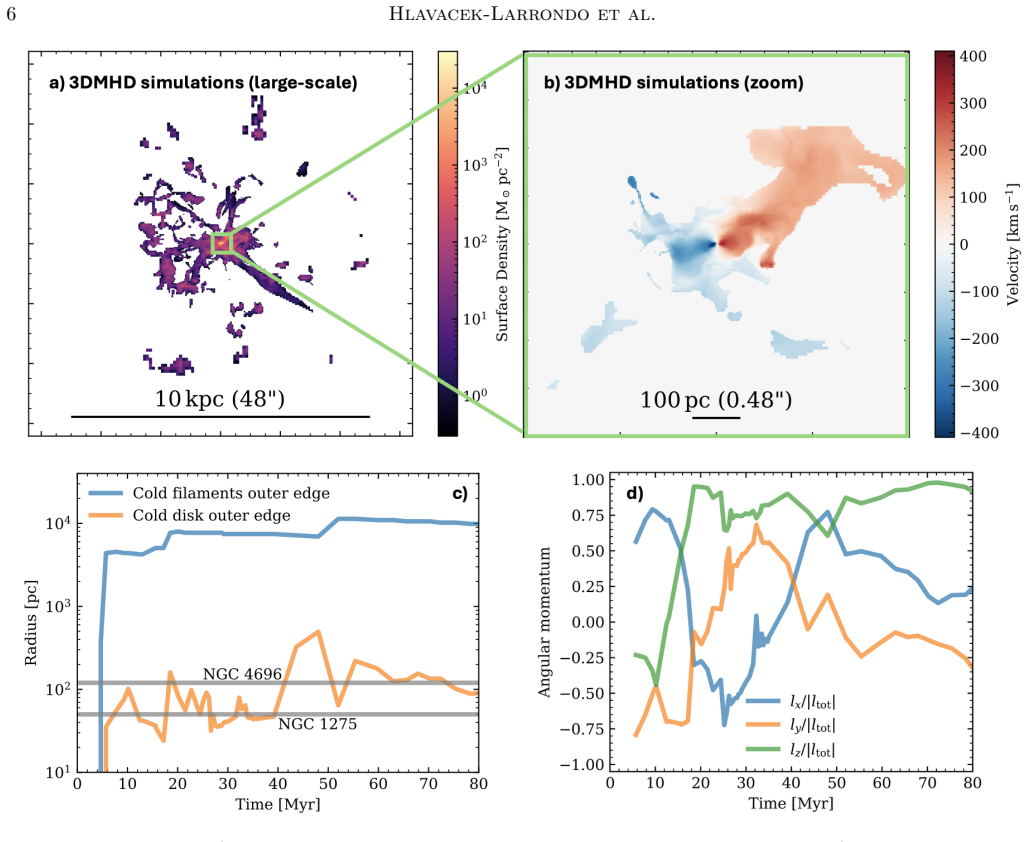
The ionized swirl is a rotating multiphase circumnuclear disk physically and kinematically connected to the larger-scale filamentary network. This supplies the long-sought missing link between kiloparsec-scale cooling flows and black hole accretion on less than 100 parsec scales. The observed morphology and kinematics are reproduced by magnetohydrodynamic simulations in which filamentary gas condenses from the hot atmosphere, loses angular momentum, and feeds a rotating disk that mediates accretion onto the black hole.
What carries the argument
The rotating multiphase circumnuclear disk that receives gas from kiloparsec filaments and channels it inward to the black hole.
If this is right
- Gas condenses from the hot X-ray atmosphere into filaments that lose angular momentum and settle into the disk.
- The disk acts as the intermediary that enables sustained black-hole accretion in radio-mode feedback systems.
- The same filament-to-disk pathway operates in NGC 1275, indicating it is common to prototypical cluster-core AGN.
- This mechanism closes the feedback loop and supplies a concrete route for self-regulated galaxy evolution.
Where Pith is reading between the lines
- The same disk-mediated feeding may occur in other cool-core clusters once comparable 10-parsec resolution data become available.
- Simulations that include explicit angular-momentum transport in condensing filaments can now be tested directly against the observed disk kinematics.
- The framework predicts that removing the disk (for example by strong jet disruption) would temporarily starve the black hole until new filaments reform.
Load-bearing premise
The S-shaped ionized-gas swirl is a rotating multiphase circumnuclear disk that is physically and kinematically connected to the larger filamentary network.
What would settle it
High-resolution kinematic maps that show the swirl has no coherent rotation or no velocity continuity with the outer filaments would falsify the connection.
Figures



read the original abstract
The Centaurus cluster is one of the most important archetypes of radio-mode AGN feedback, with its central galaxy, NGC 4696, launching powerful jets that inflate X-ray cavities and regulate cooling and star formation. NGC 4696 lies within a spectacular multiphase nebula of filaments extending over tens of kiloparsecs and spanning six decades in temperature, from hot (10^8 K) X-ray-emitting plasma to cold molecular gas. Owing to its proximity, Hubble Space Telescope H_alpha imaging reveals a striking S-shaped ionized-gas swirl within the black hole's sphere of influence - the first such structure identified in a cluster core. Here we present the first JWST observations of NGC 4696 with NIRSpec, probing the inner 618 pc * 618 pc at 10 pc resolution. These data reveal that the ionized swirl is a rotating, multiphase circumnuclear disk (CND) physically and kinematically connected to the larger-scale filamentary network. This provides the long-sought missing link between kiloparsec-scale cooling flows and black hole accretion on <100 pc scales. Strikingly, the observed morphology and kinematics are reproduced by tailored magnetohydrodynamic simulations, in which filamentary gas condenses from the hot atmosphere, loses angular momentum, and feeds a rotating CND that mediates accretion onto the black hole. A similar structure in NGC 1275, the Perseus cluster's central galaxy, together with our results on NGC 4696 - two prototypical radio-mode AGN feedback systems - points to a common mechanism: multiphase filaments transport gas from cluster scales down to the vicinity of the black hole via a CND, closing the AGN feedback loop and establishing a physically grounded framework for self-regulated galaxy evolution.
Editorial analysis
A structured set of objections, weighed in public.
Referee Report
Summary. The manuscript reports JWST NIRSpec observations of NGC 4696 in the Centaurus cluster, claiming that the S-shaped ionized-gas swirl is a rotating multiphase circumnuclear disk (CND) physically and kinematically connected to larger-scale multiphase filaments. This connection is presented as the missing link between kpc-scale cooling flows and black hole accretion on <100 pc scales. The observed morphology and kinematics are stated to be reproduced by tailored MHD simulations, with a similar structure noted in NGC 1275, suggesting a common mechanism for multiphase filaments feeding the black hole via a CND and closing the AGN feedback loop.
Significance. If the kinematic connection and rotation are robustly confirmed, the result would establish a direct observational pathway for gas transport from cluster scales to the black hole, providing a physically grounded framework for self-regulated AGN feedback in galaxy evolution. The combination of high-resolution JWST data with MHD simulations is a positive aspect, but the absence of a dynamical mass consistency check limits the current strength of the central claim.
major comments (2)
- [Abstract] The central claim that the S-shaped swirl is a rotating multiphase CND kinematically connected to the filament network depends on the NIRSpec data showing coherent rotation. The abstract provides no details on the velocity gradient, position-velocity structure, or enclosed mass within the inner ~100 pc to match the expected dynamical mass for a ~few × 10^8 M_⊙ black hole (rotation velocities ~100-200 km/s at 50-100 pc). This verification is load-bearing for distinguishing rotation from inflow, outflow, or projection effects.
- [Abstract] The abstract states that morphology and kinematics are reproduced by tailored MHD simulations in which filamentary gas condenses, loses angular momentum, and feeds a rotating CND. However, no simulation parameters, initial conditions, resolution, or quantitative comparison metrics are provided, preventing assessment of how strongly the simulations support the feeding scenario.
minor comments (1)
- The abstract refers to the structure as 'the first such structure identified in a cluster core' but does not briefly contextualize it against other known nuclear gas structures in AGN hosts.
Simulated Author's Rebuttal
We thank the referee for their constructive comments and positive assessment of the work's potential significance. We address each major comment below.
read point-by-point responses
-
Referee: [Abstract] The central claim that the S-shaped swirl is a rotating multiphase CND kinematically connected to the filament network depends on the NIRSpec data showing coherent rotation. The abstract provides no details on the velocity gradient, position-velocity structure, or enclosed mass within the inner ~100 pc to match the expected dynamical mass for a ~few × 10^8 M_⊙ black hole (rotation velocities ~100-200 km/s at 50-100 pc). This verification is load-bearing for distinguishing rotation from inflow, outflow, or projection effects.
Authors: The full manuscript (Section 3) presents the NIRSpec velocity field and position-velocity diagrams demonstrating coherent rotation. We will revise the abstract to summarize the observed velocity gradient and position-velocity structure that support the rotating CND. A direct enclosed-mass consistency check against the black hole mass is not performed in the current manuscript. revision: partial
-
Referee: [Abstract] The abstract states that morphology and kinematics are reproduced by tailored MHD simulations in which filamentary gas condenses, loses angular momentum, and feeds a rotating CND. However, no simulation parameters, initial conditions, resolution, or quantitative comparison metrics are provided, preventing assessment of how strongly the simulations support the feeding scenario.
Authors: Simulation setup, initial conditions, resolution, and comparison metrics are described in the Methods section. We will revise the abstract to include a concise reference to these elements and the quantitative agreement achieved. revision: yes
- Absence of a dynamical mass consistency check comparing observed velocities to the expected values for the central black hole mass.
Circularity Check
No significant circularity; observational interpretation stands on new data
full rationale
The paper's central claim rests on JWST NIRSpec observations of the S-shaped ionized-gas structure in NGC 4696, interpreted as a rotating multiphase CND kinematically linked to larger filaments. This interpretation is presented as a direct reading of the new 10-pc-resolution data rather than a quantity derived from prior equations or fitted parameters within the paper. The MHD simulations are described as reproducing the observed morphology and kinematics but are not shown to be the source of the claim itself; the result does not reduce by construction to any self-defined input, fitted subset, or self-citation chain. The work is therefore self-contained against external benchmarks (new telescope data) with no load-bearing step that collapses to its own definitions.
Axiom & Free-Parameter Ledger
Reference graph
Works this paper leans on
-
[1]
Astropy Collaboration, Robitaille, T. P., Tollerud, E. J., et al. 2013, A&A, 558, A33, doi: 10.1051/0004-6361/201322068 Astropy Collaboration, Price-Whelan, A. M., Sip˝ ocz, B. M., et al. 2018, AJ, 156, 123, doi: 10.3847/1538-3881/aabc4f Astropy Collaboration, Price-Whelan, A. M., Lim, P. L., et al. 2022, ApJ, 935, 167, doi: 10.3847/1538-4357/ac7c74
-
[2]
Balbus, S. A. 1991, ApJ, 372, 25, doi: 10.1086/169951
-
[3]
Bentz, M. C. 2025, Research Notes of the American Astronomical Society, 9, 128, doi: 10.3847/2515-5172/adddac JWST Observations of NGC 469613 B¨ oker, T., Arribas, S., L¨ utzgendorf, N., et al. 2022, A&A, 661, A82, doi: 10.1051/0004-6361/202142589
-
[4]
2019, in Astronomical Society of the Pacific Conference Series, Vol
Bushouse, H., Eisenhamer, J., & Davies, J. 2019, in Astronomical Society of the Pacific Conference Series, Vol. 523, Astronomical Data Analysis Software and Systems XXVII, ed. P. J. Teuben, M. W. Pound, B. A. Thomas, & E. M. Warner, 543
2019
-
[5]
Canning, R. E. A., Fabian, A. C., Johnstone, R. M., et al. 2011, MNRAS, 417, 3080, doi: 10.1111/j.1365-2966.2011.19470.x
-
[6]
2013, MNRAS, 436, 526, doi: 10.1093/mnras/stt1594
Churazov, E., Ruszkowski, M., & Schekochihin, A. 2013, MNRAS, 436, 526, doi: 10.1093/mnras/stt1594
-
[7]
J., Gallagher, John S., I., & Wyse, R
Conselice, C. J., Gallagher, John S., I., & Wyse, R. F. G. 2001, AJ, 122, 2281, doi: 10.1086/323534
-
[8]
2026, GraphingLib/GraphingLib: GraphingLib 1.6.0 Release,, Zenodo doi: 10.5281/zenodo.19936793
Coulombe, G., Lapointe, Y., Marquis, M., et al. 2026, GraphingLib/GraphingLib: GraphingLib 1.6.0 Release,, Zenodo doi: 10.5281/zenodo.19936793
-
[9]
Crawford, C. S., & Fabian, A. C. 1992, MNRAS, 259, 265, doi: 10.1093/mnras/259.2.265
-
[10]
Monthly Notices of the Royal Astronomical Society , author =
Crawford, C. S., Hatch, N. A., Fabian, A. C., & Sanders, J. S. 2005, MNRAS, 363, 216, doi: 10.1111/j.1365-2966.2005.09463.x
-
[11]
P., Lim, J., Forman, W., et al
David, L. P., Lim, J., Forman, W., et al. 2014, ApJ, 792, 94, doi: 10.1088/0004-637X/792/2/94
-
[12]
Fabian, A. C. 2012, ARA&A, 50, 455, doi: 10.1146/annurev-astro-081811-125521
work page internal anchor Pith review doi:10.1146/annurev-astro-081811-125521 2012
-
[13]
Fabian, A. C., Atherton, P. D., Taylor, K., & Nulsen, P. E. J. 1982, MNRAS, 201, 17P, doi: 10.1093/mnras/201.1.17P
-
[14]
Fabian, A. C., Johnstone, R. M., Sanders, J. S., et al. 2008, Nature, 454, 968, doi: 10.1038/nature07169
-
[15]
Fabian, A. C., Walker, S. A., Russell, H. R., et al. 2016, MNRAS, 461, 922, doi: 10.1093/mnras/stw1350
-
[16]
Outward migration of massive planets
Ferland, G. J., Fabian, A. C., Hatch, N. A., et al. 2009, MNRAS, 392, 1475, doi: 10.1111/j.1365-2966.2008.14153.x
-
[17]
2012, ApJ, 758, 103, doi: 10.1088/0004-637X/758/2/103
Gaburov, E., Johansen, A., & Levin, Y. 2012, ApJ, 758, 103, doi: 10.1088/0004-637X/758/2/103
-
[18]
Gaspari, M., Ruszkowski, M., & Oh, S. P. 2013, MNRAS, 432, 3401, doi: 10.1093/mnras/stt692
-
[19]
2017, MNRAS, 466, 677, doi: 10.1093/mnras/stw3108
Gaspari, M., Temi, P., & Brighenti, F. 2017, MNRAS, 466, 677, doi: 10.1093/mnras/stw3108
-
[20]
Gaspari, M., McDonald, M., Hamer, S. L., et al. 2018, ApJ, 854, 167, doi: 10.3847/1538-4357/aaaa1b
-
[21]
2015, Revolution in Astronomy with ALMA: The Third Year, 499, 363
Ginsburg, A., Robitaille, T., Beaumont, C., et al. 2015, Revolution in Astronomy with ALMA: The Third Year, 499, 363
2015
-
[22]
Guo, M., Stone, J. M., Kim, C.-G., & Quataert, E. 2023, ApJ, 946, 26, doi: 10.3847/1538-4357/acb81e
-
[23]
Guo, M., Stone, J. M., Quataert, E., & Kim, C.-G. 2024, ApJ, 973, 141, doi: 10.3847/1538-4357/ad5fe7
-
[24]
M., Quataert, E., & Springel, V
Guo, M., Stone, J. M., Quataert, E., & Springel, V. 2025, ApJ, 987, 202, doi: 10.3847/1538-4357/add1da
-
[25]
Hamer, S. L., Fabian, A. C., Russell, H. R., et al. 2019, MNRAS, 483, 4984, doi: 10.1093/mnras/sty3459
-
[26]
Harris, C. R., Millman, K. J., Van Der Walt, S. J., et al. 2020, Nature, 585, 357, doi: 10.1038/s41586-020-2649-2
-
[27]
2022, in Handbook of X-ray and Gamma-ray Astrophysics, ed
Hlavacek-Larrondo, J., Li, Y., & Churazov, E. 2022, in Handbook of X-ray and Gamma-ray Astrophysics, ed. C. Bambi & A. Sangangelo, 5, doi: 10.1007/978-981-16-4544-0 122-1
-
[28]
2025, ApJ, 980, 170, doi: 10.3847/1538-4357/ada7ed
Hlavacek-Larrondo, J., Choi, H., Guo, M., et al. 2025, ApJ, 980, 170, doi: 10.3847/1538-4357/ada7ed
-
[29]
Correlation with the Guide Star Catalog
Hopkins, P. F., & Quataert, E. 2010, MNRAS, 407, 1529, doi: 10.1111/j.1365-2966.2010.17064.x
-
[30]
Hopkins, P. F., & Quataert, E. 2011, MNRAS, 415, 1027, doi: 10.1111/j.1365-2966.2011.18542.x
-
[31]
Hunter, J. D. 2007, Computing in Science & Engineering, 9, 90, doi: 10.1109/MCSE.2007.55
-
[32]
Ji, S., Oh, S. P., & McCourt, M. 2018, MNRAS, 476, 852, doi: 10.1093/mnras/sty293
-
[33]
Li, Y., & Bryan, G. L. 2012, ApJ, 747, 26, doi: 10.1088/0004-637X/747/1/26
-
[34]
Li, Y., & Bryan, G. L. 2014, ApJ, 789, 153, doi: 10.1088/0004-637X/789/2/153
-
[35]
2024, ApJ, 976, 33, doi: 10.3847/1538-4357/ad7de4
Liu, W., Fan, X., Yang, J., et al. 2024, ApJ, 976, 33, doi: 10.3847/1538-4357/ad7de4
-
[36]
1990, ApJ, 349, 471, doi: 10.1086/168331
Loewenstein, M. 1990, ApJ, 349, 471, doi: 10.1086/168331
-
[37]
McNamara, B. R., & Nulsen, P. E. J. 2012, New Journal of Physics, 14, 055023, doi: 10.1088/1367-2630/14/5/055023
-
[38]
McNamara, B. R., Russell, H. R., Nulsen, P. E. J., et al. 2016, ApJ, 830, 79, doi: 10.3847/0004-637X/830/2/79
-
[39]
Mezcua, M., Hlavacek-Larrondo, J., Lucey, J. R., et al. 2018, MNRAS, 474, 1342, doi: 10.1093/mnras/stx2812
-
[40]
1957, in Radio astronomy, ed
Minkowski, R. 1957, in Radio astronomy, ed. H. C. van de
1957
-
[41]
Mittal, R., O’Dea, C. P., Ferland, G., et al. 2011, MNRAS, 418, 2386, doi: 10.1111/j.1365-2966.2011.19634.x
-
[42]
2019, ApJ, 883, 193, doi: 10.3847/1538-4357/ab3e6e
Nagai, H., Onishi, K., Kawakatu, N., et al. 2019, ApJ, 883, 193, doi: 10.3847/1538-4357/ab3e6e
-
[43]
2019, A&A, 631, A22, doi: 10.1051/0004-6361/201935350
Olivares, V., Salome, P., Combes, F., et al. 2019, A&A, 631, A22, doi: 10.1051/0004-6361/201935350
-
[44]
2024, Nature Astronomy, 8, 256, doi: 10.1038/s41550-023-02138-y
Oosterloo, T., Morganti, R., & Murthy, S. 2024, Nature Astronomy, 8, 256, doi: 10.1038/s41550-023-02138-y
-
[45]
2005, ApJ, 632, 821, doi: 10.1086/444344
Pizzolato, F., & Soker, N. 2005, ApJ, 632, 821, doi: 10.1086/444344
-
[46]
Correlation with the Guide Star Catalog
Pizzolato, F., & Soker, N. 2010, MNRAS, 408, 961, doi: 10.1111/j.1365-2966.2010.17156.x 14Hlavacek-Larrondo et al
-
[47]
Pounds, K. A., Nixon, C. J., Lobban, A., & King, A. R. 2018, MNRAS, 481, 1832, doi: 10.1093/mnras/sty2359
-
[48]
Rauscher, B. J. 2024, PASP, 136, 015001, doi: 10.1088/1538-3873/ad1b36
-
[49]
2008, A&A, 477, L33, doi: 10.1051/0004-6361:20078915
Revaz, Y., Combes, F., & Salom´ e, P. 2008, A&A, 477, L33, doi: 10.1051/0004-6361:20078915
-
[50]
Rose, T., Edge, A. C., Combes, F., et al. 2019a, MNRAS, 485, 229, doi: 10.1093/mnras/stz406
-
[51]
Rose, T., Edge, A. C., Combes, F., et al. 2019b, MNRAS, 489, 349, doi: 10.1093/mnras/stz2138
-
[52]
Russell, H. R., McNamara, B. R., Edge, A. C., et al. 2013, MNRAS, 432, 530, doi: 10.1093/mnras/stt490
-
[53]
Russell, H. R., McNamara, B. R., Fabian, A. C., et al. 2019, MNRAS, 490, 3025, doi: 10.1093/mnras/stz2719
-
[54]
Outward migration of massive planets
Sanders, J. S., Fabian, A. C., Allen, S. W., et al. 2008, MNRAS, 385, 1186, doi: 10.1111/j.1365-2966.2008.12952.x
-
[55]
Sanders, J. S., Fabian, A. C., Taylor, G. B., et al. 2016, MNRAS, 457, 82, doi: 10.1093/mnras/stv2972 Scharw¨ achter, J., McGregor, P. J., Dopita, M. A., & Beck, T. L. 2013, MNRAS, 429, 2315, doi: 10.1093/mnras/sts502
-
[56]
Stone, J. M., Mullen, P. D., Fielding, D., et al. 2026, ApJS, 283, 27, doi: 10.3847/1538-4365/ae3717
-
[57]
2026, PASA, 43, e036, doi: 10.1017/pasa.2026.10172
Tamhane, P., Sun, M., Waldron, W., et al. 2026, PASA, 43, e036, doi: 10.1017/pasa.2026.10172
-
[58]
Monthly Notices of the Royal Astronomical Society , author =
Taylor, G. B., Sanders, J. S., Fabian, A. C., & Allen, S. W. 2006, MNRAS, 365, 705, doi: 10.1111/j.1365-2966.2005.09705.x
-
[59]
Tremblay, G. R., Oonk, J. B. R., Combes, F., et al. 2016, Nature, 534, 218, doi: 10.1038/nature17969
-
[60]
Vayner, A., Zakamska, N. L., Ishikawa, Y., et al. 2023, ApJ, 955, 92, doi: 10.3847/1538-4357/ace784
-
[61]
Voit, G. M., Donahue, M., Bryan, G. L., & McDonald, M. 2015, Nature, 519, 203, doi: 10.1038/nature14167
-
[62]
Voit, G. M., Wibking, B. D., & Yaldiz, D. 2026, arXiv e-prints, arXiv:2602.15121, doi: 10.48550/arXiv.2602.15121
-
[63]
Wang, C., Ruszkowski, M., & Yang, H.-Y. K. 2020, MNRAS, 493, 4065, doi: 10.1093/mnras/staa550
-
[64]
Wibking, B. D., Voit, G. M., & O’Shea, B. W. 2025, MNRAS, 544, 2577, doi: 10.1093/mnras/staf1801
-
[65]
Monthly Notices of the Royal Astronomical Society , author =
Wilman, R. J., Edge, A. C., & Johnstone, R. M. 2005, MNRAS, 359, 755, doi: 10.1111/j.1365-2966.2005.08956.x XRISM Collaboration, Audard, M., Awaki, H., et al. 2025, Nature, 638, 365, doi: 10.1038/s41586-024-08561-z
discussion (0)
Sign in with ORCID, Apple, or X to comment. Anyone can read and Pith papers without signing in.