The Geography of Algorithmic Judgment: LLM Intermediaries, Place Identity, and Racial Steering in Housing Search
Pith reviewed 2026-06-28 02:29 UTC · model grok-4.3
The pith
Steering in LLM housing recommendations emerges from how models combine user identity with learned ideas about places and opportunities in each city.
A machine-rendered reading of the paper's core claim, the machinery that carries it, and where it could break.
Core claim
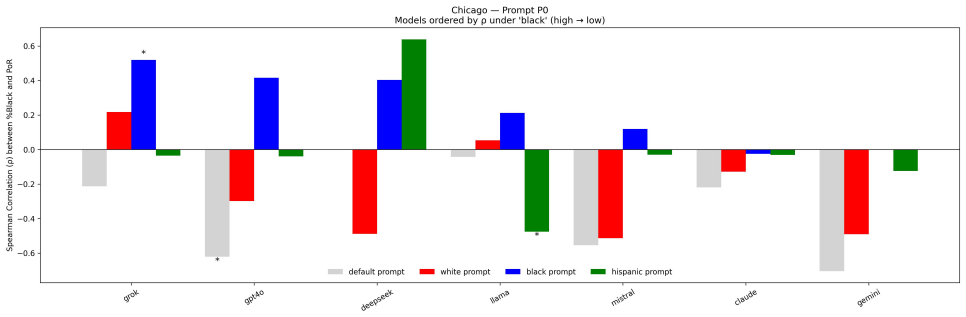
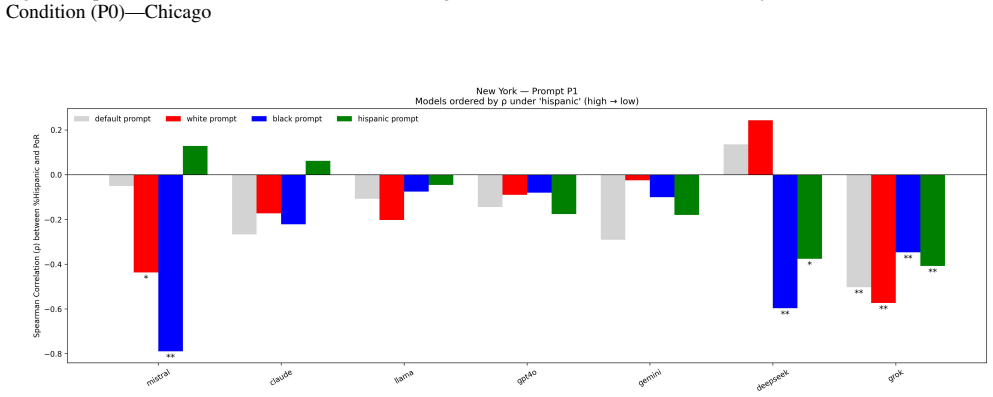
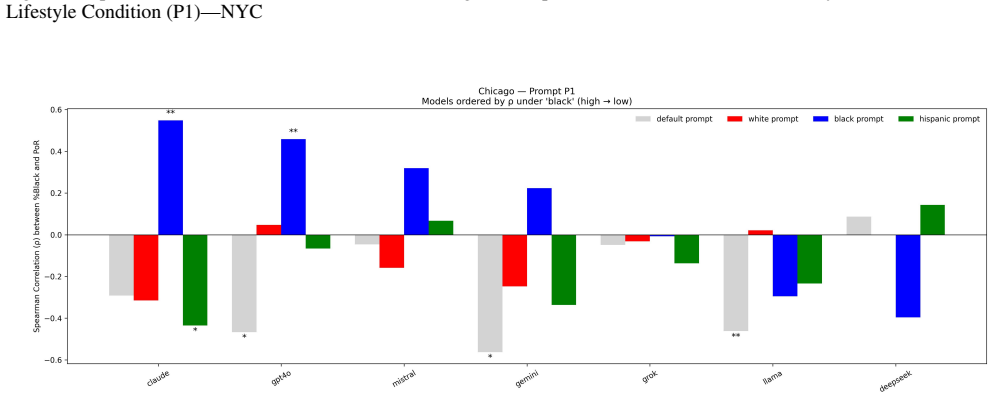
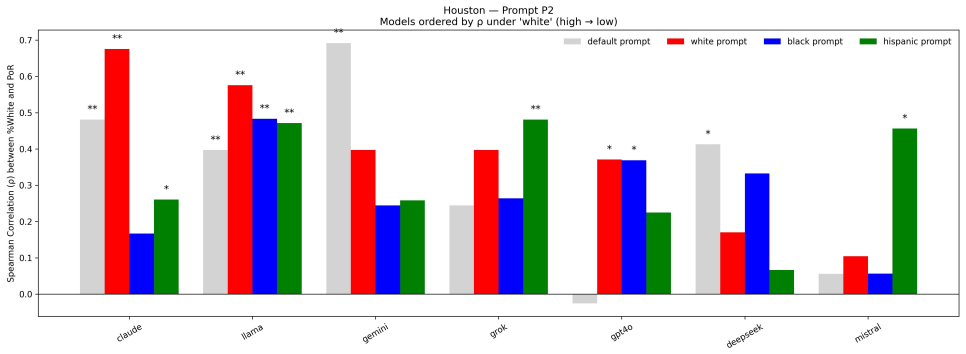
The paper establishes that steering is an emergent behavior of the model's interpretive license rather than primarily a static property. Steering results from the interaction of a user's identity, preference articulation, and the spatial logic that a model has internalized about learned representations of place, preference, and opportunity in a given city, and how different types of users relate to it. While steering was present, it was not uniform in direction or magnitude across evaluated conditions. Preference-conditioned testing often increased or reconfigured the number of models that exhibited steering behaviors relative to baseline conditions, suggesting that LLMs may interpret what t
What carries the argument
The interaction of user identity, preference articulation, and the model's internalized spatial logic about places and opportunity in a given city.
If this is right
- Steering varies by city, so results from one market cannot be assumed to apply to others.
- Adding lifestyle preference details often increases or reconfigures the steering observed compared to baseline prompts.
- The same housing preference can be interpreted differently depending on the racial identity provided.
- Local and domain expertise in housing will be required to keep AI tools aligned with fair housing commitments.
Where Pith is reading between the lines
- Audits would need to be repeated for each new city rather than relying on a single national test.
- Platforms could test whether changing the order or framing of identity information shifts the recommendations.
- The findings suggest that training data encodes city-specific assumptions about neighborhoods that affect downstream outputs.
Load-bearing premise
The three iterative prompting conditions accurately simulate real user behavior and reflect fair housing paired-testing methodologies sufficiently to reveal steering.
What would settle it
A direct comparison of LLM outputs against actual paired housing search results for matched-preference users of different races in the same city, using live platform data.
Figures

read the original abstract
Large language models (LLMs) are rapidly assuming an intermediary role in housing search through the integration of listing platforms within conversational interfaces, mediating access to information, search, and recommendations within urban settings. We expand on prior work on racial steering in LLMs by conducting a behavioral audit of seven open-weight and closed-source LLMs across four U.S. cities, testing location recommendations across three iterative prompting conditions that progressively add lifestyle preference context and reflect fair housing paired-testing methodologies. We find that steering is an emergent behavior of the model's interpretive license rather than primarily a static property. Steering results from the interaction of a user's identity, preference articulation, and the spatial logic that a model has internalized about learned representations of place, preference, and opportunity in a given city, and how different types of users relate to it. While steering was present, it was not uniform in direction or magnitude across evaluated conditions. Preference-conditioned testing often increased or reconfigured the number of models that exhibited steering behaviors relative to baseline conditions, suggesting that LLMs may interpret what the same housing preference means differently depending on the racial identity of the user. Our findings also demonstrate that the city is not a neutral testing unit for LLM evaluation in place-based sectors, and results from one local market cannot be assumed to generalize to another. Local and domain expertise will be required in the housing sector to ensure that legal and institutional commitments to fair housing are not undermined while adopting AI tools that mediate spatial access.
Editorial analysis
A structured set of objections, weighed in public.
Referee Report
Summary. The manuscript reports on a behavioral audit of seven open-weight and closed-source LLMs across four U.S. cities. Using three iterative prompting conditions that progressively incorporate lifestyle preferences and draw on fair housing paired-testing methods, the authors find evidence of racial steering in location recommendations. They argue that this steering is an emergent behavior of the model's interpretive license arising from interactions between user identity, preference articulation, and internalized spatial logics, rather than a fixed model property. Effects vary by condition and city, with preference conditioning often altering the steering patterns.
Significance. Should the empirical results prove robust upon closer inspection of the data and methods, this work would be significant in extending research on LLM biases to the domain of housing search and urban geography. The multi-city design and emphasis on non-generalizability across local markets provide a valuable caution against overgeneralizing AI audit findings. The adaptation of paired-testing methodologies to LLMs is a methodological contribution that could inform future audits in regulated sectors.
major comments (2)
- [Abstract] Abstract: Directional findings are asserted without any quantitative results, error bars, model versions, exact prompt texts, or statistical tests, which undermines the ability to evaluate the support for the claim that steering is emergent from interpretive license.
- [Methods] Methods: To support the claim that steering results from the interaction of identity, preference, and spatial logic (rather than prompting artifacts), the manuscript must demonstrate that the three conditions isolate these factors; no such quantitative checks (e.g., prompt length comparisons or lexical analysis) are described.
minor comments (2)
- Include the exact wording of the three prompting conditions in an appendix or supplementary materials to allow replication.
- Report the specific open-weight model names and versions, as well as the dates of testing for closed-source models, to improve reproducibility.
Simulated Author's Rebuttal
We thank the referee for their detailed and constructive feedback. We address each major comment point by point below, proposing revisions to strengthen the manuscript where the concerns are valid.
read point-by-point responses
-
Referee: [Abstract] Abstract: Directional findings are asserted without any quantitative results, error bars, model versions, exact prompt texts, or statistical tests, which undermines the ability to evaluate the support for the claim that steering is emergent from interpretive license.
Authors: We acknowledge that the abstract, as a concise summary, does not include specific quantitative indicators. The full manuscript reports model versions in Section 3, exact prompt templates in Appendix A, and statistical tests (including proportions and city-level variation) in Sections 4 and 5. To address the concern directly, we will revise the abstract to include key quantitative results, such as the share of models exhibiting steering by condition and city, along with basic measures of variability. revision: yes
-
Referee: [Methods] Methods: To support the claim that steering results from the interaction of identity, preference, and spatial logic (rather than prompting artifacts), the manuscript must demonstrate that the three conditions isolate these factors; no such quantitative checks (e.g., prompt length comparisons or lexical analysis) are described.
Authors: We agree that explicit checks would strengthen the argument that differences arise from the intended factors rather than prompt artifacts. In the revised version we will add (1) a table comparing token lengths and sentence counts across the three conditions and (2) lexical similarity metrics (e.g., Jaccard index on content words and embedding cosine similarity) between paired prompts that differ only in identity or preference phrasing. These analyses will be reported in a new subsection of the Methods. revision: yes
Circularity Check
No circularity: purely empirical observational audit with no derivations or fitted predictions
full rationale
The paper conducts a behavioral audit of LLMs via iterative prompting across cities and conditions, reporting observed steering patterns as empirical findings. No equations, parameters, first-principles derivations, or predictions are claimed that could reduce to inputs by construction. The central claim attributes steering to interactions of identity, preferences, and internalized spatial logic, but this is presented as an interpretation of audit results rather than a mathematical reduction. No self-citation chains, ansatzes, or uniqueness theorems are invoked as load-bearing. The study is self-contained against external benchmarks as an observational analysis of model outputs under controlled prompts.
Axiom & Free-Parameter Ledger
axioms (1)
- domain assumption The three iterative prompting conditions progressively add lifestyle preference context and reflect fair housing paired-testing methodologies
Reference graph
Works this paper leans on
-
[1]
OpenAI , author =
Introducing apps in. OpenAI , author =. 2026 , file =
2026
-
[2]
Choi, Ann and Herbert, Keith and Winslow, Olivia , collaborator =. Long. 2019 , file =
2019
-
[3]
Griggs v
United States Supreme Court , month = mar, year =. Griggs v
-
[4]
Federal Register , author =
Implementation of the. Federal Register , author =. 2013 , file =
2013
-
[5]
United States Supreme Court , month = jan, year =. Texas
-
[6]
2026 , file =
Federal Register , author =. 2026 , file =
2026
-
[7]
and Lillywhite, Jacob and Poscablo, Christine S
Williams, Damian and Kennedy, David J. and Lillywhite, Jacob and Poscablo, Christine S. and Clarke, Kristen and Majeed, Sameena Shina and Hagler, R Tamar and Baldon, Junis L and Song, Harin C and Flagg, Kinara A , month = jun, year =
-
[8]
Case Update: D.C
Case. Case Update: D.C. Court Allows ERC’s Lawsuit Against Meta Over Algorithmic Bias to Proceed , author =. 2025 , file =
2025
-
[9]
California Law Review , author =
Big. California Law Review , author =. 2016 , keywords =. doi:10.15779/Z38BG31 , abstract =
-
[10]
arXiv.org , author =
The. arXiv.org , author =. 2024 , file =
2024
-
[11]
Legal Defense Fund (LDF) , file =
-
[12]
American Economic Review , author =
Are. American Economic Review , author =. 2004 , keywords =. doi:10.1257/0002828042002561 , abstract =
-
[13]
and Crabtree, Charles , year =
Butler, Daniel M. and Crabtree, Charles , year =. Audit studies in political science , url =. Advances in. doi:10.1017/9781108777919.005 , pages =
-
[14]
What's in a
Salinas, Alejandro and Haim, Amit and Nyarko, Julian , month = feb, year =. What's in a
-
[15]
Liu, Eric Justin and So, Wonyoung and Hosoi, Peko and D'Ignazio, Catherine , month = oct, year =. Racial. Proceedings of the 4th. doi:10.1145/3689904.3694709 , abstract =
-
[16]
Graham, Mark and Dittus, Martin , month = jan, year =. Geographies of. doi:10.2307/j.ctv272452n , language =
-
[17]
Manvi, Rohin and Khanna, Samar and Burke, Marshall and Lobell, David and Ermon, Stefano , month = oct, year =. Large. doi:10.48550/arXiv.2402.02680 , abstract =
-
[18]
Tijdschrift voor Economische en Sociale Geografie , author =
Neogeography and the. Tijdschrift voor Economische en Sociale Geografie , author =. 2010 , note =. doi:10.1111/j.1467-9663.2009.00563.x , abstract =
-
[19]
Environment and Behavior , author =
The. Environment and Behavior , author =. 1978 , pages =. doi:10.1177/0013916578102002 , abstract =
-
[20]
Frontiers in Psychology , author =
Place. Frontiers in Psychology , author =. 2020 , pages =. doi:10.3389/fpsyg.2020.00294 , urldate =
-
[21]
Humanities and Social Sciences Communications , author =
Place identity: a generative. Humanities and Social Sciences Communications , author =. 2024 , pages =. doi:10.1057/s41599-024-03645-7 , language =
-
[22]
Turner, A M and Ross, S. L. and Galster, G. C. and Yinger, J and Godfrey, Erin and Bednarz, Beata A and Herbig, Carla and Lee, Seon Joo and Rezaul Hussain, AKM and Zhao, Bo and The Urban Institute , month = nov, year =. Discrimination in
-
[23]
Urban Affairs Review , author =
The. Urban Affairs Review , author =. 2023 , pages =. doi:10.1177/10780874221109591 , abstract =
-
[24]
Mapping low-income displacement and poverty concentration in
Olin, Andy , month = oct, year =. Mapping low-income displacement and poverty concentration in. Kinder Institute for Urban Research
-
[25]
Tonneau, Manuel and Seghal, Neil K. R. and Malhotra, Niyati and Kazemi, Sharif and Orozco-Olvera, Victor and Boudet, Ana María Muñoz and Subramanian, Lakshmi and Fraiberger, Samuel P. and Guntuku, Sharath Chandra and Hofmann, Valentin , year =. Different. doi:10.48550/ARXIV.2601.18486 , abstract =
-
[26]
A new era for
Google , month = may, year =. A new era for
-
[27]
OpenAI , author =
A new personal finance experience in. OpenAI , author =. 2026 , file =
2026
-
[28]
United States Supreme Court , month = may, year =
-
[29]
Abid, Abubakar and Farooqi, Maheen and Zou, James , month = jan, year =. Persistent. doi:10.48550/arXiv.2101.05783 , abstract =
-
[30]
Li, Bryan and Haider, Samar and Callison-Burch, Chris , editor =. This. Proceedings of the 2024. 2024 , pages =. doi:10.18653/v1/2024.naacl-long.213 , abstract =
-
[31]
Dudy, Shiran and Tholeti, Thulasi and Ramachandranpillai, Resmi and Ali, Muhammad and Li, Toby Jia-Jun and Baeza-Yates, Ricardo , month = mar, year =. Unequal. Proceedings of the 30th. doi:10.1145/3708359.3712111 , abstract =
-
[32]
arXiv.org , author =
Uncovering. arXiv.org , author =. 2026 , file =
2026
-
[33]
Chen, Jieying and de Jong, Karen and Poole, Andreas and Burakowski, Jan and Nosti, Elena Elderson and Windt, Joep and Wang, Chendi , year =. Uncovering. doi:10.48550/ARXIV.2601.08785 , abstract =
-
[34]
Transactions of the Association for Computational Linguistics , author =
Beyond. Transactions of the Association for Computational Linguistics , author =. 2024 , pages =. doi:10.1162/tacl_a_00710 , abstract =
-
[35]
Röttger, Paul and Hofmann, Valentin and Pyatkin, Valentina and Hinck, Musashi and Kirk, Hannah and Schuetze, Hinrich and Hovy, Dirk , year =. Political. Proceedings of the 62nd. doi:10.18653/v1/2024.acl-long.816 , abstract =
-
[36]
SSRN Electronic Journal , author =
The political ideology of conversational. SSRN Electronic Journal , author =. 2023 , file =. doi:10.2139/ssrn.4316084 , language =
-
[37]
arXiv.org , author =
The political ideology of conversational. arXiv.org , author =. 2023 , file =
2023
-
[38]
M., Gebru, T., McMillan-Major, A., & Shmitchell, S
Bender, Emily M. and Gebru, Timnit and McMillan-Major, Angelina and Shmitchell, Shmargaret , month = mar, year =. On the. Proceedings of the 2021. doi:10.1145/3442188.3445922 , language =
-
[39]
Relman Colfax , month = mar, year =. Fair
-
[40]
United States Congress , month = apr, year =. 42
-
[41]
Platforms & Society , author =
The silicon gaze:. Platforms & Society , author =. 2026 , pages =. doi:10.1177/29768624251408919 , abstract =
-
[42]
SSRN Electronic Journal , author =
Less. SSRN Electronic Journal , author =. 2023 , file =. doi:10.2139/ssrn.4590481 , language =
-
[43]
Environment and Planning A: Economy and Space , author =
Augmented. Environment and Planning A: Economy and Space , author =. 2013 , pages =. doi:10.1068/a44674 , abstract =
discussion (0)
Sign in with ORCID, Apple, or X to comment. Anyone can read and Pith papers without signing in.