Dependencies and Dataflow in Seed-Filter-Extend Pipelines
Pith reviewed 2026-06-27 20:34 UTC · model grok-4.3
The pith
Optimizing dataflow across candidate regions overcomes serial bottlenecks in seed-filter-extend genome aligners and enables GPU offloading of local alignments.
A machine-rendered reading of the paper's core claim, the machinery that carries it, and where it could break.
Core claim
The paper establishes that serial bottlenecks in seed-filter-extend pipelines can be removed by optimizing the global pipeline across regions; synthesizing insights from LASTZ, SegAlign, Darwin-WGA, and SNAP allows parallel execution across candidate regions and offloading of irregular local alignments to GPUs without unacceptable loss in sensitivity or accuracy, with the optimizations either prototyped or implemented directly in LASTZ.
What carries the argument
The dependencies and dataflow of the seed-filter-extend pipeline, restructured globally across candidate similarity regions to eliminate serial constraints.
If this is right
- Thousands of candidate regions can execute concurrently rather than sequentially.
- Irregular local dynamic programming alignments become suitable for GPU offload.
- The full end-to-end alignment workflow for large genomes runs faster on modern hardware.
- LASTZ gains concrete performance improvements while retaining its original heuristics.
Where Pith is reading between the lines
- The same dependency analysis could be applied to other heuristic aligners not examined in the study.
- Faster pipelines might allow routine alignment of genomes larger or more divergent than those currently practical.
- The approach suggests a general template for removing serial stages in other multi-stage bioinformatics workflows.
Load-bearing premise
That optimizations drawn from the four source aligners can be combined into one pipeline without introducing new alignment errors or sensitivity losses that the original methods avoided.
What would settle it
Benchmark runs of the modified LASTZ on standard genome pairs that show either a measurable drop in alignment accuracy or no practical speedup would falsify the central claim.
Figures



read the original abstract
Comparing genomes is critical for discovering mutations, tracking evolutionary lineages, and advancing cross-species genomics. Fundamentally, this reduces to an O(n^2) string-matching dynamic programming (DP) problem, a challenge that has driven decades of performance research. However, executing a strict O(n^2) DP algorithm is computationally intractable for genomes spanning millions to billions of base pairs. Consequently, modern aligners rely on global heuristics to identify thousands of candidate similarity regions between species. Unfortunately, these methods are burdened by complex serial dependencies. Once candidate regions are identified, the pipeline executes localized DP alignments, which introduce their own non-trivial heuristics and irregular data dependencies. While parallelizing dense, two-dimensional DP is a well-studied problem, accelerating this end-to-end pipeline is significantly more challenging. Parallelizing across candidate regions and offloading irregular, heuristic-laden local alignments to modern hardware (such as GPUs) remains a major hurdle. In this work, we address the challenge of overcoming these serial bottlenecks by optimizing the global pipeline across regions. We take inspiration from four papers: LASTZ, SegAlign, Darwin-WGA, and SNAP, synthesizing findings across each to inform optimizations, which we either prototype or implement directly in LASTZ.
Editorial analysis
A structured set of objections, weighed in public.
Referee Report
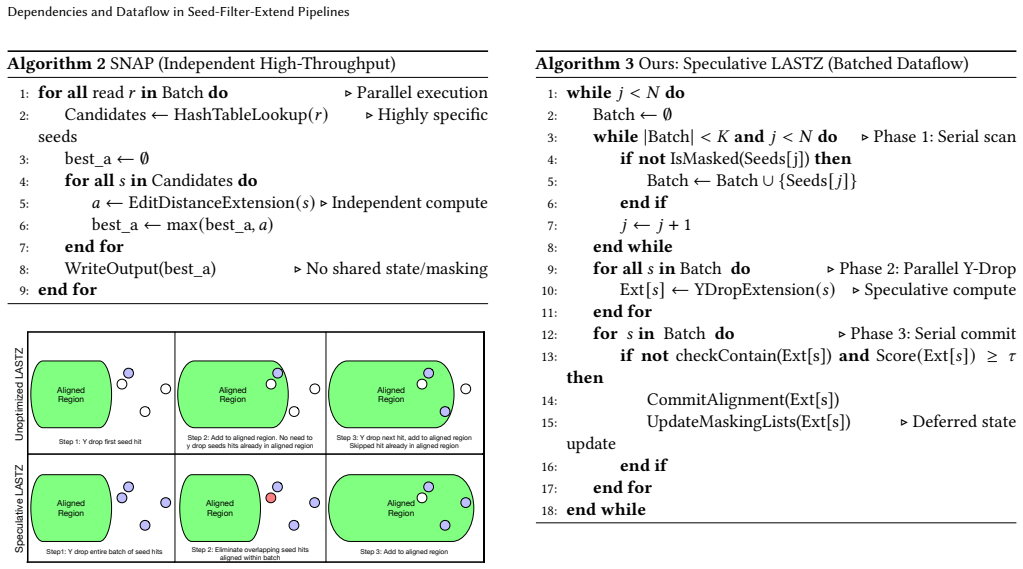
Summary. The manuscript claims that serial bottlenecks in seed-filter-extend pipelines for genome alignment can be overcome by optimizing the global pipeline across candidate regions, synthesizing optimizations from LASTZ, SegAlign, Darwin-WGA, and SNAP (with prototypes or direct implementations in LASTZ) to enable parallelization and GPU offloading of irregular local alignments without unacceptable loss in sensitivity or accuracy.
Significance. The topic addresses a practically important performance bottleneck in bioinformatics tools that compare large genomes. However, because the manuscript contains no concrete dataflow analysis, dependency resolutions, optimization details, or validation results, its potential significance cannot be evaluated.
major comments (1)
- [Abstract] Abstract: The manuscript provides only a high-level plan with no specific methods, equations, dataflow diagrams, dependency graphs, implementation details, or empirical results on sensitivity/speed trade-offs, rendering the central claim that the synthesized approach overcomes serial bottlenecks unverifiable.
Simulated Author's Rebuttal
We thank the referee for their review. We acknowledge that the current abstract is high-level and does not convey the concrete analyses present in the full manuscript. We will revise the abstract and add explicit dataflow diagrams, dependency graphs, and implementation details to make the contributions verifiable.
read point-by-point responses
-
Referee: [Abstract] Abstract: The manuscript provides only a high-level plan with no specific methods, equations, dataflow diagrams, dependency graphs, implementation details, or empirical results on sensitivity/speed trade-offs, rendering the central claim that the synthesized approach overcomes serial bottlenecks unverifiable.
Authors: The full manuscript (beyond the abstract) contains sections analyzing the serial dependencies in seed-filter-extend pipelines, including explicit dataflow diagrams across candidate regions and dependency graphs for the filter and extend stages. We synthesize specific optimizations (e.g., region-level parallelization from SegAlign, GPU offloading strategies from Darwin-WGA, and heuristic adjustments from SNAP) and describe their direct implementation or prototyping in LASTZ. We agree the abstract does not adequately preview these elements and will expand it to include key methods, graphs, and trade-off summaries. On empirical results, the paper's focus is the dependency analysis and synthesis rather than new end-to-end benchmarks; we will add references to sensitivity/accuracy data from the source tools and note that our LASTZ prototypes preserve the original heuristics. revision: yes
Circularity Check
No significant circularity
full rationale
The manuscript presents a high-level engineering synthesis of optimizations drawn from four external prior works (LASTZ, SegAlign, Darwin-WGA, SNAP) and their direct implementation or prototyping inside LASTZ. No equations, fitted parameters, uniqueness theorems, or derivation chains appear in the provided text. The central claim is an empirical plan for pipeline parallelization and GPU offload; it does not reduce any result to its own inputs by construction, self-citation, or renaming. The work is therefore self-contained against external benchmarks and receives the default non-circularity finding.
Axiom & Free-Parameter Ledger
Reference graph
Works this paper leans on
-
[1]
The NCBI handbook , volume=
The BLAST sequence analysis tool , author=. The NCBI handbook , volume=. 2013 , publisher=
2013
-
[2]
SC20: International Conference for High Performance Computing, Networking, Storage and Analysis , pages=
SegAlign: A scalable GPU-based whole genome aligner , author=. SC20: International Conference for High Performance Computing, Networking, Storage and Analysis , pages=. 2020 , organization=
2020
-
[3]
arXiv preprint arXiv:1111.5572 , year=
Faster and more accurate sequence alignment with SNAP , author=. arXiv preprint arXiv:1111.5572 , year=
-
[4]
2007 , school=
Improved pairwise alignment of genomic DNA , author=. 2007 , school=
2007
-
[5]
2019 IEEE International Symposium on High Performance Computer Architecture (HPCA) , pages=
Darwin-WGA: A co-processor provides increased sensitivity in whole genome alignments with high speedup , author=. 2019 IEEE International Symposium on High Performance Computer Architecture (HPCA) , pages=. 2019 , organization=
2019
-
[6]
GitHub repository , howpublished =
Sundram, Shiv , title =. GitHub repository , howpublished =. 2024 , publisher =
2024
-
[7]
Proceedings of the ACM on Programming Languages , volume=
Compiling Recurrences over Dense and Sparse Arrays , author=. Proceedings of the ACM on Programming Languages , volume=. 2024 , publisher=
2024
-
[8]
Proceedings of the ACM on Programming Languages , volume=
REPTILE: Performant Tiling of Recurrences , author=. Proceedings of the ACM on Programming Languages , volume=. 2025 , publisher=
2025
-
[9]
BMC bioinformatics , volume=
Parasail: SIMD C library for global, semi-global, and local pairwise sequence alignments , author=. BMC bioinformatics , volume=. 2016 , publisher=
2016
-
[10]
Code Less, Align More: A Language for Accessible and Efficient Sequence Analysis Pipelines , author=
-
[11]
The Computational Geometry Algorithms Library , author =
-
[12]
Menelaos Karavelas , subtitle =
-
[13]
The Computational Geometry Algorithms Library , subtitle =
Menelaos Karavelas , editor =. The Computational Geometry Algorithms Library , subtitle =
-
[14]
The Parmap library , author =
-
[15]
Christopher Anderson and Sophia Drossopoulou , title =
-
[16]
Patricia S. Abril and Robert Plant. The patent holder's dilemma: Buy, sell, or troll?. Communications of the ACM. doi:10.1145/1188913.1188915
-
[17]
Deciding equivalances among conjunctive aggregate queries
Sarah Cohen and Werner Nutt and Yehoshua Sagic. Deciding equivalances among conjunctive aggregate queries. doi:10.1145/1219092.1219093
-
[18]
Special issue: Digital Libraries. 1996
1996
-
[19]
Understanding Policy-Based Networking
David Kosiur. Understanding Policy-Based Networking
-
[22]
The title of book two. doi:10.1007/3-540-09237-4
-
[23]
Asad Z. Spector. Achieving application requirements. Distributed Systems. doi:10.1145/90417.90738
-
[24]
Douglass and David Harel and Mark B
Bruce P. Douglass and David Harel and Mark B. Trakhtenbrot. Statecarts in use: structured analysis and object-orientation. Lectures on Embedded Systems. doi:10.1007/3-540-65193-4_29
-
[25]
Donald E. Knuth. The Art of Computer Programming, Vol. 1: Fundamental Algorithms (3rd. ed.)
-
[26]
Donald E. Knuth. The Art of Computer Programming
-
[27]
Structured Variational Inference Procedures and their Realizations (as incol)
Dan Geiger and Christopher Meek. Structured Variational Inference Procedures and their Realizations (as incol). Proceedings of Tenth International Workshop on Artificial Intelligence and Statistics, The Barbados
-
[28]
Stan W. Smith. An experiment in bibliographic mark-up: Parsing metadata for XML export. Proceedings of the 3rd. annual workshop on Librarians and Computers
-
[29]
Catch me, if you can: Evading network signatures with web-based polymorphic worms
Matthew Van Gundy and Davide Balzarotti and Giovanni Vigna. Catch me, if you can: Evading network signatures with web-based polymorphic worms. Proceedings of the first USENIX workshop on Offensive Technologies
-
[30]
Sten Andler. Predicate Path expressions. Proceedings of the 6th. ACM SIGACT-SIGPLAN symposium on Principles of Programming Languages. doi:10.1145/567752.567774
-
[31]
LOGICS of Programs: AXIOMATICS and DESCRIPTIVE POWER
David Harel. LOGICS of Programs: AXIOMATICS and DESCRIPTIVE POWER
-
[32]
Anisi , title =
David A. Anisi , title =
-
[33]
Clarkson
Kenneth L. Clarkson. Algorithms for Closest-Point Problems (Computational Geometry)
-
[34]
Introduction to Bayesian Statistics
Harry Thornburg. Introduction to Bayesian Statistics. 2001
2001
-
[35]
CLIFFORD: a Maple 11 Package for Clifford Algebra Computations, version 11
Rafal Ablamowicz and Bertfried Fauser. CLIFFORD: a Maple 11 Package for Clifford Algebra Computations, version 11. 2007
2007
-
[36]
Stats and Analysis
Poker-Edge.Com. Stats and Analysis. 2006
2006
-
[37]
A more perfect union
Barack Obama. A more perfect union
-
[38]
The fountain of youth
Joseph Scientist. The fountain of youth
-
[39]
Solder man
Dave Novak. Solder man. ACM SIGGRAPH 2003 Video Review on Animation theater Program: Part I - Vol. 145 (July 27--27, 2003). doi:10.945/woot07-S422
2003
-
[40]
Interview with Bill Kinder: January 13, 2005
Newton Lee. Interview with Bill Kinder: January 13, 2005. Comput. Entertain. doi:10.1145/1057270.1057278
-
[41]
The Enabling of Digital Libraries
Bernard Rous. The Enabling of Digital Libraries. Digital Libraries
-
[43]
(new) Finding minimum congestion spanning trees , journal =
Werneck, Renato and Setubal, Jo\. (new) Finding minimum congestion spanning trees , journal =. doi:10.1145/351827.384253 , acmid = 384253, publisher =
-
[45]
Conti, Mauro and Di Pietro, Roberto and Mancini, Luigi V. and Mei, Alessandro , title =. Inf. Fusion , volume =. 2009 , issn =. doi:10.1016/j.inffus.2009.01.002 , acmid =
-
[46]
Li, Cheng-Lun and Buyuktur, Ayse G. and Hutchful, David K. and Sant, Natasha B. and Nainwal, Satyendra K. , title =. CHI '08 extended abstracts on Human factors in computing systems , year =. doi:10.1145/1358628.1358946 , acmid =
-
[47]
, title =
Hollis, Billy S. , title =. 1999 , isbn =
1999
-
[48]
Goossens, Michel and Rahtz, S. P. and Moore, Ross and Sutor, Robert S. , title =. 1999 , isbn =
1999
-
[49]
and Rosenberg, Arnold L
Buss, Jonathan F. and Rosenberg, Arnold L. and Knott, Judson D. , title =. 1987 , source =
1987
-
[50]
CHI '08: CHI '08 extended abstracts on Human factors in computing systems , year =
, note =. CHI '08: CHI '08 extended abstracts on Human factors in computing systems , year =
-
[51]
Algorithms for Closest-Point Problems (Computational Geometry) , year =
Clarkson, Kenneth Lee , advisor =. Algorithms for Closest-Point Problems (Computational Geometry) , year =
-
[52]
SIGCOMM Comput. Commun. Rev. , year =
-
[53]
IEEE TCSC Executive Committee , booktitle =. 2004 , isbn =. doi:http://dx.doi.org/10.1109/ICWS.2004.64 , acmid =
-
[54]
Distributed systems (2nd Ed.) , year =
-
[55]
, title =
Petrie, Charles J. , title =. 1986 , source =
1986
-
[56]
Donald E. Knuth. Seminumerical Algorithms. 1981
1981
-
[57]
E-commerce and cultural values , year =
Kong, Wei-Chang , Title =. E-commerce and cultural values , year =
-
[58]
E-commerce and cultural values , year =
Kong, Wei-Chang , type =. E-commerce and cultural values , year =
-
[59]
Chapter 9 , booktitle =
Kong, Wei-Chang , editor =. Chapter 9 , booktitle =
-
[60]
E-commerce and cultural values , editor =
Kong, Wei-Chang , title =. E-commerce and cultural values , editor =. 2003 , isbn =
2003
-
[61]
E-commerce and cultural values - (InBook-num-in-chap) , chapter =
Kong, Wei-Chang , editor =. E-commerce and cultural values - (InBook-num-in-chap) , chapter =. 2004 , address =
2004
-
[62]
E-commerce and cultural values (Inbook-text-in-chap) , chapter =
Kong, Wei-Chang , editor =. E-commerce and cultural values (Inbook-text-in-chap) , chapter =. 2005 , address =
2005
-
[63]
E-commerce and cultural values (Inbook-num chap) , chapter =
Kong, Wei-Chang , editor =. E-commerce and cultural values (Inbook-num chap) , chapter =. 2006 , address =
2006
-
[64]
Microelectron
Mehdi Saeedi and Morteza Saheb Zamani and Mehdi Sedighi , title =. Microelectron. J. , volume =. 2010 , pages =
2010
-
[65]
Mehdi Saeedi and Morteza Saheb Zamani and Mehdi Sedighi and Zahra Sasanian , title =. J. Emerg. Technol. Comput. Syst. , volume =
-
[66]
Kirschmer, Markus and Voight, John , title =. SIAM J. Comput. , issue_date =. 2010 , issn =. doi:https://doi.org/10.1137/080734467 , acmid =
-
[67]
Hoare, C. A. R. , title =. Structured programming (incoll) , editor =. 1972 , isbn =
1972
-
[68]
History of programming languages I (incoll) , editor =
Lee, Jan , title =. History of programming languages I (incoll) , editor =. 1981 , isbn =. doi:http://doi.acm.org/10.1145/800025.1198348 , acmid =
-
[69]
, title =
Dijkstra, E. , title =. Classics in software engineering (incoll) , year =
-
[70]
Wenzel, Elizabeth M. , title =. Multimedia interface design (incoll) , year =. doi:10.1145/146022.146089 , acmid =
-
[71]
, title =
Mumford, E. , title =. Critical issues in information systems research (incoll) , year =
-
[72]
and Golden, Donald G
McCracken, Daniel D. and Golden, Donald G. , title =. 1990 , isbn =
1990
-
[73]
The analysis of linear partial differential operators
H. The analysis of linear partial differential operators. 1985 , PAGES =
1985
-
[74]
IEEE", address =
A. Adya and P. Bahl and J. Padhye and A.Wolman and L. Zhou , title =. Proceedings of the IEEE 1st International Conference on Broadnets Networks (BroadNets'04) , publisher = "IEEE", address = "Los Alamitos, CA", year =
-
[75]
I. F. Akyildiz and W. Su and Y. Sankarasubramaniam and E. Cayirci , title =. Comm. ACM , volume = 38, number = "4", year =
-
[76]
I. F. Akyildiz and T. Melodia and K. R. Chowdhury , title =. Computer Netw. , volume = 51, number = "4", year =
-
[77]
ACM", address =
P. Bahl and R. Chancre and J. Dungeon , title =. Proceeding of the 10th International Conference on Mobile Computing and Networking (MobiCom'04) , publisher = "ACM", address = "New York, NY", year =
-
[78]
8 (Special Issue on Sensor Networks)
D. Culler and D. Estrin and M. Srivastava , title =. IEEE Comput. , volume = 37, number = "8 (Special Issue on Sensor Networks)", publisher = "IEEE", address = "Los Alamitos, CA", year =
-
[79]
Natarajan and M
A. Natarajan and M. Motani and B. de Silva and K. Yap and K. C. Chua , title =. Network Architectures , editor =. 960935712
-
[80]
Tzamaloukas and J
A. Tzamaloukas and J. J. Garcia-Luna-Aceves , title =
-
[81]
Zhou and J
G. Zhou and J. Lu and C.-Y. Wan and M. D. Yarvis and J. A. Stankovic , title =
-
[82]
Mapping Powerlists onto Hypercubes
Jacob Kornerup. Mapping Powerlists onto Hypercubes. 1994
1994
-
[83]
Automatic Parallelization for Distributed-Memory Multiprocessing Systems
Michael Gerndt. Automatic Parallelization for Distributed-Memory Multiprocessing Systems
-
[84]
J. E. Archer, Jr. and R. Conway and F. B. Schneider. User recovery and reversal in interactive systems. ACM Trans. Program. Lang. Syst
discussion (0)
Sign in with ORCID, Apple, or X to comment. Anyone can read and Pith papers without signing in.