The mass of TOI-1883 b: A low density super-Neptune in the ridge regime transiting an early-M dwarf
Pith reviewed 2026-06-27 21:17 UTC · model grok-4.3
The pith
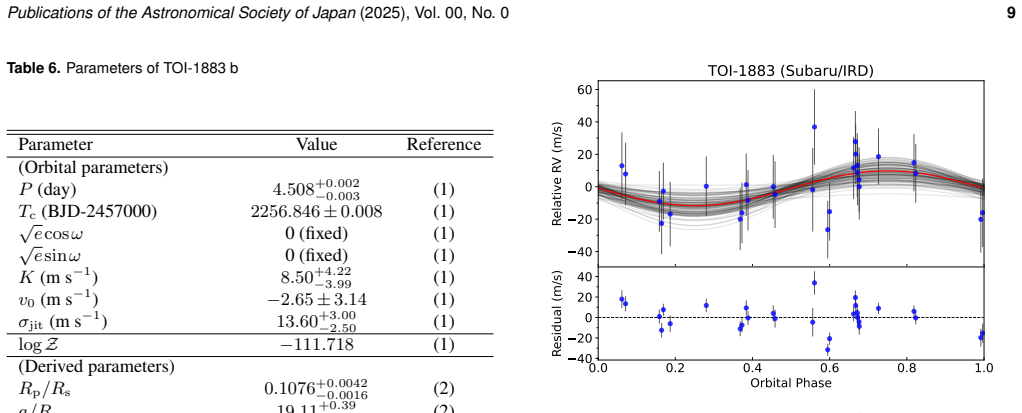
TOI-1883 b has a mass of 13.7 Earth masses and a mean density of 0.4 g cm^{-3}, marking it as a low-density super-Neptune in the ridge regime around an early-M dwarf.
A machine-rendered reading of the paper's core claim, the machinery that carries it, and where it could break.
Core claim
Radial-velocity data from the IRD instrument give a planetary mass of 13.7 +6.8/-6.5 Earth masses and a mean density of 0.4 +0.3/-0.2 g cm^{-3} for TOI-1883 b. The resulting low density leads the authors to classify the planet as a low-density super-Neptune. The period places it inside the ridge (3.2–5.7 days), and the similarity of the Neptune-desert boundary around M dwarfs to that around FGK stars is taken to imply disk-driven migration followed by early XUV-driven photoevaporation. The host-star metallicity of [Fe/H] = 0.32 is suggested to have suppressed runaway gas accretion.
What carries the argument
The Keplerian radial-velocity semi-amplitude measured from IRD spectra, converted to planetary mass and bulk density under the assumption that the signal arises solely from the planet.
If this is right
- The boundary of the Neptune desert in period-radius space is statistically similar for planets around M dwarfs and FGK stars.
- TOI-1883 b reached its present orbit by disk-driven migration and lost envelope mass through early atmospheric photoevaporation.
- The host star's supersolar metallicity prevented the core from triggering runaway gas accretion even though the core mass meets or exceeds the conventional critical value.
- The planet's transmission spectroscopy metric exceeds 140, so transmission spectra can be obtained with current or near-future facilities.
Where Pith is reading between the lines
- Additional mass measurements of other ridge planets around M dwarfs would test whether low density is a common outcome in this period range.
- Atmospheric retrievals on TOI-1883 b could directly check whether the envelope has been stripped to the degree predicted by the photoevaporation scenario.
- If the same migration-plus-photoevaporation pathway operates across stellar types, population synthesis models should reproduce the observed ridge location without separate tuning for M dwarfs.
Load-bearing premise
The detected radial-velocity signal at the orbital period is produced only by the planet's gravitational pull and contains no significant contribution from stellar activity, spots, or instrumental effects.
What would settle it
A radial-velocity campaign that either detects activity-induced signals at the same period with amplitude comparable to the planetary signal or yields a mass upper limit below 5 Earth masses would falsify the reported density and classification.
Figures

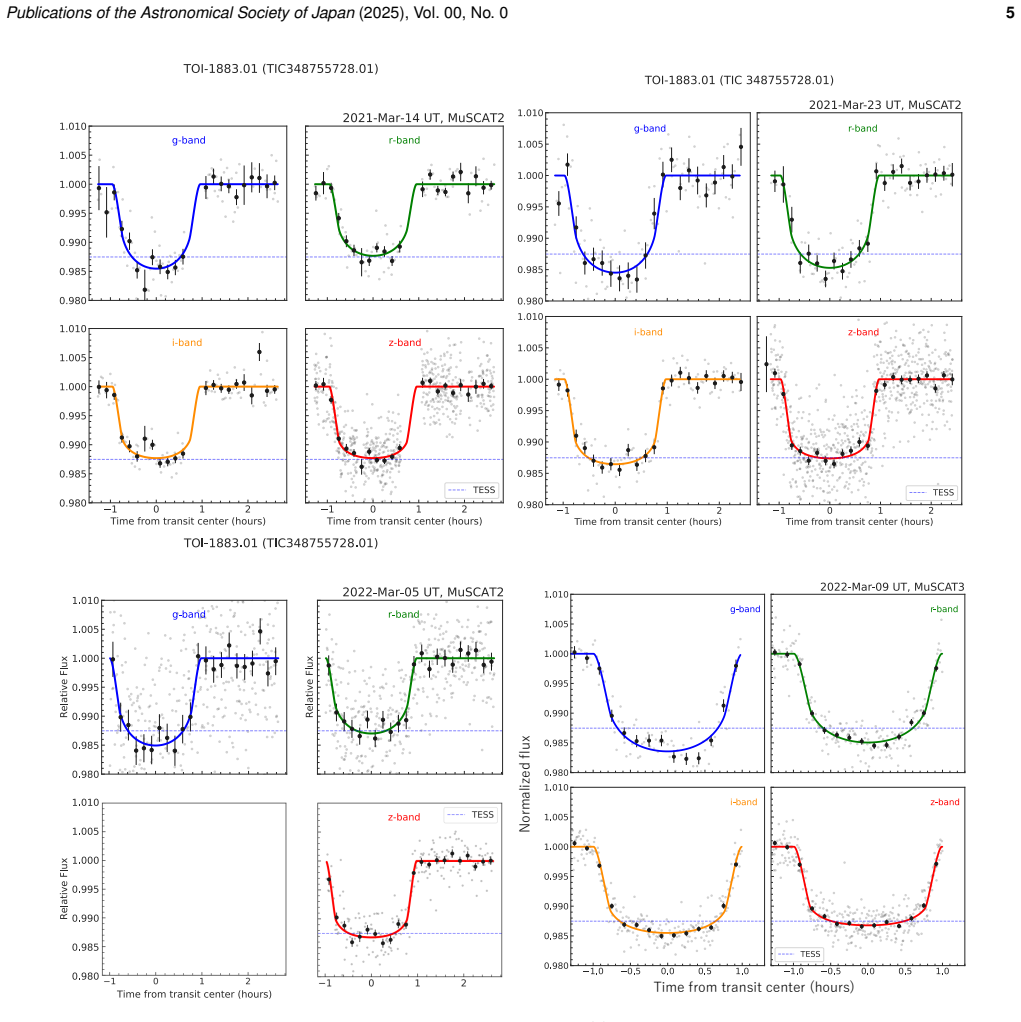
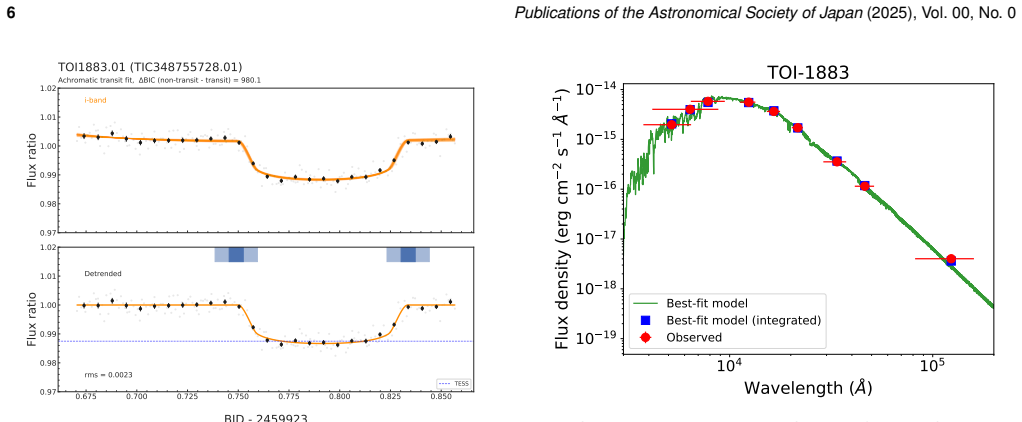
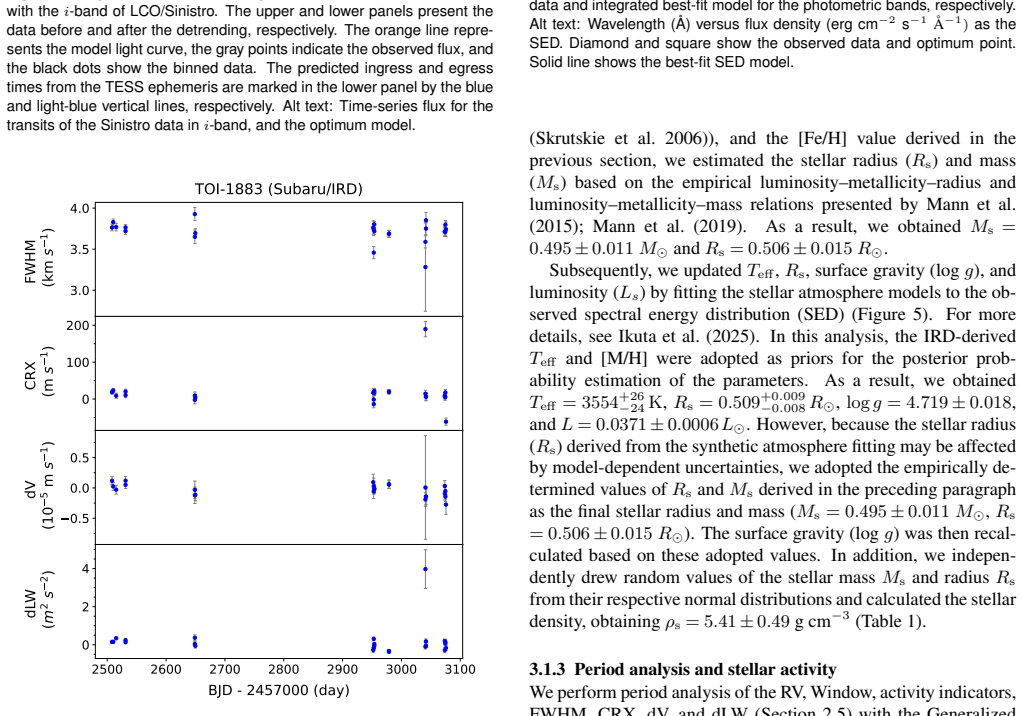
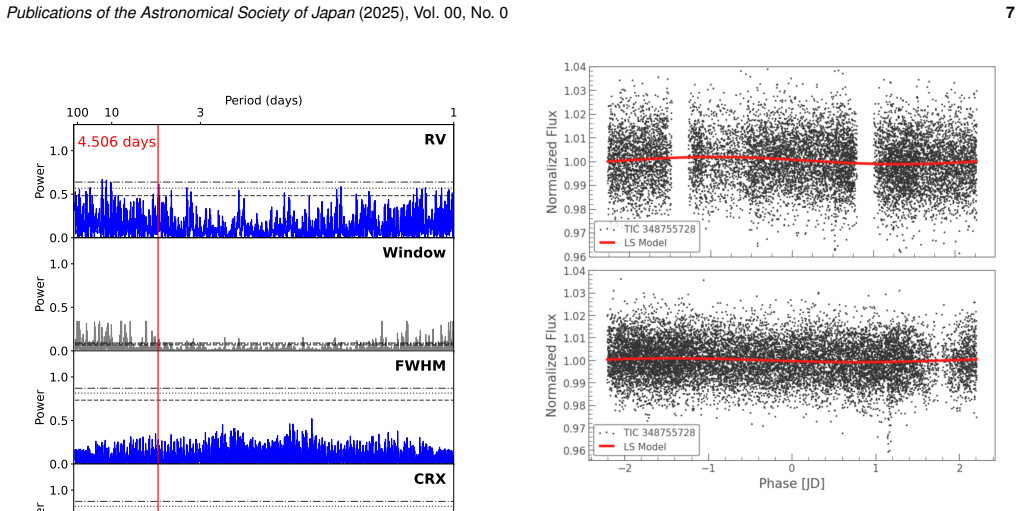


read the original abstract
Recent large-scale transit surveys conducted by space telescopes such as Kepler and TESS have revealed a vast number of exoplanets, uncovering the diversity of their population. One of the remarkable findings is the presence of a deficiency region in the period-radius distribution of short-period (< 10 days) Neptune-sized planets (4-8 Earth radii). This region is classified into the Neptune desert (< 3.2 days), the ridge (3.2-5.7 days), and the savanna (> 5.7 days) based on orbital period, each likely reflecting distinct evolutionary pathways. In this study, we used the InfraRed Doppler (IRD) instrument on the Subaru Telescope to determine the mass of the super-Neptune TOI-1883 b, which resides in the ridge region (P ~ 4.51 days) orbiting an M dwarf. We measured a planetary mass of Mp = 13.7 +6.8/-6.5 Earth masses and a mean density of 0.4 +0.3/-0.2 g cm^-3, with 3-sigma upper limits of 34.1 Earth masses, and 5-sigma upper limits of 47.7 Earth masses. These results suggest that TOI-1883 b is likely a low density super-Neptune. We also find that the boundary of the Neptune desert defined by planets orbiting FGK-type stars exhibits a similar distribution for planets around M-type stars. According to the population-based argument of Bourrier et al. (2025), this suggests that TOI-1883 b may have undergone disk-driven migration to reach its current orbit and experienced early atmospheric photoevaporation driven by strong stellar XUV irradiation. The derived planetary mass is comparable to or exceeds the conventional critical core mass. We suggest that the high metallicity of the host star ([Fe/H] = 0.32 +/- 0.18) may have suppressed the onset of runaway gas accretion. Furthermore, TOI-1883 b has a high Transmission Spectroscopy Metric (TSM > 140), making it an excellent target for future atmospheric characterization via transmission spectroscopy.
Editorial analysis
A structured set of objections, weighed in public.
Referee Report
Summary. The manuscript reports Subaru/IRD radial-velocity observations of the transiting super-Neptune TOI-1883 b (P ≈ 4.51 d) around an early-M dwarf. From a Keplerian fit they derive Mp = 13.7 +6.8/-6.5 M⊕ and ρ = 0.4 +0.3/-0.2 g cm^{-3} (with 3σ/5σ upper limits), classify the planet as a low-density object in the Neptune ridge, and argue for disk-driven migration plus early photoevaporation; they also note a high TSM (>140) and discuss the host-star metallicity in the context of core-accretion theory.
Significance. If the mass measurement is robust, the result supplies a rare density anchor for the ridge population around M dwarfs and supplies a concrete test of the Bourrier et al. (2025) migration-plus-photoevaporation scenario. The high TSM also makes the target observationally valuable for transmission spectroscopy.
major comments (2)
- [RV analysis section] RV analysis section (likely §4 or equivalent): the reported semi-amplitude and resulting Mp rest on the premise that the 4.51-day periodicity is purely Keplerian. No quantitative demonstration is given that activity indicators, line-profile diagnostics, or Gaussian-process modeling leave the planetary amplitude unchanged at >3σ; because the detection is marginal (only 3σ/5σ upper limits are quoted) this step is load-bearing for the low-density claim.
- [Stellar-parameter propagation] Stellar-parameter propagation (likely §3): the asymmetric uncertainties on Mp and ρ incorporate stellar mass and radius errors, yet the text does not show how the adopted [Fe/H] = 0.32 ± 0.18 and its uncertainty are propagated into the final planetary density; this affects the interpretation that the planet lies below the conventional critical core mass.
minor comments (2)
- The abstract quotes 3σ and 5σ upper limits but does not state the corresponding K values or the exact prior choices used in the orbit fit; these should be tabulated for reproducibility.
- Figure showing the phase-folded RV curve should include the activity-indicator time series or GLS periodograms to allow visual assessment of possible aliases.
Simulated Author's Rebuttal
We thank the referee for their constructive comments on our manuscript. We address each major comment below and have revised the manuscript to strengthen the presentation of the RV analysis and stellar parameter propagation.
read point-by-point responses
-
Referee: [RV analysis section] RV analysis section (likely §4 or equivalent): the reported semi-amplitude and resulting Mp rest on the premise that the 4.51-day periodicity is purely Keplerian. No quantitative demonstration is given that activity indicators, line-profile diagnostics, or Gaussian-process modeling leave the planetary amplitude unchanged at >3σ; because the detection is marginal (only 3σ/5σ upper limits are quoted) this step is load-bearing for the low-density claim.
Authors: We agree that the marginal detection requires explicit quantitative checks on activity. Our original analysis inspected activity indicators (Hα, Ca II) and line-profile diagnostics from the IRD spectra and found no significant power at 4.51 days, but we did not present a full GP comparison. We have now added a new subsection to §4 with Gaussian-process regression (quasi-periodic kernel) results demonstrating that the planetary semi-amplitude remains consistent within 1σ when activity terms are included. A supplementary figure comparing Keplerian-only and GP+Keplerian posteriors has been added. This supports the reported mass without changing its central value. revision: yes
-
Referee: [Stellar-parameter propagation] Stellar-parameter propagation (likely §3): the asymmetric uncertainties on Mp and ρ incorporate stellar mass and radius errors, yet the text does not show how the adopted [Fe/H] = 0.32 ± 0.18 and its uncertainty are propagated into the final planetary density; this affects the interpretation that the planet lies below the conventional critical core mass.
Authors: The [Fe/H] value and uncertainty enter the stellar mass and radius via the empirical relations used in §3; those stellar errors are then propagated to Mp and ρ, producing the quoted asymmetric uncertainties. We acknowledge that the explicit propagation chain was not detailed. We have added a paragraph in §3 describing how the metallicity uncertainty contributes to the final planetary density errors and its bearing on the comparison with the critical core mass (noting that the mass is comparable to or exceeds this threshold, as stated in the manuscript). revision: yes
Circularity Check
Mass derived from independent IRD RV fit; no reduction to inputs or self-citation
full rationale
The paper reports Mp = 13.7 +6.8/-6.5 M⊕ obtained by fitting a Keplerian model to the IRD radial-velocity time series and converting the resulting semi-amplitude K via the standard two-body mass function. No equation in the text defines Mp in terms of a prior fit, renames a fitted quantity as a prediction, or invokes a self-citation chain to justify the central numerical result. The Bourrier et al. (2025) reference is external and used only for interpretive context about migration. The measurement therefore remains independent of its own inputs and satisfies the criteria for a non-circular observational derivation.
Axiom & Free-Parameter Ledger
free parameters (1)
- RV semi-amplitude
axioms (1)
- domain assumption The observed periodic RV variation is produced by the planet and contains negligible stellar activity or instrumental contributions
Reference graph
Works this paper leans on
-
[1]
RadVel: The Radial Velocity Modeling Toolkit
RadVel: The Radial Velocity Modeling Toolkit. , keywords =. doi:10.1088/1538-3873/aaaaa8 , archivePrefix =. 1801.01947 , primaryClass =
work page internal anchor Pith review Pith/arXiv arXiv doi:10.1088/1538-3873/aaaaa8
-
[2]
Dynamic temperature selection for parallel-tempering in Markov chain Monte Carlo simulations
Dynamic temperature selection for parallel tempering in Markov chain Monte Carlo simulations. , keywords =. doi:10.1093/mnras/stv2422 , archivePrefix =. 1501.05823 , primaryClass =
work page internal anchor Pith review Pith/arXiv arXiv doi:10.1093/mnras/stv2422
-
[3]
Scalable backpropagation for Gaussian Processes using celerite
Scalable Backpropagation for Gaussian Processes using Celerite. Research Notes of the American Astronomical Society , keywords =. doi:10.3847/2515-5172/aaaf6c , archivePrefix =. 1801.10156 , primaryClass =
work page internal anchor Pith review Pith/arXiv arXiv doi:10.3847/2515-5172/aaaf6c
-
[4]
Ground-based and Airborne Instrumentation for Astronomy IV , year = 2012, editor =
Subaru FMOS now and future. Ground-based and Airborne Instrumentation for Astronomy IV , year = 2012, editor =. doi:10.1117/12.925831 , adsurl =
-
[5]
Ground-based and Airborne Instrumentation for Astronomy VII , year = 2018, editor =
The infrared Doppler (IRD) instrument for the Subaru telescope: instrument description and commissioning results. Ground-based and Airborne Instrumentation for Astronomy VII , year = 2018, editor =. doi:10.1117/12.2311836 , adsurl =
-
[6]
Precision radial velocity measurements by the forward-modeling technique in the near-infrared. , keywords =. doi:10.1093/pasj/psaa085 , archivePrefix =. 2007.11013 , primaryClass =
-
[7]
Quantifying the Bayesian Evidence for a Planet in Radial Velocity Data. , keywords =. doi:10.3847/1538-3881/ab5190 , archivePrefix =. 1806.04683 , primaryClass =
-
[8]
Transiting Exoplanet Survey Satellite (TESS). Journal of Astronomical Telescopes, Instruments, and Systems , year = 2015, month = jan, volume =. doi:10.1117/1.JATIS.1.1.014003 , adsurl =
work page internal anchor Pith review doi:10.1117/1.jatis.1.1.014003 2015
-
[9]
A low-eccentricity migration pathway for a 13-h-period Earth analogue in a four-planet system. Nature Astronomy , keywords =. doi:10.1038/s41550-022-01641-y , archivePrefix =. 2204.13573 , primaryClass =
-
[10]
TKS X: Confirmation of TOI-1444b and a Comparative Analysis of the Ultra-short-period Planets with Hot Neptunes. , keywords =. doi:10.3847/1538-3881/ac02bd , adsurl =
-
[11]
The TESS-Keck Survey. XIII. An Eccentric Hot Neptune with a Similar-mass Outer Companion around TOI-1272. , keywords =. doi:10.3847/1538-3881/ac7ce1 , archivePrefix =. 2206.14327 , primaryClass =
-
[12]
A super-Earth orbiting near the inner edge of the habitable zone around the M4.5 dwarf Ross 508. , keywords =. doi:10.1093/pasj/psac044 , archivePrefix =. 2205.11986 , primaryClass =
-
[13]
The generalised Lomb-Scargle periodogram. A new formalism for the floating-mean and Keplerian periodograms. , keywords =. doi:10.1051/0004-6361:200811296 , archivePrefix =. 0901.2573 , primaryClass =
work page internal anchor Pith review Pith/arXiv arXiv doi:10.1051/0004-6361:200811296
-
[14]
PASTIS: Bayesian extrasolar planet validation - II. Constraining exoplanet blend scenarios using spectroscopic diagnoses. , keywords =. doi:10.1093/mnras/stv1080 , archivePrefix =. 1505.02663 , primaryClass =
work page internal anchor Pith review Pith/arXiv arXiv doi:10.1093/mnras/stv1080
-
[15]
Radial Velocity Data Analysis with Compressed Sensing Techniques
Radial velocity data analysis with compressed sensing techniques. , keywords =. doi:10.1093/mnras/stw2261 , archivePrefix =. 1609.01519 , primaryClass =
work page internal anchor Pith review Pith/arXiv arXiv doi:10.1093/mnras/stw2261
-
[16]
The California Legacy Survey. I. A Catalog of 178 Planets from Precision Radial Velocity Monitoring of 719 Nearby Stars over Three Decades. , keywords =. doi:10.3847/1538-4365/abe23c , archivePrefix =. 2105.11583 , primaryClass =
-
[17]
The Journal of Open Source Software , year = 2016, month = jun, volume =
corner.py: Scatterplot matrices in Python. The Journal of Open Source Software , year = 2016, month = jun, volume =. doi:10.21105/joss.00024 , adsurl =
-
[18]
Spectrum radial velocity analyser (SERVAL). High-precision radial velocities and two alternative spectral indicators. , keywords =. doi:10.1051/0004-6361/201731483 , archivePrefix =. 1710.10114 , primaryClass =
work page internal anchor Pith review Pith/arXiv arXiv doi:10.1051/0004-6361/201731483
-
[19]
Identification of the Top TESS Objects of Interest for Atmospheric Characterization of Transiting Exoplanets with JWST. , keywords =. doi:10.3847/1538-3881/ad3068 , archivePrefix =. 2308.09617 , primaryClass =
-
[20]
The mass of TOI-519 b: A close-in giant planet transiting a metal-rich mid-M dwarf. , keywords =. doi:10.1093/pasj/psad031 , archivePrefix =. 2304.14703 , primaryClass =
-
[21]
An Earth-sized Planet around an M5 Dwarf Star at 22 pc. , keywords =. doi:10.3847/1538-3881/acb7e1 , archivePrefix =. 2302.00699 , primaryClass =
-
[22]
TOI-1696: A Nearby M4 Dwarf with a 3 R _ Planet in the Neptunian Desert. , keywords =. doi:10.3847/1538-3881/ac6bf8 , archivePrefix =. 2203.02694 , primaryClass =
-
[23]
Two Bright M Dwarfs Hosting Ultra-Short-Period Super-Earths with Earth-like Compositions. , keywords =. doi:10.3847/1538-3881/ac0fdc , archivePrefix =. 2103.12760 , primaryClass =
-
[24]
The Discovery and Follow-up of Four Transiting Short-period Sub-Neptunes Orbiting M Dwarfs. , keywords =. doi:10.3847/1538-3881/ad4115 , adsurl =
-
[25]
Validation and atmospheric exploration of the sub-Neptune TOI-2136b around a nearby M3 dwarf. , keywords =. doi:10.1051/0004-6361/202243381 , archivePrefix =. 2202.10182 , primaryClass =
-
[26]
Ground-based and Airborne Instrumentation for Astronomy VII , year = 2018, editor =
Performance tests of Subaru/IRD for very precise and stable infrared radial velocity observations. Ground-based and Airborne Instrumentation for Astronomy VII , year = 2018, editor =. doi:10.1117/12.2311832 , adsurl =
-
[27]
Predicted diversity in water content of terrestrial exoplanets orbiting M dwarfs. Nature Astronomy , keywords =. doi:10.1038/s41550-022-01781-1 , archivePrefix =. 2209.14563 , primaryClass =
-
[28]
MuSCAT2: four-color simultaneous camera for the 1.52-m Telescopio Carlos S
Narita, Norio and Fukui, Akihiko and Kusakabe, Nobuhiko and Watanabe, Noriharu and Palle, Enric and Parviainen, Hannu and Monta. MuSCAT2: four-color simultaneous camera for the 1.52-m Telescopio Carlos S. Journal of Astronomical Telescopes, Instruments, and Systems , volume=. 2019 , publisher=
2019
-
[29]
TOI-2285b: A 1.7 Earth-radius planet near the habitable zone around a nearby M dwarf. , keywords =. doi:10.1093/pasj/psab106 , archivePrefix =. 2110.10215 , primaryClass =
-
[30]
Two sub-Neptunes around the M dwarf TOI-1470. , keywords =. doi:10.1051/0004-6361/202346292 , archivePrefix =. 2306.08516 , primaryClass =
-
[31]
The California-Kepler Survey. III. A Gap in the Radius Distribution of Small Planets. , keywords =. doi:10.3847/1538-3881/aa80eb , archivePrefix =. 1703.10375 , primaryClass =
work page internal anchor Pith review Pith/arXiv arXiv doi:10.3847/1538-3881/aa80eb
-
[32]
TOI-1235 b: A Keystone Super-Earth for Testing Radius Valley Emergence Models around Early M Dwarfs. , keywords =. doi:10.3847/1538-3881/ab9534 , archivePrefix =. 2004.06682 , primaryClass =
-
[33]
An asteroseismic view of the radius valley: stripped cores, not born rocky
An asteroseismic view of the radius valley: stripped cores, not born rocky. , keywords =. doi:10.1093/mnras/sty1783 , archivePrefix =. 1710.05398 , primaryClass =
work page internal anchor Pith review Pith/arXiv arXiv doi:10.1093/mnras/sty1783
-
[34]
Masses and compositions of three small planets orbiting the nearby M dwarf L231-32 (TOI-270) and the M dwarf radius valley. , keywords =. doi:10.1093/mnras/stab2143 , archivePrefix =. 2101.01593 , primaryClass =
-
[35]
Density, not radius, separates rocky and water-rich small planets orbiting M dwarf stars. Science , keywords =. doi:10.1126/science.abl7164 , archivePrefix =. 2209.03871 , primaryClass =
-
[36]
Starspot Mapping with Adaptive Parallel Tempering. I. Implementation of Computational Code. , keywords =. doi:10.3847/1538-4357/abae5f , archivePrefix =. 2008.05478 , primaryClass =
-
[37]
PASTIS: Bayesian extrasolar planet validation. I. General framework, models, and performance
PASTIS: Bayesian extrasolar planet validation - I. General framework, models, and performance. , keywords =. doi:10.1093/mnras/stu601 , archivePrefix =. 1403.6725 , primaryClass =
work page internal anchor Pith review Pith/arXiv arXiv doi:10.1093/mnras/stu601
-
[38]
Absence of extended atmospheres in low-mass star radius-gap planets. , keywords =. doi:10.1093/mnras/stad404 , archivePrefix =. 2302.01479 , primaryClass =
-
[39]
, year = 1995, month = nov, volume =
A Jupiter-mass companion to a solar-type star. , year = 1995, month = nov, volume =. doi:10.1038/378355a0 , adsurl =
-
[40]
Characteristics of Planetary Candidates Observed by Kepler. II. Analysis of the First Four Months of Data. , keywords =. doi:10.1088/0004-637X/736/1/19 , archivePrefix =. 1102.0541 , primaryClass =
-
[41]
Measurements of Transit Timing Variations for WASP-5b
Measurements of Transit Timing Variations for WASP-5b. , keywords =. doi:10.1093/pasj/63.1.287 , archivePrefix =. 1009.5769 , primaryClass =
work page internal anchor Pith review Pith/arXiv arXiv doi:10.1093/pasj/63.1.287
-
[42]
emcee: The MCMC Hammer. , keywords =. doi:10.1086/670067 , archivePrefix =. 1202.3665 , primaryClass =
work page internal anchor Pith review Pith/arXiv arXiv doi:10.1086/670067
-
[43]
Bayesian priors for the eccentricity of transiting planets
Bayesian priors for the eccentricity of transiting planets. , keywords =. doi:10.1093/mnras/stu1561 , archivePrefix =. 1408.1393 , primaryClass =
work page internal anchor Pith review Pith/arXiv arXiv doi:10.1093/mnras/stu1561
-
[44]
A Fast, Two-dimensional Gaussian Process Method Based on Celerite: Applications to Transiting Exoplanet Discovery and Characterization. , keywords =. doi:10.3847/1538-3881/abbc16 , archivePrefix =. 2007.05799 , primaryClass =
-
[45]
doi:10.5281/zenodo.7646759 , version =
dfm/tinygp: The tiniest of Gaussian Process libraries. doi:10.5281/zenodo.7646759 , version =
-
[46]
James Bradbury and Roy Frostig and Peter Hawkins and Matthew James Johnson and Chris Leary and Dougal Maclaurin and George Necula and Adam Paszke and Jake Vander
-
[47]
arXiv preprint arXiv:2105.15183 , year=
Efficient and Modular Implicit Differentiation , author=. arXiv preprint arXiv:2105.15183 , year=
-
[48]
arXiv preprint arXiv:1912.11554 , year=
Composable Effects for Flexible and Accelerated Probabilistic Programming in NumPyro , author=. arXiv preprint arXiv:1912.11554 , year=
Pith/arXiv arXiv 1912
-
[49]
TOI-544 b: a potential water-world inside the radius valley in a two-planet system. , keywords =. doi:10.1093/mnras/stad3837 , archivePrefix =. 2310.14908 , primaryClass =
-
[50]
The evaporation valley in the Kepler planets
The Evaporation Valley in the Kepler Planets. , keywords =. doi:10.3847/1538-4357/aa890a , archivePrefix =. 1705.10810 , primaryClass =
work page internal anchor Pith review Pith/arXiv arXiv doi:10.3847/1538-4357/aa890a
-
[51]
Sculpting the valley in the radius distribution of small exoplanets as a by-product of planet formation: the core-powered mass-loss mechanism. , keywords =. doi:10.1093/mnras/stz1230 , archivePrefix =. 1811.03202 , primaryClass =
work page internal anchor Pith review Pith/arXiv arXiv doi:10.1093/mnras/stz1230
-
[52]
Caught in the act: core-powered mass-loss predictions for observing atmospheric escape. , keywords =. doi:10.1093/mnras/stab1128 , archivePrefix =. 2103.08785 , primaryClass =
-
[53]
How formation time-scales affect the period dependence of the transition between rocky super-Earths and gaseous sub-Neptunesand implications for _. , keywords =. doi:10.1093/mnras/sty1707 , archivePrefix =. 1610.09390 , primaryClass =
work page internal anchor Pith review Pith/arXiv arXiv doi:10.1093/mnras/sty1707
-
[54]
The Evolutionary Track of H/He Envelopes of the Observed Population of Sub-Neptunes and Super-Earths. , keywords =. doi:10.3847/1538-4357/ab9a4d , archivePrefix =. 2001.01299 , primaryClass =
-
[55]
Properties of the radius valley around low mass stars: predictions from the core-powered mass-loss mechanism. , keywords =. doi:10.1093/mnras/stac2488 , archivePrefix =. 2205.14020 , primaryClass =
-
[56]
A deep radius valley revealed by Kepler short cadence observations. , keywords =. doi:10.1093/mnras/stac3802 , archivePrefix =. 2301.04062 , primaryClass =
-
[57]
The California-Kepler Survey. X. The Radius Gap as a Function of Stellar Mass, Metallicity, and Age. , keywords =. doi:10.3847/1538-3881/ac51e3 , archivePrefix =. 2201.10020 , primaryClass =
-
[58]
Evidence for the volatile-rich composition of a 1.5-Earth-radius planet. Nature Astronomy , keywords =. doi:10.1038/s41550-022-01835-4 , archivePrefix =. 2212.08477 , primaryClass =
-
[59]
The K2-3 System Revisited: Testing Photoevaporation and Core-powered Mass Loss with Three Small Planets Spanning the Radius Valley. , keywords =. doi:10.3847/1538-3881/ac7807 , archivePrefix =. 2207.12755 , primaryClass =
-
[60]
TOI-1452 b: SPIRou and TESS Reveal a Super-Earth in a Temperate Orbit Transiting an M4 Dwarf. , keywords =. doi:10.3847/1538-3881/ac7cea , archivePrefix =. 2208.06333 , primaryClass =
-
[61]
Conclusive Evidence for a Population of Water Worlds around M Dwarfs Remains Elusive. , keywords =. doi:10.3847/2041-8213/acc86f , archivePrefix =. 2301.04321 , primaryClass =
-
[62]
Growth Model Interpretation of Planet Size Distribution
Growth model interpretation of planet size distribution. Proceedings of the National Academy of Science , keywords =. doi:10.1073/pnas.1812905116 , archivePrefix =. 1906.04253 , primaryClass =
work page internal anchor Pith review Pith/arXiv arXiv doi:10.1073/pnas.1812905116 1906
-
[63]
A Framework for Prioritizing the TESS Planetary Candidates Most Amenable to Atmospheric Characterization. , keywords =. doi:10.1088/1538-3873/aadf6f , archivePrefix =. 1805.03671 , primaryClass =
work page internal anchor Pith review Pith/arXiv arXiv doi:10.1088/1538-3873/aadf6f
-
[64]
, author=
The No-U-Turn sampler: adaptively setting path lengths in Hamiltonian Monte Carlo. , author=. J. Mach. Learn. Res. , volume=
-
[65]
STARRY: Analytic Occultation Light Curves
starry: Analytic Occultation Light Curves. , keywords =. doi:10.3847/1538-3881/aae8e5 , archivePrefix =. 1810.06559 , primaryClass =
work page internal anchor Pith review Pith/arXiv arXiv doi:10.3847/1538-3881/aae8e5
-
[66]
A radius valley between migrated steam worlds and evaporated rocky cores. Nature Astronomy , keywords =. doi:10.1038/s41550-023-02183-7 , archivePrefix =. 2401.04380 , primaryClass =
-
[67]
TOI-2266 b: A keystone super-Earth at the edge of the M dwarf radius valley. , keywords =. doi:10.1051/0004-6361/202347431 , archivePrefix =. 2401.11879 , primaryClass =
-
[68]
SPRIGHT: a probabilistic mass-density-radius relation for small planets. , keywords =. doi:10.1093/mnras/stad3504 , archivePrefix =. 2311.07255 , primaryClass =
-
[69]
doi:10.5281/zenodo.10736936 , url =
Soichiro Hattori and Lionel Garcia and Catriona Murray and Jiayin Dong and Shashank Dholakia and David Degen and Daniel Foreman-Mackey , title =. doi:10.5281/zenodo.10736936 , url =
-
[70]
Efficient, uninformative sampling of limb darkening coefficients for two-parameter laws
Efficient, uninformative sampling of limb darkening coefficients for two-parameter laws. , keywords =. doi:10.1093/mnras/stt1435 , archivePrefix =. 1308.0009 , primaryClass =
work page internal anchor Pith review Pith/arXiv arXiv doi:10.1093/mnras/stt1435
-
[71]
LDTK: Limb Darkening Toolkit. , keywords =. doi:10.1093/mnras/stv1857 , archivePrefix =. 1508.02634 , primaryClass =
work page internal anchor Pith review Pith/arXiv arXiv doi:10.1093/mnras/stv1857
-
[72]
Proceedings of the National Academy of Science , year = 2023, month = may, volume =
The orbital eccentricity distribution of planets orbiting M dwarfs. Proceedings of the National Academy of Science , year = 2023, month = may, volume =. doi:10.1073/pnas.2217398120 , adsurl =
-
[73]
EXOFAST: A fast exoplanetary fitting suite in IDL
EXOFAST: A Fast Exoplanetary Fitting Suite in IDL. , keywords =. doi:10.1086/669497 , archivePrefix =. 1206.5798 , primaryClass =
work page internal anchor Pith review Pith/arXiv arXiv doi:10.1086/669497
-
[74]
Improving the Efficiency of Markov Chain Monte Carlo for Analyzing the Orbits of Extrasolar Planets
Improving the Efficiency of Markov Chain Monte Carlo for Analyzing the Orbits of Extrasolar Planets. , keywords =. doi:10.1086/500802 , archivePrefix =. astro-ph/0512634 , primaryClass =
work page internal anchor Pith review Pith/arXiv arXiv doi:10.1086/500802
-
[75]
ArXiv , year=
TensorFlow Distributions , author=. ArXiv , year=
-
[76]
Elemental abundances of M dwarfs based on high-resolution near-infrared spectra: Verification by binary systems. , keywords =. doi:10.1093/pasj/psaa101 , archivePrefix =. 2010.04024 , primaryClass =
-
[77]
Elemental Abundances of nearby M Dwarfs Based on High-resolution Near-infrared Spectra Obtained by the Subaru/IRD Survey: Proof of Concept. , keywords =. doi:10.3847/1538-3881/ac3ee0 , archivePrefix =. 2112.00173 , primaryClass =
-
[78]
, keywords =
Spectral energy distributions and effective temperature scale of M-giant stars. , keywords =
-
[79]
A grid of MARCS model atmospheres for late-type stars. I. Methods and general properties. , keywords =. doi:10.1051/0004-6361:200809724 , archivePrefix =. 0805.0554 , primaryClass =
work page internal anchor Pith review Pith/arXiv arXiv doi:10.1051/0004-6361:200809724
-
[80]
The Revised TESS Input Catalog and Candidate Target List. , keywords =. doi:10.3847/1538-3881/ab3467 , archivePrefix =. 1905.10694 , primaryClass =
discussion (0)
Sign in with ORCID, Apple, or X to comment. Anyone can read and Pith papers without signing in.