TianJi-Environ: An Autonomous AI Scientist for Atmospheric Environmental Research
Pith reviewed 2026-06-27 20:27 UTC · model grok-4.3
The pith
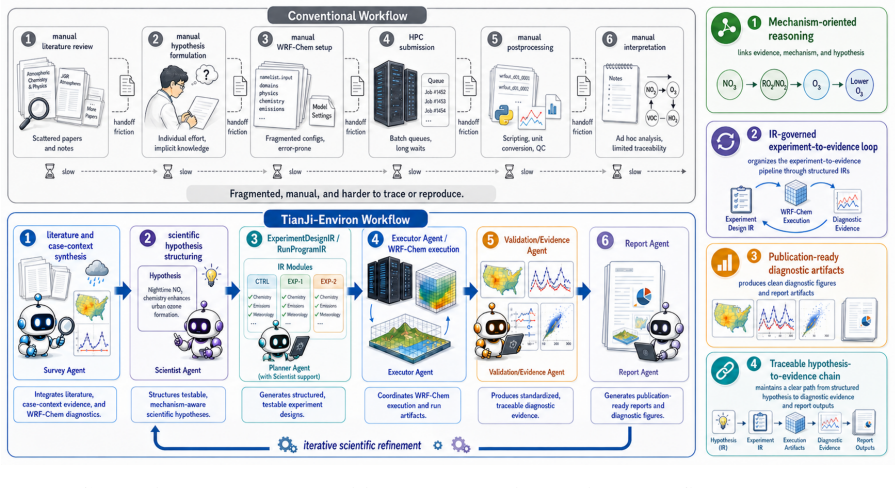
TianJi-Environ is the first WRF-Chem multi-agent system that turns mechanistic hypotheses into autonomous atmospheric-chemistry simulations and auditable evidence.
A machine-rendered reading of the paper's core claim, the machinery that carries it, and where it could break.
Core claim
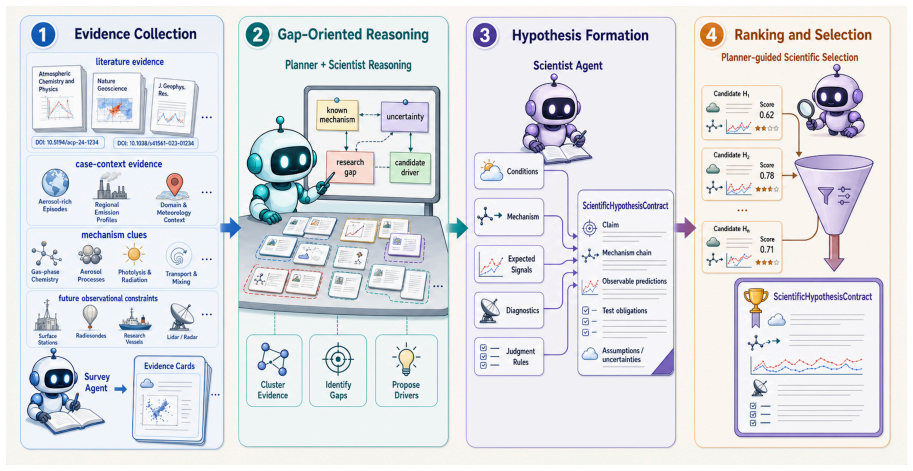
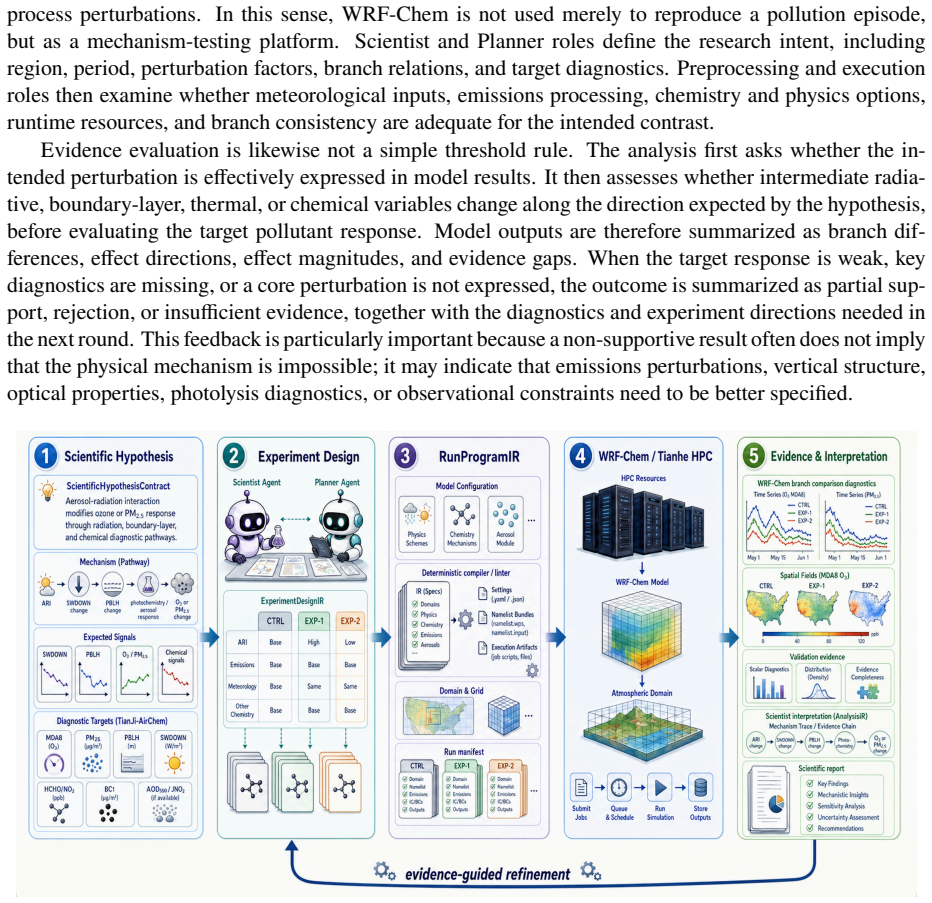
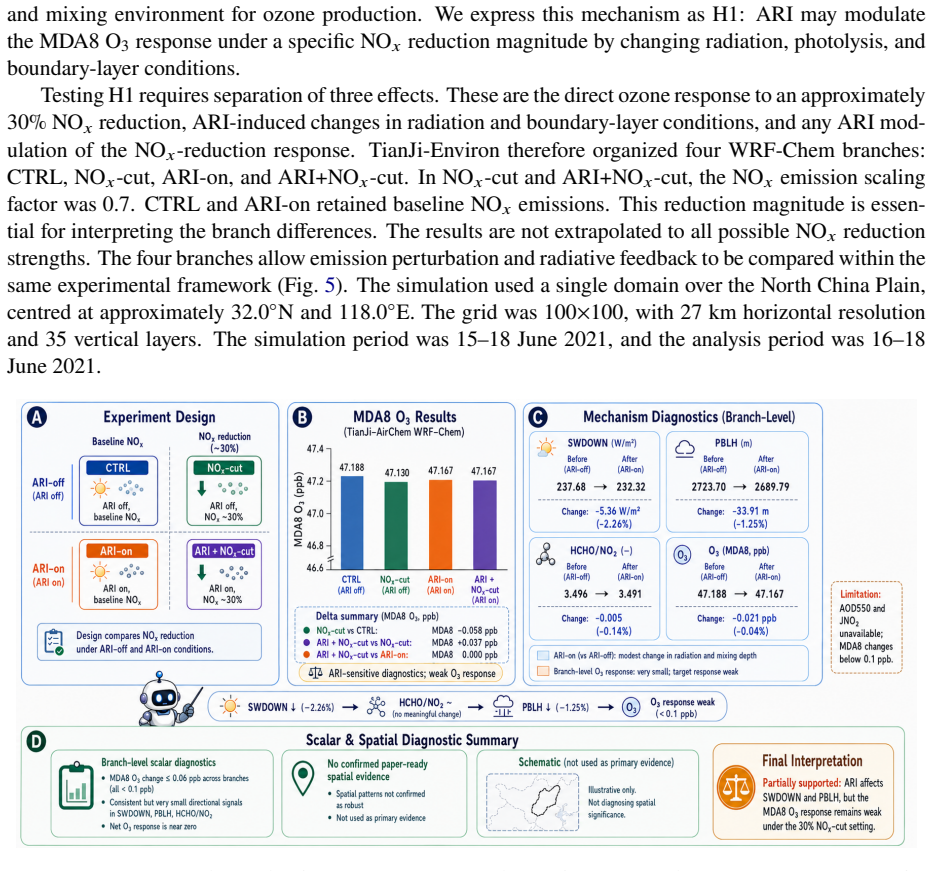
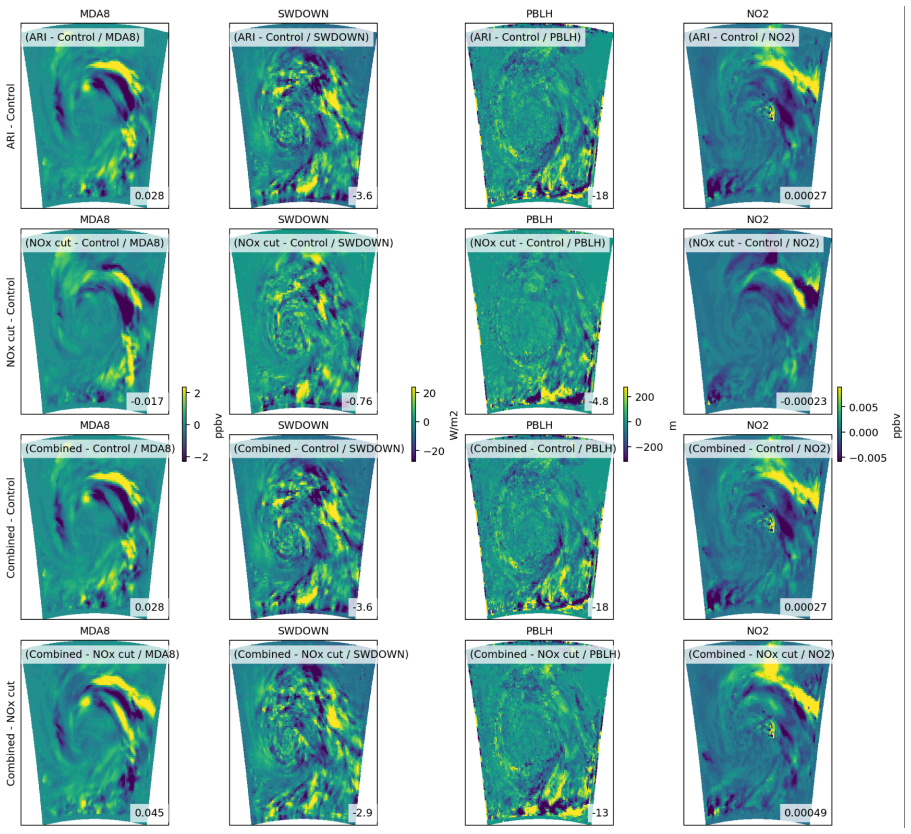
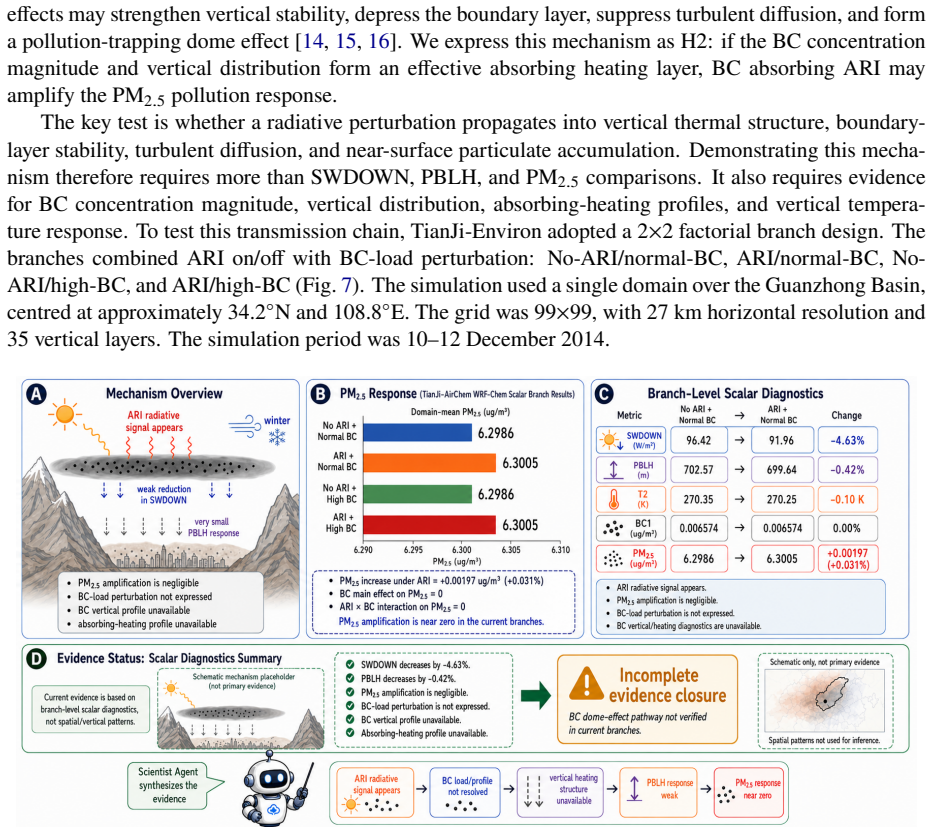
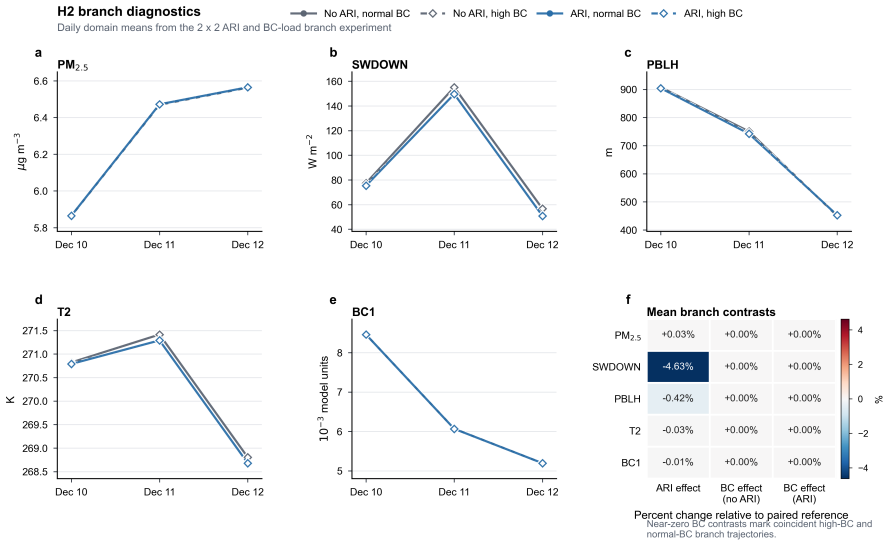
TianJi-Environ establishes the first WRF-Chem-based multi-agent framework that autonomously drives complex atmospheric-chemistry simulations, converting mechanistic hypotheses into executable configurations, testing experiments, and evidence criteria. In the ozone case it detects directionally consistent aerosol-radiation-interaction signals yet judges evidence for NOx-control response incomplete; in the PM2.5 case it traces the unsupported link to insufficient black-carbon propagation and absent vertical-heating diagnostics. These results make expert-driven mechanism validation explicit, structured, and auditable.
What carries the argument
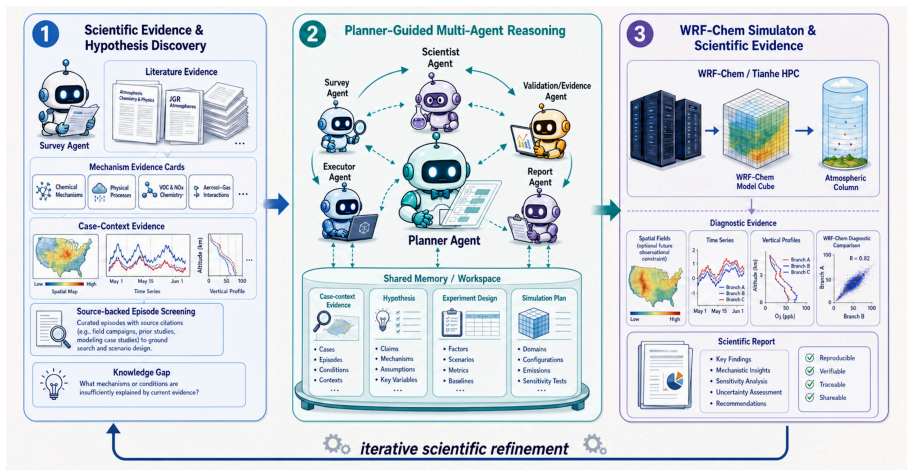
The WRF-Chem-based multi-agent framework that operationalizes hypotheses into model configurations, runs experiments, and applies evidence criteria.
If this is right
- Mechanism validation for ozone response to NOx control can be performed with explicit detection of aerosol-radiation signals alongside an incompleteness judgment.
- Particulate-matter feedback studies can localize unsupported links to specific missing propagations such as black-carbon effects on vertical heating.
- Atmospheric-chemistry experiments become traceable sequences of hypothesis, configuration, output, and evidence criterion rather than ad-hoc expert runs.
- The same multi-agent structure can be applied to other mechanistic questions in WRF-Chem without redesigning the workflow for each new hypothesis.
Where Pith is reading between the lines
- The framework could be extended to additional chemical mechanisms or different regional domains once the core agent logic is shown reliable on the two presented cases.
- If the system consistently flags evidence gaps, it might reduce the time researchers spend on exhaustive manual diagnostics.
- Integration with observational datasets could allow the evidence criteria to include direct comparisons against measurements rather than model-internal diagnostics alone.
Load-bearing premise
The multi-agent system can translate mechanistic hypotheses into correct model settings and judge evidence completeness without omitting key physical processes or introducing systematic judgment errors.
What would settle it
A controlled test case in which a known important physical process is omitted from the hypothesis yet the system still declares the evidence complete.
Figures
read the original abstract
As atmospheric environmental prediction continues to improve, interpretable validation of pollution mechanisms and feedback processes has become a main challenge in atmospheric chemistry. Yet mechanism validation based on complex numerical models still relies heavily on expert knowledge: mechanistic hypotheses must be operationalized into executable experiments, and model outputs must be organized into traceable evidence. We present TianJi-Environ, an auditable AI Scientist for atmospheric-chemistry mechanism validation. TianJi-Environ establishes the first WRF-Chem-based multi-agent framework that autonomously drives complex atmospheric-chemistry simulations, converting mechanistic hypotheses into executable configurations, testing experiments, and evidence criteria. Using ozone response and particulate-matter feedback as two representative examples, we demonstrate TianJi-Environ's capability for mechanism validation. In a summertime ozone case over the North China Plain, the system detects directionally consistent aerosol-radiation-interaction signals in shortwave radiation and boundary-layer height, but judges the evidence for ozone response to NOx control to be incomplete. In a wintertime PM2.5 case over the Guanzhong Basin, it localizes the unsupported link to insufficient propagation from black-carbon perturbation to particulate response and missing diagnostics of vertical absorptive heating. These results show that TianJi-Environ makes expert-driven mechanism validation explicit, structured, and auditable, offering a reproducible paradigm for multi-agent systems coupled with complex atmospheric-chemistry models.
Editorial analysis
A structured set of objections, weighed in public.
Referee Report
Summary. The manuscript presents TianJi-Environ, a multi-agent AI framework coupled with the WRF-Chem model for autonomous validation of atmospheric chemistry mechanisms. The system is claimed to convert mechanistic hypotheses into executable model configurations, run simulations, and assess the completeness of evidence for processes such as aerosol-radiation interactions affecting ozone and black-carbon perturbations on PM2.5. Two case studies are used to illustrate its application: one on summertime ozone over the North China Plain concluding incomplete evidence for NOx control response, and one on wintertime PM2.5 over the Guanzhong Basin identifying missing propagation from black-carbon and vertical heating diagnostics.
Significance. If the AI system's judgments prove reliable upon verification, this work could offer a reproducible and auditable paradigm for mechanism validation in atmospheric environmental research, reducing dependence on individual expert knowledge. The integration of multi-agent systems with complex numerical models like WRF-Chem represents a novel approach that could enhance the traceability of hypothesis testing in the field. The demonstrations suggest potential for identifying gaps in evidence that might be overlooked in traditional workflows.
major comments (3)
- [Abstract (ozone case)] Abstract (ozone case): The judgment that 'the evidence for ozone response to NOx control to be incomplete' is presented without detailing the specific evidence criteria, thresholds, or how the multi-agent system evaluates completeness (e.g., whether aerosol-radiation-interaction signals in shortwave radiation and boundary-layer height are quantified against expected magnitudes). This is load-bearing for the claim of autonomous mechanism validation.
- [Abstract (PM2.5 case)] Abstract (PM2.5 case): The conclusion that the unsupported link is due to 'insufficient propagation from black-carbon perturbation to particulate response and missing diagnostics of vertical absorptive heating' requires demonstration that the AI framework does not systematically omit other key processes such as aerosol-cloud interactions or regional transport; no cross-validation with expert analysis is mentioned.
- [Abstract] Abstract: The paper claims this is the 'first WRF-Chem-based multi-agent framework', but without a methods section detailing the agent architecture, prompt engineering, or integration points with WRF-Chem, it is difficult to assess novelty or reproducibility of the autonomous driving of simulations.
minor comments (2)
- [Abstract] The term 'auditable' is used repeatedly but not explicitly defined in terms of what outputs (e.g., logs of agent decisions, model configs) make the process traceable by humans.
- [Abstract] No information is provided on the computational resources required or the number of simulations run in the case studies, which would help gauge practicality.
Simulated Author's Rebuttal
We thank the referee for their constructive comments and recommendation for major revision. We address each point below, clarifying details from the full manuscript and indicating where revisions will strengthen the presentation of evidence criteria, scope limitations, and methods.
read point-by-point responses
-
Referee: [Abstract (ozone case)] The judgment that 'the evidence for ozone response to NOx control to be incomplete' is presented without detailing the specific evidence criteria, thresholds, or how the multi-agent system evaluates completeness (e.g., whether aerosol-radiation-interaction signals in shortwave radiation and boundary-layer height are quantified against expected magnitudes). This is load-bearing for the claim of autonomous mechanism validation.
Authors: We agree the abstract is too terse on evaluation criteria. The full manuscript's Methods section specifies the evidence protocol: the assessor agent quantifies signals via normalized differences in shortwave radiation (>5% threshold) and boundary-layer height (>10% threshold) against control runs, then scores completeness on a 0-1 scale requiring consistency across at least three diagnostics. We will revise the abstract to include a concise statement of these criteria and add an explicit cross-reference to the Methods section. revision: yes
-
Referee: [Abstract (PM2.5 case)] The conclusion that the unsupported link is due to 'insufficient propagation from black-carbon perturbation to particulate response and missing diagnostics of vertical absorptive heating' requires demonstration that the AI framework does not systematically omit other key processes such as aerosol-cloud interactions or regional transport; no cross-validation with expert analysis is mentioned.
Authors: The referee correctly notes that the current description does not explicitly rule out systematic omissions or include expert cross-validation. The manuscript's Discussion acknowledges the framework evaluates only the user-specified hypothesis set and does not claim exhaustive coverage of all processes. We will add a dedicated Limitations subsection clarifying the targeted scope and stating that expert cross-validation is planned for follow-on work; this addresses the concern without overclaiming completeness. revision: partial
-
Referee: [Abstract] The paper claims this is the 'first WRF-Chem-based multi-agent framework', but without a methods section detailing the agent architecture, prompt engineering, or integration points with WRF-Chem, it is difficult to assess novelty or reproducibility of the autonomous driving of simulations.
Authors: The full manuscript contains a Methods section (Section 2) that details the three-agent architecture (planner, executor, assessor), the prompt templates used for hypothesis-to-configuration translation and evidence scoring, and the WRF-Chem integration via namelist generation, output parsing scripts, and restart-file handling. We will revise the abstract to reference this section explicitly and expand one paragraph in Methods to include pseudocode for the integration workflow, thereby supporting both the novelty claim and reproducibility. revision: yes
Circularity Check
No circularity: framework presented as new tool without self-referential derivations
full rationale
The paper introduces TianJi-Environ as an autonomous multi-agent system for WRF-Chem simulations and mechanism validation. The abstract and description frame it as a new methodology converting hypotheses into configurations and evidence criteria, with case studies as demonstrations. No equations, fitted parameters, or self-citations are invoked in a load-bearing way that reduces claims to inputs by construction. The central claim rests on the system's operationalization capability rather than any renaming, ansatz smuggling, or prediction-from-fit pattern. This is a standard tool/framework paper with independent content.
Axiom & Free-Parameter Ledger
axioms (1)
- domain assumption The WRF-Chem model provides an accurate representation of atmospheric chemistry processes for the cases studied.
invented entities (1)
-
TianJi-Environ multi-agent framework
no independent evidence
Reference graph
Works this paper leans on
-
[1]
H., and Pandis, S
Seinfeld, J. H., and Pandis, S. N. (2016). Atmospheric Chemistry and Physics: From Air Pollution to Climate Change. 3rd ed., Wiley
2016
-
[2]
Jacob, D. J. (1999). Introduction to Atmospheric Chemistry . Princeton University Press
1999
-
[3]
Byun, D. W., and Schere, K. L. (2006). Review of the governing equations, computational algorithms, and other components of the Models-3 Community Multiscale Air Quality (CMAQ) modeling system. Applied Mechanics Reviews, 59, 51–77. https://doi.org/10.1115/1.2128636
-
[4]
Grell, G. A., Peckham, S. E., Schmitz, R., McKeen, S. A., Frost, G., Skamarock, W. C., and Eder, B. (2005). Fully coupled “online” chemistry within the WRF model. Atmospheric Environment, 39, 6957–6975. https://doi.org/10.1016/j.atmosenv.2005.04.027
-
[5]
Fast, J. D., Gustafson, W. I., Easter, R. C., Zaveri, R. A., Barnard, J. C., Chapman, E. G., Grell, G. A., and Peckham, S. E. (2006). Evolution of ozone, particulates, and aerosol direct radiative forcing in the vicinity of Houston using a fully coupled meteorology–chemistry–aerosol model. Journal of Geophysical Research: Atmospheres, 111, D21305. https:/...
-
[6]
Skamarock, W. C., Klemp, J. B., Dudhia, J., Gill, D. O., Liu, Z., Berner, J., Wang, W., Powers, J. G., Duda, M. G., Barker, D., and Huang, X.- Y . (2019). A Description of the Advanced Research WRF Model Version 4. NCAR Technical Note NCAR/TN-556+STR. https://doi.org/10.5065/1dfh-6p97
-
[7]
Zhang, Y . (2008). Online-coupled meteorology and chemistry models: history, current status, and outlook. Atmospheric Chemistry and Physics , 8, 2895–2932. https://doi.org/10.5194/acp-8-2895- 2008
-
[8]
Baklanov, A., Schlünzen, K., Suppan, P ., Baldasano, J., Brunner, D., Aksoyoglu, S., Carmichael, G., Douros, J., Flemming, J., Forkel, R., et al. (2014). Online coupled regional meteorology chemistry models in Europe: current status and prospects. Atmospheric Chemistry and Physics , 14, 317–398. https://doi.org/10.5194/acp-14-317-2014
-
[9]
Gao, M., Xiu, A., Zhang, X., Tong, D., Zhao, H., Liu, S., Zhang, S., Meng, X., Chen, X., Cai, S., et al. (2022). T wo-way coupled meteorology and air quality models in Asia: a systematic review and meta-analysis of impacts of aerosol feedbacks on meteorology and air quality.Atmospheric Chemistry and Physics, 22, 5265–5329. https://doi.org/10.5194/acp-22-5265-2022
-
[10]
Y ang, H., Chen, L., Liao, H., Zhu, J., Wang, W., and Li, X. (2022). Impacts of aerosol– photolysis interaction and aerosol–radiation feedback on surface-layer ozone in North China dur- ing multi-pollutant air pollution episodes. Atmospheric Chemistry and Physics , 22, 4101–4116. https://doi.org/10.5194/acp-22-4101-2022. 17
-
[11]
Li, X., Qin, M., Li, L., Gong, K., Shen, H., Li, J., and Hu, J. (2022). Examining the implica- tions of photochemical indicators for O 3–NO𝑥–VOC sensitivity and control strategies: a case study in the Y angtze River Delta (YRD), China. Atmospheric Chemistry and Physics , 22, 14799–14811. https://doi.org/10.5194/acp-22-14799-2022
-
[12]
Wu, J., Bei, N., Hu, B., Liu, S., Zhou, M., Wang, Q., Li, X., Liu, L., Feng, T., Liu, Z., et al. (2019). Aerosol–radiation feedback deteriorates the wintertime haze in the North China Plain. Atmospheric Chemistry and Physics , 19, 8703–8719. https://doi.org/10.5194/acp-19-8703-2019
-
[13]
Li, J., Han, Z., Wu, Y ., Xiong, Z., Xia, X., Li, J., Liang, L., and Zhang, R. (2020). Aerosol radiative effects and feedbacks on boundary layer meteorology and PM2.5 chemical components during winter haze events over the Beijing–Tianjin–Hebei region. Atmospheric Chemistry and Physics , 20, 8659–
2020
-
[14]
https://doi.org/10.5194/acp-20-8659-2020
-
[15]
Petäjä, T., Järvi, L., Kerminen, V .-M., Ding, A. J., Sun, J. N., Nie, W., Kujansuu, J., Virkkula, A., Y ang, X., Fu, C. B., Zilitinkevich, S., and Kulmala, M. (2016). Enhanced air pollution via aerosol- boundary layer feedback in China. Scientific Reports, 6, 18998. https://doi.org/10.1038/srep18998
-
[16]
J., Huang, X., Nie, W., Sun, J
Ding, A. J., Huang, X., Nie, W., Sun, J. N., Kerminen, V .-M., Petäjä, T., Su, H., Cheng, Y . F., Y ang, X.-Q., Wang, M. H., et al. (2016). Enhanced haze pollution by black carbon in megacities in China. Geophysical Research Letters, 43, 2873–2879. https://doi.org/10.1002/2016GL067745
-
[17]
Wang, Z., Huang, X., and Ding, A. (2018). Dome effect of black carbon and its key influencing factors: a one-dimensional modelling study. Atmospheric Chemistry and Physics , 18, 2821–2834. https://doi.org/10.5194/acp-18-2821-2018
-
[18]
Sillman, S. (1995). The use of NO 𝑦, H 2O2, and HNO 3 as indicators for ozone–NO 𝑥– hydrocarbon sensitivity in urban locations.Journal of Geophysical Research, 100(D7), 14175–14188. https://doi.org/10.1029/94JD02953
-
[19]
Sillman, S. (1999). The relation between ozone, NO 𝑥 and hydrocarbons in urban and pol- luted rural environments. Atmospheric Environment, 33, 1821–1845. https://doi.org/10.1016/S1352- 2310(98)00345-8
-
[20]
Duncan, B. N., Y oshida, Y ., Olson, J. R., Sillman, S., Martin, R. V ., Lamsal, L., Hu, Y ., Pickering, K. E., Retscher, C., Allen, D. J., and Crawford, J. H. (2010). Application of OMI observations to a space- based indicator of NO 𝑥 and VOC controls on surface ozone formation. Atmospheric Environment, 44, 2213–2223. https://doi.org/10.1016/j.atmosenv.2...
-
[21]
Jin, X., and Holloway, T. (2015). Spatial and temporal variability of ozone sensitivity over China observed from the Ozone Monitoring Instrument. Journal of Geophysical Research: Atmospheres , 120, 7229–7246. https://doi.org/10.1002/2015JD023250
-
[22]
Bi, K., Xie, L., Zhang, H., Chen, X., Gu, X., and Tian, Q. (2023). Accurate medium-range global weather forecasting with 3D neural networks. Nature, 619, 533–538. https://doi.org/10.1038/s41586- 023-06185-3
-
[23]
Lam, R., Sanchez-Gonzalez, A., Willson, M., Wirnsberger, P ., Fortunato, M., Alet, F., Ravuri, S., Ewalds, T., Eaton-Rosen, Z., Hu, W., et al. (2023). Learning skillful medium-range global weather forecasting. Science, 382, 1416–1421. https://doi.org/10.1126/science.adi2336
-
[24]
Price, I., Sanchez-Gonzalez, A., Alet, F., Andersson, T. R., El-Kadi, A., Masters, D., Ewalds, T., Stott, J., Mohamed, S., Battaglia, P ., Lam, R., and Willson, M. (2025). Probabilistic weather forecasting with machine learning. Nature, 637, 84–90. https://doi.org/10.1038/s41586-024-08252-9. 18
-
[25]
Bodnar, C., Bruinsma, W. P ., Lucic, A., Stanley, M., Allen, A., Brandstetter, J., Garvan, P ., Riechert, M., Weyn, J. A., Dong, H., et al. (2025). A foundation model for the Earth system. Nature, 641, 1180–1187. https://doi.org/10.1038/s41586-025-09005-y
-
[26]
Gui, K. et al. (2026). Advancing operational global aerosol forecasting with machine learning.Nature, 651, 658–665. https://doi.org/10.1038/s41586-026-10234-y
-
[27]
H., Steinbach, M., Banerjee, A., Ganguly, A., Shekhar, S., Samatova, N., and Kumar, V
Karpatne, A., Atluri, G., Faghmous, J. H., Steinbach, M., Banerjee, A., Ganguly, A., Shekhar, S., Samatova, N., and Kumar, V . (2017). Theory-guided data science: a new paradigm for scien- tific discovery from data. IEEE Transactions on Knowledge and Data Engineering , 29, 2318–2331. https://doi.org/10.1109/TKDE.2017.2720168
-
[28]
Reichstein, M., Camps-Valls, G., Stevens, B., Jung, M., Denzler, J., Carvalhais, N., and Prabhat. (2019). Deep learning and process understanding for data-driven Earth system science. Nature, 566, 195–204. https://doi.org/10.1038/s41586-019-0912-1
-
[29]
Guo, Z., Wang, J., Ling, F., Wei, W., Yue, X., Jiang, Z., Xu, W., Luo, J.-J., Cheng, L., Ham, Y .-G., et al. (2025). A self-evolving AI agent system for climate science. arXiv preprint arXiv:2507.17311. https://doi.org/10.48550/arXiv.2507.17311
-
[30]
Feng, P ., Lv, Z., Y e, J., Wang, X., Huo, X., Yu, J., Xu, W., Zhang, W., Bai, L., He, C., and Li, W. (2025). Earth-Agent: Unlocking the full landscape of Earth observation with agents. arXiv preprint arXiv:2509.23141. https://doi.org/10.48550/arXiv.2509.23141
-
[31]
Brown, T. B. et al. (2020). Language models are few-shot learners. Advances in Neural Information Processing Systems, 33, 1877–1901
2020
-
[32]
Wei, J., Wang, X., Schuurmans, D., Bosma, M., Ichter, B., Xia, F., Chi, E., Le, Q., and Zhou, D. (2022). Chain-of-thought prompting elicits reasoning in large language models. Advances in Neural Information Processing Systems, 35, 24824–24837
2022
-
[33]
L., Almeida, D., Altenschmidt, J., Altman, S., Anadkat, S., et al
Achiam, J., Adler, S., Agarwal, S., Ahmad, L., Akkaya, I., Aleman, F. L., Almeida, D., Altenschmidt, J., Altman, S., Anadkat, S., et al. (2023). GPT-4 technical report. arXiv preprint arXiv:2303.08774
Pith/arXiv arXiv 2023
-
[34]
Y ao, S., Zhao, J., Yu, D., Du, N., Shafran, I., Narasimhan, K., and Cao, Y . (2023). ReAct: Synergizing reasoning and acting in language models. International Conference on Learning Representations
2023
-
[35]
Shinn, N., Cassano, F., Gopinath, A., Narasimhan, K., and Y ao, S. (2023). Reflexion: language agents with verbal reinforcement learning. Advances in Neural Information Processing Systems , 36, 8634– 8652
2023
-
[36]
Wang, L., Ma, C., Feng, X., Zhang, Z., Y ang, H., Zhang, J., Chen, Z., Tang, J., Chen, X., Lin, Y ., et al. (2024). A survey on large language model based autonomous agents. Frontiers of Computer Science, 18, 186345. https://doi.org/10.1007/s11704-024-40231-1
-
[37]
Boiko, Robert MacKnight, Ben Kline, and Gabe Gomes
Boiko, D. A., MacKnight, R., Kline, B., and Gomes, G. (2023). Autonomous chemical research with large language models. Nature, 624, 570–578. https://doi.org/10.1038/s41586-023-06792-0
-
[38]
Bran, Sam Cox, Oliver Schilter, et al
Bran, A. M., Cox, S., Schilter, O., Baldassari, C., White, A. D., and Schwaller, P . (2024). Aug- menting large language models with chemistry tools. Nature Machine Intelligence , 6, 525–535. https://doi.org/10.1038/s42256-024-00832-8
-
[39]
Hong, S., Zhuge, M., Chen, J., Zheng, X., Cheng, Y ., Zhang, C., Wang, J., Wang, Z., Y au, S. K. S., Lin, Z., et al. (2023). MetaGPT: Meta programming for a multi-agent collaborative framework. arXiv preprint arXiv:2308.00352. 19
Pith/arXiv arXiv 2023
-
[40]
Wu, Q., Bansal, G., Zhang, J., Wu, Y ., Li, B., Zhu, E., Jiang, L., Zhang, X., Zhang, S., Liu, J., et al. (2023). AutoGen: Enabling next-gen LLM applications via multi-agent conversation. arXiv preprint arXiv:2308.08155
Pith/arXiv arXiv 2023
-
[41]
T., Foerster, J., Clune, J., and Ha, D
Lu, C., Lu, C., Lange, R. T., Foerster, J., Clune, J., and Ha, D. (2024). The AI Scientist: Towards fully automated open-ended scientific discovery. arXiv preprint arXiv:2408.06292
Pith/arXiv arXiv 2024
-
[42]
Ghafarollahi, A., and Buehler, M. J. (2025). SciAgents: Automating scientific discovery through bioinspired multi-agent intelligent graph reasoning. Advanced Materials , 37, 2413523. https://doi.org/10.1002/adma.202413523
-
[43]
Wang, H., Fu, T., Du, Y ., Gao, W., Huang, K., Liu, Z., Chandak, P ., Liu, S., Van Katwyk, P ., Deac, A., et al. (2023). Scientific discovery in the age of artificial intelligence. Nature, 620, 47–60. https://doi.org/10.1038/s41586-023-06221-2. 20
discussion (0)
Sign in with ORCID, Apple, or X to comment. Anyone can read and Pith papers without signing in.