Non-Archimedean Polydisc Spaces and Applications to Optimisation
Pith reviewed 2026-06-27 20:52 UTC · model grok-4.3
The pith
Polydisc spaces over non-Archimedean fields support optimization with existence of minimizers for certain functions.
A machine-rendered reading of the paper's core claim, the machinery that carries it, and where it could break.
Core claim
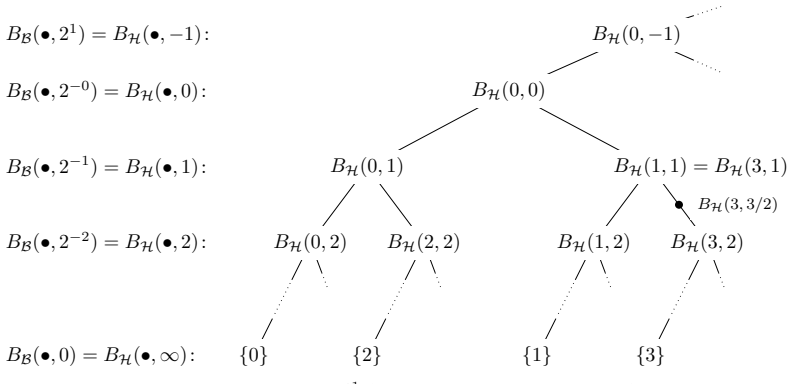
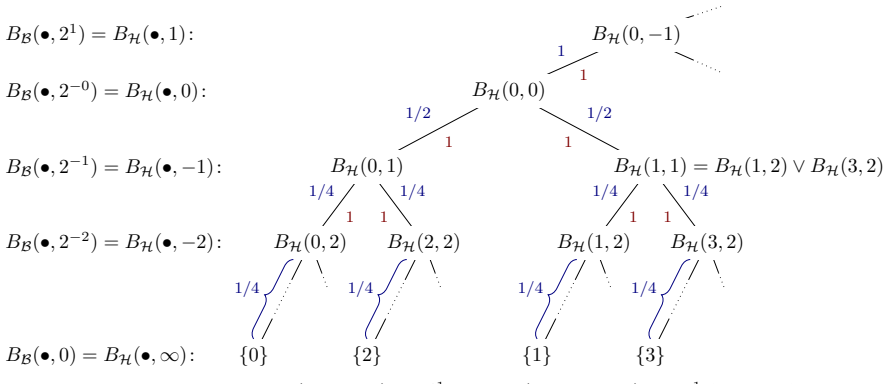
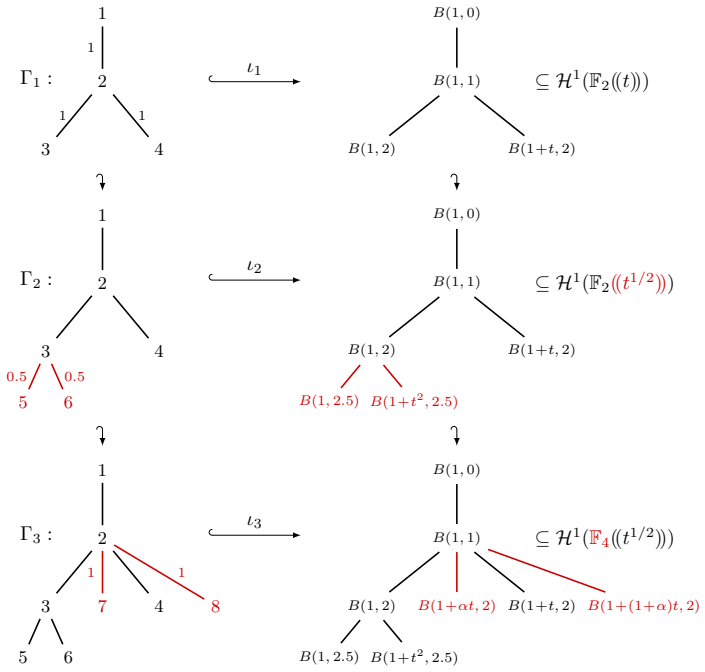
We introduce polydisc spaces as products of closed balls over a non-Archimedean field. Metric trees embed naturally into these spaces. The spaces have unique geodesics. Functions given by linear combinations of absolute values of polynomials admit piecewise polynomial descriptions along geodesics and a universal approximation property. We prove existence of minimisers for these functions and explore algorithms for finding them.
What carries the argument
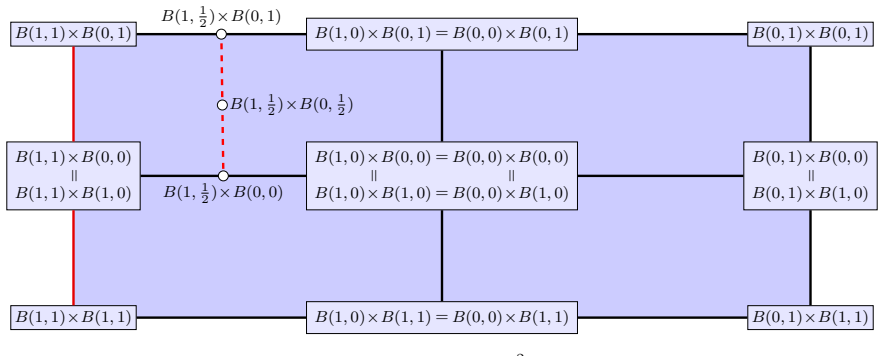
Polydisc spaces, products of closed balls over a non-Archimedean field, that retain hierarchical structure and gain geometric features like geodesic uniqueness for optimization.
If this is right
- Metric trees embed into polydisc spaces, allowing hierarchical data to be represented and optimized.
- The class of functions has a piecewise polynomial description along geodesics, enabling analysis of optimization paths.
- Existence of minimizers is guaranteed for the proposed functions.
- Algorithms can be developed to find the minimizers due to compatibility with classical techniques from geodesic uniqueness.
Where Pith is reading between the lines
- Optimization on these spaces might apply to problems involving tree-structured data in machine learning or phylogenetics.
- The framework could be extended to other non-Archimedean geometries beyond polydiscs.
- Universal approximation suggests these functions can model complex objectives in hierarchical settings.
- Implementation in software libraries indicates practical computability of the optimization procedures.
Load-bearing premise
The proposed functions given by linear combinations of absolute values of polynomials admit a piecewise polynomial description along geodesics and satisfy a universal approximation property.
What would settle it
Observing a function from the proposed class on a polydisc space without a minimizer, or an algorithm that does not locate a known minimizer.
Figures










read the original abstract
We propose a new framework for optimisation over non-Archimedean spaces inspired by Berkovich geometry. Specifically, we introduce polydisc spaces, which consists of products of closed balls over a non-Archimedean field. These spaces retain the rigid hierarchical structure of the non-Archimedean field whilst acquiring many desirable geometric features absent from it. We show that metric trees embed naturally into these spaces, demonstrating their capacity to represent hierarchical data. We study their metric geometry, establishing properties such as geodesic uniqueness, confirming their comaptibility with classical optimisation techniques. We further propose a class of real-valued functions given by linear combinations of absolute values of polynomials. These functions admit a piecewise polynomial description along geodesics and satisfy a universal approximation property. We formulate a theory of optimisation on polydisc spaces: we prove existence of minimisers and explore algorithms for finding them. We provide an accompanying open-source Julia library implementing the core objects and optimisation procedures introduced.
Editorial analysis
A structured set of objections, weighed in public.
Referee Report
Summary. The paper proposes a new framework for optimization over non-Archimedean polydisc spaces inspired by Berkovich geometry. It defines polydisc spaces as products of closed balls over a non-Archimedean field, shows that metric trees embed naturally into them, establishes metric geometry properties including geodesic uniqueness, introduces a class of real-valued functions given by linear combinations of absolute values of polynomials that admit piecewise polynomial descriptions along geodesics and satisfy a universal approximation property, proves existence of minimizers for this class, explores algorithms for finding them, and provides an accompanying open-source Julia library implementing the objects and procedures.
Significance. If the central claims hold, the work formulates a coherent optimization theory on a new class of spaces that combine hierarchical structure with useful metric properties, potentially enabling new approaches to optimization on hierarchical or tree-like data. The provision of an open-source Julia library implementing the core objects and procedures is a concrete strength supporting reproducibility.
minor comments (3)
- [Abstract] Abstract: 'polydisc spaces, which consists of products' contains a subject-verb agreement error and should read 'which consist of products'.
- [Abstract] Abstract: 'comaptibility with classical optimisation techniques' contains a spelling error and should read 'compatibility'.
- The claim that the functions 'admit a piecewise polynomial description along geodesics' is central to the optimization theory but would benefit from an explicit statement of the degree or number of pieces in the main text (e.g., near the definition of the function class).
Simulated Author's Rebuttal
We thank the referee for their positive summary of the manuscript, recognition of its potential significance for optimization on hierarchical data, and recommendation of minor revision. No specific major comments were listed in the report.
Circularity Check
No significant circularity
full rationale
The paper introduces polydisc spaces as products of closed balls over a non-Archimedean field and defines a class of real-valued functions as linear combinations of absolute values of polynomials. It then proves metric properties (geodesic uniqueness, tree embeddings) and optimization results (existence of minimisers) directly from these definitions. No step reduces a claimed prediction or theorem to a fitted parameter, self-citation chain, or definitional tautology. The universal approximation property and piecewise polynomial description are derived properties of the new function class, not inputs renamed as outputs. The framework is self-contained against external benchmarks with no load-bearing self-citations or ansatzes.
Axiom & Free-Parameter Ledger
axioms (1)
- standard math Standard properties of non-Archimedean fields and Berkovich geometry hold as background.
invented entities (1)
-
polydisc spaces
no independent evidence
Reference graph
Works this paper leans on
-
[1]
Glasgow Mathematical Journal , author=
Roundness Properties of Ultrametric Spaces , volume=. Glasgow Mathematical Journal , author=. 2014 , pages=. doi:10.1017/S0017089513000438 , number=
-
[2]
On the Uniqueness of Fr\'echet Means for Polytope Norms , author=. arXiv:2603.15785 , year=
-
[3]
Tropical Fr \'e chet means: a polyhedral approach to exact optimization
Ferry, Kamillo and Lin, Bo and Am \'e ndola, Carlos and Monod, Anthea and Yoshida, Ruriko. Tropical Fr \'e chet means: a polyhedral approach to exact optimization. J. Symb. Comput
-
[4]
Tropical Fr \'e chet Means
Lin, Bo and Ferry, Kamillo and Am \'e ndola, Carlos and Monod, Anthea and Yoshida, Ruriko. Tropical Fr \'e chet Means. Proceedings of the 2025 International Symposium on Symbolic and Algebraic Computation
2025
-
[5]
, title =
Miller, George A. , title =. Communications of the ACM , volume =. 1995 , publisher =
1995
-
[6]
, year = 1990, series =
Berkovich, Vladimir G. , year = 1990, series =. Spectral Theory and Analytic Geometry over Non-
1990
-
[7]
, year = 2026, month = feb, number =
Baker, Gregory D. , year = 2026, month = feb, number =. doi:10.48550/arXiv.2602.13278 , archiveprefix =. 2602.13278 , primaryclass =
-
[8]
Bosch, Siegfried and G. Non-. 1984 , publisher =
1984
-
[9]
Baker, Gregory and McCallum, Scott and Pattinson, Dirk , year = 2025, month = dec, journal =. Linear
2025
-
[10]
Evans, Steven N. , editor =. Local. Seminar on. doi:10.1007/978-1-4612-3698-6_7 , isbn =
-
[11]
Poincar\'e Embeddings for Learning Hierarchical Representations , booktitle =
Nickel, Maximillian and Kiela, Douwe , editor =. Poincar\'e Embeddings for Learning Hierarchical Representations , booktitle =
-
[12]
Data Mining and Knowledge Discovery , volume =
A Survey of Hierarchical Classification across Different Application Domains , author =. Data Mining and Knowledge Discovery , volume =
-
[13]
Mittal, Himanshu and Pandey, Avinash Chandra and Saraswat, Mukesh and Kumar, Sumit and Pal, Raju and Modwel, Garv , year = 2022, journal =. A Comprehensive Survey of Image Segmentation: Clustering Methods, Performance Parameters, and Benchmark Datasets , shorttitle =. doi:10.1007/s11042-021-10594-9 , pmcid =
-
[14]
and Jenkins, Stephen P
Bryan, Mark L. and Jenkins, Stephen P. , year = 2016, month = feb, journal =. Multilevel
2016
-
[15]
International Business Review , volume =
An Assessment of Hierarchical Linear Modeling in International Business, Management, and Marketing , author =. International Business Review , volume =
-
[16]
, year = 1988, journal =
Raudenbush, Stephen W. , year = 1988, journal =. Educational
1988
-
[17]
Defining Clusters from a Hierarchical Cluster Tree: The
Langfelder, Peter and Zhang, Bin and Horvath, Steve , year = 2008, month = mar, journal =. Defining Clusters from a Hierarchical Cluster Tree: The
2008
-
[18]
PLOS ONE , volume =
Hierarchical Structure Guides Rapid Linguistic Predictions during Naturalistic Listening , author =. PLOS ONE , volume =
-
[19]
and Kitchen, Christina M
Suchard, Marc A. and Kitchen, Christina M. R. and Sinsheimer, Janet S. and Weiss, Robert E. , year = 2003, month = oct, journal =. Hierarchical
2003
-
[20]
Computational
Chakerian, John and Holmes, Susan , year = 2012, journal =. Computational
2012
-
[21]
arXiv preprint arXiv:2604.17067 , year=
Trajectory-Restricted Optimization Conditions and Geometry-Aware Linear Convergence , author=. arXiv preprint arXiv:2604.17067 , year=
-
[22]
The annals of mathematical statistics , pages=
A stochastic approximation method , author=. The annals of mathematical statistics , pages=. 1951 , publisher=
1951
-
[23]
Communications of the ACM , volume=
A theory of the learnable , author=. Communications of the ACM , volume=. 1984 , publisher=
1984
-
[24]
IEEE transactions on neural networks , volume=
An overview of statistical learning theory , author=. IEEE transactions on neural networks , volume=. 1999 , publisher=
1999
-
[25]
nature , volume=
Learning representations by back-propagating errors , author=. nature , volume=. 1986 , publisher=
1986
-
[26]
Mathematics of control, signals and systems , volume=
Approximation by superpositions of a sigmoidal function , author=. Mathematics of control, signals and systems , volume=. 1989 , publisher=
1989
-
[27]
Neural networks , volume=
Multilayer feedforward networks are universal approximators , author=. Neural networks , volume=. 1989 , publisher=
1989
-
[28]
arXiv preprint arXiv:1511.06361 , year=
Order-embeddings of images and language , author=. arXiv preprint arXiv:1511.06361 , year=
-
[29]
Weil, Andr. Basic. doi:10.1007/978-3-642-61945-8 , isbn =
-
[30]
Principles of Mathematical Analysis , author =
-
[31]
Springer-Verlag, Berlin, 1999, pp
Bridson, Martin R. and Haefliger, Andr. Metric. doi:10.1007/978-3-662-12494-9 , urldate =
-
[32]
Nickel, Maximillian and Kiela, Douwe , journal=. Poincar
-
[33]
International conference on machine learning , pages=
Learning continuous hierarchies in the lorentz model of hyperbolic geometry , author=. International conference on machine learning , pages=. 2018 , organization=
2018
-
[34]
Advances in neural information processing systems , volume=
Hyperbolic graph convolutional neural networks , author=. Advances in neural information processing systems , volume=
-
[35]
American Journal of Mathematics , volume=
Discrete series and classification for p-adic groups I , author=. American Journal of Mathematics , volume=. 1981 , publisher=
1981
-
[36]
Journal of classification , volume=
On ultrametricity, data coding, and computation , author=. Journal of classification , volume=. 2004 , publisher=
2004
-
[37]
The Computer Journal , volume=
On ultrametric algorithmic information , author=. The Computer Journal , volume=. 2010 , publisher=
2010
-
[38]
Deep Neural Networks: A Formulation Via Non-Archimedean Analysis , Year =
Z. Deep Neural Networks: A Formulation Via Non-Archimedean Analysis , Year =
-
[39]
Journal of Nonlinear Mathematical Physics , volume=
Hierarchical neural networks, p-adic pdes, and applications to image processing , author=. Journal of Nonlinear Mathematical Physics , volume=. 2024 , publisher=
2024
-
[40]
Learning with the p -adics , Year =
Martins, Andr. Learning with the p -adics , Year =
-
[41]
SIAM review , volume=
Julia: A fresh approach to numerical computing , author=. SIAM review , volume=. 2017 , publisher=
2017
-
[42]
2026 , url =
Lezeau, Paul and Ren, Yue , title =. 2026 , url =
2026
-
[43]
2025 , publisher =
The. 2025 , publisher =
2025
-
[44]
Mathematical models and methods in applied sciences , volume=
p-Adic dynamical systems and neural networks , author=. Mathematical models and methods in applied sciences , volume=. 1999 , publisher=
1999
-
[45]
p-Adic Numbers, Ultrametric Analysis and Applications , volume=
p -Adic Polynomial Regression Detecting Digitwise Noise , author=. p-Adic Numbers, Ultrametric Analysis and Applications , volume=. 2026 , publisher=
2026
-
[46]
arXiv preprint arXiv:2603.00064 , year=
The minimal width of universal p -adic ReLU neural networks , author=. arXiv preprint arXiv:2603.00064 , year=
-
[47]
arXiv preprint arXiv:2508.01010 , year=
v-PuNNs: van der Put Neural Networks for Transparent Ultrametric Representation Learning , author=. arXiv preprint arXiv:2508.01010 , year=
-
[48]
Proceedings of the 31st ACM SIGKDD Conference on Knowledge Discovery and Data Mining V
Hyperbolic deep learning for foundation models: A survey , author=. Proceedings of the 31st ACM SIGKDD Conference on Knowledge Discovery and Data Mining V. 2 , pages=
-
[49]
Inventiones mathematicae , volume=
Rigid analytic spaces , author=. Inventiones mathematicae , volume=. 1971 , publisher=
1971
-
[50]
International conference on machine learning , pages=
Hyperbolic entailment cones for learning hierarchical embeddings , author=. International conference on machine learning , pages=. 2018 , organization=
2018
-
[51]
Bandit Based Monte-Carlo Planning
Kocsis, Levente and Szepesv \'a ri, Csaba. Bandit Based Monte-Carlo Planning. Machine Learning: ECML 2006. 2006
2006
-
[52]
Efficient selectivity and backup operators in
Coulom, R. Efficient selectivity and backup operators in. Computers and Games , series=. 2007 , publisher=
2007
-
[53]
Lanctot, Marc and Winands, Mark H. M. and Pepels, Tom and Sturtevant, Nathan R. , booktitle=. 2014 , organization=
2014
-
[54]
, journal=
Lorentz, Richard J. , journal=. Using evaluation functions in. 2016 , publisher=
2016
-
[55]
and Brodeur, James H
Childs, Benjamin E. and Brodeur, James H. and Kocsis, Levente , booktitle=. Transpositions and move groups in. 2008 , organization=
2008
-
[56]
Knowledge-Based Systems , volume=
Saffidine, Abdallah and Cazenave, Tristan and M. Knowledge-Based Systems , volume=. 2012 , publisher=
2012
-
[57]
Science , volume =
David Silver and Thomas Hubert and Julian Schrittwieser and Ioannis Antonoglou and Matthew Lai and Arthur Guez and Marc Lanctot and Laurent Sifre and Dharshan Kumaran and Thore Graepel and Timothy Lillicrap and Karen Simonyan and Demis Hassabis , title =. Science , volume =. 2018 , doi =
2018
-
[58]
nature , volume=
Mastering the game of Go with deep neural networks and tree search , author=. nature , volume=. 2016 , publisher=
2016
-
[59]
and Powley, Edward and Whitehouse, Daniel and Lucas, Simon M
Browne, Cameron B. and Powley, Edward and Whitehouse, Daniel and Lucas, Simon M. and Cowling, Peter I. and Rohlfshagen, Philipp and Tavener, Stephen and Perez, Diego and Samothrakis, Spyridon and Colton, Simon , journal=. A Survey of Monte Carlo Tree Search Methods , year=
-
[60]
Advances in neural information processing systems , volume=
Hyperbolic neural networks , author=. Advances in neural information processing systems , volume=
-
[61]
Journal of the American Mathematical Society , year=
Berkovich motives , author=. Journal of the American Mathematical Society , year=
-
[62]
Available from the author’s website , year=
Lectures on Analytic Geometry, 2020 , author=. Available from the author’s website , year=
2020
-
[63]
Psychometrika , volume=
Hierarchical clustering schemes , author=. Psychometrika , volume=. 1967 , publisher=
1967
-
[64]
Non-Archimedean Analysis: Quantum Paradoxes, Dynamical Systems and Biological Models , pages=
Non-archimedean analysis , author=. Non-Archimedean Analysis: Quantum Paradoxes, Dynamical Systems and Biological Models , pages=. 1997 , publisher=
1997
-
[65]
Advances in neural information processing systems , volume=
Optimistic optimization of a deterministic function without the knowledge of its smoothness , author=. Advances in neural information processing systems , volume=
-
[66]
Lang, Urs , year = 2013, url =. Length
2013
-
[67]
Gromov, Mikhail , year = 2007, series =. Metric. doi:10.1007/978-0-8176-4583-0 , copyright =
-
[68]
2007 , eprint =
Federico Ardila and Mike Develin , title =. 2007 , eprint =
2007
-
[69]
de la and Venkov, Boris , title =
Bacher, Roland and Harpe, P. de la and Venkov, Boris , title =. Annales de l'Institut Fourier , volume =. 1999 , doi =
1999
-
[70]
p-adic Geometry (Lectures from the 2007 Arizona Winter School), AMS University Lecture Series , volume =
Baker, Matthew , title =. p-adic Geometry (Lectures from the 2007 Arizona Winter School), AMS University Lecture Series , volume =
2007
-
[71]
Baker, Matthew and Rumely, Robert , title =
-
[72]
, title =
Berkovich, Vladimir G. , title =. 1990 , publisher =
1990
-
[73]
2022 , eprint =
Moise Blanchard and Adam Quinn Jaffe , title =. 2022 , eprint =
2022
-
[74]
Bosch, S. and G. Non-Archimedean Analysis , series =
-
[75]
2003 , month =
Bryant, David , title =. 2003 , month =
2003
-
[76]
2023 , publisher=
Bayesian optimization , author=. 2023 , publisher=
2023
-
[77]
2012 , publisher=
Dynamic programming and optimal control: Volume I , author=. 2012 , publisher=
2012
-
[78]
Belmont, MA: Athena Scientific , volume=
Dynamic programming and optimal control 3rd edition, volume ii , author=. Belmont, MA: Athena Scientific , volume=
-
[79]
1998 , publisher=
Reinforcement learning: An introduction , author=. 1998 , publisher=
1998
-
[80]
Burago, Dmitri and Burago, Yuri and Ivanov, Sergei , title =
discussion (0)
Sign in with ORCID, Apple, or X to comment. Anyone can read and Pith papers without signing in.