Model Multiplicity for Adversarial Detection in Small Language Model Training on Edge Devices
Pith reviewed 2026-06-27 21:24 UTC · model grok-4.3
The pith
Training multiple small language models on separate edge-device subsets detects poisoning attacks by tracking divergence between their updates.
A machine-rendered reading of the paper's core claim, the machinery that carries it, and where it could break.
Core claim
Instead of a single global model, the system maintains multiple concurrently trained small language models on distinct node subsets; divergence among these models, measured by gradient similarity, loss evolution, or parameter variance, flags anomalous or adversarial contributions for isolation or re-weighting, yielding earlier and more reliable poisoning detection than classical single-model defenses.
What carries the argument
Model multiplicity: concurrent training of multiple SLMs on independently sampled edge-node subsets, using inter-model divergence as the anomaly signal.
Load-bearing premise
Divergence between the independently trained models will specifically and reliably indicate poisoning rather than ordinary differences caused by heterogeneous edge data or benign update variance.
What would settle it
Run the same edge-scale simulation with high data heterogeneity but no poisoning attacks and measure whether false-positive isolation rates match or exceed the rates observed under actual attacks.
Figures

read the original abstract
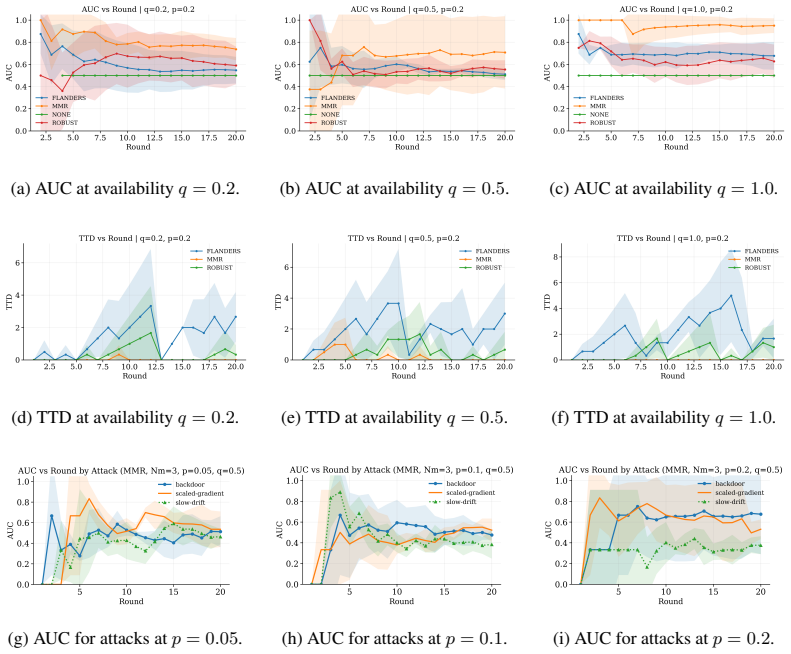
The rise of edge-based machine learning has enabled distributed adaptation of language models across mobile and IoT devices, offering privacy preservation and real-time responsiveness. However, distributed fine-tuning of language models on untrusted or heterogeneous edge nodes introduces new vulnerabilities. Compromised or unreliable devices can inject poisoned updates, leading to stealthy model manipulation or convergence degradation. Classical defenses such as robust aggregation or temporal anomaly detection operate on a single global model and are therefore limited in detecting coordinated or persistent poisoning. This work proposes a new system-level defense based on model multiplicity. Instead of maintaining one global model, the system rotates or concurrently trains multiple small language models (e.g., DistilGPT-2), each updated by independently sampled subsets of edge nodes. These models evolve under distinct training trajectories, creating multiple independent views of the same distributed population. Divergence between models quantified through gradient similarity, loss evolution, or parameter variance serves as a signal of anomalous or adversarial behavior. When one model deviates significantly from the ensemble mean, the system flags its contributing nodes for isolation or re-weighting. We implement this framework and evaluate it on edge-scale simulations of Small Language Model (SLM) training under varying heterogeneity and attack conditions. Results show that model multiplicity enables earlier and more reliable detection of poisoning compared to classical single-model defenses such as Flanders and Robust methods. Our findings demonstrate that diversity in model evolution can serve as a practical and effective defense mechanism for secure distributed learning on resource-constrained edge devices.
Editorial analysis
A structured set of objections, weighed in public.
Referee Report
Summary. The paper proposes a model-multiplicity defense for poisoning attacks in distributed fine-tuning of small language models (e.g., DistilGPT-2) on edge devices. Multiple SLMs are trained concurrently on independently sampled node subsets; divergence signals (gradient similarity, loss evolution, parameter variance) between models are used to flag and isolate anomalous updates. The abstract states that edge-scale simulations under varying heterogeneity and attack conditions demonstrate earlier and more reliable detection than single-model baselines such as Flanders and Robust methods.
Significance. If the empirical claims are substantiated with detailed, reproducible experiments, the approach could provide a practical system-level defense that exploits training diversity rather than relying solely on robust aggregation, addressing a relevant gap in secure distributed learning for resource-constrained devices.
major comments (2)
- [Abstract] Abstract: the central claim that 'results show that model multiplicity enables earlier and more reliable detection of poisoning' is presented without any attack models, metrics (detection latency, precision/recall, false-positive rates), baseline implementations, statistical significance tests, or quantitative tables/figures, so the claim cannot be evaluated.
- [Evaluation] Evaluation description: no ablation or control experiments are described that measure divergence under high-heterogeneity clean partitions (no attacks); without such results it is impossible to determine whether the proposed signal is specific to poisoning or simply reflects normal edge-data variance, which directly undermines the comparison to Flanders/Robust methods.
minor comments (2)
- [Method] The manuscript should define the exact divergence threshold or decision rule used for flagging (e.g., how many standard deviations from the ensemble mean) and report its sensitivity to hyper-parameters.
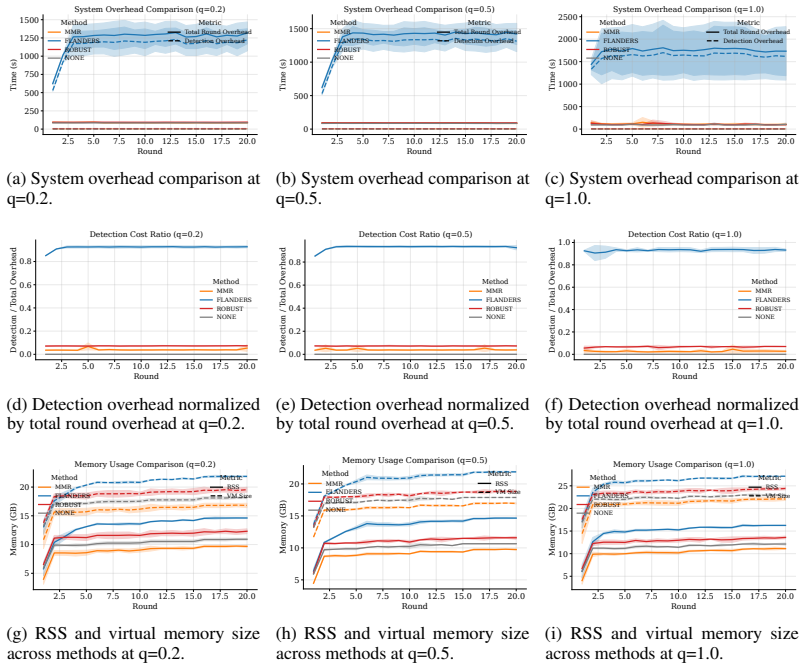
- [System Design] Clarify whether the multiple models share any parameters or initialization; if they are fully independent, the communication and compute overhead on edge devices should be quantified.
Simulated Author's Rebuttal
We thank the referee for the constructive feedback. We address each major comment below, clarifying the content of the full manuscript while agreeing to revisions that improve clarity and completeness.
read point-by-point responses
-
Referee: [Abstract] Abstract: the central claim that 'results show that model multiplicity enables earlier and more reliable detection of poisoning' is presented without any attack models, metrics (detection latency, precision/recall, false-positive rates), baseline implementations, statistical significance tests, or quantitative tables/figures, so the claim cannot be evaluated.
Authors: We agree that the abstract, being a concise summary, omits the specific supporting details. The full manuscript's Evaluation section describes the attack models (label-flipping and backdoor poisoning), reports metrics including detection latency, precision/recall, and false-positive rates, implements the Flanders and Robust baselines, includes statistical significance tests, and presents quantitative tables and figures. To make the central claim evaluable directly from the abstract, we will revise it to include brief references to these elements and key quantitative outcomes. revision: yes
-
Referee: [Evaluation] Evaluation description: no ablation or control experiments are described that measure divergence under high-heterogeneity clean partitions (no attacks); without such results it is impossible to determine whether the proposed signal is specific to poisoning or simply reflects normal edge-data variance, which directly undermines the comparison to Flanders/Robust methods.
Authors: The manuscript evaluates under varying heterogeneity levels, but we acknowledge that dedicated ablations explicitly measuring divergence signals on clean high-heterogeneity partitions (absent any attacks) are not described in sufficient detail. Such controls are necessary to isolate poisoning-specific effects from normal data variance. We will add these ablation experiments in the revised manuscript, reporting divergence metrics (gradient similarity, loss evolution, parameter variance) on clean partitions to substantiate specificity and strengthen the baseline comparisons. revision: yes
Circularity Check
No circularity; empirical system proposal with no derivations or self-referential reductions
full rationale
The manuscript proposes a model-multiplicity defense for edge SLM training and reports simulation results comparing detection performance to baselines. No equations, parameter fits, or derivation chains appear in the provided text. The central claim rests on empirical evaluation under heterogeneity and attack conditions rather than any step that reduces by construction to fitted inputs, self-citations, or renamed assumptions. The reader's assessment of score 0.0 is consistent with the absence of any load-bearing mathematical or definitional circularity.
Axiom & Free-Parameter Ledger
axioms (2)
- domain assumption Divergence in gradient similarity, loss evolution, or parameter variance between models indicates anomalous or adversarial behavior.
- domain assumption Independently sampled subsets of edge nodes produce sufficiently distinct training trajectories to make poisoning detectable.
invented entities (1)
-
model multiplicity defense system
no independent evidence
Reference graph
Works this paper leans on
-
[1]
28th Annual Network and Distributed System Security Symposium (NDSS) , year =
Manipulating the Byzantine: Optimizing Model Poisoning Attacks and Defenses for Federated Learning , author =. 28th Annual Network and Distributed System Security Symposium (NDSS) , year =. doi:10.14722/ndss.2021.24498 , url =
-
[2]
arXiv preprint arXiv:2208.10273 , year =
Long‐Short History of Gradients Is All You Need: Detecting Malicious and Unreliable Clients in Federated Learning , author =. arXiv preprint arXiv:2208.10273 , year =
-
[3]
arXiv preprint arXiv:2303.16668 , year=
Protecting Federated Learning from Extreme Model Poisoning Attacks via Multidimensional Time Series Anomaly Detection , author=. arXiv preprint arXiv:2303.16668 , year=
-
[4]
LoRA: Low-Rank Adaptation of Large Language Models
LoRA: Low-Rank Adaptation of Large Language Models , author =. arXiv preprint arXiv:2106.09685 , year =. 2106.09685 , archivePrefix=
work page internal anchor Pith review Pith/arXiv arXiv
-
[5]
Proceedings of the IEEE/CVF Conference on Computer Vision and Pattern Recognition (CVPR) , pages=
Model Poisoning Attacks to Federated Learning via Multi-Round Consistency , author=. Proceedings of the IEEE/CVF Conference on Computer Vision and Pattern Recognition (CVPR) , pages=
-
[6]
llama.cpp – Run LLaMA locally, with GPTQ / llama.cpp , author =
-
[7]
To appear , note =
A Survey of Byzantine-Robust Aggregation Methods in Federated / Distributed Learning , author =. To appear , note =
-
[8]
Advances in Neural Information Processing Systems (NeurIPS) , year=
Machine Learning with Adversaries: Byzantine Tolerant Gradient Descent , author=. Advances in Neural Information Processing Systems (NeurIPS) , year=
-
[9]
ICML , year=
Byzantine-Robust Distributed Learning: Towards Optimal Statistical Rates , author=. ICML , year=
-
[10]
IEEE Transactions on Pattern Analysis and Machine Intelligence (TPAMI) , year=
Robust Aggregation for Federated Learning , author=. IEEE Transactions on Pattern Analysis and Machine Intelligence (TPAMI) , year=
-
[11]
Proceedings of the Twenty-Eighth International Joint Conference on Artificial Intelligence (IJCAI) , pages=
FABA: An Algorithm for Fast Aggregation against Byzantine Attacks in Distributed Neural Networks , author=. Proceedings of the Twenty-Eighth International Joint Conference on Artificial Intelligence (IJCAI) , pages=
-
[12]
ICML Workshop on Federated Learning , year=
FlaNDERS: Federated Learning with Anomaly Detection based on Residual Statistics , author=. ICML Workshop on Federated Learning , year=
-
[13]
Network and Distributed System Security Symposium (NDSS) , year=
FLTrust: Byzantine-Robust Federated Learning via Trust Bootstrapping , author=. Network and Distributed System Security Symposium (NDSS) , year=
-
[14]
Proceedings of the International Conference on Machine Learning (ICML) , year=
The Hidden Vulnerability of Distributed Learning in Byzantium , author=. Proceedings of the International Conference on Machine Learning (ICML) , year=
-
[15]
Proceedings of the 3rd Symposium on Operating Systems Design and Implementation (OSDI) , year=
Practical Byzantine Fault Tolerance , author=. Proceedings of the 3rd Symposium on Operating Systems Design and Implementation (OSDI) , year=
-
[16]
International Workshop on Multiple Classifier Systems (MCS) , series=
Ensemble Methods in Machine Learning , author=. International Workshop on Multiple Classifier Systems (MCS) , series=
-
[17]
Efficient Large-Scale Language Model Training on GPU Clusters Using Megatron-LM , author=. arXiv preprint arXiv:2104.04473 , year=
-
[18]
Advances in Neural Information Processing Systems (NeurIPS) , year=
A Little Is Enough: Circumventing Defenses for Distributed Learning , author=. Advances in Neural Information Processing Systems (NeurIPS) , year=
-
[19]
Proceedings of the USENIX Security Symposium , year=
Local Model Poisoning Attacks to Byzantine-Robust Federated Learning , author=. Proceedings of the USENIX Security Symposium , year=
-
[20]
Proceedings of the International Conference on Artificial Intelligence and Statistics (AISTATS) , year=
How to Backdoor Federated Learning , author=. Proceedings of the International Conference on Artificial Intelligence and Statistics (AISTATS) , year=
-
[21]
CVPR , year=
Constrained Backdoor Attacks on Federated Learning , author=. CVPR , year=
-
[22]
Proceedings of the 23rd International Conference on Artificial Intelligence and Statistics (AISTATS) , year=
Asynchronous Federated Optimization , author=. Proceedings of the 23rd International Conference on Artificial Intelligence and Statistics (AISTATS) , year=
-
[23]
Proceedings of Machine Learning and Systems (MLSys) , year=
Towards Federated Learning at Scale: System Design , author=. Proceedings of Machine Learning and Systems (MLSys) , year=
-
[24]
MLSys , year=
Federated Optimization in Heterogeneous Networks , author=. MLSys , year=
-
[25]
International Conference on Learning Representations (ICLR) , year=
Federated Learning with Matched Averaging , author=. International Conference on Learning Representations (ICLR) , year=
-
[26]
OPT: Open Pre-trained Transformer Language Models
OPT: Open Pre-Trained Transformer Language Models , author=. arXiv preprint arXiv:2205.01068 , year=
work page internal anchor Pith review Pith/arXiv arXiv
-
[27]
A Short Study on Compressing Decoder-Based Language Models , author =
-
[28]
Proceedings of the 58th Annual Meeting of the Association for Computational Linguistics (ACL) , year=
MobileBERT: A Compact Task-Agnostic BERT for Resource-Limited Devices , author=. Proceedings of the 58th Annual Meeting of the Association for Computational Linguistics (ACL) , year=
-
[29]
TinyLlama: An Open-Source Small Language Model , author =
-
[30]
Proceedings of the 41st International Conference on Machine Learning (ICML) , volume =
Evaluating Quantized Large Language Models , author =. Proceedings of the 41st International Conference on Machine Learning (ICML) , volume =
discussion (0)
Sign in with ORCID, Apple, or X to comment. Anyone can read and Pith papers without signing in.