On the sharp linear convergence rate of the circumcentered--reflection method on subspaces
Pith reviewed 2026-06-27 20:49 UTC · model grok-4.3
The pith
The circumcentered-reflection method converges at the sharp rate ρ_V when initialized in subspace V.
A machine-rendered reading of the paper's core claim, the machinery that carries it, and where it could break.
Core claim
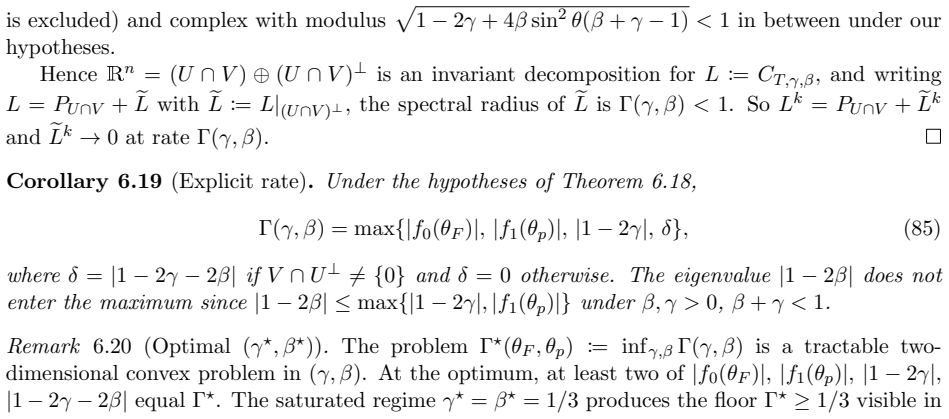
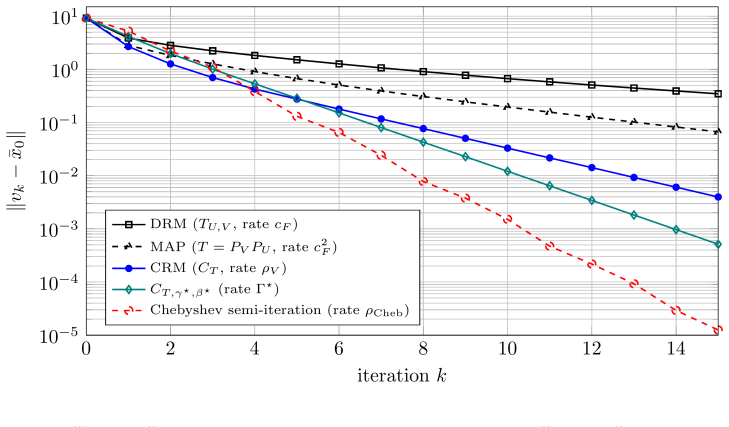
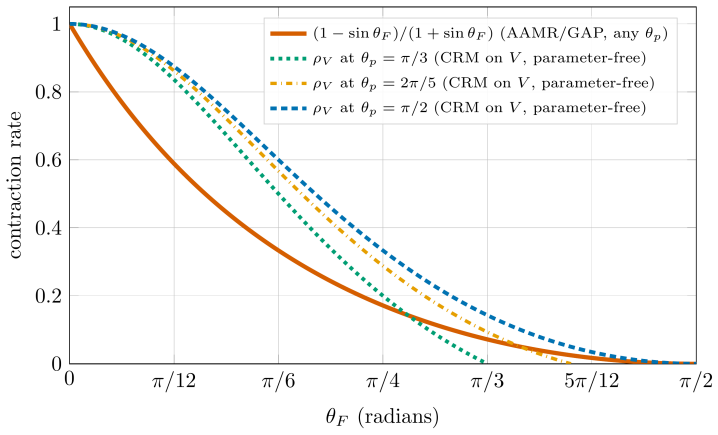
When initialized in V, the circumcentered-reflection method contracts at the rate ρ_V = (sin²θ_p − sin²θ_F)/(sin²θ_p + sin²θ_F), where θ_F is the Friedrichs angle and θ_p the largest principal angle between U and V. This bound is sharp, attained on an explicit ray in V, and is optimal among parameter-free single-step iterations. The constant ρ_V is derived via Kantorovich's inequality on a single self-adjoint operator on V, and the method restricted to V coincides with the linesearch maps A_T and B_T. Moreover, ρ_V is strictly less than c_F² whenever θ_F < π/2, with exact one-step convergence if θ_F = θ_p.
What carries the argument
The circumcentered-reflection operator restricted to the subspace V, equivalent to linesearch maps and analyzed using Kantorovich's inequality on one self-adjoint operator.
If this is right
- The bound is attained along an explicit ray in V.
- Over-reflecting either reflection inside the circumcenter does not improve the rate.
- One-step convergence holds exactly when the Friedrichs angle equals the largest principal angle.
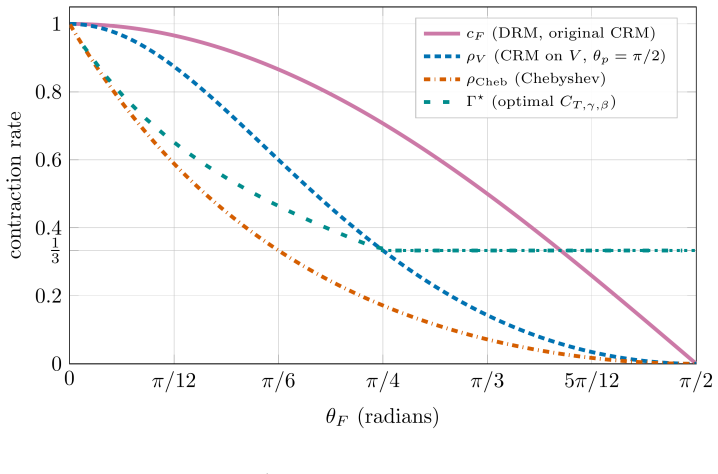
- Chebyshev semi-iteration on the product of projections attains a rate strictly smaller than ρ_V, improving by a factor of at most 2.
Where Pith is reading between the lines
- Initializing in a subspace may improve convergence for other reflection-based projection methods.
- Since faster rates require memory, hybrid methods combining single-step geometry with limited memory could be explored.
- The optimality among single-step methods suggests that ρ_V is a natural benchmark for comparing new parameter-free algorithms on subspaces.
Load-bearing premise
The analysis relies on the circumcentered-reflection method being equivalent, when restricted to V, to the action of a single self-adjoint operator to which Kantorovich's inequality can be applied.
What would settle it
Numerically compute the norm of the iteration operator or the observed contraction ratio for CRM starting from a vector along the explicit ray in V, for subspaces with θ_F < θ_p, and verify if it matches ρ_V rather than the larger known rate.
Figures

read the original abstract
For two subspaces $U,V\subseteq\RR^n$, the circumcentered--reflection method (CRM) of Behling, Bello-Cruz, and Santos~\cite{BBS2018} computes the projection onto $U\cap V$ using only the reflections across $U$ and $V$, with known linear-convergence rate $c_F$, the cosine of the Friedrichs angle. We prove that, when CRM is initialized in $V$, it contracts at the strictly smaller rate $\rho_V=(\sin^2\theta_p-\sin^2\theta_F)/(\sin^2\theta_p+\sin^2\theta_F)$, where $\theta_F\in(0,\pi/2]$ is the Friedrichs angle and $\theta_p\in[\theta_F,\pi/2]$ the largest principal angle between $U$ and $V$. The bound is sharp, attained on an explicit ray in $V$, and optimal among parameter-free single-step iterations. The constant itself is not new: Bauschke, Bello-Cruz, Nghia, Phan, and Wang~\cite{BBNPW2016} identified it as the optimal rate of the relaxed alternating-projection family and of their adaptive linesearch map $B_T$. Our contribution is that the parameter-free geometric circumcenter attains it as well, via Kantorovich's inequality applied to a single self-adjoint operator on $V$. Restricted to $V$, CRM coincides pointwise with the linesearch maps $A_T$ and $B_T$ from the Gubin--Polyak--Raik framework~\cite{GPR1967}. We further prove $\rho_V<c_F^2$ whenever $\theta_F<\pi/2$, with one-step convergence exactly when $\theta_F=\theta_p$. Over-reflecting either or both of $R_U$, $R_V$ inside the circumcenter does not help. Going faster than $\rho_V$ universally requires memory: Chebyshev semi-iteration applied to $P_VP_U$ attains a strictly smaller rate, beating $\rho_V$ by a factor at most $2$, attained in the limit $\theta_F\to\theta_p$.
Editorial analysis
A structured set of objections, weighed in public.
Referee Report
Summary. The manuscript proves that the circumcentered-reflection method (CRM), when initialized in subspace V, converges linearly to the projection onto U ∩ V at the rate ρ_V = (sin²θ_p − sin²θ_F)/(sin²θ_p + sin²θ_F), where θ_F is the Friedrichs angle and θ_p ∈ [θ_F, π/2] is the largest principal angle between U and V. This rate is strictly smaller than the known Friedrichs rate c_F whenever θ_F < π/2, is attained on an explicit ray in V, and is optimal among parameter-free single-step iterations. The derivation proceeds by restricting CRM to V, establishing pointwise coincidence with the linesearch maps A_T and B_T, and applying Kantorovich's inequality to a single self-adjoint operator on V; additional results address over-reflection and the advantage of memory-based accelerations such as Chebyshev semi-iteration.
Significance. If the central claims hold, the work supplies a sharper, explicit convergence rate for CRM that matches the optimal rate previously identified for the relaxed alternating-projection family and the adaptive linesearch map B_T, while demonstrating that the parameter-free geometric circumcenter construction attains this rate. The independent Kantorovich-based derivation on a single operator, the explicit sharpness example, and the strict inequality ρ_V < c_F² constitute clear contributions. The comparison showing that memory is required to beat ρ_V further clarifies the method's position within the broader landscape of subspace iteration methods.
minor comments (2)
- [§1] §1, paragraph following Eq. (1.3): the statement that 'over-reflecting either or both of R_U, R_V inside the circumcenter does not help' would benefit from an explicit reference to the theorem or proposition that establishes this claim.
- The notation for the principal angles θ_p and the Friedrichs angle θ_F is introduced clearly, but a short reminder of their definitions (or a pointer to the standard reference) in the statement of the main theorem would aid readers who consult only the results section.
Simulated Author's Rebuttal
We thank the referee for their positive assessment of the manuscript and for recommending acceptance. The summary accurately captures the main results and contributions.
Circularity Check
Derivation self-contained via Kantorovich; self-citation not load-bearing
full rationale
The paper's central derivation restricts CRM to V, establishes pointwise coincidence with known linesearch maps, and obtains the rate ρ_V by applying Kantorovich's inequality to a single self-adjoint operator on V. This chain is presented as independent of the cited prior rates for other methods. The references to BBNPW2016 and BBS2018 identify the constant and the method but are not invoked to justify the CRM-specific rate; the abstract explicitly separates the contribution as the Kantorovich application. No equation reduces by construction to a fitted input or self-citation, and the sharpness claim is supported by an explicit ray construction. This is a normal minor self-citation pattern without circular reduction.
Axiom & Free-Parameter Ledger
axioms (1)
- standard math Standard properties of orthogonal projections, reflections, and principal angles between subspaces in Euclidean space R^n
Reference graph
Works this paper leans on
-
[1]
Arag´ on Artacho, F. J., Campoy, R.: A new projection method for finding the clos- est point in the intersection of convex sets. Comput. Optim. Appl.69, 99–132 (2018). doi:10.1007/s10589-017-9942-5
-
[2]
Arag´ on Artacho, F. J., Campoy, R.: Optimal rates of linear convergence of the averaged alternating modified reflections method for two subspaces. Numer. Algorithms82, 397–421 (2019).doi:10.1007/s11075-018-0608-x
-
[3]
Ara´ ujo, G. H. M., Arefidamghani, R., Behling, R., Bello-Cruz, Y., Iusem, A. N., Santos, L.-R.: Circumcentering approximate reflections for solving the convex feasibil- ity problem. Fixed Point Theory Algorithms Sci. Eng.2022, Article 1, 1–30 (2022). doi:10.1186/s13663-021-00711-6
-
[4]
Arefidamghani, R., Behling, R., Bello-Cruz, Y., Iusem, A. N., Santos, L.-R.: The circumcentered–reflection method achieves better rates than alternating projections. Comput. Optim. Appl.79, 507–530 (2021).doi:10.1007/s10589-021-00275-6
-
[5]
Aronszajn, N.: Theory of reproducing kernels. Trans. Amer. Math. Soc.68, 337–404 (1950). doi:10.1090/S0002-9947-1950-0051437-7
-
[6]
arXiv preprint arXiv:2505.17258 (2025).doi:10.48550/arXiv.2505.17258
Barros, P., Behling, R., Guigues, V., Santos, L.-R.: Parallelizing the circumcentered–reflection method. arXiv preprint arXiv:2505.17258 (2025).doi:10.48550/arXiv.2505.17258
-
[7]
Bauschke, H. H., Bello-Cruz, Y., Nghia, T. T. A., Phan, H. M., Wang, X.: The rate of linear convergence of the Douglas–Rachford algorithm for subspaces is the cosine of the Friedrichs angle. J. Approx. Theory185, 63–79 (2014).doi:10.1016/j.jat.2014.06.002
-
[8]
Bauschke, H. H., Bello-Cruz, Y., Nghia, T. T. A., Phan, H. M., Wang, X.: Optimal rates of lin- ear convergence of relaxed alternating projections and generalized Douglas–Rachford methods for two subspaces. Numer. Algorithms73, 33–76 (2016).doi:10.1007/s11075-015-0085-4
-
[9]
Bauschke, H. H., Combettes, P. L.: Convex Analysis and Monotone Operator The- ory in Hilbert Spaces, 2nd edn. CMS Books in Mathematics. Springer, Cham (2017). doi:10.1007/978-3-319-48311-5. 48
-
[10]
Bauschke, H. H., Combettes, P. L., Kruk, S. G.: Extrapolation algorithm for affine–convex fea- sibility problems. Numer. Algorithms41, 239–274 (2006).doi:10.1007/s11075-005-9010-6
-
[11]
Bauschke, H. H., Deutsch, F., Hundal, H., Park, S.–H.: Accelerating the convergence of the method of alternating projections. Trans. Amer. Math. Soc.355, 3433–3461 (2003). doi:10.1090/S0002-9947-03-03136-2
-
[12]
H., Ouyang, H., Wang, X.: Circumcentered methods induced by isometries
Bauschke, H. H., Ouyang, H., Wang, X.: Circumcentered methods induced by isometries. Vietnam J. Math.48, 471–508 (2020).doi:10.1007/s10013-020-00417-z
-
[13]
H., Ouyang, H., Wang, X.: On the linear convergence of circumcentered isometry methods
Bauschke, H. H., Ouyang, H., Wang, X.: On the linear convergence of circumcentered isometry methods. Numer. Algorithms87, 263–297 (2021).doi:10.1007/s11075-020-00966-x
-
[14]
Behling, R., Bello-Cruz, Y., Santos, L.-R.: Circumcentering the Douglas–Rachford method. Numer. Algorithms78, 759–776 (2018).doi:10.1007/s11075-017-0399-5
-
[15]
Behling, R., Bello-Cruz, Y., Santos, L.-R.: On the linear convergence of the circumcentered– reflection method. Oper. Res. Lett.46, 159–162 (2018).doi:10.1016/j.orl.2017.11.018
-
[16]
Behling, R., Bello-Cruz, Y., Santos, L.-R.: The block-wise circumcentered–reflection method. Comput. Optim. Appl.76, 675–699 (2020).doi:10.1007/s10589-019-00155-0
-
[17]
Behling, R., Bello-Cruz, Y., Santos, L.-R.: On the circumcentered–reflection method for the convex feasibility problem. Numer. Algorithms86, 1475–1494 (2021). doi:10.1007/s11075-020-00941-6
-
[18]
Behling, R., Bello-Cruz, Y., Santos, L.-R.: Infeasibility and error bound imply fi- nite convergence of alternating projections. SIAM J. Optim.31, 2863–2892 (2021). doi:10.1137/20M1358669
-
[19]
Behling, R., Bello-Cruz, Y., Lara-Urdaneta, H., Oviedo, H., Santos, L.-R.: Circumcentric directions of cones. Optim. Lett.17, 1069–1081 (2023).doi:10.1007/s11590-022-01923-4
-
[20]
N., Santos, L.-R.: On the centraliza- tion of the circumcentered–reflection method
Behling, R., Bello-Cruz, Y., Iusem, A. N., Santos, L.-R.: On the centraliza- tion of the circumcentered–reflection method. Math. Program.205, 337–371 (2024). doi:10.1007/s10107-023-01978-w
-
[21]
Behling, R., Bello-Cruz, Y., Iusem, A. N., Liu, D., Santos, L.-R.: A finitely convergent cir- cumcenter method for the convex feasibility problem. SIAM J. Optim.34, 2535–2556 (2024). doi:10.1137/23M1595412
-
[22]
Behling, R., Bello-Cruz, Y., Iusem, A. N., Liu, D., Santos, L.-R.: A successive centralized circumcentered–reflection method for the convex feasibility problem. Comput. Optim. Appl. 87, 83–116 (2024).doi:10.1007/s10589-023-00516-w
-
[23]
On the geometry of circumcentric directions of cones
Bello-Cruz, Y.: On the geometry of circumcentric directions of cones. arXiv preprint arXiv:2604.26228 (2026).doi:10.48550/arXiv.2604.26228
work page internal anchor Pith review Pith/arXiv arXiv doi:10.48550/arxiv.2604.26228 2026
-
[24]
H.: Numerical methods for computing angles between linear subspaces
Bj¨ orck,˚A., Golub, G. H.: Numerical methods for computing angles between linear subspaces. Math. Comp.27, 579–594 (1973).doi:10.1090/S0025-5718-1973-0348991-3
-
[25]
L.: The convex feasibility problem in image recovery
Combettes, P. L.: The convex feasibility problem in image recovery. Adv. Imaging Electron Phys.95, 155–270 (1996).doi:10.1016/S1076-5670(08)70157-5. 49
-
[26]
Deutsch, F.: Best Approximation in Inner Product Spaces. CMS Books in Mathematics. Springer, New York (2001).doi:10.1007/978-1-4684-9298-9
-
[27]
Elad, M., Milanfar, P., Rubinstein, R.: Analysis versus synthesis in signal priors. Inverse Probl. 23, 947–968 (2007).doi:10.1088/0266-5611/23/3/007
-
[28]
Fundamentals of Algorithms, vol
Escalante, R., Raydan, M.: Alternating Projection Methods. Fundamentals of Algorithms, vol. 8. SIAM, Philadelphia (2011).doi:10.1137/9781611971941
-
[29]
In: 2017 IEEE 56th Annual Conference on Decision and Control (CDC), pp
F¨ alt, M., Giselsson, P.: Optimal convergence rates for generalized alternating projections. In: 2017 IEEE 56th Annual Conference on Decision and Control (CDC), pp. 2268–2274. IEEE (2017).doi:10.1109/CDC.2017.8263980
-
[30]
Friedrichs, K.: On certain inequalities and characteristic value problems for analytic func- tions and for functions of two variables. Trans. Amer. Math. Soc.41, 321–364 (1937). doi:10.1090/S0002-9947-1937-1501907-0
-
[31]
B., Koshy, M.: Acceleration schemes for the method of alternating projections
Gearhart, W. B., Koshy, M.: Acceleration schemes for the method of alternating projections. J. Comput. Appl. Math.26, 235–249 (1989).doi:10.1016/0377-0427(89)90296-3
-
[32]
Gubin, L. G., Polyak, B. T., Raik, E. V.: The method of projections for finding the common point of convex sets. USSR Comput. Math. Math. Phys.7, 1–24 (1967). doi:10.1016/0041-5553(67)90113-9
-
[33]
A., Young, D
Hageman, L. A., Young, D. M.: Applied Iterative Methods. Academic Press, New York (1981); republished by Dover, Mineola (2004)
1981
-
[34]
V.: Functional analysis and applied mathematics
Kantorovich, L. V.: Functional analysis and applied mathematics. Uspekhi Mat. Nauk3, 89–185 (1948)
1948
-
[35]
L.: Error bounds for the method of alternating projections
Kayalar, S., Weinert, H. L.: Error bounds for the method of alternating projections. Math. Control Signals Systems1, 43–59 (1988).doi:10.1007/BF02551235
-
[36]
C., Wei, M.: History and generality of the CS decomposition
Paige, C. C., Wei, M.: History and generality of the CS decomposition. Linear Algebra Appl. 208/209, 303–326 (1994).doi:10.1016/0024-3795(94)90446-4
-
[37]
SIAM, Philadelphia (2003)
Saad, Y.: Iterative Methods for Sparse Linear Systems, 2nd edn. SIAM, Philadelphia (2003)
2003
-
[38]
W., Sun, J.–G.: Matrix Perturbation Theory
Stewart, G. W., Sun, J.–G.: Matrix Perturbation Theory. Computer Science and Scientific Computing. Academic Press, Boston (1990). 50
1990
discussion (0)
Sign in with ORCID, Apple, or X to comment. Anyone can read and Pith papers without signing in.