Inverse scattering for the focusing nonlinear Schr\"odinger equation with elliptic background and full soliton gas
Pith reviewed 2026-06-27 19:14 UTC · model grok-4.3
The pith
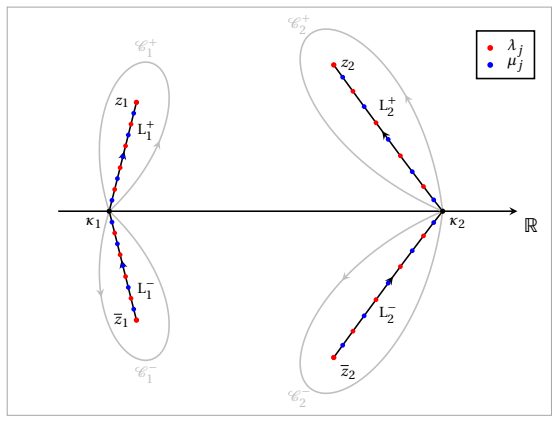
Direct and inverse scattering transforms are constructed for the focusing NLS equation with elliptic travelling wave backgrounds whose spectral bands intersect the real axis, and this class of data intersects the full soliton gas nontrivial
A machine-rendered reading of the paper's core claim, the machinery that carries it, and where it could break.
Core claim
For initial data of the focusing NLS that approach an elliptic travelling wave with distinct phases at plus and minus infinity, and whose associated spectral bands intersect the real axis, both the direct and inverse scattering transforms exist; moreover this family of data has non-zero intersection with the full soliton gas.
What carries the argument
The direct and inverse scattering transforms adapted to the Zakharov-Shabat operator with an elliptic travelling wave background potential.
If this is right
- The Cauchy problem for the focusing NLS with such initial data can be solved by reconstructing the solution from its scattering data.
- Full soliton gas data that are elliptic at both ends of the line can be evolved using the inverse scattering method.
- The non-trivial overlap supplies concrete examples of soliton gas configurations sitting on a non-constant background.
- Long-time asymptotics for these solutions follow from the standard steepest-descent analysis of the associated Riemann-Hilbert problem.
Where Pith is reading between the lines
- The same scattering setup may be used to derive modulation equations that describe slow variations of the elliptic background parameters.
- Dense soliton gases on elliptic backgrounds could serve as test cases for numerical integrators of the focusing NLS.
- The construction suggests a route to studying soliton gases for other integrable equations that admit finite-gap backgrounds.
Load-bearing premise
The spectral bands of the elliptic travelling wave must intersect the real axis.
What would settle it
An explicit initial datum asymptotic to an elliptic travelling wave with bands intersecting the real axis for which the inverse scattering map fails to recover a solution with the same asymptotics.
Figures


read the original abstract
In this manuscript we develop the direct and inverse scattering problem for the cubic focusing nonlinear Schr\"odinger equation and for initial data that are asymptotic to an elliptic travelling wave with distinct phase at $\pm \infty$. We consider the case in which the spectral bands intersect the real axis. We then show that this class of initial data has non zero intersection with the full soliton gas initial data.
Editorial analysis
A structured set of objections, weighed in public.
Referee Report
Summary. The manuscript develops the direct and inverse scattering problem for the cubic focusing nonlinear Schrödinger equation with initial data asymptotic to an elliptic travelling wave with distinct phases at ±∞, specifically in the case where the spectral bands intersect the real axis. It then shows that this class of initial data has a non-zero intersection with the full soliton gas initial data.
Significance. If the central claims hold, the work would extend inverse scattering theory to a new family of non-decaying backgrounds, providing a bridge between elliptic travelling waves and soliton gases. This could enable analysis of long-time asymptotics and modulation in integrable systems with periodic or quasi-periodic backgrounds.
major comments (1)
- [Abstract] The central claim requires that there exist parameters of the elliptic travelling wave for which the spectral bands intersect the real axis while the phases at ±∞ remain distinct. The abstract states the setup holds under this band-intersection condition, but no explicit parameter values, existence proof, or verification that the admissible class is non-empty appears in the visible statement of the result. This must be supplied (e.g., via a concrete example or theorem establishing the parameter regime) because an empty class would render both the scattering development and the intersection claim vacuous.
Simulated Author's Rebuttal
We thank the referee for their careful reading and for identifying this important clarification needed in the presentation of our results. We address the single major comment below.
read point-by-point responses
-
Referee: [Abstract] The central claim requires that there exist parameters of the elliptic travelling wave for which the spectral bands intersect the real axis while the phases at ±∞ remain distinct. The abstract states the setup holds under this band-intersection condition, but no explicit parameter values, existence proof, or verification that the admissible class is non-empty appears in the visible statement of the result. This must be supplied (e.g., via a concrete example or theorem establishing the parameter regime) because an empty class would render both the scattering development and the intersection claim vacuous.
Authors: We agree that the abstract and main result statements should explicitly confirm the admissible parameter class is non-empty. The manuscript develops the direct and inverse scattering theory under the standing assumption that parameters exist yielding real-axis band intersections with distinct phases at ±∞, and then proves a non-trivial intersection with full soliton gas data within that class. However, no concrete example or existence verification appears in the abstract or theorem statements. In the revised manuscript we will add an explicit numerical example (specific values of the elliptic-wave modulus, frequency, and phase parameters) together with a short verification that the bands intersect the real axis while phases remain distinct; this example will also be used to illustrate the non-zero soliton-gas intersection. The addition will appear in the introduction (new subsection) and will be referenced from the abstract and main theorem. No changes to the core theorems or proofs are required. revision: yes
Circularity Check
No circularity; derivation chain is self-contained with no reductions to inputs by construction.
full rationale
The manuscript develops the direct and inverse scattering problem for the focusing NLS with elliptic background initial data (under the stated band-intersection assumption) and then establishes a non-trivial intersection with the full soliton gas class. No equations, fits, self-citations, or ansatzes are quoted that would make any claimed result equivalent to its inputs by definition. The work is presented as constructing new scattering theory rather than deriving predictions from prior fitted quantities or self-referential uniqueness theorems. This is the expected honest non-finding for an abstract-level description of a technical development paper.
Axiom & Free-Parameter Ledger
Forward citations
Cited by 3 Pith papers
-
Long-time asymptotics of a full arbitrary-genus dark soliton gas for the defocusing nonlinear Schrodinger equation
Derives long-time asymptotics of a full arbitrary-genus dark soliton gas for defocusing NLS, yielding an N-dimensional Riemann-theta finite-gap solution with O(t^{-1}) or O(t^{-1/2}) errors in different sectors.
-
Long-time Asymptotics of a Full Camassa-Holm Soliton Gas
Long-time asymptotics for the full Camassa-Holm soliton gas are obtained from a limiting RH problem with two reflection coefficients, producing elliptic-function leading terms in three regions.
-
Large-time asymptotics of a new KdV soliton gas
Derives explicit leading-order large-time asymptotics for a new KdV soliton gas with two nonzero reflection coefficients, expressed via Jacobi elliptic functions on a hyperelliptic surface.
Reference graph
Works this paper leans on
-
[1]
M. J. Ablowitz and H. Segur,Solitons and the Inverse Scattering Transform, SIAM, Philadelphia, 1981
1981
-
[2]
Scattering and inverse scattering for first order systems
R. Beals and R. R. Coifman, “Scattering and inverse scattering for first order systems” , Comm. Pure Appl. Math.37, 39–90 (1984)
1984
-
[3]
Soliton shielding of the focusing nonlinear Schrödinger equation
M. Bertola, T . Grava and G. Orsatti, “Soliton shielding of the focusing nonlinear Schrödinger equation” , Phys. Rev. Lett.130(12), 127201 (2023)
2023
-
[4]
Integrable operators, dbar-problems, KP and NLS hierarchy
M. Bertola, T . Grava and G. Orsatti, “Integrable operators, dbar-problems, KP and NLS hierarchy” , Non- linearity37(8), 085008 (2024)
2024
-
[5]
∂-problem for the focusing nonlinear Schrödinger equation and soliton shielding
M. Bertola, T . Grava and G. Orsatti, “ ∂-problem for the focusing nonlinear Schrödinger equation and soliton shielding” Bertola, Marco; Grava, Tamara; Orsatti, Giuseppe Proc. A481(2310), 20240764 (2025)
2025
-
[6]
Inverse scattering transform for the focusing nonlinear Schrödinger equa- tion with nonzero boundary conditions
G. Biondini and G. Kovaˇ ciˇ c, “Inverse scattering transform for the focusing nonlinear Schrödinger equa- tion with nonzero boundary conditions” , J. Math. Phys.55, 031506 (2014)
2014
-
[7]
Long-time asymptotics for the focusing nonlinear Schrödinger equa- tion with nonzero boundary conditions at infinity and asymptotic stage of modulation instability
G. Biondini and D. Mantzavinos, “Long-time asymptotics for the focusing nonlinear Schrödinger equa- tion with nonzero boundary conditions at infinity and asymptotic stage of modulation instability” , Com- mun. Pure Appl. Math.70, 2300–2365 (2017)
2017
-
[8]
Long time asymptotic behavior of the focusing non- linear Schrödinger equation
M. Borghese, R. Jenkins and K. D. T . R. McLaughlin, “Long time asymptotic behavior of the focusing non- linear Schrödinger equation” , Ann. Inst. H. Poincaré C Anal. Non Linéaire35, 887–920(2018)
2018
-
[9]
Long-time asymptotics for solutions of the NLS equation with a delta potential and even initial data
P . Deift and J. Park, “Long-time asymptotics for solutions of the NLS equation with a delta potential and even initial data” , Int. Math. Res. Not.24, 5505–5624 (2011) 32
2011
-
[10]
Long-time asymptotics for solutions of the NLS equation with initial data in a weighted Sobolev space
P . Deift and X. Zhou, “Long-time asymptotics for solutions of the NLS equation with initial data in a weighted Sobolev space” , Comm. Pure. Appl. Math.56, 1029–1077 (2003)
2003
-
[11]
NIST Digital Library of Mathematical Functions
“NIST Digital Library of Mathematical Functions” , Release 1.2.6 of 2026-03-15. F . W . J. Olver, A. B. Olde Daalhuis, D. W . Lozier, B. I. Schneider, R. F . Boisvert, C. W . Clark, B. R. Miller, B. V . Saunders, H. S. Cohl, and M. A. McClain, eds
2026
-
[12]
The inverse scattering transform for the focusing nonlinear Schrödinger equation with asymmetric boundary conditions
V . Demontis, B. Prinari, C. Van Der Mee, and F . Vitale, “The inverse scattering transform for the focusing nonlinear Schrödinger equation with asymmetric boundary conditions” , J. Math. Phys.55, 101505 (2014)
2014
-
[13]
The stability spectrum for elliptic solutions to the focusing NLS equation
B. Deconinck and B. L. Segal, “The stability spectrum for elliptic solutions to the focusing NLS equation” , Phys. D346, 1–19 (2017)
2017
-
[14]
Primitive potentials and bounded solutions of the KdV equation
S. Dyachenko, D. Zakharov, and V . Zakharov, “Primitive potentials and bounded solutions of the KdV equation” , Phys. D333, 148–156 (2016)
2016
-
[15]
Asymptotics of KdV shock waves via the Riemann–Hilbert ap- proach
I. Egorova, M. Piorkowski, and G. Teschl, “ Asymptotics of KdV shock waves via the Riemann–Hilbert ap- proach” , Indiana Univ. Math. J.73(2), 645–690 (2024)
2024
-
[16]
L. D. Faddeev and L. A. Takhtajan,Hamiltonian methods in the thoery of solitons, Springer, Berlin, 1987
1987
-
[17]
Orbital stability of periodic waves for the nonlinear Schrödinger equation
T . Gallay and M. Haragus. “Orbital stability of periodic waves for the nonlinear Schrödinger equation” , J. Dyn. Differ. Equ.19, 825–865 (2007)
2007
-
[18]
Rigorous asymptotics of a KdV soliton gas
M. Girotti, T . Grava, R. Jenkins, K. D. T .-R. McLaughlin, “Rigorous asymptotics of a KdV soliton gas” , Comm. Math. Phys.384(2), 733–784 (2021)
2021
-
[19]
Soliton versus the gas: Fredholm determinants, analysis, and the rapid oscillations behind the kinetic equation,
M. Girotti, T . Grava, R. Jenkins, K. D. T .-R. McLaughlin, A. Minakov, “Soliton versus the gas: Fredholm determinants, analysis, and the rapid oscillations behind the kinetic equation,” Comm. Pure Appl. Math. 76(11), 3233–3299 (2023)
2023
-
[20]
Long time asymptotics of the generalized soliton gas of the mKdV equation
M. Girotti, R. Jenkins and K. D. T .-R. McLaughlin, “Long time asymptotics of the generalized soliton gas of the mKdV equation” , in preparation
- [21]
-
[22]
Long time asymptotic behavior of NLS with step-like oscil- latory initial data
T . Grava, R. Jenkins, X. Zhang and Z. Zhang, “Long time asymptotic behavior of NLS with step-like oscil- latory initial data” , in preparation
-
[23]
Exact theory of two-dimensional self-focusing and one-dimensional self-modulation of waves in nonlinear media
V . E. Zakharov and A. B. Shabat, “Exact theory of two-dimensional self-focusing and one-dimensional self-modulation of waves in nonlinear media” , Sov. Phys. JETP34, 63–69 (1972)
1972
-
[24]
E. D. Belokolos, A. I. Bobenko, V . Z. Enol’ skii, A. R. Its and V . B. Matveev,Algebro-geometric Approach to Nonlinear Integrable Equations. Springer Series in Nonlinear Dynamics, Springer, Berlin, 1994
1994
-
[25]
The Riemann-Hilbert problem and inverse scattering
X. Zhou, “The Riemann-Hilbert problem and inverse scattering” , SIAM J. Math. Anal.20(4), 966–986 (1989) 33
1989
discussion (0)
Sign in with ORCID, Apple, or X to comment. Anyone can read and Pith papers without signing in.