Cruise Ship-Associated Andes Virus Cluster aboard MV Hondius, 2026: A Stochastic Scenario Analysis
Pith reviewed 2026-06-27 17:59 UTC · model grok-4.3
The pith
Stochastic modeling indicates two latent infections at embarkation best explain the 2026 Andes virus cluster on the MV Hondius.
A machine-rendered reading of the paper's core claim, the machinery that carries it, and where it could break.
Core claim
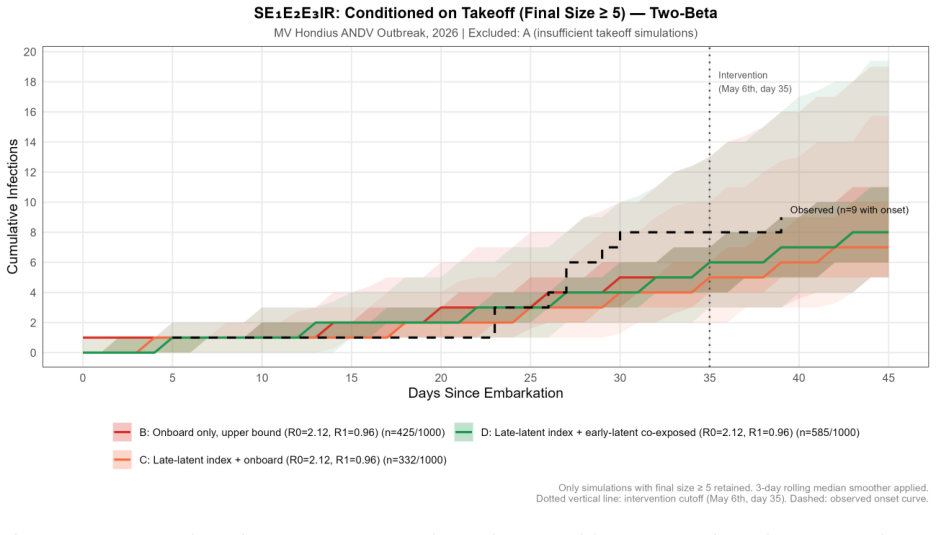
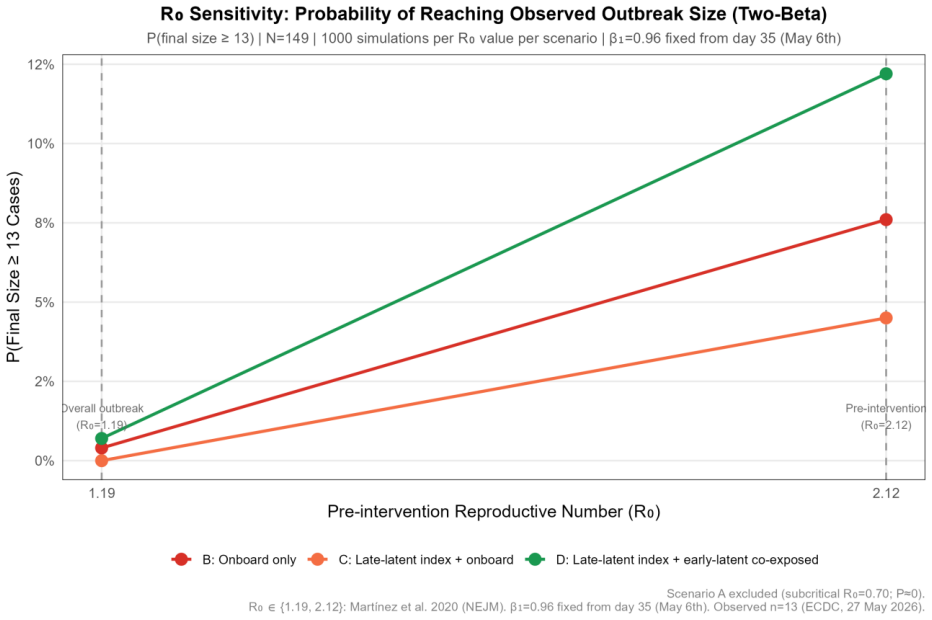
Scenario D with two latent infected persons at embarkation was most consistent with the observed outbreak, yielding P(final size >= 13) = 11.6% and P(takeoff) = 58.5% at R0 = 2.12. Approximate Bayesian computation provided complementary support for multiple latent infections at embarkation, especially E1(0)=1 and E3(0)=2, though R0 remained weakly identifiable. A day-35 transmission reduction changed takeoff probability little.
What carries the argument
Stochastic epidemic model run on four embarkation scenarios with reproductive numbers taken from published ANDV estimates, used to compute consistency probabilities for observed outbreak size.
Load-bearing premise
Reproductive numbers from published ANDV estimates accurately represent transmission dynamics aboard the ship.
What would settle it
A new outbreak with known initial latent count and final size that ranks a different embarkation scenario highest would contradict the consistency ranking of Scenario D.
Figures



read the original abstract
In April 2026, the MV Hondius expedition cruise ship became the site of the first documented cruise ship-associated Andes hantavirus (ANDV) cluster, with 13 confirmed and probable cases and 3 deaths among 149 passengers and crew. We applied a stochastic epidemic model to evaluate four embarkation scenarios under reproductive numbers anchored to published ANDV estimates. Scenario D, involving two latent infected persons at embarkation, was most consistent with the observed outbreak, yielding P(final size >= 13) = 11.6% and P(takeoff) = 58.5% at R0 = 2.12. Approximate Bayesian computation provided complementary support for multiple latent infections at embarkation, especially E1(0)=1 and E3(0)=2, but R0 remained weakly identifiable. A day-35 transmission reduction changed takeoff probability little in this counterfactual model. Findings support exposure-history assessment, early onboard surveillance, rapid isolation of symptomatic cases, and postdisembarkation monitoring for travelers from ANDV-endemic regions.
Editorial analysis
A structured set of objections, weighed in public.
Referee Report
Summary. The paper applies a stochastic epidemic model to four embarkation scenarios for an Andes hantavirus (ANDV) outbreak aboard the MV Hondius (149 passengers/crew, 13 cases). It concludes that Scenario D (two latent infections at embarkation) is most consistent with the data, yielding P(final size >=13)=11.6% and P(takeoff)=58.5% at R0=2.12 anchored to published ANDV estimates; approximate Bayesian computation (ABC) supports multiple latent infections at embarkation but finds R0 weakly identifiable. A day-35 transmission reduction is examined as a counterfactual.
Significance. If the anchored R0 and latent-period assumptions hold for shipboard mixing, the scenario probabilities and ABC results offer a quantitative basis for prioritizing exposure-history assessment, onboard surveillance, and post-disembarkation monitoring. The use of ABC to evaluate initial conditions is a methodological strength that allows direct comparison of embarkation hypotheses.
major comments (2)
- [Abstract] Abstract: The headline ranking of Scenario D as most consistent rests on probabilities computed at R0=2.12 taken from external ANDV estimates, yet the same abstract states that ABC left R0 weakly identifiable from the outbreak data. This means the reported P(final size >=13) and P(takeoff) values are not constrained by the observed cluster and inherit any mismatch between published household/rodent-contact R0 and the cruise-ship contact matrix (shared cabins, dining, excursions).
- [Abstract] Abstract: No model equations, state variables, transition rates, or contact assumptions are supplied, nor are any validation checks, sensitivity analyses, or raw data shown. Without these, it is impossible to verify whether the stochastic structure reproduces the observed final size or whether the latent-period distribution matches the ship setting.
minor comments (1)
- [Abstract] Abstract: The day-35 transmission-reduction counterfactual is mentioned without reporting the resulting change in takeoff probability or the precise implementation (e.g., which compartments are affected).
Simulated Author's Rebuttal
We thank the referee for the constructive comments on our manuscript. We respond point-by-point to the major comments below and will make revisions to improve clarity and completeness.
read point-by-point responses
-
Referee: [Abstract] Abstract: The headline ranking of Scenario D as most consistent rests on probabilities computed at R0=2.12 taken from external ANDV estimates, yet the same abstract states that ABC left R0 weakly identifiable from the outbreak data. This means the reported P(final size >=13) and P(takeoff) values are not constrained by the observed cluster and inherit any mismatch between published household/rodent-contact R0 and the cruise-ship contact matrix (shared cabins, dining, excursions).
Authors: We agree that the reported probabilities for Scenario D are computed under a fixed R0=2.12 drawn from external ANDV literature and are not directly constrained by the ship outbreak data, as the ABC analysis shows R0 to be weakly identifiable. The abstract already notes the ABC result on R0, but we will revise the abstract to more explicitly distinguish the anchored-R0 analysis from the ABC results and to note the possibility that shipboard contact patterns differ from household or rodent-contact settings used in the external R0 estimates. We will also add discussion of this limitation. revision: yes
-
Referee: [Abstract] Abstract: No model equations, state variables, transition rates, or contact assumptions are supplied, nor are any validation checks, sensitivity analyses, or raw data shown. Without these, it is impossible to verify whether the stochastic structure reproduces the observed final size or whether the latent-period distribution matches the ship setting.
Authors: The methods section of the manuscript describes the stochastic SEIR model, including state variables, transition rates, and contact assumptions based on ship layout. However, to make the abstract self-contained and address the concern, we will add a concise description of the model structure and key assumptions to the abstract. We will also incorporate validation checks, sensitivity analyses, and a supplementary table of raw case timing data in the revised manuscript. revision: yes
Circularity Check
No significant circularity; external R0 anchoring is independent
full rationale
The paper applies a stochastic SEIR-type model to four embarkation scenarios, anchoring R0 to published ANDV estimates from the literature and using ABC to assess consistency with the observed 13-case cluster. R0 is explicitly stated as weakly identifiable from the ship data, so the reported probabilities (e.g., P(final size >=13)=11.6% for Scenario D at R0=2.12) are conditional outputs given those external parameters rather than a self-referential fit or prediction. No equation reduces to its own inputs by construction, no self-citation chain is load-bearing for the central claim, and the model structure is applied to external benchmarks. This is standard parameter use from prior independent studies.
Axiom & Free-Parameter Ledger
free parameters (2)
- R0 =
2.12
- initial latent infections
axioms (2)
- domain assumption Published ANDV reproductive number estimates apply directly to the ship transmission setting.
- domain assumption Stochastic model structure and contact assumptions match the cruise ship environment.
Reference graph
Works this paper leans on
-
[1]
Evidence for human-to-human transmission of hantavirus: a systematic review
Toledo J, Haby MM, Reveiz L, Sosa Leon L, Angerami R, Aldighieri S. Evidence for human-to-human transmission of hantavirus: a systematic review. J Infect Dis. 2022;226(8):1362-71
2022
-
[6]
Transmission potential of the novel coronavirus (COVID-
Mizumoto K, Chowell G. Transmission potential of the novel coronavirus (COVID-
-
[7]
Infect Dis Model
onboard the diamond Princess Cruises Ship, 2020. Infect Dis Model. 2020;5:264-70
2020
-
[8]
Estimating the asymptomatic proportion of coronavirus disease 2019 (COVID-19) cases on board the Diamond Princess cruise ship, Yokohama, Japan, 2020
Mizumoto K, Kagaya K, Zarebski A, Chowell G. Estimating the asymptomatic proportion of coronavirus disease 2019 (COVID-19) cases on board the Diamond Princess cruise ship, Yokohama, Japan, 2020. Euro Surveill. 2020;25(10):2000180
2019
-
[9]
Counting everyone onboard is not enough: modelling lessons from the MV Hondius Andes virus outbreak
Chowell G, Mizumoto K. Counting everyone onboard is not enough: modelling lessons from the MV Hondius Andes virus outbreak. J Travel Med. 2026 [In Press]
2026
-
[10]
Cruise Ships as Amplifiers of Emerging Zoonotic Threats: Implications of the Suspected Andes Hantavirus Cluster aboard MV Hondius
Thaledi S, Pal S, Juyal D. Cruise Ships as Amplifiers of Emerging Zoonotic Threats: Implications of the Suspected Andes Hantavirus Cluster aboard MV Hondius. J Travel Med. 2026:taag034
2026
-
[12]
Hantavirus-associated cluster of illness on a cruise ship: ECDC assessment and recommendations
ECDC. Hantavirus-associated cluster of illness on a cruise ship: ECDC assessment and recommendations. 2026 [cited 2026 May 17]; Available from: https://www.ecdc.europa.eu/sites/default/files/documents/TAB-hantavirus-06052026.pdf
2026
-
[13]
Andes hantavirus outbreak in cruise ship
European Centre for Disease Prevention and Control. Andes hantavirus outbreak in cruise ship. 2026 [cited 5/27/2026]; Available from: https://www.ecdc.europa.eu/en/infectious-disease-topics/hantavirus- infection/surveillance-and-updates/andes-hantavirus-outbreak
2026
-
[15]
Approximate accelerated stochastic simulation of chemically reacting systems
Gillespie DT. Approximate accelerated stochastic simulation of chemically reacting systems. J Chem Phys. 2001;115(4):1716-33
2001
-
[22]
Boundary hit
R Core Team. R: A language and environment for statistical computing. R Foundation for Statistical Computing, Vienna, Austria. http://wwwR-projectorg/; 2024. Author biographical sketch: Raj Kumar Subedi is a doctoral candidate and a 2CI Fellow in the Department of Population Health Sciences, School of Public Health, Georgia State University, Atlanta, Geor...
2024
-
[23]
Disease outbreak news: hantavirus cluster linked to cruise ship travel, multi-country
World Health Organization. Disease outbreak news: hantavirus cluster linked to cruise ship travel, multi-country. Geneva: World health organization; 2026
2026
-
[24]
Viral shedding and viraemia of Andes virus during acute hantavirus infection: a prospective study
Ferrés M, Martínez-Valdebenito C, Henriquez C, Marco C, Angulo J, Barrera A, et al. Viral shedding and viraemia of Andes virus during acute hantavirus infection: a prospective study. Lancet Infect Dis. 2024;24(7):775-82
2024
-
[25]
Equivalence of the Erlang-distributed SEIR epidemic model and the renewal equation
Champredon D, Dushoff J, Earn DJ. Equivalence of the Erlang-distributed SEIR epidemic model and the renewal equation. SIAM J Appl Math. 2018;78(6):3258-78
2018
-
[26]
Hantavirus in humans: a review of clinical aspects and management
Vial PA, Ferrés M, Vial C, Klingström J, Ahlm C, López R, et al. Hantavirus in humans: a review of clinical aspects and management. Lancet Infect Dis. 2023;23(9):e371-e82
2023
-
[27]
Super-spreaders
Martínez VP, Di Paola N, Alonso DO, Pérez-Sautu U, Bellomo CM, Iglesias AA, et al. “Super-spreaders” and person-to-person transmission of Andes virus in Argentina. N Engl J Med. 2020;383(23):2230-41
2020
-
[28]
Harnessing testing strategies and public health measures to avert COVID-19 outbreaks during ocean cruises
Chowell G, Dahal S, Bono R, Mizumoto K. Harnessing testing strategies and public health measures to avert COVID-19 outbreaks during ocean cruises. Sci Rep. 2021;11(1):15482
2021
-
[29]
Epydemix: An open-source Python package for epidemic modeling with integrated approximate Bayesian calibration
Gozzi N, Chinazzi M, Davis JT, Gioannini C, Rossi L, Ajelli M, et al. Epydemix: An open-source Python package for epidemic modeling with integrated approximate Bayesian calibration. PLOS Comp Bio. 2025;21(11):e1013735
2025
-
[30]
Approximate Bayesian computation in population genetics
Beaumont MA, Zhang W, Balding DJ. Approximate Bayesian computation in population genetics. Genetics. 2002;162(4):2025-35
2002
-
[31]
Approximate Bayesian computation (ABC) in practice
Csilléry K, Blum MG, Gaggiotti OE, François O. Approximate Bayesian computation (ABC) in practice. Trends Ecol Evol. 2010;25(7):410-8
2010
-
[32]
Population growth of human Y chromosomes: a study of Y chromosome microsatellites
Pritchard JK, Seielstad MT, Perez-Lezaun A, Feldman MW. Population growth of human Y chromosomes: a study of Y chromosome microsatellites. Mol Biol Evol. 1999;16(12):1791-8
1999
-
[33]
Differential elimination for dynamical models via projections with applications to structural identifiability
Dong R, Goodbrake C, Harrington HA, Pogudin G. Differential elimination for dynamical models via projections with applications to structural identifiability. SIAM Journal on Applied Algebra and Geometry. 2023;7(1):194-235
2023
-
[34]
A tutorial on structural identifiability of epidemic models using StructuralIdentifiability
Liyanage YR, Saucedo O, Tuncer N, Chowell G. A tutorial on structural identifiability of epidemic models using StructuralIdentifiability. jl. arXiv preprint arXiv:250510517. 2025
2025
discussion (0)
Sign in with ORCID, Apple, or X to comment. Anyone can read and Pith papers without signing in.