X-Palm: Paired Multispectral-to-Smartphone Dataset for Cross-Domain Palmprint Authentication
Pith reviewed 2026-06-27 18:09 UTC · model grok-4.3
The pith
X-Palm supplies the first paired dataset that links controlled multispectral palm images to unconstrained smartphone captures from the same identities.
A machine-rendered reading of the paper's core claim, the machinery that carries it, and where it could break.
Core claim
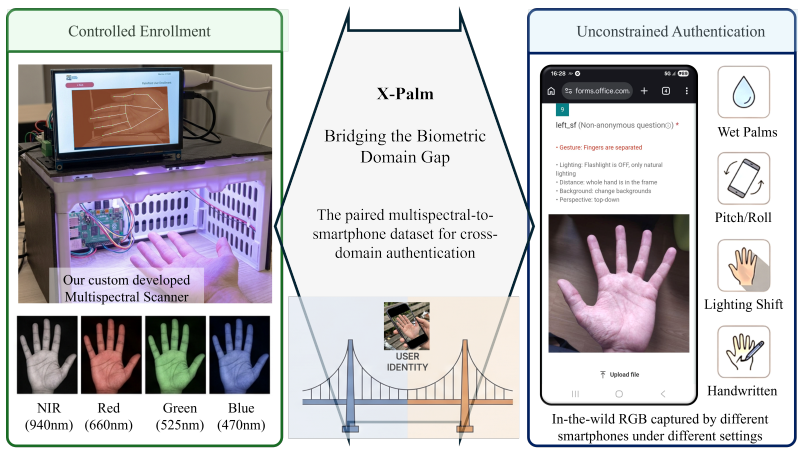
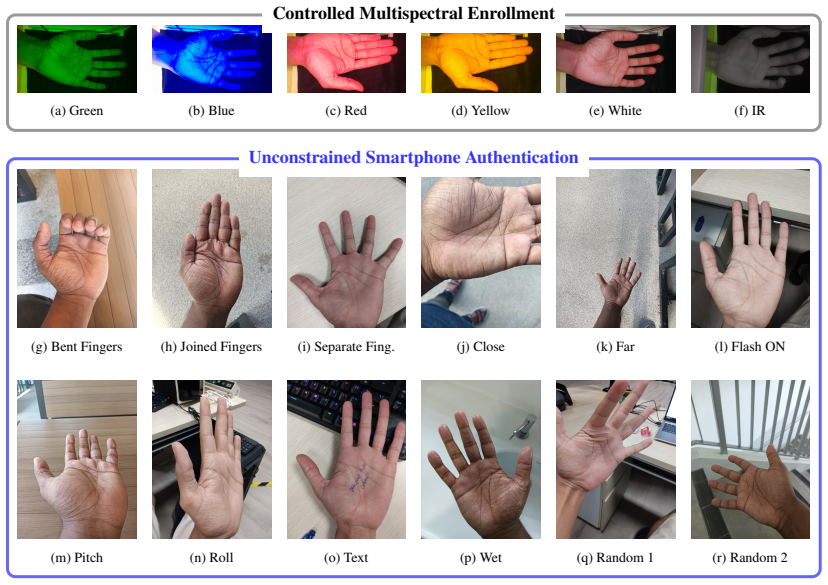
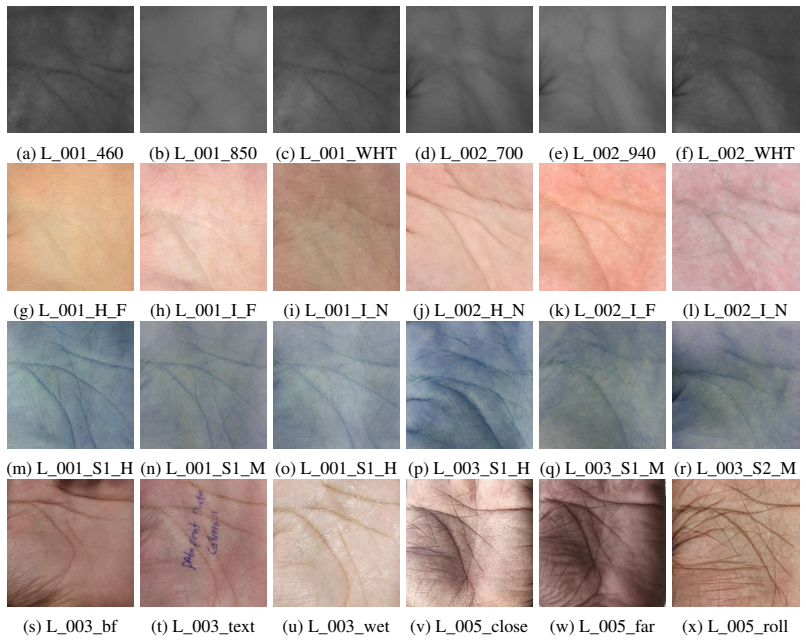
X-Palm is the first palmprint dataset to supply paired-identity acquisition across two domains: a controlled multispectral scanner built for reliable enrollment and an unconstrained smartphone setting in which each participant captures their own palms under simultaneous variations in hardware, pose, illumination, background, camera distance, perspective, and surface conditions such as moisture or occlusion.
What carries the argument
Paired-identity acquisition that records the same 206 hands once in each domain so that models can be trained to map between controlled multispectral enrollment and variable mobile authentication.
If this is right
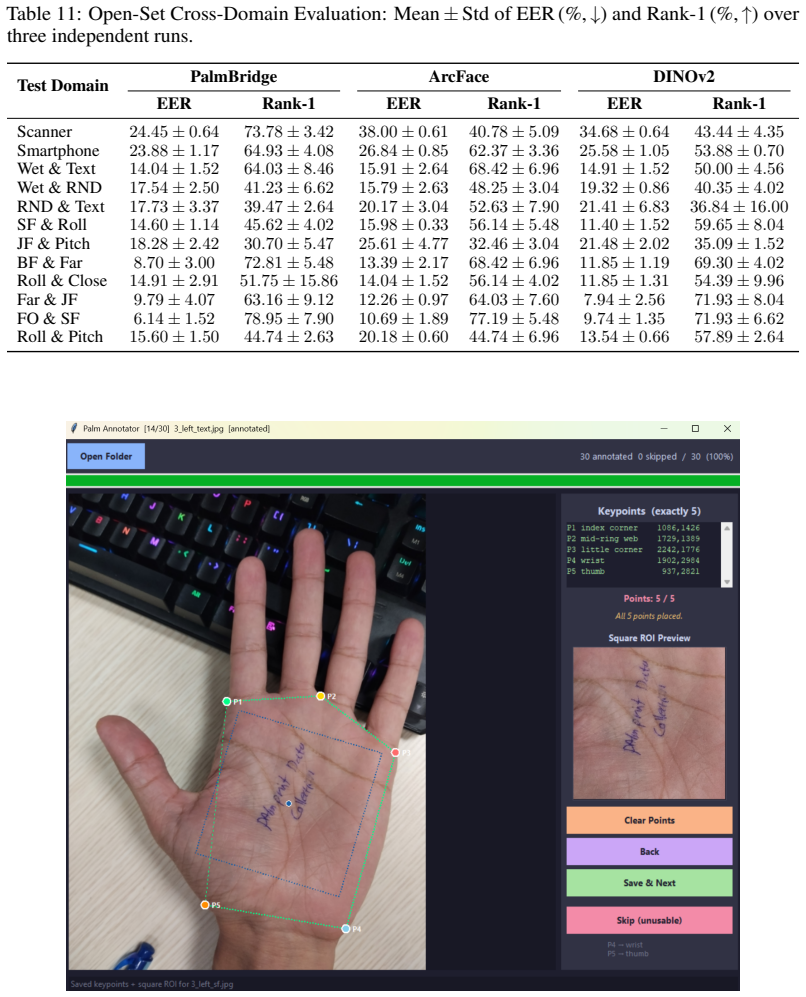
- Existing state-of-the-art models that perform well on controlled palm data suffer severe accuracy loss when evaluated on the smartphone portion of X-Palm.
- Models retrained on X-Palm maintain consistent performance when tested on either the multispectral or the smartphone images.
- The dataset supplies a concrete benchmark for measuring cross-domain generalization in palmprint authentication.
- Public release of the images and evaluation code allows other researchers to test domain-adaptation techniques on this paired setup.
Where Pith is reading between the lines
- Similar paired collection protocols could be applied to fingerprints or face images to create training sets that close domain gaps for other mobile biometrics.
- The explicit listing of simultaneous variations (hardware, pose, lighting, occlusion) gives a checklist that future smartphone biometric studies can use to document their own capture conditions.
- If the pairing proves reliable, the dataset could support supervised domain-adaptation losses that explicitly penalize mismatch between the two acquisition setups.
- A practical next measurement would be to test whether models trained on X-Palm retain accuracy when the smartphone images come from a completely different phone brand or operating system not seen during collection.
Load-bearing premise
The participant-collected smartphone images capture the full compound variability of actual unconstrained deployments without collection bias or pairing errors between the two domains.
What would settle it
An experiment that trains models on X-Palm and then tests them on a fresh collection of smartphone palm images from new users or unseen phone models, checking whether accuracy remains higher than models trained only on controlled data.
Figures

read the original abstract
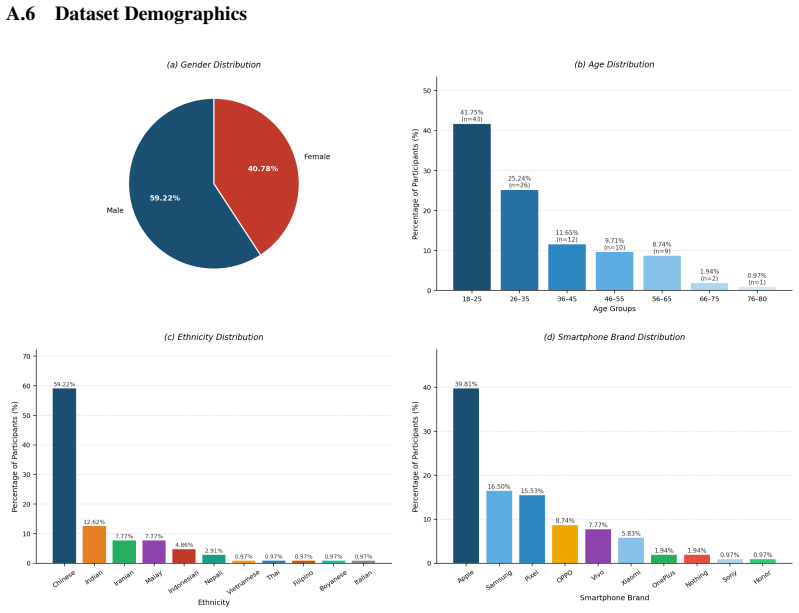
Palmprint modality offers a privacy-preserving biometric solution, yet its deployment is hindered by the domain gap between controlled enrollment and unconstrained authentication. Existing datasets are largely restricted to controlled setups and fail to capture the compound variability of real-world environments. In this paper, we introduce X-Palm, a cross-domain dataset comprising 6,006 palm images from 103 individuals (206 hands). To the best of our knowledge, X-Palm is the first palmprint dataset providing novel paired-identity acquisition specifically designed to bridge the gap between reliably controlled multispectral enrollment and unconstrained mobile authentication while encompassing a broad spectrum of in-the-wild variability. Unlike existing datasets that focus on single to a few variations, X-Palm addresses the massive modality and environmental shifts encountered in practical deployments by capturing paired data for identities across two distinct domains: (1) a controlled Multispectral Palmprint setting using our custom-developed scanner, and (2) an unconstrained smartphone palmprint setting that is participant-driven, incorporating simultaneous variations in hardware, hand pose, illumination, background, camera-to-hand distance, perspective, and palm surface conditions (e.g., moisture and occlusions). Our extensive benchmarks of 12 SOTA models reveal that while existing methods achieve high performance on controlled data, they experience severe performance collapse on X-Palm. Conversely, models trained on X-Palm demonstrate consistent robustness across domains, positioning X-Palm as a valuable resource for training a model towards real-world, cross-domain generalization. Data access instructions and the related benchmarking codes are publicly available at: https://github.com/X-Palm/X-Palm-2026
Editorial analysis
A structured set of objections, weighed in public.
Referee Report
Summary. The paper introduces X-Palm, a cross-domain palmprint dataset with 6,006 images from 103 individuals (206 hands), featuring paired acquisitions between a controlled multispectral scanner and unconstrained, participant-driven smartphone captures that include variations in hardware, pose, illumination, background, distance, perspective, and surface conditions. It claims to be the first such paired-identity dataset designed to address the domain gap for real-world mobile authentication, with benchmarks on 12 SOTA models showing performance collapse for existing methods on cross-domain tasks and improved robustness for models trained on X-Palm. Data and code are released publicly.
Significance. If the collection protocol, identity pairing, and benchmark results hold with appropriate controls and statistical reporting, X-Palm would provide a valuable paired resource for training and evaluating cross-domain palmprint models, addressing a gap in existing datasets that are mostly controlled. The public release of data access instructions and benchmarking code is a clear strength that supports reproducibility.
major comments (2)
- [Abstract] Abstract and Benchmarks section: the central claims of 'severe performance collapse' for existing methods and 'consistent robustness' when trained on X-Palm are load-bearing for the dataset's utility, yet the provided abstract contains no quantitative metrics, tables, error bars, or specific results (e.g., accuracy or EER values); the full manuscript must supply these details with clear intra- vs. cross-domain comparisons to substantiate the claims.
- [Dataset Collection] Dataset Collection section: the identity pairing across the two domains and the claim that participant-driven captures faithfully represent compound real-world shifts are foundational to the paired dataset contribution; the manuscript should provide explicit details on pairing verification procedures, exclusion criteria, and any quantitative diversity metrics to address potential collection bias.
minor comments (2)
- [Abstract] Abstract: the breakdown of images per domain, per subject, or per hand is not stated, which would aid readers in assessing balance and scale.
- The GitHub link and data access instructions should be verified for completeness, including any required IRB or consent documentation references.
Simulated Author's Rebuttal
We thank the referee for the constructive feedback on our manuscript. The comments highlight important areas for improving clarity and substantiation of our claims. We address each point below and will revise the manuscript accordingly.
read point-by-point responses
-
Referee: [Abstract] Abstract and Benchmarks section: the central claims of 'severe performance collapse' for existing methods and 'consistent robustness' when trained on X-Palm are load-bearing for the dataset's utility, yet the provided abstract contains no quantitative metrics, tables, error bars, or specific results (e.g., accuracy or EER values); the full manuscript must supply these details with clear intra- vs. cross-domain comparisons to substantiate the claims.
Authors: We agree that the abstract would be strengthened by including quantitative metrics. The full manuscript's Benchmarks section already contains detailed tables reporting accuracy, EER, and other metrics with intra-domain vs. cross-domain comparisons across the 12 SOTA models. To address the comment, we will revise the abstract to summarize key quantitative results (e.g., specific EER increases indicating collapse and corresponding robustness gains) while referencing the tables. We will also highlight any error bars or statistical reporting present in the benchmarks. revision: yes
-
Referee: [Dataset Collection] Dataset Collection section: the identity pairing across the two domains and the claim that participant-driven captures faithfully represent compound real-world shifts are foundational to the paired dataset contribution; the manuscript should provide explicit details on pairing verification procedures, exclusion criteria, and any quantitative diversity metrics to address potential collection bias.
Authors: We agree that more explicit details will improve transparency. In the revised Dataset Collection section, we will add descriptions of the identity pairing verification procedures (including manual review and automated matching steps), exclusion criteria applied to invalid or low-quality captures, and quantitative diversity metrics (such as statistics on pose variation, illumination conditions, background types, and other environmental factors). This will better substantiate the real-world variability and address potential bias concerns. revision: yes
Circularity Check
No significant circularity
full rationale
The paper introduces a new empirical dataset (X-Palm) with paired multispectral and smartphone captures, along with benchmarks on 12 external SOTA models. No mathematical derivations, equations, fitted parameters, predictions, or self-citation chains appear in the provided text. The central claim rests on the collection protocol and observed performance gaps, which are independent of any internal reduction to inputs. This is a standard dataset contribution with no load-bearing self-referential steps.
Axiom & Free-Parameter Ledger
Reference graph
Works this paper leans on
-
[1]
Deep learning in palmprint recognition: A comprehensive survey,
C. Gao, Z. Yang, W. Jia, L. Leng, B. Zhang, and A. B. J. Teoh, “Deep learning in palmprint recognition: A comprehensive survey,”IEEE Transactions on Systems, Man, and Cybernetics: Systems, vol. 56, no. 3, pp. 2143–2162, 2026
2026
-
[2]
Multi-order texture features for palmprint recognition,
Z. Yang, L. Leng, T. Wu, M. Li, and J. Chu, “Multi-order texture features for palmprint recognition,”Artificial Intelligence Review, vol. 56, no. 2, pp. 995–1011, 2023
2023
-
[3]
Human identification using palm-vein images,
Y . Zhou and A. Kumar, “Human identification using palm-vein images,”IEEE Transactions on Information Forensics and Security, vol. 6, no. 4, pp. 1259–1274, 2011
2011
-
[4]
Show your palm to pay: Are customers ready for palm print recognition technology in retail stores in china?,
T. Yu, A. P. Teoh, J. Liao, and C. Wang, “Show your palm to pay: Are customers ready for palm print recognition technology in retail stores in china?,”International Journal of Human– Computer Interaction, vol. 42, no. 3, pp. 1776–1805, 2026
2026
-
[5]
Palmprint biometric versus encrypted hash based digital signature for securing dsp cores used in ce systems,
R. Chaurasia, A. Anshul, A. Sengupta, and S. Gupta, “Palmprint biometric versus encrypted hash based digital signature for securing dsp cores used in ce systems,”IEEE Consumer Electronics Magazine, vol. 11, no. 5, pp. 73–80, 2022
2022
-
[7]
A secure and efficient biometric template pro- tection scheme for palmprint recognition system,
A. Sardar, S. Umer, R. K. Rout, and M. K. Khan, “A secure and efficient biometric template pro- tection scheme for palmprint recognition system,”IEEE Transactions on Artificial Intelligence, vol. 4, no. 5, pp. 1051–1063, 2023
2023
-
[8]
Multispectral palm image fusion for accurate contact-free palmprint recognition,
Y . Hao, Z. Sun, T. Tan, and C. Ren, “Multispectral palm image fusion for accurate contact-free palmprint recognition,” in2008 15th IEEE International Conference on Image Processing, pp. 281–284, IEEE, 2008
2008
-
[9]
Toward mobile palmprint recognition via multi- view hierarchical graph learning,
S. Zhao, L. Fei, B. Zhang, J. Wen, and J. Cui, “Toward mobile palmprint recognition via multi- view hierarchical graph learning,”IEEE Transactions on Information Forensics and Security, vol. 20, pp. 101–113, 2025
2025
-
[10]
Towards palmprint verification on smartphones,
Y . Zhang, L. Zhang, R. Zhang, S. Li, J. Li, and F. Huang, “Towards palmprint verification on smartphones,”arXiv preprint arXiv:2003.13266, 2020
-
[11]
Efficient deep palmprint recognition via distilled hashing cod- ing,
H. Shao, D. Zhong, and X. Du, “Efficient deep palmprint recognition via distilled hashing cod- ing,” inProceedings of the IEEE/CVF Conference on Computer Vision and Pattern Recognition (CVPR) Workshops, pp. 0–0, 2019
2019
-
[12]
Palmprint recognition in uncontrolled and uncooperative environment,
W. M. Matkowski, T. Chai, and A. W. K. Kong, “Palmprint recognition in uncontrolled and uncooperative environment,”IEEE Transactions on Information Forensics and Security, vol. 15, pp. 1601–1615, 2019
2019
-
[13]
Compnet: Competitive neural network for palmprint recognition using learnable gabor kernels,
X. Liang, J. Yang, G. Lu, and D. Zhang, “Compnet: Competitive neural network for palmprint recognition using learnable gabor kernels,”IEEE Signal Processing Letters, vol. 28, pp. 1739– 1743, 2021. 10
2021
-
[14]
Innovative contactless palmprint recognition system based on dual-camera alignment,
X. Liang, Z. Li, D. Fan, B. Zhang, G. Lu, and D. Zhang, “Innovative contactless palmprint recognition system based on dual-camera alignment,”IEEE Transactions on Systems, Man, and Cybernetics: Systems, vol. 52, no. 10, pp. 6464–6476, 2022
2022
-
[15]
Comprehensive competition mechanism in palmprint recognition,
Z. Yang, H. Huangfu, L. Leng, B. Zhang, A. B. J. Teoh, and Y . Zhang, “Comprehensive competition mechanism in palmprint recognition,”IEEE Transactions on Information Forensics and Security, vol. 18, pp. 5160–5170, 2023
2023
-
[16]
Co3net: Coordinate-aware contrastive competitive neural network for palmprint recognition,
Z. Yanget al., “Co3net: Coordinate-aware contrastive competitive neural network for palmprint recognition,”IEEE Transactions on Instrumentation and Measurement, vol. 72, pp. 1–14, 2023
2023
-
[17]
Sf2net: Sequence feature fusion network for palmprint verification,
Y . Liu, L. Leng, Z. Yang, A. B. J. Teoh, and B. Zhang, “Sf2net: Sequence feature fusion network for palmprint verification,”IEEE Transactions on Information Forensics and Security, vol. 20, pp. 9936–9949, 2025
2025
-
[18]
Palmbridge: A plug-and-play feature alignment framework for open-set palmprint verification,
C. Zhang, Z. Yang, L. Yan, S. Li, A. B. J. Teoh, B. Zhang, and Y . Zhang, “Palmbridge: A plug-and-play feature alignment framework for open-set palmprint verification,”arXiv preprint arXiv:2601.20351, 2026
-
[19]
Tscan: Teacher-student co-learning adaptive network for cross-device palmprint recognition,
H. Li, H. Shao, Y . Ren, and D. Zhong, “Tscan: Teacher-student co-learning adaptive network for cross-device palmprint recognition,” inChinese Conference on Biometric Recognition, pp. 101–111, Springer, 2025
2025
-
[20]
Generating stylized features for single-source cross-dataset palmprint recognition with unseen target dataset,
H. Shao, P. Li, and D. Zhong, “Generating stylized features for single-source cross-dataset palmprint recognition with unseen target dataset,”IEEE Transactions on Image Processing, vol. 33, pp. 4911–4922, 2024
2024
-
[21]
A convnet for the 2020s,
Z. Liu, H. Mao, C.-Y . Wu, C. Feichtenhofer, T. Darrell, and S. Xie, “A convnet for the 2020s,” inProceedings of the IEEE/CVF conference on computer vision and pattern recognition, pp. 11976–11986, 2022
2022
-
[22]
DINOv2: Learning Robust Visual Features without Supervision
M. Oquab, T. Darcet, T. Moutakanni, H. V o, M. Szafraniec, V . Khalidov, P. Fernandez, D. Haziza, F. Massa, A. El-Nouby,et al., “Dinov2: Learning robust visual features without supervision,” arXiv preprint arXiv:2304.07193, 2023
work page internal anchor Pith review Pith/arXiv arXiv 2023
-
[23]
Arcface: Additive angular margin loss for deep face recognition,
J. Deng, J. Guo, N. Xue, and S. Zafeiriou, “Arcface: Additive angular margin loss for deep face recognition,” inProceedings of the IEEE/CVF conference on computer vision and pattern recognition, pp. 4690–4699, 2019
2019
-
[24]
Magface: A universal representation for face recognition and quality assessment,
Q. Meng, S. Zhao, Z. Huang, and F. Zhou, “Magface: A universal representation for face recognition and quality assessment,” inProceedings of the IEEE/CVF conference on computer vision and pattern recognition, pp. 14225–14234, 2021
2021
-
[25]
Multi-target cross-dataset palmprint recognition via distilling from multi-teacher,
H. Shao and D. Zhong, “Multi-target cross-dataset palmprint recognition via distilling from multi-teacher,”IEEE Transactions on Instrumentation and Measurement, vol. 72, pp. 1–14, 2023
2023
-
[26]
Lsfm: light style and feature matching for efficient cross-domain palmprint recognition,
S. Ruan, Y . Li, and H. Qin, “Lsfm: light style and feature matching for efficient cross-domain palmprint recognition,”IEEE Transactions on Information Forensics and Security, vol. 19, pp. 9598–9612, 2024
2024
-
[27]
Learning to generalize unseen dataset for cross-dataset palmprint recognition,
H. Shao, Y . Zou, C. Liu, Q. Guo, and D. Zhong, “Learning to generalize unseen dataset for cross-dataset palmprint recognition,”IEEE Transactions on Information Forensics and Security, vol. 19, pp. 3788–3799, 2024
2024
-
[28]
Unified adversarial augmentation for improving palmprint recognition,
J. Jin, C. Zhao, R. Zhang, S. Shang, Y . Zhao, J. Wang, J. Zhang, S. Ding, W. Jia, and Y . Wu, “Unified adversarial augmentation for improving palmprint recognition,” inProceedings of the IEEE/CVF International Conference on Computer Vision, pp. 14141–14151, 2025
2025
-
[29]
Single source domain generalization for palm biometrics,
C. Jia, X. Dong, Y . L. Lai, A. B. J. Teoh, Z. Yang, X. Zhang, L. Wang, Z. Jin, and L. Yang, “Single source domain generalization for palm biometrics,”Pattern Recognition, vol. 165, p. 111620, 2025. 11
2025
-
[30]
Mobile contactless palmprint recognition: Use of multiscale, multimodel embeddings,
S. A. Grosz, A. Godbole, and A. K. Jain, “Mobile contactless palmprint recognition: Use of multiscale, multimodel embeddings,”IEEE Transactions on Information Forensics and Security, vol. 19, pp. 8428–8440, 2024
2024
-
[31]
The multiscenario multienvironment biosecure multimodal database (bmdb),
J. Ortega-Garcia, J. Fierrez, F. Alonso-Fernandez, J. Galbally, M. R. Freire, J. Gonzalez- Rodriguez, C. Garcia-Mateo, J.-L. Alba-Castro, E. Gonzalez-Agulla, E. Otero-Muras,et al., “The multiscenario multienvironment biosecure multimodal database (bmdb),”IEEE Transac- tions on Pattern Analysis and Machine Intelligence, vol. 32, no. 6, pp. 1097–1111, 2010
2010
-
[32]
Matching contactless and contact-based conventional fingerprint images for biometrics identification,
C. Lin and A. Kumar, “Matching contactless and contact-based conventional fingerprint images for biometrics identification,”IEEE Transactions on Image Processing, vol. 27, no. 4, pp. 2008– 2021, 2018
2008
-
[33]
Ridgebase: A cross-sensor multi-finger contactless fingerprint dataset,
B. Jawade, D. Mohan, S. Setlur, N. Ratha, and V . Govindaraju, “Ridgebase: A cross-sensor multi-finger contactless fingerprint dataset,” in2022 IEEE International Joint Conference on Biometrics (IJCB), pp. 1–10, IEEE, 2022
2022
-
[34]
An unconstrained palmprint region of interest extraction method based on lightweight networks,
C. Lin, Y . Chen, X. Zou, X. Deng, F. Dai, J. You, and J. Xiao, “An unconstrained palmprint region of interest extraction method based on lightweight networks,”Plos one, vol. 19, no. 8, p. e0307822, 2024. 12 A Appendix / supplemental material A.1 Related Works In-the-Wild Palmprint AuthenticationCASIA-MS (8) introduced multi-spectral imaging to capture ha...
2024
discussion (0)
Sign in with ORCID, Apple, or X to comment. Anyone can read and Pith papers without signing in.