Virial-based extraction of structures in numerical simulations: The vibes tool
Pith reviewed 2026-06-27 18:06 UTC · model grok-4.3
The pith
Virial theorem defines core boundaries in star formation simulations by tracking energy evolution during growth.
A machine-rendered reading of the paper's core claim, the machinery that carries it, and where it could break.
Core claim
The vibes tool builds structures iteratively from density peaks and applies the virial theorem at each step to monitor the structure's total energy; the boundary is chosen from the evolution of that energy, producing cores that are stable with respect to shape constraints, iteration step size, and peak selection while being less sensitive than density-threshold methods such as hop and dendrogram.
What carries the argument
Iterative virial-theorem evaluation on growing structures, which sets the boundary from the spatial evolution of the structure's total energy.
If this is right
- Extracted cores remain coherent with each other and physically motivated across different simulation snapshots.
- The method is far less sensitive to its working parameters than density-based algorithms.
- Cores defined this way are expected to better represent the reservoirs that collapse into single or multiple stars.
- The core mass function derived from such extractions should be more robust for studies connecting it to the stellar initial mass function.
Where Pith is reading between the lines
- The same energy-based boundary criterion could be adapted to observational data cubes if line-width and column-density maps allow an approximate virial analysis.
- Running the extraction on time-series snapshots might show how core boundaries migrate as turbulence and gravity evolve.
- If the method proves reliable, it could be used to re-analyze existing simulation suites and test whether the resulting CMF shape changes systematically.
Load-bearing premise
The evolution of a structure's total energy as it grows spatially provides a reliable physical boundary that corresponds to the gas reservoir forming a single star or close multiple system.
What would settle it
In the same simulations, compare the material inside each extracted core at the identified boundary with the stars or multiples that actually form from that material at later times.
Figures




read the original abstract
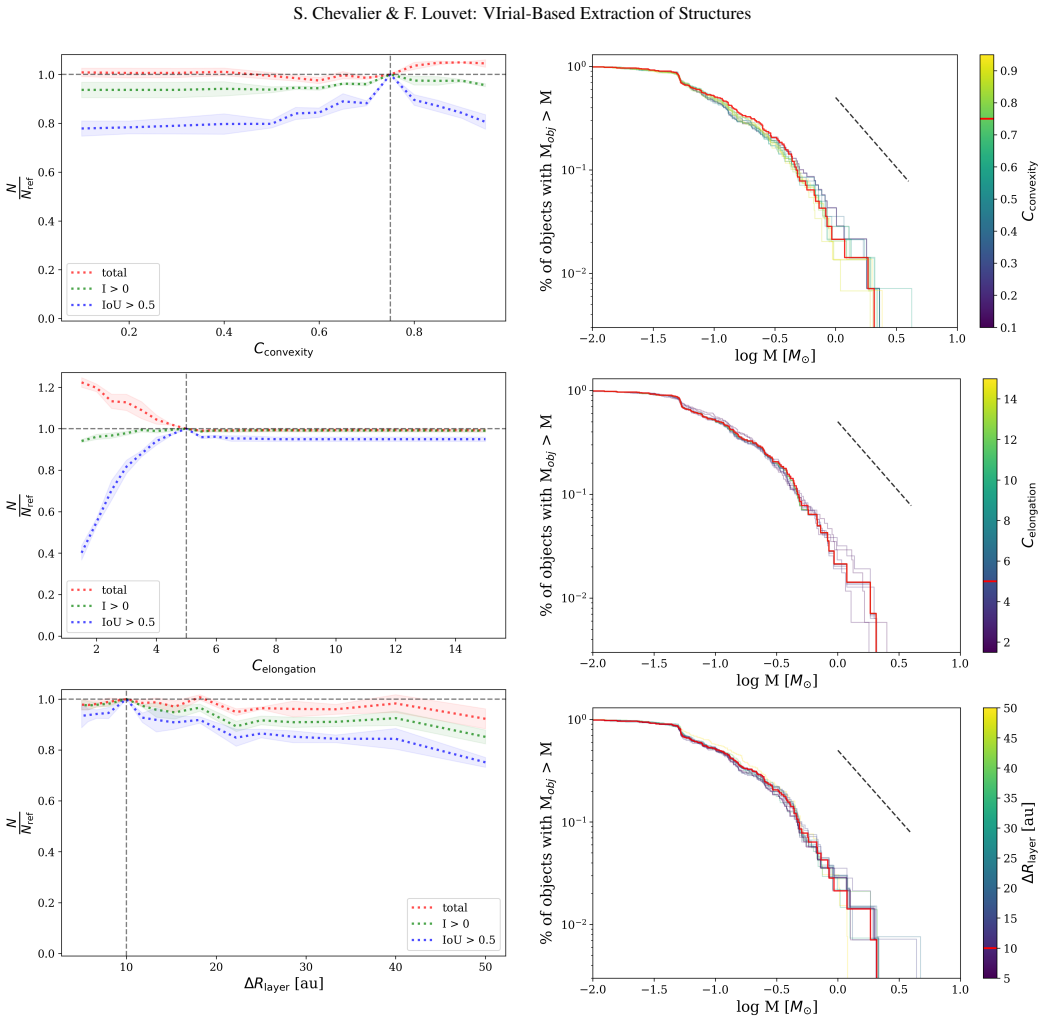
The processes that determine the stellar initial mass function (IMF) and its connection to the core mass function (CMF) are among the major open questions in star formation. The definition of a core remains unclear, yet the way they are extracted from simulations and observations critically shapes the CMF. Nowadays, cores are mostly detected through their density or intensity only. We aim to explore a new way to define cores in 3D numerical simulations based on a direct application of the virial theorem, and break free from some limitations induced by density-based methods. We intend to improve the accuracy and the physical meaning of the extracted cores. We developed vibes, an innovative method that makes full use of the virial theorem to extract overdensities in simulation snapshots. It works by building structures iteratively around density peaks, and applying the virial theorem to the structure at each iteration. Then, the structure boundary is set from the evolution of the its energy as it spatially grows. We used STARFORGE simulations to test the sensitivity of the extraction process to the main working parameters (constraints on the structure shape, iteration step, and peak selection criteria). This sensitivity is observed to be low. We compared our extraction with two density-based extraction algorithms, hop and dendrogram, that are observed to be very sensitive to their input density threshold parameter. Vibes returns structures that are coherent to each other and physically motivated, and it appears much more stable than existing 3D extraction tools. By defining the boundary of the cores on a physical criterion rather than on a user-defined set of density parameters, we expect such extracted cores to be closer to their forsaken definition: gas reservoirs that will form a single star or a close multiple system.
Editorial analysis
A structured set of objections, weighed in public.
Referee Report
Summary. The paper introduces the vibes tool for extracting structures from 3D star-formation simulations. It builds overdensities iteratively around density peaks, applies the virial theorem at each step, and sets the boundary where the structure's total energy evolution indicates a physical transition. Tests on STARFORGE snapshots show low sensitivity to iteration step, peak selection, and shape constraints; comparisons indicate greater stability than hop or dendrogram methods, which depend strongly on density thresholds. The authors expect the resulting cores to better match the definition of gas reservoirs that form single stars or close multiples.
Significance. If the energy-evolution boundary reliably selects Lagrangian material that collapses to single stars, the method would offer a parameter-light, physically motivated alternative to density-threshold extractions and could tighten the CMF–IMF connection. The reported low parameter sensitivity and direct use of the virial theorem are concrete strengths; however, the manuscript provides no forward integration or multiplicity statistics to test the central physical correspondence.
major comments (2)
- [Abstract] Abstract: the expectation that energy-based boundaries yield cores 'closer to their forsaken definition' as single-star reservoirs rests on an untested premise; the manuscript reports only algorithmic robustness tests (parameter sweeps and hop/dendrogram comparisons) and contains no particle-tracing, forward collapse, or multiplicity comparison that would link the extracted volumes to actual star-formation outcomes.
- [Method] Method (iterative virial application): the boundary is chosen from the evolution of total energy as the structure grows, yet no quantitative criterion, error propagation, or sensitivity of this choice to the free parameters (iteration step, peak selection) is supplied; without this, it is unclear whether the reported low overall sensitivity extends to the physically decisive step.
minor comments (2)
- [Abstract] The abstract states that sensitivity 'is observed to be low' but does not report numerical measures (e.g., fractional variation in core mass or radius across the tested parameter ranges).
- [Method] Notation for the virial quantities (kinetic, potential, and surface terms) should be defined explicitly when first introduced to allow readers to reproduce the energy-evolution diagnostic.
Simulated Author's Rebuttal
We thank the referee for their constructive comments. We address each major comment below.
read point-by-point responses
-
Referee: [Abstract] Abstract: the expectation that energy-based boundaries yield cores 'closer to their forsaken definition' as single-star reservoirs rests on an untested premise; the manuscript reports only algorithmic robustness tests (parameter sweeps and hop/dendrogram comparisons) and contains no particle-tracing, forward collapse, or multiplicity comparison that would link the extracted volumes to actual star-formation outcomes.
Authors: We agree that the manuscript contains no particle-tracing, forward integration, or multiplicity statistics. The abstract uses 'we expect' to signal a physically motivated hypothesis based on the virial theorem rather than a demonstrated result. We will revise the abstract to distinguish clearly between the demonstrated algorithmic stability and the anticipated physical correspondence to single-star reservoirs. revision: yes
-
Referee: [Method] Method (iterative virial application): the boundary is chosen from the evolution of total energy as the structure grows, yet no quantitative criterion, error propagation, or sensitivity of this choice to the free parameters (iteration step, peak selection) is supplied; without this, it is unclear whether the reported low overall sensitivity extends to the physically decisive step.
Authors: The reported sensitivity tests cover iteration step and peak selection, but we acknowledge that an explicit quantitative criterion for boundary selection from the energy evolution, together with associated sensitivity analysis, is not detailed. We will expand the methods section to define the boundary criterion precisely and add targeted tests of its sensitivity to the free parameters. revision: yes
Circularity Check
No circularity: direct application of virial theorem to external simulation data
full rationale
The derivation applies the standard virial theorem iteratively to structures grown from density peaks in STARFORGE snapshots. Boundary selection follows from computed total-energy evolution at each spatial growth step. This is a direct computation on input data without parameter fitting, self-referential definitions, or load-bearing self-citations. No equation reduces to its own input by construction, and the method is independent of the interpretive claim about correspondence to single-star collapse outcomes. The paper remains self-contained against external benchmarks.
Axiom & Free-Parameter Ledger
free parameters (2)
- iteration step
- peak selection criteria
axioms (1)
- domain assumption The virial theorem can be applied iteratively to growing overdensities to determine physically meaningful boundaries.
Reference graph
Works this paper leans on
-
[1]
Powerlaw: a Python package for analysis of heavy-tailed distributions
Powerlaw: a Python package for analysis of heavy-tailed distributions , volume =. PLoS ONE , author =. doi:10.1371/journal.pone.0085777 , shorttitle =. 1305.0215 [physics] , keywords =
work page internal anchor Pith review Pith/arXiv arXiv doi:10.1371/journal.pone.0085777
-
[2]
Six myths on the virial theorem for interstellar clouds. , keywords =. doi:10.1111/j.1365-2966.2006.10880.x , archivePrefix =. astro-ph/0606071 , primaryClass =
-
[3]
On the structure of molecular clouds. , keywords =. doi:10.1111/j.1365-2966.2012.22130.x , archivePrefix =. 1209.3346 , primaryClass =
-
[4]
Gravity or turbulence? IV. Collapsing cores in out-of-virial disguise
Gravity or turbulence? - IV. Collapsing cores in out-of-virial disguise. , keywords =. doi:10.1093/mnras/sty1515 , archivePrefix =. 1710.07384 , primaryClass =
work page internal anchor Pith review Pith/arXiv arXiv doi:10.1093/mnras/sty1515
-
[5]
FellWalker - a Clump Identification Algorithm
FellWalker-A clump identification algorithm. Astronomy and Computing , keywords =. doi:10.1016/j.ascom.2014.11.004 , archivePrefix =. 1411.6267 , primaryClass =
work page internal anchor Pith review Pith/arXiv arXiv doi:10.1016/j.ascom.2014.11.004 2014
-
[6]
Towards a more realistic sink particle algorithm for the RAMSES code
Towards a more realistic sink particle algorithm for the RAMSES CODE. , keywords =. doi:10.1093/mnras/stu2005 , archivePrefix =. 1409.6528 , primaryClass =
work page internal anchor Pith review Pith/arXiv arXiv doi:10.1093/mnras/stu2005
-
[7]
Star Formation: Statistical Measure of the Correlation between the Prestellar Core Mass Function and the Stellar Initial Mass Function. , keywords =. doi:10.1088/2041-8205/725/1/L79 , archivePrefix =. 1011.1185 , primaryClass =
work page internal anchor Pith review Pith/arXiv arXiv doi:10.1088/2041-8205/725/1/l79 2041
-
[8]
, year = 1953, month = jul, volume =
Problems of Gravitational Stability in the Presence of a Magnetic Field. , year = 1953, month = jul, volume =. doi:10.1086/145732 , adsurl =
-
[9]
Power-law distributions in empirical data
Power-Law Distributions in Empirical Data. SIAM Review , keywords =. doi:10.1137/070710111 , archivePrefix =. 0706.1062 , primaryClass =
work page internal anchor Pith review Pith/arXiv arXiv doi:10.1137/070710111
-
[10]
Cloud properties across spatial scales in simulations of the interstellar medium. , keywords =. doi:10.1051/0004-6361/202348983 , archivePrefix =. 2403.00512 , primaryClass =
-
[11]
The fragmentation of molecular clouds in starburst environments. , keywords =. doi:10.1093/mnras/stae2812 , archivePrefix =. 2501.03323 , primaryClass =
-
[12]
Journal of Computational Physics , year = 2002, month = jan, volume =
Hyperbolic Divergence Cleaning for the MHD Equations. Journal of Computational Physics , year = 2002, month = jan, volume =. doi:10.1006/jcph.2001.6961 , adsurl =
-
[13]
The Virial Balance of Clumps and Cores in Molecular Clouds
The Virial Balance of Clumps and Cores in Molecular Clouds. , keywords =. doi:10.1086/513708 , archivePrefix =. astro-ph/0607362 , primaryClass =
work page internal anchor Pith review Pith/arXiv arXiv doi:10.1086/513708
-
[14]
Core Mass Function: The Role of Gravity
Core Mass Function: The Role of Gravity. , keywords =. doi:10.1086/588608 , archivePrefix =. 0801.2257 , primaryClass =
work page internal anchor Pith review Pith/arXiv arXiv doi:10.1086/588608
-
[15]
HOP: A New Group-Finding Algorithm for N-body Simulations
HOP: A New Group-Finding Algorithm for N-Body Simulations. , keywords =. doi:10.1086/305535 , archivePrefix =. astro-ph/9712200 , primaryClass =
work page internal anchor Pith review Pith/arXiv arXiv doi:10.1086/305535
-
[16]
A high order Godunov scheme with constrained transport and adaptive mesh refinement for astrophysical magnetohydrodynamics. , keywords =. doi:10.1051/0004-6361:20065371 , archivePrefix =. astro-ph/0607230 , primaryClass =
work page internal anchor Pith review Pith/arXiv arXiv doi:10.1051/0004-6361:20065371
-
[17]
Smoothed particle hydrodynamics: theory and application to non-spherical stars. , keywords =. doi:10.1093/mnras/181.3.375 , adsurl =
-
[18]
Dense core formation in supersonic turbulent converging flows
Dense Core Formation in Supersonic Turbulent Converging Flows. , keywords =. doi:10.1088/0004-637X/729/2/120 , archivePrefix =. 1101.2650 , primaryClass =
work page internal anchor Pith review Pith/arXiv arXiv doi:10.1088/0004-637x/729/2/120
-
[19]
STARFORGE: Towards a comprehensive numerical model of star cluster formation and feedback. , keywords =. doi:10.1093/mnras/stab1347 , archivePrefix =. 2010.11254 , primaryClass =
-
[20]
Effects of the environment and feedback physics on the initial mass function of stars in the STARFORGE simulations. , keywords =. doi:10.1093/mnras/stac2060 , archivePrefix =. 2205.10413 , primaryClass =
-
[21]
The Physical Origin of the Stellar Initial Mass Function. , keywords =. doi:10.1146/annurev-astro-052622-031748 , archivePrefix =. 2404.07301 , primaryClass =
-
[22]
GIZMO: A New Class of Accurate, Mesh-Free Hydrodynamic Simulation Methods
A new class of accurate, mesh-free hydrodynamic simulation methods. , keywords =. doi:10.1093/mnras/stv195 , archivePrefix =. 1409.7395 , primaryClass =
work page internal anchor Pith review Pith/arXiv arXiv doi:10.1093/mnras/stv195
-
[23]
A Constrained-Gradient Method to Control Divergence Errors in Numerical MHD
A constrained-gradient method to control divergence errors in numerical MHD. , keywords =. doi:10.1093/mnras/stw1578 , archivePrefix =. 1509.07877 , primaryClass =
work page internal anchor Pith review Pith/arXiv arXiv doi:10.1093/mnras/stw1578
-
[24]
The Formation of Stellar Clusters: Mass Spectra from Turbulent Molecular Cloud Fragmentation
The Formation of Stellar Clusters: Mass Spectra from Turbulent Molecular Cloud Fragmentation. , keywords =. doi:10.1086/321626 , archivePrefix =. astro-ph/0104127 , primaryClass =
work page internal anchor Pith review Pith/arXiv arXiv doi:10.1086/321626
-
[25]
A census of dense cores in the Aquila cloud complex: SPIRE/PACS observations from the Herschel Gould Belt survey. , keywords =. doi:10.1051/0004-6361/201525861 , archivePrefix =. 1507.05926 , primaryClass =
work page internal anchor Pith review Pith/arXiv arXiv doi:10.1051/0004-6361/201525861
-
[26]
The Core Mass Function across Galactic Environments. II. Infrared Dark Cloud Clumps. , keywords =. doi:10.3847/1538-4357/aacb7c , archivePrefix =. 1806.02213 , primaryClass =
work page internal anchor Pith review Pith/arXiv arXiv doi:10.3847/1538-4357/aacb7c
-
[27]
The W43-MM1 mini-starburst ridge, a test for star formation efficiency models
The W43-MM1 mini-starburst ridge, a test for star formation efficiency models. , keywords =. doi:10.1051/0004-6361/201423603 , archivePrefix =. 1404.4843 , primaryClass =
work page internal anchor Pith review Pith/arXiv arXiv doi:10.1051/0004-6361/201423603
-
[28]
Strong dependence of the physical properties of cores on spatial resolution in observations and simulations. , keywords =. doi:10.1051/0004-6361/202040053 , archivePrefix =. 2107.05813 , primaryClass =
-
[29]
Core mass function in the high-mass star formation regime
ALMA-IMF: XV. Core mass function in the high-mass star formation regime. , keywords =. doi:10.1051/0004-6361/202345986 , archivePrefix =. 2407.18719 , primaryClass =
-
[30]
A numerical approach to the testing of the fission hypothesis. , keywords =. doi:10.1086/112164 , adsurl =
-
[31]
On the Virial Theorem for Turbulent Molecular Clouds. , keywords =. doi:10.1086/171946 , adsurl =
-
[32]
Multiscale, multiwavelength extraction of sources and filaments using separation of the structural components: getsf. , keywords =. doi:10.1051/0004-6361/202039913 , archivePrefix =. 2102.11565 , primaryClass =
-
[33]
Source extraction and photometry for the far-infrared and sub-millimeter continuum in the presence of complex backgrounds. , keywords =. doi:10.1051/0004-6361/201014752 , archivePrefix =. 1011.3946 , primaryClass =
work page internal anchor Pith review Pith/arXiv arXiv doi:10.1051/0004-6361/201014752
-
[34]
, keywords =
A refined particle method for astrophysical problems. , keywords =
-
[35]
, keywords =
The initial conditions of star formation in the rho Ophiuchi main cloud: wide-field millimeter continuum mapping. , keywords =
-
[36]
The unexpectedly large proportion of high-mass star-forming cores in a Galactic mini-starburst
The unexpectedly large proportion of high-mass star-forming cores in a Galactic mini-starburst. Nature Astronomy , keywords =. doi:10.1038/s41550-018-0452-x , archivePrefix =. 1804.02392 , primaryClass =
work page internal anchor Pith review Pith/arXiv arXiv doi:10.1038/s41550-018-0452-x
-
[37]
High-Mass Star and Massive Cluster Formation in the Milky Way
High-Mass Star and Massive Cluster Formation in the Milky Way. , keywords =. doi:10.1146/annurev-astro-091916-055235 , archivePrefix =. 1706.00118 , primaryClass =
work page internal anchor Pith review Pith/arXiv arXiv doi:10.1146/annurev-astro-091916-055235
-
[38]
The core and stellar mass functions in massive collapsing filaments
Core and stellar mass functions in massive collapsing filaments. , keywords =. doi:10.1051/0004-6361/201834094 , archivePrefix =. 1902.05744 , primaryClass =
work page internal anchor Pith review Pith/arXiv arXiv doi:10.1051/0004-6361/201834094 1902
-
[39]
The Life and Times of Star-forming Cores: An Analysis of Dense Gas in the STARFORGE Simulations. , keywords =. doi:10.3847/1538-4357/adb71d , archivePrefix =. 2502.15057 , primaryClass =
-
[40]
The Perils of Clumpfind: The Mass Spectrum of Sub-structures in Molecular Clouds
The Perils of Clumpfind: The Mass Spectrum of Substructures in Molecular Clouds. , keywords =. doi:10.1088/0004-637X/699/2/L134 , archivePrefix =. 0906.0331 , primaryClass =
work page internal anchor Pith review Pith/arXiv arXiv doi:10.1088/0004-637x/699/2/l134
-
[41]
ALMA-IMF. III. Investigating the origin of stellar masses: top-heavy core mass function in the W43-MM2&MM3 mini-starburst. , keywords =. doi:10.1051/0004-6361/202142951 , archivePrefix =. 2203.03276 , primaryClass =
-
[42]
Journal of Computational Physics , year = 1999, month = sep, volume =
A Solution-Adaptive Upwind Scheme for Ideal Magnetohydrodynamics. Journal of Computational Physics , year = 1999, month = sep, volume =. doi:10.1006/jcph.1999.6299 , adsurl =
-
[43]
The density variance -- Mach number relation in supersonic, isothermal turbulence
The Density Variance-Mach Number Relation in Supersonic, Isothermal Turbulence. , keywords =. doi:10.1088/2041-8205/727/1/L21 , archivePrefix =. 1010.3754 , primaryClass =
work page internal anchor Pith review Pith/arXiv arXiv doi:10.1088/2041-8205/727/1/l21 2041
-
[44]
Structural Analysis of Molecular Clouds: Dendrograms
Structural Analysis of Molecular Clouds: Dendrograms. , keywords =. doi:10.1086/587685 , archivePrefix =. 0802.2944 , primaryClass =
work page internal anchor Pith review Pith/arXiv arXiv doi:10.1086/587685
-
[45]
The ALMA Survey of 70 m Dark High-mass Clumps in Early Stages (ASHES). I. Pilot Survey: Clump Fragmentation. , keywords =. doi:10.3847/1538-4357/ab45e9 , archivePrefix =. 1909.07985 , primaryClass =
-
[46]
doi:10.1111/j.1365-2966.2009.15868.x , eprint =
The simultaneous formation of massive stars and stellar clusters. , keywords =. doi:10.1111/j.1365-2966.2009.15621.x , archivePrefix =. 0908.3910 , primaryClass =
-
[47]
The highly variable time evolution of star-forming cores identified with dendrograms. , keywords =. doi:10.1093/mnras/staa2253 , archivePrefix =. 2004.01263 , primaryClass =
-
[48]
Cosmological Hydrodynamics with Adaptive Mesh Refinement: a new high resolution code called RAMSES
Cosmological hydrodynamics with adaptive mesh refinement. A new high resolution code called RAMSES. , keywords =. doi:10.1051/0004-6361:20011817 , archivePrefix =. astro-ph/0111367 , primaryClass =
work page internal anchor Pith review Pith/arXiv arXiv doi:10.1051/0004-6361:20011817
-
[49]
Towards a comprehensive scenario
Global hierarchical collapse in molecular clouds. Towards a comprehensive scenario. , keywords =. doi:10.1093/mnras/stz2736 , archivePrefix =. 1903.11247 , primaryClass =
-
[50]
Determining Structure in Molecular Clouds. , keywords =. doi:10.1086/174279 , adsurl =
-
[51]
ALMA-IMF. XX. Core Fragmentation in the W51 High-mass Star-forming Region. , keywords =. doi:10.3847/1538-4357/ae0619 , archivePrefix =. 2509.06749 , primaryClass =
-
[52]
Dense Cores in IRDC G14.225-0.506 Revealed by ALMA Observations. , keywords =. doi:10.3847/1538-4357/adc398 , archivePrefix =. 2502.16413 , primaryClass =
discussion (0)
Sign in with ORCID, Apple, or X to comment. Anyone can read and Pith papers without signing in.