Quantum resource localizability transitions in deep thermalization
Pith reviewed 2026-06-27 18:21 UTC · model grok-4.3
The pith
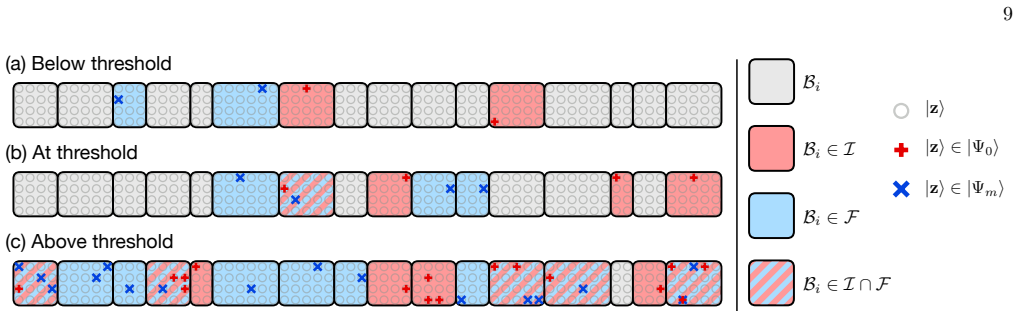
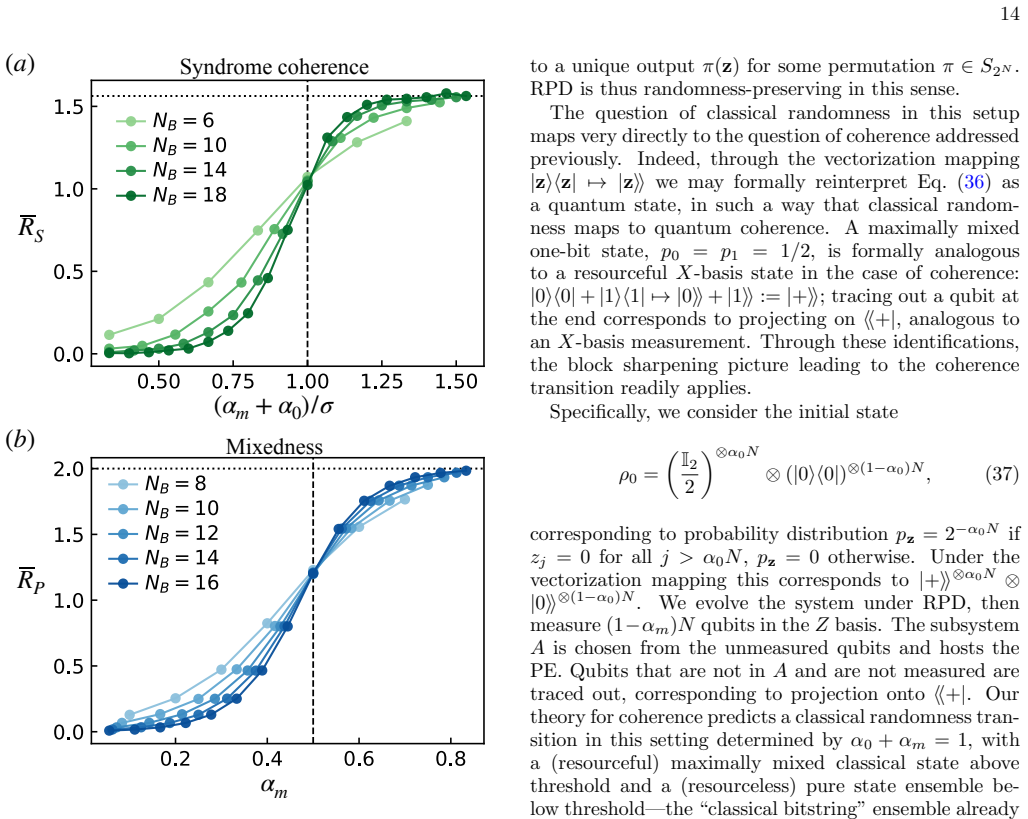
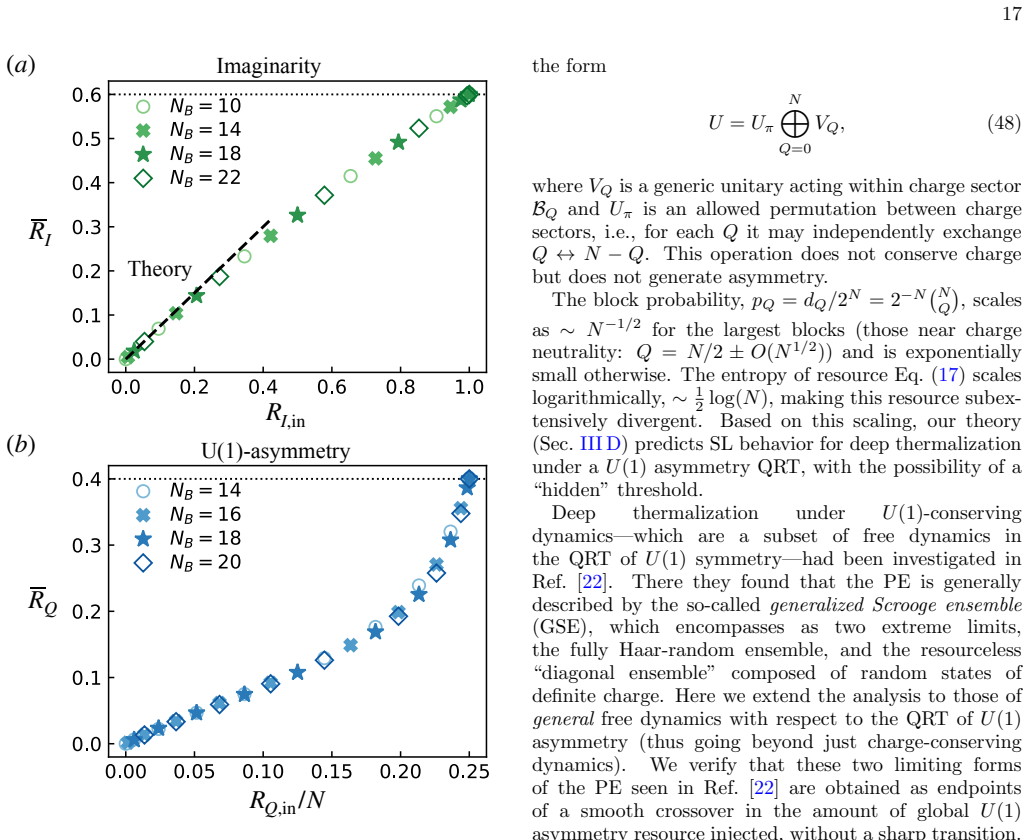
Quantum resource theories divide into smoothly localizable and threshold localizable classes under deep thermalization due to block sharpening.
A machine-rendered reading of the paper's core claim, the machinery that carries it, and where it could break.
Core claim
QRTs fall into two classes: smoothly localizable (SL) QRTs, where the resource content of local post-measurement states changes continuously with the global resource density, and threshold localizable (TL) QRTs, where the local resource content jumps discontinuously from minimal to near-maximal past a critical global resource threshold. This SL-TL dichotomy traces to block sharpening: each QRT is viewed as coherence between blocks in Hilbert space, and local resource content depends on the measurement's ability to collapse an initial superposition into a single resourceless block. The resulting analytic theory quantitatively predicts phase boundaries across studied QRTs and is validated by n
What carries the argument
Block sharpening: the mechanism in which each QRT is treated as coherence between blocks in Hilbert space so that local resource content is set by whether a measurement collapses the state into one resourceless block.
If this is right
- In SL QRTs the local resource content of post-measurement states changes continuously with global resource density, producing continuously tunable wavefunction distributions.
- In TL QRTs the local resource content jumps discontinuously past a critical threshold, producing a sharp transition between a resourceless deep-ergodicity-breaking distribution and a resourceful maximally random one.
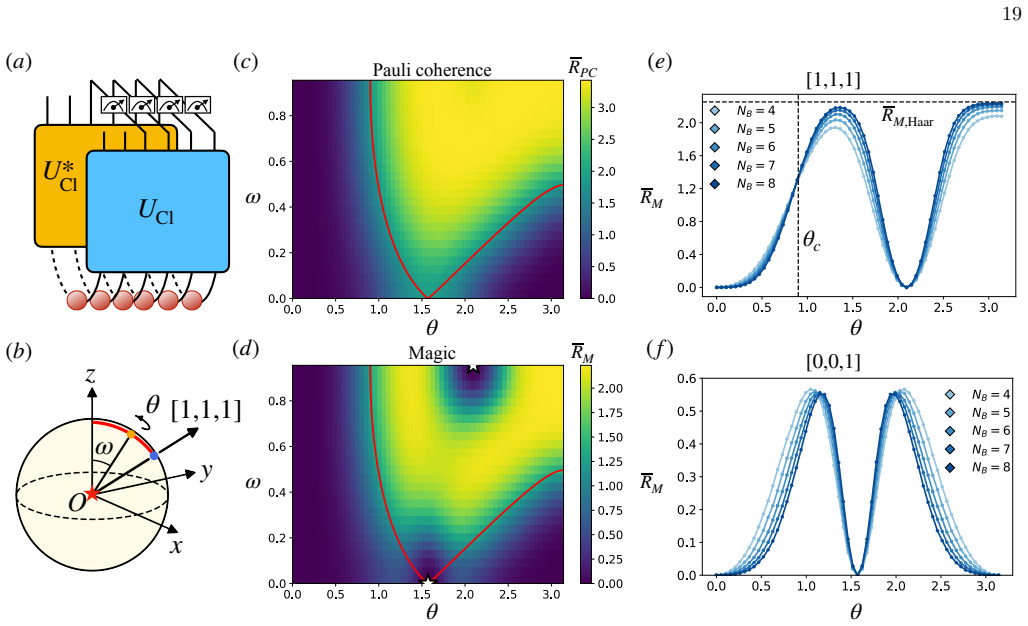
- The analytic theory quantitatively predicts the phase boundaries for all studied QRTs including non-stabilizerness, coherence, asymmetry, imaginarity, and non-Gaussianity.
- A novel magic transition appears in zero-rate quantum error-correcting codes, previously expected only at finite rates.
- The framework yields new implications for quantum resource certification protocols that rely on ensembles of post-measurement states.
Where Pith is reading between the lines
- The SL-TL classification may apply to other emergent local statistics beyond the deep thermalization setting.
- Resource certification protocols could gain sensitivity by selecting measurement bases that place the system near a threshold localizability boundary.
- Global resource density could serve as a control knob to switch a many-body system between ergodic and non-ergodic local behavior in experimental platforms.
Load-bearing premise
Every quantum resource theory can be viewed as coherence between blocks in Hilbert space such that local resource content is fully determined by whether a measurement collapses the initial state into a single resourceless block.
What would settle it
Numerical simulation of a specific QRT and measurement basis in which the local resource content versus global density fails to follow either the predicted continuous curve or the predicted discontinuous jump at the analytically calculated threshold.
Figures



read the original abstract
We investigate how quantum resource constraints affect deep thermalization, the emergence of universal local wavefunction distributions from partial measurements of a quantum many-body state. Quantum resources, such as non-stabilizerness (magic), coherence, asymmetry, imaginarity, and non-Gaussianity, are essential for quantum information processing, and constraints on their global abundance can reshape these emergent distributions. To address this question, we develop a unified framework for deep thermalization within general quantum resource theories (QRTs). Our central result is that QRTs fall into two classes: ``smoothly localizable'' (SL) QRTs, where the resource content of local post-measurement states changes continuously with the global resource density, set by the initial state and measurement basis, yielding continuously tunable wavefunction distributions; and ``threshold localizable'' (TL) QRTs, where the local resource content jumps discontinuously from minimal to near-maximal past a critical global resource threshold, producing a sharp transition between a resourceless, ``deep-ergodicity breaking'' distribution and a resourceful, maximally random one. We trace this SL-TL dichotomy to an information-theoretic mechanism, block sharpening: by viewing each QRT as coherence between blocks in Hilbert space, we show that the local resource content depends on the measurement's ability to collapse an initial superposition into a single resourceless block. Our theory is analytically tractable and quantitatively predicts the phase boundaries across all studied QRTs, which we validate with extensive numerical simulations. Finally, we highlight two consequences: a novel magic transition in zero-rate quantum error-correcting codes--previously believed to occur only at finite rates--and new implications for quantum resource certification protocols based on post-measurement state ensembles.
Editorial analysis
A structured set of objections, weighed in public.
Referee Report
Summary. The paper develops a unified framework for deep thermalization in general quantum resource theories (QRTs), claiming that QRTs divide into two classes—smoothly localizable (SL) and threshold localizable (TL)—based on an information-theoretic 'block sharpening' mechanism. In SL cases the local post-measurement resource content varies continuously with global resource density; in TL cases it exhibits a discontinuous jump past a critical threshold. The framework is asserted to be analytically tractable, to quantitatively predict phase boundaries for coherence, magic, asymmetry, imaginarity and non-Gaussianity, and to be validated by extensive numerics; two applications (magic transition in zero-rate QEC codes and resource certification) are highlighted.
Significance. If the SL/TL classification and the associated analytic predictions hold, the work would provide a systematic way to connect global resource constraints to emergent local wavefunction statistics across multiple QRTs, with concrete implications for error-corrected quantum computation and certification protocols. The explicit mapping of every QRT to a block-coherence picture and the derivation of closed-form phase boundaries would constitute a genuine unification.
major comments (3)
- [theory section on block sharpening] The central claim that every QRT can be represented as coherence between blocks such that local resource content is completely determined by whether a measurement projects onto a single resourceless block (abstract and the paragraph introducing the information-theoretic mechanism) is load-bearing for both the SL/TL dichotomy and the quantitative phase-boundary formulas. For resources such as magic or non-Gaussianity it is not obvious that intra-block contributions vanish or that a canonical block decomposition exists; if such contributions are present the discontinuous jump and the analytic predictions would not follow. A concrete counter-example or explicit verification that the resource measure is strictly zero inside each block is required.
- [results on phase boundaries and numerical validation] The abstract states that the theory 'quantitatively predicts the phase boundaries across all studied QRTs' and that these predictions are 'validated with extensive numerical simulations.' No derivation of the closed-form expressions, no error analysis on the numerics, and no statement of whether any parameters were fitted to the same data used for validation are supplied. Without these steps the independence of the predictions from the validation data cannot be assessed and the circularity concern cannot be dismissed.
- [applications paragraph] The novel claim of a magic transition in zero-rate quantum error-correcting codes (final paragraph) rests on the TL classification for non-stabilizerness. Because the block-sharpening assumption is unverified for magic, this consequence is not yet supported; an explicit calculation of the relevant block decomposition for the stabilizer code subspace is needed.
minor comments (2)
- Notation for the global resource density and the local resource measure should be introduced with explicit symbols and units in the first appearance.
- Figure captions should state the system size, number of disorder realizations, and any fitting procedure used to extract numerical phase boundaries.
Simulated Author's Rebuttal
We thank the referee for the careful reading and constructive feedback. We address each major comment below and will revise the manuscript to incorporate the requested clarifications and explicit verifications.
read point-by-point responses
-
Referee: [theory section on block sharpening] The central claim that every QRT can be represented as coherence between blocks such that local resource content is completely determined by whether a measurement projects onto a single resourceless block (abstract and the paragraph introducing the information-theoretic mechanism) is load-bearing for both the SL/TL dichotomy and the quantitative phase-boundary formulas. For resources such as magic or non-Gaussianity it is not obvious that intra-block contributions vanish or that a canonical block decomposition exists; if such contributions are present the discontinuous jump and the analytic predictions would not follow. A concrete counter-example or explicit verification that the resource measure is strictly zero inside each block is required.
Authors: We agree that explicit verification of zero intra-block resource for each QRT is necessary to fully substantiate the block-sharpening mechanism. The manuscript constructs the blocks via the natural decomposition into resourceless subspaces (e.g., stabilizer states for magic, Gaussian states for non-Gaussianity), with the resource measure defined to vanish identically inside each block by the resource theory axioms. To address the concern directly, the revised manuscript will add a new subsection with explicit block decompositions and proofs that the chosen resource measures are strictly zero within blocks for all five QRTs studied, including concrete examples for magic and non-Gaussianity. revision: yes
-
Referee: [results on phase boundaries and numerical validation] The abstract states that the theory 'quantitatively predicts the phase boundaries across all studied QRTs' and that these predictions are 'validated with extensive numerical simulations.' No derivation of the closed-form expressions, no error analysis on the numerics, and no statement of whether any parameters were fitted to the same data used for validation are supplied. Without these steps the independence of the predictions from the validation data cannot be assessed and the circularity concern cannot be dismissed.
Authors: The closed-form phase boundaries are derived analytically in the theory section from the block-sharpening probability without reference to numerical data. The simulations use independent Monte Carlo sampling with no fitted parameters. The revised version will add an appendix containing the full step-by-step derivations of the phase-boundary formulas, statistical error analysis (including bootstrap estimates) on all numerical curves, and an explicit statement that no parameters were fitted to the validation ensembles. revision: yes
-
Referee: [applications paragraph] The novel claim of a magic transition in zero-rate quantum error-correcting codes (final paragraph) rests on the TL classification for non-stabilizerness. Because the block-sharpening assumption is unverified for magic, this consequence is not yet supported; an explicit calculation of the relevant block decomposition for the stabilizer code subspace is needed.
Authors: We agree that the zero-rate magic transition claim requires explicit confirmation of the block decomposition for the stabilizer code subspace. The revised manuscript will include a dedicated calculation showing that the code subspace decomposes into blocks where the magic measure vanishes identically (corresponding to the stabilizer states), thereby rigorously establishing the TL character and supporting the transition at zero rate. revision: yes
Circularity Check
No significant circularity; derivation self-contained within proposed framework
full rationale
The paper introduces a block-sharpening mechanism by explicitly viewing QRTs as coherence between blocks, derives the SL/TL classification and analytic phase boundaries from that representation, and validates the resulting predictions against independent numerical simulations. No quoted step reduces a claimed prediction to a fitted parameter on the same data, a self-citation chain, or a definitional equivalence; the central claims follow from the stated information-theoretic construction rather than presupposing their own outputs.
Axiom & Free-Parameter Ledger
axioms (2)
- domain assumption Every quantum resource theory can be viewed as coherence between blocks in Hilbert space.
- domain assumption The local resource content of post-measurement states is completely determined by whether the measurement collapses the initial superposition into a single resourceless block.
invented entities (2)
-
Smoothly localizable (SL) and threshold localizable (TL) classes of QRTs
no independent evidence
-
Block sharpening mechanism
no independent evidence
Reference graph
Works this paper leans on
-
[1]
phase basis
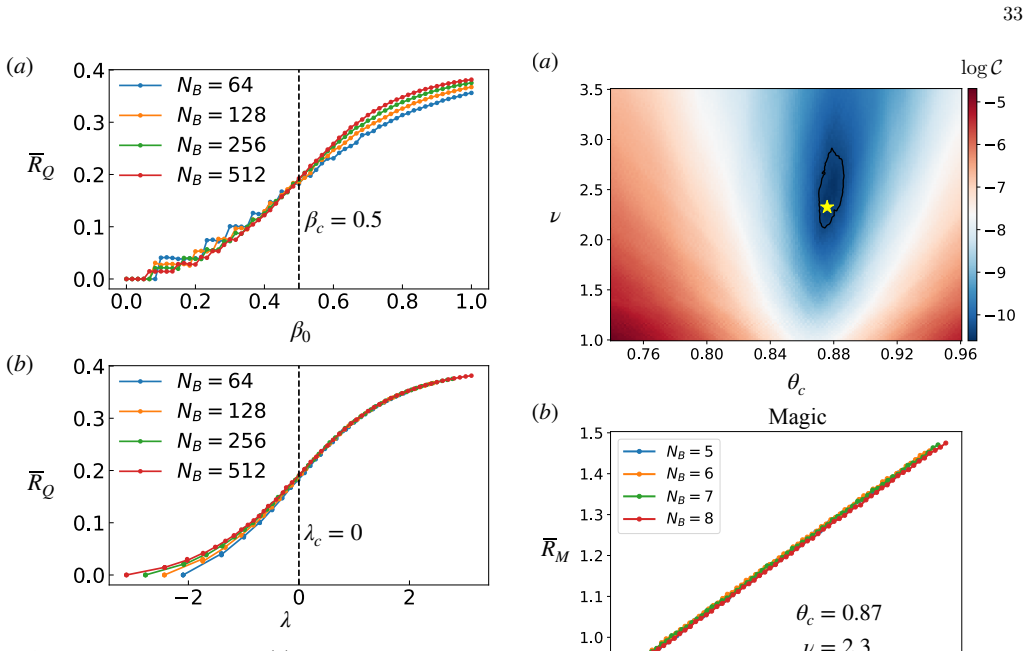
Numerics We let the operatorOin the initial state be u(θ,n) =e −i θ 2 n·σ,(56) whose action is a rotation byθaround the axisn, so that |Ψ0⟩ ⟩=|u(θ,n)⟩ ⟩⊗N .(57) Above,θ∈[0, π] andnis a unit vector. We will tune the latter continuously from [0,0,1] to [1,1,1]/ √ 3, moving along the smaller arc of the great circle connecting the two points, which can be con...
-
[2]
slice of the phase diagram (i.e., wheren= [1,1,1]/ √ 3), obtained by solvingθ c inR P C[u(θc,arccos(1/ √ 3))] = 1, see Fig. 5(e). Details of the finite-size scaling analysis are presented in Appendix E, from which we extract an estimate of the critical exponentν= 2.3 +0.6 −0.2. This value is close to both the theoretical predictionν= 2 in Ref. [90] (upcom...
-
[3]
coher- ent noise
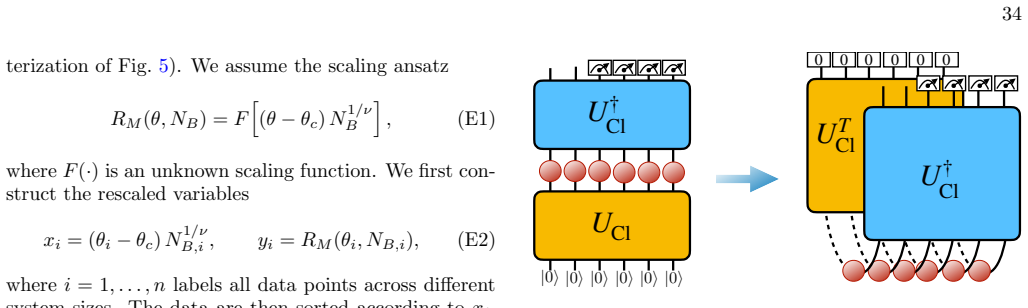
Relationship to encoding-decoding magic transitions Here, we comment on an interesting and important re- lationship between our result on magic localization tran- sitions in deep thermalization and magic phase tran- sitions recently observed in quantum error correction (QEC) circuits [58, 59]. In those works, a stabilizer in- put state|0⟩ ⊗N is evolved un...
2023
-
[4]
Bluvstein, A
D. Bluvstein, A. Omran, H. Levine, A. Keesling, G. Se- meghini, S. Ebadi, T. T. Wang, A. A. Michailidis, N. Maskara, W. W. Ho, S. Choi, M. Serbyn, M. Greiner, V. Vuleti´ c, and M. D. Lukin, Controlling quantum many-body dynamics in driven rydberg atom arrays, Science371, 1355 (2021)
2021
-
[5]
J. C. Hoke, M. Ippoliti, E. Rosenberg, D. Abanin, R. Acharya, T. I. Andersen, M. Ansmann, F. Arute, K. Arya, A. Asfaw, J. Atalaya, J. C. Bardin, A. Bengts- son, G. Bortoli, A. Bourassa, J. Bovaird, L. Brill, M. Broughton, B. B. Buckley, D. A. Buell, T. Burger, B. Burkett, N. Bushnell, Z. Chen, B. Chiaro, D. Chik, J. Cogan, R. Collins, P. Conner, W. Courtn...
2023
-
[6]
Iqbal, N
M. Iqbal, N. Tantivasadakarn, R. Verresen, S. L. Camp- bell, J. M. Dreiling, C. Figgatt, J. P. Gaebler, J. Jo- hansen, M. Mills, S. A. Moses, J. M. Pino, A. Rans- ford, M. Rowe, P. Siegfried, R. P. Stutz, M. Foss-Feig, A. Vishwanath, and H. Dreyer, Non-Abelian topologi- cal order and anyons on a trapped-ion processor, Nature 626, 505 (2024)
2024
-
[7]
E. H. Chen, G.-Y. Zhu, R. Verresen, A. Seif, E. B¨ aumer, D. Layden, N. Tantivasadakarn, G. Zhu, S. Sheldon, A. Vishwanath, S. Trebst, and A. Kandala, Nishimori transition across the error threshold for constant-depth quantum circuits, Nature Physics21, 161 (2025)
2025
-
[8]
S. Wang, T. G. Kiely, D. Tell, J. Obermeyer, M. Baren- dregt, P. Bojovi´ c, P. M. Preiss, A. Sarma, T. Franz, M. P. A. Fisher, C. Xu, and I. Bloch, Observation of strong-to-weak spontaneous symmetry breaking in a dephased fermi gas (2026), arXiv:2604.16137 [cond- mat.quant-gas]
Pith/arXiv arXiv 2026
-
[9]
J. Choi, A. L. Shaw, I. S. Madjarov, X. Xie, R. Finkel- stein, J. P. Covey, J. S. Cotler, D. K. Mark, H.-Y. Huang, A. Kale, H. Pichler, F. Brandao, S. Choi, and M. Endres, Preparing random states and benchmark- ing with many-body quantum chaos, Nature613, 468 (2023)
2023
-
[10]
J. S. Cotler, D. K. Mark, H.-Y. Huang, F. Hern´ andez, J. Choi, A. L. Shaw, M. Endres, and S. Choi, Emergent quantum state designs from individual many-body wave functions, PRX Quantum4, 010311 (2023)
2023
-
[11]
W. W. Ho and S. Choi, Exact emergent quantum state designs from quantum chaotic dynamics, Phys. Rev. Lett.128, 060601 (2022)
2022
-
[12]
P. W. Claeys and A. Lamacraft, Emergent quantum state designs and biunitarity in dual-unitary circuit dy- namics, Quantum6, 738 (2022)
2022
-
[13]
Ippoliti and W
M. Ippoliti and W. W. Ho, Dynamical purification and the emergence of quantum state designs from the pro- jected ensemble, PRX Quantum4, 030322 (2023)
2023
-
[14]
Ippoliti and W
M. Ippoliti and W. W. Ho, Solvable model of deep ther- malization with distinct design times, Quantum6, 886 (2022)
2022
-
[15]
Chan and A
A. Chan and A. De Luca, Projected state ensemble of a generic model of many-body quantum chaos, Journal of Physics A: Mathematical and Theoretical57, 405001 (2024)
2024
-
[16]
D. K. Mark, F. Surace, A. Elben, A. L. Shaw, J. Choi, G. Refael, M. Endres, and S. Choi, Maximum entropy principle in deep thermalization and in hilbert-space er- godicity, Phys. Rev. X14, 041051 (2024)
2024
- [17]
-
[18]
Srednicki, Chaos and quantum thermalization, Phys
M. Srednicki, Chaos and quantum thermalization, Phys. Rev. E50, 888 (1994)
1994
-
[19]
Rigol, V
M. Rigol, V. Dunjko, and M. Olshanii, Thermalization and its mechanism for generic isolated quantum sys- tems, Nature452, 854 (2008)
2008
-
[20]
Nandkishore and D
R. Nandkishore and D. A. Huse, Many-body localiza- tion and thermalization in quantum statistical mechan- ics, Annual Review of Condensed Matter Physics6, 15 (2015)
2015
-
[21]
A. M. Kaufman, M. E. Tai, A. Lukin, M. Rispoli, R. Schittko, P. M. Preiss, and M. Greiner, Quan- tum thermalization through entanglement in an isolated many-body system, Science353, 794 (2016)
2016
-
[22]
D’Alessio, Y
L. D’Alessio, Y. Kafri, A. Polkovnikov, and M. Rigol, From quantum chaos and eigenstate thermalization to statistical mechanics and thermodynamics, Advances in Physics65, 239 (2016)
2016
-
[23]
D. A. Abanin, E. Altman, I. Bloch, and M. Serbyn, Col- loquium: Many-body localization, thermalization, and entanglement, Rev. Mod. Phys.91, 021001 (2019)
2019
-
[24]
C. Liu, Q. C. Huang, and W. W. Ho, Deep thermaliza- tion in gaussian continuous-variable quantum systems, Phys. Rev. Lett.133, 260401 (2024)
2024
-
[25]
Chang, H
R.-A. Chang, H. Shrotriya, W. W. Ho, and M. Ippoliti, Deep thermalization under charge-conserving quantum dynamics, PRX Quantum6, 020343 (2025)
2025
-
[26]
W.-K. Mok, T. Haug, W. W. Ho, and J. Preskill, Nature is stingy: Universality of scrooge ensembles in quantum many-body systems, arXiv preprint arXiv:2601.00266 (2026)
arXiv 2026
-
[27]
Bhore, J.-Y
T. Bhore, J.-Y. Desaules, and Z. Papi´ c, Deep thermal- ization in constrained quantum systems, Phys. Rev. B 108, 104317 (2023)
2023
-
[28]
Lucas, L
M. Lucas, L. Piroli, J. De Nardis, and A. De Luca, Generalized deep thermalization for free fermions, Phys. Rev. A107, 032215 (2023)
2023
-
[29]
Bejan, B
M. Bejan, B. B´ eri, and M. McGinley, Matchgate circuits deeply thermalize, Phys. Rev. Lett.135, 020401 (2025)
2025
-
[30]
C. Liu, M. Ippoliti, and W. W. Ho, Coherence-induced deep thermalization transition in random permuta- tion quantum dynamics, Phys. Rev. Lett.136, 100404 (2026)
2026
-
[31]
Chitambar and G
E. Chitambar and G. Gour, Quantum resource theories, Rev. Mod. Phys.91, 025001 (2019)
2019
-
[32]
B. M. Terhal and D. P. DiVincenzo, Classical simulation of noninteracting-fermion quantum circuits, Phys. Rev. A65, 032325 (2002)
2002
-
[33]
Lloyd and S
S. Lloyd and S. L. Braunstein, Quantum computation over continuous variables, Phys. Rev. Lett.82, 1784 (1999)
1999
-
[34]
S. D. Bartlett, B. C. Sanders, S. L. Braunstein, and K. Nemoto, Efficient classical simulation of continu- ous variable quantum information processes, Phys. Rev. Lett.88, 097904 (2002)
2002
-
[35]
Sierant, P
P. Sierant, P. Stornati, and X. Turkeshi, Fermionic magic resources of quantum many-body systems, PRX Quantum7, 010302 (2026)
2026
-
[36]
Baumgratz, M
T. Baumgratz, M. Cramer, and M. B. Plenio, Quanti- fying coherence, Phys. Rev. Lett.113, 140401 (2014)
2014
-
[37]
Winter and D
A. Winter and D. Yang, Operational resource theory of coherence, Phys. Rev. Lett.116, 120404 (2016)
2016
-
[38]
Streltsov, G
A. Streltsov, G. Adesso, and M. B. Plenio, Colloquium: Quantum coherence as a resource, Rev. Mod. Phys.89, 041003 (2017)
2017
-
[39]
S. P. Kelly, U. Poschinger, F. Schmidt-Kaler, M. P. A. Fisher, and J. Marino, Coherence requirements for quantum communication from hybrid circuit dynamics, SciPost Phys.15, 250 (2023)
2023
-
[40]
Bravyi and A
S. Bravyi and A. Kitaev, Universal quantum computa- tion with ideal clifford gates and noisy ancillas, Phys. Rev. A71, 022316 (2005)
2005
-
[41]
Leone, S
L. Leone, S. F. E. Oliviero, Y. Zhou, and A. Hamma, Quantum Chaos is Quantum, Quantum5, 453 (2021)
2021
-
[42]
Liu and A
Z.-W. Liu and A. Winter, Many-body quantum magic, PRX Quantum3, 020333 (2022)
2022
-
[43]
Tirrito, X
E. Tirrito, X. Turkeshi, and P. Sierant, Anticoncen- tration and nonstabilizerness spreading under ergodic quantum dynamics, Phys. Rev. Lett.135, 220401 (2025)
2025
-
[44]
Dowling, P
N. Dowling, P. Kos, and X. Turkeshi, Magic resources of the heisenberg picture, Phys. Rev. Lett.135, 050401 (2025)
2025
-
[45]
Bravyi and D
S. Bravyi and D. Gosset, Improved classical simulation of quantum circuits dominated by clifford gates, Phys. Rev. Lett.116, 250501 (2016)
2016
-
[46]
Howard and E
M. Howard and E. Campbell, Application of a resource theory for magic states to fault-tolerant quantum com- puting, Phys. Rev. Lett.118, 090501 (2017)
2017
-
[47]
Leone, S
L. Leone, S. F. E. Oliviero, and A. Hamma, Stabilizer r´ enyi entropy, Phys. Rev. Lett.128, 050402 (2022)
2022
-
[48]
Turkeshi, E
X. Turkeshi, E. Tirrito, and P. Sierant, Magic spreading in random quantum circuits, Nature Communications 16, 2575 (2025)
2025
-
[49]
Verstraete, M
F. Verstraete, M. Popp, and J. I. Cirac, Entanglement versus correlations in spin systems, Phys. Rev. Lett.92, 027901 (2004)
2004
-
[50]
M. Popp, F. Verstraete, M. A. Mart´ ın-Delgado, and J. I. Cirac, Localizable entanglement, Phys. Rev. A71, 042306 (2005)
2005
-
[51]
Hamma, G
A. Hamma, G. Styliaris, and P. Zanardi, Localizable quantum coherence, Physics Letters A397, 127264 (2021)
2021
-
[52]
Agrawal, A
U. Agrawal, A. Zabalo, K. Chen, J. H. Wilson, A. C. Potter, J. H. Pixley, S. Gopalakrishnan, and R. Vasseur, Entanglement and charge-sharpening transitions in u(1) symmetric monitored quantum circuits, Phys. Rev. X 12, 041002 (2022)
2022
-
[53]
Y. Li, X. Chen, and M. P. A. Fisher, Quantum zeno ef- fect and the many-body entanglement transition, Phys. Rev. B98, 205136 (2018)
2018
-
[54]
Barratt, U
F. Barratt, U. Agrawal, A. C. Potter, S. Gopalakr- ishnan, and R. Vasseur, Transitions in the learnability of global charges from local measurements, Phys. Rev. Lett.129, 200602 (2022)
2022
-
[55]
Agrawal, J
U. Agrawal, J. Lopez-Piqueres, R. Vasseur, S. Gopalakr- ishnan, and A. C. Potter, Observing quantum measure- ment collapse as a learnability phase transition, Phys. Rev. X14, 041012 (2024)
2024
-
[56]
X. Feng, N. Fishchenko, S. Gopalakrishnan, and M. Ip- politi, Charge and Spin Sharpening Transitions on Dy- namical Quantum Trees, Quantum9, 1692 (2025)
2025
-
[57]
S. Choi, Y. Bao, X.-L. Qi, and E. Altman, Quan- tum error correction in scrambling dynamics and measurement-induced phase transition, Phys. Rev. Lett. 125, 030505 (2020). 28
2020
-
[58]
M. J. Gullans and D. A. Huse, Dynamical purification phase transition induced by quantum measurements, Phys. Rev. X10, 041020 (2020)
2020
-
[59]
M. P. Fisher, V. Khemani, A. Nahum, and S. Vi- jay, Random quantum circuits, Annual Review of Con- densed Matter Physics14, 335 (2023)
2023
-
[60]
A. C. Potter and R. Vasseur, Entanglement dynamics in hybrid quantum circuits, inEntanglement in Spin Chains: From Theory to Quantum Technology Appli- cations, edited by A. Bayat, S. Bose, and H. Johannes- son (Springer International Publishing, Cham, 2022) pp. 211–249
2022
-
[61]
Niroula, C
P. Niroula, C. D. White, Q. Wang, S. Johri, D. Zhu, C. Monroe, C. Noel, and M. J. Gullans, Phase transition in magic with random quantum circuits, Nature Physics 20, 1786 (2024)
2024
-
[62]
P. Sierant and X. Turkeshi, Theory of magic phase transitions in encoding-decoding circuits (2026), arXiv:2603.00235 [quant-ph]
arXiv 2026
-
[63]
Huang, J
H.-Y. Huang, J. Preskill, and M. Soleimanifar, Certi- fying almost all quantum states with few single-qubit measurements, Nature Physics21, 1834 (2025)
2025
-
[64]
Z. Du, J. Liu, E. X. Huber, Z.-W. Liu, and X. Ma, Certi- fying localizable quantum properties with constant sam- ple complexity, arXiv preprint arXiv:2509.17580 (2025)
Pith/arXiv arXiv 2025
-
[65]
N. D. Varikuti, S. Bandyopadhyay, and P. Hauke, Deep thermalization and measurements of quantum resources (2025), arXiv:2512.09999 [quant-ph]
arXiv 2025
-
[66]
Chakraborty, S
S. Chakraborty, S. Choi, S. Ghosh, and T. Giurgic ˘ a Tiron, Fast computational deep thermalization, Phys. Rev. Lett.135, 210603 (2025)
2025
-
[67]
Zhang, P
B. Zhang, P. Xu, X. Chen, and Q. Zhuang, Holographic deep thermalization for secure and efficient quantum random state generation, Nature Communications16, 6341 (2025)
2025
-
[68]
X.-H. Yu, W. W. Ho, and P. Kos, Mixed state deep thermalization, Phys. Rev. Lett.135, 260402 (2025)
2025
-
[69]
A. Sherry and S. Roy, Do mixed states exhibit deep ther- malisation?, arXiv preprint arXiv:2507.14135 (2025)
arXiv 2025
-
[70]
Sherry, S
A. Sherry, S. Mandal, and S. Roy, Information phases of partial projected ensembles generated from random quantum states and scrambling dynamics, Phys. Rev. B 113, 104301 (2026)
2026
-
[71]
M. McGinley and T. Schuster, The scrooge ensem- ble in many-body quantum systems, arXiv preprint arXiv:2511.17172 (2025)
arXiv 2025
-
[72]
Jozsa, D
R. Jozsa, D. Robb, and W. K. Wootters, Lower bound for accessible information in quantum mechanics, Phys. Rev. A49, 668 (1994)
1994
-
[73]
Goldstein, J
S. Goldstein, J. L. Lebowitz, R. Tumulka, and N. Zangh` ı, On the distribution of the wave function for systems in thermal equilibrium, Journal of Statistical Physics125, 1193 (2006)
2006
-
[74]
Goldstein, J
S. Goldstein, J. L. Lebowitz, C. Mastrodonato, R. Tu- mulka, and N. Zangh` ı, Universal probability distribu- tion for the wave function of a quantum system entan- gled with its environment, Communications in Mathe- matical Physics342, 965 (2016)
2016
-
[75]
E. T. Jaynes, Information theory and statistical me- chanics, Phys. Rev.106, 620 (1957)
1957
-
[76]
F. G. S. L. Brand˜ ao, M. Horodecki, J. Oppenheim, J. M. Renes, and R. W. Spekkens, Resource theory of quan- tum states out of thermal equilibrium, Phys. Rev. Lett. 111, 250404 (2013)
2013
-
[77]
G. Gour, M. P. M¨ uller, V. Narasimhachar, R. W. Spekkens, and N. Yunger Halpern, The resource the- ory of informational nonequilibrium in thermodynam- ics, Physics Reports583, 1 (2015), the resource theory of informational nonequilibrium in thermodynamics
2015
-
[78]
Marvian and R
I. Marvian and R. W. Spekkens, Extending Noether’s theorem by quantifying the asymmetry of quantum states, Nature Communications5, 3821 (2014)
2014
-
[79]
Aberg, Quantifying superposition (2006), arXiv:quant-ph/0612146 [quant-ph]
J. Aberg, Quantifying superposition (2006), arXiv:quant-ph/0612146 [quant-ph]
Pith/arXiv arXiv 2006
-
[80]
A. Mani, F. Rezazadeh, and V. Karimipour, Quantum coherence between subspaces: State transformation, co- hering power,kcoherence, and other properties, Phys. Rev. A109, 012435 (2024)
2024
discussion (0)
Sign in with ORCID, Apple, or X to comment. Anyone can read and Pith papers without signing in.