Classifying galaxies in the Galaxy10 DECals dataset using Inception and Residual CNNs
Pith reviewed 2026-06-27 18:38 UTC · model grok-4.3
The pith
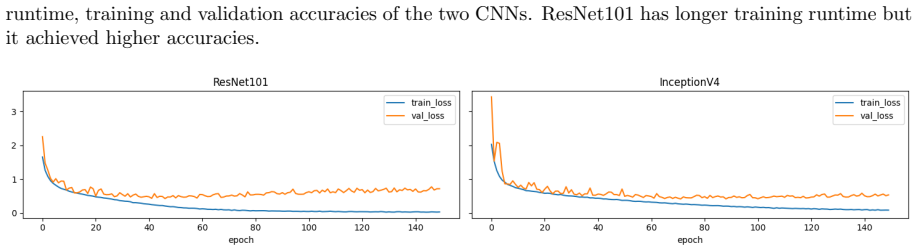
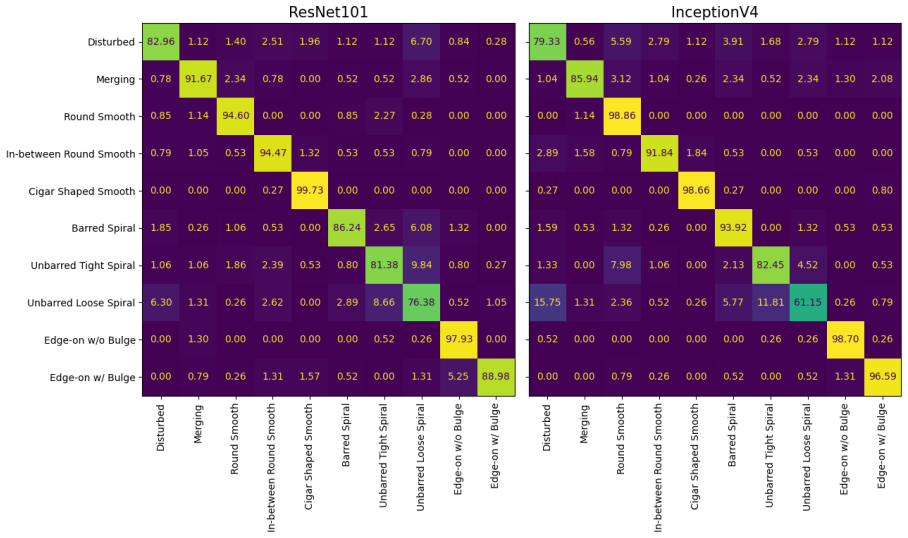
ResNet101 and InceptionV4 both classify galaxies at about 90 percent accuracy, with ResNet101 performing better.
A machine-rendered reading of the paper's core claim, the machinery that carries it, and where it could break.
Core claim
In this work, we analyze the performance of ResNet101 and InceptionV4 on a spatially-augmented Galaxy10 DECals dataset. Retaining the ten-class classification of galaxies, we modify the image count of each class. We find that ResNet101 and InceptionV4 models achieved accuracies of ~ 90%, comparable with reported performance in the literature. In terms of performance metrics, ResNet101 is superior to InceptionV4. Our results indicate that either of these CNN architectures could serve as a robust foundation for specialized pipelines for classification of galaxy images from upcoming surveys.
What carries the argument
Comparison between ResNet101 residual connections and InceptionV4 parallel inception modules on the class-count-modified Galaxy10 DECals dataset for ten-class galaxy morphology classification.
If this is right
- ResNet101 delivers superior performance metrics compared to InceptionV4.
- Both models attain accuracies around 90 percent that match existing literature.
- Either network can serve as a starting point for building classification systems for new galaxy surveys.
- The approach of adjusting class image counts and applying spatial augmentation supports effective model training.
Where Pith is reading between the lines
- If the balancing step proves unnecessary, simpler training on original distributions might suffice for similar performance.
- These models could be adapted for real-time classification in upcoming survey pipelines if computational costs remain low.
- Cross-validation on datasets from other telescopes would test whether the reported superiority generalizes beyond DECals data.
Load-bearing premise
Altering the image count per class in the Galaxy10 DECals dataset, combined with spatial augmentation, produces a training distribution whose performance metrics generalize to unaltered survey data without introducing class-balance artifacts that favor one architecture over the other.
What would settle it
Running the trained models on the original Galaxy10 DECals dataset without class count modification or augmentation and observing either substantially lower accuracy or InceptionV4 outperforming ResNet101.
Figures

read the original abstract
Image data regarding galactic morphology is expected to increase both in quantity and quality for the next foreseeable years; thus it is important to explore which deep learning architectures adapted for image classification tasks are cost-effective. Residual and Inception networks are ideal for exploring classification convolutional neural networks (CNNs) due to their computational efficiency, achieved through techniques such as residual connections and parallelized inception modules, enabling deeper networks without excessively increasing computational complexity. In this work, we analyze the performance of ResNet101 and InceptionV4 on a spatially-augmented Galaxy10 DECals dataset. Retaining the ten-class classification of galaxies, we modify the image count of each class. We find that ResNet101 and InceptionV4 models achieved accuracies of $\sim$ 90%, comparable with reported performance in the literature. In terms of performance metrics, ResNet101 is superior to InceptionV4. Our results indicate that either of these CNN architectures could serve as a robust foundation for specialized pipelines for classification of galaxy images from upcoming surveys.
Editorial analysis
A structured set of objections, weighed in public.
Referee Report
Summary. The paper evaluates ResNet101 and InceptionV4 CNNs on the Galaxy10 DECals dataset after modifying per-class image counts and applying spatial augmentation. It reports ~90% classification accuracy for both models (comparable to literature) and claims ResNet101 is superior based on performance metrics, concluding that either architecture could foundation specialized pipelines for future galaxy surveys.
Significance. If the empirical results and superiority claim can be verified with full methodological details and ablations, the work would offer a practical benchmark for applying established residual and inception architectures to large-scale astronomical imaging, supporting cost-effective classification pipelines for upcoming surveys. The purely empirical nature provides no parameter-free derivations or machine-checked proofs.
major comments (3)
- [Abstract / Dataset section] Abstract and dataset description: the central superiority claim for ResNet101 rests on a training distribution created by explicitly modifying image counts per class before augmentation; no ablation is reported that tests whether the performance gap survives on the unaltered original class distribution or a held-out test set drawn from the survey's native balance.
- [Experimental setup / Results] Experimental setup / results: accuracy figures of ~90% and the ResNet101 vs. InceptionV4 comparison are stated without any training protocol, data-split details, hyperparameter settings, statistical tests, or error bars, rendering the performance comparison unverifiable from the given text.
- [Results] Results section: the claim that either architecture 'could serve as a robust foundation' for specialized pipelines is load-bearing on the reported metrics generalizing beyond the authors' chosen per-class counts, yet no sensitivity analysis to class-balance artifacts is provided.
minor comments (2)
- [Methods] Notation for model variants (ResNet101, InceptionV4) should be defined consistently with any cited literature implementations.
- [Figures / Tables] Figure captions and table headers lack explicit mention of whether metrics are computed on validation or test splits.
Simulated Author's Rebuttal
We thank the referee for the constructive feedback. We address each major comment below, indicating revisions where appropriate to enhance methodological transparency and address concerns about class distribution effects.
read point-by-point responses
-
Referee: [Abstract / Dataset section] Abstract and dataset description: the central superiority claim for ResNet101 rests on a training distribution created by explicitly modifying image counts per class before augmentation; no ablation is reported that tests whether the performance gap survives on the unaltered original class distribution or a held-out test set drawn from the survey's native balance.
Authors: The per-class image counts were modified to mitigate the severe imbalance present in the original Galaxy10 DECals dataset, a standard approach for training stable classifiers. The test set was held out after this modification and augmentation. We did not perform the requested ablation on the unaltered native distribution. In revision we will report the exact original and modified counts, clarify that the superiority claim applies to the balanced setting, and add an explicit limitations paragraph noting the absence of native-balance testing. revision: yes
-
Referee: [Experimental setup / Results] Experimental setup / results: accuracy figures of ~90% and the ResNet101 vs. InceptionV4 comparison are stated without any training protocol, data-split details, hyperparameter settings, statistical tests, or error bars, rendering the performance comparison unverifiable from the given text.
Authors: We agree that the submitted text omitted these reproducibility details. The revised manuscript will expand the experimental setup section to specify the train/validation/test split ratios, optimizer, learning-rate schedule, batch size, epoch count, augmentation parameters, and any repeated runs with error bars or statistical tests. revision: yes
-
Referee: [Results] Results section: the claim that either architecture 'could serve as a robust foundation' for specialized pipelines is load-bearing on the reported metrics generalizing beyond the authors' chosen per-class counts, yet no sensitivity analysis to class-balance artifacts is provided.
Authors: The claim is qualified to the balanced, augmented distribution used in the experiments. We will add a short sensitivity discussion in the results section that examines how performance varies with different class-count ratios and will note the dependence on the chosen balancing strategy as a limitation. revision: yes
Circularity Check
No circularity: purely empirical evaluation of off-the-shelf CNNs
full rationale
The paper reports accuracies from training ResNet101 and InceptionV4 on a modified Galaxy10 DECals dataset (altered per-class counts + spatial augmentation). No equations, derivations, fitted parameters renamed as predictions, or self-citation chains appear in the abstract or described content. The central claims are direct empirical measurements on the authors' chosen training distribution; they do not reduce to self-definition or imported uniqueness theorems. This matches the default non-circular case for standard ML benchmark papers.
Axiom & Free-Parameter Ledger
axioms (1)
- domain assumption Cross-entropy loss and standard data-augmentation operations preserve semantic labels for galaxy morphology classes.
Reference graph
Works this paper leans on
-
[1]
Millman, Rene , title =
-
[2]
Al-Sibai, Noor , title =
-
[3]
Surveying the Universe with Rubin Observatory
-
[4]
Astronomical Data Analysis Software and Systems XXVII , year = 2020, editor =
Convolutional Neural Networks in Astronomy, and Applications for Diffuse Structure Discovery. Astronomical Data Analysis Software and Systems XXVII , year = 2020, editor =
2020
-
[5]
No. 324. Extra-galactic nebulae. Contributions from the Mount Wilson Observatory / Carnegie Institution of Washington , year = 1926, month = jan, volume =
1926
-
[6]
Leung, Henry , howpublished =
-
[7]
Overview of the DESI Legacy Imaging Surveys. Astron. J. , keywords =. doi:10.3847/1538-3881/ab089d , primaryClass =
-
[8]
Learning multiple layers of features from tiny images , year =
Krizhevsky, Alex and Hinton, Geoffrey , address =. Learning multiple layers of features from tiny images , year =
-
[9]
The Sloan Digital Sky Survey: Technical Summary
The Sloan Digital Sky Survey: Technical Summary. , keywords =. doi:10.1086/301513 , archivePrefix =. astro-ph/0006396 , primaryClass =
work page internal anchor Pith review Pith/arXiv arXiv doi:10.1086/301513
-
[10]
Galaxy Zoo: Exploring the Motivations of Citizen Science Volunteers. Astron. Educ. Rev. , keywords =. doi:10.3847/AER2009036 , archivePrefix =. 0909.2925 , primaryClass =
work page internal anchor Pith review Pith/arXiv arXiv doi:10.3847/aer2009036
-
[11]
Galaxy Zoo DECaLS: Detailed visual morphology measurements from volunteers and deep learning for 314 000 galaxies. , keywords =. doi:10.1093/mnras/stab2093 , archivePrefix =. 2102.08414 , primaryClass =
-
[12]
and Vojtekova, Antonia and Anku, Anna and Walmsley, Mike and Garland, Izzy L
O'Ryan, David and Merin, Bruno and Simmons, Brooke D. and Vojtekova, Antonia and Anku, Anna and Walmsley, Mike and Garland, Izzy L. and Geron, Tobias and Keel, William and Kruk, Sandor and Lintott, Chris J. and Mantha, Kameswara Bharadwaj and Masters, Karen L. and Reerink, Jan and Smethurst, Rebecca J. and Thorne, Matthew R. , title =. doi:10.5281/zenodo....
-
[14]
Monthly Notices of the Royal Astronomical Society , volume =
Gharat, Sarvesh and Dandawate, Yogesh , title = ". Monthly Notices of the Royal Astronomical Society , volume =. 2022 , month =. doi:10.1093/mnras/stac457 , url =
-
[15]
Deep Galaxy: Classification of Galaxies based on Deep Convolutional Neural Networks
Deep Galaxy: Classification of Galaxies based on Deep Convolutional Neural Networks. arXiv e-prints , keywords =. doi:10.48550/arXiv.1709.02245 , archivePrefix =. 1709.02245 , primaryClass =
work page internal anchor Pith review Pith/arXiv arXiv doi:10.48550/arxiv.1709.02245
-
[16]
and Al-Roainy, Ali A
Ba Alawi, Abdulfattah E. and Al-Roainy, Ali A. , booktitle=. Deep Residual Networks Model for Star-Galaxy Classification , year=
-
[17]
Monthly Notices of the Royal Astronomical Society , volume =
Cavanagh, Mitchell K and Bekki, Kenji and Groves, Brent A , title = ". Monthly Notices of the Royal Astronomical Society , volume =. 2021 , month =. doi:10.1093/mnras/stab1552 , url =
-
[18]
The Classification of Galaxy Morphology in the H Band of the COSMOS-DASH Field: A Combination-based Machine-learning Clustering Model. , keywords =. doi:10.3847/1538-4365/ace69e , archivePrefix =. 2307.02335 , primaryClass =
-
[19]
Galaxy Morphology Classification using EfficientNet Architectures. arXiv e-prints , keywords =. doi:10.48550/arXiv.2008.13611 , archivePrefix =. 2008.13611 , primaryClass =
-
[20]
Wuyu Hui and Zheng Robert Jia and Hansheng Li and Zijian Wang , title =. 2022 , month =. doi:10.1088/1742-6596/2402/1/012009 , url =
-
[21]
Galaxy morphology classification using VGG16
-
[22]
Galaxy Classification Using Transfer Learning and Ensemble of CNNs With Multiple Colour Spaces. arXiv e-prints , keywords =. doi:10.48550/arXiv.2305.00002 , archivePrefix =. 2305.00002 , primaryClass =
-
[23]
Detection and classification of galaxy morphology based on YOLOv5. Third International Conference on Computer Vision and Data Mining (ICCVDM 2022) , year = 2023, editor =. doi:10.1117/12.2659975 , adsurl =
-
[24]
YOLO-CL: Galaxy cluster detection in the SDSS with deep machine learning. , keywords =. doi:10.1051/0004-6361/202345976 , archivePrefix =. 2301.09657 , primaryClass =
-
[25]
Rethinking the Inception Architecture for Computer Vision
-
[26]
Deep residual learning for image recognition , author=
-
[27]
Densely Connected Convolutional Networks
Densely Connected Convolutional Networks. arXiv e-prints , keywords =. doi:10.48550/arXiv.1608.06993 , archivePrefix =. 1608.06993 , primaryClass =
work page internal anchor Pith review Pith/arXiv arXiv doi:10.48550/arxiv.1608.06993
-
[28]
EfficientNet: Rethinking Model Scaling for Convolutional Neural Networks
EfficientNet: Rethinking Model Scaling for Convolutional Neural Networks. arXiv e-prints , keywords =. doi:10.48550/arXiv.1905.11946 , archivePrefix =. 1905.11946 , primaryClass =
work page internal anchor Pith review Pith/arXiv arXiv doi:10.48550/arxiv.1905.11946 1905
-
[29]
You Only Look Once: Unified, Real-Time Object Detection
You Only Look Once: Unified, Real-Time Object Detection. arXiv e-prints , keywords =. doi:10.48550/arXiv.1506.02640 , archivePrefix =. 1506.02640 , primaryClass =
work page internal anchor Pith review Pith/arXiv arXiv doi:10.48550/arxiv.1506.02640
-
[30]
Charles R. Harris and K. Jarrod Millman and St. Array programming with. 2020 , month = sep, journal =. doi:10.1038/s41586-020-2649-2 , publisher =
-
[31]
The pandas development team , title =. doi:10.5281/zenodo.3509134 , url =
-
[32]
Inception-v4, Inception-ResNet and the Impact of Residual Connections on Learning
Inception-v4, Inception-ResNet and the Impact of Residual Connections on Learning. arXiv e-prints , keywords =. doi:10.48550/arXiv.1602.07261 , archivePrefix =. 1602.07261 , primaryClass =
work page internal anchor Pith review Pith/arXiv arXiv doi:10.48550/arxiv.1602.07261
-
[33]
Al-Sibal, Noor , title =
discussion (0)
Sign in with ORCID, Apple, or X to comment. Anyone can read and Pith papers without signing in.